Forging a Disciplined Patient Mind for Dealing with the Uncertainties of Trading
Randy Howell explains why traders' emotional reactions sabotage performance and outlines five steps to build a probability-based mind: emotional regulation, mindfulness, identifying your internal dialogue, memory work, and intentional practice. Diaphragmatic breathing and observing your internal critic are key techniques.
Chapters
Welcome everyone. My name is Randy Howell with my Traders State of mind. And before we go any further, let's just find out if we're talking to one another. Okay. If someone would just please type in a Y if you can hear me, I would appreciate that. And it will allow us to know that. Yep, you guys are hearing me and I don't have to launch into the something. Okay, There we go. Yes. Thank you. Thank you. Thank you, Larry. Okay, let's start here. And by the way, one, one little bit of housekeeping is I keep my questions toward the end, but as we go through this presentation, if you have a question, please go ahead and ask it. Just type it in and Delores will have it. And at the end of the presentation, your question gets answered first. Fair enough. Okay, I want you to take a look at this title. Oops. Even before then, what I'd like to do is thank Nick and Sarah of the Super Trader. It's. They have a strong parallel between. What we do here is both, you know, they're trying to build a system that allows you to take a lot of emotion, a lot of psychology out of the process of trading. And I really, I really appreciate that. What I also know that anytime you're risking capital with an uncertain future, there is going to be trader psychology involved. So here we go. Now, one of the biggest problems in trading, okay. Is for people coming from a technical background coming into trading and literally it looks like a really good deal. And all of a sudden trouble happens and everybody I talk to seems surprised when they tell me about the problems they have in trading. And it supports surprising is that these symptoms, these not the inability of taking the trade, you know, getting out of the trade, revenge, trading, all that stuff are common to trading. But somehow it's like a deep secret. You go, this is what I'm doing. I'd say, yeah. And you and everybody else that hasn't trained their emotional brain to the environment of trading. Yeah. So what we want to do is we want to take a look at it and start saying, hmm, what's going on here? And what can I do about it? Okay, that's where we're gonna go.
And to begin with the problem, and this may be for you guys who are not technical, this may be a bit much. But the bottom line is that it's your autonomic nervous system responding to uncertainty. That's the problem you're having. And the problem is, listen to the word autonomic. It's happening outside of the reach of your control. It's happening automatically. Pow, pow, pow, pow. And what you're doing is you're seeing exactly what your deepest beliefs are about your ability to manage uncertainty being revealed in your trading account. And you would also see it revealed in your fears or your impulses in trading. That's what we're looking for, friends. This is the, this is the, this is the big deal.
And you know.
You can do numbers. That's particularly these people who've come in from a technical side, they can do numbers. And it's easy to think I can apply that to trading. Hey, man, all that knowledge I have, my ability to crunch numbers and work with numbers. That, boy, this is gonna, this is gonna be a cakewalk. Then they start trading live capital and something happens very differently. And what I want to do is this fellow you probably know, Bill Gates, it's not like he's an unfamiliar guy. But what I want you to do is listen to what he's saying here. Success is a lousy teacher, okay? It seduces smart people into thinking they can't lose. Why is that important in trading? I'll tell you why. You're going to be losing a lot, okay? The key, though, is the brain does not learn from success.
The brain learns from, from failure. Do you see a problem here? Is we all want success and we all, we all are scared out of our gourds of failure. Yet the only time the brain, that's you, your mind learns is when you actually fail. It gives, it opens the door to learning. Success actually locks a pattern and it becomes, like, resistant to change. And unfortunately, the brain that you brought to trading, my friends, that brain, no matter how good it is, no matter how much you like it, is not fit for trading two different worlds. And I'll be talking about that a little later.
The problem is that knowledge often becomes a shield shielding you from the fear of failure that's lying behind there. And that's what we want to do. And unfortunately, fortunately, depending on how you want to say it is that trading exposes that fear of failure. And so you start with the, you know, you try, you know, I know what you do. You try the old tried true ways. And you know what happens is you start discovering I've got this impediment. I can't, I can't get to that where, where I'm a consistently profitable trader. And if I only knew more. How many times you thought that if I get another course, if I get another teacher, if I do this, if I do that, I'm gonna find that holy grail.
The problem is you haven't got the assessment tools. And if I only had that, I would be able to predict the future more accurately, man. Yet here's the problem, friends. Limbic patterns simply blow knowledge out of the door. And that limbic pattern is triggered every time that you engage uncertainty. Therein lies the problem. Your old ways of, ways that you dealt with not losing and winning. I have to win, you know, it's really important. I hate losing. And boy, the one thing I really don't want to do is I don't want to fail. And yet the problem with trading is that you are going to fail, you are going to lose, okay? And this is really all about that. Let me give you an example from another field. Baseball. You know, you think about it, a really good hitter, a.300 hitter. I mean those, those guys are very rare. In fact, with the.300 average, you're pretty much going to get in the hall of Fame. Yet what I want you to do is think about what a.300 hitter means.
Think of the reverse side. 70% of the time, seven times out of 10, he's not getting on base. Not by hitting anyway. Okay? So what you're looking at, he has a high success rate. He has a high failure rate. No, he doesn't have a high success rate. He has a low success rate and a high failure rate. However.
That's a good deal by baseball standards. It's a good deal. And you don't take, he doesn't take all that. Seven times isn't seen as failure. It's just simply part of the game. And he's been doing it since little league. So we get there and we go, wow. So when knowledge failed to do the trick, fear of failure is exposed. You get stuck in it. Like this guy here. No one had taught them to use failure as a tool to develop the mind for trading. Okay? Because what happens very quickly is you find out the mind that I brought to trading is not going to work now. It's not going to work for success in trading. I need to build a new mind. But that also means that your mind, your brain is failing in this new environment. And most people are going to try to cover that up, not see it, rather than use it as a way of developing the mind. That's again, the brain does not learn from success, it learns from failure. And you know what we like to do?
We like to think, oh, this is pretty simple. Because really what I know is that I really am operating from a certainty based mind. I'll talk about That a little bit more later. Okay. And what I really want to do is get to a probability based mind. How hard can that be?
Changing your brain's habits, especially the ones that have produced success in the past, is difficult. Habits are, you know, what happens is when the limbic brain finds a solution to a problem, it'll lock in that solution into a habit and then you fire that habit a number of times and it locks it in into trait and it becomes resistant to change. And so what happens is you're measuring your thinking.
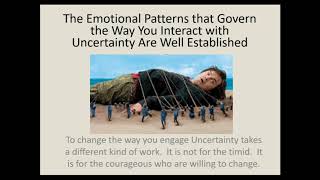
By not about what you think, how you feel about your thinking, but you're measuring it by what it's producing in your trading account. It's going to show you big, huge gap. And you know, there's lots and lots of platitudes about this, about, you know, the thing is that you can't win every trade. It's, you know, one, it's not one certain trade, blah, blah, blah. But have you ever noticed that they're only words? The real question is, how do you change your response to uncertainty? This is the big question. And to be honest with you, it's just not. Nobody, very few people have the solution here. The emotional patterns that govern the way you interact with uncertainty are well established. They are what we call limbic memory, implicit memory, limbic learning, okay? And you become tied down to them, just like this poor guy right here. You have to change how the emotional brain builds meaning and belief. And what I'll say about this is that within the structure of an emotion, first of all, most people have no idea what an emotion is. An emotion is not a feeling. It's not even psychological at all. It's very biological. It's actually a biological action potential that governs and coordinates the reactions between you as an organism and the market as an environment. And they happen spontaneously. They happen before and often without thinking. They just happen, they coordinate, and you get stuck in them based on that success.
So you have to change how the emotional brain builds meaning and belief. That's what it really boils down to. And.
Then you start going, whoa, I get it. That emotions react to conditions before thinking occurs. That's the piece I hope you, you really get here is that you bring this logically, this rational based mind to trading and you think, well, I'm rational. No, you're not. You are an emotional being who rationalizes. You are not a rational being that has a few emotions. You're actually an emotional being. Your entire biology is built around interacting with the environment. Those are emotions, you know, and you want to see it in trading. Think about the last time I there's a whole slew of these things is a lot of people I work with have already lost before they begin because they already have a dread of walking into their trading room and getting down to business. So they're already in a trading not to lose position. Other people can't pull the trigger. They start seeing, they start seeing a setup, they start seeing confirmation. They keep asking for more and more and more. And it may seem logical or rational at the time, but it's not. The left brain, the thinking brain is rationalizing to support the fear of loss, the fear of failure that the emotional brain is experiencing. If you run it to revenge trading, give it a little more. Oh my God, it just took my money. I'm going to get it back. I'm angry, I'm going to get it back. Suddenly all that thinking, it's not rational now. It's tainted by anger and would seeks revenge. Or how about over trading? I'm going to make money, I'm going to get money. I'm going to show people, I'm going to show people that I matter. I'm going to, I'm going to be king on the mountain. I'm going to get in there and they're overconfident.
And overconfidence is a very dangerous, dangerous piece of chemistry. It's like euphoria. You literally begin to believe with certainty that the good times are going to roll on forever. You're no longer in a probability based world. You go back into this certainty based world. That's a fallacy. This is what you have to overcome as a trader. So emotions have already been happening before thinking wakes up. And that friends is the problem. We have to wake up so that your thinking brain and your emotional brain are working together.
The problem is that you have to change this way your brain reacts to uncertainty as a threat. The mammoth is not a dangerous animal in this illustration. Okay, but if you're that cave guy picking some berries, you look at it and all of a sudden it can easily trigger to one of two things. One is, oh my God, I have a woolly man approaching me. I need to run, I need to get all this stuff or go, I need to go alert my friends and wait. Whoa. We have a really great meal going on here. This is the autonomic nervous system at work. It gets, it gets you to the fight flight response before, before thinking can actually happen. It will happen in nanoseconds whereas thinking requires about a half a Second, to really get on. And there's actually a place in the brain about the way the brain is organized is that information comes into something called the thalamus region. And a decision is made about what kind of potential is out there, whether or not it's threatening or whether it's good. And a decision is made to either route that signal to the amygdala and to fight flight if it's dangerous or to the thinking brain if there's something going on here, we should investigate.
What I ask you to hear is that decision happens in nanoseconds and it's based on deeply primitive, primitive assumptions and experience. And it's happening right now. Every time you trade, it's happening. So a lot of people recognize they really need to change. And they've tried a lot of different things. And these are some of my favorite that I've heard all over the time.
I'm just going to keep a positive mental attitude. And what I'll say is, good luck with that. You think the trading gods care that as you take losses and losses that you're going to maintain this positive mental attitude, thinking that the good times are right around the corner. Now the truth is, is you're in randomness and you're in probability and these things are occurring. And you have to build the mind to accept that. Visualization and affirmations, you know, I use these quite extensively in my work with Traders. And what I also know is that visualization and affirmations are not really effective when under pressure. They're good when you're being, everything's cool, everything's calm, you can visualize. But when you're under stress, survival instincts take over and it creates a different thing. If you do not adapt the visualization affirmations to the environment that you're going to be working it. In nlp, you know, everybody thinks neuro linguistic programming. You know, I teach, I have clients who are master NLP people and they're coming to me. Go figure. Again, what's happening is that you're not able to get to the primitive belief and the way the routing occurs to trigger fight flight, calming it down and pulling a different mind up. Tapping is very similar to EMDR as a way of working with, kind of working with traumatic memories and things like that. But the key is, is that you have to go in and you have to get at the very belief deep within the emotion about your ability to manage uncertainty. If that doesn't change, all this other stuff, including tapping, is surface hypnosis. You know, I Use hypnosis in my work quite a bit. And anybody that does works with me realizes that there are just lots and lots of guided meditations to do. And what I recognize is hypnosis is good for being able to kind of shut down the left brain's talk so that you can talk to the right brain. But I'm not expecting it to change behavior. I'm silencing the left brain so I can talk to the right brain where all the emotions are. I'm not expecting hypnosis to change anything because all you're doing is you're putting band aid over a wound and eventually that band aid is going to wear out. And the prosperity thinking, folks, you know, there's this source out there and I'm going to think all the goodwill thoughts and, you know, what I project out is going to come back to me. That's a great fantasy until you put it. You put it literally under the microscope with money at risk, and you start discovering it's not really about prosperity thinking, it's about probability thinking. We'll cover more of that in a little later. So what I want you to recognize here, and I'm going to put it up front is I want to talk about the minds that actually are successful at trading. And I'm going to use two examples of non success and success. And I'm going to. We're going to start. We're going to compare the African lion to the American cougar. Okay? The African lion is apex predator, okay? And he is built. He is built. Or she too. Actually, the she's do all the hunting. They are. They're built to hunt in packs and stalk. They have large prides and they take heavy losses. They get kicked in the jaw by zebras, they get gored by gazelles. There's lots of things that happen to them. And they have a very short lifespan, but they have a breeding program that compensates for that. However, if you were to take that king of the jungle and you were to put him into the American forest, he'd starve. Okay? Apex predator that he is, but he's only an apex predator for that environment. This is when you look at an apex predator like the American cougar, they hunt completely differently. You're looking over here on the left at a cougar hunting. He's hanging out on a tree. He's just kind of hanging there, not doing much. You actually, when you look at him, you might actually think, oh, he's probably asleep. He's just. He's doing anything but no, what he's being is he's practicing patience. What he knows is he knows the habits, the setups of the white tailed deer. And he's waiting for that setup to be confirmed.
When that setup is right, he's going to launch. Like they're on the left, on the right. And it's interesting the way they kill. They do not strangulate. They don't rip them open it. What they do is when they're coming down, they hit them with those big huge paws and it literally snaps the neck of the white tailed deer. The deer drops, boom. There's no fight.
If the cougar doesn't do it right and the deer gets up and runs, the cougar does not chase. It minimizes the loss.
It's highly disciplined. It's very patient. I want you to hear those operative words. What it knows is that first of all, it doesn't run around in a pride. And one lioness is going to raise cubs, not with any help from the male. So, you know, keeping healthy is a big deal. Okay? So here you get it.
If it misses, it just simply climbs back up in the tree, starts the process over again looking for the setup, looking for the trade to set up again. Because it's all probability. Now, this animal is wired for the probability of hunting.
In the forest. Okay? Now if you took that same animal and you put him on the African savannah, he'd also have a problem. What we're talking about here is not your notion of winning and losing. That's either right or wrong. We're saying you need to examine your notions of winning losing in the environment that you're asking to work with. Okay? This is where the problem really begins. Because what we're saying is this. You're literally going to have to transform this whole urgency of winning into patient discipline. There are two routes for success in a lot of societies. The first is being an Alpha. Where you want to win. You're going to make things happen. Literally, you just, you have that sense of urgency to do things. And when alphas, no matter how successful they've been in corporate or business life, come into trading, they blow themselves up. They have that winning that. I don't want to lose, man, I want to win. I want to be number one. And I want to make things happen. And in doing that, what they do is they jump into trades before the trades there, or even when they imagine the trades there and it blows them up. They over trade, they revenge trade. The other side of that is perfectionism, where they don't want to lose. They're going to do everything right so they won't lose. And what you discover in trading is that this is about randomness, Organization of randomness into patterns that you can win sometimes. That happen sometimes, and they don't happen sometimes. So you begin to see that you know something, you can do everything right and you can still be wrong in trading. So we're going, how do you go about doing this? How do you take this mind and brain that I brought to trading.
That I'm beginning to understand? It's just simply by evolution and natural selection. It's just simply not right. Well, we're very fortunate as human beings. As we're not stuck in a particular mindset, we can evolve the mindset that we bring to trading. What does it require? We use a five step process at trader state of mind. It's pretty simple. The very first thing is you come up with a very different understanding of emotion when you work with me. And the first thing that has to happen is emotional regulation. You have to learn what an emotion is. Instead of being knocked upside the head and thinking, you know, I'm being emotional, I have emotional thinking. Your thinking is always emotional. All thinking is emotional state dependent. The key is how do you regulate the emotion? That's the big deal, friends. And by ignoring emotions and facing it and having some failure with the emotions, you never learn to regulate it. The second thing is mindfulness. I'll talk a little bit more about that in a moment. The key though is mindfulness gets you to be able to step out of thought and step out of what in the world you've thought and begin to really notice stuff. Not as like, oh, this is me thinking. You begin to say, oh my gosh, who's in my head? Or as Pink Floyd said, there's somebody in my head and it's not me. And you're going to discover in a minute that yeah, that's true in mindfulness. One of those discoveries is that you learn about the historical internal dialogue. And this is the bane of your success in trading. It's the one that holds you back. It's been going on right underneath your radar. And you may even once you become aware of it, you go, I had no idea what's sitting down there. I've been hearing this conversation my entire life. And this is not me. No, it's not. This is historical internal dialogue. Your mind is a lot more complex than you thought. And then the fourth step is we start self development. We actually start developing other emotional programs within Your brain to produce a completely different mind that thinks in probability areas. You know, right now you have a brain that thinks from a survival instinct under pressure of certainty. And what we want to do is we want to produce a brain that produces a mind under pressure that maintains thinking and probability. Big deal. And the fifth thing is you have to become intentional about the mind you bring to trading. I mean, with the guys I work with, there's no more of this. Just turning on the machines and just, you know, okay, I got my mind, I've done my charting, I've done, I'm done. I start trading. No, no, no, no, no, no. What happens is you're like the baseball player who gets in the on deck circle and you have this elaborate process that you're going through to get the mind ready to hit the hundred mile an hour fastball. When you go from on deck to the batter's box, you still have an abbreviated process that you've used since little league to get your mind ready to hit the ball. That's what you have to do. And you have to become completely intentional rather than just having any old mind that happens to drift by that day.
So let's start right here. Let's start with emotional regulation.
What you're going to discover is this. Your IQ is okay, but if you start noticing there's lots of very smart people that work for other people who are not as smart as them, but they have an emotional intelligence up and beyond smart people. It's the same thing here. People with a lot of knowledge. I mean, I'm talking the engineers. I'm talking about those computer guys. I'm talking about the attorneys, the accountants, all those. Oh, and the worst airline pilots. What happens is these people have a lot of knowledge that they know how to use, not under stress. And they also are constantly being wired to not lose. You know, when someone builds a bridge, I want that civil engineer thinking about not building a bridge that collapses. That's what I want him doing, okay? A trader can't think that way and win. So ultimately, you're talking about developing your emotional intelligence rather than your iq. There's plenty of IQ going around. Most people I work with are very smart, very knowledgeable. They just can't use their knowledge under pressure.
So let's talk about what the emotional brain sees. This was a bad movie, but a great, great photograph. Okay, here you have Caveman. He's far more handsome than our ancestors, by the way. And you're looking at a saber toothed tiger that would have 6 inch incisor teeth rather than these foot long guys. Okay? But what happens that that tiger comes forward into.
Into your frame of reference and what it does is it triggers immediately to danger.
In the same way that a setup shows up as danger to the emotional brain, potential loss. The same way that when you get into a trade and it goes against you.
Danger. The same way that when a trade goes right and you finally get into the black, that you have this urgency to take profits right then before they're taken away. Danger. Do you see the danger? That danger goes right into the sensorial information to the thalamus. Thalamus says danger. And all of a sudden thinking or communication to the thinking brain is cut off and it's sent down the low path to the amygdala and. And there you go with an emotional hijack. Fight flight triggers. And all of a sudden the survival instincts take over and your perfectly fine human thinking brain is dust. That happens all the time. So what we want to do is we want to be able to change that. We want to understand emotions as actions, potentials, okay? We want to drive and recognize they're trying to coordinate action. What we have to do first is regulate that thing so that it doesn't crank up and then just take over everything. So what we want to do is learn how to manage the biology. Emotion, emotions are biological friends. They're not psychological. They take over your psychology. Okay? So uncertainty is the rule. And understand your brain is organized to hate uncertainty. So you've got a problem. You're going to have to. You're going to have to have. You have this enormous bias and you're going to have to learn how to cool it down so it doesn't go and fight flight. And what you discover very quickly is this, is that breathing and tension, muscle tension are part of the complex of an emotion. Tomorrow when you trade, I want you to notice your breathing. Notice that you're probably breathing high up in the chest and rapidly or you're holding your breath a lot.
If you're doing that, you are doing everything you can to arouse the emotion to fight flight. You probably will also notice that you have tension in your jaws, your eyes, your gut, your thighs, wherever, okay? You are also at that moment, your body is preparing the big muscles of the body to run or fight.
You are already heading toward fight flight that time. Do you think it's going to compromise trading mind? Absolutely. This is the first place you use the volitional skills of breathing and we call it diaphragmatic breathing as a matter of fact, both my group course and my individual course, the first two to three weeks are training the body under pressure to respond differently to uncertainty by breathing and by tension reduction under pressure. Though this isn't yoga studio where that doesn't work. Now you have to, you have to train to the environment. You're going to be operating in the uncertainty and the drama of trading. That's where you need to be able to retrain the way the body reacts to uncertainty. But this is where it starts. Because when you do that, it leads to a calmer mind. That calmer mind opens a whole big huge door, comes second. That's the second second step.
What we do is we teach this. And what I'll say is this is a process that I found that works. The next thing is you learn mindfulness. You learn how to step back out of thoughts and you start discovering something really bizarre. You and your thoughts are not the same. You and your beliefs are not the same. In fact, this thing that you've been calling you, this I, that explains things to me. There's none of that either. What there is, these emotional programs have duked it out and organized a self that can, that can experience the environment and live. Unfortunately, the observer of that goes to sleep and doesn't see it as just one potential organization of a self. Okay. It locks in and says, no, this is me. So you've been actually kind of dropping the ball, learning to recognize that mindfulness is actually the ticket. It's actually the key to the freedom to redevelop the mind. And for us especially far trading and the uncertainty of that. And this is where it gets interesting because there's a.
Neurobiology in the last 10 to 15 years has opened up the eyes of many people. And this is the big deal about your brain and your mind. Your brain is really a community of rival emotional programs that is duked it out to organize itself.
You'll see that if you, if you want to see a really great kids movie that I actually encourage all my people to see is.
It'S called Inside out by Picture Disney. And it's a cartoon about a little girl going through a move and she has these emotions at play in her mind and, and they duke it out all the time. They're always in competition with one another and some take the lead while the others and others are pushed away. And you see the moods and you see the way the girl interacts with the world based on those emotional programs. Well, friends, they hired neural scientists to help them depict all that. That's the way the brain works. The miracle, the crazy thing that happens between the generation between brain and mind is that those emotional programs are given voice in your mind as thoughts. This is where it gets interesting. So you're gonna have a number of emotional forces working in the mind. You're gonna have different perspectives, okay? And it's these perspectives that you discover is, you know something, while I was asleep and I didn't have an observer, I had a mutiny going on in my hands. And I never saw it. I'm beginning to wake up and I realized, man, I've got an internal struggle. And the board of directors of the company called me and, you know, there's power struggle and I need to wake up and I need to whip this thing to action and get the right guys to be able to be managing and creating the mind. This is what we teach. And as you do this, in step three, you start going, well, let's take a step back and look at the bad news. And what you'll discover is this, is that there is this thing called a historical internal dialogue. Okay? And you go, well, an internal dialogue. You have thoughts. And now, Randy, you're saying that there's multiple sources of thought. Yeah. There's multiple perspectives going on. If you've never had an argument with yourself, then good luck. And in this perspective, you're discovering that there are two major players that somehow you have, in not wanting the discomfort, you have ignored and have given enormous power. The first is the inner critic. Have you ever fallen into self doubt, self condemnation, and you just don't know and all of a sudden, or have you ever fell into kind of grandiosity, this certainty where I've got it, I've got it together, I'm going to go do this, I can do this. Take this trade, take this trade, take this trade. Both are what we call the emotional program, the inner critic. It's known by various things through different cultures. You know, in ancient Chinese philosophy, it's called yin yang. There's this destructive part of the self. There's this constructive part of the self. The American Cherokee Nation viewed that man mind was composed of two wolves, a good wolf and a bad wolf, dark and light. And if you followed the dark wolf, things were gonna end up bad for you. If you followed the light wolf, things were gonna be really cool. And they held that the one that you fed was the one that won. So you begin to see the struggle going on. And I also. And what you in something like Hinduism, what you discover is that the God both is A creator, a sustainer and a destroyer. So they're putting all that stuff all in the same boat in the Abranic religion. It becomes even more interesting that there is an. There is a something called Satan. Satan that which causes you to err. Okay? And if you and I were to get into a time machine and go back to the Aramaic times, and we were seeing a bunch of guys talking in Aramaic about this inner critic, and we were to go to him and say, could you translate this inner critic into English that we could understand? And they'd say, yeah, they'd been talking to Satan and all this kind of stuff. They'd say, yeah, it's translated as prosecuting attorney.
So what it really boils down to is you have a prosecuting attorney running around in your head.
Okay? Both the perfectionist not wanting to make a mistake, and also the alpha who wants to make things happen and getting overconfident. That inner critic is there as a destructive force within you and you can interpret it any way you want. There's also another element of that self, that part that feels, you know, you see that face of that guy right there where you go, he's not so certain. You know, it's like, oh, oh boy, what is this? You see what we call the orphan nature, okay? The adapted voice. And that adapted voice would be something that you need to mentor. You've left him alone with the inner critic for a long time and he's doing the best job he can, but he really needs some help. The good news is this or the bad news, You've inherited these self loving beliefs.
As these action voices in your head. And they've been organized, most likely since your formative eras. But it could be through culture, it could be through circumstances in your life. It could be a lot of things. Could be all those gigantic losses you've had in trading where you begin to doubt yourself. The key is this. They are not who you are. They are just simply emotional programs that you've come to believe.
As yourself. They're faulty assumptions. Okay?
Now.
Step four. There's good news, friends.
Very few people get to this part. People finally awaken to this internal dialogue and they realize, oh my gosh, this is me. I might as well give up. No, they're in the same way that there are destructive elements of the self. There's fear and there's overconfidence. There is also discipline. There's the discipline of a ruler. There's also the courage of a warrior. There's also the self soothing the self, compassion Very important of a caregiver. And there is also the clear thinking, the impartiality of sage. These are emotional programs on the sidelines, under pressure in your brain that you need to learn how to bring forward into working awareness. And it just so happens that we use a very unique process called memory enrichment, where we actually go into memory and we find where these emotional programs have moved forward and actually impacted the way things turned out from performance.
But the brain had not included them. From the experience into the memory, we open that up and we restructured the memory so that you have direct access. It really happened to these emotional programs. That's what makes it so different than visualization and affirmations. You're capable of doing this.
So we have all this just sitting in our DNA and what we're doing in our coursework, we're actually focusing on redesigning the mind that engages uncertainty.
What we know you need discipline. Discipline is maintaining order under pressure of a ruler. And think of George Washington. You know, what he, you know, what he pulled off is pretty amazing.
He had a ragtag army and he beat it. Beat the largest standing army in the world with a little French help. And you know, if it weren't for Napoleon, if it weren't for the French, no, the United States wouldn't be here today. Yet you see that he held an entire nation together. You know, he was maintaining order under pressure. That's in you too. The second thing is you have the courage of a warrior living within you. You have the ability of turning toward your fears, mastering them, because the fear actually has an enormous lesson to teach you. If you have the courage to face the fear, to face the demon.
This also is an emotional program living within your brain. You also, and this is the, probably the most underworked of all the emotional programs is self compassion or what we would call caregiver, that you know something I want to ask you how many times when you've made a mistake or loss and you beat yourself up, how many times has it ever helped?
Never.
However, what you need in times of suffering is you need self soothing. You need the compassion. And compassion is an emotion that literally undoes that suffering and allows you to grow from it. This is one of the most important things in the world is people do not practice self compassion as traitors and they better learn how to. When those three emotional programs or archetypes are in place and they're working.
What happens is that the impartiality of a sage can show up. You can think clearly under what has been fog of unknowing. And you realize that, yeah, this is ambiguity and this is the best thinking that we can do here. And friends, these are emotional programs just waiting for you to pull them up, to get them exercised and to be able to work them back. To our friend George Washington here you have him going across the Potomac about to attack the Delaware. I'm sorry. About to attack the Hessian renegades, mercenaries of the English empire. Surprise attack and they win. The key is what you're doing under that discipline. Look at the men around you and maybe a woman, what you see is that they're organized and they all look. I'm going to tell you something. This is a fearful situation. The river's frozen. He's having to sneak up before dawn and all this stuff's going on. You know, they're scared, but they're finding the courage. They're soothing their fear. They're finding the courage and they're thinking really clearly and then they act. You have the ability of doing this. This is the intention.
Working with me requires you to come to a moment of where you bring an intentional mind to the act of trading. You just don't bring any old mind that happens to show up. This is probably the biggest thing in the world because ultimately what you discover is this. You have never controlled outcome. That's an illusion. Okay. What you control is the mind that you bring into the moment of performance.
Following your rules, executing. You know, if I could only do that, then I would be. I would be fine. I would be making a good bit of money. Well, you can learn to do that. I get it that the brain and mind that you inherited from your history and from biology isn't going to do that. And yet you can learn to adapt it to this new world. But you have to decide you want to.
So what you're doing ultimately is you're mastering your dragons of fear, of sabotage impulse. Everybody experiences those. Those are the big three friends. Most people live out of fear and they could never imagine that there was a problem beyond fear. And then they discover overconfidence or impulse. There's also a lot of people that end up starting to produce success. And then what happens? They sabotage themselves because other things are going on inside their mind. They're not aware of that. You can become aware of.
Mistakes failing. It's just simply approach as sideposts and that you can learn from them. These are the skill with the skills of bringing the empowered mind to bear, you turn toward what you've been avoiding. The uncertainty of trading is still Present. Nothing's going to change that. You're not going to whip up a new mind in my work that allows you to say a few magic words and change everything. No, what you're going to do is you're going to learn to be intentional about the mind you bring to manage uncertainty. And you're going to keep your wits about you and you're going to follow your rules. That's the way it works. So, friend, that skill five, that intention.
The truth of the matter is this.
You're going to bring an organization of the mind into trading no matter what.
That's the way it works. The only question is, how much money do you want to invest in the learning of that? How much do you want to blow up and counts? Or how much do you want to die the death of a thousand tiny cuts before you come? And you realize this mind that I brought to trading is not working yet. I can see now that there is a process here that leads to the development of a mind that can deal in probabilities. Yes. And my question to you is pretty simple. Who's going to populate your committee? Are you going to use the one that you brought down? Are you going to develop one specifically for the environment of trading?
And for those of you.
Who won't change, who are saying, you know something, I realize that this is really important.
The truth is most people stay stuck because they fear failure. And this is why they're having problems.
So where do you start? First of all, probably not a whole bunch of you guys know who I am. So what I want you to do is this. I want you to go get my free, my free, my free book. And it's at this, it's at this sign right there. Can you just type it in? Put it on there. And what I want you to do is get the free ebook. And it's a collection of articles by me that are very cogent to trader's mind. Just, just as a start. And then I want you to start looking around and reading the other articles. There's tons of articles. Start watching the videos. I have over 200 videos on YouTube that are again, focused on this stuff. I want you to look at them, I want you to study it and start going, oh, my goodness. I now I see what the problem's been.
I haven't got the right mind to deal with the conditions of uncertainty. So what I'm asking is get the free stuff. Get the cheap stuff. Read, watch the videos and really learn. Read. And then maybe get the book. But if you're serious, you know, if you're really serious, when you realize you know something. I've spent a lot of cash, invested a lot of money in training myself in knowledge. And I recognize that once you have knowledge.
The vast majority of trading is emotional discipline.
Getting the psychology right to use all that wonderful knowledge you have and all that systems you have. If you're looking at that, I encourage you to look at the group course. It starts in January and if you go ahead and get in early, you get a bunch of free stuff. But the main thing is I'm not trying to induce you to necessarily buy the course early. The key is this, is that most people sign up late for this course and they don't understand that this thing is boy, it start, it hits the ground running and you better be right. That's why a lot of people start early. But look at it, the last one though is that if you're really interested and you're serious about this trading and you're ready to learn and want mentorship, look at the individual course, really read about it because what you can discover, it's highly comprehensive and it's highly personal. It really gets really in depth. And if you're in it, what I. And by the way, one of the major things of it is that it comes with 10 one hour sessions with me, whereas the group course does not come with any personalized time with me. It's a big deal. Okay? And it's what a lot of it's what the serious people really go after now.
And that's my pitch because ultimately this is something you need to decide whether or not you really want to be a trader and whether or not you've pushed and taken your mind as far as you can and you need somebody to help you work on the next level. Professional athletes do it all the time. They find a sports psychologist to take them to the next level. And you're going to have to decide whether or not you want someone to help you build a mind that can go to consistent profitability. And now have you got any questions? Let me know. I would be happy to answer whatever questions you have in the next couple minutes. And here's for Martin. I'm convinced that trading is 100% mental. That is belief systems. Well, it's not 100%. You have to have the knowledge or you can't go to the ballpark. But once you get to the ballpark, the mind that you bring to the ballpark is the big deal. Money management and minimizing loss. And seems most Important can you expand with good R and R rest and relaxation?
Tell me what the R and R is. Okay. What I can say is this is money management and minimizing losses is what you'll discover about really good traders is that they are master losers. They recognize and they buy into. Okay, risk. Oh, risk and reward. Yeah, for sure. The thing is, when you are looking at risk and reward, what you also have to look at is what mind am I bringing to that moment? If you're captivated by I've just won five straight men, I'm up couple grand, I'm feeling on top of the world, and you look at risk and reward with that mind, you're in trouble. At the same time, if you've just taken three or four hits and you're down, your counts down, you're going, oh my God, I'm about to have to call in for more money and buy, trade or ever. And you take a look at risk and ward, and all of a sudden it looks very different. What we're saying, it's. It's all about the mind that you bring to trading. This is the deal. Okay, so that's good question. I like that. And it comes down to what mind am I bringing into it now? I don't have any more questions. Well, I want to tell you we get to adjourn early then. I want to thank you.
I love talking with traders about how to manage mine, how to manage emotion and to take charge of their emotional nature. And so I am very fortunate for that. And if I can help you, please let me know. Meanwhile, I hope everything goes well for you. I hope you a prosperous life and may we meet again in the future. Take care.