Forging a Disciplined, Patient Mind for Dealing with the Uncertainties of Trading
Randy Howell explains why successful traders often fail: they're wired to be right, not to think in probabilities. He covers emotional regulation, mindfulness, and stress inoculation techniques to build a disciplined mind that handles market uncertainty.
Chapters
Welcome everyone. My name is Randy Howell with Traders State of Mind and that website is my Trader State of Mind. There's a long story behind that. We're doing something a little special this evening. We're looking at one particular aspect of trader psychology. We're taking a look, going, you know, something.
For all. For as long as I've been doing this, I've discovered that one of the biggest problems in trading, particularly getting traders up and running, is the amount of people coming from technical backgrounds into trading. They have really strong left brain, but there's a problem with translating that into trading. We're going to be exploring that starting real soon. Now the only thing I have in terms of home housekeeping stuff is that type your questions in.
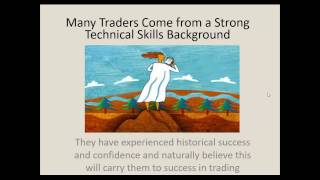
If there some of them, Dolores will be able to answer the ones that are more directed toward trader psychology. I'm not going to answer during the program because we discover that a lot of questions are answered as I go through the program. At the end we'll cover them, but go ahead and write them in as you come across them. I welcome those because that lets me know that you're not asleep and that you're actually thinking and you're engaging with me and I want your engagement. Okay, but let's do this guys. Let's move forward and start asking this question. You know, many traders come from strong technical backgrounds. I mean, how many, how many engineers, how many IT people, how many accountants, how many people? You know that whole thing where you're really good with numbers, you're really good with logical and rational thinking. And then you come and you. And besides that, a lot of people are like rock stars. They have been very successful using this left brain stuff. And they're sitting there and they go, wow, you know something, I can really see how I can be really good in trading. You know, all these numbers and stuff like that. You know, it's very important to be able to look at logic and reason and stay there in order to trade. Man, I've got it down. That's just what I've gotten. And I've had success too. But in much the same way that people in businesses can be very good with the technical stuff, they're really good with that left brain stuff. So good. They've been superstars and they get kicked up into management. When they get to management, the environment changes and the skills that they used as technicians with technical knowledge no longer apply in the world of management where you're organizing people, organizing emotions and suddenly suddenly the superstar becomes not so good and it really depends on whether or not he's mentored or she is mentored and can catch on soon enough. So what we want to look at is people who, okay, we've had some historical success. And I feel really confident because, hey, I can do this, I can come into trading and I can make this really work. So we do that. And what happens is that this very famous guy who knows a little bit something about little, little something about the ID field, you know what, what Bill Gates said, quote, is success is a lousy teacher. It seduces smart people into thinking they can't lose. Now what I want you to think about is all those left brown people, all those, all those logical thinkers, engineers, man, you don't want them to, you know, you want to give them, you know, when they're building a bridge, you want some tolerances there. You don't want to be wrong. An airline pilot, for God's sake, you don't want him to be wrong. The same thing with an accountant. You can see that IT guys are going, you know, I need to do this without eras. The deal is, this is the brain does not learn from success.
Success locks in a pattern so that it becomes resistant to change even when it begins to fail. These are the old ways that you don't want to move from yet. Those old ways were very successful back then in another place, in a time. But then you take the same skills, you apply them to trading and it's a different world. The, the laws of success are different here, and yet they keep working harder and harder and harder. And you keep trying to use those skills that brought you success, but something's not working, but you don't question it. You just think, I just need to work harder, I need more, I need more stuff. And so ultimately you get to the old tried and true ways now become an impediment to. You're becoming the consistently profitable trader that you set out to become.
Ultimately, just like in this graphic, old ways do not open new doors. And what happens if you're going to learn to think differently, which is going to be required, friends, you're going to have to open new doors. To do that, you're going to have to let go of your old ways. And believe me, don't believe me, listen to your trading account. And you know what we've noticed here? Minimally, the people that we work with have been trading for two to five years.
I'm whistling Dixie to these people when I tell them that it's a different world. What I'm looking for are People who've recognized the old ways aren't working and they realize that they don't know how to build new ways. But first you have to discover those new ways are not going to work. But ultimately though, what traders do is they say, you know, if I only knew more, you know, you know, what new assessment tools can I use? You know, what new this, what new that, what new that can allow me to predict the future with more accuracy. Wrong kind of thinking. That's the kind of thinking that gets us to the paralysis by analysis. And that more knowledge just requires more and more brain to be able to process it. Meanwhile the trays gone. And all of a sudden what happens with most traders that have a really left brain thing, they start having a dread, they start having a fear of losing that really gets in their way. And so the thing is, you're looking at this and out of this, you know, you go, wow.
Really smart logic driven traders get stuck and stay stuck.
You can hear that even when saying, oh yeah, you want to know. The ones that have the most difficulty are those engineering types. It's true. The thing is, this is what has to really sink in. What worked then does not work now. A different mind is required. If you're asking that you're in the right place, you begin to actually say, you know something, it's not all the problems out there, it's not my methodology.
It'S not all my toys. You know, I've got plenty of them and they're expensive toys. What happens is it's me. There's something going on in me that's not allowing me to be able to manage uncertainty. Wow. When you come there now, you are really beginning to ask the question. Because ultimately.
Changing your brain's habits, particularly ones that have been successful in the past, is difficult. Habits, you know, really only ultimately comes down to it are neural networks that trigger. And suddenly before you know it, the routine is there. You just fall into it and before you know it, it's there. I'm going to give you an example. I work with a guy and we're actually working on sizing up now. He's.
He became, he establishes numbers and stuff like that with one contract. He's at three contracts now. And what we're trying to do is we're getting him to finally stabilize what's wrong with him at three. And ultimately what he's discovered is this.
What he's discovered is this, is that one contract he was not in a situation where he had a fear of losing. Okay, now he could afford that. But when he came to three contracts, the size of the risk was larger. And suddenly what happened is. And once he got into a trade, he has literally a five bar chart that's basically telling him really soon whether or not that trade needs to be in there or not. And what he's doing though he knows better. When he's in a sane mind, is he saying, you know something, I just need to get this thing some room. It could work out what he's done.
He'S removed himself.
From the plan, trading his plan and what he's done. He's now gambling. He does not have the law, he does not have probability as an edge on his side anymore. He's given that to the casino. Same thing here is what we really are having to do is we're having to re develop a certainty based mind that you came equipped with. It wants to control outcome, it wants to control environment, it wants to be right. We have to move that into a probability based mind that recognizes that both winning and losing are part of trading. And the key is you better become really good at losing because if you don't, you're not going to be a winner in trading. Seems weird though. You know, here we are. Most westerners are really built to win. To win, win, not to lose. It was Bear Bryant of Alabama many years ago that said a tie is like kissing your sister. Losing is not acceptable. And all of a sudden you realize in trading, you take that into trading and you've got problems because every trader loses. It's just how skillful he is at losing. Really defines whether or not he's a lucky trader and wins sometime or whether or not he's a consistently winning trader. That's the big deal. And my promise to you is that your brain and your psychology are going to be dead against you. Creating this new mindset of this. It is. It's got millions of years of default programming that wants to control environment that does not. It wants to be a control freak. And yet at the same time it wants to control something that cannot be controlled. Up until this time, where you've been before, you have been a big fish in a small pond. Your waves create some big stuff. You can control that pond. Suddenly what you are now is a minnow in a vast ocean. You have to think differently for survival and particularly for thriving.
Ultimately, this is what happens with traders.
Particularly ones that are just absolutely dead set on using left brain analysis all the time. Without emotional intelligence work, they become tied down to the very patterns that used to be successful what happens is they don't know how to interact with uncertainty. And yet.
To change the way you engage uncertainty completely takes a different way of thinking. Of what? Different way of lily experiencing the uncertainty.
It's for the courageous who are willing to change. Most people really are scared of change.
And ultimately they will do anything not to change. But in trading, you really do come to a fork in the road where you realize that, no, I don't have to change. I can stay mired in this way. I'm trading now, or I can begin to change. And I realize that. You know something? I don't know if the change is going to be successful or not. But what I do know is if I stay in the old way, I see what's happening. I'm bleeding. Yet at the same time, how can I trust developing this new mind? Do you see the dilemma? Do you see the sticking? Because ultimately.
Here'S the real problem.
The real problem is that emotions react to conditions before thinking occurs. All that left brain power we've been talking about that you were so good at. It's simply, you know, the truth is, logical people experience.
Is that emotions just simply bypass thinking unless you train them differently. You're literally looking. If you look at this graph, what you're actually looking at is an emotion happening. It's firing an emotional program that moves into circuitry. And suddenly you change the chemistry that's going between those axons and neurons and, and all that electrical energy becomes your thoughts. And depending on what kind of chemistry it is, whether or not it's cortisol or whether or not it's a balanced mind tells you whether or not how you're going to be thinking or not. And that's happening before.
You start thinking. You don't believe that, huh? You know, if you're a cognitive behavioral guy like I used to be, it said no thought came first and then emotion. Well, in emotional intelligence work, it's. The exact probable difference is what happens. In this illustration, what you're looking at is man's out picking. He's becoming an agricultural guy. He's out picking. He sees a mammoth, okay? Now, the mammoth.
For him is dangerous. It's proven over history, creating a pattern of danger. And what happens is the brain automatically is firing to get the heart and everything to beat and begin to get ready to respond to that emergency. Thought hasn't occurred yet. The energy, all that networking that's going up in the new brain, where that logical thinking is, it's just simply hijacked or short circuited because Right now the emotion fires first. He's already on the move before you start thinking, okay, Emotion, out of the body comes motion. So now the deal is this. That's your old brain, that's the survival instincts. And here's the deal. Your brain sees capital risk as a threat to life or as an opportunity to seize immediately. Both work for survival 6 1/2 million years ago up into probably 10,000 years ago. Dangerous for probability though. A very different way of working between emotion, brain and mind has to evolve. And it's not going to evolve by itself unless you just got dealt a heck of a good hand in the lottery. Okay, so what we want to do is say, okay, well.
Going to solve this problem. And this is a list of how people most commonly are trying to work with their psychology to build a mind that can trade in uncertainties. They try that positive mental attitude, they look in the mirror, they get jazzed up, they think positive thoughts and I'm going to win, it's going to be a winner today. Blah blah, blah, blah blah blah. Does it work? No. Okay. Trading can take out a positive mental attitude like none other. It's not a positive mental attitude that you need. It's a probability based mental attitude where you're looking at well what is that? What is the markets willing to give me? Okay, Even within that context, you know something, I know that it's giving me stuff. I have to be very careful to be ready for whether or not it's going to be really giving me something or whether or not I need to be clearing out of this trade really fast. It's not a positive mental attitude, it's a probability based attitude. Visualization. How many of you sit there and think positive thoughts and think and see all the money you're going to be making and all this kind of stuff without the emotional and the meaning support that's needed. A lot of people affirmations, goodness gracious, they're all over the place. I see people and it's not like I don't use visualization affirmations in my business. My coaching, I do. It's just that what I realize is that you have to understand emotion and where visualization affirmations are placed. Okay? They become important once you understand the emotional nature of something. Nlp, gosh, used all bunch in sales and marketing and stuff like that and it's taught like it's going to solve stuff. But I haven't found NLP to be very effective. Changing the way people interact with uncertainty. It's pre surface, it doesn't take the underlying meaning and change it. It wants to use logic as a way of changing deep seated emotional beliefs. Tapping, that's the new and everybody wants to tap, tap, tap, tap, tap. And oh, that's going to solve my problem. And it does disrupt the emotional pattern in that moment, but the pattern comes back. Okay? Hypnosis. Can't tell you how many of those people use hypnosis. I'm going to build myself to be a winning mind and stuff like that. And again, it's not like hypnosis is bad. You know, if you get, if you take my courses, you discover really quick or you go to my website, you realize I have a lot of auto hypnotic tapes that you can buy, okay? It's not that it's bad, it's just that you have to understand that hypnosis is creating a trance, a circuitry, a surface circuitry that doesn't have great depth. The circuitry in your brain about that. The way you react to uncertainty has the depth of the Grand Canyon. Do you see the difference? And also that prosperity thinking, you know that positive thinking where things are good, things going to happen, serendipity is going to be there, mind over matter, blah, blah, blah. I know plenty of people who have lost lots and lots of money trying to apply these things to trading, okay? And it's not as if they're bad, it's just that you have to understand how they can be useful with the context of building a probability based mind. And I hope you get that. And I was actually thinking about how what are your favorites? But this is good enough. Ultimately.
All these do not get the default beliefs that drive emotional reactions. Unless emotions.
Are learned to be dealt with, nothing's going to work. Friends, you are an emotional being trying to be rational. You're not a rational being trying to be emotional. You are emotion. You are the embodiment of emotion and you better get used to it. Well, you know something, how do you change? How do you. What is, what does a trader need to look like?
This is one of my favorite ways of describing traders mind. I like to take a look at the American cougar and I like to compare him to the African lion. The African lion is a lot like what most traders want to be in trading. They stalk prey, they chase prey and by the way, they get wounded a lot, okay? And they need large pride populations to be able to maintain themselves. If you took that same African lion and put him into American forest, he'd starve. Okay, now let's take it this take A look at this other apex predator, the American cougar. What I want you to notice the work of trading is rooted in patient observation, not urgency.
A cougar does not hunt by stalking.
A cougar knows the patterns of the whitetail deer. What they will do is they say, okay, the white tailed deer, they have these patterns. There are these highways that the deer use all the time. I can depend on a setup every once in a while where a deer shows in it. Well, what I'm going to do is I'm going to climb this tree where wait patiently. And if you take a look at a cougar in a tree on a limb, you might look at him and think, well, he's just being lazy. No, he's not. What he's doing is he's patiently waiting for the deer to show up. He's an ambush predator. If you want to survive and prosper in trading, you're going to have to become an ambush predator. And what you're looking at is, this is the deal. It's what you are. In the same way that the cat on the left is patient, patient, patient, patient. Then suddenly, when everything sets up, strike.
There, you see this? Nothing but business. But I want you to see the hunting style is driven by patience. It's not driven by urgency. Okay? That's the deal. You're not, you're not setting a goal for money.
While you're trading. What you're doing is you're setting up a goal for your performance, a goal for the process. How well did you perform? If you perform well, the money's gonna take care of itself. You have methodology with an edge that gives you that edge. But this is the deal. What we want to see is we want to say, this is how we need to develop the mind. Now, how do you go about doing that? You know, how do you transform urgency to act into patience? Very patient discipline. And by the way, that urgency to act is not necessarily jumping into trades, being stupid enough of that too. But the urgency to act is also like you're sitting there and setups are coming, they're getting confirmation, it's getting juicy, it's getting hot. And suddenly you find yourself in hesitation. Suddenly you're absolutely taken up by a fear of losing. What if I lose? What if I lose? What if this is not right? Well, there's a good chance it's not. That's why you have stops. That's why you are going to limit your losses. But the thing is, you see that urgency right there that happens with the Emotion or what you see on the other hand of people is they, they want to make something happen, they want to chase the trade. And doing that, they jump into trades they shouldn't be in. So you're seeing the urgency to act, getting them into trades. You're also seeing the urgency to save yourself staying out of trades. Okay, and you're thinking, oh well, where did the logic go? Okay, well it's gone. So the first thing you're gonna have to do is you're gonna have to really truly decide that you're willing to change and that the way you're doing it, it's just not gonna work. And that you're tired, tired of just throwing money down and watching it disappear into really good traders accounts. That's what you have to do at first and you have to look at your pride and say it's just not working. That's really the simple truth of it. I need to find something that does work. So what we have done over, gosh, over the last seven or eight years, we've developed a five step process where really it is, it's really a transformation where it starts out where you are kind of like stuck in your comfort zone. And over time what happens is with persistency, with practice, you learn how to develop new emotional and mental skills that allow you to engage in uncertainty and you become a new creation. Where does it start? It starts with emotional regulation. Until you learn how to regulate emotion, there's no way that you're going to be able to develop patience, develop the mind that can trade in probability.
The second thing that we teach is mindfulness. Mindfulness is enormously important and more about that later. But enough to say is that you have to come to a moment of where you recognize that you and your thoughts, you and your beliefs are not the same. And that who you say you are is just one potential organization of a self that's powerful, very powerful. The third thing is once you develop your mindfulness, you've awakened this observer, you start discovering the historical internal dialogue. And I'm going to, I have a number of slides I want to show you about that. It's so important because what happens is the me that you think you are has been absolutely taking a nosedive in trading. The fourth thing though is you also have to learn how to develop your, what I call your empowered nature. You are full of emotional programs that have not been developed.
In the environment you need them in. And what we do is we actually have, have a series of exercises that we take those emotional programs, learn how to produce them, and they become active in your current awareness. Powerful. The fifth is you have to become intentional about the mind you bring to trading. Any old mind that just happens to be there is not good enough. You know, learning to be such a good trader that you look and say, you know, I'm not fit to trade today. I'm not going to trade. That's one of the best trading decisions in the world. And the truth is, you discover is that there is a process that you can go through that allows you to get into the right mindset. We teach that. So now that we've done that, you know, let's take a look at this thing. Let's start taking a look at emotional regulation. Let's start looking and saying, you know something.
How do you actually go.
And regulated emotion? First of all, the big thing to understand is an emotion is simply not what you think it is at all. It's not touchy feeling. It's not a feeling.
Literally an emotion from an evolutionary psychology and from a neurobiological perspective is an action potential.
That coordinates the action between environment and organism. So we can say that an emotion is these action potentials that you have when you as a trader are trying to dance, engage the markets, okay? And ultimately the emotions that show up are the ones that are going to dictate how that action is coordinated, Whether or not you're going to run and hide, or whether or not you're going to approach with patience and discipline. That's what we want to learn how to do.
And let's take a look at understanding emotions as action potential that drive coordination is really important because ultimately, when you're looking at this slide, you're looking at primal fear.
And in the same way that that caveman experiencing primal fear, biological threat, your emotional brain is experiencing the same thing every time you risk capital.
On a trade. The key is, is can you regulate that? Can you take it away from being biological threat? Can you make it psychological discomfort? And can you regulate that psychological discomfort so that you build an emotional base mind that is engineered to be able to deal with uncertainty. Because ultimately, what happens with most traders, that they become hyper vigilant because they keep bounding, they keep banging their head up against the wall. And what happens? The brain says, this isn't working. I need to produce hyper vigilance. And suddenly what happens is you already start having dread before even the trading day. Or you start really having this thing where your finger freezes on the mouse. Or what happens is that you get into trades and it Starts going your way. You feel powerless and before you know it, you're acting like a horse in a burning barn. This is all what has to be regulated. All those are biological threats. What happens is you're going to have to distinguish between biological threat and disease and psychological discomfort yourself. Your brain's not going to help you. It's built for a completely different reality. So the thing is once that hyper vigilant triggers, suddenly arousal of an emotion happens, okay? And arousal gets to a moment of where it hits a threshold and suddenly it's no longer building up. Building up. Suddenly it starts flooding into the body. Suddenly it's no longer arousing. Suddenly a feeling happens. A feeling is the chemistry of that emotion in your bloodstream and in your brain altering the way you think. And the chemicals, my friends, if it's anxiety is cortisol. If it's grandiosity or overconfidence, it is testosterone and adrenaline, okay? You're looking for a blend that allows you to risk, but you're also looking for where you patient, you're calm, you know you want some of those endorphins. So what you're doing is literally those emotional programs where it produce this. But now you got the feelings flooding through your body, okay? And then all of a sudden it's those feelings propel you into emotional motivation where you're either attacking or avoiding or you're approaching. And what happens is you have to train yourself to manage that because you need to be an approach motivation rather than attack or avoid motivation. That's the necessity of it. And it's not going to be natural. You're going to have to learn how to do it.
Then that emotional belief kicks in. You know, ultimately the belief comes down to this, is do you believe when push comes to shove with trading account as your witness, not what you're lying mind says.
Are you capable of managing the uncertainty to your advantage? The truth is the human animal is wired to believe he isn't. That's why he avoids as much as he can. You're going to have to turn this, okay? Suddenly.
This is where it's all made. This is where you make your trading decisions. And you can either stay stuck here or you can move to another place, okay? Because ultimately with the emotional regulation skills and we use the way you breathe, what we call diaphragmatic breathing. Other people would call it pranayama. Other people would call it bellows breathing. What happens is that use that in muscle relaxation. Because guess what? Because an emotion is biological, it will have its. It will have a biological signature. Breath and tension in the body, as well as heart rate are parts of an emotional complex. You have volitional skill that you can alter the way you breathe, like when you're scared. Watch yourself tomorrow, you know, suddenly you'll find yourself stiff. You're going to find yourself riveted to the screen and you're not breathing or you're panicking. You are adding gasoline to the burning coals of emotion. What happens is that you have to learn to use breath diaphragmatically so that you're breathing in a way that produces calmness in patients. You have to be able to relax the muscles so that you take away fight flight. And you have to say, okay, I can use that to calm the pulse rate down so that I'm. So that I'm not triggering the sympathetic nervous system. Okay, that's fight flight. And in here, there are lots of people that I work with will have a very beautiful photograph of a place where they feel calmness. And they learn how to use the breathing and the relaxation skills along with mental imagery to be able to produce a safe place that allows them to calm their bodies down. Okay? Calming the body down does not solve the problem, friends. But if you do not calm the body down, you don't have emotional management. If you don't have emotional management, you're never going to get to the door of the mind. But let's say that you said, you know, randy, I'm going to take your course. I'm going to learn this emotional state management stuff. What's then, does that solve the problem? No. Mindfulness, friends. This is one of the major skills.
In mindfulness. You're literally truly discovering that you and your thoughts, you and your beliefs are not the same, that there's a separate separateness between mind as thoughts and awareness. And what you begin to recognize is that I need to be taking a closer look at all these thoughts running around in my head because they're coming literally from emotional programs. I want to know what emotional programs are there. And what happens is I know that what I've been doing is I have literally been projecting my beliefs about the markets onto the markets. I'm not trading the markets. I'm trading my virtual representation of the markets based on my beliefs. And you're discovering its effectiveness or ineffectiveness by the health of your trading account. With the development of mindfulness.
There is a whole new step, okay? There's a whole new step that becomes available because the very first thing you discover is the mind's not what you think it is. The brain's not what you think it is. In our business, we don't separate brain from mind. We think that's a very perilous distinction. The Brain.
By Eagleman Grapes, Neurobiologist says, is literally a community of rival programs that have duked it out and the winner has taken all. And that is the one that, that's the. That's the emotional programs that pretty much guide your reactivity to the environment, that coordinate action with your environment. There's a great movie. It's a cartoon, a kids cartoon that I love people to watch. It's called Inside out by Pixar Disney, that describes how the emotional programs create the mind. And it's. It's dead on. It's animated. It's a great, It's a great, great, great film. I encourage this. But here's the deal.
That brain, through those neurons and axon has electrical current moving through it. That is thought.
In the miracle of consciousness, the brain producing electricity becomes the mind. The mind is not a community of emotional programs. The mind becomes a committee.
Whose members are trading. It's this organization of this committee, the mind that you're looking at. And this is where it becomes really interesting. Because what I do, I also teach you to take a good look at this. Once you start waking up the observer, what you discover is you've been asleep and this. And this committee of the mind has just been just absolutely out of control. And trading forces you into acknowledging that your mind's out of control.
Based on the environment that it's in. What you discover very quickly is step three. You use that observer, that mindfulness, and you're locating the internal dialogue. This is the one that you think is you thinking, okay? It just sits in the background. You don't necessarily listen to it when you beat yourself up, okay? What you're doing is you're hearing in a dialogue, going on the head. You hear this critical voice and you're hearing this, oh, no, not me, Mr. Bill. No, no, no. You're hearing that or you're hearing temptation and you're hearing lust wanting more and more and more. What happens is that's not you. That's not who you are. That is one potential organization of the committee of the mind. And this is what you have to learn, how to organize, because otherwise it's not a good deal.
Ultimately, what people will recognize is that there is an inner critic living within your mind. You will know that inner critic by the judgment, by something that criticizes you. You're Never good enough. You got this. Who said you could trade? Look at that stupid move. Blah, blah, blah, blah blah. Or that inner critic will show up as a tempter. Get in this trade. Get in. It's gonna work. It's gonna work. Hey, give this thing some move. Give this thing some room, man. It'll. It, it'll turn back on you. It'll turn good. Good for you. Yeah, yeah, yeah. Do it, do it, do it. And you're breaking your rules and stuff like that. Then you also have an adapted voice that I call orphan. It's the voice of your fears. It's the voice of your overconfidence. It's the voice of trying to prove yourself, prove your worth by your performance. And as long as you're using trading as a way of proving yourself by performance, man, you've got some nasty gods. Because the markets really don't care. And you can't control the markets if this internal struggle that you have been literally avoiding. And I had one guy in our group course that's going on right now when he first came upon this in the training and says, Randy, I'm so glad that I'm taking your course. I literally had no idea that this conversation was going on. And then I started looking for it and it was all over the place and I didn't even know it was going on. I had been absolutely ambushed by it for I don't know how long. I had learned to be blind to it. And that's what happens with most people, is they, they learn how to blind themselves to this very dangerous conversation that will literally limit the development of your potential as a trader. So that's running around in your head whether or not you like it or not. The truth is, is that you inherited these self limiting beliefs from your history.
That brain plopped itself right down into a family, a set of rules within a, within a larger family, within a tribe, within a community, within a culture. And what happens is that you do not have beliefs. My friends. They're having you. What you're having to learn is how to separate yourself from all the stuff that got downloaded into you before trading. Because they there, you know, if you cannot keep your head together while trading, it's not going to work. So what we're doing is we're saying, oh golly, these are default programs, yet these are just emotional programs that became beliefs. Okay? They were faulty assumptions that you inherited. And what you're doing is you're seeing them in action. Your trading account now, okay, that's the bad News friends, that's the bad news. What I also want to do is talk about the good news, okay? In the same room. In the same way that the inner critic and the orphan are very real in the trading mind, as part of the committee of the mind that you really truly have to learn to regulate the biological system. You have to be able to produce the mindfulness. You have to use that mindfulness to spot these particular emotional programs going viral in your mind and start changing the structure of the committee of your mind that trades. Trading forces us to develop our potential in a very different direction than the historical one. That's tough news, but it's good news, okay? We all have undeveloped potential burned into our DNA. It's just a matter of whether or not you have the courage and the motivation to decide, I'm going to do this, I'm going to stop being, I'm going to quit magical thinking and I'm going to start saying, you know something, I can develop the mind for this. And suddenly what you discover is this, what you learn in both our group course and our individual course, these emotional programs, okay?
In the same way that you will have judgment, criticism and temptation and fear and overconfidence in you, as emotional programs, you will also have the courage, I mean your ability to literally face up to your dragons, okay? You will also have the discipline of a ruler. Do you think George Washington was thrilled about being in a boat on Christmas Day, going across the Delaware with a bunch of ice about to attack, hopefully some Hessian soldiers and taking the British by surprise? Yet if not for him, if other people did not have confidence in him, if he was not able to maintain order, there's not a United States.
You also experience the self compassion, the self soothing, the self nurture of a caregiver. These are emotional programs, you know, this is what's necessary to calm the fears of your orphan nature. You can't bully it, you can't talk tough to it, you can't push it around. It just turns into an 800 pound gorilla and shuts down your mind for trading. That does not work, logic does not work. What happens is this self compassion, understanding the pain, calming it down, recognizing, yeah, this is a tough situation when that happens and the warrior and the ruler part of you take over, it creates a space for this impartiality. You would know it is clear thinking of the sage. Suddenly you can look at your rules and suddenly you don't feel like screwing around with them. What you do is you realize the only thing, the only edge you have is following those rules and you stay them. These elements, these are emotional programs living in your brain, okay? They are just waiting for you to develop them, okay? They will not develop spontaneous like spontaneous combustion. You're going have to develop them. But as you do, what happens is that you become intentional in the same way here. Now we're looking at George Washington going across the Delaware Christmas Day, it's icy, it's a pre dawn attack. And the Haitians and the British don't know what about to happen to them. The thing is, is that you begin to say, you know something? One of the big flaws that I've had is first of all, I didn't know there was anything outside of logic there and my fear and my anger. But what I realize now is that I have the ability of intentionally creating a mind.
Okay? Out of the discipline, out of the courage, out of the self soothing, out of the impartiality that can turn toward the uncertainty. And recognize that you cannot control outcome. What you can control is your performance. That is what gives you the edge. What you do is you organize that as a state of mind that you bring to the management of uncertainty.
I'll give you a story is that.
I work with a trader and this is a guy who's learning to work at three contracts right now. And what he's basically discovered is that he had mastered this thing at one contract. But when we went to three, what happened is ultimately he was scared to lose again. He started seeing the pressure and the losses are a lot bigger. And what he would do is that he would see, he would see in the way he determined whether or not he needed to be in a trade or get out of the trade. He would know in his three minute bars he would be able to see very clearly by the end of the third bar whether or not I need to be in or not yet. He was so scared of losing that he would say, oh my God, you know something, I don't want to lose. What I need to do is suddenly fear is gripped him. Do you hear that? There wasn't self soothing there, there weren't other mentors managing the fear of the orphan. And all of a sudden he says, you know, I'm going to give it a little bit more room. I'm going to do this, I'm going to do that because I don't want to lose. Maybe it'll turn, maybe it'll turn around. He's no longer a trader managing risk. He's a gambler at the mercy of the casino.
He's learning how to retool that. He's going, okay, now I see this is where I have to work. And there's a whole series of exercises for him. So when all that happens, when you get this intention going, what happens?
The uncertainty is still there, friends. The unknown still there. What's different is your emotional response to the uncertainty. You no longer have to conjure up a dragon. It can just be a trade. Suddenly you become master of your psychology that you bring to trading.
You become master of the mind that trades. You realize that, that you can control.
And if you can't control it, you don't trade.
The key though is this, is you're no longer trying to control outcome. You're no longer trying to control the environment. That worked in survival. That worked may be in your corporate job or your business, but this is a vaster system.
And the rules don't apply.
Is you can't conquer something as a way of proving yourself in trading that you were able to do in business. You have to master the internal dragon. This is what's there. Mistakes are just simply mistakes. When a mistake happens, you learn. Okay, is this a method mistake? Did I not follow my rules? Is this a psychological mistake? Did I not have my mind ready for this moment? Or was this mistake? Was it simply landing on the wrong side of probability? You discover that it's just lost. You landed on the probability. And by the way, it's same thing with win. It's just a win. There's no reason to get all bent out of shape. You just landed on the right side of probability. This is the skills that are taught.
And all our empowered stuff, okay, you turn toward that dragon and you mastery. So in this last skill, what you really do is you ask the question, you know something? Who am I going to populate my mind with? I'm going to have a committee of the mind. Who am I going to populate it with? Am I going to use the ones that came with me through history, or am I going to develop the mind and develop the particular emotional programs needed to to deal with uncertainty. The committee, the mind is going to show up. Which one? Which would you prefer? This is where it gets really on the market is you realize if I really want to become a consistently profitable trader, this is the, this is the leap that you're going to have to make. You're going to have to get out of the old story of trying to think that you're going to have being able to predict better and you're going to end up in paralysis. By analysis. What you're going to have to do is you're going to have to come to a moment of where you're going. I accept probability, and I can see that I'm actually walking the walk, because when probability doesn't turn on my sign, I'm still okay. That's the big deal. So it's really, you know, you have a choice about the matter, and what I. The next thing is literally.
You have to become the change. Friends, most people stay stuck because they fear change.
Ultimately, your brain is really wired to fear uncertainty and stay away from it, to avoid it. And yet, at the same time, trading doesn't give you a choice. Okay?
That's why people have problems in trading. That's why you would have problems in trading. The real key is, do you want to produce the change? If you do, there's lots of stuff, by the way, on our website that are free. You read lots of articles, see lots of videos. I have about a hundred videos on YouTube. I have gobs and gobs of articles that can be read. But when you start getting past that, once you start realizing, no, what I really want to do is stop feeding my mind's incessant need for more information, and I start needing to say, how do I change? Ultimately, it comes down to two big things. It comes down to the individual course and the group course. The individual course is for very serious people who really say, you know something. I want. I want help. I want mentorship. I want a very highly comprehensive and very personalized course. That's what it's all about. However, we are also having. A little later this month, we're having a group course. And what I'm asking. I'm asking people who are just saying, you know, I want to check this guy out. I really need to learn this. But the truth is, you know, I just don't have. I don't have that much money to throw around. But at the same time, I want. I want to learn how. I want to learn the skills. I want to learn how to develop that mind. Randy's talking about what I want you to do. Come to the group course, okay? And if you come early, you get a free gift. It's worth a couple hundred bucks. And it's. It's an emotional regulation workshop. It's. And I give it because I want to tell you something, people. 60% of the people in the group course sign up late, and they get ready to come in, and they don't realize, oh, my God, Randy is starting. He's reviewing the first skill in the first session and all of a sudden you go, oh my God, I'm caught with. Trying to catch up with stuff. What I'm asking you to do, if you're interested in really becoming consistently profitable trader, take this group course, sign up, get this free gift and start practicing so that you practice. You practice. You practice so that when you show up at the group course, you have done lesson one, you're ready for lesson two and you're ahead of the game. Okay. That's what I ask and it's very interesting is that the next class starts March 23rd and it's. Oops, I'm sorry. Yeah, I'm right. Hey, sometimes I'm right. The key is this, is that you need the time, the reps to do the emotional regulation training. You need to be able to sit in front of computer as you trade. And you need to be practicing emotional regulation and calming yourself down so you don't get hijacked before you get to mine. That's the deal. And it's, you know, if you pay for it all in one swell, it's $11.95. But we also have our payment plan where you pay $239 per session for five times. Okay. And the key is, is that people will do that. And we recommend early simply because a lot of people will get in and then, okay, I just got in. And then the next day they get billed for another $239. What we want you to do is spread these things out, take advantage of the way this thing is. But more than anything, take advantage the opportunity you have to develop your potential. That's the deal. Okay. So.
I. If you have questions, this would be a really good time to ask them. I love, I love good questions from.
Oh, yeah, Laura says we will be sending you recording of this. You know, we'll have to render it and then it will be available on our website tomorrow morning. Yeah, and we'll send you the link to do that. So we have any questions?
Okay.
Is it Dolores? No.
This is from William. Is the emotion that comes before conscious thought the same as what we call subconscious thought.
Then? Subconscious thought justifies what the subconscious is already.
Conscious thinking. You know, this is where a lot of people really try to cram a square peg into a round hole. Okay. What I call subconscious, Freud wootton.
Subconscious, for me, is stuff out of your awareness. It's stuff that is preverbal. Emotions happen before language.
They're altered by language. And to have thinking, you have to have language in the same Way that if you've ever had the experience of running across a snake, a poisonous snake, and you jumped and then the heart palpitated, then you had all this other stuff. What happened is that in seeing the stake that had already been embedded as threat, the emotion, pow. There was no thinking. There was nothing that got to the cerebral cortex. First you had already jumped away from the snake. Then interpretation, thought started happening. Okay. That's very important to understand. You experience that. You experience that in trading. Like with all these people who have problems with getting into trades. They freeze and they don't. They get seized. They're not thinking. Thinking comes online later. And I'm. And later, a half a second is a lifetime in biology. Okay, so I just finished your excellent book. Well, thank you very much. My question is, does the group cover. Group course cover the how part? Absolutely. It does. Such as how to develop and activate the warrior, etc. And integrate them into.
Mind. Absolutely. That's exactly what it does.
No, it's not rehashed at all. What happens is that what most people. What you discover with the group course is that there's a large number of guided meditations where I'm teaching you how to do this. Then what happens is there are exercises that you're learning how to internalize it and make it a reflex action in your body. Now, this is literally about how when you read what I'm writing about in the book, you're saying, well, golly boy, that's just pretty. It's interesting the way he flows this. The real thing is that that book.
You can't teach how in a book. You can teach how with video. You can teach how with the other stuff. But, yes, this definitely teaches how.
This is from Warren. I think this would be great for me, but what if I find that it's not a good fit? Well, tell me something. What do you do when you're trading? Okay.
What happens is that there's risk in everything. Okay. There are enormous. There's people in this audience that have taken this course and have been clients of mine. If. If a few of you will just simply type in and address this. This is Jerry, Is it? Yeah, that. Just simply say, that was Warren. Just simply say.
If you want to talk to somebody who's been through my work there, like I said, there are a number of people in this webinar tonight. Because what you discover is people who have already done my work will continue going and watching these programs simply because they want to stay. They want to stay in the know. They want to Stay current with this information. Okay. And this is from Scott.
Spring is around the corner. How have you been doing? I am truly grateful for the impact you and Randy have had on my life. Trading has been a blessing. Hiding. Hiding among the thorns. Yeah. And Warren, I'll go back to that. That's Scott DeMars. He. He's been a group course guy, and he's a. He's a good student. If you come into this course and don't work and you expect your brain to open and all this information to come into it, and it teaches you how, it's not going to happen. Scott's a hard worker. What he did is he got the guided meditations. He practiced them. He did the work of this stuff. And what happens? That's one guy. And here's David Dubay. Best money you'll ever spend. And David is Polaris Trading. He teaches trading, and he's a damn good trader.
And he's open to speaking to anyone. And I know that you can contact him through.
And there's Scott's address. No, that was Scott. Okay. Oh, that was personal. And David, I know that can be reached through Polaris Trading. And it's not like David needed me. David's a professional trader. He's been trading for 30 years. He, you know, he's, he's done all the stuff. The thing is, it's. What happened is he recognized that, you know, once you're a professional, it's just like in golf. All those guys have sports psychologists working with them because what they want is, they want to make sure they're in peak performance, mind. Okay, but anyway, Warren, you have a number of people saying it's the best money they've ever spent. And I agree. And we developed this course because a lot of people couldn't afford the individual course. And yet I kept having trader trainers like David saying, randy, we want something that will teach the basic skills and will give these people a foot up and allow them to really start working with emotion and learning how to work it. So, Warren, my view, if you get people like that, and again, there are other people I'm sure will be happy to talk to you. And again, right here, talk to them at the same time, you still have to pull the trigger. You have to decide, is this risk, Is this, is this a viable risk? I have never had a person in the group course who was not thrilled about what they received for their money. Okay, so from there any rate, are there any other questions, Friends?
I don't see them. Anyway, I want to thank you for showing up tonight, being strong, being courageous. And what I want to do is I really want to invite you into a new world of trading. I know that they're hard working people here. I also know the way that a lot of trading is presented is they don't tell you how hard this is going to be to turn a buck.
Yeah, there's one, there's one other real longer question. Oh, he left. Well, you can go ahead. I can still do his question.
The information you deliver is awesome. What do you mean by working on the material? Can you give precise examples of things one needs to do to change their emotions? And again, I think this is a question that does not apply to trading. Yeah, it's about life. But trading is necessary. What happens is that there's a series of things is that besides the intellectual development, you know what, you can get that in a lot of different places. I think mine is a particularly good intellectual treatment of emotional intelligence applied to trading. But ultimately it really starts coming down to.
Learning how to calm yourself down, focus your attention and start developing these inward skills. First of all, in what I call in the yoga studio, through the guided meditations and stuff like that. However, what you have to do is you have to start applying them in the environment of trading. Because otherwise if you do not apply them and at first it's gonna, you're gonna be all thumbs, you're gonna be a beginner and you're gonna say, well, Randy, I tried to regulate my emotion but you know, I just got blown out of the water. And what you do is you say, okay, tomorrow I'm going to be, I'm going to be back here learning this, I'm going to be applying this breathing and you're going to get better and better and better at it until it becomes habitual. Okay, that's the thing, is that you and I also have a lot of stress inoculation or desensitization modules in my work where you're being put into situations and you're practicing them in visualization and then you're applying them directly to the work. Okay, I do a lot of that and that probably comes from a lot of my work with violent prisoners and at risk youth where I did a lot of training, emotional, emotional training of when people were angry, when triggered to anger and they needed to learn how to calm down. So anyway, I want to thank you. I've had a great fun and I really hope you take advantage of this. It can be life changing from what Scott Demar says, from what David Debay says, it's just something where you begin to realize that you really, truly can have the skills put in your hands. And as you develop those skills, you begin to say, oh, my God. Oh, my God. I become master of how I engage the coming and goings of uncertainty. It's powerful stuff. Friends, I wish you well, and I thank you. And I. And I hope to see you in the next class. Or if you want an individual course, I'm there for that, too. Just let us know. Okay. If you're really interested, hit contact us, ask for a consult with us, and we'll talk. Take care, my friends. I've had a lot of fun, and I thank you for coming. Goodbye.









