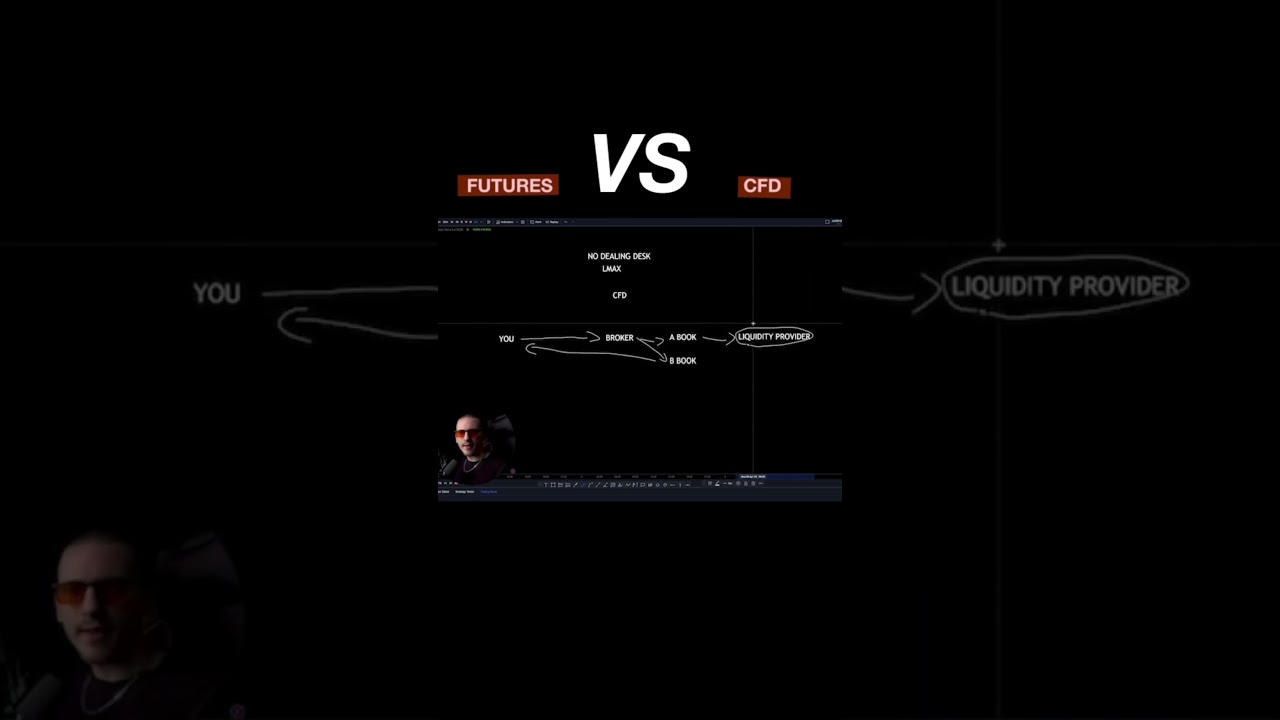
Futures orders go to exchanges where algorithms find counter-parties, while CFD orders usually go to the broker's B-book, making the broker your counter-party. Most brokers claiming to be ECN don't actually execute that way unless you're in their A-book. CFDs create more conflicts of interest: brokers profit from your losses through commissions, spreads, and swap mark-ups.
Chapters
So when you open a trade in futures, you are sending the order through the broker. The broker also through the data feed is sending the order to the exchange and the exchange through so-called matching algorithms finds you a counterparty in the market. So the exchange finds you a counterparty, confirms the order to the broker, which gives you back the contract. With CFDs instead, you're sending your order to your broker and most likely the broker will put your order in the so-called B-book, which means actually the broker is your counterparty. And even if the broker says we are an STP broker, we are an ECN broker. 99.9% of the time they are not. They may be offering you ECN prices. Your order might go also straight through a process. Your order might actually be processed straight through, but not straight through their liquidity providers, straight to the B-book. No dealing desk brokers, which are very few— the only one I'm 100% sure is a no dealing desk broker is LMAX. And trust me, you're not getting into these brokers with a $500 deposit. Most of ECN brokers only provide you ECN prices but not ECN execution. The only way they will provide an ECN execution is if they put you in the A-book, because then in the ECN, which is the electronic communication network, they will match your order with the liquidity provider, which is usually a bank. And by the way, the same goes for prop firms. But I think that with prop firms, the percentage of people that are being actually A-booked are even lower than normal brokers. So in the futures market, the conflict of interest you have with the brokers is only based on commissions, which is okay. So their interest is that you trade as frequently as with highest size as possible. In CFDs, the conflict of interests is commissions, spreads, eventually swaps if there's a markup also there, and counterparty gain. Because being your counterparty, the broker is earning money when you lose. Same with prop firms. So CFDs are the big casino. They are dipped in conflict of interest. But at the end of the day, who gives a shit? If you're profitable, you're profitable both in futures and in CFDs.