Getting Over Trading Under Control the Patient Alpha Emerges
Randy explains why successful traders sabotage themselves through overtrading, tracing it to fight-or-flight instincts and the need to feel in control. He teaches emotional regulation and mindfulness to shift toward patient, probability-focused trading, comparing it to a cougar's ambush strategy versus a lion's chase.
Questions this video answers
March 8, 2018
Five sessions delivered every two weeks over 10 weeks (virtual classroom access).
$11.95 (likely per-session/installment) or $239 (full price).
$3,500 total or three payments of $1,200 over three months.
Chapters
Welcome, everyone. Welcome to this webinar. And I'm excited to see you. I'm excited to be here today. Before we get started even further, let's just do this. Is that if you can hear me, just simply type in yes and click in. And so we know that. And of course, if you can't hear me, type in no in order. I love that. I love that elementary school humor. I can't ever get over it. Okay, yes, Good. Thanks. Today we're doing something a little different. We're isolating. Recently, what I have had is a major influx of clients who over trade. And I started going, well, this is really interesting. What's, what's the deal? And to a person, these were people who came to trading from success in other fields and they were what we would call Alphas. Okay, that one who wants to win, who wants to drive it home, just really in it, doesn't like losing and had produced a lot of trading. But when they got to, when they got to trading, somehow that winning formula turned against them. We're going to be looking at that this evening and going, what? What's going on here? And why can't my winning ways work? So last thing is that I hold my questions toward the end, there should be plenty of time. I discover that.
I have a hard time being interrupted and then losing the flow of my thoughts. So this is just something that's adapted over time. So hold those questions, write them in as we go along, and Dolores will keep them and at the end we'll start answering them. Okay, let's start that. First of all, everybody knows Richard Branson. And here's Richard Branson with one of his really great quotes. Money is for making things happen. Wow. Who does not come to trading with this idea of making wealth happen, making that financial freedom happen, making personal freedom happen, and we want to do it. And you know, the thing is, is, you know, Richard Branson is an Alpha's Alpha. He's proven it. But what we have to do is something very rare. It's this very nature of doing in order to make things happen that we're going to have to re examine. Okay?
The question here is very serious. What purpose lies behind jumping into trains impulsively? Despite my best laid plans, I know plenty of people who are good Alphas. They get into trades and they will end up jumping in and chasing trades that in a sane mind they would never get into. But then they get into it, go, oh, my God, what have I done? And then they try to. I don't want to lose. I don't want to lose. And they start, they start giving that trade room and they end up losing bigger. And then they get mad and start revenge trading. This is something that in another time, in another place, in another business and another corporate endeavor, that might have been incredibly useful behavior.
Okay, but you know, I've worked with Alpha males. Once they figured out how to trade, they actually have looked at me and says, randy, this is the best money I've ever invested. I now know that I'm not going to give up control, that I'm never going to be a consistently profitable trader. I'm going to go back to being an entrepreneur. And it was the best deal they ever made. We want to talk to the people who over trade, people who are Alphas who say, you know something? How do I adapt my nature of Alpha into the trading Alpha, the patient Alpha? How do we do that? Well, that's what we're going to look at. Okay.
Hold on, I'm trying to read a note here, but you're not trying to talk traders. No, no, we're not talking you out of trading. What we're doing is we're saying you're going to need to adapt. You're going to need to adapt the Alpha that you are for the Alpha that produces success in trading. That's what we're saying. And a lot of people aren't willing to do that, and they don't need to be trading. So in taking a look at this.
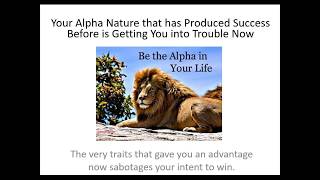
That Alpha nature of yours has produced success, and it's producing so much success, you go, why would I change it? It meant it, it rocks it. You know, it does a lot of stuff. It's brought the kind of success I want. And, you know, here we have this ad. Be the Alpha in your life. It seems like the best thing to do yet. The very traits that Alpha gave you in business and in corporate turn against you, and it ends up sabotaging your intent to win, your capacity to win. So now we've looked at this and go, wow, Alpha's got some problem trading, doesn't he?
Yes. And by the way, I would apologize to every Alpha female in the audience, but what I've discovered over time is that I've been working with traders for over 10 years now, and I have run into one Alpha female during that time. And the rest of the alphas I've worked with, the ones who really wanted to make things happen, really wanted to win, all that stuff, were males. And so in this particular case, because of the, because of the Size of the.
Universe of males in this, I'm referring it to as male. You'll see that throughout here, but it's not. I totally acknowledge that a female can be Alpha. What we want to do then is let's take a look at the traits of alpha that make them successful in one domain and let's start going, let's see if it's going to work in trading. First thing is an alpha wants personal control of environment. He wants to be the control. Second is he believes that force of will can actually control outcome. He's going to make things happen. He can push this through. He can trust his gut instincts. He also has a very strong need to win and to achieve. Okay, I can, by sheer willpower, by just working harder, by working smarter, I can win this game.
The next is that he's highly persistent. He will not give up. It's hard for him. It's hard for him to give up. Okay, it's hard. He also dislikes losing. It's kind of like Bear Bryant said, you know, you know, tying is like kissing your sister. It's all about winning. Or Vince Lombardi saying, you know, if you show me a loser, I'll show you a loser. And you're going, wow. He does not like taking losses. He is highly competitive and he strives to be the best. And he's also, he's also very biased to make things happen by taking action.
And he has this very confident leadership that engenders a sense of status, a sense of like, look, I can do this. I have full confidence I can do this.
Now it sounds like, you know, this is a good idea. Why wouldn't I want to be that way? Boy, that sounds like a winning combination. Well, let's take a look at it in trading. Okay, let's see the way it works in trading. This is for the folks who want to win by making things happen. What you discover is that this leads traders to chase trades that aren't there. Only marginal. How many times have you got into setups? You ended up jumping into a trade for whatever known reason you get into it, it just absolute boomerangs on you and you get out of it and go, what was I thinking? Why did I did that? Why did I chase that trade? Well, this is why. This is the quality of alpha. This making things happen, this will to win, this desire to win, this striving to win, that absolutely blows the mind that you need for effective trading away. You chase the money.
Let'S go to the next one. Then you hold on to Trades because you don't want to lose and you make the loss bigger. Who in here has done that? You look at it, it's absolutely. You get the stop, more room and you get it bigger. And then you. Then you just keep adding to the trades in hopes that it's going to turn around. This is called gambling. Friends and Alphas are very prone to this behavior. I've seen a lot, many of the guys who come to me, particularly of the alpha quality, coming from successful backgrounds, it's not unusual for them to have lost half a million, a million, $5 million, and they finally come to the moment going, you know something? This is not working. What, what, what do I need to do? The real question, are you willing to change how you're an Alpha? That's with the big deal. But let's not stop there. Let's just say you start winning, you get yourself under control and you start winning. This leads to a misguided confidence to act on instinct rather than staying in discipline and patience. And what do you do in a short period of time? You give back all the gains that you made and more. How many of you have experienced that? A good bit. What I want you to see is the very things that Alpha gave you are now becoming a liability in trading. And then very common is you get angry at taking losses and you get into a battle of wills with the market. Do you think the markets care? Do you think the markets even know you're there? No. And this is when you get where the alpha blows out accounts. He burns through capital until he begins to recognize that.
What worked in the environment that I came from is not working in this environment. What does work in this environment? Now, that's a very powerful question. And so what we do is we come down to this, and this is where we make a great divide over. Trading.
Really is both a biological and psychological issue. There are certain things about biology, particularly our inheritance from past ancestors, that set up good leaders for this problem of being able to be an effective trader. At the same time, what you'll discover is that in trading, often alphas have come to align their sense of identity, their sense of worth, with their ability to make money. This becomes a very big issue in trading because you know that that means that you think that you can win. And unfortunately, in trading, that's an illusion. You can't make winning happen. It's only a probability. So we're looking at this and we're going to say, wow, okay, well, how does this work? Let's look at the biology and the ancestry first. Okay, what happens? Let's look at this as when you jump into a trade and that you shouldn't be getting into. What you're really doing here is information is coming in, okay? Information is coming in to your brain from the senses. You're looking at traits, you're looking at the setup, you're looking at that, and suddenly all this information comes into what we would call the sensory thalamus, the hypothalamus. And it says, wow, there's prey out there. Let's chase it, let's get it, let's get it right now. And it's so overwhelming, this need to, this, this compulsion to chase, that all of a sudden the hypothalamus cuts out the route to the neocortex, or what we would call rational thinking. Instead, it takes the dirty path, it takes the shortcut to the amygdala, moves it into fight flight. And then all of a sudden you're chasing the trait. You have this urgency to act before it gets away and you take it. That's what every Alpha is working with. And I cannot tell you how often you see the Alpha having an impulse problem where he's sitting there watching setups and suddenly just looking at the setups, he decides he's got to make something happen. You know, you've got to do something to make something happen. And he looks at something and suddenly that Alpha takes over, that urgency to act takes over and he chases. This is what you have to learn, how to disrupt and to rebuild. That's the pure biology. But let's go, let's go down to where this biology came from. Let's talk about the origins of the Alpha. You didn't land. It just didn't drop off the cabbage wagon yesterday. Friends, there is a strong need to win, was needed for the struggle of survival. You had to believe you were going to win even if you didn't win. You would rather believe in the illusion of winning, of controlling outcome, than the actual failure of being eaten alive. Pretty simple. Okay, so there was this striving to win and being competitive in a very dangerous world that literally very like a laser focused the attention on winning, on being competitive, of winning. Winning. Winning and not losing. Because not losing meant forfeiting your life and are forfeiting members of your community's lives. Remember this clan you're looking at, These were small clans and they were hunted. But saber toothed tigers and the big bears, they had every right to be a little wary. They had a little right to sit there and be proned for action. So the other thing is, there was also a need to make things happen sooner than later. Things happen. You know, when you have. When you have bad things coming at you, you need to act now. If you see something good out there, say like prey that could. That could feed your clan for a week or two, you need to act then. You don't need to wait and think about it while it gets away. You need to go for it. Now, do you see that correlation in trading? And when you're looking at setups, you see a possibility arise and you say, I need to grab that thing now before it gets away.
Well, this is where it came from. And this, these are the conditions, these are the adaptations. This is a natural selection that led to the phenomenon called alpha.
So we understand that it was really great for survival. But more than that.
That alpha being able to hunt really well, being able to defend really well, and being highly competitive gave him status that. That status gave him the comforts of the life of a clan, but also it gave him access to the gene pool. So there was very much of a big power play. And you discover that's what it's all about in evolution. It's all about your participation into the gene pool and being able to project your stuff, your genetics into the future species. And we are prone to that also, because what you discover is this is caveman still with you. You may look sleek, you may look like an egghead, but my promise to you is that caveman's back there, survival brains back there, the survival brain that needs to be able to chase prey, chase trades. Now that makes things happen back then. Manufactures things to do. Doesn't want to take a loss that could be life. Well, I don't want to take a loss in trading. This is what's there. And what we need is a very new alpha mine, okay? That takes advantage of this whole new thing because those traits that we've talked about, where we lined up. I tell you what, Doris, go back to the one that show the traits. It was one of the first slides. I want to show this to you. There it is. What I want, I want you to look at this. In trading, you want personal control of the environment. You don't have it in trading, you're. Even if you're a big fish, six foot five, you're still insignificant in the immensity of the markets.
The alpha believes that he can control outcome.
In trading, you get very clearly you don't control outcome. If you believe that you're living in an illusion. What happens is that everything exists as probability. Even if you do everything right, you can still be wrong. There's strong need to win and achieve. I want to have financial freedom. I want to have personal freedom. I once did a survey in a class much like this on a webinar like this. And I asked people, what were they thinking about as they were trading?
Friends, two thirds of the people, over a hundred people, were thinking about winning while they were trading, which, by the way, they have no control over. They're thinking about something that's impossible to control. What do you think happens when things don't go your way? You get frustrated, you start getting fearful. You start doing like that. The Alpha also dislikes losing. The he doesn't like taking a loss. What you discover with great traders is they don't necessarily have these spectacular home run days all the time. What you start noticing about them is they have small losses. What they have become is a very good loser. It's not like they like or dislike losing. They know that losing is part of this game. And having an issue with losing just simply doesn't matter to the trading gods. Taking small losses allows you to trade another day and allows you to be there for when the good times are rolling and your profits run. It's highly competitive. Well, who are you competing against in trading? Are you competing. You might compete against some people in your trade room. Okay, for what? You're competing against a market that doesn't care that you compete against it.
Then you're striving to be the best. Good deal. I still like that one. Also, the bias to make things happen by taking action.
You know, impulsive trading, has it ever done any good for you? Not so much.
Leadership, engendering status. How many times have you gotten overconfident when you've started winning and suddenly you discovered that overconfidence ended up leading to feeling good and leading to over trading. So all of a sudden we're seeing, oh my gosh, now go back to the slide we were on. What we began to see is this. You can go there. That's a good place. Many of the traits as they're presented in the Alpha's makeup simply are dangerous for the trading mind.
So what you discover is this is. The conditions for success are different in the world of caveman. In today's trader, the Alpha developed a belief in his certainty, prevailing in an uncertain world. Even if it was an illusion, it was a necessary illusion. And that illusion allowed us to become an enormously successful species. Yet.
That same ancestor is still with you in the fight flight, the need to win every time you trade.
Somehow the trader has to adapt the Alpha. You still have to have a lot of the desire, you really have to have the tenacity, you have to have all that. But it has to be redirected, friends. It has to be redirected in a very powerful way. And in particular, you have to become comfortable with the uncertainty of trading. That's the new Alpha Rising, friends.
So what we see is all these Alpha qualities, having been very successful, got ingrained as pattern.
We brought them to trading and we discovered that, wow, they're turning against us now. Often what we see is that Alphas master other people and conditions. But the deal in trading is different. You're not mastering other people, you're not mastering other conditions, you're mastering yourself. That's the true power.
So the Alpha is not going to go away.
But he does have to adapt his Alpha nature to the needs of managing uncertainty that he cannot control. And ultimately the illusion of control needs to die to be able to build the probability mind that we're going to be talking about in just a few moments. So here we go. This is what we're looking at on the left side. You're looking at the Alpha being able to control the outside. That's what he was all about. He was about controlling outcome. He was about controlling literally the circumstances in the environments of his world. Yet what we have to now learn is the war is on the inside. The struggle is on the inside, it's the internal world. So we're going to have to take a lot of the qualities of the Alpha and adapt them for a very different world. We're going to have to really find the patience to wait for things to develop. That replaces the urgency to act. This is going to be it's and it's a challenge for an Alpha. But I have seen people learn how to do it in our courses all the time. But primarily the biggest thing he has to do is he has to let go of the illusion of control.
No matter how much you want to overpower the markets, no matter how much you've got the stuff, you've got the right stuff. What you realize is that you have no control over whether you win or lose. You have a probability of winning. And what the great traders have done, they've come to the moment of realizing that they don't get excited about winning because all it is, you just landed on the right side of probability. It wasn't me, it was me performing in such A way that the best chance for landing on the right, proper right side of probability were there losing. A professional traders can be looking at losing and going, well, did I handle methodology right? Did I hand the, did I handle my mind right? Did I handle all that right? Yeah, it just landed on the wrong side of probability. Would I take that set up again? Absolutely. It's a good, it's high probability. I just limited my loss and I'm moving on. Very different, very different sense of humble confidence rather than false confidence there.
And what we discover here is this.
You control only the mind that you bring to the moment of performance, friends, not outcome.
Winning is out of control.
And you have to learn how to become a very good loser despite your desire to win.
And despite your competitiveness is that you're going to lose a good bit of the time. It's kind of like in baseball. You don't look at it very much, but if you hit 300, if you get base hits 3 out of 10 times, less than half, only a third of the time, less than third of the time, you're getting the hall of fame in trading. What if we looked at it and go, you know, most really successful traders, they're, they're, they're winning somewhere between 35% of the time and say 60% of the time. That means they're losing between 40 and 35, 30 and 65% of the time. Their job is to manage their risk, manage their losses. They know that odds are stacked against them winning, but what they're doing is. What they're, what they're doing is they're stacking their ability on the number of wins and the size of the wins and the size of the losses so that they understand that if they start their ratio of winners to losers is 2 to 1. They're making a lot of, they're making a lot of money. If they're, if they're only winning 40% of the time, they're making good money. They realize that winning is an art. And the conversation, the perception you have of losing has to drastically change. This is what we're talking about here. So the question really becomes, and I'm hoping this relates to you guys, this is a slightly different presentation than I normally do, but I just started seeing so many alpha males come in with this winning attitude and they were blowing themselves up, blowing up accounts, jumping into trades, revenge trading. And they're going, you know something? I have 25 years in business and did incredibly well or I wouldn't be able to trade. But I Can't go on doing this. What's, what's going on here? Can you help me? The answer is yes. The real key is how do you go about rebuilding this long held successful traits that are no longer serving you? Okay.
It'S not that these traits are bad. I want you to get that. I want you to understand that they have been very good. It's just that in the environment of trading, they don't work like they did in the environment, say of caveman, of survival, of business or corporate. That's all we're saying, is that we're coming to a moment where we go, hmm, I need to adapt to the trading environment rather than continuing to try to force my will upon the markets. That's the hard part for the Alpha today because he really has had an enormous amount of success enforcing his will. I once had a trader who very much a self made man. He and he literally had a portrait of John Wayne behind him when I worked with him on Skype. And he really identified with John Wayne, that character. And this man had built a struggling farm into an international agribusiness that had container ships full of his hay going to Asia. And truth is, he had either 6 to 10,000 acre farm that he raised the hays on and stuff like that. And he took gambles. He was a gunslinger. And that gunslinger had done an enormous job and he built a family business and family investment firm. What he was discovering though, and because of the business he was in, he was very familiar with options because he was constantly having to use options to be able to cover.
Sending things over to the south, to Asia. Yet what he discovered is that gunslinger would get in to his trading and do a lot of damage. And he didn't want to give up that gunslinger. But over time, what John did is he took that gunslinger and trained him into a skilled marksman.
That's what I want you to see is that we're talking about tweaking, adapting the nature.
The gunslinger, very successful in business but very bad in trading, needed to be adapted to being a skilled marksman. Okay. In the trading world. And then his trading took off and he was about as big an Alpha. He was 6 foot 5. He was the whole, whole alpha game. So it can be done. And what I want to do is let's talk about what the differences are. I want to talk about two apex prater predators, okay?
Both alphas man the lions on the right and let me, let me talk about him. The alpha lion is part of a pack that stalks and chases its prey. Kind of like what alphas do when they want to make chase and stuff like that. They also take heavy, heavy losses. They get gored, they get kicked by. You know that you get kicked in the jaw by a zebra and you've got yourself a problem. And consequently they take heavy losses and they have to have large prides to be able to keep filtering new animals, new lions into the chase.
Yet on the other side, you're looking at the North American cougar.
Completely different. Completely different animal. He's an apex predator. Okay? He is the apex predator. He lives in forests and he primarily hunts the white tailed deer. Does he stalk them? No. Does he chase them? No. What he does is he climbs a tree, sits on a limb, waits very patiently. Hear that word? He's not trying to make things happen. What he's doing is he's waiting to see what the forest will give him. In the same way that a trader needs to sit and wait to see what the market will give him. He's patient. And yet, when the time comes, when the deer sets up, there is a springing into action. And interestingly is that the cougar does not kill by fighting. He kills by snapping the deer's neck with his paw and the deer just drops. There's no chase. If the deer, if the, if the, if the cougar misses that, the deer gets up and runs off. The cougar does not chase.
He really limits his losses. And if you've ever been around white tailed deer, you realize besides having antlers, they also can stand erect and they can box with their hooves and. Absolutely.
It'S like daggers. So it's not like you want to get in a fight with the deer. What he does is he takes the loss, he minimizes it. He goes through the tree, waits for the setup. He knows more deer is coming his way. What I want you to understand is both these alphas are apex predators, but they are adapted to different environments. The problem with them, it's been done by natural selection, and they're stuck in that adaptation. Human beings can adapt by design.
And this is what the invitation to you is, is that we can adapt by design to move from, you know, I prefer stalking and chasing. It just gets my. It gets my blood pumping and man, it feels good. Yet it doesn't work in the environment of trading. And I want to make my money in trading. I need to adapt that alpha. I need to adapt that apex predator so that it becomes an ambush predator that takes minor losses and makes kills very easily. That's what we're talking about friends, we're talking about. There's nothing wrong with the adaptation the African lion has done. It just would not work in the forest of North America.
The cougar totally adapted to the conditions of the environment in North America, in the forest, North America. So the real key is you're not stuck.
Like they are. You can adapt intentionally on purpose. It just depends on how you go about doing it. What we're looking to do. If you take a look at that image on the right, what you're seeing is what would be known as a flow state where you look at it. And for that, that, that what he's doing in his performance.
Is literally he's got high skills like any traders can. Any trader worth his salt who's been trading for a while is going to have really good skills. And at the same time, there is also high stress. The challenge is high. And what he's doing is he's choosing the emotional state that he's going to be in for that performance. And if you take a look at this flow thing, what you said is you, you see, there's some of the apathy, worry, you've plenty of them. Boredom, people getting bored, Relaxation. I'm too relaxed to trade. Anxiety, I'm worrying. Arousal, I'm getting angry. And this control, what you begin to see is in the apex of that comes this new state of mind that is the confluence of different emotional programs that you become.
You learn how to master. You can't control outcome, but what you can control is the mind that you bring to the moment of performance. What you can control is not. You don't have freedom from emotions. What you have is you have freedom of emotions. About saying, okay, I know the default programming when I hit uncertainty is literally that I am going to sense vulnerability and I can either fight or flee at that particular moment. Okay, that's the default programming of fight flight. And the alpha is choosing fight aggression, taking action. Yet it's not functional in trading. What we're looking to do though, is say, you know something? What we want to do is create a new emotional cocktail that creates a mind built for the management of uncertainty. Yeah, that's the performance mind. Friends. Okay, so the first thing, how do you do this? Okay, let's take a look at this. The very first thing is emotional regulation.
Or what we would call step one. What we have is the. We have in both our group course and our individual course, there are five skill packages that are learned, okay? And we say step one, step two, step three. We understand that there is a process that we're teaching to be able to adapt the brain and mind from the old mind to the probability based mind. The very first thing is we need to manage the impulse to act. Because ultimately the urge to chase trades can be dampened by learning how to anticipate and to manage the Alpha's need to make things happen. What you would see in the first parts of our work is that you learn how to use your breathing by bellows breathing and learn to relax muscles. Because what happens is those two elements, breathing and muscle tension, are actually parts of an emotion. They're parts of the arousal of the emotion. And if you started tomorrow and started saying, I'm going to look and see what's going on. When I start anticipating a trade, you're going to start noticing your jaw starts tightening, you start getting really ready for a fight. You know, your muscles tense up, you're all sitting like that and you'll be holding your breath. What we want to do is say, okay, that's the precursors to act, to jump, to produce impulse, to jump into chase, into a trade. And what we want to do is we want to start regulating it so that we slow it down so it doesn't hijack us. That's through emotional regulation that can be done. That's the first either two or three weeks of our training in either the group course or the individual course. Because we realize that you've got to train the body. You know, it's got default programming going on that's just not going to change because you start saying a few fancy affirmations and have some visualizations and you think you're going to.
Train your subconscious by hocus pocus. It's not going to work that way. No. You're going to learn skills that allow you to calm the physicality, the biology, the emotion down. Then what you're going to do is you're going to interrupt the urge to jump into the trade. You're going to manage the chase motivation. And out of that, what you start noticing, as you're able to pull that back, you start noticing patience arising. Okay? And with that patience, we're still a long ways from it, but we start realizing that it's that patience that has to be added to become the ambush predator. Okay? Because the lion, they're all about running down prey and jumping on things. The cougars not.
Step two. We also have to start developing mindfulness as a way of like stepping out of the urgency of emotion and thought. And take a look at this, this illustration Here, basically what you're looking at is that we are completely restricted in what we see. We get locked into a tunnel vision, and we don't see anything else. And what we have to start learning is to intentionally alter.
The glasses, the eyes that we're seeing through. The observer, we're seeing through. That's what we have to learn to do. This becomes designed because ultimately what you discover here is this. You and your thoughts, you and your beliefs are not the same. There's no just you. They represent only one potential organization of a mind that you bring to trading friends. In mindfulness and awakening the observer, you really begin to go, oh, my gosh, you know, And I realize that, you know, I have default programming has been organized into identity that I have mistakenly called me. You're going, no. What Randy's saying is actually identity is quite fluid, that it can be redesigned to perceive uncertainty very differently. And that's what we want to do, friends. That's what the gift of mindfulness can give us. Then we take that tool and we start reordering the brain and the mind for trading performance.
You know, most people say, you know something, Randy? This committee, the mind stuff you're talking about, you say that I've got voices running around in my head. Oh, you've got tons of voices. And if you don't think you had them, just think about the last time you took a hit and you started beating yourself up. There's at least two people going off in there in your head. When you have mixed emotions about something, when you have mixed opinions about something, you hear an argument going on in the head about what you should do.
Right now. Because your observer doesn't know how to observe the committee of the mind. You don't know how to manage that. As a trader, you're going to have to learn. You're going to have to learn who's going to be in control of the mind that trades.
The one that you brought is not going to work. What we need to do is we need to develop a mind that can engage uncertainty and stay patient and stay disciplined and stay impartial. That can be done if you learn how to organize the mind that engages uncertainty friends.
So mindfulness is the very tool that is used to redevelop the committee of the mind. And let's talk about this. Let's talk about the committee of the mind, what it really needs to look like. Have you ever heard the expression, to a hammer, everything's a nail? That's the way most people operate.
Your job is to Reorganize that bias thinking into a performance team for managing the uncertainties of trading. If you've ever seen four man bobsleds, it is an incredible thing. Dolores and I watched the Olympics and you know, you're talking about hundreds of seconds, hundredths of a second, that separate the goal from not placing. And it's this precision, it's this ability to perform with a team leader, with everybody organized, everybody intentional, everybody focused on the task. They're not thinking about winning, they're thinking about performing. Friends, this is the new alpha. You're adapting to patient discipline for performance rather than chasing profits. This is the new alpha, friends.
Then.
In doing this.
You also.
Have to start calming both the voice of your fears and your urgency to act. If you were to slow down your thinking through mindfulness tomorrow, when you started looking at your tendency to urge to get into trades, you will notice there's a conversation in your head.
One of the most diabolical things in the world was for someone to say, well, if I got voices in my head, you're crazy.
That's diabolical. Because if you don't know that you have different forces with very different agendas running around in your head, you are at enormous disadvantage. They're there. And by ignoring them, you give them enormous strength to do destructive stuff and to keep yourself limited. So you end up really changing your whole idea about winning. It moves from controlling the outcome to controlling the performance mind. This is where the real power comes.
And as you do this, just like in that bobsled, you start developing the performance mind. And it's rooted in discipline and patience. It's not rooted in an urgency, it's not rooted in a desire to win. It's rooted in a desire to perform well. Because ultimately, when you perform well, magic happens. Suddenly the edge that theoretically your methodology and platform give you can be realized. Because now your mind also is in tunem with the edge. You're focused on performance which you can control, and not on the outcome which you cannot control. Do you see the difference there, friends? It's huge. You learn how to access the emotional programs of discipline, of courage, of self soothing impartiality from real experience rather than affirmations and visualizations. In our work, we actually go back into memory and we isolate these particular emotional programs and performances that you've had in other domains. And we get you to enrich them and we learn, we teach you how to pull them forward. It's kind of like a method acting where you actually go to the emotion and bring the emotion forward and then deliver your lines, your performance from that emotion. Very powerful stuff. And this is the, this is one of the defining things in this work is that you can have a rote saying, this is what I'm supposed to do, here's my plan, here are the steps. But if you're not managing the mind that knows those steps, those steps are going to evaporate during stress. Okay, so there you go. And in doing that.
In feeling those emotions that bring forth the performance mind, you're able to tame the demons, the demons of impulsivity, the demons of over trading that urgency to act, that not willing to take a loss because it may say something about you as an alpha, you as a winner. This is where you start realizing that, okay, the focus is on discipline, on courage, on self soothing impartiality. That's the whole thing. And you also discover that in doing this, it's just a loss. You don't have to revenge trade, you don't have to say I lost, I'm going to make that up. No, it just take a loss. It's just probability. It's interesting is that.
A few years ago I was rocking watching track and field and I watched the hurdles because I tried to hurdle when I was in high school, discovered that I'm just not, I was never going to be a good hurdler. Okay, let's just say that. But I get how mind and body really have to come together to be able to race hurdles. And there was this race where this American guy was favored to win and favored to win gold, stuff like that. And all the announcers were just going gaga over him and all this kind of stuff. And then the race began and he did shoot out, he did win and he set a world's record. And they were all excited, the announcers were, the journalists were, and they were running to him and they just wanted to know what was on his mind, what was it like in that winning, what was it like? What did it feel like? The world wants to know what it felt like. And you know, the athlete was sitting there trying to get his breath back and once he got his breath back, he looked and says, you want to know what I was thinking when I was racing? And they just thought, oh yes, oh, he's going to talk to us about what's going on inside his mind. He says, okay, I'll tell you. 1, 2, 3, 4. 1, 2, 3, four. 1, 2, 3, Four. 1, 2, 3,4. No, no, no, no, we want to know what you were thinking. He says, One, two, three, four, one, two, three, four. One, two, three, four. That 1234 is something that for God knows how many years coaches have been working with him to coordinate muscle activity with mind doing races. No doubt a sports psychologist had got a hold of him and taken the 1234. 1234 to maintain peak performance mind. But he wasn't any other place other than the moment of performance. He was not out there feeling victory, he was performing. Now when he got on the podium and stuff like that, he was jubilant and stuff like that. And when he was being interviewed, he acknowledged that we had outcome goals set 10 years ago that I would be sitting up here and tonight they're realized. So we had outcome goals. But he did not confuse his outcome goals winning a goal with his performance goals of performing. That's what I want you to see. Traders do that all the time. Most people do that at time. I'm saying there's a better way. This is the huge shift, friends. This is the huge shift.
So here it is. Fundamentally.
You'Re going to need to develop the mind from the one that you brought to trading to the mind that can be successful in trading. It's a requirement, friends. It's not an option. If you have not come to that moment, then it's a waste of time for you and I, for you to be listening to me, because you're not there yet. You haven't recognized that. No, this is. Trading.
Represents something that you're not going to conquer the typical way you're going to have to adapt the way the mind engages uncertainty. And my question is this. Are you ready and willing to do it, to make it happen and do you really want it? Because if you really want it, it's easy for people to say, oh, yeah, Randy, I'll think about this for a while, you know, yeah, yeah, yeah, yeah. And they go off and blow another account. And they go, yeah, I should have listened to him. Let me blow another account while I'm learning this lesson. And before you know it, they've blown their capital up. I see it all the time. What I'm asking of you is, do you have the wisdom now to look at it and go, you know something, I need to, I need to get this mind thing fixed if I'm going to make a successful career out of trading. And no matter how much knowledge I have, it's not going to make a difference unless I can get my head screwed on straight. So you have a choice between the fixed mindset or the growth mindset. And friends, I hope you choose the growth.
Because you're investing a lot whether or not you like it or not. And what I'm wrecking, what I'm asking of is you're going to have to invest in self development.
And your mind self development to make all that stuff run. So how do you become the change? First of all, we're having a group course start pretty darn soon. And what I would, what I would encourage you to do is to really consider it. It's five sessions based every two weeks for 10 weeks. And you get a virtual classroom that you have unlimited access to. And it's a very powerful course. You teach the basic skills of. Talked a little bit about here and it's an enormous improvement. And I'm gonna, I'm actually quote a guy who just is finishing it. He just handed in his trading, his psychological trading plan to me. And here's a quote from him. Okay. The group course has been outstanding. This is exactly what my trading needs. I've done a number of other psychology courses over the years. They seem to lack a practical component to, to apply what is learned. Your course addresses this issue.
Friends. That's the key case. This is not about platitudes. This isn't talking about things what should be. This is actually teaching you how to build the mind for effective trading. Okay. That's the first thing. And I.
If you sign up by 3:17, you get a free gift. It's emotional regulation workshop that we did a while back. You can buy it on our site for $199. You can get it free by signing up early. And you need to. The second thing is our individual course. Our individual course is highly comprehensive and very personal. And a lot of traders who take it, they're very serious and most come down to it. Comes. The major difference is this is. Yeah, there are more materials, there are more cool little trinkets in it. But more than anything is it comes with 10 personal consults with me on Skype every day. I'm all over the world working with Skype with people from different areas working on this stuff and we get really deep. We really get down to the very, very, very core of the problem and reconstruct it there. It's very powerful and it's, you know, ultimately often it comes down to money. The, the, the group course is.
Cheaper, okay. Whereas the individual course is more expensive. But it's so much comprehensive, comprehensive. It really depends on what you're looking for. So those are the two avenues. But if nothing else, what I'd encourage you to do is to at least get the free book on our website. Look at. There's lots and lots of YouTube videos. There's lots and lots of articles. There's. There's lots and lots of stuff on the website. People spend a lot of time there. So what I encourage. Oh, and by the way, the ebook. Get the ebook. Mindful trading. It's a very powerful thing. If you haven't read it. I thank you for being here. And what I would like to do is if you have questions, I would love to be able to answer them. Type them in. And.
We have a comment from earlier. Okay. Just finished my day's entry in Trade journal before starting your webinar. Noted. Last two days turn winning trades into small losses.
Two days turning the winning trade small losses because I managed the trade and moved my stop too soon, too tight. So I know what, what you're. I'm having a hard time following. So I know what you're talking about. With this analysis, made note to let the acceptable risk play out. Thanks, Randy, for the reinforcement. You're welcome. The key is that this is really all about training and altering default programming, both biological and psychological, into a new paradigm of thinking that works. That really works with the. With that ability to manage uncertainty. That's really the key.
So I don't see any other comments or any other questions. So if that's the case, we will be closing down here pretty soon. I want to. Thank you.
Just in time. Okay. Question.
Okay.
How. Just.
The cost. Okay. What is the cost? The cost of the. The group course is $11.95 or $239.
Every two weeks, five times. Okay. A lot of people take that option because it just makes it a lot more. It makes it more affordable.
The individual course is $3,500 or three payments of $1,200 over three months. And again.
They'Re built to be able to try to break them up so that you can get at them and can afford them. Okay, that's it. My friends, I thank you for coming. It's been fun. And if I can help you, let me know. Take care.










