Getting Real Growing Up as a Trader
Randy Howell breaks down why traders sabotage themselves: evolutionary wiring pushes optimism bias and fight-flight panic, while an inner critic fuels self-deception. Mastery requires rewiring through breathing work and mindfulness to trade on probability instead of emotion.
Chapters
As does now starting. All attendees are in listen only mode. Welcome, everybody. My name is Randy Howell with Trader State of mind. And we're here to have some fun today. And the. We want to really find out, hey, are you ready to really become a trader? I mean, it's. Let's. We're going to be thinking about that, but first, can you hear me? I'd hate to sit here and talk for an hour and find out that nobody can hear me. If some people just simply put some yeses in the chat box, I would really grade it. I would really appreciate it. Okay. Yep. Okay. The second thing is I just. We just see a question coming in. But. And what traditionally I have done is I hold my questions toward the end. And I'm glad you wrote the question in because I will address it, just not right this second.
That's the major thing. And outside of that, I'm ready to rock and roll. Oh, by the way, I want to tell you, it's really interesting. This topic and particularly the video that I did with it on YouTube, has created a biggest controversy as I've ever seen in the world. I've got. Boy, I want to tell you something. Some people are doing some serious character assassination on me. And I did remove them from YouTube, but I also found a lot of people saying, you know, coming and saying, no, this guy's. It got to be an enormous debate between really two sides. One, seeing that, you know, for whatever reason, I'm a stoic or this and that. The other, and other people saying, no, you know, trade for a while and try to become profitable. And this guy's really talking to you in a way that you need to be talked to. Okay. Oh, and by the way, we are celebrating press variance rover landing on Mars today. That's a. You know, that's the kind of man, I love science fiction. Like that stuff, man. So anyway, congratulations, us. So let's go. Let's take a look at this. You know, do you remember the. Do you remember just how it started out? You know, you were just gonna. Just through sheer, sheer, just presence of mind, you were gonna jump out of the bowl of your comfort zone. You were gonna leap and you were gonna make money. You started doing the numbers and you really decided, you know, gosh, man, look what happens when you just size this thing up. You golly, this is the best thing in the world. And people are selling you on that. You know, all you have to do is keep your emotions in check with that ambition and understand there are two fundamental reasons that traders get in to trading. One is financial freedom. They want to make money. And the second thing is they want personal freedom. And you begin to see that a lot of times it's not greed. It is just simply saying, you know, I can provide better for my family, I can provide better for the universe. I can do a lot of things. I can do more things for the world. I need to be moving in this area, and it just looks like I can do it. And they get in okay, they get in and things change enormously. And at first, you know, you were going to, sure, it's going to work. You know that you had it together. You know, you. You put money into your training. You, golly, got. Would you jump from teacher to teacher to teacher. You were looking for that thing that would be allowing you to really take that bull by the horns and win. You got the right equipment. I can't tell you how many traders have closets and closets and closets full of old equipment. And they have even said, you know something, you know those really big trash containers that you take your garbage out to the side of the road? I can't tell you how many of those I've taken out, too. So we're looking at this going, you know, it's simply not the. At the. You're investing money in training, you're investing money in process, you're investing money in equipment. And you're sure that with your attitude that it's going to work. Yeah. This is called optimism bias. And friends, when you were. When your caveman ancestors and mine were on the African savannas, and even after that, we had to have a burning, burning bias that we were going to succeed, because the truth is, it was a pretty skinny, skinny possibility.
In trading. All of a sudden, it comes all the way back from the African Spanish. It comes homo sapien, not just hominoid, but a homo sapien. And all of a sudden, that Homo sapien sitting in front of a computer and ready to win. And yet that's when it kicks in. That optimum bias meets a reality of its different order. That's where it really begins. So we get to this thing. You maintaining that positive attitude, you're doing all that, and all of a sudden you go, the P and L just keeps busting you. No matter how much you rev yourself up, no matter what you decide, no matter how much you say, you know, winning is just right around the corner. I'm about there. What we notice is we start lying to ourselves. And believe me, it's not just you, the brain Your brain will deceive you every lick of the way. You think about the ultimate deception, how a person becomes drug addicted. That is enormous deception, because ultimately the brain just simply wants the dopamine fix or the endorphin fix, and it starts creating a whole sort of story about getting it. Once it says, oh, wow, that drug supplies me with that. And all of a sudden you get. The brain's making all sorts of deceptive stories about you're needing that and craving that. Same thing with trading. You have this desire, I want to make money. Which, by the way, just let you know, is the. That's not allowed when working with me is. The moment you start talking about money, what happens? I said, can you control that? Can you control.
That you win or not? And the answer is no. So if you try to control something that is not controllable, what happens to you? You get traumatized. You get beat up pretty good, okay?
So we get this and we go, wow, huh? And all of a sudden we find out, guess what? You have to begin to own the problem. It's. The problem's not in the lack of knowledge that you have. It's not in your. It's not that you don't have will. It's not that you don't have desire. The truth is, though, you came.
Equipped to trading with a mind that simply is not up for the job and most likely added on to that in the formative period of your life, as that brain is really forming, how you interact with the environment, you don't get the kind of coaching and mentorship that allows you to think in probabilities rather than certainties. So we trap ourselves and all that stuff. You just kept wanting it. And what you discover is the problem's not out there. The problem is in here, inside your main brain. Something we're going to be getting to a little later today is that this whole sense of reality that you have, you know, ultimately that reality is not out there. The reality that you're seeing, or what in neuroscience we would call virtual representation or symbolic representation in the head. You are creating the world based on your biases and your beliefs, okay? And you pretend that world is real. And truth is, it's not. It's a belief. You may be certain about it, but certain is also a feeling. And all of a sudden you realize, well, you know something? I've got this mindset and I want to make it work. It's worked for me before. I don't know why it's failing me now. And, friends.
The key is that you were sabotaging this from the get go. Okay. And again, what happens is that.
You weren't looking at what the trading account can tell you. The trading account is your friend. It's your friend. It's the only, it's, it's, it's brutal. It's a brutal friend. But it's going to tell you the truth rather than you making up.
Deceptions stories, alibis for all the stuff. It's just like with this YouTube stuff is that you know, people who have been around the game. I had a, I had a hedge fund manager decide to work with me today. And truth is, he's profitable, his clients are happy. But what happens is what he understands is that he's leaving money on the table. There's something missing there and he needs to find it. And he can't find it himself by himself. He's looking, say I need help. I need to see something that I can't see because it's limiting the potential of who I am as a trader, investor and a human being. So there he is. And here we go, going, okay, wow. Now you're telling me that the brand that I brought and its conditioning.
Is now sabotaging me. Yeah. And the deal though is your trading account is going to tell you if you're sabotaging your or not. And it's not to accept your bs. It's really phenomenal and I think this is why I've made some people mad on YouTube. And that's good.
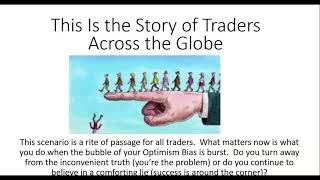
Here we are. This right here, this graphic is the story of trading across the globe.
We there's statement that 95% of traders lose money. What we they don't say is the people who make money, it's not the 5%, it's 2%, the ones who are consistently profitable enough to produce the kind of income that supports living. And yet at the same time, you carry that optimum bias with you. And you, you take that cognitive dissonance with you where you don't want to hear anything other than what your beliefs are. And you keep failing and failing and failing. And the difference is this, is that life goes on for a long time, you know, is that, you know, my father smoked Camel unfiltered cigarettes for 52 years. And back in the times when you started really discovering the cigarettes, really not good for you. My dad stayed with Camel unfiltered because that's what he got used to. And so, and people would say, Mr. Howell, don't you think you really ought to at least go to filtered Cigarettes, so they're not so bad for you. And he just, he would look and say, I don't see myself. I'm in good shape. What are you talking about? Because the thing is, he wasn't. Didn't want to see through the addiction, I might add, the danger of what he was doing. He was walking down that hand, about to fall off.
52 years later, he goes into a doctor because he, guess what he's having problems with. With oxygen. Getting enough oxygen and there's too much CO2 in the lungs, blah, blah, blah. And the doctor says, well, Mr. Howell, you need to get your affairs in order. Your lungs are black. They're extracting little or no oxygen, okay? He got all religious at that point. It was like, oh, my God. Oh my God. Only then did he quit smoking, but it was way too late. Instant karma versus regular karma. You have to be able to observe, to listen to what is actually stopping you of why you're walking off that plank, in this case, this finger. So we want to do that. The optimum bias in you is going to be able to sit there and say, you know something, I prefer this little lie because it makes me feel good and I don't like the inconvenient truth. I'm the problem. So you're looking at it and going, I'm going to stay in that comforting lie of success around the corner. And the truth is, is that unfortunately for you, most people's capital is limited and their time is limited. And most people that I work with, the reason ultimately that they decide to actually act, do something, it's pretty simple. It's because they're in a place where they are scared of failing. And what they realize if they keep doing what they're doing, their capital is going to run out. So they're in a place where they're saying, you know something.
I need to face the music. But it's only then that they do that. So let's start here. Let's start right here. And let's say, hmm.
The key, friends, this really isn't about you and your psychology. Initially. It doesn't start there. The problem's your brain. Your brain literally was forged under enormously different times and places than you live now. Just 12,000 years ago.
12,000 years ago, there were saber tooth tigers roaming there. Yeah. Now that's a big cat. And they preyed upon us. And you begin to realize, you know something, we have a brain built for that. That literally life is dangerous and we need to be prepared. We need to have a Negative assessment bias that looks out into the world and sees bad things coming. We need that. However, if we want to get to the probability mind that produces success in trading, we have to become comfortable with the uncertainty of looking at all those bushes and recognizing only one in 10,000 of them has a saber toothed cat behind it. And yet your brain is built to assume there's a saber tooth tiger around every corner. So you got this. You go, what am I going to do about it? Your trading account is showing you that you've got a problem. And the real key is, okay, are you listening? Are you, are you insisting about staying in that zone? Saying, I know what it's like to trade. The one that I like the most is that for those of you who have followed me for a long time realize I don't trade, I don't care to trade, I don't like trading, I like the brain on uncertainty. People come to me and right now we have a full practice. It's not like. It's not like. And it's all referral. So the thing is, is that they say, well, you can't possibly teach psychology if you've never traded. And I'm going, you know, it's pretty simple. This is a compression of time. And what you're looking at is the brain on uncertainty and what the brain does under those circumstances. And can you help a person disrupt, basically that appraisal that has you jumping into trades that you don't need to be, or an appraisal that has you not able to get into trades. That's the deal. And the truth is, is that it comes from your caveman ancestors. And it really looks like this. You know, we have a fight flight and also, by the way, slash approach motivation that is at the very core of our emotional being. When you look at something that the limbic system, the emotional brain sees as dangerous and understand the emotional. The emotional brain was designed for the African savannas and for the dangerous world back then. It was not designed to live in a world of probability that the big cat's not there. And ultimately, at the point of threat, okay, at the point of danger, there came to be something called the fight flight response that originated in the amygdala. And when you see uncertainty and you're confused and not. You don't really know what's going to happen, what you're doing is you are fundamentally triggering the fight flight response unless you know how to disrupt it. And before you know it, it can take various directions. It can take, I'm gonna Fight him. I'm gonna show him. I'm gonna, I'm gonna take that threat and I'm gonna, I'm gonna make it smaller. I'm gonna beat it to submission. We call that revenge trading. We call that over trading. Or it can say, I'm a void, I'm a void. And you can't get into trade, you can't pull the trigger. So because ultimately the emotional brain is thinking, well, if he doesn't get in the trade, he can't, you know, he's, he's not at threat. So if I can keep him from getting in the trade, emotional brain wins. Meanwhile, you're going, oh man, thinking brain really wants to get in that trade because it was really high probability trade. And that's the kind of stuff I need to be doing. Or even worse is the one where scarcity thinking, what I've have is going to be taken from me, stops you from staying in a trade and you get out when they just turn black. I hate that. That's all.
That'S all derivative. Not what you learned in your families, that's derivative of what evolution planted and carved in you. So trying to push it, trying to force your way into there, all you're doing is triggering.
You'Re doing a confrontation that you will not win. You will crack. You may have the willpower to sustain for a while, but the willpower will get sapped and you will find yourself a scared animal all over again.
And then you come to this moment of truth. And even this is scary for the brain. You know, the thing is, you're looking at a man looking at two roads. Which do I take? There is uncertainty in that question. And that itself caused the brain to feel vulnerable. If it feels vulnerable, guess what? It leads right into a sense of fear. If it runs into a sense of fear, it's because suddenly it's threatening. I don't know the outcome here. And you're going, okay, well that's a direct trigger to fight flight even there.
But then it gets worse.
You come to the moment of where you know something.
That uncertainty itself is creating this stuff. And I have to be able to teach the brain to behave very differently when engaging uncertainty. And this is really what, you know, it's essential in trading because the time compression between cause and effect, that, you know, you can be in a trade and you know, literally 15, 20 seconds, 3 minutes, 4 minutes, 15 minutes later, Bam, you, you, you, you get hit with results. You know, my dad, in the example I gave you, it took him 52 years to figure out that was a bad idea and the trap had already closed on him. Here we're saying as long as you stay in mindlessness, you stay stuck with the mind. And you're basically, you're bringing a brain into the worst nightmare it can imagine. And you are trying to ask it to avoid what it was built to do, avoid uncertainty. So the question is, okay, this is what I brought to the game, man. And now what I want to do is I want to show you an emotion, what it looks like on a graph, okay? And understand anytime that you get under stress, anytime that you're in the experience of a challenge of living, okay.
There is a moment where a stressor triggers in the environment and automatically an emotion happens, stimuli happens, and it triggers. Take a look at that big gigantic spike.
That's what an emotion looks like. When it triggers particularly a big emotion like say, anger, fear, it spikes. That's 45 minutes up and it's 45 minutes down to cool down. Now, if you grasp the idea that all thinking is emotional state dependent and suddenly you have a surge of emotion going on, in this case, fear, what do you think the kind of thinking that comes out of that emotional ground is going to be? Yeah, you can look for more confirmation. You're gonna take the money before it's taken away from you. You're gonna go bananas. When the trade starts going against you. You're gonna take scared money and you're gonna follow it. And you're gonna throw away good money into that scared money. Yeah, that's what happens, friends. And you think about it like over trading, we've been talking about the fear, but over trading, the eagerness, the lust, the eagerness, the greed is really. You want to hunt the quarry, you want to hunt the quarry, you want to go after it, you want to get it while going is good. And the truth is there's a rule.
The markets will show you what it's willing to give you.
You're not a stalking predator, you're an ambush predator. That's the whole point. So you're beginning to say, wow, if I don't learn how to be able to manage my emotions, they're gonna sweep me away. Anytime I engage uncertainty, particularly when I'm risking capital.
Particularly if I know I have a finite level of capital.
That if I fail, I'm not sure what I'm gonna do. I'm not sure what I'm gonna tell my wife. I'm not sure. I have no idea. I'm gonna have to go back to work. I'm gonna. Can you hear the fear, Bill? Yeah. So we get there.
Most people have been attempting to control.
These impulses that arrive from, you know, engaging uncertainty and leading to fight flight by willpower stuff. Tough upper lip. Or just put your emotions at the door, okay? And they're not allowed here. And yet, at the same time, unfortunately, despite those exaggerated words, is that you're not a rational being.
You're actually an emotional being.
And the truth is, you don't have emotions. They're having you. And what you call thinking is simply the thinking brain, producing an alibi that supports what your emotional brain has already decided. That's the rub. Willpower is in limited supply, and once you start using it, it starts draining and wearing out over time. And so finally, when you try to use it, it finally blows up in your face. The pattern's there. It's really the belief lying behind the pattern that we have to get to, the belief about your ability to manage uncertainty, okay. And understand nature's against you.
We already have a brain that's built around fear, and that's just the way it is. Now let's take this, and we're going to actually step into a little bit of the way emotions actually work, okay? And understand. An emotion, to me, is a biological action potential that coordinates activity and emotion in the environment. That's different. Anytime there is a perturbation, anytime there is a change in status in the environment, in the markets, by definition, there is going to be an emotion. The only thing is which one. And this is where your limbic system really plays a big role, your emotional brain, and in particular, your thalamus region. In the thalamus region, there is a what we would call a traffic hop or an air traffic controller that really controls the thinking and the direction and the energy that's going to be put into different things. And it makes an automatic appraisal. An event happens. There's an automatic appraisal that happens in nanoseconds about whether or not that's a danger, the information's a danger, or whether or not it's not a danger and can be pursued by the thinking brain.
Now, based on history and all this evolutionary psychology that we've talked about, it's easy for that appraisal machine to be biased toward, oh, my God, I need it. This is dangerous. It will trigger that, and it'll take the low road. It'll lead to the amygdala. It'll lead to the activation of fight flight, which is the emotions that lead to action to Behaviors and all those things of freezing, of jumping into trades, all that stuff. But it's at this moment of appraisal, because at the moment of appraisal that traffic cop makes a decision about where to route the sensorial data. If it sends it the low road to the amygdala, it takes, get this point, 003 seconds, nanoseconds.
However, if it sends it to the thinking brain, it takes microseconds, a quarter of a second at best. So you've got something that's already fired in the amygdala, already lit up. The fight flight stuff, chemistry is already boiling, and it's already going into your system. And then a lifetime later, by these numbers, the information gets to this thinking brain where it can be deliberated.
That's an emotional hijacking. And if it's dangerous enough, the traffic cop just simply stops all information going to the thinking brain for appraisal. And you hit the emotion, you hit the action, and boom, you're gone. It's at that appraisal moment, friends, that is what has to change.
Right now. You have automatic appraisals that you've inherited from our caveman ancestors. You have those same automatic appraisals that have been reinforced by family learning and identity learning as you're growing up in your formative period. And your brain's organizing how you respond to the conditions and challenges of life. So it's right here. It's right here. And this becomes what I call response ability.
It's easy to respond to the traffic cop going down the low road. It happens automatically. But to be able to disrupt that and to be able to say, no, I'm going to respond in a thoughtful way. That takes work that just isn't magical thinking, where I'm going to think up a few visualizations and affirmations and positive thinking, and everything's going to be hunky dory. Those never touch the automatic appraisal meanings, beliefs.
That are limbic in nature. This is where we have to start changing the responsibility, because otherwise you're never going to be able to change the response you currently have to the management of uncertainty. We need to change it. How do we do that? Well, the very first thing is, this is what I ask you to recognize. There is no such thing as freedom from emotion. The only time that you don't have emotions, it's when you're dead. And I'm not wishing that on you, okay? However, once you grasp, oh, you mean I just can't leave emotion, tap the door. No, can't do that. That sounds good and makes men virulent. But the truth is, it's dangerous. It's dangerous advice. What you can have, though, is freedom of emotion and this responsibility. You can begin to say, how do I want to respond to uncertainty? The good news is that you can train yourself to respond very differently from a sense of curiosity rather than from fight. Flight, a position of patience, completely different animal. And that can be trained. That's the good news. And you know, really, when it comes down to it, boy, why do I need to do this? It's very simple. All thinking is emotional state dependent. If you came to recognize that, you know, fundamentally.
What we call the emotional brain, the limbic system, your neocortex, the thinking brain, actually grew out as a tumor from it, and it became active. Best guesses right now are about 200,000 years ago. Okay, short. And.
There is tremendous communication technology going from the limbic system into the thinking brain. However, there is two little 19th century telegraph lines coming back from the thinking brain back into.
The emotional brain. You see the dilemma here? You're going to have to maximize your capacity to use your mind to be able to change the brain. That's the key. And the first place you stop is, oh, my gosh, all my thinking is emotional state dependent. So what you're saying is that I need to learn to manage emotions to be able to give rise to a mind that can, in fact.
Engage uncertainty with a disciplined, impartial mind. And a patient would do. That's correct. And how do we do this first thing? This is stuff that I teach, that I teach to everybody I teach in my group course and in my individual courses. The key is the first thing you have to do is you have to get the big emotion from getting out of hand. It just so happens that because emotions are biological rather than psychological, they will have a biological signature.
That part of that signature is the way you breathe. Fear requires this kind of tight, fast breathing or holding your breath. Anger requires this holding your breath. And what you're doing is you're automatically shutting off oxygen to the brain and beginning to get that oxygen and glucose into your big, big muscles, getting ready to fight flight. If you alter that to bellows breathing, diaphragmatic breathing, you automatically interrupt the process that.
That the traffic cop has already sent the signal and it's beginning to rev up. You can interrupt it. This is known as emotional regulation. It's based on Vincent's work from Harvard. He's great. He was a great cardiologist, research cardiologist Rick Benson and he studied Hindu yogas. And what he. They were saying they could control a lot of stuff about respiration that western science at that time said they couldn't. He got him into his laboratory, hooked them up and found out yes, they could. And what he did is he stripped out the religion, the culture, and he found out that it was breath and muscle relaxation that was doing the job. And ultimately what he taught was how to.
Have a stressor evoke. And when it fired, it produced the relaxation response rather than fight flight response. And it's. At first he thought he was going to change the world. And he found out that it changes your ability to manage the intensity of the emotion. It does not change the belief that drives your ability to manage uncertainty. That was the thing. Yeah. And if you want to look at this, particularly the tension in your face, the way you hold stuff, get a mirror and tomorrow put that mirror up and watch your face. Watch the, that from your shoulders up. And it's, it's not pretty, but you're going to see the tension on your face. You're going to see yourself holding breath. You're going to see yourself going through the, all the stuff. And when you begin to say, oh my God, wait a minute, Randy is saying that the breathing, the tension and all that stuff are part of the emotion. Yeah. It's called emotional revving up. Okay. And you can interrupt it. That's the first deal, friends. Okay, but understand this.
The. And how do you do it? This little diagram is that you can, you can find this anywhere. You know, those very smart people says, well, you know, I'm getting all Randy's information and I'm just going to listen to his wise words and I'm going to, I'm going to become the competent trader. What happens is go to anywhere. I got this off the Internet. What you do is you say, how do you breathe? And a diaphragm way that interrupts the process of emotions. Here it is, right here. You pull air into belly, expand the chest hold and then you release slowly. You keep doing that because that is the state that is the breathing style and muscle style that promotes relaxation. Okay. Calm, rest, digest the parasympathetic nervous system. And you begin to realize, oh my God, I can just do this because you know, anger and fear are going to constrict. And what you're doing is you're actually using the parasympathetic nervous system to calm down the sympathetic nervous system. That's fight, what we call fight flight. So you're looking at it and going, I can learn to do that. Yeah. And I. I teach this stuff in all my courses. When you, when you, when you sign up for the group course or do my individual course, you're. You're going to do that before we even meet. To get into my group course, you need to have been studying this and working with this and beginning to retrain the way you breathe under stress two weeks before you actually show up for class. Okay. Or more so we've gotten that. We go, okay, motion regulation. How cool. But this is not going to solve the problem.
What we need is tool.
That allows us to open the door to the mind and look in.
That's where the beliefs are.
That's where the beliefs are that you've probably hidden from yourself about your ability to manage uncertainty, particularly if you're an alpha type. Who in the world would acknowledge fear when alpha types generally are driven by a need to matter and they do it by conquest. Okay? But in developing it, you develop the sense of observation, of mindfulness or metacognition. And here you guys get to be. It's a surprise is that's actually me. Okay? Believe it or not, that's me. And this is the thing, is what we want to do in observation and mindfulness, we want to actually develop the capacity to be able to observe ourselves, to be able to step back out of our thoughts and to start noticing that you and your thoughts are not the same. In fact, you're not having thoughts, they're having you. And as you develop this faculty of being able to step back out of thought, you begin to really realize, my God, whoa. This stuff has been going on forever. And this is a faculty. This is a faculty within the human genome. And what we're really doing is in observation. This really shows it. Well, this is how most people on the left. This is how most people do. They. They just get all bent out of shape. They get. They so get so fused into their thinking that they think that's them on the right, you see, observer mode. The guy stepped back out and going, boy, these are some wicked thoughts running around in my mind.
And perhaps you need to look at them. But more than anything is you're going, my gosh, how do I look at that and really begin to discern what on earth is going on here? I see these thoughts running through my brain, and if they're not mine, whose are they? Good question. And we come down to this, is that there is an inner commentary going on inside your brain at all times. I Call that inter commentary. I call it the inner critic. It judges.
Okay?
Criticizes, it tempts. And you see it here in this image. And by the way, that's my son, okay? And that's me whispering in his ear, the miracle. Photoshop. The thing, though, is there's this constant internal commentary going on in your head, and you pretend it's. Oh, it's just kind of back there. Friends, that is really important. That is the piece that you're going to have to learn to master in order to become a consistently profitable trader. It has opinions and it has all sorts of things to say about you. And it's part of what really, truly you have to master. And in it, it's so pervasive, and you don't really recognize that the brain. If you look at the brain as a community or a neighborhood of rival emotional programs that duke it out competitively and cooperatively make deals with each other to be able to create a self that can survive in the environment. One of the best movies I've ever seen is picture Disney's Inside out, where you get to see inside the little girl's head with all these emotional programs that are given voice in her mind and are duking it out, producing cooperation, going into mutiny and stuff like that. This is what's going on inside your head, and it's dangerous if you leave it unattended. Friends, this is why observation is so critically important.
You end up finding out when that brain goes from brain as neighborhood and it becomes mind, this miracle called mind. Suddenly those emotional programs are given voice as your thoughts.
And what you discover is this, is that you're no longer. You're no longer.
You're talking about a committee of the mind. You're talking about a governing committee of the mind. And as observer, you're beginning to wake up and you realize something. Oh, my God, I have been asleep. And there are some. There are some factions in this governing committee that want to take the company in a very destructive way. There's other factions within this governing committee that want to take it in more constructive ways. And the truth is I have left the mind unattended. And I need to. I need to. I need to stop that. I need to really sit there and say, I need to take ownership. I need responsibility for what players in the mine actually control, how I interact with uncertainty. This is the root of your trouble, shrimp. You're already going to have a negative assessment chain in your brain whether or not you like it or not. If you let it get away with murder, then that's exactly what it'll do. And let me show you the murder, okay? Inside you is something that I call the inner critic. You know, have you ever heard that inner commentary? And you hear that little thing saying, you're not good enough. It goes back. Let's go back to the biggest problem that traders have. They report to me. They're. They're really scared they're going to fail. And if they fail, you know, first of all, burn up their income. They don't know what the hell they're going to be doing and all that kind of stuff. But if they fail, they're going to be a loser. Oh, my God, there it is. And what you hear in your brain, you're going to be a loser. You're going to lose. You're not going to make it. You're not going to make it or prove yourself. Prove yourself, man. You do this and people really, they're going to really want. They're going to see you really are. That's running it. That's not just in your head, friend. It's in everybody's head. This guy, Jesus had the same problem when he got pushed out into the wilderness and he duked it out with the. This inner critic and duked it out, duked it out. And even when the inner critic left, called the adversary in those days, it left only waiting for a more opportune time.
That's what traitors really have to get, is that.
To be a successful trader.
Eternal vigilance is the cost of freedom, friends. That's the deal. You have to learn that there is no avoiding this part of yourself. It has to be mastered. And the other thing is that this is actually. I love it. The inner critic will do stuff like this is even when you're trying. I have been known for people to draw their inner critics and things like that. And here's one of the. Here's the kind of drawing that would show up, you know, some. You can't even draw me right, you know, and you go, wow, I tell you, that is a brutal. That's a brutal part of myself. And, you know, we have to measure up, you know, if we don't, oh my God, what's going to happen? So the deal is this. Every time you hesitate, every time you revenge trade or over trade, the inner critics there whispering in your ear, okay?
And what happens is that for some reason, we don't want to acknowledge it's there. And by doing that, we basically allow it to backdoor right into our mind and take over it's crazy.
And it's a boxing match. This is the internal struggle that you have not mastered in trading. As you master this struggle, trading really calms down. It's no longer this fight. But the truth is, is that you have been boxing with one hand tied behind you. Worse than that, often blindly. You're not going to overpower it, you're not going to deny it. You don't pretend it's not there. What you do is you develop the capacity to master it. That's large part of it. And why is this so necessary in trading? It's called time compression. You know, in trading it happens so fast and the results are there in your P L so fast that you can't lie to yourself. You can't, you just can't produce that alibi that makes you feel better whereas in other walks of life you can. But this is the deal is that this is, this is what it's telling you is this part of you has to be mastered, has to be mastered. And what we want to produce again with that responsibility, we're looking to be able to say, you know something, how do I respond to potential danger, how do I respond to potential loss? And the whole key is, is that if you leave it to nature's way, to evolution's way, it's not going to be pretty. However, we human beings are enormously gifted species. We have the capacity of altering the way we respond to uncertainty. You know, the shark smells dangerous, smells fear. And if you're fearful around an animal like that, then it's going to target you. It's just amazing, isn't it?
Now the other thing is that this is the piece that really gets people is that.
The brain creates the mind. And then the mind can start tinkering with the brain which causes the brain to produce an evolving mind. And MC Escher is showing you this in this, in this drawing of where literally one hand is drawing the other hand as it evolves. It's the same thing that happens in trading is you have to begin to take on the responsibility of forming the mind that you're going to engage with uncertainty and quit the stupid talk, quit thinking that it's just going to be some teacher, some holy grail. No, it's you. It's in the rough, but you're the one. And what ultimately we do is we teach you these emotional programs through a process called reconsolidation. We find the ability for you to be able to find discipline, courage, self soothing.
And impartiality as a way to respond to Uncertainty rather than the old fear based or aggression based stuff. That's what we're teaching. And the real key is that it can't be done just through visualization. It has to be done where you're really putting, you're putting it face to face. And you train yourself, okay, from what you were given by nature for survival to a new warrior, a new, different kind of warrior, a new kind of player that recognizes probability and it changes the meaning of loss.
Losing to the people that I teach is simply landing on the wrong side of probability.
Winning is only landing on the right side of probability. It's no big deal. As a matter of fact, you're taught to have gratitude for when you follow your rules. That's real victory. Because if you control your performance, the performance will take care of itself. So what you really get is the world out there. The world of trading is always going to be. Life is going to progress, present challenges to you. They're just going to happen. That's life. You know, whatever explanation you want to give. I just simply know challenges show up in your lap whether or not you like it or not. And from my standpoint, I've chosen to believe that they're there to hone and to carve me into more a higher, effective person. And.
What you change is the mind that engages the challenges of life, the challenges of the unknown, the challenges of uncertainty, the challenges of saying, you know something. This belief I have about losing, it's just not serving me well at all. Then he's like, wow, this belief I have about winning, making money is not serving me well at all. I need to have beliefs rooted in performance.
That's when you start creating the mind inside that is very adaptive to being able to be consistent, profitable in your trading. And then the miracle happens. And I love, I'm kind of Stephen Colbert. This is my favorite movie series of movies of all time. You end up growing the mind that you bring to manage uncertainty. You find, you know, Eragon was born to be king, but he had to, he had to achieve that destiny. You know, certain people who had deep sense of compassion had to be there to be able to carry the ring. There needed to be wisdom, there needed to be, they needed to be love. They needed to be the spirit of a warrior. Okay. They needed to think clearly, all that. And you're beginning to see all these live within you. The reason this franchise is so, so, so powerful is that it was able to take archetypes, Jungian archetypes, and show them through actors that the real, the Fight of the journey. And you've entered a journey. And as long as you're in trading, you're going to be on a self mastery journey. And if you don't develop yourself from where you are, victory is really hard to get. So what, we're invited, our invitation is to wake up. Just to wake up and get real and to start saying it's my responsibility. If I choose to be a professional trader, I also am choosing to organize the brain and the mind to react very differently to uncertainty, not produce a bunch of excuses and attack the trader psychologists on YouTube. But no, I mean actually change, change yourself. You know, it's, I'm not the problem. The problem is the guy's mind. So how do we do that? Well, it's right here, you know, is that.
Ultimately once you get past all my free stuff, you realize that my free stuff is really all about telling you what the problem is so that you have a clear understanding of the problem rather than this crazy stuff that people teach you about it. And knowing the problem. Though I do teach you some skills that have been around anywhere between 2500 and 4000 years. I teach you emotional regulation. I don't mind giving that away. I don't mind giving mindfulness away. Buddha brought that forward 2500 years ago. But ultimately, if you want to learn this stuff and you've been kicking the tires, people will watch my videos for I don't know how long, okay? And they play them while they trade, they do all this stuff. And that's good. I like that. I hope I'm helping them. But ultimately it comes down to two ways of acquiring these skills. The group course, which, you know, basically is a very excellent course, it teaches you the basic fundamentals you need to create the mind to engage in certainty with. And we have one coming up in April. And I truly encourage you, if you're thinking about it, is to get in early and start the work now so that when you finally get to the course and we start having meetings, you're prepared because like I said, the emotional regulation part is rote training. The other thing is that we have an individual course that is far more comprehensive and very more personal. It comes with, you know, 10 sessions with me and they're all on Skype. And it's, it's very personal and it lasts for three or four months. The group course lasts two months, five sessions, over 10 weeks. And you know, the thing is, is that.
When it comes down to it.
Most people have been trading and blown up or really hemorrhage cash for a long time before they come to the idea that you know something. I need to actually find someone who actually knows how to equip you to change. And what I ask you to do is go to the website, really dig deep, get my books read and decide, you know, is this a guy that I'm willing to work with and try to figure out if I can trust him. If you're at a point of going, if you're seriously considering the individual course, get a free consult. We, we just are, we have. We to be honest with you, we just don't have many time slots anymore and I can't just get calls and just talk for an hour to someone who just, just wants to spill his guts to me. Now this is really about. I need to evaluate Randy Howell, find out whether or not I think he can, he can help me. And I might add I'm evaluating you to see if I think I can help you. So I want to tell you these both are very powerful ways. Meanwhile, if you're just getting used to my work, go to the website and get the free ebook. Okay. If you're a little further along the line, read my book Mindful Trading. Get the. Yeah there's all sorts of things you put lots of free resources, lots of, lots of just content rich site, take a look at it. And I want to thank you for coming and if you have questions. Yeah, here's from, here's the one from. Hello Randy, I have an impulse behavior. Could you advise me on some tips so that I can practice in my trading day? Yeah. First of all, brief is that impulse, I can promise you is the impulse to act is happening way before you think it's happening. You may. If you go into the trading day and are thinking I'm going to make some money today, you've already shot yourself in the foot. You were there to perform. Okay, that's what you were there. The other thing is that there are a number.
We do a lot of stress inoculation work where we're training a person to start experiencing stress and then as the stress builds up, builds up, builds up. We build a corollary path right beside that old neural path that interrupts the path and brings in a different, a different belief system into that moment. That's the more sophisticated end of my work. But the major thing is that if you were to just simply start relaxing your body as you trade and you are also breathing and if I were you, particularly if you're impulsive, most likely when you enter your trade room You've already primed. Okay. And you need to be looking at the tension in your body. You need to be looking at the way you breathe. And you begin to go, okay, I can, I can interrupt the impulse that way now, getting at the belief that's driving it. You know, impulse is about, I want to make money. I need to make money. It's almost lust or greed. And that, that, that's a deeper question. And that's not going to be. Find words to tell you that changes the world and that. That's neural surgery. Okay. Okay. If you have any other questions, this is time to do it. Our.
Comments or anything. Okay. Hi, Randy. Thanks for your video explanations about emotional control. I am. I always see your videos on, on YouTube. Yeah, nary well, thank you. Thank you very much. And you know something? I, you know, it's interesting. I got, I really was shown why I have very little Brazilian people in my work is. The guy said to me when he was thinking about, he says, you know, Randy, the problem is that your course is the cost of a car in Brazil. And I had people.
From India say, randy, your course, the cost of a small house. And I beg, you know, and what can I do? I. But I really appreciate it and I wish you well. I really do. And keep, keep looking at the videos I have found. I get feedback all the time from people who say that they've become profitable watching my videos. Then it's just like that was. That was news to me. Okay.
You're the last person that the traders contact. Yep, that's it. Do traders have to pay the price first before they consider your course? I wouldn't necessarily say pay the price. They have to get hit so hard that they conclude very clearly that what they're doing isn't working. It's very similar. My background is through public mental health and I've worked with addictions. I've worked with at risk populations. And you know, in addictions, what happens is that there's a curious place there.
Where the person with an addiction problem has to hit the concrete so hard that it scares them and makes them go, oh my God, if I don't get something done with this, it's gonna kill me. Okay. But not so hard as to actually kill them. And if you're in the addiction field, what you realize that you're gonna lose about 70% of the people you work with through not just suicide, but through crazy behaviors and things like that. And that, that really, that that number works well with what. What I've got. Do you Think drinking coffee during trading time affects our body? Oh God, yeah. That's a, that's, that's speed, that's caffeine, my friend. Is that my own. The compromise place that I'm at with that is I personally have to have one cup of coffee and you're talking about a guy used to, to drink oh two or three pots of coffee a day back in my, in my other years. But I drink one cup of coffee in the morning and I need that for cranking up. And my wife can tell you that if I don't have that cup of coffee, it's just not a pretty day. I'm not a pretty sight. What I do not like is when traders develop a dependency on caffeine to be able to stay at an alert stage. When you, when you, when you're taking amphetamine, which is what caffeine is, you're gonna, you, you are going to have a crash. Whether or not you like it or not, it's going to crash. It's not going to be pretty. I'd rather find a place where you can stabilize a certain level of arousal which is what the caffeine is doing for you and to keep it there and to monitor it and you know, later in my courses a lot of people will do it with.
With heart rate monitors where they're saying I need my heart rate in a particular range. I can't be too calm heart math to trade but I need it elevated a little bit. So I'm alert, I'm focused, I'm ready. But I have not activated the fight flight response. So that's ultimately what you're gunning for. But yeah, too much coffee is dangerous. You're going to pay for it. I have adhd. Is trading very ever train well.
It'S difficult friend.
I, you know, I have worked with a number of people with ADHD and I've had a couple.
I've had, I've, I've had a couple guys with ADHD and significant adhd. That's just not a little distraction but like, like a motor, you know, that type of thing is that they were able, they, they really, they really took care of their diet. They really looked at that and they were able to bring it back down. I mean like red dye is gone from your diet, that type of stuff. Sugar is gone from your diet and ultimately it can be done. I've seen it done. The odds are not in your favor. Okay. And I.
And at the same time, if you have ADHD and you take an amphetamine what you're going to notice is that you slow down, okay? If I take an amphetamine, I speed up. That's one of the biggest differences you can tell. And suddenly the amphetamine is very different in your body from the person with true adhd and with, with, you know, getting yourself in that zone can lend you to, yes, you can trade, but you have to be incredibly careful. You, you would probably not be trading for more than an hour a clip. Then you would be getting your body back in management and you would. And by the way, I don't think anybody should be trading for more than an hour and a half, an hour and 15 minutes at a clip anyway. It takes, it sucks all the glucose out of the brain and it needs 15, 20 minutes to recover. Going back to the gas station, put some more glucose in there. Do you think meditation has its place with emotional regulation? God, yeah. Particularly, you know, understand I'm going to be very focused when I'm talking trading, I'm talking mindfulness meditations. You know, if you're talking about having a spiritual component to preparation for the day, you're probably going to have different kinds of meditation. Mantra driven, breath driven, visual driven type of meditations that get you closer to a sense of your divine.
At the same time. The mindfulness stuff, I will, I, first of all, I, I.
I meditate a lot. Okay, A lot. And I also take breaks where I interrupt my process during the day and I breathe myself down and this is like three or four minutes at a time type stuff. But the, it's, yeah, meditation is critical because what happens is in meditation you start, you start hearing the inner critic more clearly and you start beginning to separate from that and you begin to start having the ability to start kind of checking out and figuring out the forces in the mind. It's much more, it's much more powerful. So thank you. I have enjoyed myself. It's been a lot of fun. And I'm gonna go have that proverbial glass of wine now. And meanwhile, I wish all of you a great life. I wish you great trading. And if you're following this, get a mirror and watch yourself in the mirror trade tomorrow and be prepared to go, oh, my God. Okay, Anyway, goodwill friends, be well, take care.









