Getting Unstuck Mastering the Emotions of Traders Psychology
Randy Howell (webinar) examines why conventional 'winning' mindsets often fail in trading. He argues trading measures success only by the trading account, and that survival/competitive instincts (wanting control, never losing, persistence) can lock traders into maladaptive behaviors. Howell advises building a probability-based mind via emotional intelligence: regulate biological emotions, develop mindfulness to observe automatic programs (inner critic, 'orphan' fear), and intentionally cultivate emotions that support disciplined, impartial performance. He contrasts athletes/surfers who 'take what the ocean gives' with entrepreneurs who insist on control, and offers courses (individual and group) plus recommended readings (Goleman, David Eagleman, Gladwell, Mark Douglas).
Chapters
Welcome everyone. My name is Randy Howell and we are here for something really exciting. To me, it's just something where I started thinking about this, started listening to people, and I'm going to ask you a couple questions before we really get started. And here they are. What are your beliefs and assumptions about winning and are they working in trading? Okay, I want you to listen to that because we're going to be exploring this at great depth and looking at how traders get stuck, okay. And they discovered that they can't really somehow master the emotions of trader psychology. We're going to be taking a look at that much deeper. So couple things. One, if you folks were here last month, we had an unmitigated disaster. The cable company, the Internet company decided to test our line exactly when we decided to have our webinar. So if you were part of that moment, I still deeply apologize. And it's raining here in Charlotte, North Carolina, so I'm sure they're not out testing the lines anymore. So we got that passed. The other thing, for those of you who don't know the way I do, my process is that I wait toward the end in order to answer questions. You're welcome to ask questions as we go along. Just type them in and we will come to them after I finish my actual lesson. Okay, that's it. So let's get started. Okay. You know.
Everybody wants to win. It seems like this is a slam dunk, a non secular, of course you want to win, you want to be a winner, you want to make money by winning. And of course you don't want to lose.
Most of us come out of really competitive cultures, okay? That's built upon winning, being number one and never losing.
And the truth is that why would anyone not think about being a winner? Why would anyone think about it? It most likely has served you well.
And yet at the same time.
That same winning mindset, is it working as well in trading as it did in business or the corporate world? If it simply feels right, okay, that's different. Okay. A lot of people do things because it feels right. The problem though is that, is it helping you to win? I know you're striving to win. That's the question. And the real question literally is, are you stuck?
Are you stuck? So.
But what does your trading account say about your trading, about your winning attitudes? Are you winning by its standard, not by the way you feel? Okay, but are you winning by what your trading account tells you?
That's where the real trick is. That's where the rub is, okay? It just cuts to the chase. The only measuring tool that you have in trading really is your trading account. You can talk a game all you want, okay? But ultimately it's the results in your trading account that tell you whether or not whatever winning mindset you have, no matter how you framed winning, it's telling you your trading account and your trading account alone is telling you whether or not you're being successful or not. So that's what we want to be able to look to, okay? And it's the only one that counts. So what we know we're doing is that you were projecting beliefs about your ability to manage uncertainty onto the markets. And what you would know that's happening is that the trading account is measuring the effectiveness of those beliefs to extract capital out of the markets. That's the assumption we have, okay?
Now.
Honest traders, when they start going and taking a look, they start saying, you know something, I have plenty of knowledge about winning and I need to be testing my mindset and I need to see the results. But at the same time, what we have is we have a self image of what winning is all about, what a winner is all about. And it's very important to maintain that in the midst of uncertainty, a lot of people. And what I want to do is I want to really get into this notion of what exactly does it mean to be a winner in trading, okay? We're going to be looking at that because trading is going to change, challenge your concepts of winning that you brought over from business and corporate. Okay. Or for whatever you were doing. And we want to take a look at that. We want to take a look at the self image it's built around winning and the need to.
Nurture that and to feed that self image of being a winner. Because what happens is most traders get into trading, they keep trying to feed the need to be the self image of being a winner, but the trading account is not playing along with the game. So what we want to do is, let's take a look at this, let's take a look at this winning self image and begin to look at it. In trading, the first thing is you start asking this question, well, what does it really mean to be a winner? Well, let's go down it. Winning is what it's all about, man, I tell you, I want to take home the bacon. I want to be number one, I want to make money, I want to win certain amount of money every day. You know, that's what I want to do. And it's particularly not losing whatever you do, don't lose. A tragic flaw right there. Okay. And wanting to be right. How many people? And I've worked with a number of like portfolio managers. It's just one of the most difficult things they had. They came out of being a market analyst and they came into management of portfolio and they wanted to be right. They had been sitting there for years selling their information to other portfolio managers and traders and they got into trading and they wanted to be right. And it would piss them off when they weren't right. And they would get in just enraged and had a lot of revenge trade. The need to be in control, okay, is that I want to be control of what's going to happen. I don't want to be wrong. Whatever you do, I don't want to be wrong. I have this positive mental attitude and I am going to keep that positive mental attitude because that's going to infest everybody around me and it's going to make everything right. That's of course with the assumption that your positive mental attitude has the ability of infecting the markets. It doesn't. Then you start visualizing success. I literally know people who will literally have beautiful Maseratis. They will have their big homes, they will have all sorts of emblems and they're visualizing success.
They're missing something that they're saying, that's winning. And I'm going to organize my subconscious around it. The markets don't care. Others try to have this winning attitude by being perfect, by never making a mistake. It's if I'm perfect, if I do everything right, then I'm going to win. And that works really well in business. It works really well in a lot of endeavors, particularly in academia and also controlling your own destiny.
We're taking a look at this. I remember when I was in high school, I played for high school. That was a perennial, big, huge powerhouse.
On the side of the dressing room as we would be walking out, it had. This is football. Yeah. And American football. That for those of you from other parts of the world, it says winners never lose, losers never win. Okay. We grew up with that. There was a whole winning thing. And in football our job was to dominate the other person. You know, whether or not it was a one on one drill or whether it was done as a team or you were dominating the other team is you were using your willpower to prevail yourself over another person. So now we've gotten this winner thing. Now let's add one more part of this winning mind. Okay. This is the part that Becomes bothersome. Okay. It is these aspects of the winning attitude that we want to really examine closely. What's happening with millions of traders right now is that they're losing money and staying and just staying tough. And they're not looking at the evidence that what they're doing, their attitudes are not being supported. Excuse me, go back one slide.
It's this persistence, it's this single mindedness, it's never giving up, it's this toughness, it's this fighting into the, the fight is won. It's hard working. How many of you bring that attitude into trading? You know, you see that you're not winning, you see that you're just going to push through it, you're going to work through this problem. And a lot of traders end up there for years and years and it costs them tens of thousands, hundreds of thousands of dollars. But it's this, it's this part, it's this winning attitude, it's this toughness, it's never giving up business. That also stops us from really assessing whether or not what we're doing is working or not. But we say I'm going to be tough. I know that I'm going to have to be persistent. But are you learning? Okay, there's no doubt, there's no doubt at all that the winning mindset works in other areas. Okay. But that success also blinds us.
What's going on in trading? Okay. Plenty of people, I work with, plenty of people who have done exceptionally well in their lives and they come into trading and they think they're going to take the same winning strategy that they used in business or their corporate lives and they're going to apply it to trading and it's just going to be easy. And they get in there and what happens is it's not easy. And that the very things that made them successful in the environment that they were from is now killing them in this new environment of trading. But understand this winning also works on an instinctual and survival level. You know, without it, this need to win, this need to survive as a species, we would have never conquered the odds that we've done. Therefore, it got wired into us as traits. And here are the ones I want you to look at. Self preservation, okay? It's all about self preservation, but it's all about power. It's all about lily being able to defend oneself and being a force to be reckoned with. And also status. Can you gain respect and get other people to help you? Take a look at this. You're having a Macedon being Taken down by a group, a tribe, a clan of warriors. And that is a very dangerous ordeal they're doing. At the same time, they have to do it or there's no food. You see this need for survival. They have to have food. At the same time, there is massive risk. Look how big that animal is compared to the humans. Do they have to have power? Do they have to feel like they're a force? Yes, they do. Do they get status out of this? Yeah, they become warriors. They become people that are respected in the community and the clan that's wired into us. We bring those instinctual motivations with us to trading survival, whether or not it's avoiding threat or whether or not it's being angry and attacking or chasing the prey. So what's happened.
Is we take that caveman mind that was developed, gosh, from 6 million years ago to probably about 30, 20 million, 20,000 years ago, and this becomes. This becomes the big deal.
We know we are seeing a little thing that said, you may be getting to great. We may be having degraded signal. Let us know. Just put in yes or no. Are you getting good signal? Is everything copacetic? Because we're having a thunderstorm here. I know that.
Good. Thank you very, very much. Okay, so what we've got here, from the African savanna to the caveman to modern man, that's you and me.
That's been an enormously successful formula, and you want to keep it ongoing, and it keeps on winning. It works. It works on the high school football field. It works in corporate America. It works in a lot of places. And we bring that. Of course, we bring that into trade. Of course we do. You know, you're assuming that it works. It's always worked. Okay, and so what we do.
We transfer it, okay? We now we just take it over there and say, well, it's been successful. I'm just going to generalize it over here to trading, and everything's gonna work out fine. And actually.
You know, you think about it. You go, well, why wouldn't I. Why wouldn't I trust it? And yet what I ask you to do is. You know something? When you're deciding, I'm gonna win today.
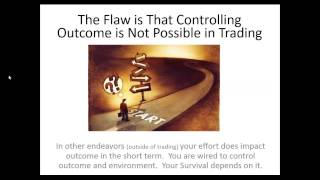
Do you have any control over that? No. Are you gonna lose today? You don't have any control over that either. There's. There's certainly traders have to deal with a lot of losing, though. Are you going to control what the markets are going to do? No. So you begin to see, oh, my God, there's something wrong here with what I'm bringing and ultimately what it really comes down to, think about this, okay, you have this idea, I'm going to go try, you try, you do. You do it again and again and again. You keep doing it, you keep doing it, you keep doing it and that produces success. That's part of the success mindset. And my question is that working for you in trading, okay, you get caught up in it and you have this idea, the self image of yourself as a winning, I've got a winning mind, I'm going to do this thing. And part of that is doing and doing and doing and not giving up. And you'll finally get to this success. I can't tell you how many people I work with that have great knowledge of trading. They just can't apply it in the heat of trading. And they keep doing it, they keep doing it, can keep doing it. And they keep expecting if I just do it more, I'm finally going to win, it's finally going to prevail. And yet no matter how hard they try, it just keeps on, you know. And yet they have been successful with the same thing of just never giving up and pushing through obstacles. Here they are and they just want to have the same thing. But the key is this, my friends. This is the tragic flaw.
In the winning tradition that set persistence, staying locked into a mindset when outcome is impossible, controlling outcome is impossible. Remember the whole thing about this, this thing is that you can control outcome.
Yet when you get to trading, you discover that controlling outcome, it's an illusion. And yet you keep trying, you keep trying, you keep trying. Okay, ultimately.
You know something. Did it work with Saber two tigers? Yeah, no problem. Did it work with woolly mammoths? Yeah, no problem. Few more dead probably yet. The thing is, is that you come in, you're wired for this, you're wired to take on the markets and you start applying the same thing to the markets. And it doesn't work. Because ultimately what we've got here is this is this whole Seth image of being a winner comes into conflict with results. You're thinking I'm going to bang this thing out. And it's the rub. You're very self image coming out of this competitive environment locks you into poor performances. As long as you have this attitude that's projected in this image, you're gonna have a really hard time in trading because what happens is that you're not going to learn, you're not going to begin to recognize one great truth. What is the trading account telling me? Should I be examining the very Mind that I'm bringing into the performance of trading. Okay. If I have a methodology that works. What's going on? So here we go. This is, you know, if you, if you know Kareem Abdul Jabarri, you realize he's one of the greatest basketballs ever. And he's making a quote here. You can't win unless you learn how to lose. Oh, my gosh, I hate losing. I just hate losing. And yet what you're having is one of the greatest athletes of all time is saying, you better get used to losing because you can't learn how to win unless you know how to lose. It's not just feeling shame and stuff like that. When you lose, what you're looking is you're exploring what really happened there and you're growing from the loss. So what happens is that we actually want to become really good losers. Doesn't that sound so grating to a winner's mindset? I have to learn how to lose. Well, okay. And we fight it. Yet great traders are very good losers. They're not foolish enough to try to compete with the market. Instead, what they're doing is they're learning how to minimize losses when they're wrong. Okay. As a, as a way of winning. And I'd like to tell you a story here. It's.
At the end of the, toward the end of the Vietnam War, American negotiators and Viet Cong negotiators were talking with one another and they were negotiating. And this one American general was talking to his counterpart with the Viet Cong. And the general, the American general looked at the other general and said something. He said, you never won a battle. You never won a battle. And the Viet Cong general looked at him and said, that's irrelevant. We won the war.
There's great wisdom in what that Viet Cong general said. And the lack of the arrogance, the arrogance of the American who didn't realize that the Viet Cong weren't looking at winning battles. They were looking at much longer. And they were looking at something on a different probability scale winning the war. And they did. So we're looking at that and we're going, okay.
What we now know is this, is that particularly with Alphas, they want to make things happen. It's one of those things that all those Alphas who have produced success in business and corporate world have to learn a completely new way of interacting with the markets. It's just not about making things happen. It's about listening to what the market will give. What you see with, particularly with Alpha type folk Is that they want to. They want to make things happen. And what they do is you got to be doing something to be doing something. How can you win if you're not doing something? I'd rather be doing something than just sitting here. Yet what they discover, they end up chasing trades and they end up impulsive trades. They over trade, then they revenge trade and they blow up big chunks of cash.
So what we're doing is we're saying, yeah, it was luck. There's nothing wrong with that mindset. It's just that it's not an effective mindset in trading. We need to relook at this thing. So now. So let's take it. Let's take a step further.
What we really are looking for.
The surfer takes from the ocean what the ocean will give us. Sometime it's not very pretty. Like over in the left, you know, he's getting popped up pretty good. And what you do is you minimize that loss so that you can surf another day. Does it sound like trading? Yes, it does. Then every once in a while, the ocean gives you the ride of your lifetime. And what you look at this. Do you think this surfer in here is being euphoric or he's scared? No, what he is, is. He is in the midst of the moment of that. He's taking what the ocean will give him the same way a trader takes what the markets will give him. And sometimes he has to be prepared for losses and minimize those. And he has to be prepared for the moment where things go his way and he takes advantage of it. This is a lot like trading. But what I want you to see, this surfer is not controlling outcome.
He is not controlling outcome. What he recognizes in the vastness of that wave that that guy's coming through that tunnel in. He has zero control over it. However, what he has is control over himself. That's the piece I want you to get. And here's the deal with traders, particularly the ones that come out of Alpha presentations.
They have been.
A very big fish.
In a small pond. They were actually able to influence the environment they were in and actually influence greatly what happened. Okay.
Suddenly the person who is used, and also, let's say the species that's used to having this kind of control suddenly is forced into another environment where literally he's become a minnow in a vast ocean. What you discover is that he no longer is a big fish in a small pond. What he is, is he's a little minnow in a vast ocean. Completely different perspectives. Okay, so this is what we're the real question is, are you willing to adapt rather than stick to this persistence? Are you listening, can you listen to the, to the trading account and say, you know, something is trying to tell me if I only had the ears to listen. And so now what we're doing is we're going, okay.
We know that we've been maybe big fish in a small pond and we actually were able to influence outcome in that old environment. But in this new environment of trading, that's not so it has different rules and we need to learn to live in those rules of that environment if we wish to thrive, if we wish to survive and not become extinguished. So and that's not, unfortunately that's not what the problem. You know, this is one of my favorite Zen Buddhist guys and I want you to listen to what he's saying. People have a hard time letting go of their suffering and yet there's a lot of suffering going on in trading. I mean you hear people take losses, oh this is, you just hear the suffering. But then out of fear, the unknown, they prefer the suffering they know that's familiar than to change. That's human trait. And this can be very much locked in, it can become locked into this winning attitude that I'm asking you to question. Because ultimately what we're trying to do is we're trying to build a probability baseline, right. Rather than maintain the certainty based mind that you came to trading with. That's the big deal. And I want to give you an example. This is really about the alpha who learned something. Is a couple years ago I was working with a very successful serial entrepreneur. Literally when he graduated from college, just as a kid, he sold a bar business for $500,000. That got him started. He started that bar business even before he was 21. And over the time he had owned and built a number of very successful businesses. At one time he and his partners had sold a concern and it was an all cash deal and they had a lot of loot hanging around. And then he started talking to his brother about trading. And what Matt discovered is that. Oh, I see now is that trading is a capital intensive industry. Well, I've got a lot of capital, so what I'm going to do is learn how to be successful in this business. And then after I learn how to do it, I'll bring my partners in and we've got the capital. This is going to be a fun thing. This can be like everything else I've done. Three years later, he was not successful.
In his work with me, he actually became successful.
He had three to four months of, you know, steadily increasing profits. And then with hit one, he came to me and said, Randy, the best money I've ever spent is with you because I've discovered something. And I said, what's that, Matt? He said, I'm not a trader and I don't want to become one. I like control.
What Matt did is he got out of trading, he went back into finding businesses and building businesses and selling them for a lot more than he, he bought them. And that' doing now. But what he did is he discovered that he was not willing to redesign the mine for trading. And what he did is he said, okay, I still have a lot of capital and I'm going to go and I'm going to use it a different way. So what I'm asking you is this.
The only real question is how much suffering do you have to experience in lost money, wasted time and aggravation before you adapt to this new environment? Or do you dare, do you keep on, keep on, keep on and go down with the Titanic? Because clearly the markets will let you do that. And a lot of professional traders that make really good money really want you not to change because it's highly profitable for them for you not to change. Okay? And ultimately.
Whether or not.
It'S alphas trying to make things happen or fear based traders trying not to lose, it is driven by the fear of the unknown. Understand it's in our ethos to, to try to control the unknown, to predict the unknown, to, to control the environment, to control the outcome. We come from a dangerous world just 150 generations ago, okay. To be successful in trading requires a new order of understanding. It requires you to understand your fears. It also requires your sense of urgency, your sense of like, you know, I'm getting, I'm getting hyped up, I want to win that need to win. It also say what's behind that and it also is about learning to be what's behind that need to control. Otherwise, just like this slide says bang head here, you can do that for as long as you want and it will let you. The whole notion of being competitive and trying to beat something is going to be a problem in trading. The markets don't care if you're competitive and who are you as a minnow to compete with the vast ocean. What happens is it's a much more humbling experience. It's much more about, well, I can't force the markets to do anything, but if I, if I change my attitude, I can Start developing a sense of what is it really willing to give me. Completely different attitude, okay? If you come to that moment, okay, the question really comes is how do you develop a probability based mind? Even if you wanted to, how would you do it? Okay, you're going to have to rebuild the mind to work in this new environment. And that's what I want you to understand. There's nothing wrong with the mind that you used to have, okay? But the problem is that mind doesn't work in this new world. And ultimately what you discover is that you have to re change it. Because ultimately.
You cannot control the markets, but you can control yourself. That's the big deal. Okay? And with traders, they want to win, they can't control that. They want to make money, they can't control that. They can control literally the mind they bring into a moment of performance. And friends, that's the edge. Because if you have a methodology that gives you an edge in probability in the markets, your job then is to develop a psychology that can drive that edge so that it extracts capital out of the markets. So.
What we're doing is, we're saying, how do you do that? Well, the way I teach it is it starts by becoming, start developing your emotional intelligence. Begin to understand what emotions are, okay, and what they're not and that there is no freedom from emotions or freedom of emotion. And then what you have to have to learn. And by the way, freedoms are all about act. I mean emotions are all about action. And the emotion happens in milliseconds, whereas your thought about that emotion happens half a second later. Who do you think is going to win? And also the emotion is far stronger than the thought.
The second thing is what we teach is that you're going to have to learn how to regulate emotions in emotional regulations. What you discover emotions are biological, they're not psychological, they take over your psychology. And what you have to learn is that there's no avoidance of emotion. What there is, is there actually is working with the emotion, discovering first of all managing the intensity, the emotion. And that's not ignoring and denying them. It's like going, well, emotions, if I know that they're biological action potentials that basically coordinate the action between environment and organism and the market and you or the, the environment and the organism is you realize, okay, I have to control that intensity because once it fires, it's going to produce action. You'll see that every day. If you, if you can't pull the trigger, you're seeing that, you're seeing the emotion of anxiety Trigger. And what it's doing, it's a coordinated activity between you and the environment. And what it's saying is that you're going to lose. I'm going to stop you from getting in. It may be that when you get into trades and it goes against you that you get really angry, get scared and all that kind of stuff. And suddenly the emotion triggers and you get angry and you start throwing good money after bad. Then you get really pissed off and you start revenge trading. And before you know it, you've blown up your whole day. Okay? Those are emotions. That's the emotion. Getting there first, thought showing up later. And the whole key is this is so powerful, friends. I teach it as the way a person breathes. When you see the emotion, understanding, it's biological. You discover that your heart rate, you discover that the tension in your body, you discover that your breath, it's all about the emotion. Tomorrow you start watching yourself trade and you discover that, wow, you know something? I'm holding my breath, I'm tense all over. And what you're beginning to go is take the first step, regulate that emotion before it jumps all over you. And it is going to jump over you if you don't. If you don't regulate it. Okay? That's the first thing that I teach.
And what most people discover is that they have not had a chance. They got the right mind, they've got great knowledge and they want to win, but emotionally they're not. They don't know how to manage the emotion and they're blown out of the water before they even started. That's the first thing that you got to do. The second thing that has to happen, at least in the way I teach it, is you have to develop the capacity for mindfulness. I get a lot of comments about this image because what happens is most traitors, when they acknowledge it, their mind is full of bunch of junk about what could happen, about what happened in the past, blah, blah, blah. But what happens is that their mind is not like that dog, that the mind is not in the moment, okay? And in mindfulness, one of the powerful things you learn about brain and mind is that you and your thoughts are not the same. You and your beliefs are not the same. The truth is, these are not even your thoughts and beliefs. They're having you. They come out of your history. They were already wound into you before you knew what was happening. And they are incredibly primitive and they are happening to you before you can think. You can say, I know what to do, but I just can't do it. And that's exactly because you don't understand the emotion and you don't understand the belief within that emotion. And with mindfulness, as you develop it, and by the way, mindfulness is a sense of stepping back out of thought, and you start noticing that your thought and your. The awareness are separate from one another. And you can actually slow it down. You can watch thought arise. You can see it to have a life and then recede back down if you as a witness or observer don't fuse to that thing. And what happens is most traders are so clueless the beginning that they don't even know that their future, their observer, is there and that the observer is frozen thought streams. They're just being drifting in a shipwreck. Powerful need, because without it, it's the detective tool. It's the detective tool because once you develop mindfulness, you come to the door of the mind and you can open it. You can start looking in, and you can actually see what's driving mind. And it's not that hard, really. You know, it's. It's not that hard. Once you understand the primitive brain, it's just not that hard because the reasonable brain really doesn't have much say. So in all this stuff, it's all decided, and the reason and logic are producing explanations. Okay, so we got the mindfulness thing, and you develop that. And we have very specialized ways of developing it. And what you ultimately discover is the mindset as you understand it has been basically, it was fixed long before you could think for yourself and before you came to trading. And with mindfulness, what you begin to do is you begin to observe it as something malleable. There is no permanent me sitting around there. Like, what happens is you realize, oh, you know, in this. On the left side, what you see is on this program that happens before you discover. There's a lot of influences in your brain during your formative period that form you into this winning notion about what it takes to be a winner. Okay? And then on the left side, you start seeing all that gobbledygook. And in mindfulness, what you begin to do is you start waking up the observer and you start realizing, I can make sense out of this and I can start managing the emotional programs that are giving rise to my thinking that friends is a big, huge thing. Because what you realize is that your brain is constructing an organization of the self that's adaptive to environment. That's the one you bring to the game of trading, and it's not the one that works in probability management, it works in certainty management, certainty of survival. So then we go, okay, and what we understand is the primitive thing is this, this image shows you a lot of what is going on in your brain, in your mind when you're trading. You look at these guys right here, they're, they're, they're dealing with a bear that's probably coming to attack their clan. They're putting their lives right on the line and they've got those, what, six foot stuff and they're dealing with a 12, 1300 pound bear with big old like, with like massive claws. You know that they're scared, you know that they have to regulate that. You know, they have to find the courage, you know, they have to find the discipline, you know, they have to recognize I have to do this. Otherwise what happens if it gets to my clan? We have a very serious problem. So you're looking at it and you're going, wow. When you feel fear of loss or that excitement of I'm going to chase prey, this is what your emotional brain is into. It's not looking at a bunch of charts and little gibberish on it. It's looking at survival instinct friends, okay? And it's much faster than thought. It's lightning, understand? Information is coming in through the, to the brain stem. It hits the amygdala, it hits the hippocampus, it makes the decision where it's going to react even before thought, which means you're already behaving before you think.
Or whether or not it should be sent up to the thinking areas of the brain and everything hashed out. These guys, it didn't get, this took the low road, they're reactive, they, that's what's happening to you. And anytime that and the emotional brain is not going to be able to tell the difference between biological threat like this and psychological discomfort. Oh my God, I'm risking this capital and what if I lose it? Psychological discomfort, can't tell the difference until you can regulate this and say, wow, that fear and that fear that drives all this stuff is what I call orphan, okay? Orphan is your fears. And we kind of give it a name, we give it a Persona so that you can talk to it and calm it down. But you're going to have to, you're going to have to calm it down physically and you have to calm it down mentally because ultimately what you discover in the mind, you are always hearing these emotional programs that form you because in the brain they're emotional programs. But what happens is they show up these Emotional programs show up as thoughts in your mind. So you realize that there's been a highly competitive thing about.
Who controls the committee of the mind, who controls that mind of yours. And it's a group of emotional programs. And in this particular image, what you're looking at is you're seeing someone being controlled by probably criticism, by judgment. And what if you go in and there's a voice in the back of your head saying, you're going to lose, you're going to lose, you're just not confident you're not going to lose, what do you think is going to happen? You know, the thing is, if you don't know how to deal with that and say, well, I'm just going to tough it out. You're not going to tough it out. Remember, the emotional brain is far more powerful, far quicker, and takes over thought. The deal is it's going to trigger to fight flight unless you do something else. And we call this the inner critic and the orphan. The. The inner critic is that part of you that wails on you, that criticizes you, judges you, beats you up. And the other voice, fear, is like, oh, my God. Oh, my God, how am I going to make it? How am I going to make it? What am I? What am I? Who thought. Who said I could trade? These are not you. These are a particular construction of a self in your mind.
That got laid down to programming before you could think for yourself. And ultimately.
Ultimately, this is the roller coaster ride. Okay? If you're mindless, this thing on the, on the left side, the cycle of market emotions, how many of you fell into this thing? Oh, yeah, yeah, yeah, I'm good to go. Yes. I've got some excitement. Yeah, yeah, yeah. I'm a little fear and I'm ready to go. And I get kind of that euphoric stuff. And what happens is that, wow, man, I'm really smart. I've won something. I'm really gotten euphoric. And all of a sudden you start making really dumb, stupid mistakes because you're buying high. And then you start realizing and going, oh, my God. Then you start hitting this whole cycle of anxiety and just moving down to fear and then desperation and panic and just having all this stuff. And that's when you sell, okay. And then you start coming out. You got the depression. Hope starts and relief starts coming, and maybe you cycle back into optimism if you've got this winning attitude business going on rather than learning. That roller coaster right there has been going on forever. It's been going on since time Immortal. And that's what your brain's going to do if you leave it to its own devices. And then you have one of the richest people in the world who says a person who cannot manage their emotions cannot manage their money. So there you go. So what we want to do.
Is we want to intentionally develop other emotional programs to engage the uncertainty of the markets other than the ones that you arrived with. That's what we want, friends. That's how you produce success. So ultimately what I want you to do.
As soon as this slide changes, this guy, do you think he's thinking about the future? Do you think he's thinking about the past? No, he's totally in the more he's in performance mind. He's in that moment right then and there, okay? Our brain is built to be negative, okay? To interpret negatively. Yet in flow performances like what this guy is doing, the mind is in disciplined, it's patient, it's focused and ready to engage the moment. This is what my traders, my work with traders.
This is what I teach you how to do. Because ultimately this is a performance.
And what you're doing is you're learning how to build a performance mind that manages your methodology. And you stay in the moment of performance. You're not thinking about, you're not looking at your P and L statement, you're not thinking about winning or losing. Everything's focused on performance. That friends, is.
Yeah, like, like a great athlete, like this guy, like great traders, I might add. Okay? So.
The truth is, is that it's a, this is a slightly specialized part of my work where what you do is you, you start really realizing that you don't have freedom from emotion, but you do have freedom of emotion. You can train yourself literally when you walk into this uncertainty, you know, this probability world, what you can do is you can actually train the particular emotions that allow you to interpret the markets. Ultimately everybody has a little projector that they're watching in the back of their mind. What happens is you need to become the owner of that projector. You need to be able to develop the emotional cocktail that allows you to maintain order, okay? To be able to produce and activate emotions that allow you to have a disciplined, courageous, self soothing or patient mind that's impartial, that can be taught. Isn't that a wonderful thing? The deal.
When you do that, it changes everything because ultimately you end up with a very different possibility and potentiality in your trading. You're not seeing through the eyes of enthusiasm, you're not seeing through the eyes of excitement. Euphoria or fear, you're seeing through the eyes of discipline, impartiality. That friends, is where it's all about performance, it's not about outcome. And again, I actually use process called emotional enrichment. Where we actually go into where you have experienced these emotions. And what we do is we deconstruct the memory and reorganize how it actually presented itself so that you actually have confidence that yes, it did happen under stress. It's not visualization where you're hoping to be able to convince your subconscious that, that you can perform this way. No, you're going back and saying, no, dude, it really happened. And what I now know how to do is I know how to pull that emotion up into working mind. That's a big difference than hoping that the mind can pull it up. Actually knowing how to pull the emotion up, that creates a certain kind of thinking.
And we call it emotional enrichment. That's what you learn. And ultimately what happens here.
This is what, if you take a look at this image, this is what a peak performance mine looks like in action. You know, these guys got things going on in this sailboat. And what you're noticing in order to get balance, you're seeing everybody, you're saying the, you're seeing that the captain of that ship, he's got everybody leaning in a different direction to be able to counterbalance it. And what you're looking at going, if they're not do things right, it's the ship's gonna.
It'S gonna have a problem. The thing is, is what you discover is these guys are in a stressful situation, but the way they have generated the emotions to be in that is that stress is performance. It's not about oh shit, what's gonna happen. It's more about this is the performance right here, right now. This is where we're dancing with this moment. That's what you ultimately need to learn how to do. And that's what we teach. The truth is that the challenges of uncertainty just simply never change. It's what the mind, the structure of your mind, not the one you came with friends, the one that you built specifically for probability management. What you realize is that you brought a mind, no matter how good it was, for certainty trying to control outcome. And you're saying that just doesn't work in the size of the markets. It's a different environment, It's a probability based mind. I have to build it. And yes, I know how to teach you how to do that. Okay.
And.
Truly what happens is that you learn to turn toward your dragons and your demons that have been stalking you. You know, the thing is you can ignore them and keep away from them in most of your life. But what you discover very quickly in trading those dragons and demons, they're stalking you. And what you learn to do is say, well, the truth is I no longer fear fear. I actually turn toward my fear, my discomfort, because I know that it's becoming my teacher now. It teaches me what I need to know about myself to manage uncertainty. I wouldn't necessarily say your dragons become your friends, but what happens is they become your teachers. Maybe ones that you don't want around all the time. But this is the probability based mind where you realize that no, I'm not running for my life, that's not a saber tooth tiger. What happens is that there's something that does not fit my self image and I want to avoid it because it's not consistent with that self image. And what you're doing is saying, no, I need to turn toward that because it's limiting my ability as a trader. And you learn how to master what's at the core of the discomfort. And when you do that, what you discover is this, is that.
These internal emotional programs.
What you discover in the miracle called mind, they take on images at the level of brain, it's just electrical, bioelectrical stuff going through neurons. But in the level of the mind, suddenly all this stuff given symbol, symbolic representation. And suddenly what you discover.
Is that you have learned to produce the courage of a warrior. You have learned to produce the discipline of a ruler. Understand, George Washington really had his work cut out for him. He was not a really trained military guy, but he knew how to lead people and people had faith in him. If you've ever seen the painting of Crossing the Delaware, you see the power of George Washington to lead people. He was able to maintain order under pressure. What you also see is that you have a working self soothing a caregiver where you're not trying to shout down or embarrass your fear. What you're doing is you're calming it down, you're soothing it and you're nurturing it. And out of that you're no longer triggering your emotional brain or your amygdala to and taking over mine. What you're doing is you're calming it down so that this impartiality, this very crisp, logical thinking of a sage could show up, can actually do your trading plan, can dance with your methodology, can dance with your rules, and you end up going, well I hear my rules and I followed my rules. And that's the performance. That's how I measure success in trading. I measure it by did I perform well? Not did I win this trade, but did I perform well. If you have a methodology that does extract capital, like in simulation, you build the mind so that you do it when you're risking capital. That's how you do it. Just about everybody can learn to do that. And ultimately it's what's going to have to happen.
You can stick with your winning ways. Understand there's nothing wrong with your old ways, that the way that brain and mind built success.
But it was based on the principles of control of outcome. Just like the guy that I told you about, the serial successful entrepreneur. He finally came to the moment. What he realized is that he didn't want to give up control over outcome. Okay? And what he decided is that he understood that in order to become a successful trader, he was going to have to let go of control over outcome and he wasn't willing to do it. And I've had another really good trader, when I was talking to about this very guy, said, you know, it's just a waste for a perfectly good entrepreneur to become a trader. That's just a waste. You know, the way they think is really good for entrepreneur, but it's terrible for trading. Why would any good entrepreneur want to do that? And I've come to really understand what he's saying and appreciate it. The key is you really truly have to want to produce success in training. You have to be fascinated by it to the point where you're willing to give up the old certainty based mind that you came with both by biology and socialization for psychology and say, I need to develop a probability based mind, it can be done. These traits right here, these emotional traits can be brought forward and literally you can learn how to inject them into uncertainty. And it produces a completely different way of being in the world. It produces the probability baseline. Now how do you become this change? Well, friends, there are several different ways. First of all, if you're not acquainted with my work, get my book, get some of the free stuff, read the articles, watch the videos. There's hours and hours and hours of content that you can get through my website, get really into this and recognize this is what you're going to have to do in order to become a successful trader. But when you come to the moment where you bought the book, got the guided meditations and you're still looking around saying, the truth is I need help, I Need help developing this thing, which you do. Okay. There's two major ways. The individual course is a highly comprehensive, highly personal course where you own the materials and you and I meet individually ten times over the course of three or four months together. Okay. And it is there by Skype. Okay. So we're literally, we're looking at each other, we're talking with one another, we're listening to one another, and it's a journey. And what you have is you have a personalized coach, performance coach working with you to dig and to dig and to dig and to get in there. It's a powerful course. The group course was developed a few years ago when a number of trader trainers says, Randy, we really want our people to get exposed to this work and start really developing some tools, but they just can't afford take your individual course. And so we developed a group course where people come together and it's a virtual classroom where you go to the virtual classroom, you study what's in that classroom, you start applying it in your trading, and it teaches the same basic skills that the individual course does. And it includes five group sessions with me. Okay. It's in a webinar floor mat. We go over. And literally what you discover is this is a process I teach. I mean, you literally go from emotional regulation to mindfulness, to the internal dialogue, to awakening the power within you, dealing with the internal struggle, intentionality, and then developing a trading plan, a psychological trading plan. It follows the process so that when you walk out of it, you have the tools to develop. And maybe you're not completely there, but boy, you're a long ways where you are. It's also the classrooms open 247 and a lot of people actually take it. And by the way, we're having a class start in June, so put it on calendars. The thing is, is that it is far and people, a lot of people take it as a self study because, you know, it also comes with recordings of the, of the classes and stuff like that. And because of the. There's just lots of, I mean, you know, it's not unusual to have someone from Australia, someone from California, someone from New York, and then people from UK in a class and poof, that's a lot of time zone. So anyway, those are the two major pieces that we talk about. And if you're really serious about it and you're going, you know something I need, I want to talk with Randy. I want to see, I want to get a feel of him. Is he trustworthy? Can, you know, is he the guy who can help me or not? I invite that. I don't blame you for being hesitant. I skeptical. I invite you for a free consult. You just go to our website and you'll see. Contact us and just ask for a free consult. And Dolores will find a time that we can work and we'll talk and we'll dig down and we'll see whether or not this work would be good for you or bad for you or whether or not this is something that you're ready to do. Okay. So anyway, I want to thank you for this time and if you have questions, please type them in. And here's. This is from Guy. So, Randy, are you saying that self affirmations of self belief and visualizing success can have a strong negative effect on my trading mind, so the conditioning of a winning attitude will go against me? No, that's not exactly what I'm saying. Darn good question, Guy. What I'm saying is this. There is a major mistake that is made in the use of visualizations and affirmations. What you're. It is wishing something would happen. And you're sitting there and you're going, but do I really have the skills? I know and I actually saw this with some, some Olympic folks last time I was watching and these two women were in a toboggan, what do you call those? Slouch loosh. And what they were doing is they were, they were making mistakes and they were these, they had, these been, had been in track before and they had aged out of track. So these people had had all the sports psychology that the world's ever known. And well, we'll just do visualization. We'll get past those particular mistakes. They came out, did the same dang thing over and over again and they didn't even place. Okay, the deal is, is that visualization. I use visualization. It's not like I don't use it. I use affirmations. But what I do is I actually use actual experience.
To root that visualization and root that affirmation in. I'm not producing, I'm not asking a person to start wishing they were thinking that way and visualizing them. I'm going to show them that we can reconstruct memories and, and that they in fact have already performed that way. And I can teach them how to be able to find the emotional mind that creates the performance mind. That's what I'm saying. Ultimately what happens with a lot of people, they will use that and they will visualize. Visualize and then they Go in and think they're a winner. They get into trading, they get traumatized and they end up. Then they end up really spooked. That happens a lot. I see it every day. So that's what I was really meant to.
Do. You speak. Oh.
When we study and practice trading, we program the subconscious part of our brain. Now when we focus, concentrate on the presence in the conscious mind, so called occupy mind and out control of destruction. And cut. Control of destruction. Does subconscious mind take over? Now this is. I don't operate with this language. Okay, I know there's a lot of stuff where you're programming the subconscious mind and stuff like that. There's a lot of hypnosis, There's a lot of stuff. I work on a framework of emotional intelligence. What we're doing is there's nothing unconscious. I can tell you right now there's four self loving beliefs that drive trading. There. It's no rocket science. It's a sense of inadequacy. It's a sense of not mattering. It's a sense of being worth less than and a sense of powerlessness. If you're human, those are in you. What we're doing is we're looking in your performances and we're finding which ones match up with your performances. That's generating the problems. What you're programming is you're going right into the fear. You're not programming something on a subconscious level. You're going directly into it. Now does. Are there things out of awareness of your mind? Yes, there are. You pushed them out. When you talk subconscious to me, you're talking brain stem and you're talking about emotional brain where you know, basically it's reactive in nature and there is just enormous amounts of activity we're doing that are an automatic. What you're calling subconscious, I'm talking about as an automatic mind. And I'm. Like I said, I'm coming out of. I'm not coming out of new age. I'm coming out of emotional intelligence. But it's not. It's. What you're doing is you're just not going to repeat something. Repeat something, repeat something and change a core belief.
You're not going to do it. It sells a lot of stuff. The secret sold a lot of stuff. But the thing is, is what you get around those people and you discover is they're selling merchandise. People don't really change. They keep it up because it makes them feel good. It's the same thing that with Alphas who have done very, very well with their Strategy of success mind. And they get into trading and blow it up. I mean, I've seen people blow literally four or five million dollars. And they have this positive. They have all the visualizations, have all that stuff. And they can't understand why they haven't reprogrammed their subconscious mind. It's because they weren't looking at the amygdala, they weren't looking at. At the hippocampus. They weren't looking about the brain. The emotional programs that give rise to mind. And the thing is, I'm working directly with that. And ultimately I'm. What you might call subconscious is what I would call orphan. Okay. Orphan.
Would be your amygdala. And it will have core beliefs about your ability to manage uncertainty. And those don't have to stay unconscious. Those can become. You can become very aware of them and you can learn how to recode them, but you recode them emotionally. You approach them through compassion, not through mind thing. So anyway, sorry about that, but that's just one of those things. Can you suggest any books on this theme?
Trader Psychology.
Emotional. Daniel Goldman has written the gold standard on emotional intelligence.
Eagleman, if you want to get into the neuroscience of it, Eagleman is. I think it's. Daniel Eagleman is one of the. David Eagleman.
Incognito, will give you an enormous thing. If you read Blink by Gladwell, you'll get the idea. You'll see all this stuff working in the background.
There is another one that I would really suggest also.
Jill Bolt Taylor is a neuroscientist. Well, what used to be a neuroscientist from Harvard, who has written a book call A Stroke of Insight. And she was a neuroscientist studying strokes. And she had a stroke. And she's showing you.
From the inside out what a stroke does, knocking out the left brain and what the right brain perceives as the emotional brain perceives that. Those would be really good starts. I would also really suggest mindful training. My book, because it really, you know, I'm writing one specifically. I'm taking neural science and I'm taking attachment theory, and I'm weaving it into a narrative about trading. It's a very powerful thing. But ultimately.
Trading in the Zone by Mark Douglas is a great book. It really is.
Fundamentally what most people say is that Mark Douglas does a very good job of telling you what the mind needs to look like, but he doesn't know how to teach you how to build the mind to do what he talks about. And that's a fair Criticism. And it just so happens I teach how to build that mind. Okay. And loved your book. Thank you. An absolutely wonderful webinar. Randy, if I wanted to consult, is this done in person or over the Internet? Cause I'm from South Africa. Well, no, it's done on the Internet. It's done by Skype. And as a matter of fact, I just had a. I had a Skype conversation with a guy from South Africa. We had a little bit of problem with the Skype connection and he finally acknowledged that South Africa has bad Internet problems. But. But yeah, what we would do is you would just hit the contact us. Dolores is just really good at, you know, taking global time zones and finding out a way for us to match up and be able to talk with one another. And she's already done it with people in South Africa, so I know we can do that. I'd love to talk to you. Okay. That's it, folks. I really. And thank you for the person who said, really wonderful book. If you're going to read Neurobiology and if you're going to read really How Attachment, how the Brain Organizes into a Mind.
My book is Mindful Trading. So anyway. And you can only get it on my website. Okay. So anyway, I thank all of you. This has been fun for me. And I'll tell you something. I really hope you get it. There's nothing wrong with your mind. It's just been built and adapted to do another function other than probability based thinking. Okay. And it does take work, it does take effort to go in and really understand the dynamics of the fight flight response that your emotional brain tends to have. Okay. And to be able to retrain it so that it trusts higher brain function and you literally can keep it calm when there's uncertainty there. Okay. So anyway, I thank you very much. It's been my pleasure. And I wish the best for each of you and every way in your life. Thank you. Good evening.









