How to Avoid Hesitation as a Trader
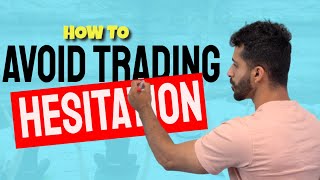
Kardec Trader explains why traders hesitate and how to fix it: start with smaller position sizes like $50 or $100 instead of $200 to lower the psychological sting of losses, track 10 trades to prove your strategy works, then gradually scale back up. A 40-50% win rate with proper risk management is the target.
Chapters
So as a trader, we hesitate a lot when it comes to trading. Now, the reason we hesitate is because of our lack of confidence, right? So, for example, this is something that you guys are probably familiar with when you see a chart and when you see a starting play. So let's say a stock is kind of breaking out of this key level. Let's say this key level is 70 bucks. Now, when this stock gets to 70 bucks, and you tell yourself, hey, whenever this stock gets to this critical point, I, I am going to enter because this is my setup, these are my entry signals and so on. But what tends to happen is the moment the Stock gets to 70, or let's say it breaks out of your key zone that you are so focused on, you don't execute and you don't follow your plan and you hesitate on this trade. And because of hesitation, you're missing out on a lot of money and you're kind of disrupting your whole PL for trading. Now, in this video, we're gonna break that down and we're gonna understand how to overcome that and how to position yourself in the right direction to actually avoid hesitation and overcome it the right way.
Now, the way to avoid hesitation is, number one, you wanna size down, right? You wanna build confidence. And the way to build confidence is sizing down. So this is what I mean by sizing down. So let's say right now your max risk amount is $200 per trade, right? So this is your risk amount per trade. Now, obviously, depending on your account size and depending on how you're trading and so on, you should understand your risk amount. Now, everyone is gonna have a different risk amount. And if you're unfamiliar with risk amount and how to calculate the proper risk management strategies, I have a video on it. I am going to post link around this video. Just click on it, go to the risk management video and check it out because that's gonna break down how to apply proper risk management as a trader. Now, going back to this $200 per trade, let's say, is your average risk amount. So what I would do is I would size down. So Instead of risking $200 per trade, I would now cut down by half or 14 or even 1/3. Meaning that if I'm risking $200 per trade, I'll say, you know what, I'll risk $100 per trade or I'll even risk $50 per trade. Now, the idea of reducing risk or downsizing on my play is now I want to focus on building confidence. So now my focus becomes on building confidence by taking trades and not allowing my emotions to take over. So, for example, right? On a normal trade, you're hesitating, right? Because you don't know if the stock's gonna keep going higher. So, like the example I gave earlier, let's say $70. You said, I'm gonna get into stock if it breaks 70, and when it does, you hesitate, right? That's because, like I said, you lack confidence. You're not sure, and you don't want to lose money. So in your head, you go, oh, my God, if I get in at 70 and the stock goes down or the play goes against me, I'm gonna lose $100. I'm gonna lose $200. So mentally, you're not okay with that loss amount. Right? And I get it. Everyone hates losing money. But you guys gotta understand, as traders, you're gonna lose money, it's okay. It's gonna happen as long as it's part of your plan, as long as it's managed and controlled risk. Right? Which is why I said, go check out the risk management video if you are having problems with management managing risk or knowing how to properly position size. Right? Now, if you cut this by half, let's say instead of 200, it's 50, you kind of reduce that fear of losing a lot of money or losing a good amount of money. So now, technically, if you're wrong, once, you lose 200, but now if you take four trades, you're gonna lose the same amount, avoiding commissions and fees, right? So what that allows you to do, it allows you to test the waters more, build confidence to see if you're right or wrong, and kind of figure yourself out, Right? Understand? Okay, I'm trading breakouts. When is the best time to trade breakouts? When is not the best time to trade breakouts? What other factors do I have to look at? So you're able to experiment the strategy, risking less money and still be in the game. And that's what you want to do. Now, when you do that over and over again, you tend to build confidence, obviously, if you're right. So think about this, right? Let's say you take this trade and you're not focused on, you know, being right or wrong. You're just focused on the trade you size down. Now, when you size down, that fear of like, oh, my God, I'm gonna lose $200 is eliminated. Now it's a much smaller amount, which you're not gonna care about as much as you would with 200 or your original position size so your execution, in my opinion, becomes a lot cleaner and faster because that weight on your brain kind of gets eliminated. So when that gets eliminated, your execution, right, gets a lot faster. There's no hesitation at this point. Now, what that allows you to see is now let's say out of 10 trades. And guys, you should always be tracking your trades and always monitoring each trade. So if I was to go back and ask you this question, you should know each one of your breakout trades. How well they did, how bad they did, what you could improve on, your max loss amount, risk amount, all these things. You should always measure your trade metrics. So let's say you take 10 trades. Out of those 10 trades, you're right six times and you're wrong four times, right? Since you're wrong four times, right, let's say on each time you're wrong, you lose about $40. And each time you're right, you make about $100, right? Now this, in my opinion so far looks good, right? And I'm gonna see where, I'm gonna explain to you where I'm trying to go with this. Now, in this situation, on a span of 10 trades with Proper Risk Management, you made $600 and you lost about $160, right? So since you lost about $160, what does that bring your total P and l from making 600 and losing 160, this brings you at $340 green. So basically in this trade, you're still green. Now the idea here is now you know that your breakouts work, right? You're trading the right strategy, you're looking at the right elements, everything is working well. Now is where you can take that $50 max loss amount and increase it to 100, right? You can increase your position size. And now let's just say hypothetically, you were trading 10 contracts or 10 shares. Now you can go to 20 contracts or 20 shares, right? You do that again, you track it again and you see how is your consistency building? How is your trading building? Now if that keeps building up and you're still around, in my opinion, 40 to 50% win percentage, meaning you're right four to five times out of 10 times with probably proper risk management, slowly increase your risk to the proper risk management amount, and then at that point that hesitation will slowly pull away. Because now you understand the game, right? And understanding the game, in my opinion is knowing to have proper risk management and having a solid win to lose percentage, right? 40 to 50%, in my opinion is fair. Meaning you're right four out of ten times. But remember, you can be right four out of ten times in trades. But. But if you don't have proper risk management, right, you can be wiped out. Like, you can be completely wiped out. So in this situation, if that happens, that's where the next stage kicks in. And the next stage is just slowly increasing, right? Your position from $50 max loss to 100 to 150 to your normal rate of 200. So basically what you did is you went down to 50, right? You allowed yourself to test the waters more. Once you got comfortable, you built it up, you got more comfortable, built it up, and then finally got to your normal amount, which was your original amount. And now your confidence is back to where it should be. And now the hesitation aspect gets eliminated or gets reduced, which kind of makes your trading better. And this is the proven method that I think everyone should follow if you want to avoid hesitation and build confidence to an amount which is, you understand the game a lot better. Thank you so much for watching, guys. If you guys have any questions, please follow my Instagram. I'm going to post my Instagram right here. DM me. I'll be answering any trading related questions at all there. Once again, if you like the video, please give it a thumbs up and subscribe to this channel and I'll see you next time. Thank you.









