How to Build a Patient, Disciplined Trader Psychology
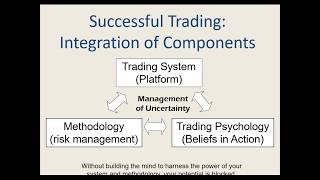
Rande Howell presents a webinar on rebuilding trader psychology to perform under uncertainty. He argues most traders bring a ‘‘control/outcome’’ mindset evolved for certainty—this clashes with markets, producing fear, hijacked emotion, revenge/impulse trading and poor results. Howell frames trading as a three-legged stool (platform, methodology, psychology) and emphasizes that psychology is the often-missing leg. He proposes a five-part development path (1. emotional regulation; 2. mindfulness/observing self; 3. uncovering historical internal dialogue; 4. activating empowered emotional programs such as courage/discipline/self-compassion; 5. intentional construction of the trading mind) and uses the ambush-predator (cougar) metaphor for patient discipline. He describes practical training (individual and group courses), logistics, and Q&A; recording access and course costs are provided.
Questions this video answers
$3,500 (three–four months; payment option: $1,200 per month over three months).
Quoted in the talk as "$11.95" and described as "can be broken down into five payments of like $239 a piece" (transcript wording).
Randle states attendees will get an email with the recording link "tomorrow morning."
Chapters
Welcome everyone. I am delighted you're here and just want to do. Before we get started and me ramble on for a while, I want to check to make sure that the sounds there and everything's copacetic. So if you will just put ok, just type in okay and send it. Don't, send your, don't, don't raise your hand because we don't know what that means. We don't know if that means that you can or can't. Okay, so we're good? We are good. Yes. Okay. Now the only other rule that I have is that I go through a presentation and answer questions at the end. Okay. I just find a lot of questions are that way. And plus my really simple brain just gets all hijacked. Often when I'm beginning, when my train of thought gets interrupted. Not your, it's not your, your doing, it's my simple brain. And other than that, I'm, I'm raring to go. I really wanted to talk with you today, so let's start here. Okay? Trading is an endeavor that requires the whole brain. The whole brain has to participate. But both the emotional brain and the rational brain, the left brain and the right brain. Yet what we've done is we've made an enemy out of the emotional brain. Okay? We want to conquer emotions, not use or master emotions. And what we're going to be doing today is we're going to be looking at this.
We'Re going to be looking at this and go, is that a very good idea?
And how are we going to work with this? How are we going to say, how can I get all this reason from my left brain, from my thinking brain and all this emotion that I've been trying to ignore and push away, how can I get them together.
And build a very different kind of mind.
Than the one you're currently using in trading? Understand you're bringing a mind into trading that was designed, evolved for managing certainty, for managing and controlling outcome and controlling environment. And it just so happens that means nothing. As a matter of fact, it means less than nothing. Trading. How are we going to do this? Okay, well, let's take a look at it. The first thing is, you know, practically everybody comes into trading with a certain mindset about winning and being successful. And then we go and we put that prosperity type of thinking into play and trading, okay? All that hard work, that persistency, that winning attitude, that force of will, then all of a sudden these are the assumptions, okay, that you're working for to say, what is it going to take to build a successful mind for trading. And you do all that and then something happens. It's not working. It's not working. According to your trading account, it's either bogged down or losing money that you know that cuts of a thousand, the bleeding of a thousand different cuts or the gashing of when you blow up accounts and you look at it and you go, so you know, yeah, I am, I am trying to use successful thinking. I am using this prosperity mindset. And you know something? It's not working. And by the way, it's never worked in trading. No matter how what you've experienced before you come into trading and this, this controlling outcome business, being alpha or being a perfectionist and not losing, not making mistakes can be enormously successful in other domains. However, when put to the test in trading, that cash machine that you're looking at right there sucks up cash. We know that. But then you go, well, okay, people want to look for the answer though to what's missing, what's the problem? They want, they want to, they look everywhere and they don't look in the right place. They look in all the wrong places because they're convinced that the problem is out there. And if you take a look at this slide, what you're really looking at is really, if you take a look, trading, okay, as a three legged stool, each of those legs start, it starts with the trading system or can start with the trading system where you get that platform and darn, you need one, you really have to have platform. If it's, it's, it's a funky system, you've got problems. If there's delays in it, you've got problems, then you need a methodology, you need a way of being able to manage the risk. Okay, because ultimately what you are as a trader is you're a risk manager. Intellectually, you know they're going to be losses and they have to be managed. But friends, that's where the, that's where the problem starts. Your trader psychology, that's really your beliefs in action. That's all the beliefs that you're projecting onto the phenomenon called the markets. And you're getting feedback about their effectiveness through your trading account. And it will not lie to you. You can lie to yourself. I'm just around the corner. Success is right around the corner. I'm almost there, I'm almost there. But the trading account's not gonna lie. It's gonna tell you the cold truth. Ultimately.
Because of that bias, because we, we really don't, we don't want the problem to be inside out there. Traders look truly for the solution and their methodologies and their platforms and they don't look at my psychology. What's the problem here? Maybe it's me. Only years later do they recognize that their psychology is the actual culprit. Okay.
These three areas work together a whole. And what happens is, it's just like today it's really interesting is a company and I were talking and they're, they're a trade trader training company and they're gonna start doing some interviews with me and stuff like that. And they said, you know, it's really interesting. We just don't do trader psychology stuff. It just doesn't seem to be, you know, it just doesn't seem to be a big thing that we're doing, but we'd like to explore it. Then I asked the question, well, tell me something, how many people in your audience, which, you know, they have like a hundred thousand people that are working with and how many of them are successful? And he said, well, really very few, but that's not what we really focus on. We teach them how to trade and how to do this and how to work with these things. And I said, well, are you teaching them how to trade like methodology or trading system or the psychology or the system? What I want you to see is that it's, it's implicit over the entire industry. They leave out trader psychology. Yet top level for performers in all domains from, you know, from tennis to golf and stuff like that, where literally people are working at the peak level of their performance. They all have psychologists working with them because they know it's about beliefs and action.
So what I want you to do is start noticing that one of the things missing here is that I need to be examining my beliefs in action.
Because my promise to you.
Is having knowledge of trading, having a great platform and a reliable methodology is useless without molding your psychology of performance to meet the needs of managing the uncertainty found in trading. How many people in here have actually said, you know something? Okay, what I actually know is that I need to be able to rebuild my psychology to work with probability. Because what happens, there's going to be a lot of losses. Even though I proclaim that I'm a winner and I don't want to lose, but what happens, I need to make a correction. Otherwise, otherwise things are going to keep flying out of the. Things are going to keep going wrong. Okay, so we get this. And despite their results, they remain convinced that their current success strategies will work. If only, if only, if only they Find the secret. And that's what I want you to hear, is that, hmm, what is this secret that everybody's saying, oh, the secret of great trading. The secret of this. The secret of making, oh, 30% return this month. The secret. The secret. The secret. What I'm asking, are you still falling for those sucker lines? What I'm asking you to recognize is the secret is you.
The secret is, are you willing to rebuild the mine that performs well, embraces uncertainty, embraces probability? Or does that mind cringe at the thought of losing and not winning? That's the big deal.
You know, the problem starts with a brain that evolved with the modus operandi to control outcome and environment. It's a survival value that got really wired into us. This evolved into what we know as survival instincts, and they're at play all the time when you trade. This is the domain of the emotional brain.
And that's already been declared the enemy by your rational brain. Do you see this problem that's going on? The rational brain wants to be right, okay? And what happens is it takes probability. It sees the probability. It finds itself wrong. And suddenly the emotional brain is seeing that as a threat to being, and all of a sudden, it gets hijacked. But on top of that, a psychology develops that produces a fear of losing and a need to win, okay? Which are the uncontrollable variables in trading. Who in here, despite what beliefs they have, can say, I am going to win. I'm going to make this happen and actually have it happen. That doesn't last long. That dog doesn't hunt, okay? But what does? So ultimately, we've got this glitch, okay? And until we learn to work with that survival brain, work with that caveman brain, work with that emotional brain, we're going to continually be hijacked by it, okay? Because ultimately, all this glorified rational thinking that we think we're doing, all that left brain is really doing is it's producing an alibi, an explanation for what the emotional brain has already decided. That emotional brain has decided something, particularly around threat, in nanoseconds.
The rational mind is about a half a second late to the show.
And that is a lifetime, friends. That's a hijacking. That's absolutely freezing and not knowing what to do. That's having wild, crazy thoughts. That's over trading. That's revenge trading. That's freezing, okay? That's what happens there. Meanwhile, you and nearly everyone else has declared emotions the enemy.
The instinctual mind is always seeing the potential of losing as A threat and triggers emotional hijackings at almost all the wrong times. This is what we have to learn how to manage. And until you learn how to manage this is that the knowledge really is irrelevant because you'll have the knowledge, but it's not usable when you need it, when you're in the flux of uncertainty and everything's probability. And the truth is, is that it's ambiguous. You don't know there is a set of rules, but should I bend them? Should I do this, should I do that? That's the kind of thinking right there that's dangerous. So in doing this, until you retrain this thing, okay.
Until you retrain this other brain of yours, this is what's going to happen. It's going to continue hijacking the trading brain. And that's what's probably happening. If you're a regular trader, and I'm talking about, you could be a propriety trader, you could be an institutional trader, you could be, you could be in a trading firm, you could be a retail trader, it really doesn't matter. You could be an active investor, you could be portfolio manager. Ultimately what happens is that all of us, because we have an animal nature, we are Understand less than 0.2% separates us from chimpanzees. We have a lot in common with those guys. And what you discover is that you start going down there and you discover this emotional brain has enormous influence. And the question is, how do you go about managing it so that you are rational and patient and cool in times of stress of where you don't know what the outcome is going to be, which is required in successful training.
So, but just before we leave all this stuff, I want to, want to really go into this, this is a famous photograph where, I mean, this kid's what, 18 months to 24 months.
And he already has that tough, that tough guy, that success, mind controlling primal program. Fear is the answer. And you know, you go, just do it like this guy. I'm just going to tough up on it, okay? Or you just going to be a wuss. You've got to be strong, you've got to be a winner. Nothing else is acceptable. You've got to conquer your fears rather than master your fears. Take no prisoners. Ultimately, what I'm asking you to take a look at is take a look at the trader psychology that you're bringing to this game. Is it working?
And I'm not asking you to make a value judgment about. Well, I think it's, you know, yeah, I think it's working. I'm just aware, you know, I've only been trading five years and I've only canned how much money. But I can see, I can see how it works and I'm going to finally get there. What I'm asking you to do is recognize, oh, that's a rational brain, totally out of whack. It's making an alibi for the emotional brain, not wanting to accept that it's wrong. It wants to control outcome. What I'm asking you to do is look at the trading account and say, wow, what's my trading account telling me? And maybe, just maybe, the success formula, the success mind that I've basically been sucked into, I kind of accept maybe I need to re examine that. Not, not in the past. Because you may have used that success mind incredibly well in business or in corporate life. What I'm asking is.
Is for you to recognize that the conditions of success in business and the conditions for success in trading are very, very different. There is no control over outcome in trading. And there is in business. At least it appears that way in the short term. Okay? So.
This is where it really gets in. Our addiction to being a winner and not being a loser is brought into trading. Where this force of will is a way of controlling outcome and emotion is not only useless, it's dangerous. This is what we bring in there. And all of a sudden we get into the circle of like, okay, okay, there is this, you know, I've got to, you know, I've got to do it. I have access. I'm going to achieve. I'm going to achieve. I get this access, I get revved up. I'm activating all this stuff, I've this winner's mind and I'm going and I accelerate that and I'm gonna make something happen.
Just don't sit there. Do something. A fatal formula for trading. Do something. Most of trading is patience.
So in this winter state of mind, we're losing is bad. Okay? What happens is that it keeps making you just absolutely slam into the wall over and over and over again.
Now you get traumatized and anxiety and self doubt start crawling into your performance mind. You keep doing. It's kind of like what Einstein said. The definition of insanity is doing the same thing over and over and over again and expecting something different. No, transform the mind that's engaging it. Okay, this is what we want to do. We know, and this is the big deal that I'm asking you. Your, your mind, your brain is basically archetypally set to be in control of environment and outcome, it's that way. It's always been that way. And that primitive brain is not going to change.
Yet in trading. It's a patient discipline mind that's needed. And until you make that paradigm shift from those two, success is going to evade you on a level that is possible in trading. So ultimately, the beliefs that form you as a trader psychologically simply are not working. Controlling outcome and probability management is at the core of the problem. Okay, that's the deal. And of course, though, you know, looking at this thing, if you first fail, try, try again. But of course you're not going to listen to that because what happens is that as the brain ages, it doesn't like to change anymore. You know, when you're young, the brain is still learning how to do things and it's really open to organization. As you get a little older, what happens is it doesn't want to change unless it's slammed into the dirt. That's what I would call, you know, burning up capital. Okay? You try harder and harder to be a winner. And all this to avoid the real need to adapt your beliefs from wherever you brought them to this world of probability and uncertainty. This is the, this is the big deal, okay? This is the deal that we have to learn how to do. And you know, actually what I'll, what I'll say is, what does this actually look like in trading? Okay, let's take a look at this thing. Is there anybody, Let me ask a question so far, is anybody getting this? Are you beginning to see that you know something? It's not my fault. I brought a brain to trading that just simply, it's out of its league, it's in a different world and it has to be reorganized. Does anyone, does it make sense to you? Let's take a peek at it and see what happens in our instinctual mind and our psychology when you're not willing to adapt your beliefs about managing uncertainty. Okay, let's see this. And let's say, let's look at revenge trading. Okay? You know, you're set up with a belief and what happens is you have this winning idea and that you're going to conquer everything. And ultimately, ultimately what happens, you get into a trade, you lose and go, ah, well, okay, then you lose again. You start going, I'm getting a little pissed off. And then before you know it, you lose. And then all of a sudden you get angry, you're going to get back at the markets. Do you see the activation of the fight flight response here? The psychology and the biology figure it's being threatened, okay? And threat on a biological level, not on a discomfort psychological level, but on a biological level. You get angry, and then you start wanting to take back from the markets what it's taken from you. And, boy, has that ever worked? Of course not. Then let's take. Let's take impulse trading or over trading. Over trading is a form of impulse trading. You're sitting there and you go, you know, I want to be at the core of it. You've got this thing of, I want to be a winner. I want to be a winner, and, man, I'm going to make some money. I need to be making some money. You know, I'm going to do that. And I'm want to win. I want to win, okay? And you start getting all cranked up. Probably listen to some Tony Robbins tapes, and you've gotten yourself all cranked up. You're ready to go. You're ready to take advantage of everything. You start seeing setups, and they start getting there, and you start looking at them going, yeah, there's a good one. And you start going, okay, I'm going to take them. I take it. I'm going to take that one. And after the carnage is over, you go, you know something?
I had to. I had to bend my rules in order to make that acceptable.
An acceptable trade to take. Okay? It really wasn't the setup that my rules told me, but what you see is that the emotional brain got all ramped up and the rational brain started making alibis for what the emotional brain had already decided. This is what I want you to see. Okay?
And then what's worse, okay, is this. This is what happens. And.
Particularly for you folks who start having anxiety before you actually enter into your trade room, and you start having kind of a sense of dread and you have this. This foreboding. What happens is usually that's a product of your doing something over and over and over and over again expecting a different result, but getting slammed, getting pinched, Bam, bam, bam. What happens is your emotional brain, your amygdala in particular, had decided, you know something? When I see that type of situation arise, I'm just going to go ahead and kick the anxiety. I'm going to put. I'm going to emotionally hijack him before he can do something stupid. So now you've got trauma memory involved, and you've gotten hyper vigilance of the amygdala, or what I call the orphan involved. And it's really been. The psychology is really whacked out, and you're Having real serious trouble. Okay, so we've seen the bad news. Okay, let's take a look at the good news. Let me ask you a question here.
Who in here would really be willing to go through the effort of changing their trader psychology to become a success in trading? You know, would you really be willing to do it? Would you be willing to look at the beliefs that you're projecting? Would you be willing to look at what you don't want to see about yourself? Okay, who in here recognizes that the obstacle in their trading performance is in fact them? Okay? It's not a new gadget, it's not a new teacher, it's not a new platform, it's not a new methodology.
It's them.
Third thing.
You know, this resistance to change is both biological and psychological. Without the evolved probability mind, though, you're going to lose.
You're going to lose out on the one thing that you can control in trading. You. The mind that you bring into the performance of trading. That friends, that's the holy grail. That's the piece that fortunately, with emotional intelligence, it can be learned. You can actually learn to build that mind. Just like the scaffolding, just like the mind here in this image, you can actually build that mind. Does it take effort? Yeah, but no more effort than all the work that you've put into trading thus far. Just imagine putting in a little more effort and being able to develop a mind that can use all those great tools and knowledge that you have. That would be powerful.
So then we actually come to the moment. Here's how, okay, you're going to be shown how I can teach you to redevelop your mind for trading. The goal is patient discipline. Okay, but how do you develop it? And by the way, it's really interesting. I work with a physicist, an Italian, lives in Barcelona. And what he did is he said to you, he says, randy, when I read your book, I read the theory of what you do, and I was really impressed because you've really been able to see how brain biology, emotion and mind work together to create a self that trades. He said, I've never seen that before. But now that I'm taking your course, what I recognize is that, oh my God, now I'm learning theory in action. Okay? The same thing is here. What you're basically doing is you're looking at theory.
We don't necessarily see the theory in action right now. We're just looking at it and going, well, how do you do this? I have a particular model that I like to use for trading, for the trading mind. And I like to use the American cougar. The North American cougar, very interestingly is the American cougar is a good sized cat. It's 200 plus pounds.
It is an apex predator, and it is a very successful predator. Okay? And people often think, well, you know, yeah, it probably stalks and tax. No, it doesn't. The way it is an ambush predator. What it does is it will climb a tree like the one you see here, or it will climb a rock and sit and wait very patiently. Because the cougar has learned the habits of the deer and knows where the deer cross. In the same way that you know what a good setup is, you see the patterns, same way the cougar is seeing the patterns. And you're waiting on that pattern to come to a moment for ambush, for action. And then when the, when he takes action, it's bam. It's out of nowhere, okay? And if he misses the kill, and by the way, he does not kill by fighting and stuff like that. He kills by hitting the deer in the head, the neck with his paw and snapping his neck. The deer drops. There's. There's none of this chase. There's none of this fight that goes along. He's not a revenge trader. If the deer gets away, he cuts his loss and it's gone. He gets back in search, going back to his setup, waiting for the next deer to show up, to show up in the setup. That's what he does. Now you look at that, you go, well, you know, lions are much more. Lions are great predators and they've adapted a different style. They stalk. They also are in an environment where they can use stalking, they can use chasing, they use teamwork in order to pull down animals. If you took that same lion and put him in the Arican forest, he'd starve. Okay, here. What I'm asking you to look at is that this cat.
Has evolved to a place where he becomes an ambush predator in a forest. In the same way that you've gone from other places and you've come to trading. And I'm asking you that, do you think it's time for you to adapt your strategy? Adapt the way your mind engages uncertainty probability for this new game we call trading, that's the big ticket.
So fundamentally, so that's a model for what the trading mind needs to look like? Okay. If you were motivated and willing to change, how would you go about doing it, though? How would you actually transform this urgent discipline that I want to make things happen? Gosh, I don't want to be wrong. Into patient discipline of where it is about the performance, it's not about the outcome. Okay?
That first one is literally being ready and willing to change rather than wanting change to occur your way.
And over the course, you know, over the course. Oh, I'm sorry, please change. Over the course of the last 20 years as a therapist, I've worked extensively with really high risk populations. And during that time, I came to develop a process for radical change. And I want to share that with you. Okay? And what I've discovered is practically everything that I learned. What I thought was, you know, thought what's in the textbook supposed to be right, didn't work very well at all in real practice. And I had to change things. The way I teach and the way that if you were to become a student of mine or you really explore relationship with me, it's very simple. The very first thing is you learn a lot about emotional intelligence. You learn a lot about what the heck's going on in the brain and what's going on in your psychology that stops you from performing at the level that you need to be forming because the brain's going to stop you. It does not like trading. It is the antithesis of what it was built to do. And your psychology, particularly for those of you who are really into winning or not losing, man, you're just absolutely setting yourself up for slaughter in a game like trading, where you don't have control over the outcome. Whether or not you win or you lose, you control your performance.
First thing is emotional regulation. You have to be able to regulate that emotion so that it doesn't hijack mind. The second thing is you're going to need to produce mindfulness so that you can become an observer of all that crazy stuff running around in your head, like that self doubt, like that overconfidence that leads to over trading. You need to observe it. Okay? The second third is that you need to discover the historical internal dialogue. That's the one that when nobody's around and when you're being very quiet and you don't feel comfortable, or when you're facing something and you hear, oh, you're going to lose, you're going to lose. I can never win. I can never win. You know something? I'm going to make the thing happen. Those conversations that repeat incessantly in the mind, this is the historical internal dialogue. It's not you. It's just simply one organization of a self that evolved. And because of your lack of awareness, you think that's you. The fourth thing is you have to self develop your inherent empowered skills. We have emotional programs in our brain that can give rise to the emotions needed for probability management. Remember, most of us decided that emotion is the enemy. But what I'm telling you is no, emotion's not the enemy. You're your own worst enemy. If you learn to use emotions in a very powerful way, you create the mind that engages uncertainty, or you show up with the mind that evolution gave you. Which do you want?
I can tell you the one that evolution and adaptation to your family system is not going to work very well in trading unless you won the genetics lottery. And I don't work with those people. Okay.
So then fifth, you have to become intentional about the mind that you bring to trading. You just can't show up with any old mind. It has to be a work of art. In the same way that you know people in football again, in tennis and golf. At the high end, you're looking at people who develop a mindset that they go out and play from. They know that they can't control the outcome. However, what they know is they can control the mind that produces performance and friend. That's the holy grail. That's what the great traders know. So let's take a look at these one on one. Okay?
Oh, she did. Boy, she's ahead of me. Doris is ahead of me.
First step, emotional regulation. Basically, you're going to have to manage the survival instinct, okay? Otherwise it's going to take over your training mind. It's going to trip to fight flight in a heartbeat. Because ultimately your brain cannot tell the difference between biological threat and psychological discomfort. Okay? And emotional regulation. What you would be learning from me is not how to breathe in a yoga studio where you're using diaphragmatic breathing in a very safe, cool place. No, you're going to be learning how to breathe diaphragmatically under the stresses of trading. It takes some. It takes some work. Usually it takes two or three weeks of concentrated effort to begin to train, retrain. The way your body and your brain are doing that. If you take a look tomorrow, if you trade tomorrow, watch. Watch your body. Watch the way you breathe. And you will see it. Until you can regulate that, the tension in your body and the. The way you breathe, you are just simply throwing gasoline onto the smoldering ambers of emotion. You have to start here. You have to be able to manage the emotion so that it doesn't hijack mine. That's the first thing that you're going to do. And why do you have to do this? In this particular image you're looking at what happens when the instinctual and emotional brain get exposed to risk and probability. Okay? It perceives it as threat when you are sitting there and if you have say, problems with trade entry and your little finger just freezes on that mouse and you can't pull the trigger. This is basically what's happening to you. This is what your emotional brain is seeing. Oh my God. There's a thousand pound saber tooth tiger with 6 inch. And this one looks like it's about 12 inch incisor teeth about to absolutely swallow me whole after stabbing me. And of course the body's gonna go bananas. Of course it's gonna trigger to fight flight. However, that emotional brain is just simply being exposed to the uncertainty of risk.
Psychological discomfort. It can't tell the difference. Friends, that's what you have to be able to regulate, okay? Most people make trading decisions from reactive emotions. And until that, until you learn to get past that, you stay stuck. That's the first thing. Second thing is mindfulness. What you're looking for in mindfulness is to recognize that mindfulness leads to the ability to step back out and observe what I would call the observing self. You start noticing some powerful things. You start noticing that you and your thoughts and you and your beliefs are not the same. You start discovering that ultimately what happens is the confluence of thoughts and beliefs that you have in your brain and in your mind that creates the reality of the trading that you're doing is simply inherited from history. And it was, it was already formed in you before you could think for yourself. And it just when you started waking up consciously, you just assumed that's the way it was. That was me. No, your awareness and your thoughts and beliefs are not one and the same. It is just simply one potential organization of a self. And as you learn to observe, you get to be designer.
Of the mind that you're bringing in to manage uncertainty. Powerful stuff. Friends.
This is not a trick. This is something that you learn how to do and you start recognizing, oh my God, yeah, I can reorganize the emotional programs and produce a very different mind. Yes, you can. And I can show you how to do that.
Ultimately then this observer that you're creating is you. You wake it up and you discover that you've got a mess going on in the committee of your mind. You know, ultimately what you discover very quickly is the brain on a fundamental level is actually a community of rival emotional programs. And they are Both competitive with one another and also cooperative with one another. And they create itself based on circumstance, based on just the circumstances of growing up and who you're attaching to. And that's what organizes you into a particular self. It's one that's built for survival within the system, the ecosystem. Usually, like your family of origin, your culture, your community that you were born into, it is not built to become. For you to become a successful trader. Two completely different circumstances. And yet that's what you bring to trading, and that's what you're asking to trade in probabilities. It's not designed for that. And then.
When that brain creates a mind, suddenly it's just not a bunch of rival programs creating this organism. It's now a mind with various forces at a committee at around a table, and they're duking it out for control. Like in this image right here. It's the reorganization of this committee through mindfulness that produces the mind that trades effectively. And that is what has to be taught. Because ultimately it starts out as you have to recognize the internal dialogue. You have to recognize that, my God, there's this internal dialogue, this. These thought streams coming through my mind all the time. And you know something? I didn't even know it was there. You know, I just thought it was my thoughts running around in there, and I just was ignoring it. Oh, no, no, no, no, no. It's enormously powerful. You know, you're being not able to observe it allows it to work basically like an attack submarine. You're underneath water, you're not aware of it, suddenly you've been torpedoed. So what do you, what do you. What happens is this, ultimately, this is where it gets interesting. Because in my teaching and the way I teach, as you become an observer, what I'm asking you to do, first thing is I'm going to ask you not to find the good news, but the bad news. And the bad news is what I call the inner critic and the adapted voice or the orphan. The inner critic, you will know. Has anybody in here ever beat themselves up mentally? Of course you have. Everybody. And my question is this. Has it ever done any good in your trading? No. It digs the fear deeper. In this image, what you're looking at, you're looking at the inner critic as a judgmental or critical component or as a temptation that's going, take it, take it, take it. And then you're looking at this guy in confusion. I don't know, I don't know, I don't know. That would be the orphan. This is what's been running your trading mind. When put into pressure.
It's not secret, but it's your avoidance of this internal struggle that keeps the observer fused to a particular organization itself that's not doing so well in the management of probability. So you're getting this? You're going, wow, I got this in my head? Yes. Here's the good news though, is you inherited these self limiting beliefs. And by the way, they're easy. Ultimately, what you discover is that your trading woes are all about you projecting a sense of not being good enough, of not being worthy, of not being, of not mattering, being powerless onto the markets. And what happens is the markets are showing you that face. They're just showing you the underlying belief that's within you, that's within you. Hold on a second here.
It's your job to dig those beliefs out instead of shying away from them. And then what you're doing is you're recognizing that. Hmm? I don't have to be stuck in those beliefs. They are not me. They're just an organization of a potential self. And step four is when you start awakening the empowered emotional programs, okay? They, they literally, literally you never will have freedom from emotion. That's where the emotions the enemy. And you just don't want to have emotion. But, well, the only time you don't have emotions is when you're dead. Okay? And what we want is for you to become master of those emotions. We want you to have freedom of emotion. The truth is the challenges of trading, the uncertainties of trading, the struggles of trading are going to be ever present. What matters is what mind you're bringing into that moment, okay? And here's what I want to teach you how to do, okay? In the same way that fear is a resonant program, member of the committee of the mind, in the same way that criticism, self doubt is in your mind are that overconfidence thing where you're hearing that you're hearing, oh, you can do it, you can do it, do, do, do, that's just the inner critic. These are two streams of thought. These are two emotional programs among many. It's just that those are the ones that got organized and those are the ones that are triggered because they're so associated with uncertainty and being exposed to uncertainty and the fight flight process, okay? However, in the same way that you have those programs, you also have the courage of a warrior living within you to turn toward your fears and have the courage to master them rather than try to conquer them. You also have the discipline of a ruler. You have the capacity in you to maintain order under pressure. And in my work, I use memory restructuring, memory enrichment to get at these and for you to feel these emotional programs. And you create a mind from the MOSA programs, those emotional programs. You also have the self compassion, the self soothing of a caregiver. Until you learn to have compassion for your suffering, for your struggles, and to calm that fear down, you never get to organize the power that's within you. And when you do, finally calm that fear down, call forward your courage and pull forward your discipline, you discover there's an impartiality, a clear thinking of a sage living within you as emotional program. The deal is, is you can learn how to operate these emotional programs or archetypes and have them fire when you're exposed to uncertainty. Rather than fight flight. You bring an intentional mind into the moment. You just don't use the mind that you got stuck with. Okay, so now we have the ability of producing the intentional mind. You decide what emotions will show up to create the mind that engages uncertainty. Do you want it to be the historical mind that you've got right now that's triggering all the stuff in your trading, or do you want an empowered mind that's intentionally built.
Intentionally built for managing probability? Okay, you have different beliefs, you begin to restructure those beliefs, and you build a new crew within the self to be able to manage that completely different. And ultimately what you discover is that by developing these aspects of the self and turning toward the fears, what you do is you learn how to master the demons, fear, sabotage, and impulse. Okay? You're no longer scared of being scared.
This inner struggle is never going to stop. The difference is self doubt is confronted and you start bringing apart the inner critic. You start calming that orphan nature of yours, and you find the discipline, you find the courage and the impartiality and the self soothing to create the mind that's patient and disciplined in the face of uncertainty. That, friends, is emotional intelligence. And it can be taught. That's theory in action.
And you know, ultimately.
You literally have to intentionally build the committee of the mind for managing uncertainty.
If you've looked at your trading and you're not satisfied with it, okay? And you know that you have the knowledge, you have all the toys, and you recognize that you know something. This really is about developing my psychology of performance to be able to use the tools that I currently have. And you can learn how to do that. And yes, I can teach you. Okay, so you've gotten There. And you go, okay, I can create this mind myself. Yes, you can. Yes, you can. You can create the mind that lets go of the illusion of control over outcome and embraces the ability to manage the mind that engages the uncertainty. And friends, that's the edge that you've been seeking. So how do you go about this, you know, how do you go about.
Shifting this thing and beginning to get. Develop the intelligence? First of all, you know, I have a pathway here. First of all, if, if you, if you've never really just, you know, just heard of me going, wow, this guy, this guy sounds. This is really interesting. He's really speaking to something. The first thing I would encourage you to do is go to my website and get the free ebook, okay? Just get it and say, you know something, I'm going to start reading more about this guy and look at the videos there. I have a number of videos sitting on my homepage. You can find numerous articles. And what I would encourage you to do after that is get my book, Mindful trading, Mastering your emotions in the inner game. It lays out the theory I use and it will, it will show you what the education with me will do. It's going to put that theory into action. If you're more serious.
Ask for a free consult. You go to the website, you hit contact us, and Dolores will find a time for us to meet. This is. If you're serious and you realize that this is what standing between you, okay, and the success, you know, is possible. The last thing, if you're just kind of kicking tires and you just don't know, and I haven't lost enough money yet, and I really don't want to acknowledge this. Read my book, read the articles. And if you're going there, there is a powerful group course that I have that we offer, that is.
I ask you to the website and take a look at it, okay? In the same way that the individual course, the major thing about the individual course, what is so different about it than the group course, is that it's three or four months long and it's one on one with me, okay? It's. And it's tailored for your needs. It's very comprehensive. It is tremendous depth. If you're serious about becoming a real trader, I would encourage that. Okay, so here we are. What I want to do is I want to thank you for coming. And what I want you to do is ask yourself, what have I learned here? What I ask you, take a look at what you've learned about your brain, emotion and mind. How they are together as one. What I hope you've also learned is how important it is to name your fear.
And really come to the moment of being able to isolate the voice of that fear rather than run from it and hide from it and avoid it. And so if you're there and if you're going, I need to really check this out. There's lots of good stuff on the website. Go there and then also.
Get that free console. So how do you become the change? Well, we encourage this is that most people ultimately once they go through all the stuff, there's lots and lots of free stuff, there's lots of inexpensive stuff that people peck around and start with and say, let me just get to know this guy. Go to the weapon, do that, go to the web and website and do that. However, ultimately there are two different ways of putting that theory into action and making the change is that there's the individual course. And this is, this is for serious people who are really serious. And ultimately, as core is, it's 10 one on one personal consults with me via Skype and it has a very comprehensive multimedia package that comes with it. It's, it's, it's big time and you own that. Okay. It is powerful and it gets into the very nitty gritty and how to put that theory into action to become the intentional self. The group course covers the basic materials, but it's done in a group setting. And you go to a virtual classroom to learn from all the materials, the MP3s, the MP4s, all the documents and stuff like that. And fundamentally, there's a class coming up in September. We're currently in the summer class right now. And in September we'll be starting that up for those people who are just not so sure or they're sitting there going, you know something, my pocketbook's really important. This is a very good course. It was built because of trader trainers telling me, randy, a lot of my traders can't afford this. I need to have more cost effective method. So.
What I would also, and by the way, what I would really recommend that you do, particularly if you're going to take the group course, considering it is register early, start it really early. Because the thing is, is that a lot of people will get the group course and they'll start it two months before it starts. So they have a huge, huge head start. And when they get there, they get to get into the process that I teach, but they really get a lot of the stuff done before then. I want to thank all of you for being here. And if you have questions, please write them in. I'll take the time to answer a number of them. And the major thing is I really want you to answer this question. You know, if you were in a place, if you had the capacity of being able to create an intentional mind that really was the one that you needed to work with probability, would you be willing to do it? This is a time, this is a place that this is possible. And it's here, it's now. So are there any questions?
Not so far.
Okay.
There is a question about cost. The individual course costs $3,500 and it's again, it's three to four months or it can be broken into payments of 1,200 per month over three months and that that allows you to spread the cost over three months rather than all at one time. The group course, $11.95 and can be broken down into five payments of like $239 a piece. Okay. And again, what we're doing is we're trying to make that accessible for you.
Hi Randy, can you send us the recording? Of course we can. What happens is.
Okay, and tomorrow morning you're gonna get an email with the link to it. What will happen? All you have to do is hit that link and you'll be taken to the recording of this and you'll be able to watch it. It'll be on our homepage and you'll be able to watch it as many times you want. So yes, absolutely. You'll have it tomorrow morning. Okay. The link. So that means you can review this stuff tomorrow morning. So there any other questions? Thank you. And see it. Thank you. Which do you recommend? Individual group it. You know, that really depends if.
It really depends on your level of seriousness and it also depends on what you can afford. If all things are equal. Oh, go with the individual course. It is enormously comprehensive. And the problem with the group course is that it gets at the orphan nature, it gets at the fear based stuff. But it doesn't have me as a mentor through that area. And that is a big deal to have a mentor, a coach who can coach you through that. A lot of people will look at me and say, Randy, this is really a no brainer. What happens is that with the individual course I get you and with the group course I get to talk to you every two weeks for a little bit. But the truth is what I'm really buying is you.
That was said to me and I will share that with you.
I like what you were Saying it all makes a lot of sense. Yes, it does. And I don't know why other people make this thing so difficult. This is literally a number of years ago I was a cognitive behavioral therapist and I really believed all that stuff and then went to a four day seminar with one of the founders of emotional intelligence. And I remember walking out of that workshop and I came back home and I sat down with my wife and I said, dolores, I don't know what I am now, but I know that I'm not a cognitive behavioral therapist anymore. And ultimately I began to really, truly. And also.
I have a science background. So a lot of this stuff is just, you know, I read this for pleasure, okay? But I came to a moment of where I realized that you cannot separate biology, brain, emotion and mind. And that we are, a lot of us, we are, we are. Our emotional brain, we share with other social mammalians. My dog, for instance.
It is animal and nature. And it has to be learned, to be dealt with for you to become fully human, for you to be able to develop the potential of what human beings have been gifted with. And in that, it does make a lot of sense. And what most people talk about when they look at this work and they talk about this work is, Randy, what I really like about you, mechanically have put together, put together a process that goes from one step, integrates it to the next step, integrates it into the next step and the next step in a very logical way. And it is because ultimately what you discover is this process that I teach. It starts with emotional regulation, it goes to mindfulness, goes to historical.
Internal dialogue, it goes to the empowered self, it goes to intentionality. There is this process that you go through, you learn how. And the exercises I use truly wake this stuff up in you. And it allows you, if you're, if you want to, to redevelop the mind for probability based thinking. A lot of people really don't want to change. And they talk about change like they talk about trader psychology. You know, I'm on a lot of programs that we talk trader psychology, but the thing is, very few people do traitor psychology. That's really getting down in the dirt and getting dirty. And you get in and you go, you know, ultimately this is about the heritage of me as a social, mammalian and survival instinct, and me as a psychological being that has been gifted with the ability of reorganizing this material.
And a lot of times you may not need it, but in trading, you're going to have to reorganize the priorities.
The modus operandi of the brain. You're going to have to do that if you're going to be a successful trader. There's no way around it and this is a very powerful way of being able to do that. So I really thank you for that comment. And any rate. Are there any other questions?
Yeah, there's a payment plan for both. For both the individual course and for the group course. We found that.
That'S something that makes it a lot more reachable for people. And the truth is that part of this for me is that I want to be able to reach you, I want to be able to teach you how to do this. So that what you're going to discover is that yeah, this stuff can be applied to trading. And it really does it, does it. You apply it and you start realizing that, man, my trader psychology and my methodology and my platform are working cohesively together. And it does change that. It also changes the rest of your life too. Most people discover that they, they got a lot more than they bargained for. They find that their relationships are better, the relationship with themselves are better, their golf games are better, their tennis games are better, all sorts of things like that. Okay. My native language is not English, but understand it and speak also. Does it matter? No. I work with. The guy that I'm working with right now is Italian and.
What I would call a heavy accent. I imagine he would, I imagine he would say that I have a heavy southern accent and him trying to understand my English. But the thing is, is that I work with people in all sorts of different. All over the world, okay. And I.
Work with people that.
Are from the Middle east and they speak from there that English is their second language. From Europe, from Singapore, from Australia, if they call that English down there. But no, that really, that really. And for all the Aussies there. I am so sorry. I love your country very much and I taught there a couple years ago and it was just, I just got like, golly, if I were going to move someplace, it would be Australia. But no, the English as a second language is just simply not there. Particularly with the individual course. Because you know, what's happened is it's all, I mean, you're getting a 270 page.
Textbook, you're getting videos, you're getting MP3s, you're getting lots and lots of materials and you sit there and you can easily, you can listen to them at your own pace. And, and.
Yeah, and it's all electronic, so it's like it can be downloaded in almost an instant. You Know that we see that a lot. We no longer mail anything because, you know, when you start sending things out of this, out of the United States, things get kind of dicey. And so, no, the second language business is not a problem at all. Your English is better than mine. Okay? So as my wife can attest, and without spell check, it would be hard.
Our friend in our head does not like change. No, it doesn't. And there's, you know, there's two. There's a couple ways of looking at it. I like your comment a lot. Is that just simply becoming an adult. I used to think I wouldn't want to work with young, young and young adults. Then I worked with a series of young adults, and they were so much easier to teach than the older people. Okay. And what I got is their brain was still fresh. It was still open to change. It was still designing. It was still designing the way it was going to operate in the world. When you start aging, a lot of that closes down and the brain doesn't want to change unless forced to. Okay? And ultimately, in trading, and I've seen people blow half a million, million, $5 million before they really came to the conclusion that they did in fact, have to change. That's a heavy duty price to be forced to change. And other people blow up and they realize, oh, my God, I wish I had known this was. I could. I could have worked with my head instead of just all this money that I've squandered and all other things. But the truth is, is that also that inner critic part of the self does not want. It wants you impaled in your suffering. It wants literally for you to be diminished as a possibility to diminish your potential as a trader, as a human being. It is going to do that. And the difference is that you have to come to the moment of realizing that backseat driver in your head is not going to go away and you're going to have to deal with it. And I teach very specifically how to deal with that and to recognize it and to work with it and to move beyond it.
That's not really a good way of saying it. It never leaves. But you learn to deal with it much more effectively and it doesn't ambush you and torpedo you nearly as much. That's a very fine thing.
That's it. Okay, friends, I really appreciate your time. I do. I've had a blast. I love talking about this stuff. And friends, this is your career in trading, okay? It is. It is. Anything that you want to do, you can do there's no doubt about it. What I'm inviting you to do is to recognize is that no matter how you turn the table, trader psychology is part of your trading. And it is also the part that is the last place people look.
And they discover it's the first place they should have looked, but their money's gone. What I ask you to do is say, you know something? What I'm going to do is I'm going to devote myself and invest myself in developing my psychology for trading. They do it in other professions. I should be doing it here. And understand this. The deal with trading is the mind that you brought into trading, friends, simply is not going to be the mind that is going to produce success in trading. That has to be rebuilt. And until you understand that, accept that and say, well, how do I rebuild it? You're stuck. Okay? The good news though is that new mine can be taught. Okay? And I'm willing and I would love to have the opportunity of teaching you. Take care, my friends. I've really enjoyed myself and I'll be signing out and again, you'll be getting an email tomorrow so that you can go and get the recording of this. Take care and God bless you.









