How to Maintain Emotional Control in the Heat of the Moment
Rande Howell presents a recorded seminar for traders that explains why live trading hijacks rational thought—trading combines uncertainty and risk that the brain reads as biological threat—and argues that mastering trading requires training emotional programs, not just systems. He outlines a multi-step process (emotional regulation, mindfulness/observer stance, intentional practice, archetype-based emotional enrichment) and answers audience questions about common trading failures (fear, revenge trading, inability to stop). Practical next steps include a free book, group course, and individual mentoring.
Chapters
Sa.
There we go. I think we're good. Okay. We're still trying to get past the technical thing. I think we just did. If you can hear me now, type yes or a Y. Okay. I'd appreciate that.
Let's see. Yes. Yay. Thank you, Wendy. Thank you very, very much. And thank you to the people that said that. We just had this moment. I feel like we just went through this crash with you guys, this wild week is that we were ready to go, and all of a sudden everything just went dark. And then we couldn't get our microphone going. And I'm glad to hear it's going now. First of all, for those of you who've gotten through this wild week and it's not over, all I can say is my hope. It sounds like you're speaking from inside a box. Sounds like I'm speaking from inside a box. Geez. Let's see here. Yes, yes, yes. Well.
I'm not looking at anything that we can do. Our mic is showing fine.
Is this the right mic, Boris? That's the right mic. Okay. But we're gonna have to go anyway, my friends. Sounds fine. Sounds fine. Even better. I like that. Tell them if they're still having sound problems to sign out and sign back in again. Yeah, if you're having sound problems, sign out and sign back in. Because it may have been something when we had something where the screen went blank and when we got it back up, at first we didn't have audio. So just, you know, you may have to do the same thing we did. Okay. So anyway, friends, I want to thank you for being here this afternoon, and I hope that you have survived the wild week. I was noticing David Dubay, a really fine trading coach, is with us today, and his comment was wild week. And I bet this is a wild week, my friends.
Speaking of that, how to maintain emotional control in the moment.
How many times have you used the words if and if only to describe how close yet so far away you are from the next level in your trading? Now, that next level could be getting to profitability. It could be moving to the next level. It could be hitting a sustainable income. All those are levels for different traders in different moments in time.
It's those dreaded emotions that keep getting in the way. Let's look at that now and let's see. What is it going to take to move from being basically just in the drift of the markets, about being able to work with the markets and see what they're willing to give, and you maintain a disciplined, impartial mind. Let's take a look at this.
One thing that I've noticed over time is I was actually thinking about doing this. I was looking at the advertising, that variant that comes over my screens from my email about all these organizations that offer trader training. And it was like, guy, you're gonna make, you know, it's. Besides having those big disclosures they have, they have, basically, they make like, it's gonna be easy that you're just turn this corner and with this new system, with this new that, with that new this, you're going to make it okay. The truth is, is that traders have no idea what they have gotten into when they get into trading. You still see all those ads, but the impact of emotions is ignored while trading is presented like it's some intellectual activity.
Just devoid from emotion. Yet when you start trading live with capital at risk, whoa, something completely changes. Yeah.
Oh, by the way, I will say this in the mix of this is I hold questions toward the end, and so we'll get to them. Type them in if you've got them, and I'll get to them. But I find it really interrupts my thought process and I often answer the questions along the way. So what I want you to look at.
Is this. Intellectually, trading looks easy. The problem is when you try to do it, you get all that truth business and you're going, hey, you know something, as easy as this sounded, I'm in deep water now and something has to give. So we know that intellectually, we know that. And what I'll say is, this the guy that I was talking about, David Debay, he's one of the first guys to say, friends, if you're in my course, ultimately what happens is you still have to look at your mind that's doing the trading. And there's a reason that David has been a client of mine. He's a great trader. But what he recognizes is that he has to keep his mind tuned and he has to be able to work that problem. Most traders don't come in to trading thinking that they need to do anything about the mind they bring to trading. And then they do all this stuff and then they discover, wow.
This is what, on the left, what a trader thinks he's getting into. You look at it and you go, you know, yes, it's a dangerous thing out there, but we're safe within this, this cage. And we take photographs, and we'll have photographs and video to share with all our friends back home about how close we came to a shark. And you do get the thrill, but you don't get the risk, okay? You don't get the risk. The risk is not real. And you can hit the reset button. It's just a game at this time. However, for the person on the right, this is a different game. You still may be in the ocean with the shark, but this time there's nothing between you and the shark. This is the difference between sim and live trading. People say, man, I can really do this, man, this is great. I've got it down. I know people who become masterly as sim traders. They make a lot of paper profits, but when they get to trading, something happens. Survival instincts kick in, and before you know it, it's a different game. And that's the piece that has to be accommodated. Because ultimately.
Your body treats.
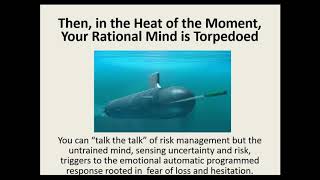
This whole sense of this instinctual stuff interacting with uncertainty. It doesn't treat it as an intellectual exercise. What happens is it treats it as literally a threat to life. And suddenly what happens? In a moment, we're going to go through this and actually look at what happens to your mind when you're trading, when you get hijacked here in a moment, but ultimately you get torpedoed. In the heat of the moment, the rational mind is torpedoed. You might talk the talk of risk management, but to the untrained mind, sensing uncertainty and risk triggers the automatic nervous system to bam. And it thinks. And you'll be seeing more of this. It thinks a lot more rapidly than the rational mind and it takes over in a heartbeat. You can literally be right there. One moment you can be in control, and the next moment you're out of control. That's how fast this is. And I want to show you what you're up against. I promise you, you did not have an idea of what was going to happen to you all. A trader, you know what happens is that you are managing a practice of managing uncertainty and risk, never comprehending what you've got yourself into. Look at this. When you take a look at this illustration, suddenly you get an idea. Everything's been cool. You walk out on the diving board, you look down, there's nothing there. Suddenly the height that all that stuff kicks in, and you really get it. The brain.
Is built to experience the combination of uncertainty and risk as imminent biological threat.
Now, that sounds like an intellectual exercise, but you've experienced it, friends. Whether or not it's just having dread walking into your trading room, whether or not it's looking for more confirmations and finally getting so many needs for confirmations that you never get in the Trade, you see the brain acting as that uncertainty and risk as an imminent biological threat. When you get into a trade and you get some profit and suddenly you have this urgency to get out with a little bit of bigger profits, you have, you experience the same thing. This is how powerful instinctual emotions are.
So you've been sold on trading as if trading was all about platform and methodology. That's what you're looking at here. What I want you to grasp here is that trading really is more like a three legged stool that has to work together. You need a good trading system and a lot of people go through a lot of effort to finally find one that works and doesn't fall apart. Then they go into the methodology, how to manage risk. And you go through a lot of stuff, man. How many indicators have you got? How many different teachers have you done? How many trading rooms have you been in? You're all looking for the holy Grail. You're saying if I only find it then everything will be copacetic. But what hasn't been taken account of is who's driving the methodology, who's driving the trading system. Okay.
There is just little problems and it's called trading psychology that keeps raising its ugly head and spoiling the dream. But yet nobody likes to talk about this trading psychology stuff. Yet what you discover is once you know how to trade, once you've spent your two to five years learning a system, knowing how to trade and being able to produce paper profits, you come to the moment where you realize that this is a head game. This is about what beliefs do I really have.
That are being engaged with uncertainty, what do I really believe about my ability to manage uncertainty? And then you're projecting those onto the markets and you're getting a feedback loop in your trading account. And friends, this one piece right here is the most neglected piece in trading. Nobody tells you about it. Yet when you get it that 95% of traders aren't making money and only 1% are making good money, really good money, you start to go, wow, man, there's something really missing here. And all of a sudden you go back to what's the trading psychology? What are the beliefs in action that are driving my methodology? Okay, you can have a great methodology, but if your beliefs are about that, you're not going to measure up that your beliefs that you're powerless against this big machine or it's not going to work out, the beliefs are going to dominate, they're going to spoil the performance that drives that methodology.
So we get this, is that.
People get really good.
About their system and about their methodology, but then they just neglect the mental side, the emotional side of the game. This is the glitch that crashes the dream, friends. And until you solve this problem, you're not going to make it as a professional trader. But don't trust me. I mean, I could just be sitting here trying to sell you something. What I'm asking you to do is to trust the truth revealed in your trading account.
And ultimately what you're looking at in this image right here is the problem that traders have all the time. You need that higher cortex to trade. That's the one that can work in probability. That's the one that's logical, that's the one that's rational. What you get in a hijacking is what's on the right. You get an absolutely hijacked, disabled higher cortex and you have an amygdala running the show that's all about fight, flight. How many times have you experienced that? And after it's all over with, you look at it and go, what was I thinking? Why did I do this? Friends, this is why. The survival instincts of the emotional brain sees threat, hijacks reason. And there you are. The question is, do you really want to stay there? Okay, let's take a look at this one step closer because I really, I'm a glutton for this. I want people to see that, yes, the dream of trading is very possible, but to get to that dream, you're going to have to reorder the mind that you bring to perform that drives that methodology of yours, that drives the trading platform. And I want to look at it. This is actually a schematic about the way this works in the emotional brain and the higher cortex too. Okay, that thinking thing, the neocortex.
You have sensory information coming in through your eyes, through your ears, through your noses. Just all that stuff, it's just coming into the brain. It stops at the thalamus. And this is kind of the gut level analysis machine that's in the brain. And it's working on both history and belief. The history of what's happened before. Oh my God, have I been slaughtered here before? Have I just jumped in and made whole bunches of money right here before? Yay. Yay. And what do I really believe about, is this a danger or is this something that I, that I'm ready for? The thalassmus makes a quick decision, quick gut level decision about whether or not it's dangerous or not. Okay, right then and there.
It sends the impulse out 12 nanoseconds later, it's to the amygdala fast.
Smoking hot fast. Meanwhile, if the thalamus even sends the message to the neocortex, that thinking part, it's going to take 24, twice as much time for the high road for you to be able to use your thinking, your logic and your reason while you trade. So the fear based system of the amygdala or the anger based system of the amygdala has already activated before the neocortex even gets started. Worse though, friends, is that the neocortex grew out of the amygdala, out of the limbic system of the emotional brain. And ultimately lots of communication links went from the limbic system into the, into the new brain. It's like just a sophisticated network. Okay, so it's a very, very strong link. However, the new guy on the block, the neocortex, just has a couple little telegraph lines, a very weak link back into the limbic system, back into the amygdala to be able to manage it.
If you cannot manage that link, you don't get to have the probability mind that you need for trading. And its evidence is most people can't do that. By the 95% of traders being unprofitable and only one really making the money.
What'S common is the left side of this diagram. It hits the amygdala and fires right into, right into the survival mind and all the adrenals crank up, the cortisol cranks up, everybody cranks up and you're in fight flight and suddenly you're making decisions, okay, between literally, wow, I'm making decisions from fight flight versus probability mind and friends, this is the big thing about sim or live trading, about the shark on the outside of the cage or the shark that you're really swimming with in the water is that.
There'S a weak link and everything's loaded by your brain to go down the low road to the amygdala and fight flight.
The thing is, in sim, there's not really a danger. It's all reset buttons.
Swimming with the shark, putting capital at risk though completely different angle. It's real, you're playing for keeps. It's a very big deal.
So we have to learn how to interrupt and reroute the biology of uncertainty.
Uncertainty is what you see on the left side of this graph. Probability is what you see on the right side of this graph. The brain is not built for probability, it's built for certainty. This I hope, allows you to See the problem that you face, this is what all those wonderful ads that tell you how much money you're going to be making.
All that stuff, this is what they forget to tell you. That's the part you have to master.
The brain deplores uncertainty. It wants control. Without control, the brain is plunged into vulnerability. Okay.
And that's the big problem, Friends.
Which is directly linked to the fight or flight response. You trigger this response every time you experience self doubt, every time you experience grandiosity, every time you have an emotional hijacking.
Every time you engage uncertainty. And yet these people are saying, yeah, just use this system, use this stuff, man. Don't worry about it, you'll be making money. They're not recognizing how the brain works and how the brain is totally stacked up against you. And the brain in a push come to shove match with the mind, it's going to win every time. Friends will means nothing. It just hijacks the whole darn thing.
So we're looking at this and we're going, wow, we get this. We know this vulnerability. I'm going to experience vulnerability every time I experience uncertainty and risk together. And vulnerability is hardwired by flight. Wow. Well, what am I gonna do here now? I hope you can understand why you're having problems with emotional control in the middle of heat.
And here we go. I want to show you the vulnerability line. What you're looking at right here is literally just any event that activates uncertainty. That would be like deciding to get into a trade that could be looking at and saying, I'm about to risk capital. And yeah, everything is lined up and it says, this is a valid setup. I need to be in. Well, what you know is you're risking capital.
That'S getting into the ocean with the shark. You are then activating uncertainty right then and there. Uncertainty automatically activates the brain's vulnerability. Your brain is so wired not to want vulnerability, wants to be in control of outcome, it wants to be in control of environment, it wants to be right. And suddenly it's plunged into a situation where as one as you want, you just don't know if you're going to be right or wrong. And you're vulnerable. And there it is, down to threat, to survival, down to fight flight activation health. However, if you were able to manage this, if you were able to build the mind like we teach in our courses, how to produce disciplined curiosity, how to produce an approach situation where you step back out of this default programming that the brain's been trained to experience between uncertainty and Vulnerability and fight flight. And you go, something I can retrain the brain.
To hit vulnerability and move toward discipline. Curiosity. Yes, you can. That's the approach, motivation. And that's what I call the probability mind. It has to be trained, though. It's not natural. And that's the point. And I want to. This is actually one of my favorite tennis players. And it's because he's no longer a young man, okay. And what he's done is he's reinvented himself. What I want you to imagine is, do you think a guy like Roger Vinegar is just sitting there going, you know something, I'm just going to go out there and win. I'm going to dominate, stuff like that. Well, the truth is his body has had enough problems, he's had enough injuries. He's playing at the very top of the game. And what's interesting is, listen to his quote. Under pressure. I can see things very clear now. Do you think Roger works with his head game as well as his methods, his platform?
All top performers do. And the question is, do you want to be a top performer?
Methodologies and platform are driven by the performance of your psychology. Under pressure. Knowledge is never safe. Knowledge just means I have knowledge. It's just the price to play the game. At the same time, I have to be able to use that knowledge under pressure.
Or it's not really useful knowledge. It's just knowledge that I can use on playing Trivial Pursuits, which is talking about trading. It's not about how do I actually build a mine.
So, friends, we come to this moment where you go, do I want to learn how to use emotional programs to build the trading mind, or do I want to continue what I'm doing Now? Do you want to learn how to use emotions to create the kind of thinking required for probability management? This is the essence of emotional intelligence, friends. It's understanding emotions, how they really work, rather than this pop psychology stuff that I keep hearing about how.
Emotions and cognition work together, how all thinking is emotional state dependent and how to use emotions and to regulate emotions to create the kind of thinking you need to be able to trade in probability and have the mind to perform in probability.
And what you're looking here is we teach a process.
It's not an event, it's a process. It requires a dedicated effort to be able to change established neural pathways and patterns into higher functioning ones. And it starts with emotional regulation. You really, truly have to be able to regulate the intensity of the emotion. If you don't, you're never going to get to the mind where all the fun stuff is. The second thing we teach is mindfulness. You're going to need to develop a very different understanding of the mind than you currently have. And I'll be talking about that a little later. But once you do, once you develop this mindfulness, the ability to observe, you're going to start literally instead of avoiding, you're going to go searching for this submerged internal dialogue that's been holding you back. You'll find it. You just didn't want to. You know, you tried to throw it away, you tried to get rid of it, but darn if it doesn't come back to you again and again and again in trading. So you might as well. If you're going to be successful in trading, you're actually going to have to do something about it rather than ignore it. The fourth thing is we start teaching you how to free what I would call your heroic nature from exile. You have the capacity to have the mind in play, just like Roger there. That allows you to play under stress from an optimal mind. It's different than what you came to the game with. The mind that you brought to trading is not going to be the mind that's going to bring success in trading. Fortunately, that mind can be built, and this is the way you do it. Then from that empowered nature, or what I would call your heroic nature, you're going to embrace the internal struggle again. The challenges of trading, the challenges of uncertainty are not going to change. Uncertainty is going to always be hardwired. Vulnerability, vulnerability to fight flight. That's not going to go away, friends. What's going to change.
Is the emotions that you bring into play at the moment of uncertainty and vulnerability. That's what's going to change, friends. It makes all the difference in the world. The sixth thing we teach is that you have to become intentional.
As a practice. You just can't decide, oh, yeah, I'm gonna go in there and trade. You're going to be checking out your mind. You're going to be learning. You know something, if my mind's in the right place, I'm ready to trade. But you know, the thing is, as a professional trader, I know that if I can't get my mind right, I'm not going to be so foolish.
As to trade and put my mind, put my emotional system through an old way of dealing with uncertainty that leads to fight and flight. This is what we teach friends, and it's a process. It's something that anybody can learn.
The next thing is this, is that emotions are at the root of cognition in the way you see things. Okay? That's the number one thing in the world you need to understand. And what you realize is that you are not a rational being. You are an emotional being that has rationalizing capacity. And what we want is to be able to come to the moment saying, this is the first step, friends. You get it by managing the emotions that create the mind. You manage the emotions that arise even before you have the mind retrained. That's what we're out to do. And what does it really look like? You've seen guys like this. You've seen the fear, you've seen the anger, You've seen the revenge trading. You've seen the freezing, the freezing of the thumb on the on the trigger. You've seen people falling apart during trades. You've seen the self loathing that comes after taking a loss. You've seen all that. That's the stuff. Traders don't recognize emotions until they're ran over.
That's too late, friends. Nor do they know how to calm them down. This is what has to change images like this. And I have a very close friend of mine is a very, very good trader. He does very well. And I actually have a video of him triggering to anger in a trade, taking his chair and throwing it up against a wall and the chair blowing up. That's where he started. Kind of like that guy on the right side. The key is, is that in learning how to work with that anger and actually saying this anger is trying to teach me. This is how you do it. The first thing I got to do though is I've got to cool it down.
First step, emotional regulation. What you discover is emotions are biological, friend because they're biological. Breathing and tension are parts of that emotion. Both breath and tension are part of what is known as the arousal component of an emotion. That's where it starts keying up. Tomorrow when you sit and trade, I want you to notice your body. Notice the tension in your body, notice that you're holding your breath. Get a mirror to look or if you have a video camera, put a video feed on yourself. It's a humbling experience to see. Oh my God.
I've already been whacked out by emotions and I haven't even started trading. I had no idea the emotion was there.
This is a call for emotional regulation and emotional intelligence. You have to develop it. Thank God you can.
What you can do by using the body to manage the biology of the emotion, you can calm the emotion down. What does that do for you? Do you see that little pinpoint, that little almond shaped thing in that, that guy's brain? That's the amygdala. That's the one, that's the, that's the center of fear. What happens when you calm your emotion down? What you're doing is you're calming its hyper vigilance to hijack mind.
Once that baby triggers, it's generally 45 minutes before you get your handle back on. Yet using breath and relaxation, you can interrupt the power and you can calm the amygdala down so that it doesn't reach fight flight. You've got a good fight and chance to maintain the kind of mind, the probability mind, the disciplined impartial mind that you need at that moment. Emotional regulation starts that process. Step one. That's not enough though, friends. Emotional regulation, as much as I tout it.
Gets you to the door of the mind, it doesn't get you in the mind where all the beliefs are at play. The kind of thinking that really has to be transformed. The second skill is mindfulness. You begin to recognize in mindfulness, it's really cool. It's a way of stepping back out of thought and recognizing that you and your thoughts.
Are not the same, you and your beliefs are not the same. And you start, you know, and again, we have a very specialized way of developing this talent within you into a skill where you step back, you look at it, you go, oh my gosh, I'm beginning to realize that the, this thing that I've been calling my thoughts is that I don't, I'm not having thoughts, they're having me and they're not the ones I need to be having at this particular moment in time. You have a lot of work to do to re control of the mind that you've lost. So in mindfulness you get to see where you're stuck. And the biggest part though is that you're doing it without judgment or blame. You're realizing, no, all the brain did was adapt you to circumstances and then went on automatic. And all you're doing is you're experiencing that adaptation, that automatic adaptation as neural pattern being fired when you face uncertainty in your training. So you're born into this history, okay, and they're creating your stuff. But I'm telling you is that this is when you need to change. And I'll give you a really good example of this. I worked with a small hedge fund and two of the traders sat side by side, okay? One was known as a star. The other you kept around because he was pretty good. He was okay. He was profitable. They were best friends. They used the same technology, they used the same methodology. They were. They did everything alike except that one was very good and everybody thought was the superstar. The other was, well, keep them around. The difference is the observer.
What observer they brought to the management of possibility. This was done through mindfulness. And what you discover in this is that the guy who was making all the money recognized probability mind. He recognized that he was focused on performance, not on results. The other guy was trading not to lose. Do you see the power of the. Literally of the mind, of the observer that you bring that moment? Okay. And fortunately, the guy who ended up both guys worked with me, the second guy ended up working for me. Once he realized, my God, how did this guy get to this position? And he was able to get to a very different position.
So.
Here we go.
You don't. I'm going to say something that may sound weird to you. It's a biological perspective, okay? You do not see reality. You've never seen reality. In neurobiology, we would say that your brain has taken sensorial modalities and created a virtual representation. That's your beliefs that you then you project onto the. Onto the markets that virtual representation. The effectiveness of that virtual representation that you have is measured in your trading account by your success or not. There's no. We're not looking for truth. We're looking for effectiveness. And here you can take a look at. You have two different creatures, and one's just full of all sorts of doubts and worries and all that kind of good stuff. The other one is here in the moment. What we want in mindful trading is to be in the moment with a particular mind. Nothing changes until that moment happens.
And this actually brings us to the. Probably one of the bigger ideas in my work is that the brain, from a neurobiological perspective, is really a committee of rival emotional programs that have duked it out, have been competitive with one another, and have taken over and creates the winners and losers, creates the mind. And what you see as a mind is really more like a committee where these thoughts have been given voice. And when you develop mindfulness, what you discover and you start waking up and you start looking at your mind instead of ignoring it, you realize, oh, my gosh, this mind has been unattended. It's really out of order. It needs to be brought back into management. It is just absolutely disordered right now as far as trading goes. And it needs to be brought back into order so that it can be probability based. That's what we were intending to do. But hold on to that thought about the mind as a committee, okay? And if you've experienced this committee, the last time you had self doubt, have you heard the internal argument, have you ever over traded and have you heard that lust to get in the trade? And the part of you says, I don't know, I don't know. You have experienced the trading mind. You have experienced the committee of the mind. It's going on, friends. It's going on with you or without you. And most people, most traders trade mindless. So it's going on underneath the hood of their mind and blowing up their accounts. So what we want to do, what we want to do.
Is use mindfulness to look into the mind, to look into this internal dialogue. That's what we're out to do. We want to.
See what players are actually in action. So when we do that.
The very first stop in the way I teach this is, this is. We recognize that your trading mind has been dominated under stress by what I call the inner critic and the adaptive voice. Okay? These are major players. If you've experienced self doubt, fear, impulse, you have experienced the inner critic and this adapted voice. Have you ever wanted to prove yourself? That's the adapted voice. Have you ever heard that? You're never going to make it. Prove yourself. Prove yourself. Take it, take it, take it right now. Of course you have, friends. This is an uncontrolled mind.
A rookie mind playing in a very deadly game. And this is not the order of mind that you need present while you trade if you want to become successful. However, the inner critic and the adapted voice are going to be there. I actually call them inner critic and orphan. The orphan is actually your amygdala. From a biological standpoint, you will hear this lecture, you will hear this criticism, you will hear this judgment, you will hear this temptation and seduction going on inside the mind all the time. The key is, unless you develop the awareness to disrupt it, you're just drifting in it and it's controlling you. You're not controlling it, it's having you. What we want to do is recognize this.
You inherited the inner critic in the orphan, both from your history and from what we call your growing up from your formative periods. And you develop beliefs about your adequacy, your sense of mattering, your sense of worth and your sense of power. I don't have a business. If it weren't for a bunch of men in middle aged years trying to prove to something who Most likely to someone who's probably already dead. They're still trying to prove they matter. Other people are trying to prove that they're right. It's okay to be right. I'll do anything I can to not be wrong. You know, I'm going to be a good person. I'm going to be right. I'm going to be right. That doesn't work either. Other people born into scarcity minded families where they don't believe they deserve to make good money. Other people were born into families where they learned that they're really powerless, that the world's too big, it's going to take over and it manifests in their trading. These are history prints. These are your default programming that can whip or whisper or shout in your mind's ear. What I'm saying is you've got to kind of get in control of this to develop the trader's mind. Fortunately.
You can free your heroic nature from exile friends bringing in these emotional programs. Remember, these are emotional programs into play. Creates the trading mind and it's just a completely new job for the psychological awareness of a trader. You discover that in the same way that the fear and judgment that you experience from the inner critic and the orphan, just as those are there, you also find that courage, discipline, self compassion, impartiality are always there too. They can become part of your internal dialogue. If you start becoming an emotionally intelligent user of that dialogue and begin to understand the way it works. Let's take a look at that a little closer. Okay. The interesting thing.
Is that.
All thinking is emotional state dependent. And ultimately what I'm teaching is, I'm teaching you how to take different emotional programs, pull them forward. And the ones that I'm interested in are courage, the ability to face your fear, discipline, the ability to maintain order under pressure.
Self compassion or self soothing, calming your fear down to produce the impartiality, the ability to think clear of a sage. That's what we're doing. These are all traits within the human genome. The difference is that your brain has not embedded them as default programming.
In trading. What you're learning to do is going, you know something? Oh, I can open up these emotional programs, pull them forward and out of that emotional cocktail I create a mind that can deal with probability and not fire, fight, flight. Yes, friend, that's where the power comes. And what you discover is I've combined emotional programs with what something is called archetypes. Archetypes are simply symbolic representations of those emotional programs. Like in here, you're looking at a Warrior, basically, confronting his dragons. You're looking at a ruler, in this case, George Washington, that led.
A pretty ragtag group of guys to defeat the world's greatest country and become the United States. You're looking at Mother Teresa giving care to the untouchables. And you're looking at Spock thinking clearly. You're. These are both symbolic representations, but they're also triggering and resonating with emotional programs. And probably the best movie I've ever seen is Lord of the Rings, where you see these archetypal representations there. The reason that you feel Argon so strongly is because he's resonating that ruler energy in the same way the movie the Gladiator with Russell Crowe, Russell Crowe with Maximus. He is exuding that archetypal energy. And I can't tell you how many men relate to that. But ultimately, these are the traits, the emotional traits that are necessary to build the mind for trading. Does that mean that everything. You walk in the sunset and everything's cool? No. What you have.
Is a new committee of the mind.
That can perform in the midst of the challenges of uncertainty and risk. Friends, this is the performance mind. This is what I call traitor state of mind. You take a look at this boat right here. Those guys are challenged. It'd be easy to fall into fear. It would be easy to fall into powerlessness. Yet they're all strung together. They're all working together as a team. The same way that your mind can be built, the separate members of the mind can be built into a functioning unit to manage the uncertainties of trading and life. When that happens, and friends, I train people on this all the time. I promise you, you can do it.
You end up mastering your dragons.
The dragons are still there, but a new mind engages them. That's all the difference in the world. What you have control over in trading is not the outcome.
Your investment in prediction is nuts. You don't know what's going to happen. Your investment in being right, does it work? No. Your investment in the performance mind, like our friend Roger was showing you in tennis.
Is that they have a clear mind. They have the right players in the mind, engaging the process.
That.
Is the Holy Grail.
You are the Holy Grail, friends. You are the edge that you've been looking for. You're a diamond in the rough, but you got the materials. It's a matter of going in and working with them, bringing them forward and nurturing them so that they become the resonant programs, emotional programs that greet uncertainty rather than the default programs. And you become like a surfer. You know, you think about it. A surfer and a wave. Look at that wave. The surfer does not control the outcome. Matter of fact, he could get wiped out pretty easily. He controls the mind that he's bringing to the performance in that moment. What he does is he learns to dance with that wave. He learns to really live with that wave. And this is the really key.
He's in touch. He manages the mindset. And this is the same thing that you're going to have to learn to become a professional trader. A successful professional trader is all that knowledge, friends. That's just the price of admission. And you most likely have way too much junk sitting in closets. What's necessary is to develop the mind.
That drives that methodology and that platform, that stable mind that can go through the last week and walk out disciplined and impartial.
That's the trick dance.
The question is, do you want to do it? Because ultimately this is that there is going to be a committee of the mind. There's no way around that.
There are going to be voices in your head. The difference is you have the decision about which ones to listen to. If you train yourself, it's going to require some training, friends. The committee of the mind is going to be there and tomorrow I ask you to sit there and go, what mind am I bringing into this moment? Really check out. And don't necessarily trust yourself. Start observing your body. Look for the tension. Look for the tension in the shoulders, the jaw, the legs. Look for the breath. Look for all these things. Notice the heart. Start noticing. Are you trading from fear not to lose or trading from fear? Or with the anticipation of chasing the trade, making things happen, all will have elevated stress levels. Or do you have the team together that's looking to see what the market will give and recognize that you don't control winning or losing.
You can control your performance. And that's the itch.
This is your moment. This is what you're going to have to learn if you're going to become a professional trader.
What's the next step? Well, first of all, if you've never heard of me or if you're a beginner, I encourage you to go to my website. It's down there. That's the www.mytraderstateofmind.com. and get my free book, the free one, okay. And just start reading and start exploring about what on earth you've gotten yourself into.
But once you've done that, you also notice there's a lot of articles. You notice that there's a lot of videos. Educate yourself, it's free. Get yourself where you're going. Okay, I'm beginning to understand this. And then you start going, well, how do I change? Some people find that reading the book, using the workbook and getting some of the general guided meditations is all they ever need. Other people recognize, you know something, this is really interesting stuff. And what he's doing is he's training to a process. This is not just some helter skelter thing. It's a process that takes you from one thing, adds another, adds another, adds another. And we teach it in our group course and our individual course.
Ultimately that's where it's going. Just depends on whether or not you want to develop the mind that can engage the markets from a professional standpoint. For instance, that's the big deal.
So the thing about our group course, it starts in March is five group meetings with me. And you have a virtual classroom. It's open 247 and the next class starts March 22nd. I encourage you, okay, registration is open now and we already have a number of people who have joined and what they're doing is they want to get a head start because what happens with traders is they will sign up late and they're way far behind when they get there. Because when you get to the first session, I will have assumed you have been practicing with the emotional regulation section already and we're moving. There's so much material in this course that you're going to have to really get that you really need to get there. What I'm doing is I'm offering a free gift for sign up. It's a $200 gift. Emotional regulation for early sign up. Because I want you to get started early so that you really max out on this course.
The next thing is the individual course. This is for people who are dead serious about this and they realize the value of a mentor. It is a very highly comprehensive and personal course. With me it comes with a completely different set of educational materials that's much more comprehensive. But the major thing is it comes with 10 one hour sessions with me over Skype over a three to four month process. It's powerful. How do you go about really thinking about this and what's best for you and where you want to go is I would, what I would encourage you to do after you've really thought about it and really explored this and realized I get it.
If you're really down to it, I ask you to get a free consult if you're going, you know, Somewhere between that group course and individual course. You know, I want to talk with this guy. I want to see if he's for real. Get a free consult. You go to the website, hit free consult. And what Doris will do is contact us. And Doris will schedule a time with us that coordinates your time zone with mine. And we will. We will sit there and we will take a good hard look at the psychology you're bringing and what needs to be done to get it to shape that it needs to be. Questions already. Oh, I've got some questions. And I was going to say, please write your questions in because.
We'Ve got a few minutes and I'd love to. I love good questions. This is Andrew. Here's Andrew. I love this. The way a guy starts. So, okay, here are my issues. I've been trading and sim trading futures and options for over seven years full time. Wow. Here are my problems. Fear. Yeah. Not executing on my setups. Fear. Putting on trades without a setup. Most likely just a. That's the horse in the burning barn based on fear. Yeah. Not taking off, losing trades and adding to them. Yeah. There's more fear. Yeah. You've got it going. Huge losses. Trying to avoid a loss. I am stuck back in sim. Well.
I traded my setups and sim today. Record day for me. Made over $75,000 trade size. Can I do that in my own accounts? That I can do in my own accounts.
What? When I. When I finally put on a real trade, it is usually at the wrong time without a setup. So am I so fearful it is ridiculous? Well, you know, first of all, I don't frame it that way at all. What happens is that.
You'Re like the slide where I showed where there's a shark outside the shark tank and everybody's in, taking pictures and they feel, you know, when you look at a shark up close, man, I'll tell you, you feel it in your bones. But when you have bars between you and that shark, you know, there's no real losses. So you can hit the reset button.
Yet if you took the woman in the water with that great white shark floating around, there's a totally different feel there. It's real. That woman's vulnerable. If that shark goes one way or the other, she's gone. It's that simple. What happens is that you're going to have to learn to deal with the core of the fear. Can you learn how to do that? Yes, you can. The way you've done it, you've traumatized yourself pretty good. You know, you've spent seven years repeating. Probably the same.
Okay, I'll put it this way. The same dumb things over and over and over again.
And my hope is I've been around people who've lost, oh, gosh, a couple hundred thousand, a million, 5 million, $10 million. And it really comes down to, you know, if they'd only realized, if I'd only accepted the humility to say, I need someone to help me to get past these issues and find this core that I know is inside me. And I would encourage you to get the free consult. You know, if I were living like that, it would be insane. But, yeah, you can overcome that. I hope you decide. This is Diego. This is Diego. I am profitable 78% of my trade days. The problem is that I lose a lot on my losing days. Yeah, that's the way it works. I just can't stop trading to try. I can't stop trading to try. I can't stop trying to come back. What can I do to work on that? Well.
The simple thing is, talk to me about that. If you want some advice.
What you're having to do here is that it is very common when you take a look at a professional trader who's making money and a trader who's not making money, what you will see is almost everybody has regular okay days, and they'll have a few really great days. But what you'll see with professional traders is on the losing days, they keep their losses small. They don't lose the psychological control to get sucked into the trade. They realize that we get into a trade. If their hypothesis is not right, they get out of the trade. There's a very fine trader in the. In the. In the audience today. His name is David Dube. And if you want to meet someone who can really teach, he's one of the few that I really, truly recommend. He gave me an example about a year ago when he and I were talking. He says, randy, I was taking what I call an intuitive trade. And David's been around for 35 years. He's got all the trappings of trading success and all that stuff. And because he's been around so long.
His intuitive trades are really just that. He doesn't know how he knows something, but he knows it. And he said. He gave his group. He said, I'm going in this trade. It's an intuitive trade. He got into it and it didn't meet criteria. And David just got out of the trade. There wasn't a big deal about it. There was anything. And other people stayed in that trade and ended up making a lot of money. And they said, oh David, you didn't stay in. David you didn't stay in, you should have. And David said, no, it didn't meet my criteria. And I got in, it wasn't there and I got out. There was no, there was no, oh my God, I can't let it lose. I can't let it lose. I'm not going to give it a little, you know, David comes to that, you know, probably with a natural streak, but he also trained with me. Okay, that's the kind of stuff you're looking for. And that is a difficult pattern to change. Just trying to do it by willpower, friend. I.
But the real key is what you're doing is you're saying I need to start training myself after I've been winning. I have to train myself not to allow myself to fall into euphoria. You would call that feeling good or overconfidence. That's the longer answer in what you actually have to do to the trader who's beginning to win euphoria. Feeling good is dangerous and that's a lesson that you haven't learned right now. But that's the deal is you just simply. A professional trader does not allow themselves to feel good while they're trading. Now they may go whoop it up afterwards, okay, but while they're in the performance, it's all business. They're not allowing, they don't get outside of discipline, impartiality.
Last question, friends. John. This is John.
I guess to call the committee one would need to remember. Calling the committee or what supports remembering in your process? That's a really powerful question.
It's a very good question. The actual way I do this is I actually go into memory of a time when you have been challenged, you have experienced fear, you did not know the outcome of the event, but you struggled through and you landed well. And we go through a process that's very unique to me where we go in and what we do is we deconstruct that memory. Because ultimately all a memory is is your brain taking sensorial information of an event, encoding it based on the observer and emotion that you're in into a memory. What I do is I go into that memory, pull it, we pull it back up, we start deconstructing it and we start finding the emotional programs of discipline, courage, self soothing and clear thinking that had to have been there for you to have performed the way it did.
And we learn, we teach you how to pull those forward as feeling okay. And out of that, what you discover very quickly. The theory behind this is that all thinking is emotional state dependent. When you feel an emotion in you, what you're feeling is the chemistry of the emotion altering thought. And what I'm doing is I'm teaching you how to take a memory and build a feeling state. A cocktail that allows you to produce a disciplined, courageous self soothing and impartial mind. That's what I'm doing. Okay, one more. But that's the answer to that. I don't know if that helps you, but that's the way I teach it. Actually a very technical process, the way we. We actually call it emotional enrichment. This is Jay Wagner. I don't know. Okay. This is Jay Wagner. And I'm assuming I had a. I had a chemistry teacher back in college by the name of Jay Wagner. Randy, I have followed you for years and am a big fan. Well, thank you very much. I recently found myself doing the best I had ever done in trading, but uncomfortable in that place. I could feel myself being stretched being there and could only stay in that place a couple of days before reverting. Yep. How does one stay in the new mindset that is newly formed? Thanks.
Jay Wagner is called become a client of mine. That's a silly answer, but I'll answer it another way. This way for you is that the key is what you're doing is you're looking at a situation of worth at that particular moment in time. Okay. And you're going, you know something? I've done all this and I've gotten this stuff and do I really deserve this? And the truth is a lot of people really don't believe that they deserve. Okay. And all of a sudden you get there, you're uncomfortable with it. That discomfort is a sense of, oh, this doesn't feel like me. It might even be shame. And what you need to be looking at is the historical dialogue that is triggered by your success. Because what you're talking about appears. And again, I don't know you. It's not like you've given me permission to walk with you in your head. Okay. And I don't do that unless I'm given permission. Is that it sounds like there's an internal dialogue where really it's about winning and the deserving of winning. And I once worked with a guy who traded with a high six figure account, did well. And every time it moved over into seven figures. Darned if he would not lose back down. This had been going on for five years when I met him. And Ultimately it came down to growing up in a family where he learned literally that he was not worth a million dollars. And Darn, you know, 40 years later, if he's not proving an utterance out of a family's mouth, in his, in the moment trading, every time he hit that seven figure thing, he would lose back down. He was following the family myths, legends, and he had to learn how to break that legend and create a very different narrative about winning. And a lot of it, a lot of on high end traders that are profitable, I actually ask them to start looking at their money conversations and start recognizing that as long as it's all about money, about making money, that ultimately it's going to be an inward funnel that kind of gets them and blows them up at some time. What you discover, if you take a look at George Soros, he is one of the world's largest philanthropist. What you discover, and I'm not saying that I like him, I do like him and I'm not saying he's a perfect example, but what you discover, his conversation about money is much bigger than what can I keep and what can I take? All the toys are mine. He's now using money to open opportunity for generations of people that he will never know. And it's one of the same things. As part of the antidote to the fear of winning is to begin to ask, you know, first you have to get past whatever story that you suck down and incorporated into your brain from your family. But then you have to start saying what story, what narrative am I going to live in about the way that I use money?
And it, I mean that's more than about learning to become a competent trader. That's really about becoming a human being and beginning to see how trading fits in to your growth as a human being. And that's what I would guess there. Okay, friends, I'm going to tell you something. This has been interesting questions. I really like this. You guys have made me think today. I appreciate that. If I can help you, I really would like to be able to have that opportunity. There are several people in here who are asking questions that really they need to find the motivation they need to take the next step. Because you keep thinking it's going to change, it's going to change. After seven years, my goodness. After five years, my goodness. Do you think it's going just you're going to walk outside and it's going to be change. It's like my cats on these rainy days that we've been having recently in North Carolina. My cat goes to the door, walks outside, it's raining. And they go, what does he mean, it's not summer? And come back in five minutes later, they're at it again. They're at it again. They're at it again. They never get it. What I'm asking to you is be more than an animal. Recognize and go. I get it. Nothing is going to change unless I enter the process of change, no matter how deep your pockets are. Okay, friends, I wish you well. I cannot tell you how much I hope that you find deep meaning and value in yourselves and the way you live your lives, and that you learn to use trading as a fulcrum for that. So thank you very much, and if I can help you, please get in touch. Take care. Bye. Bye.









