How to Stay Cool, Calm and Collected while Trading
This content was created by Kardec Trader. This content was uploaded by Kardec Trader. This is a YouTube video titled "How to Stay Cool, Calm and Collected while Trading" created on February 9, 2017. It features Randy Howell discussing the psychological aspects of trading, focusing on emotional intelligence, managing uncertainty, and developing a mindset suitable for trading. The content is a monologue or lecture format, not a conversation.
Chapters
Welcome, everyone. My name is Randy Howell with my trader state of mind, and I am delighted to have you here. And I'm excited about what we're going to be doing today. What I want to do first is just get past a couple of things. Like, for instance, I'm assuming that everybody can hear me. So if a few of you would just type in yes or no. Of course. If you, if you, if you couldn't hear me, you couldn't type in no, could you? But just let me know that you can hear me. Yep. Okay, good. I hate it when you start talking and discover that there's not a connection there. Any rate, the second thing is, for those of people who haven't been to one of my webinars, I hold questions toward the end, okay? And a lot of questions get answered. And the truth is, is that.
When a lot of questions start coming in, I kind of get taken off topic and I don't, I don't get done what I, what I set out to do. So it's, it's kind of like it's set up that way. But any rate, I welcome you. And what we're going to be doing today is going really. What does it take to produce a calm, cool, collected mind to manage uncertainty of trading with? Okay, and my question as we start along with this is that when, when life throws a monkey wrench into your scheme of things, when things don't go your way, what do you do? How do you habitually react to the randomness of something happening out of the blue? How do you react? It's going to tell you a lot about the way that you react in trading also, or respond. What we're looking to do is we're recognizing the one thing about trading that's going to be massively different than most any other field that you will ever imagine is that you have zero control over what's going to happen, over what I call outcome. And when that happens, and if you're a control freak or if you're an alpha, what happens when control breaks down? Do you just get stronger, meaner, and go into anger and try to force things? Or you on the other end, you go into fear or uncertainty and you end up kind of choking down, closing down, or just absolutely becoming a horse, like a burning in a barn. We're going to be looking at, what does it really take to produce this calm, cool mind, okay? And where we want to start, we want to start, believe it or not, with our old friend Charles Darwin. Okay? Now what we want to do Is, you know, how are you about adapting? Okay, you know what happens is this is I'm actually going to be going to give you this quote first. Okay. This is from the Wednesday, February 1, Wall Street Journal, the management section and the headline to this is Shifting gears after promotions. And the subhead is the transition from specialized jobs to general manager positions is becoming tougher as employers trim management layers, demand faster results, do not provide mentorship. First sentence is this just like a car stuck in gear. Many functional.
Leaders struggle to shift into a new mindset after they become general managers. What I want you to recognize is that you're in an industry that most of the retail traders, they come from a technical field. If you're not it, you're an engineer. If you're not an engineer, you're an airline pilot. If you're not an airline pilot, you're an accountant. It goes on and on and on. There are so many of these people who got really great left brain skills and they're good, they're very good at that engineering type of thinking. Yet when they come to trading.
New skill set, what happens? They find their skill set no longer applies. Okay? The real deal, the mindset that worked, that was so successful in another field and another time and suddenly the emotional skills to actually use technical knowledge is the skill in demand. Okay? And the real question is back to Charles Darwin here is who survives? You know, when it comes down to it. Listen to this quote from him and see how it applies to trading. In the struggle for survival and you know what that feels like in trading, the fittest win out at the expense of the rivals because they succeed in adapting themselves to fit their environment. I want you to hear that very closely. And this is one of the major flaws that traders make, our new traders make as they come into trading. They really think the skills that they had in the past, particularly the technical skills, the knowledge skills that's going to give them the edge in trading. The truth is what you're going to discover is.
Knowledge is the price of admission to trading. Everybody, even the idiots that been trading two to five years or more who think everything ought to be free and just have this whole thing is I'm just trying to find the holy grail out there, have the knowledge. What they don't have are the emotional skill sets to build mind that can trade effectively with that knowledge under the pressure of uncertainty. So that's what I want you to see. Okay, the first thing is this, this isn't, we don't have to bang this thing and Say this is all a psychological problem. This isn't just about trader psychology. This is about your biology. And are you willing to guide, to nurture and redesign that biology that will produce a mind psychology that allows you to trade in the new environment with new skills of emotional intelligence? Okay, that's what we're talking about. So let's start in the beginning. Let's start.
With whatever trader should know and it should be imprinted on his brain. The left two sides of this, of this three legged stool that I've kind of put here is the trading system. That's that platform you use that you know, it's the one that you know, you, you hope it doesn't blow up on you. You hope it, it, you hope it's there in time. You hope your order feels right, you're hoping that you get out of trades on time, you're hoping all that stuff, it's got to work. There's a lot of trading systems around, there's a lot of planning platforms around and a trader goes through a lot to finally build a platform that works for them. A lot of work. The second is you darn well better have a way of managing risk. Your methodology, your rules that you're using. Because ultimately anything can happen at any particular time. You have a prediction, you have a hypothesis that you know has a likelihood that actually happening. It doesn't mean it's going to happen. And you have to have it so that, that methodology sets you up so that probability smiles on you. Okay? That's what a consistent trader has to have. It has to have a methodology that manages risk so that overall, ultimately you end up with an edge that if you flip coins long enough, you're going to end up taking, you're going to extract capital out of the markets. Okay.
Oh, then someone had just said the slides aren't changing. I did stay a long time on that first one. But let me know if you're not looking.
Just tell me if you, if the slides are changing for you. No. Okay, that's okay, that's one that did. No. Yes.
Slides change for me on integration of mind. Yes. Okay, we're on the integration of mind. Okay. I don't know what's going on for. We're having a bunch of people say that slides are.
Changing. The one person, ask them to sign out and sign back in again. Okay. What some very smart consumer of webinars has said is sign out and sign back in. You probably it's just like when I do Skype stuff is when the first time I call someone, everything's yaya. And what we have to do is we have to terminate the call and we have to start over and we get a better connection. Okay? Anyway, so we have this methodology. This is where all that left brain stuff is so important. You better have a fine left brain to get that platform together, to get that methodology together. Do that back testing, do that testing.
Okay? The correct slide will be saying integration of mind as a part of a trading system. Okay? Then there's this third part sitting over there on the right that says trading psychology, managing the mind. This is the incredible thing. What happens is that if you look at your trading psychology in the same way that you would look at a race driver, he drives the car that races, okay? If you put me in a Formula one car, I would probably kill myself and everybody else because I cannot imagine driving at speeds like that or acceleration like that. I am ill equipped emotionally to manage that environment. I don't have the skill sets yet. That technology is just like the racing.
The whole racing track, the actual Formula one car. That's your risk management, that's your methodology and that's your platform, that's your trading system. Nobody would think in their right mind to get in a car like that or much less. I'm in Charlotte, North Carolina getting a stock car that's going 220 miles an hour. You know that it takes a certain kind of training and a certain kind of person to be able to manage that. It takes a lot of skill sets. They don't fall off of trees, they're developed. And yet we treat traders often think, yeah, we get those left two things. You know what happens is that, yeah, man, my mind's good to go. And the truth is it's. No, it's not. Unless you happen to win the genetics lottery. What happens is you're going to have a mind that is highly suited to whatever you were doing, should be at least what you were doing before trading, but is not suited to the rigors of trading. It's a different environment and it's going to have to be real rebuilt. If you're coming from a left brain type of industry, you have been doing everything to control outcome. Okay? Engineers don't want failure, accountants want perfection.
It's want accuracy. But the thing is, is that in trading there is no perfection, there is no controlling outcome. Suddenly the whole rules change. And yet we try to use the same old mind to drive a very different racing machine. And people, people really screw up doing it. So this is the area I can't help you with the trading system, I can't help you with met, I can help you with trader psychology. I can teach you how to become a better driver of the machine that you need to be driving in the environment that you need to be driving in. So let's look at this. So we now we know hopefully that you get is the mind that you bring to the markets, okay? It's part of the trading system and most likely unless you won the genetics lottery, you're not bringing the mind that's going to win in trading. It has to be developed for a very new environment. So how do you go about doing this? Well.
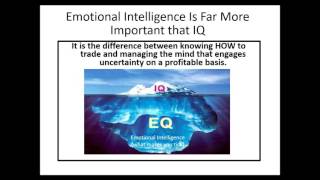
You start with emotional intelligence and what you discover is emotional intelligence. And I will define emotional intelligence here is knowing what makes you tick and knowing how to change and develop the you and how it ticks in an environment, okay? That's the big deal. The deal, the deal is this is that there's a huge difference between knowing how to trade and managing the mind that engages uncertainty at a profitable level. When you see top end golfers and they're competing for big payoffs, do you think any of those guys doesn't have a trader, doesn't have a sports psychologist that works on his retainer? They know what it's like to be competing at that level. They need someone on their side to keep their mind right screwed on straight so that they stay focused on performing and taking, taking care of process rather than trying to win.
What happens on any given day, any of those players out there can win. What happens is the golfer and you know, any other athlete basically has to put himself in a position where they are controlling their performance and that's controlling their belief systems. Okay? This is the shift in mindset that traders, particularly with technical backgrounds.
Don'T take stock off, okay? Because they don't realize it really has to be developed. This is what we want to look at, understand it's very important to have all that technical knowledge. It's great that you got the IQ stuff down, but that's just the ticket, man. That's just the ticket to the pla, to the ride.
Now you're gonna have to learn how to operate in this new environment. You got it? Okay, so what happens next is this, and this is a big part and then it's counterintuitive but essentially okay to develop.
The mindset you need is counterintuitive because ultimately everything that we're taught is based on rationalism and keep rational, stay rational. And ultimately the big huge shift that's occurred in the last 20 years as emotional intelligence work, neurobiology has arisen and it's kind of like it's knocked the you know what out of the cognitive behavioral therapist. Because in cognitive behavioral there is a belief that cognition comes first and then emotion. Okay? And I used to be a card totem.
Cognitive behavioral therapist. And over time I came to realize the flaw, the deception to that. Because in emotional intelligence work what you discover is this. Everything is about emotion. All thinking is emotional state dependent. And if you don't believe that, go back to the last time you traded today and start noticing when you were making a critical decision, whether or not it was entry, whether or not it was management in the trade exiting, or what you did after you exited. What happens is that it, particularly if you had a flawed decision and you go, why did I do that? You know, why didn't I get in that trade, man? I had all the confirmation I wanted. It was a legit, it was an a trade. Why didn't I take it? What you're looking at is fear had seized the mind and out of that fear cortisol fearful thinking arose. And suddenly all that logic that you have was simply producing an explanation that supported fear. Okay? And so you started making fear based decisions. In that moment it made sense. And the same thing with revenge trading. You know, you get angry and what happens is it makes sense that you're going to attack that. All the logic circuit says, I'm going to make them pay, I'm going to take it back. It may have worked in your past line of work or in your family or something like that. But the thing is, is you discover, oh my God, my thinking got absolutely corrupted by the emotional state. Yes, yes, As a matter of fact, the thinking came out of the emotional state. So we know it's counterintuitive, but what we're getting is that the thinking gets corrupted during poor performances in trading based on the emotion, this emotional intelligence, this way of learning emotion so that you are not trying to be free from emotions, but what you're trying to do is that you have freedom of emotion. You're realizing there are always going to be challenges. And it's just that most likely both the psychology and the biology, your mind, when it engages uncertainty is going to turn toward fear or aggression, okay? Which basically makes a gambler out of you. And it makes people who know how to really trade and are emotionally stable. It makes them easy for them to take money from your hands. This is where we're at. So what we want, what we want Emotions. We want to be able to choose the emotions that show up in a moment of uncertainty rather than the ones that are default programmed to show up there. That's the big deal. That's a really big deal. The U.S. army spends an enormous amount of energy and money training soldiers in the midst of chaos. The fear of death to, to have emotions very different than fear. They think calmly, they're very collected. That's what we're talking about here. We're talking about being able to go in and go, okay, we know these army guys, they're challenged. Those are real bullets. And at the same time, it would be so easy to go back to default programming. Like I probably would have put in a situation like that and fall apart and get myself killed. However, they've been trained emotionally to respond to the danger of uncertainty and very differently. What happens is that you haven't been trained that way. Training is available. It can be done, and it must be done if you're going to be a consistently successful trader. And I want to make a distinction. You know, a lot of people say, well, hey, I won, I won a lot of money. Winning a trade is very different than consistently winning and trading. Any idiot can get lucky and win money, then give it all back. That's what most traders, and that's most emotionally unintelligent traders do. But let's take a look at emotion and start looking about how you can use emotion to be able to develop the mind that can manage the uncertainty and risk involved in trading. Instead of going cuckoo, it keeps it solid, cool, calm and collected. First of all, an emotion, an emotion is actually a biological action potential of the body that creates the mind that is set to trigger anytime there is a disruption to a standard sensorial pattern that already exists in the environment. And what that might look like for you if you have a hard time pulling the trigger is before you ever show up, everything's cool, you're not even thinking about it. And you've got, you know, you, you turned your charts on, they're populating, and nothing, you know, nothing's there. There's no setups at all. And then you start seeing confirmation. Okay, the confirmation is a disruption to a standard sensorial pattern of what we would call homeostasis. Everything's copacetic, everything's calm, nothing's happening. Suddenly something's happened. And the only question there is what emotion is going to show up.
What happens with most people. And I'm going to run through these pretty quickly because.
This is really built about how you build A mind arousal is you absolutely beginning to rev up. And tomorrow when you're trading, I want you to look at this man. I want you to look at your body. And when you feel the tension in your body going, oh, and emotions arousing, I should calm, I should calm this tension down before it just whacks me in the head. Or when you're watching your trades and you start noticing your breathing, you go, yeah, I'm not breathing. Or you know something, my breathing is very fast and shallow. You are fanning the fires of emotion. You're asking that emotion to grow in intensity and take over. Okay? And then the fixation and your heartbeat, I want you to start noticing it and realizing those are emotions.
That's the emotional signature of an emotion growing. And right there you have a chance to deal with it a little bit more about that later. The second part is feeling. This is all that touchy feely stuff that menly men just don't want to deal with, friends. Touchy feely is so far from what an emotional feeling is. That feeling, that subjective experience of emotion. You know when you have to knot your stomach or you feel, you feel, you know you have that, oh my God, you feel that flush of energy, all that stuff. What you are feeling is not arousal of an emotion cranking up, but you are actually seeing a switch that has flipped and suddenly that emotion is flooding through as chemistry into your body and your brain, altering thought.
This is when you get hijacked, friends. This is when you get hijacked. You can do something about arousal when you catch it feeling. All you can do is say, I need to step away from the trading and I need to go burn this chemistry out of the system. You got to get the cortisol, that would be fear or anxiety or you've got to get the adrenaline and the dopamine. That would be the overconfidence of over trading and revenge trading. You've got to burn it out of your system because all it's going to do is burn a hole in your wallet. Okay? You're way past the ability to rationally and logically think at that time. The third is motivation. What is that emotion telling you to do? Fundamentally, it's only going to tell you to do one of three things. Attack. That's all that anger, that's that over trading, that's that revenge. Trading, avoid. That's all that hesitation to get into trades. That's all that fear of missing out of profits and getting out of trades early and all that angst that you have approach.
Approach is a sense of curiosity. This is where you're calm, you're cool, you're collected and you move toward the uncertainty and you're listening to the uncertainty. You're not trying to control it, you're not trying to avoid it or attack it. You're seeing what it will give to you.
That's the end goal from a performance standpoint. The fourth one is meaning or belief. These are the self looming beliefs that you bring and attach to the emotion. And yeah, a lot of these are learned during the formative period often known as your childhood. I tend to prefer to say this is when your brain shows up in an environment into a soup and learns to survive in that soup. You have a family of origin stuff where they're downloading default programming into you. You have a larger community that's downloading stuff. You have a culture that's downloading stuff. And that's the historical self. That's what you bring to trading and that's what has to probably get changed. Okay? The fifth is temperament. That's your genetic predisposition. That's something that is far, far, far beyond.
What I do. That's something where.
That'S past my pay grade. So anyway, now let's take a look and say, hmm.
What I hope you have guessed by this time is that your trading mind is really an emotional cocktail. Okay? The problem with uncertainty, the brain, is that your brain's an emotional cocktail. And ultimately what happens until you wake up to this and you start becoming the designer of what emotions are showing up to create the mind, you are not going to be the driver that can drive the machine call your trading. Okay? This is how it works. The key is, is that your mind, you know, really your brain is really a community of rival emotional programs. And if you've ever seen the movie Inside out, it's a good depiction of how emotional programs show up and create mind. And that's a, that's a Pixar Disney film. I highly recommend it. It's one of the better films that really allows you to see how emotion and mind really work now. And this is where we have to recognize that knowledge alone is just not going to work. Okay. Ultimately though, it goes back to this. And this is follow this train. This is back to feelings, okay? This is that chemistry of emotional belief and perception.
You feel the emotion, okay? Those feelings create a belief and the certainty in whatever direction the emotion is taking you. I want you to hear that the belief is spitting there. You run into uncertainty, there's a triggering There's a sense of vulnerability and suddenly what happens is the chemistry shows up and starts pushing the direction that the emotion is taking you. That's attack, avoid, approach, okay? This is the emotional state is everything.
This is what creates the understanding of your world. This is where the self limiting beliefs the that hold you back. These are the mental obstacles that stop you from trading to your greatest potential. And until you are able to see that belief that's stopping you. And a lot of menly men do not want to see it. They do not want to acknowledge that they have fear. They don't want to acknowledge that they can't conquer things. The truth is that emotions are like an 800 pound gorilla. They could care less that you bark.
They just simply take over. So you're looking at this and you're going.
Ultimately I want you to really understand the meaning in this slide here, okay? The emotional brain makes a decision, okay? And the thinking mind produces an explanation that supports that decision. Or as Huxley said, man is not a rational being, he is a rationalizing being, okay? And you can see that with whatever context your mind likes to do. The world's out to get me, you know, I'm gonna make it happen. Or you know something, I have to be right. What you discover is you're projecting your beliefs onto the markets every day. As a matter of fact, they're not even your beliefs. What you discover very quickly is that what you call you is. And the beliefs that you're projecting really is your brain taking all the sensorial modalities coming in from sight, smell, stuff like that, creating a virtual representation.
Of the outside world and projecting onto that virtual representation what it thinks it's going to do, okay? You don't know reality, you don't know the markets. What you know is only your virtual representation rooted in your beliefs. So what happens is when you turn to your trading account, your trading account is telling you in black and white whether or not the beliefs that you're bringing.
To trading are effective at extracting capital or not. Because ultimately you do not believe. And then see, this is a big huge fallacy when they say don't believe your feelings, believe, you know, believe the facts. Well, what happens is, believe me, believing is seeing, okay? Otherwise everybody would be making money. So what I want you to do is that, let's think about this, okay? Let's look at it from trading, from euphoria based thinking. Ultimately what you're doing is that you win. And what happens is your limbic system gives you a little squirt of dopamine in the reward system. And it says, I like that. It makes me feel really good. I want more. Unfortunately, traders will sit there and say, well yeah, it feels really good man. I like feeling good. The problem they don't realize is that now what they've done is that they got dopamine, high grade cocaine and testosterone. Lack of sense of risk guiding the decisions you're making about probability and risk. Dangerous, dangerous, dangerous. And what you do is you fall into the casino trap, you win it, they want you to win initially, they hook you and they're going to drain you for the rest of the night. So that's, that's what happens with Euphoria. Okay? You can't allow that to happen. Yet it feels so good. Why wouldn't you want to feel good about winning a trade? Because it alters the perception of the mind that you bring to looking at the next setup. That's why. Then.
Let'S look at trading from a fear based mind.
This is when cortisol is driving thinking. Suddenly what happens with under, under the influence of cortisol what your mind starts doing, it's kind of like Chicken Little. It looks out there and sees the sky and thinks it's falling. It has a negative perception on everything. It starts saying oh my God, things are going to go horribly wrong. I can just do that. I know they're going to go wrong, wrong, wrong. I should have done this. You know some I should trade exactly opposite the decisions I make.
What happens is that there you are. You have not managed the emotion that creates thinking. And this is something that again what I want to emphasize and I'm guessing that everybody in this, in this, I started say this room but yeah, in this room they're here to learn about how to manage the psychology of mind to become better traders. I understand that and I, and I. What I know is that as long as you don't recognize, oh my God, I'm just like that technical geek that was so darn good. And then they moved me over to management where suddenly all the skill sets that made me good, useless. I have to learn a new skill set for this new world, this brave new world that I'm in. And it's not going to happen because of wishful thinking.
So what we get is that no, you can't leave emotions at the door. And this sign, this is really great. You know, basically what happens is you bring a survival instincts with you. Whether or not you acknowledge them or not. You bring that hominoid from 6.5 million years ago. You bring that along with Lucy, you bring that along with all the others up through CRO Magnon. And what happens is here we are this new Homo sapiens, and we so would love to look back and deny our animal nature, our historical nature and say, stop following me. Quite quit being with me. Well, it can't. It's your limbic brain, okay? What happens is until you learn to master your limbic system, you're not going to produce the mind that trades and it is going to follow you. Okay? This is programming, friends. This is programming. And I call it the default programming. You're going to have to undo biological programming that kept us as a species from, allowed us to grow and prosper. You're gonna have to overcome default programming that you learned in your families and through experience about controlling stuff. You know, how many traders want to control outcome, how many traders don't want to lose, how many traders think they've got to win.
Think about it. You have absolutely no control over why not? You win or lose.
And yet you're investing heavily into that. And what I'm telling you is you're investing in the wrong thing. You invest in performance, okay? You invest in the process of performing in the moment. If you have a methodology that has an edge, that's how you exploit that edge.
However, the moment that your mind shifts from performance to outcome, your gambling, that's the big thing. Okay? So what we want to do, if you, if you want to make this huge transition.
From the survival based mind that you brought to trading and that detailed mind that was so good, that can control outcome and predict future. And if you want to make a mind that can deal in the probabilities, the very first thing you have to start interrupting arousal, you take a look at this guy right here, what happens? Bad movie, but very interesting concept is that you're looking at it, understand 12,000 years ago we still had confrontations as human beings with cats like this.
And they had six inch incisor teeth. They didn't have a foot incisor teeth. But the thing is, is they were very dangerous animals and they preyed upon us.
It is instinctual in the same way with snakes is. It's instinctual to have a fear response based on the booger man. And when you see that instinctual peace go, it triggers. And what do you start seeing? Arousal happens. You start holding your breath, you start having tense muscles, you have fixation, your pulse starts pounding, you start increasing energy and whap. You have reactive thinking.
That's default programming. Friends, that's boom. The key is, how do you go about regulating it? Well, it's called emotional regulation. You know, ultimately, in the, in the courses that we teach and I would like to make a thing is that I get a lot of people who study yoga in my courses and they think, well, and they say, well, Randy, I already know yoga. I already know how to breathe, so can I skip this section? And I say, no, you don't know how to use breathing as a skill outside of yoga. Do you know how to produce calmness in a state of uncertainty? And they look at me and says, well, you breathe. I said, well, no, you're producing breathing and relaxation in a studio that is very, very safe and there's very little uncertainty. That has absolutely nothing to do with the uncertainty you're going to find in the world of trading. It's like me sitting and giving you guys this talk today, and me going out outside and there's a war going on and suddenly I'm in combat. I can still breathe, but do you think I'll remember to breathe and to calm myself down while I'm in combat? No. Ultimately, the very first stage, if you're going to create a process that creates change, the change of mind that can manage probability, the very first thing you have to do, you have to interrupt the default programming, emotional programming that's messing with your mind anyway, okay, so let's, let's take it one step further. Let's say you get to this moment. And by the way, it's very common for a trader to spend two or three weeks moving from literally learning how to breathe and changing the way his body has been running, breathing and intention for decades upon decades, and then applying it to trading where he is realizing, okay, I can manage the intensity, emotion as I'm trading. That's a big first step, but it's not going to win the game.
Learning how to regulate emotions gets you to the door of the mind. Like in this illustration.
When you get to the door of the mind, you open it and friends, this is where it's powerful. The very first thing is most people don't recognize that you know something. This whole notion of observation, of mindfulness, of metacognition, is an enormously important tool that's completely underdeveloped in our society. But if you want to become a quick study in changing the mind for trading, it is a tool you better learn. Okay. In mindfulness, what happens is you discover some interesting things, is that you discover that your thoughts, your beliefs are not the same thing. As you. You and your beliefs, you and your thoughts are not you. As a matter of fact, what you discover is this, actually startling at first, is you don't have emotions, you don't have beliefs, you don't have thoughts. They have you. They're creating you. Because what happens, they are downloaded from getting born into that soup, getting born into that environment and learning how to survive from your family. And you're basically, you're a social mammalian, so it's your family, your clan, and you're learning how to survive in that environment. And then you're taking that and applying it to trading.
You're absolutely history. Okay? You haven't had original thought. What we're looking for is to wake up and to learn. As a matter of fact. Let's go to the next slide. Doris. What we want to do is we want to develop the observer. We want to step back. Like in this illustration here, you're looking at a man looking across what I would like to think of as the African Serengeti. Suddenly, what you're doing is you're realizing he's just not responding from a default standpoint to the environment around him. Suddenly what he's recognizing is that I can observe that. And what I really begin to realize is no longer can I just notice that I'm having feelings and emotions. I can actually have observations about the emotions I'm in. I can start designing the kind of thinking, the kind of beliefs, the kind of emotions I pull forward into working awareness as I'm experiencing the uncertainty of negotiating a life. And what you particularly discover is that this. I. You keep talking about this. You. You know, all that is.
Is one potential organization of a self.
Okay? You didn't come stock with it. You learned it. You learned it from your family of origin. You learned it from circumstances. You learned it from your history. You learned it from your culture. And it organized you into a self that thinks, this is it. I am a self. I'm looking out there. No, it is one point of view, one point of reference, and that point of reference can be changed. Remember, it's all about survival instinct. Trading is all about probability. It has to make that huge jump, and you can change that the second. And the tool that you use is the observer. And you will have experienced this observer. Okay? Anytime that you've had that sense of, like, stepping out and you've been in a really great experience, and, like, it seems like it just flows, and it's like you can step out and you can watch it. A lot of performers have that Experience of where it seems like in slow motion. Michael Jordan would talk about everybody else being in slow motion and he was in normal motion. He's in observer mode. He's learning how. And Michael Jordan learned how to intentionally provoke it. So you're beginning to get that. But once you learn how to produce that observer, you know, in Zen Buddhism that's the whole goal. What you are, you become witness as observer to the coming and going of thought. In this work, it's different. What you're doing is we darn well know that there's internal conflict going on within you. You're human, okay? And, or as the apostle Paul would say, you know something, I don't know what I do. I try to do good. But you know the good that I try, I do the exact opposite. Well, I'm a mess. I keep trying to do good, but I keep doing the exact opposite of what I wanted to do. That's what you begin to see, okay? And you go, oh my God, what's going on here? This internal conflict and it's this internal dialogue.
That you have to master. It's really interesting. I have a guy in one of our, in our current group course that's at this stage where he's actually learning this skill. He says, randy, I want to thank you so much. I've been trading for 10 years and I had no idea that this inner critic guy was running in my head telling me what a loser I was. And I've just, it was totally underneath the radar and now I can wake up and observe it and go, oh my God, that's not me. And I no longer need to pretend it's not there. I can forcefully shut him up. Power. He's learning to awaken the observer and he's beginning to notice that he and his thoughts are not the same. He, he could become designer of those beliefs. So what happens is once you get this.
Observer going, the very thing that you're going to do is you're going to start finding the internal dialogue, okay? And tell me, which of you has not had dread going toward the trading. You've had a bad day and all of a sudden the dread starts even before you get to the room. Who hasn't experienced anger about losing and wanting to get it back? Who hasn't experienced the worry, the debate.
The self doubt of worry about oh my God, am I going to make it? And after losing the self pity, the fear, the resentment, these are the thoughts that you're looking at. You're going, you know, I'm trying To ignore them. I'm trying to push them away. No, friends.
With emotional regulation and observation, you're turning toward them because you want to know the emotional programs that those are coming from. Remember, you're a community of rival programs, and only one group has won out. And that's created itself that you think you. No, you need to dig down and find out what in the world's going on. These are the beliefs. These are the voice of the police that you're projecting on the market. You better get control of this. So I'm gonna give you.
It's not so hard. It's not so hard. Friends, there's an element within you called the inner critic. It is the part of you that criticizes you, that judges you, that's telling you that you're not good enough and tempts you. You got to do more. Do more. More. You get this. And predicts doom. Everybody has one. It goes back to Chinese philosophy. There's a yin yang, there's destructive quality. There's a constructive quality. It's there.
In the Abranic religions, we would call that the accuser, the prosecuting attorney. Okay? Known as other things. That's one side. It's going to happen. If you try to ignore it or try to out and try to make it positive thinking, it's going to chew you alive. Under performance. The adapted voice, the one that you brought to trading, it's going to be a doubter. Oh, I never win. Chicken Little. Oh, negative things are going to happen. The gambler. I'm not going to leave any money on the table. The perfectionist. I have to win every time. I can't lose. The entitled one. You know, I just want to make money. I want to make money. The con, that's when you start lying to yourself. I've actually had guys lose their houses and never told their wives until the bad guys showed up. Fraud. That's when you start pretending to be good. But when you're not, you go to these trading communities and they start talking about, man, I just hit a big one, man. I tell you, look at me. Look at me. When you darn well know that 95% of traders are losing, that guy's losing money, too. He just happened to win. It's fraudulent orphan. That's your sense of missing out. That's your fear. And that's the one that you need to learn to nurture. The saboteur. That's the one that keeps blowing things up. You're putting good trades together, good days, good weeks together and all Of a sudden you blow it up. There's something in you that doesn't think you deserve the big money. The alpha. Get a lot of these, they've been successful in other domains. They come into trading, fall flat on their face, they over trade, they want to win, they make things happen, doesn't work. You are born into these self funding beliefs, but there's no reason to get stuck there, particularly if you have a live trading account. Okay, so what we want to learn how to do with all this observation and all the skills that we've been talking about, you want to learn how to reconstruct the committee of the trading mind, okay, Ultimately what happens is this, is that if you understood one too far, is that your mind is like a fractal. In the same way that you have a group of people around you that you are both in conflict with, in cooperation with, same with your mind, the inner game. You have a committee, okay, where your beliefs are being traded. This is where it's at. What you will discover in observation as you wake up and you realize that man, your mind has been really neglected. You have neglected the growth and the maintenance and building the mind for trading. And what happens is you need to change that. You have to come to the moment where you realize, I'm going to have to reorganize the mind. There's plenty of emotional programs I can reorganize around. You know, there's a lot of familiar patterns that have had their way for a long time and they don't want to give up. But you can rearrange, you can rearrange that and I can actually it's pretty easy.
Ultimately what you're looking for. In the same way that there is fear and criticism that live in your brain, that creates a mind, there is also the courage of a warrior that will confront your dragons.
Every one of us. There is the discipline of a ruler maintaining order under pressure. There is also the self soothing of a caregiver calming down the fear.
And ultimately what you discover is this when you start having compassion for your suffering, and I guarantee you as a traitor, you do produce suffering. You might call it challenges, you might call it agitation, you might call it, you know, the Buddhist would call it suffering. Okay, the key is, is when you soothe it through compassion and with courage and with discipline, what happens is you calm the fear of that adapted self that I call orphan down. And it allows the impartiality, the clear thinking of your sage like quality to come forward and actually trade in probabilities.
That's how it's done. Your orphan nature is your limbic system, and it's all about survival instincts. Your sage is all about the management of probabilities. You need this stuff. These are all emotional programs that are given voice in your mind as thoughts, as your beliefs. This is where you work. You organize these. And again, this is. This is what we teach in our courses. Ultimately, you end up learning to master the dragons of your fear, of your sabotage, of your euphoria and your impulsiveness. Mistakes no longer are about a characterization of your soul or your being. They're mistakes in performance that you can do something about. You. You've made this separation between your worth as a human being and your net worth, your mattering as a human being and your performance. How much money I've got. Your adequacy, your level of competence to trade and your being. Powerful stuff, friends. This is something that can be taught. We do it every day. There's people in this room tonight who have gone through this programming, okay? And what I've discovered is people like to come back to this, these webinars because it refreshes what they need, what they've learned, and it keeps them up and stable. So here's the deal, is this.
Uncertainty has to be approached. It cannot be avoided or attacked. I want you to think about super bowl the other night, and I'm an Atlanta fan, okay? What happens is Tom Brady and the Patriots never saw the outlook going, we've lost this game. In Patriot terminology. What happens is those guys, it's all called do your job. Even when they were 25 points behind, they stayed focused on do your job, do your job. After Brady throws in an interception to pick six. Do your job, do your job. What happens is that.
They cultivate this mind, okay? You have a committee of the mind that you bring to the ambiguity and uncertainty of trading, okay?
When you're trading not to lose or trading to win or trading to prove yourself, you. You're giving enormous power to uncertainty to blow you apart. It's called do your job, Stick to your process. And what happens? You start learning the skills of saying, how do I follow my rules? What I realize, it's my emotionality, my emotional reactivity that's causing me to flip out and not follow my rules. These guys in New England, what happens? They stuck to their process. They didn't think about the outcome. They stayed in process, and darned if they didn't win. So there you go. This can be done. It can be done like in football. It can be done in tennis. It can be done in chess, it can be done in trading. So my question is really this.
If you recognize that the committee of your mind is going to show up anyway to manage the uncertainty of trading, it's going to happen. Which do you prefer? Do you prefer intentionally building the committee so that you have a mind that can manage the process, manage the performance of trading, or would you like to stick with the mind that you brought to trading?
The point is, is you have to have an intentional mind to stay your plan, to stay the course to. Because there is so much randomness, there's so much uncertainty, there's so much probability that the logical mind bent on controlling outcome is going to get blown out of the saddle. However, if you're not thinking logic, if you're going, you know something, I need to root myself in discipline, courage and self soothing impartiality will show up and I will be able to manage probability. Then that's how it goes. So this is the thing is ultimately you're gonna pay or you're gonna be rewarded for what mind you bring to trading. If you listen to your trading account, it's gonna tell you point blank, you can't lie to it well until you don't have enough money in it and you have to start listening, realizing, oh my God, mine, my trading accounts, I'm about to blow it up. So the deal is, what do you want to do?
The deal, what I would say is this. We appear to be missing some steps here, friends. Let's find out. There's.
This is funny. It's on my, it's on my front out. There we go. Yay. There you go. Uncertainty, Uncertainty and, and just shows up the first thing. If you're going to change the mind, build it for uncertainty. You're going to have to learn emotional regulation skills. No way around it. Otherwise you're just a sitting and duck for emotional hijackings. Happens all the time. That's why people lose the most money. The second thing is you really need to develop a practice of mindfulness. Being able to step back out of thought, step back out of who you thought you were and to recognize, oh, this is just one organization itself. Powerful stuff you do no longer take it so personal. You realize.
My thoughts and I are not the same. My beliefs and I are not the same. I can reorganize this. Then what you do is you start observing for the internal dialogue. And this is when people start going, I had no idea, Randy, that this was running underneath my radar. I had no idea. I wish somebody had Told me this a long time ago. The key is, it's there. You need to learn to diagnose it. You need to learn to recognize. Ah, there's that inner critic, there's that orphan nature of mine. I need to really do this and I need to stay rigorous with myself. Because the next step is you have to also awaken the empowered programs of the self. You have inherent resources within you that are enormously powerful. That's that discipline of the ruler, that's that courage of the warrior, that's that self soothing of the caregiver, and that's that impartiality of the sage. They're there, they're emotional programs. The thing is that you have to learn to wake them up, to nurture them and to grow them so they become active members of the trading mind. And yes, we do that. We teach that. You know, we teach it through a process called emotional enrichment and symbolic representation. Powerful, powerful stuff. It can be taught. And the last thing is you have to become enormously intentional. This is something that happens a lot. People learn this process and they start going, I got it, I got it. I know how to do this now. No, you don't. The old programs are there waiting to pop back up in place. What happens is you have to become highly intentional about what mind you're bringing into the management of uncertainty. Okay? You can't just. Well, I'm in good shape. No, you're not. In the same way that a great baseball hitter studies pitchers, studies the tape, but also practices getting his mind in the right zone to hit 100 mile an hour fastball, that's on deck stuff. And he's been doing that since little league. And when he gets in the box, he has an abbreviated way of getting in that zone. Again, you have to constantly manage the emotional state, the mind that you're in, as you're engaging. That's the intentionality. It never goes away or you'll fall back into mediocrity. So, friends, my invitation is if you get this, if you finally get that, you know something.
I'm gonna, I'm gonna need to, I'm gonna read. I, I have to redesign my mind. The question becomes, how do you become the change? Okay, and the first thing, if you know nothing about me, start with all the free stuff, my website, you can spend hours on that thing. I've got a hundred videos on YouTube, I have articles out of the yin yang and start with the book, start growing, going through materials. But the thing is, ultimately, you watch stuff like this, you listen to Me and you come to a moment where you go something. How do I engage this guy? How do I actually start learning how to do this? Well, there's a couple ways. The individual course, it's highly comprehensive. It is very personal. It's the one that lasts for three or four months. You have ten consults with me. You have this multimedia learning system that is downloaded to you. You're using is powerful and it's the one that if, if all things being equal, I wish everybody could do it. But I also know that sometimes it's more expensive than handle. There's two other options though. There's a group course that we're. We'll be having another one in a month or two. We have one going on now, it starts in March and it's much more affordable. It goes over these very skill sets about how to develop them and bring them to forefront. It's powerful. There's also a self study that some people do that it's the group course without the interact. Without the group.
Yeah. Or you can convert it. Yeah. The thing is a powerful options and if you recognize. Okay, I came to trading with a really great skills. I have technical skills that it could zoo. But the truth is, is if I'm going to be successful in trading, I mean really successful, consistently profitable. True. I need, I need to develop the emotional side and get this act together. If you, if you're there, just go to the, go to the website, hit contact us and ask for a consult with us. We'll talk about it, we'll see what's best for you. And if I can't help you, I'll let you know. But at least get the free gift. Okay.
So do you have any questions? I've taken a little longer and I thought I'd actually shorten this thing. But give me, give me, give me that time and I'll use it. So type in your questions if you have any. Okay. And we'll start with this one. What part of the brain produces cortisol? The actual part of the brain that produces it? I don't really know. That's not the point. Cortisol is a neurotransmitter. So it is a hormone that works in the brain and in the body. Okay. And it's not like you have a choice about whether or not it's going to be.
It's going to be there or not. It's simply the moment that you hit the moment of where you have a. You have a situation that shows up that goes beyond the surprise section. And the emotion starts building, the cortisol is automatically going to start building up and pumping into your system and then you've got a problem. I've read a few times that programmers stand out with their difficulty mastering trading. Have you seen this? Yes, I have. But it's not, it's just not programmers, it's anybody from a technical field. The very guys who think that they will have an edge in the mastery of the technical knowledge required. I get a lot of engineers, I get a lot of programmers, I get a lot of accountants, I get a lot of the people that have to be right. That's the thing is what I want you to hear. In your training, were you taught to be right? And most programmers are, you know, the last thing you want is that. But the thing is, is that that's left brain knowledge. And what you're really saying is that they have not developed, they have not developed the emotional brain to be a partner with their left brain. So it's not like it's not like it can't be, but you, you have to develop it. I love you. Mention of archetypes. Can you recommend any to study past or present?
I can tell you this, is that the person that I believe that does the best job of communicating the archetypes from the Carl Jung's tradition into modern, into modern English is a woman by the name of Carol Pearson. She's written a couple stuff. I used to recommend that people buy the book Awakening the Heroes within. But it's so darn long that it's hard. I just found it really hard for my students to get through. But the thing is, what I'd ask of you is to look at archetypes really as emotional programs. Archetypes. The thing is there are warriors in every culture, there's caregivers in every culture, there's leaders in every culture. And ultimately what you discover is those traits that needed for a successful society are wired in as emotional programs. So I actually unite the archetypal energy with the emotional program, the emotional energy. And I have found that to work a lot better than just the archetypes. Next question. I try not to get extremely excited when I win to help reduce fear of losing. Is this a good practice? Well, yeah, sure, but you laid the problem right here. I try not to get extremely.
I lost him, Doris.
I try not to get extremely excited. The truth is what you're telling me is you're already getting excited. You're already getting, you're, you're getting the dopamine rush and all like that is. The truth is, is that you have to train yourself that when you win, and this is something where you train yourself where you win. Ultimately, all you're doing in winning, in trading is landing on the right side of probability with a slightly greater edge than landing on the wrong side of probability. But it's a good start. Next question. Can you give an example of how you could awaken that is the Destroyer or the Orphan are another one of these guys? Well, I can tell you this. The Destroyer is a more advanced concept that I don't go with until.
Until people demonstrate they have, what, the big four awakening. That's pretty easy.
If you go back and start noticing what you're drawn to, you know, what kind of literature you're drawn to, what kind of movies you're drawn to. And let's just say I'm going to take me. Okay.
What happened with me is that when I was in high school, I had to take Latin because of what I was going to be doing in college. And I really didn't particularly like Latin that much. But then I hit Julius Caesar and his conquest of Gaul. I started reading about him and they started talking about.
These guys. These. Now I'm forgetting what their names are.
What are the officers of the Roman army.
Anyway? Officers. And they were literally taught to stand with the authority of Rome and speak from a sense of power in a crowd. I just was asking. Yeah, the Russell the gladiator thing. The thing is, these guys were trained that way. That so resonates with me, okay, that when I was doing my early work, when I was asking for an image of that archetype to show up, it showed up as this gladiator, like guy. Like Russell Crowe, like guy, okay. With breastplate, the whole nine yards. And it's not like I got all bent out of shape like Centurion. Yeah, Roman centurions. Is that. Ultimately what happened is that Roman centurion embodied that sense of discipline. Okay. That being able to manage under. Under duress. Okay. And that is what I very much focused on.
That's how you can awaken them. That would be more of the pictorial way. I actually also do memory enrichment, where you go into specific memories and you recode the way the brain has encoded memory. That's a lot more. That's far more advanced than can be talked about here. But if you start going and start noticing, like when you see a Madonna and Child thing, does it call you? That's awakening of the archetype. When you see. When I see an image of Winston Churchill and he has a Karsh photograph, a very famous photograph of him where he's got this cigar, taking it out and he's looking like he's about to eat alive somebody. And Karsh had said, get that damn cigar out of your mouth to Winston Churchill. And he was pretty pissed off and was coming out. But what happens, I look at that and I realize Winston Churchill. If it weren't for Winston Churchill, practically anybody in the United States would be speaking German today if not for that man. And he held together. He held together the allies during the darkest time. I feel that that's what we're talking about. Hi. Hello. So what's the most important is to be self aware of our emotions when trading more than self aware of the emotions. Self aware of emotions is a start. What happens is that what we're looking to develop is the. Is the ability of having freedom of emotion. Okay. And I mean in a real way, not puffed up. Is that you. What you really want to say is I know that when uncertainty and vulnerability show up, I know my biology and my psychology are going to want to go down fear or anger. What happens is I need to develop not just the awareness but the skill set to bring forward.
A very different. I need the discipline, I need the courage, I need the self soothing that allows me to think clearly. So it's not just self awareness. That's very glib, by the way. It is literally under pressure. Can you bring forward these particular emotional programs that. That allow you to work with probability and not trigger to fear? That's what I'm talking about. Last question, folks. As a person who practices mindfulness for over three years, I have seen significant shift in trading. How does the change occur on levels of beliefs? Thank you. That's a really good question.
First of all, what most people who have practiced mindfulness, when they get involved with my work, what they say is, Randy, you are turning mindfulness on its head. And it's true. What happens is I want you to be witness to the coming and going of thought. I want you to be able to see thought emerge in the screen of the mind. I want you to have the ability of watching it without attaching to it. And I want you to see that thought just simply go back into the void from which it came. However, what I know is thoughts come out of emotional programs. Thoughts literally are emotional programs that have been given voice in your mind. I'm interested in digging and diagnosing down to the emotional program. Okay. That's what I'm interested In okay, because that is where the good news and the bad news is. And when you get to that, you go, I can see now that my orphan nature, my fear based nature is really a lot more I can observe. I'm aware of it, but what do I do about it? The difference between the mindfulness work is that I am much more involved in saying, okay, now that we recognize what mind is showing up, how do we need to alter it to be ready for the management of uncertainty? That's where the work with the emotional programs and the archetypes really is so valuable. It makes a huge difference. So that, that would be the way I would answer that. And good for you that you're practicing mindfulness. Okay. And my hope is, is that you can produce that mindfulness as you actually trade. But what I, what I invite you to do is go, what would it be like if I were able to use that metacognition, which is another name for mindfulness, to be able to create a specific mind for the management of uncertainty? Not just mindfulness of where you're stepping back and you're the observer observing thing, but you're actually saying, what particular mind do I need together that gets me past the survival instincts and into the probability based mind. That's the deal. Okay. Now we will be sending you a link to the recording tomorrow. Okay. Because we have to get it rendered tonight. I want to thank each and every one of you. I have really enjoyed myself and I like your questions. These were really great questions. And I also, no matter what happens, I wish the best for you. This is a really tough field. It's something where people get into this. They are, from my perspective, they're deceived. They have no idea what they're walking into when they actually start to trade. They don't. And working through this, man, this is hard work. It's hard work. You go, wow, yeah, I've got all this technical knowledge, but when is it going to start paying dividends? And if I can help you.
I love helping people get past this moment in their evolution as a trader. So I, I wish the best for all of you. I wish prosperity for all of you. And if I can help you, ask for that free consult. And with that, I, it's time to go. I've enjoyed myself and the best everybody.









