How to Stay Disciplined When the Trade is Going Against You
Randy Howell explains why traders lose discipline when trades go against them: the brain treats monetary loss as a life threat, triggering emotional hijacking. He recommends emotional regulation through breathing, mindfulness to separate yourself from anxious thoughts, and self-compassion to retrain automatic defensive patterns.
Chapters
The broadcast is now starting. All attendees are in listen only mode.
Welcome everyone. My name is Randy Howell with Traders State of Mind and I thoroughly welcome you to this moment in time. I'm glad you're here. And first off, let's just find out if everybody can hear me. If you'll just put in the chat a yes or the question box, just say yep. Okay. Thank you, Brian. Thank you. Thank you. Okay, and the other thing that if you don't know kind of the route, the shtick I use is that I make a presentation and I do not answer questions during the presentation because maybe more than anything else is I. It disrupts my thought pattern and process and I forget where I'm at and I have a hard time. So I hold them. Toward the end of the session, there'll be some time. Okay, let's get started. You know.
Audio is bad. Let's, let's check that out. Let me know if you can hear me well or if there's an audio bad going on. Okay.
All good. Sounds like Darth Vader. Is that good or bad.
Right here? Okay, so what I'm guessing is that audio is something. That audio is clear. Okay, so we're good and sound like Darth Vader. I just want to sign out and sign back in again. Okay, you might want to sign out, Brian, and then come back in. See if the, if the gods favor your next connection over the one that you've gotten right now. That happens when I'm on zoom quite a bit. I have to. Particularly if you're from another part of the world. In the United States, a lot of times it's just necessary to do it a couple times to be able to find the right magic elixir. So good luck there, Brian. But I do, I kind of like the idea of Darth Vader. I really do. Anyway, you know.
Everybody'S got a plan and if they could follow that plan, there'd be a lot of traders making a lot of money. But it just seems like the very moment that trade goes against you, something snaps.
And there's lots of different explanations. But what we're going to be doing is exploring what snaps. And I'm going to give you a cheat already up front. Is that your emotional brain, the Malian brain, the, that primitive part of us, that midbrain cannot tell the difference between money and risk to money and life. And risk to life. The risk to life. And that when something goes against you or you take a loss, what you are doing is you're fighting for your life. And the emotional brain, now a lot of us call that the subconscious. No, it's just a different part of your brain. And it's very primitive. It's what we share with other social mammalians.
And it just so happens this big huge gray stuff that makes it so special really just thinks it's really important. But what it doesn't understand is that the emotional mind brain actually makes the decision and the thinking brain follows suit. So we're going to follow that and what we're going to do is going to say, okay, how does this all start? How does this all start? And there we go. Oops, you're ahead of yourself, my friend. Okay, we're having some technical issues. It's, we've got a jittery computer, we're trying to calm it down. What I'm amazed, what I'm really amazed with, after working with 20 years with folks is that traders are the last people to suspect that trading psychology is an issue. I was giving a talk, actually an answer question to a large podcast where I had a bunch of traders, options traders in this particular case, where they were, they were asking me questions like is trader psychology real? And you know.
I'm going, my qu. My answer is, well, tell me something. Look at your trading account. Are you, do you have a healthy trading account that's growing as a return on investment or are you having one that's going up and down and not is non consistent? And then it's like, well, how much does trading psychology count? And what you discover is I have.
To. Until you acquire the knowledge and can actually use technical analysis and have a set of rules, that does give you an edge, trader psychology really doesn't matter. Okay. Because most likely you're going to, you're sitting there playing paper and you have, you have a reset button and so the money and the risk factor don't come in. So you have to develop an enormous amount of knowledge. However, at some moment, what most traders do discover, usually too late, I might add, that, that that knowledge is never enough. They can talk shop talk trading all the time. But, but when it comes down to applying that knowledge under the auspices of uncertainty, things fall apart and they discover, usually after losing a bundle of money or leaving tremendous amounts of money on the table because they can't take a trade, is. Yeah. What you discover is, yeah, trading psychology is in fact a problem. So let's, let's see if I can just hit this button. Is that right? Oh, it didn't happen.
Like I said, we're having. Now do it. Ah. And here's the deal.
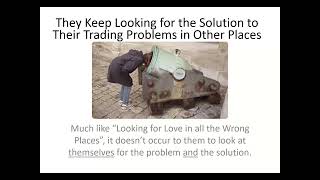
This is how I feel. And by the way, this photograph is taken in Charleston, South Carolina, where they had the mortars fire the first shots of our civil war. And you're looking at a girl looking down the muzzle of. Of a cannon. So, so what do you do? And that's what a lot of traders do. You keep looking for solutions like moving from teacher to teacher, from system to system. And you're looking for that magic that allows to give you that, you know, give you that edge. You do that and you think, you know, I'm going to find it. And what we don't ever look at is you looking at the space between your ears and going, what's going on in there? Okay, how is it contributing to the problems I see that I'm having? Because most people I know that have traded, most people I meet have been trading for minimum two years where they kind of know the technology a little bit, but mostly four and five to 10 years where they've gone through the route they thought they were going to win. They had the winning combination, they were winning, thinking. And they kept looking and sticking their head in various cannons. And finally they came to a moment where they realized that, you know, something. It's, it's. It was between the two ears. That's it is. And what's occurred is this.
Unfortunately, we carry flesh with us, or what I would call neurobiology. And that neurobiology, it's all about organizing the potential that you are into a particular self that can survive, not thrive. Okay. That's what you're trying to do in trading survive. And in that time that they, you become locked into a comfort zone, a perceptual map that literally becomes a tunnel. And all you see is through that tunnel, you don't see. Everything else, you know, from my perspective is your brain, when you're born, immediately starts going, just kicking gear and is saying, I need to organize the potential of myself in order to be able to survive in the world that I am now. Thrust. It organizes it into familiar pattern. It habituates, and then it becomes automatic and just simply sinks beneath the threshold of. Of your awareness. You never even know it's there. It's kind of like the story of the elephant that's been tied to a post that he can't move from and has become so used to being tied to that post that when they take the chain off the post, the elephant no longer wants to try to get away because it's got a pattern. And for it it's normal to be held by the chain and the chain doesn't even have to be there anymore. It's in the mind. So the key is that we have to begin to start saying, how do I take those blinders off? So that my vision opens up to a greater sense of who I am as a human being and I can reorganize that material into an effective trader. That's what we're looking to do. Okay. And to do this and to survive that particular deception. And traders do that a lot. Traders basically have to come to the moment that the head game does matter. And it matters big time. And they recognize that they are. I tend to. A lot of the people I work with are actually quite smart. They have like really cunning, sharp minds and have done very well in other endeavors in their life. And they get to trading and they think they're going to use that success model and they start using it. It's going to. It's been successful before and it blows them up.
So what happens is they have to use a different perspective. Okay. And the problem is most people never realize what's really going on. And I'm going to give you, I'm going to give you an answer about that. I'll give you an illustration is that I work with a guy, as a matter of fact, I just saw him an hour ago before. Before this is that he and I are working in an advanced stage. And what we're doing is we're using a place where you are basically imagining the problem that you have and you've been able to define it pretty darn well. And it's almost like a holographic three dimensional film that you can walk around, you can slide around, you can really look. And. And what had happened ultimately is he's an options trader and he was doing okay. He saw the trade coming, he saw the loss coming. He handled it really well. He bought some puts because it might go well. And then when in. What happened before he knew it though is that first of all he was no longer looking at his charts. He was no longer following his rules. He was playing by kind of feel and aggression. And he also sized up because he was going to make that money back. He didn't want to lose. And what happened is he ended up blowing a big, big chunk of change. And ultimately when you really go and really focus down on it, what had happened to him in kind of randy speak is that he was following the rules, he was solid.
Except for one thing. In the back of his mind, he was Going to make some money today. I'm going to win. Now what I want you to understand is that you, the trader has no you, you do not cause winning or losing. You set yourself up for potential of winning and losing. And if you have an edge, you're going to win more than you lose and accumulate capital. Okay, but you don't have, you don't have control over the outcome. Well, what happened is when he took that loss or he, he, when he took the loss, what triggered was I'm not going to lose. But the I'm going to, I'm not going to lose was already in his head when he actually the order fill happened and he was ready to manage that trade. And ultimately there's a part of him, he grew up in a culture and in a family that was highly competitive and they, you had to be very smart and you had to be able to out compete your siblings and it was kind of used and so he didn't want to lose. So the key is, is it, it ended up blowing up. And what was there was a certain rebel part of himself. Okay, that says, well I'll show you.
That's where the discipline broke down. Okay. Now what we've done is we've mapped that, we see that literally how it works and matter of fact what we've done is we've to actually show what the facial expressions are and we added a heart rate monitor that allowed us to see literally where that exactly happened and it allows us to be prepared as we move into that moment. Okay, the discipline just broke down though.
Excuse us one more time. Do you like that music? So the question is, how have you tried to fix the problem? There are tons and tons of different way your affirmations or big time visualizations. NLP tapping, cognitive restructuring, brain entrainment, positive self talk, prosperity thinking, the list goes on. Okay. And what I want you to notice is this. It's the very only difference between problems you're having before trading and problems you're having in trading now you'll notice a similarity and what happens to you in trade. The difference in trading is time compression is that in regular life you can kind of hide from the truth, okay, and just kind of deny it and just create all sorts of convenient excuses and place blame elsewhere. But in trading, your trading account just simply is not going to tolerate your lying. It doesn't care. It doesn't when you fabricate an excuse. Because ultimately what you're doing in trading is that you are projecting the beliefs you have about being able to manage the uncertainty of the challenges of living. And you're actually seeing how effective those beliefs are.
And what you discover is very people have it and they pride everything else except for actually getting at the belief itself. And for me, that's where the magic happens. The problems keep happening. They won't go away. And you try everything. And especially what you try is you try not to look in the mirror. You try not to say, oh, my God, this is me. This is me that's doing this. And the biggest courageous thing, I think a trader really ever comes is when they look in the mirror and they say, you know something? This is me. I know that I can trade when the money's not real. But the moment the money gets real and risk triggers that old primitive brain to think of the challenges of living, suddenly everything's out the gate. And this time, though, is you have to face it or you have to blow through your money and finally have your spouse get really annoyed with you and finally have to leave the game of trading. And, you know, the trading gods don't care. You know, they're just as open to you making money as losing money. But the thing is, is that it's time to understand the problem better, okay?
The point is this. Your mind may be willing, but your flesh is not buying into it. Your flesh, that neurobiology, that. That brain of yours became human about six and a half million years ago. It was built to survive, okay? It was built to survive in a time that 95% of people were dead by the age of five and everybody was dead by age 25. So you had a lot of things you had to do, and there's a lot of threats going on. And so you had to be prepared for those threats. You got wired into the neurobiology, the flesh. And meanwhile, this tumor grows out of the emotional brain, okay? And as it grows, complicated networks of communication go into the new brain from the emotional brain. But the reverse, there's only two little 19th century telegraph wires going back into the emotional brain from the new brain. Do you see how this could really get you into trouble? Well, it does.
And here's the deep. Here's the deal. If you take a look at this, actually, I find this pretty amusing. What I want you to see is information is coming up that brainstem, okay? It gets to the emotional brain, the limbic brain, okay? And finally, way, way, way over there, it finally gets to the thinking brain, the rational brain. The problem is when it hits that limbic system, okay? The problem, it's very simple. It's an emotional response that happens in nanoseconds. And it's in the bloodstream, the cortisol, the testosterone, the dopamine, all that stuff before the data gets to the thinking brain to be able to think rationally and logically. So the thinking brain's left out, and you find out about it going, what happened? What happened? Why on earth did I do that? Well, you did that because you were not aware of how powerful the emotional brain is and probably have been trying to ignore emotions and push them away rather than realizing that you are an emotional being. You're not rational. You rationalize. And until you learn to work with those emotional, those emotions to produce the mind, then you've got a problem. Okay? So how do you get to be comfortable with the unknown? Okay? And letting go of control, that's what your old brain is built to do. And you have created the old brains, the one you carry around in the midbrain, you create. You have created its worst nightmare by subjecting it to trading. And until you begin to go, how do I. How do I understand this in a context that allows me to be able to manage this better rather than trying to bully and push everything away? No, what happens is you need to master the emotions. And how do you go about that, that lack of control and outcome? Oh, man, oh, man, oh, man. That is the hard part. The guy that I was telling you about a little earlier, that was really what the problem was. He didn't want to lose, you know, something. He was going to show everybody, and that's the way he grew up. That's the way he formed. And it just so happens that doesn't cut it in trading. It made him a very wealthy man in business. But he has to be able to change the business mind into the trading mind. It's a very different animal. So we come here and we get it. Is that your brain involved to avoid uncertainty because it was associated with biological threat. The moment that you felt uncertainty, your brain became vulnerable. I mean, you'd feel very vulnerable about a great white shark too, I bet. And at vulnerability, the brain gets confused. And the brain does not like getting confused. And what it does is it jumps right to the amygdala, triggers, fight, flight, and there you go, okay? The predators after you at that particular time, in the time that we. That our midbrain was forming, it was dangerous, okay? And unfortunately, whether or not you like it or not, it doesn't really matter, is that your emotional brain can't tell the difference between biological threat and psychological discomfort. Further, it can't tell the difference between money as a symbolic representation of power, of mattering, of worth and status. Okay. And the real deal can't tell the difference. So what you've got is you've got money. The primitive brain looks at it as like, oh, that stuff, that's the environment and that's where my sense of mattering comes from. Money. Yeah, we want to make some money today. Yeah. And what you're doing is that you're constantly having money threatened in trading. Okay. To the primitive brain. And until you change that, you're going to have those storms that's going on in that guy's head. So you go, wow, man, I brought a brain unfit to do what I'm asking it to do. Yes. That would be the very first smart thing that traders recognize is that this isn't their fault. Now this is just evolution, psychological evolution. And you got some stuff that compounded in family of origin development. But what you've really got, you've got a brain built for one thing and you're asking it to do another that it considers its nightmare. That's what you got. So you develop this comfort zone that's those blinders and tunnel vision that there. And that's not going to hack it. Okay. But it's comfortable, it's familiar. And your brain will accept something that's familiar. Though it's self limiting than to push into uncertainty to see if magic can happen. Trading is not going to give you a choice about the matter. If you stay in that comfort zone, you're not going to become a successful trader. And do you know how many successful traders there are? It's estimated about 2% are consistently profitable and actually make their way through trading. The rest have high ideas and they're rah, rah, rah, they're raw, they're ready and they get. And what happens is they bring that and that positive bias they have, but they're stuck in a comfort zone that doesn't allow them to build the mind that works with probability rather than certainty. That's the deal. And what happens when discipline breaks down? Uncertainty's there and the, and the thing all of a sudden after you take a loss, 2, 3, then you start going, you start getting a little more itchy, a little more itchy when you're trying to pull the trigger and getting another trade, okay, on one side, on the other side there's another part that says oh my God, they've taken part of me, I need to get it back. I'm going to get it back now, and all of a sudden you start trading with a lot more leverage than you should, and just, you start moving into markets, you start making really crazy decisions and the uncertainty monster gets you. And if you want to see this graphic and really understand how it works, here it is right here. What I want you to think is you're looking at the automobile called the brain in this particular thing, and you're looking at this geeky, you know, guy, and he thinks he's in control. He's got it. He's. Man, he's not back there in the printed world anymore. He's. He's in charge of the environment in which he exists. He's got a house with central heating and cooling. He's got this, he's got a car. You know, he's not, you know, he's not subject to the weather, to hunger, to all that stuff. Under control.
Meanwhile, in the backseat is the primitive emotional brain. Totally different agenda. The emotional brain is working in the present moment.
And when it sees threat to capital, it sees threat to self, okay? Or when it sees opportunity as, as capital gain, he jumps into it. And often without really understanding what's going on. Okay, so here's the deal. Here's what it looks like, okay? Here we are starting out as some hominoid at one other time a place a long time ago, and we became Homo erectus. We started doing. We'd already started doing the cool things. We became Coromagnon, we did all that stuff, and suddenly we started developing really cool tools. And before you know it, we're sitting in front of a computer. But what I want you to notice is throughout the evolution is that hominoid that we once were, that 98, understand, a bonobo chimpanzee. There's less than 2% genetic difference between us. We're almost kissing cousins. Okay? That kind of should give you an idea. All those survival instincts are there. And the key is, is that if the successful mind just simply has to be reordered, and the good news is that it can in fact be taught. Okay? And when you're doing it, what you recognize is that we have inherited a need to control as a survival trait. And what we're going to have to do is we're going to have to reorder that trait. We're going to have to recognize that success is not about controlling outcome, winning. Success is about controlling the mind we bring to performance.
That's the trick. That's the kind of control that you have to be able to start generating to Be able to produce the eye the kind of results you want. And here, what I want to do is, the point I want to make here is that all thinking is emotional state dependent and that your brain really should. I would encourage you to look at as a community of rival emotional programs that are highly competitive and cooperative, trying to figure out how to organize the self that would be you. And this is from a movie, Inside out by Pixar Disney. And what you're doing is a conception of a little girl's, a young girl's brain. And inside that brain, what you have, you have these particular emotional programs that are trying to be cooperative, but every one of them are trying to be the dominant one. And what you see is. You see a mess. The girl, the girl's a mess. Well, the emotional programs running around in your head is electricity. This is exactly what it looks like you have. It's. It's organized you into survival self. And what you're doing is you're running into. You're running into the new world, the brave new world called trading. And you're discovering that survival safe just simply doesn't cut it. And from there, from there, what you're also getting is that you're beginning to recognize that you are actually projecting, okay, your interior beliefs that you have about your ability to manage uncertainty out into the world. Okay, so it starts out as you have core beliefs about your capacity to manage uncertainty. And then out of the language, out of the actions you produce, your performances actually reveal those beliefs in action. Okay, that's the way that would really work. Okay. And that's the part that people don't really like. That's not. You went backwards.
So what we've ultimately got, there we go, is you have an observer. You might even know that you have an observer. But I would contend that all reality is observer generated. The quantum mechanics boys say, well, actually there is no such thing as mass or energy. What there is an observer of potential. And that observer of potential is what gives shape. So what you're getting is you're having an observer doing a film of your beliefs, interacting with your emotions. And it's creating your perception of the world out there. Now that's not gobbledygook. Every time you look at your charts, okay, what you're doing is you're seeing the observer and the beliefs that the observer has embedded, interacting with the emotions, creating and being projected onto the markets. You're actually seeing perception. I have a client who literally one time asked me, he pulled up a chart and really good Trader, okay. And he said, randy, what do you think I see right here? And I said, well Christopher, I don't really know. Why don't you tell me? I see blood.
He has an observer that has a set of beliefs and an emotional response of a predator that he sees people where retail traders can easily be shaken just a little bit. And what happens, he can suck their blood. So I want to tell you, if you get it, he's all perception is observer generated. That's the whole point. And the key is how you go about building a mind for the manager of an uncertainty. Okay? The key this is that first thing is to recognize that the default programming of your brain and mind will, will resist change because of the inherent fear of the unknown in all its forms, particularly in trading, represented by the potential loss of capital or to it the loss of life. That's what we're talking about. And here's the way it would look. And if you take a look at this thing, this is what the brain really sees. When you're fighting not to lose, you're seeing something very dangerous. And it becomes automatic. And the thinking brain never even has a dang thing to say about it. It's already in fight flight before. And by the way, that's done in 003 seconds. If that information even gets to the thinking brain from the thalamus, it takes at least a quarter of a second. That means that you basically had a quarter of a second, the emotions had a quarter of a second head start to produce the chemistry of the feeling of an emotion that takes over your perception. That's how you have a hijacking, friends. That's exactly how you have a hijacking. So the first thing that we want to learn is emotional regulation, at least in my teachings and work. And what you're going to recognize is that you are an emotional being. And emotions are biological in their nature. They are not psychological. They take over psychology. So the very first thing that you need to be able to do is to be able to slow an emotion's density down so that it doesn't spill over and become chemistry in your bloodstream. You're cooked then. And what you discover is breathing and tension reduction can be used to slow the emotion down. Think about it. When you're angry or when you're scared, you hold your breath, you breathe, okay? And then you start getting tense. You know, my fists get tense, the neck, jaw, all that stuff gets in. What you're looking at is emotional arousal. You're not looking at tenseness in the Muscles, you could see it that way. But the thing is, is that that is emotional arousal. And what I want you to do tomorrow, get a mirror, or better than that, get a webcam and video yourself trading and watch the fun. I mean, it's, it's, it's kind of embarrassing. You say, oh my God, I had no idea. You see the tenseness, you see the bulgy eyes, you see the holding of breath, you see all that st. Those are emotions, friends. And this is where emotional intelligence really is about understanding that stuff and learning how to really work with it, okay? The third thing that's got to happen is that you have to learn to develop mindfulness or an observing self as a skill. It's got to be done, friends. In mindfulness, what you basically discover is that you and your thoughts are not the same. Listen to that one more time. You and your thoughts are not the same. No, these are my thoughts. I know that these are my thoughts. I can, I can look, I can hear him. I, I, I, I, I. And what I would tell you is that, that I, you keep talking about, it's just simply one construction of a self that has been created and that the observer that you are has fused to, okay?
And you don't know it. You need to be able to step back out of thought, which is what the observing self does. But you and your thoughts are not the same. And as you do that, you discover really quickly that you run into this thing is that you start looking and you start going, you know something? I'm no longer going to be scared of my trading account. Because what my trading account is doing, it's actually revealing the self limiting beliefs that are holding me back, that I refuse. Another part of me refuses to see. The trading account is your friend if you learn how to observe it. So you come to see you. It's just one potential organization of a self rather than you, okay? And thank God, because boy, I'm tell you something, I would have had a tough life. And then what you're doing with that observer is that you're beginning to see the observing self. And you're beginning to look at all this junk, all this, these things, thoughts whirling around your mind, having conflict inside you, all that fear, all that self pity, all that resentment, all that rebelness, that anger, all that stuff. And you realize that there is another part of you talking, okay? And you realize that inside you there is something that's very destructive. I call that the inner critic. And it will, it will, it will stop you from getting into good trades, it will encourage you to get into bad trades.
It will encourage you to make up for prior losses, even though intellectually you understand that can't be done. And you start also recognizing that there's an orphan nature to you that really just truly believes that it's a, it, it, it's worthiness, it's mattering and all that stuff start really coming into play. And that ultimately is what you're going to have to learn how to master and to change.
So we've done that. And then what we do is we realize, well, you know something.
That'S where most people find they're stuck. They find themselves an adaptive self that, that's just your brain organizing your potential into a self that can survive. And it survived before trading, then it got into trading. And it's a different environment and you weren't adapted very well. And you have to learn to change who you are to be able to make a more effective trader. That's the adapted self. And the inner critic is that judge, okay? That criticism, that's not you. But you have to learn to observe it and go recognizing wow. And what you do from there you begin to say, you know what?
I begin to recognize that there are a vast number of different voices within my head. Okay. And if you don't think you do, you've got a really serious problem, okay, is that you have an enormous. If you've ever been of two minds or more than two minds, you've experienced this. If you've ever had an internal struggle going on about which way to go and stuff like that, you are actually on a biological level, what you're experiencing is different. Special interest groups of neurons, activity, are having an opinion and it's diametrically opposed to another part of the brain. Now we call those, when those, when those have elevated up to mind, mind is where those, all those, all those emotional programs are given voice. And so you end up realizing, wow, I've got a lot going on. And what happened is I have a very deeply undisciplined mind that I have brought to trading and I've been exposed, I've got to reorganize it to higher functioning. And this is where it comes down. Because ultimately, ultimately is this. It's easy to get to fear or overconfidence. They're built right into your evolutionary psychology. You know, we.
On the African savannas, we assumed, we came to assume that behind every bush out there that we could see from the bluff, there was a saber toothed tiger, when in fact only One tiger was out there, but it was for our survival. It locked in as a trait that's been transmitted genetically into us. That's evolutionary psychology. Then we grow up in families that even if you go in a really great family, most likely you're going to walk out of that family with scarcity thinking, you know, keep a job, get a good job, you know, do the good, blah, blah, blah, blah. You're not. And you may also grow up as a rebel. You may. There's all sorts of things, Alpha, where the way I matter is by winning. There's all these things that may work really well, but they don't work in trading. What we're looking for.
We'Re looking for certain emotional programs, the discipline of ruler, the ability to maintain order under pressure, okay? We're looking for the courage of a warrior that would allow us to turn toward our fear. It's not the absence of fear, friends. It's the willingness to turn toward that fear and protect a greater hold. Also, we need to develop that self soothing, that self compassion, that mercy of a caregiver within us. You're going to be taking losses for as long as you trade. And you need to have mercy on yourself rather than self condemnation. Self condemnation just digs the grave deeper. The mercy, the self compassion allows you to get through that, connect back to your inherent worth, okay? So that your sense of worth is not built around if you're winning or losing. You no longer confuse your performances with your being. And that's what really great traders learn. And then what happens if you're able to work those first three pieces? What you get is you get the impartiality of the sage. Impartiality is an emotional state. Probably has only been around for about 25, 50,000 years. It's a new kid on the block, and it is contaminated by fear very easily. So you're, you're talking about building, you're finding these emotional programs within the self and you're learning how to say, you know something, I need to be acting and thinking from these intentionally, okay? Rather than basically the neighborhood I brought with me. Yeah, we need to change this. And this is where we start saying we need an intentional mind. From there, you have to go, well, how. What does this look like in real action? This is a really good example. You know, this is a seasoned team of people doing a sailboat race at a rally, okay? And what you're looking is you have a captain who is barking orders, maintaining order and stuff like that. And everybody there has an assigned role that they need to be forming so that ship stays together and is competitive. Now, there's a lot of energy that's been put into that. In the same way with any elite athlete or elite performer, you know, whether or not it's Russell Wilson, Tom Brady or whoever, what you're seeing is, man, they. They realize that to be elite, not. Not good elite is that it's a mind game. You have to prepare the mind to meet the challenges. The challenges are coming, friends. Okay? You're gonna lose a lot in trading.
Can you produce the mind that deals with that and can find the edge and keep those losses small? And when you finally are fortunate to get into a really good trade is you can let it run and to be able to take the profits that are given there. Yeah, that's the discipline. And what you discover is that discipline ruler manages that entire. That entire group of emotional programs. Nobody is just in competition with one another. There's an authority there. The CEO, the governing. The chairman of the board has finally woken up and taking care of the mutiny. And the governing board, the chairman of the board is there, and you begin to see, oh, okay. He's bringing order to the way you respond to uncertainty. That's what you can control. It's like in the PGA golf tournaments. You know, all those pros can putt, all those pros can drive, but when the money's down, there's only about 10 really big money makers. And what those guys know, they know that they don't control the crowds. They don't control the weather. They don't control whether or not another guy is having a heck of a day or not. What they can control is the mind that's focused on that little ball. That's it. And they take their sports psychologist with them. You are in a field that requires an elite way of being there to be able to be consistently profitable. And what I'm saying is you need to train the mind that simply is not built. What you're asking it do to be able to perform in the face of uncertainty. That's what you need to do, friends. And I'll give you the. I'll give you the idea of a cougar. I want you to look at a cougar. The North American cougar is an apex predator in North America. The African lion is the apex predator in the. In the savannas in Africa. The lion has a lot of losses. He chases, he stalks. He gets hit a lot by big animals. Faces are broken. They're gored. And what happens is they have Heavy capital loss. So they have to have a big breeding program to replenish that capital. And you'll see lion prides 20 and 30 strong because of the losses they're taking, okay? They're apex predators in that environment, okay? However, if you took that African lion and brought him into the American forest, he'd starve. A pack doesn't work well there. Meanwhile, the cougar. The cougar is not a stalking animal. It's an ambush predator. It climbs a tree, hangs out on a limb 15, 20ft up. He knows the networks of transportation in the forest where the deer use their little paths and things like that. He knows the setup. So he gets out on the limb, is watchful, wakeful, waiting for the deer to show up and set up. When it comes down, there's not very much fighting at all. First of all, the deer never sees him, okay? And most likely his neck is snapped before he hits the ground. So there's not. There's not much fighting. There's minimum losses. If they miss and the deer gets away, the cougar doesn't chase. It climbs back up the tree, sets up again, patiently waits for the next deer to show up in the setup. Both these animals are apex predators, okay? What I want you to recognize, and you need to choose is that a lion just doesn't work in trading. The cougar, the ambush predator, works really, really well. The lion would work really well in corporate America and business and all sorts of places. But I want you to take a look at that, the lion who stalks and stuff like that. And you have to decide which way you're going to develop your potential.
If you understand, the lion doesn't work. It's not like it doesn't work in all an area. It's a dominant. It's the apex predator in the environment that it developed for. What we're saying is you need to redevelop.
Okay, the kind of mind that you have brought to hunt. Instead of being a stalker, a chaser, you have to become a patient ambush predator, okay? So that's what we're going to do. And what I want to do is.
Most people take a while to wake up and to recognize that they are going to have to take responsibility for the development of the mind they bring to trading. It's unlike most other minds, okay? It's not. Winning and losing are simply about performances. Winning just becomes landing on the right side of probability. Losing becomes just landing on the wrong side of probability. The real question is, how well did you perform?
Now, what I want if for those of you who don't know me very well, I invite you to go to YouTube, I invite you to go to my website and read. There is a content rich place there where you can do a lot of reading, a lot of videos and you begin to see. Yeah. And get the free book for goodness sake. And what happens is you get to really see where I'm coming from and how I'm taking neurobiological emphasis to the basically adaptive forces that drive human development.
When you get there, if you've done that, really start looking at the book. Start, start really. Also ultimately it comes down to knowledge is by itself it's never going to work. We've developed two courses, one group course and the other an individual course. That's not, it's just not giving you the knowledge. It's actually showing you how to apply it to yourself, how to develop these, these strengths within the self so that you're actually prepared. Okay. The group course, we're having it start pretty soon and we truly. Yeah. A week from today. And the truth is that we only have room. We've already got a little over 30 people now and we only have room for a couple more. However, if you're looking at it, what we also encourage people to do is start way early, say for the summer course where you have started developing and working with it before you come to the first session. Because this course hits the ground running hard and if you're not ready for it, you're overwhelmed. Okay. And it teaches you the core skills. That's the big deal. But it's, it's something where in my guess is that you. We still have a sign up bonus to the. Yeah. Through. Through Saturday at 5:00'. Clock. Yeah, through Saturday at 7.5o'. Clock. Yeah, this coming Saturday. And it's literally, it's a, it's an emotional regulation training that I did for professional traders a couple years ago. The thing is, it's not really to entice you. What we want you to do is to recognize that if you're going to do this work, it takes about three or four weeks minimum to start retraining the way the body responds to uncertainty. Okay. And that's the big deal. And it starts that way. It's, it's an intense course. The individual course is really for people who want me as mentor and want to take it a good bit deeper. Okay. And it's just very comprehensive, it's very personal. And the thing is, is that you need to be serious about it. If you want to talk to me about it? Because it's. I. I really. I just simply don't have time to talk to everybody who wants to talk to me about. Well, I was just maybe thinking about someday. I was thinking about getting a guided meditation, and I'm sorry, you know, that.
Got way too much on my plate. So the thing is, if you're really seriously considering the individual course, ask for a free consult. The major thing is that I hope what you have recognized is, is the need to be able to develop mine specifically for managing uncertainty. That's what I'm hoping. And I have time for some questions, and I think there's already a few here, which is, you guys are great. Usually what happens, nobody actually comes in and asks questions until the end. So.
This is Kelly. No, Dajean. Oh, DeJean. Okay. Better, more effectively. No, the blue box. Oh, the blue box. I'm having issues implementing the mindfulness practice while trading. What are some ways I can use to better, more effectively implement while trading? Should I begin by listening to your meditations while trading? A lot of people do that, but I'll say is this, and I'm assuming that you have not been in the group course, and you would have no idea what. How I train mindfulness. What I can tell you is this is I actually have a very good mindfulness test tape on the retail stuff. And it's like, room is a mind is a room. And what you really need to be able to do is first learn how to produce a state of mindfulness, you know, kind of what I call it in the yoga studio. But the thing is that the. The mindfulness that you have in the yoga studio is worthless in trading. As soon as you learn it, you have to be able to start applying it as you trade. The same way the knowledge you have of trading is pretty much worthless when you get into live trading. Okay, is that you. You start there and you start saying, okay, I'm going to start exposing myself and intentionally provoke mindfulness. Step out of thought while I'm trading for moments. And what you're really looking for is you'll notice that you are a participant in the trade and that you can be an observer of the trade. You can't be both at the same time. So you produce mindfulness and you take a look at what's going on, inform that participant, and you go back into being a participant. So that's the way. I would recommend that that's the way George Soros does it. I love this Aloha. Aha. My name is Brando. Brandoli. And I'm from Maui, Hawaii. I've been there. I've been there. I will say that I like the Sorcerer's Island, Molokai a little better. And I like the big island quite a bit. And if you ever go to my website, you'll discover I have a lot of photography from. From. From Hawaii. I love that place. I would like to say thank you for everything you and Dolores do well. Thank you. I've listened and watched all your YouTube. Oh, my gosh. All 213. My goodness. I have been educating and trading for two years. Good. And still can't progress into becoming a profitable trader. I am not disciplined. Now, what I'll say is, under pressure, you're not disciplined. I don't know what the rest of your life is like, and I am greedy. What I want you to listen to is the observer is already frozen to a particular organization of your potential. I come to think that I need subconscious work. No, you don't. That's. Oh, boy.
You need to become aware of what the limbic system is, what you need. Because I believe that the way I have been raised in life is the cause of this. What's your thoughts on the matter? Well, I'll tell you what. Just from your caveman days, the brain that you brought to trading is not going to work. Okay. Right off the bat. And there's no doubt that most people they're growing up in regular old family of origins, have those problems from their evolutionary psychology just wrapped up. And if you grow up in a competitive family and you think you have to win, okay, well, you've got a problem in trading if you grew up in that. Where it's. Where there's scarcity thinking. Okay. And, well, guess what? You're going to have problems in trading if you grow up in a traumatic. I grew up in a profoundly alcoholic, dangerous environment. Okay. And. And I. I am the only survivor. You can really say is that it's. It's unique. And it took me a lot of work to be able to organize myself, but, yeah, you have to work through that. But if you're going to work through that, that's.
You're better. You better be ready for change. But it has to be done. This is. Thomas. Biologically speaking. Where'd it go?
Okay, we lost. We lost it. Biologically speaking, what is the use of our inner critic? To destroy us. Why do we have such a thing in our mind? Who knows? I don't know. I mean, man has been creating all sorts of stories and narratives about It. You know, in the Abranic religions, we talk about fallen angels and we talk about the devil and stuff like that. But if you go to Kabbalah, what you'll discover is Satan. Sadat is that which stops you from being your best. Okay, you begin. You just have to look and recognize that the ancient Chinese had already figured out destruction and construction just simply a part of the human thing. The Hindus, when they were inventing their God, discovered there was a creator God, there was a sustainer God, and a destroying God. We have all sorts of explanations that. Why, I have no idea. I just simply know it's there. Stephen. Stephen, I purchased the book and workbook. How different is the group course from all the material? Oh, my God. What you're receiving in the book and the workbook are information and knowledge.
And a little bit where, if you're smart enough, you can begin to apply it emotionally in the. In the group and in the individual course. Knowledge is the start. You're being taught processes that allow you to go in and redesign the mind, work with the brain and do stuff that it. It's just like. It's the difference between a pop gun and a howitzer. Okay. That's the way I would explain it. Okay. I am not going to try to pronounce your name. I have a really hard time doing that. How to get rid of the guilt of trading so many times. I think it's just like gambling and it's wrong. How do you get rid of the guilt? Well, first of all, understand guilt from a neurobiological emotional intelligence perspective is that guilt is an emotion. It says the attachment bond has been broken. It needs to be repaired. I think we're really talking about shame. Shame is an emotional and toxic level that says there's something wrong with me. Okay, I'm flawed.
A healthy shame. From an emotional intelligence perspective, shame is telling you the way you're currently organized is not working for the good of the whole. And shame is disorganizing you so that you can organize yourself into higher functioning. What I encourage you to do is to look at that is as shame and really become master of it and learn from the shame and to recognize it's disorganizing me, which scares the heck out of the primitive brain. But in standing up with these particular strengths, what you get to do is you get to reorganize the self. And good luck. That's a lot of work. I had to do that. Kelly, I have been following you for quite a while. Well, thank you. Appreciate everything you do. Do you have recommending recommendations for having fear when setting the trades? I am extremely disciplined when in the trade, but fear of loss prevents me from. Yeah, from setting trades up. Your thoughts? Well, what I would say is that what you're looking to do is you're looking to mollify fear into concern. You need to be concerned. Okay, you're risking capital, for God's sake. But fear, to the primitive brain, there are two forms of it. Fear itself is imminent exposure to threat. Okay, I'm about the trade goes against you. Anxiety is imagining the future as bad things, which is usually what people who have problems getting into trades or having their. What if I lose? What if I lose? And what I would say is, this is what you're going to have to do if you're going to produce success, is you're going to have to master the fear that lurks behind loss. Most of us have a fear of losing that we developed. I mean, I can't tell you how many times I have heard this. Is that really smart guys talking to me and says, randy, when I was growing up in school, I would make a 95 on a test. I'd be so happy, I'd take it to my father. My father said, where's the other five points?
Rather than celebrate with me. So we learn to fear loss from a psychological standpoint. We've already got that fear of, the fear of loss of life that's coming from our psychological environment, evolution. So the thing is, is you have to master that. And kicking tires, you know, ultimately, unless you just get real lucky and kick the right tire, I guess it's not going to do. The thing is, is you're going to act, you're going to have to master the fear. And that's what, to me, that's what, that's what the power of trading does, is that you can't get past that trading account. It's going to keep telling you the truth whether or not you like it or not. Okay? And so good luck. There's a great group course that can help you though.
Here's Sergeant Dow Jones Jones. That's pretty interesting. I only seen two traders who were successful. I am not in the top 2% crowd anyhow.
In any area. I. One of my better. One of our better friends has made over $100 million in the last couple years. Okay? There's plenty of guys like that.
How do I know if I am capable to become a trader? Well, you may not be honest with you. The odds are stacked totally against you, okay? And it Comes to a time I worked with a guy who was a serial, very successful entrepreneur and he had sold a business and for cash no less, and had a heck of a lot of cash. And he talks to his brother who's a trader and begins to understand that trading is a capital intensive industry. And he says, well, I've got the, I've got the capital. I have to learn how to do the business. And four years later nothing was happening. And he learned how to be a successful. Later he was, he was consistently profitable working with me. Then he one day he comes in and says, Randy, I want to thank you. This is the best money I've ever spent. I know that. I don't want to be a trader. Okay? He said, I want control. Then I said, you should stay an entrepreneur. He said, yes. So what I'm, what I'm encouraging you to do is that I'm going to tell you something. Training is just simply not for everybody. And there's an. If you already have an anxiety predisposition.
Boy, that is a heck of a mountain to try to climb. And I would encourage you to look at it very seriously. And if work with and start noticing. What is it that really stops me? Is that Matt, the guy that I was talking about a little earlier, you know, ultimately he loved the challenges of, you know, of turning a business into something great and making a lot of money doing it. You know.
It'S really terrible to waste a perfectly good entrepreneurial mind on trading. Okay. It's in many ways a waste of good energy, of taking an accounting or engineering mind that really thinks in boxes and stuff like that and certainties. And then I'm going to force this thing into becoming a trading mind that accepts ambiguity as part of life.
I encourage you to look at it that way. Okay. This last one from Ronald.
I've only discovered your work about a month ago and it's amazing. I've been stuck in a cycle for about five years. Yep. Of doing well for a few weeks or two years of doing a week or two, then having huge losses that set me back. Please advise possible. Well, what you've got is a case of euphoria is that when you start winning, unfortunately the brain doesn't learn. What it does is it stay it. It starts getting dopamine and dopamine gets you euphoric, you get overconfident and you start really blowing up stuff or your self worth wasn't there in the first place. You start making money and you start finding ways of blowing yourself up. Okay. I don't that would be. That's the kind of stuff that people come into our group courses and our individual forces to discover. But you're already seeing I can do, I can trade. The problem is most people don't realize that getting over fear is just simply one step on a very long ladder and you get to the next rung and it's about winning. Is that managing winning really becomes challenging. So that's what I would say to you. Okay. That you'd be a perfect candidate for taking something like this and starting thing. You know, what is this? Why am I sabotaging myself? Okay. And it's either from a kind of a lust where you think, oh boy. Oh, yeah, yeah, yeah, I got it, man. Look at me, look at me. Or fear like, oh my God, I'm getting. It's getting really good. Something's bound to fail. Okay, friends, I want to thank you. I've thoroughly enjoyed myself and I only wish you the best. And tomorrow, what I'd like you to do is really when you trade, if it's not tomorrow, whenever the next time, really take a look at it and recognize your trading account is your best friend. You just don't like. You don't necessarily like what it's telling you. Okay. You need to listen and you have to decide whether or not you really want. Are willing to reorganize the self to become a consistently profitable trader. You will have to do that unless you happen to have won the genetics lottery. Not too many people do that. And when you see guys who have won the genetic lottery, you don't really want to be like them. Okay. The key is, is that the call to become a consistently profitable trader for most traders is self mastery. And that's what you have to choose if you. If you choose that and they I will take a look at our work. That's what it's built for. Self mastery. So I've had a wonderful time. I hope you have a great, great life. And if I can help you. Oh, yeah, yeah, yeah, yeah. My wife, who is very Irish, wishes you a Happy St. Patrick's Day. Good evening.









