How to Stick to my Rules When I Get in a Trade
Randy Kardec explains why traders abandon their rules once they're in a trade. Your evolutionary instincts and beliefs about loss hijack your rational plan when uncertainty hits. He teaches emotional regulation, mindfulness, and building what he calls empowered emotional programs to stay disciplined.
Chapters
The broadcast is now starting. All attendees are in listen only mode. Welcome, everyone. Welcome to this month's webinar. And first thing before we get started or anything is let's make sure that you can hear me. We hear you. Listen to that. You must have been here before. Thank you. Thank you. Thank you. Okay. The other thing is, is that I hold my questions toward the end. That doesn't mean that if you have a question, you can't just go ahead and write it in. That would be really helpful to us because that would, instead of having a lag, it would allow us to have a couple questions while other people are getting their act together and maybe formulating a question. So that's. That's the only housekeeping thing there is. Now let's really. This headline, why can't I stick to my rules when I get in a trade? Actually came last week in a conversation I'm having with the trader. And he said, I can't understand it. I don't understand why I can't do this. I have a plan. I know what it is. I get in and then all of a sudden stuff starts going on and happening, and before I know it, it's just gone crazy. And when the smoke clears, I see the damage. Now, the question we really wanted to look at is what was going on in that guy's mind? That he's okay. One moment he gets into the trade and it starts taking off. That he would literally have a corrupted mind, loses his mind and get replaced by a caveman brain scared or lusting after the big. The big, the big pot. We want to take a look at that. So where we're going to start is this.
Is that the truth is.
The truth is people have no idea what they're stepping into when they step into trading. You know, it's sold. That's kind of like, you know, you know, you. All you do is follow these rules and you work with this probability and you can make. Look at all this money. Now, they're not talking about how few people actually make money in trading, but they're really showing you the idea of what you can do. But the thing is, is you are walking into what I call a mind M I n d seal. And if you don't know what you're stepping into and what you are activating when you step into a trade and suddenly you're no longer in control of winning or losing is that you are dealing with probability and uncertainty. If you do not understand what's going on there, you are going to have Serious problems. So tonight what we're going to be doing is we're going to take a look at the foundation of the problem and then I'm going to show you what I teach for helping people overcome that and to begin to really master.
The self they bring into engaging that uncertainty. So the main thing is this, the mind that you bring to trading is not going to be the mind that's going to produce success in trading. You go, well, why not? The truth is, is that you have a brain and a mind that comes out of that brain that was built for survival, success, biological survival, success in a very dangerous world.
Back then there were saber toothed cats that were looking for us. They were massive animals. And there are also like mastodons that men would organize themselves and attack. When the mastodons 20 times the size of each man, they had to be gaga. They had to have, they had to have irrational exuberance to be able to charge that and to think that they were going to take down that mastodon and nobody get hurt. Well, there was a lot of hurt. But the thing is, is that the village needed to be fed. So the deal is this.
Is that the big reality check, your best friend, is something you wouldn't imagine. It's your trading account. It is going to tell you whether or not your beliefs that you hold about your ability to manage uncertainty. I mean, your limbic beliefs, your implicit beliefs. I'm not talking about the ones that you stand in front of a mirror and say, I'm a disciplined trader, I'm a disciplined trade, blah, blah, blah. No, I'm talking about the ones that actually open up the possibility, the way you're going to perform. Okay? The deal is what you're actually seeing when you trade. And in your trading account are the beliefs about your ability to manage uncertainty loss, okay?
You're putting them to the test and you're actually seeing which ones are showing up. If you happen to have a mind that is built on the belief that, you know, this is just simply winning is just landing on the right side of probability and losing is just landing on the wrong side of probability relative to me, most likely you're going to be okay. But if you're going to have a belief, I've got to win, I've got to make money, I hate losing. If you bring beliefs like that into trading, it's going to blow up in your face. It's amazing, isn't it? So out of this, we're going to. Hmm. Well, tell me a little bit about why trading Psychology. The reason, the reason people come to my webinars and start watching my YouTube videos like.
All nighter with them is because they have been successful before. They get into trading and all of a sudden what they're discovering is something's really wrong, is the mind that they brought truly is not working now and that trading account revealing it. The real question is this. Are you motivated to change something that evolution has wired in to your genome? That's really the question. So let's take a look at this first. Let's take a look at what really. If you think about trading as a way of system.
There'S three legs to a successful trader. One is that trading system, your platform. You know, it's gotta work. You can't have your platform messing you up and not getting you into trades and holding stuff up. It has to, you have to be so intuitive with it, much the way a race car driver is intuitive with driving that big massive machine. You put me in a machine like that, I'm probably hurting myself. But they're, they're there. But the thing is, you have the trading system, then you, then you invest in methodology where you actually build rules that allow you to manage the risk of winning and losing capital. Okay, you do that. And as long as there's no real capital there, you can just. Most people find that after several years of really building their skill sets up, they can almost mint money when there is no. When there's a reset button, when it's paper trading. Because the truth is.
If you are not willing to change the way you interact with that uncertainty, stay in the mode of where you're doing paper trading where there's no risk. Because ultimately what we're doing is that the moment that you actually start risking something, you, you land. In trading psychology, how do you manage the mind that you bring into the thing? So what you're seeing is successful trading is trading platform methodology. That's what everybody learns in the hope of becoming a very successful trader. What's missing is how do I develop the trading mindset that allows me to extract more capital out of the markets than I give back in? That's the trick. And that's why maybe 2% of traders really are consistently profitable and make really good money. 5% is the tops. And so you're looking at it and going, well, what's wrong with me? And it's not you, friends, it's not you. What happens is this graphic pretty much shows that we are carrying instinctual responses to uncertainty from our most distant relatives. Not even Homo sapiens, but before then.
So you've gotten that moment and you're saying, stop following me. I don't want all this instinctual stuff coming into me as a modern man sitting in front of a computer, playing a probability game that the caveman never even understood. Okay? So what happens is we're going to need to say, you bring instinctual survival skills to the table that were useful in the jungle or the African savannahs, but are lethal. They're killing you when you trade. And until you come to the moment of saying, well, well.
What do we do here?
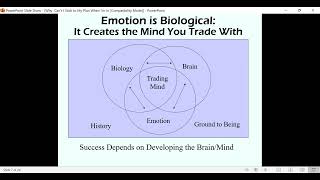
Well, we have to re engineer the trading mind, okay? And a lot of it is just beginning to understand that we're a lot more complex than you imagine. From my view is that I do not separate your biology, your brain, emotion, and mine at all. I see them as functioning. They're different aspects of the same thinking process. And you have to learn how to say, how do I produce a trading mind? And that falls under emotional intelligence, not cognitive intelligence. You have to develop your mind for trading. And fundamentally, I think what's missing most is the actual courage of saying, I have to change. I see my trading account is steadfastly telling me that the mind that I'm bringing into trading isn't working.
And then the biggest one is to actually take responsibility.
Remember, this is not your fault. You know, you bring evolutionary psychology that's totally against you becoming successful trader to the game. And then that same brain grows up in a family system and a culture and circumstances in a community that also ding it up. Because ultimately.
Your brain is an adaptive. Is really an adaptive organism. And out of that, what happens, this is where it really begins to really focus on, is that, you know, ultimately this thing you call trading mind is a function between these particular forces right here. The brain, remember, its survival instincts are totally dead set against you.
Risking capital, not because it's capital, but the caveman brain sees the risk of capital is the risk of life. Completely different games. Caveman has no idea what money is. This biology, you become wired to respond automatically to threats and opportunities.
That's what happens. You know, if you have ever, ever over traded, you jump in, you're responding to opportunity. Oh, yeah, there's a mastodon. Let me go get it. And then also, all that stuff gets wired into emotions, and we're going to be talking a little bit more about motions here in a second, because they're not what you think they are, okay? They just are not what they. You think they are at all. So we're looking at it and going, oh, okay. And then I've been born into a history. Like for instance, you may be born into a competitive family where it's really competitive. And what happens, you grow up with that competitive mind and it's done really well for you. You know, it's got you in a good play, good places. You bring the brain, you come to trading and that, that competitive mind is going to kill you. Also. You might grow up in a scarcity mindset in a family that says, no, we need to play it safe. Then you get into trading, you can't get in trades. So you begin to see how all this stuff works. You get born in that history. And the real question, it's all glued into a ground to your being. More about that a little later. So now we've gotten this thing where.
How do you change this deep seated belief patterns about your ability to manage uncertainty? How do you do it? How do you do it? Well, first thing in the process that we teach, we start with learning how to regulate an emotion. His emotions are biological in nature and when they rev up, they have a process they go through. And unless you learn how to regulate that and calm it down, you're never going to be able to establish a mind that works in probability. Okay?
That's at the very bottom of it. Then you're going to have to develop mindfulness, the ability to step back out of thought and to separate yourself from thinking and to recognize that you and your thoughts are not the same. In fact, in neurobiology, what's said is that, no, you don't even have thoughts. They're having you. They're creating your experience. You're blind to it. You don't have the mind fullness to be able to see that. And you end up bringing a mindless mind that doesn't know how to deal with uncertainty into this trading. Then what happens is with mindfulness, it's like you can open the door of the mind and look in and start making sense out of all this stuff. And what you're going to discover is that there is an internal dialogue going on in your mind all the time. And you'll hear it, it's criticizing you, it's doing this and the other. There's fear. You talk about fear. Oh my God, I don't want to get in. I don't want to get in. I want to lose. God, what an opportunity. I better take this right now. I hate losing. I. That thing's, that thing's out to get me. I'm going to get it. That's the internal dialogue. Okay, then fortunately, the fourth piece that we teach is about finding out that we have empowered emotional programs that are embedded in our DNA. And ultimately what we want to learn how to do is to awaken those empowered programs and start making them normal and start making them the ones that trigger when there is a change, when there is a change of status in the markets. That's what we want to. We want to control what emotions arise, give rise to mind. We're not trying to control whether or not we win or lose. We're wanting to control the mind that we bring into that moment. And they have some very empowered sections that can really help you. And there are some things that are very destructive. We'll be talking about that. So you've gotten that. But then you have to become intentional. You have to become intentional about what mind you're going to be bringing into the internal dialogue and into your performance in trading. It just can't be any old mind that might be. There is a really good trader if, if he had an argument or she or it had a argument with their spouse and it still was unfinished and he still. All that kind of stuff you don't trade, that's under your skin, man. And the. What it takes to put together a mindset that can really work in probability.
You just have to learn to respect it. Okay, so we've seen this and this is what we teach now. So the first thing, the first thing that you're going to have to begin to do is you're going to have to learn emotional state management. And where this is where the little brand, this is where emotional intelligence comes in, is first and foremost. What you discover is an emotion is not psychological. An emotion actually is a biological action potential that coordinates activity between you, the trader, the organism, and the markets, the environment, the jungle. And if there is a. Once that emotion has found an emotional pattern that works for survival and it will lock it in and it will become automatic. It will become so automatic that it's working on instinct. So when you see that trade going against you.
What happens is that the instinctual part of that emotion pops up without you having to think. And it's already in anger or it could be in fear. But the thing is, that's the pattern. That's the piece that's got there. And your job to recognize that. I need a lot more than iq, okay. I need a lot more than spending a bunch of capital on learning how to trade. I also have to invest in myself and develop the Mind that can in fact engage that. And that's emotional intelligence, how to use emotions. Because ultimately what you discover is this.
Is that the lack of management of fear or anger is going to bind you to repay repeating patterns, okay? Because fear, and particularly emotions response to that is what hijacks emotional thinking. Fear is the mother of all emotions. It is probably the, I mean even fruit flies with a hundred neurons in their brain, they understand that if they see a shadow above them, that that really is a fly swatter and they automatically respond based on fear. Then what happens is that you, then you start developing fear based or anger base, which is really part of fear as a herd or hunter mentality. If you over trade, if you revenge trade, that's the hunter. If you have that fear based stuff, you're running, you're hiding, you're doing stuff like that. So these are the ancient impulses and you start making trading decisions not out of your trading plan, okay?
You're making decisions and you're trading based on ancient instinctual urges for survival, okay? And what you do out of that is you transfer your hard earned capital to the 5% of traders who have produced a disciplined and impartial mind when they are subjected to the challenges of uncertainty. So that's what you got. Now what I also want to do is say now that we understand what an emotion is, okay.
Pop quiz coming up for you. No, we understand an emotion is a biological action potential and that it's operating outside of mind. It overruns mine, but it's happening outside the very first things. When there is a change in status, say in the markets.
There is the swelling up and the arousal of an emotion has to build up energy. Build up energy. Remember it's a biological action potential and it's going to have to take action. You have to build up, you have to build up the energy ready for that fight or flight. Then what happens is the next thing is that there is the motivation of that emotion as it arises. Those motivations, attack, avoid, fight, flight or approach. That's another deep primitive motivation, emotional motivation that you need to learn about and to start developing for you to be able to approach uncertainty. Completely different emotional response at that time. There's also the meaning. The meaning is the beliefs that you hold about your ability to maintain yourself under challenging moments of uncertainty. And the truth is most people have beliefs that are not good for accumulating capital in trading.
The fourth part of the emotion is the feeling is that, oh, I hate that feeling, that tit in my stomach, blah, blah, blah, that that feeling is actually the chemistry of an emotion operating in your blood and your brain, altering the way you perceive reality. And it just so happens if you have a belief that in the end, you know, I have to win in order to matter, I have to make money in order to matter, well, what happens is you're going to find that to be a hard belief, meaning that's now become cemented to the emotion. And suddenly that's the alpha's problem, is that they want to win, but they want to win to make money, to prove themselves, to show that they matter, that they're in control, and that they have great status. You know, it's really interesting, just before I came on here, I was talking to a good close friend of ours, Mitch Abel. And if you are looking to find out how to trade options, you need to check him out. He's made well over $200 million in the last several years. And basically what he was talking about is how, you know. And I said, mitch, how did you, you know, how did you learn to do this? And he said, it changed. What happens is my belief changed because I lost a lot of money at one time, and it was a lot of money to me now then. And I thought for sure my wife was going to leave me. And I told her about it. And what she did is we cried together, holding each other. And out of that, what I learned was that whether or not I win or lose, I'm okay. I'm loved. Now. That is what did it for Mitch. He, you know, he said, winning and losing is nothing. My wife is not going to leave me. If I win or lose, she might get pissed off at me. She might be happy for me. But the thing is, she. She's. They're rock solid. And that is the kind of beliefs that you're going to have to develop. And his. He had to change his beliefs about his sense of being lovable, about his mattering, and about his worth as a human being. And he was able to see it through the eyes and actions of his wife. That's how he started building the mind that could manage uncertainty. Okay, now, so we've gotten that feeling in the temperament. That's genetic predisposition. And that's something where, if you happen to be the nervous type, you know, you come by it naturally, that kind of thing. You're still gonna have to learn how to manage that, okay, so that it doesn't just absolutely roll over you. So there. Now we have, we. We have a definition of emotion. We have how an emotion is Structured. And what's important about this is that once you grasp what an emotion is and once you see, oh, God, there's actually an emotion is a fairly complex thing. Yeah. And now we are going to learn how to start saying, hmm, hold on a moment, we're having some. Okay, now what we want to do is how do we go about. How do we go about mastering your emotions and developing your emotions to have a different response to the challenges of living? This is where emotional intelligence and the understanding of emotional intelligence is so powerful. Emotional intelligence, fortunately, can be developed. Cognitive IQ is pretty much set. But emotional intelligence is learning what makes you tick, then developing skill sets that allow you, that allow you to manage yourself under uncertain conditions. So we've gotten that. And so now what are the skills? Let's take a look at them.
The very first skill is emotional regulation.
You have to disrupt the arousal of an emotion. And do you remember that? Do you remember that? Arousal? That's the very first thing that happened, is that when there is a change in status, automatically, by definition, an emotion is going to rise as that emotion starts gaining arousal, getting ready to act. That's where it needs to be calmed down. What happens is if you hold your breath or if you have rapid breathing, you are fueling fight flight. You were asking, please come in. Most people are blown away when I have them study. I often will have them take pictures, have film of themselves as they trade, and they're blown away when they realize, oh, my God, I'm not breathing. Look at that, I am tense. It looks like I am a stiff. Just stiff, stiff. That's all emotional arousal. The muscles get tense, they get fixated, the heart starts pounding. And that's tell you, oh, we're putting, we're putting the chemistry of that emotion into the bloodstream, friends. You have increasing energy and suddenly the reactivity, just like that, that is how an emotion takes. And that what I've just explained takes nanoseconds to happen. For information to get through your senses into your thinking brain takes at least a quarter of a second. You have the emotional reactivity of learned emotional patterns based on situations firing and in the bloodstream in nanoseconds. And you have, you have a thinking brain that you desperately need during trading, already blown out of the water before the information even gets there. Friends, that's the thing that holds you back. That's the piece. That's the piece that's saying, I need to change this.
Yep. Thank you. So. And what can happen is through your breath, through the way you hold Tension, breathing, diaphragmatically using bellows, breathing. That's the first thing we teach is you can calm that impulse down. So that it no longer sweeps you away. You're no longer going, what happened? When smoke clears and all the money's gone, you're going, you know something? I've calmed it down. It didn't take over. That doesn't mean the problem solved. But you've gotten to the door of the mind. To work with mind and the inside of the mind, the thinking mind is you're going to have to develop mindfulness, the observer of the self. So that you can truly step back out of thought and realize it's not you. Which is the first really hard thing. What do you mean, my thoughts and I are not the same? That's exactly what I'm telling you. And what happens is that.
If you look at mindfulness as stepping back out of thought. And coming to the recognition that you and your thinking are not the same, it opens up a whole other world. Well, then you say, well, who am I?
Well, the cool thing is this. Is that who you really are. In quantum mechanics, what you're taught is that you exist as potential.
And the observer of that potential, this observer that we were talking about creating, is what gives shape to the potential. There is no you. There is no final you. There is in neurobiology. What they would say is that.
Your brain is a community of rival emotional programs that are duking it out to control the potential that you are. That becomes fused and becomes the self. Okay, and you're going, oh, my God. Mindfulness can allow you to start looking at that and realizing this is the tool for objects. This is the tool that you use to actually reconstruct the self. And it becomes the window you look through and recognize. Let's find out what makes me the trader tick. What do I need to improve about the way he's currently organized.
To be able to build a better mind site mindset for the. For trading. Because ultimately, here's the deal in developing this observing self. What happens is this, is that. Oops, there we go. What happens is that. Here's an illustration. If you can imagine yourself.
You'Re watching this egg fry. And what you notice is that there is a watcher of that egg frying. And then that whatever beliefs you have, that egg may be. Oh, that's a soft. I love that. And we put some grits on that. Boy, that would be really good. Tasty. Other people would look at that, like my granddaughter, and say, oh, it's Got a yolk in it. I don't want to have that. So all of a sudden, two different observers are seeing the potential of that egg very differently. But this is also where our beliefs become embedded. And we start. We, our beliefs start forming what we see in the world. If you believe that the markets are out to get you, if you believe that you're never going to make it, if you believe you're going to make a whole bunch of money, those are not beliefs that are going to serve you well in trading. You have to learn how to step back and going, okay, how do I go about.
First of all, finding out what makes me tick, okay, so that I can start changing it?
That is why you develop the observing self. And what happens is we spend a good bit of time on helping people to develop that faculty of themselves, and all of a sudden what you recognize, you become an observer of that internal dialogue of that talk going on inside the mind. You know, all that yakking, all that chatter, that monkey mind. Well, what you're doing is you're slowing it down and you're beginning to say, what is this? Because all of a sudden what happens is you begin to realize that that internal chatter is actually the internal dialogue that you haven't even noticed was there. There's actually a name for it. It's the difference between noise and substance, and it is telling something. That internal dialogue is. That's where your emotions, that is where your beliefs are being tied together. And you're listening to them and you're beginning to say, I need to. I need to step back out of this and start finding out what is it they're really saying to me. Remember, you're adapted. Okay? So it's helping you to begin to say, well, what actually is going on? What do you think you're going to find in there? Well, the very next skill that we teach in our. In our work is this, is that. That internal conflict inside you there is what I would call, I call an inner critic. And that inner critic is the part of you that judges you. If you've ever said, heard someone say about you, you're your own worst critic. Well, what you're done is your observer has so fused to the inner critic, living it within you, that all you do is you go, yep, that's right, that's me. When in fact, it's just one organization of potential that you have. And I can promise you, you do not want the inner critic in the mindset that you're bringing to manage uncertainty. That's where the disaster comes in. But that inner critic is in relationship with what is known as a Jungian work, the orphan. It is that part of the brain that is developing you to survive in the world. And unfortunately for human beings is that. I don't know if you've noticed, friends, but we are all born into a very broken world. Just think about. If you want to take a look at American politics right now, you will see how broken not just we in the United States are, but the world we are born into, that broken world. And guess what? Your brain's job is to engineer you to survive in that world. And by organizing your potential into that self, what happens is that it gets locked in. And that is what start. That potential is what starts developing you. And this is where the problem's at, okay? It is this finding this inner critic and finding this adapted self and recognizing that those are just two parts of the mind that you have. And by the way, when you move from the brain as a community of rival emotional programs to the mind, what you're really doing is the mind is a space.
Where.
These aspects of self, these emotional programs are given voice. And what you hear the voice as is thoughts. Or you might see those thoughts. And the deal is, is that those thoughts are part of a governing committee of the mind where the CEO or the chairman of the board has been asleep at the wheel and he wakes up and starts looking and realizing that his governing committee has enormous, enormous competitive pressures going on. And there is a mutiny going on about who's. Which direction the self is going to go. And this is the tool where you go. And this is the bad news. This is the part we call the bad news. And it's. It's the part that you really have to kind of begin to understand or you stay stuck in all these limiting patterns. Like with this next slide, I want you to take a look at this. This is where we're using these two dancers. Because that inner critic and that inner critic, the inner critic and the orphan nature kind of like are like these two dancers. They're wrapped, they're in an intimate dance. But that inner critic is the part that judges you, that criticizes you, that you never measure up, you're not good enough, tempts you, has you inflated your ego, and all of a sudden you start lying to yourself. And it's the part that predicts doom, okay? And anytime you've taken a loss and you hear all the stuff there, that's not you, I'm asking you to step back out of that and to recognize. Oh, my God. That's the inner critic. And the part that feels horrible is your orphan adapted nature. And what you'll notice on the right side of the screen, I've named a few of this. I doubt. Oh, no. I'm going to never win Chicken Little. Oh, my. Negative assessments of the future gambler. I'm going to take all that money. The perfectionist. You know something? If I. If I. If I. If I do everything right, then I won't be wrong and people will like me. The entitled one. I spent all this money to learn how, and I'm going to win the con. You just lie to yourself, okay? The fraud. You're pretending to look good when you're not. Your orphan nature. That's when you trigger to fear, trigger to anger. That is your orphan nature, friends. The saboteur. That's the part of you that says, you know, I'm doing pretty good. I've got this. Hey, I think I figured this out. Yeah, man. I feel really good. Pretty good. You cannot allow yourself to feel. Feel good. When you trade is when you feel good, you're producing euphoria. You're triggering dopamine as a transmitter to be. To be a neurotransmitter to be built in your brain. And suddenly you're snorting cocaine while trying to trade. And that is not a good deal for success in trading, okay? And also the other side of that is you start winning and go, oh, my God, you know something. Something's got to fall. This is. This is too good to be true.
The other. Another one that's very important is Rebel. That's the one that hates losing. And you know when that trade goes against you? Because I'm gonna get you. I'm gonna show you. I'm gonna show you. Yeah. Yeah. And before you know it, you blow up. And all of a sudden, the trading gods don't really care, but you've just taken a big loss. And the Alpha. And you might think, well, what's wrong with Alpha, man? It really served me well at one time. Alpha wants to win out, which you don't have control. You want to make things happen. And in trading, what you learn is you don't make things happen. You take what the markets will give you. And I have to win. And I hate losing. Well, that's tough. And the deal is, all of it's for status. I matter because I am the Alpha. And the truth is, is it's a very bad mind to bring to trading. It's very good in building a Successful business and stuff like that. But. But to actually bring it to trading is dangerous. And you know, the truth is, is I don't have a really outstanding business if it weren't for people acting from this.
So what I want you to understand, this is what's going on inside your head beneath the radar screen. And this is what has to matter. This is where you have to go in and say, I need to take a good look at this. Even though it's uncomfortable, I need to start recognizing these two forces. Have had carte blanche access to my mindset that I bring to the management uncertainty for a long time. And it's demonstrated it's not working well. So what you're doing, you're saying, what do I do there? The fourth skill that we teach is using mindfulness to develop indwelling resources. They are emotional programs living in you that have been around since our caveman days that are built to pull groups of people together and for them to be able to survive the challenging circumstances. And this is the thing, is that you may not have learned how these can work right now. The thing is you're going to have to learn how to pull them up and build a mine. And rather than the one that's in Mutiny under pressure, okay. Is you're going to have to build that. And this is when you start realizing that, oh my gosh, as a human being, as conscious creation, you have been given a tremendous gift. You can actually reorganize the self that you are, the potential that you are, into a mind that can in fact manage uncertainty and distinguish between money and power. It's big deal. And to recognize that the game of trading not about winning and losing.
It'S about performance. It's about following your rules. It's about performing your plan, even when things all the sorts of flak and staying in your rules even when the flak's all around you. This mind can be built, and that is the very powerful thing that is so wonderful. And this is the deal. What I want you to do is say.
Recognize that these emotional programs, both the dark side of the internal program, are the empowered side. They're there. They are in your genome. It's just a matter of whether or not you've had the mindfulness to be able to spot them or even the ability to calm down long enough to be mindful to be able to spot these and say, you know something, I need to rearrange the emotional programs, the archetypes that I use to build a mind to bring to trading. This is the ticket, friends. This is when you rec. Usually this is what happens after about four or five years. You recognize that, yeah, the skills you have and knowledge, it's just simply the ticket to the game. What you're going to have to do is you're going to have to develop the mind. And most traders that have made that transition today, you know something, 80, 90% of trading really is. It's all psychology. And yet that's the least developed part of people's traders program. Look at where you've learned psychology. They may give you lip service and stuff like that, but they don't teach you a process to produce a different mind. That should tell you something. But what do these emotional programs look like? Well.
I have isolated.
Four programs that are absolutely necessary to produce a mind that is stable, disciplined, patient and impartial. When in the midst of the challenging moment of uncertainty, you have to have the courage of a warrior, you really, truly have to look at yourself in the mirror and say, boy, something I really messed up. And you're going to have to start learning from the mistake rather than hating losing. You're going to say, what do I learn from this? But you have to have the courage to master your own dragons. Very people, people don't like that. They, you know, they, they don't have the skill sets. And yet that courage warrior. Remember, the courage of a warrior is not about he man. It's not about, it's not about being a tough guy. It's about recognizing that the big struggle is never out there. It is in here. And that if you're going to produce mastery of the self, you're going to find those dragons and you're going to master them and you have to have that warrior instinct. It's in you, it's built into you. But your job is to recognize that, oh, it's the internal war that I need to be developing. I can look buff and all like that. The trading gods really don't care about that. But the struggle to maintain mine under pressure is a different deal. You're going to have to develop the discipline of ruler. I'm showing George Washington here as a symbolic representation of that. I mean, I'm going to tell you George Washington was a very wealthy man. He married the wealthiest woman in the colonies and then he risked everything.
And men had faith in him and would follow him. That's the kind of thing is you have to be. You have to have the discipline of a ruler to be able to maintain under pressure, maintain yourself under pressure. All these I'm talking about. These are these symbolic representations that resonate. They speak to me, okay? And at the same time, we also teach it from memory where we go in and teach you how to access emotional programs from a way that you have a memory of these things existing. We actually manufacture experience back into memory to be able to access and go, oh my God, I know what that feels like. I can produce the feeling and I can produce the mind that you also need the self soothing, the self compassion of a caregiver here shown by Mother Teresa. The thing is, beating yourself up. Let me ask you guys, has beating yourself up helped you become a better trader yet? No, but at the same time, it's what the inner critic would have you do. And it just beats the problem further, further down. What you have to have is self. Compassion is the antidote to fear. It's not courage. You calm yourself, you soothe yourself. And what happens is compassion also is unique among emotions in that it can take a neural network that's been established, highly myelinated, insulated, and it can tease it apart so that it can be reordered into higher functioning. That's pretty fantastic. If you do those three things, if you develop those traits living within you, what happens is you can become impartial. You can have the impartiality, the clear thinking of a sage, represented by Spock here. These are indwelling emotional programs that have been with Homo sapiens far, forever. And what we're saying is that you can develop these, you can go beyond, go beyond the self limiting beliefs of mattering, of not feeling worthy, of feeling inadequate and unlovable like our friend Mitch was talking about. And you can discover that these pieces are there. You can reorganize it, and out of that you become, as Nelson Mandela said, you become captain of your own destiny. What you're looking to do is to intentionally bill the Committee of the Mind for managing uncertainty. That's the powerful thing. That's self mastery. That's not trying to train the subconscious by affirmations and visualizations. What happens is you're going down to your inherent worth. And again, what happens is we also teach how to access that inherent worth that lives within. All.
Deal is there, but if you don't have access to it, it doesn't exist. And what we're doing is we're learning to wake it up. And we're realizing that life will always be struggle. But you can bring a very different mind than the one you arrived with.
Into the game. That's the deal, friends. And the question is who's gonna populate your committee? And I mean that. Who is gonna populate your committee that you bring? Most people would go in there and think their minds just fine and stuff like that, and they get battered. And the deal is, is do you take that is going, hmm, I need to learn from this or no, I'm just gonna push ahead. If you, the buying you brought to trading on the left side of this graph, what you're looking at, it's impulsive. You're going to jump at opportunity. You're going to jump at some fear based, oh my God, I've got a profit now. I better take it right now before it's taken away from me. That's the mindset you bring, and that's what I call mindless trading. You're blind to the internal dialogue. You're not managing it. You're just letting it run however it wants to run and thinking that's normal. Well, it may be normal, but it's not healthy. And then what happens though, if you stay mindless, you really stay unaware. You're looking through life through a peashooter and you're not looking at the potential that you exist in. And what happens is your adapted voice is going to be reacting from fear or impulse because that's all it knows. All it knows is fight flight. You're going to have to teach it differently. Or what you can do is you can become a master of the self where you're emotionally regulated, you're calm, and your focused mindset and you realize that you know something. I am in command of the mind that I bring into the performance. I'm not in command of winning and losing.
I am capable of producing the mind. And it's that mind, it's that intentional mind that I'm saying that you can develop. That is the edge, friend. That is the psychological edge that you need to drive your method edge. Otherwise, your method edge. The moment you get in the trade, like when we started in the beginning, this guy's, oh, he can trade. He can just mint money. When he's not really risking capital at the moment, he's risking capital, gets into trade, something takes over and he's gone. What we're saying is that you know something.
By developing this mind differently, you no longer have to act from fear. You're no longer trying to cover the fear up and pretending it's not there. You're no longer trying to pretend that the inner critic's not there. No, you develop the self to confront them, to master them. Friends.
That is what A traitor is going to have to do to be in that 2 percentile.
There are people I know that you know in retirement, that's what they do is they trade in a, in a, in a group. And you know, they, it's something that occupies their time and if that's what they want, good for them. They found a fairly inexpensive way as long as they're not risking too much capital of playing around and finding a bunch of guys to hang out with and stuff like that. Or you can say, you know something, I am here to really, truly not just make money. What I realize is that if I do everything, if I've developed the mind, yeah, I'll end up making money. But the real thing is what happens is that trading provides the ground for me to produce self mastery. Okay, that's the deal where this course impacts you far beyond trading. You begin to realize that truly. It's amazing. So my question to all you folk is this. How do you become the change? You know, you can wish and hope. I understand that. I know a lot of people that wish and hope.
I was talking to this trader literally just before getting on here, Mitch Abel, and he says, yeah, I have a guy in my class right now and what happens is that he knows how to trade, but when he gets in there and the capital stuff like that, he just freaks out and blows up capital. And I have been trying to get him to come to you, Randy, but he just won't do it. He can't. He just doesn't want. He just don't. I don't know, Randy. I don't know why he won't come to you. He's losing a lot of money and it's very clear that he does not. He's not in control of the mine. He brings in the moment. All I can say is, you know, may he hit the brick wall enough so that he wakes up and sees that the mine he brought to the the game isn't working. And there is no shame in recognizing that I need to develop the mind for trading. And we've got a couple ways to do that. We have a group course.
It's five group meetings with me and it's a webinar format. Meetings are recorded so that all the time challenge people will be there. And you end up getting copies of all the recordings and all like that. What happens is that it teaches the very process that I just showed you, okay? It teaches it about how you put together this mind to engage that and you have unlimited access to it 24, 7 and the next one we're having is going to be starting in March. I encourage you, if you're really thinking about this, to register early simply because for you to use start, you first train on breathing. And it takes about a month, two months to be able to start reorganizing the way you respond. Breath wise, intention wise, uncertainty. You have to people who do that come prepared for the class because we're going to jump right in. And if you, if you register the day before, you know it's, it's going to be an uphill ride. So we even give you a free gift that's worth a couple hundred bucks. And so it's emotional regulation workshop, which is a great thing to learn really well before you come to that class. So.
Come to the website, take a look. Okay. Now. And also it can be broken down into five payments. Okay. The individual courses is highly intensive, it's comprehensive, it's personal. And you really get into, you really get into the way that brain and mind have been organized, okay. And you really get down into where the core beliefs are beginning to challenge them and saying, you know something, I get it. These are the core beliefs about my mattering, my worth, my lovableness and my adequacy. Where. This is where we're changing those on a highly personal level, powerful course. Okay? So, and that comes as a. It comes with 10 sessions with me over three to four months. And it's basically a graduate level multimedia course. It's powerful. Now my question is, do you have any questions?
Would you please share Mitch's.
What is Mitch's website?
Yeah, I will. And what happens is I should just, it should be. Just.
Let'S find out what he's asking. Would you please share Mitch's information? Yeah. I mean, if you put in Mitch Abel.
Yes, he has a website and if you just type in Mitch Abel, you'll get to him. Okay. But concurrent.
He has a convoluted name for his company. Yeah. And we'll put that there.
How is the group course different? Me? Basically what happens is that the group course you're working with, they're usually 25, 30 people in the class. And your access to me primarily is during those hour units. I'll do some email and stuff like that, but you're not going to be having one on one time with me. Okay. And the, what I'm teaching is, are the fundamental skills that you need. But in the individual course, there's a lot more there.
In the individual course, the main thing is you have 10 sessions on Zoom with me over a period of three or four months. And most people that choose the individual courses, Randy, you know, look, I've been looking for the teacher you for a long time and I look at it and going, I'm going, I want you to teach me. So there you go. Now the deal is, is that the materials are kind of the same, they're more polished and stuff like that in the individual course.
Oh yeah. The deal though is it's an incredibly personal experience. Okay. There you get into the very depth of learning how to look at the dragon and to master the dragon. And by the way, there is the address of Mitch's investments current.
And he called me today simply because he said we finally have gone live. He's revamped his website and stuff like that. And he's a very good instructor. He's an options trader though. Okay, that's the deal. So.
Can participant of DSM have one to one 10 minutes? No, no, that's not. Look, when you start having 25, 30 people and they can have all 10 minutes, my time gets burned down. The deal, the deal of the.
The original intent of the group course was trader trainers were coming to and says, Randy, our guys can't afford your individual stuff. We need something that we can give them and maybe less contact with you, but they need the core skills that you're teaching. And what I did is I put together the core skills and I mean the skills are there and they're learnable. But you know, the thing is, is that, you know, time, time is pretty precious here. We, we have, we have been very blessed to have lots of interest and lots of clients and we have to manage, we have to manage my time. So how the SM course differ, I think that's it.
And by the way, David, I'm going to plug David here too. I like Mitch too, but Mitch is a, Mitch is a options trader. David Dubay is one of the better. He, he's from the old school. He survived into computerization. He has all the trappings of being a very successful trader and he also teaches and David, David, if you'll write in the name of your company, I think these guys ought to know. David is a guy that I would trust with my life and he's also one of the traders. When you get around really highly successful traders, they're a little weird. And what happens is what I like about David Dubay is he's a great guy. Okay?
So I would encourage both those. Those are the two, actually. Those are the two guys that I now recommend is David Dube for the rest of trading and Mitch for, for what he does. The key is they're both.
Long histories of being uber successful in trading and they love teaching. Okay? So that's the deal. Okay? You know, there. And there's David's thing, it's Polaris Trading Group. And like I said, he, he's a great guy. I cannot recommend him more highly, so. But what I want you to notice is you're going think if I find the right teacher, I'm going to learn how to do this. Okay? What I'm saying is these are two of the better trainers around and they have shown that they really, truly know how to trade and done it on a large scale and they can teach really well. Okay? The deal is you still have to get down and you're going to have to build a mindset that can take what they teach and make it actionable in trading. Okay? That's the deal. So you've gotten two great traders to look at and I. I wish you well no matter what happens. And if I can help you, I'd be happy to talk to you and see where we go from there. Take care. I've had a great time.









