How to Stop Giving It All Back
Rande Howell explains why traders give back their winnings using neurobiology and evolutionary psychology. Your primitive brain treats losses like threats and winning triggers overconfidence. He teaches diaphragmatic breathing to interrupt emotional hijacks and building internal archetypes to create a disciplined mind.
Chapters
The broadcast is now starting. All attendees are in listen only mode.
Welcome, everyone. My name is Randy Howe of Traders State of Mind, and I am delighted that you are here today. And first thing is, let's just find out if you can hear me. If some kind people would just type into the question box of why, I would greatly appreciate it. One person says, any sound? And is anybody. Can anybody hear me? Okay, I can hear you. Okay, so we've got one person that hears me and one person that doesn't. Okay. Yes. Okay, now we're going. Okay. I hate it when we start out with a technical glip that knocks out everything good. Well, what we're here to do is really look at a very common problem in traders as they try to grow and they evolve from where they're looking in and their eyes are wide open and they think, oh, my gosh, you know something, there's some. I'm going to have personal freedom, I'm going to have financial freedom this week, all this really cool stuff. And then they get into trading and find out, my God, this. There, there is. There's stuff going on here that I had no idea about. Okay? And what happens is, it seems like I start. I start having a really good morning or a good day, maybe a good week, and then before I know it, I've given it all back and then some. And what we really want to look at is how does that losing streak, how does that taking a loss start? What we're going to take a look at is how to use emotions intelligently and how to not use emotions intelligently. And the last thing is I hold questions toward the end, but I encourage you to, if you have questions as we go along, go ahead and type them in because that will help me. And particularly at the end where I'm saying, okay, I'm finished and I'm ready for questions. And then it takes a while for people to start asking questions, and it would greatly help me out. Okay? So as you go along, let me know. So now we really come to this thing and we're really going to say, you know something, how do I stop giving it all back? And what we recognize is something has happened, okay? Something has happened that you've been winning and then you take some losses and you start giving it back and things just go crazy. Okay? We're on the burning belt. There we go. And out of that we want to say, you know something, how did this happen? You know that the losses are going to come. You know, all that stuff, intellectually, you've Got it. Your thinking brain has it, but it's so hard to take the loss, particularly after you've been doing really well. And all of a sudden you start giving it back and there's almost like a panic there. Oh, my God, I gotta. I gotta get that money back, man. How is that riding so good? And the question is, how did that happen? How did you get sucker punched? How did you start trading? Well, then all of a sudden, you didn't see the gremlin come in, take away the trading mine, and all of a sudden you take a loss and another loss and another loss, and then you're going to. Then you're revenge trading. And before you know it, it all blows up and you've given it all back.
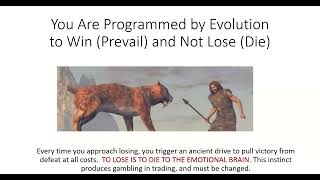
So here's the deal. What I want to really do is come to this image and what it represents. This. There is a man from somewhere between 20,000 years ago to 100,000 years ago, and he's facing a moderately sized saber tooth tiger. Notice those big, huge incisor teeth. A really big saber toothed tiger at that time could be 1300 pounds. A big animal. Okay? At the same time, understand this. As we were seen as like really tasty treats. Their main stuff was other big animals. But what happens, you see this guy, he's got this skinny little stick with a rock on the end of it. And here's the deal. You are programmed by evolution to win, but particularly not to lose. Because losing to your caveman brain does not mean, oh, I lost, man, I lost money. He has no idea what money is. He does know what dying is, though. And you're looking at a situation right here where death is everywhere. This is what your primitive caveman brain, arcade woman brain is going through when you've been riding high and all of a sudden you start taking a loss. All of a sudden, it's not just money that's being threatened. It's your life and your primitive brain that's being threatened. This is why it's so hard. The other thing that you really need to understand.
They were two different ways, is that if. If this caveman loses everything, you know, you really understand. Oh, man, I tell you, I hate losing. I hate losing. I'm not going to allow myself to lose. I'm gonna. I'm gonna get it back, okay, from after all those wins and you lose it. But there is another side of this, and this is what happened to you in the beginning. You got overconfident, you started winning. And basically what that is, is that you've got this button to the. That reward chemistry, dopamine. And you start winning, and you're saying, boy, I'm really trading good. And then you go, oh, I'm winning more, and I'm winning more. I'm doing really well, man. I'm up 2,000, $3,000. Hey, I'm. I got it. I got it, I got it. That is the kiss of death from a caveman perspective. If you were to take a look at that behavior, Think about it. You have six to eight men who are about to attack a woolly mammoth that's about 30 to 40 times his size, okay? So you've already got this big, big, huge gap. And then his tusks reach out 10 yards.
So he can start sweeping his tusks, and he can take you out. He can break your back. The thing is, those guys had to get cranked up. They had to feel exuberant. They had to feel all that. And they said, you know, if we attack it as a group, we can bring it down. Because what happens if we bring that down? We get massive rewards. First of all, we get to feed the village or the settlement for a month. We also get prestige. We also are the ones who get to breed into the population, into the genes, big inducements. Those are kinds of the rewards that allow these guys to get stir crazy and to look at a huge giant and say, we're going to attack it. It's kind of like when you're looking at it, going, look, God, look at this setup. I'm going to make a whole bunch of money. It's the same thing. You're hitting that dopamine, and what you're doing is fundamentally, when you're hitting the dopamine rewards system, you're snorting cocaine. And I do not recommend snorting cocaine in traveling because it's going to have you euphoric. Everything's great, everything's riding on. Everything's wonderful. So what you have is you have these two traits. You start winning.
You start piling up that cash, and you go, oh, man, all right, I've got it. I've got it. I'm in the flow. But what you don't recognize is that euphoria has been kicked in. And you would know that euphoria by feeling good and start getting confident, okay? And out of that, you're no longer. You're kind of getting more loose on your trades and stuff like that. You think you've got it. You think you know what you're doing. And this is the kiss of death. Is that you're no longer following your rules, they're beginning to stretch, and you're taking a little more risk and this stuff and that and the other, and before you know it, then you get popped. And suddenly that survival strategy that one had you facing, going after a woolly mammoth, believing that you were going to win and that you were not going to die.
Often those guys did get killed. However, it was such a successful survival strategy for the group that those were reasonable losses. Okay? Now, the traitor doesn't have that group and stuff like that. And the lions and tigers and bears are gone. But that brain that got us into this trouble is still there, and it's still quite activated, because the truth is, is that you spend very little time really saying, well, what is this mammalian brain that Randy talks about, this ancient primitive brain that is built on survival instincts? I don't even notice it until it wipes me out. So now we've really get to see it. We get to say, okay, we now know that you hate losing, okay? But at the same time, you get euphoric because you see winning, and that caveman brain activates. It doesn't know that you're in the 21st century. It's going, winning. We took the woolly mammoth down, everything's great, and I lived. And by the way, this is why.
The military only recruits young guys, okay? They're the ones who think they have a bulletproof raincoat just like our caveman ancestors, and they don't think, you know, people are going to die, but it's not going to be me, okay? It's the same instinct activated, and they go out, and, you know, before they know it, they get pretty traumatized if they're actually in line of fire. That's a big difference. So now we've gotten this thing.
And we go, you know something? Just at that moment when you go, I'm doing so well. I'm doing so well. And suddenly, whatever happens, you've gotten a little loop. You didn't even see that you got looped. And all of a sudden the storm starts, okay? It's the very time you really actually need when you start taking a loss, Taking a loss. And these may be losses where you're not making psychological mistakes. It's just probability. But that doesn't matter to the brain if you're not well trained. Suddenly a storm's there, and that emotional storm wipes out the whole nine yards. This is the ancient emotional storm, okay? And suddenly the knowledge of trading that you possess is swept away, and you are a Primitive Caveman in the 21st century not knowing what's going on. It happens that fast, Friends. Okay, now let's go one step further. These emotional storms. Let's look at this. Okay, What I want you to see, that's happening. We're going to make a, we're going to make a leap from the imagination. You see over here on the left, you're looking at this dude looking at a nine foot bear and suddenly what happens is what's activated by uncertainty, Danger is you're looking at an ancient brain going, oh my God, I'm in really serious trouble. What's automatically activated? I mean, I'm talking in nanoseconds and I want you to be applying this to your trading and seeing that. Yeah, this ancient brain is observing too. It doesn't have language like your thinking brain does. It has emotions. It emotes. And emotions are not what you think they are. They are biological action potentials that when they trigger, they trigger in nanoseconds and they're in the bloodstream altering the way you perceive reality. And what there anytime that there is a change in status in your charts, by definition there is a change in emotional and the emotional response you're having to that. So you've got it. Then you get the emotional storm, it fires and suddenly what happens is that that instinctual fight flight syndrome fires because it is bypassing thinking. And all of a sudden you're doing the dumb stupid things and you're going crazy. And all of a sudden you look at it and I used to be doing so good when I was, I was so getting, I was getting so feeling good and all that stuff. I could really see the future. And all of a sudden I start taking losses and I can't stop. And all of a sudden it blows everything up. That is kind of pictorially what happens. You have a guy looking at a threat or what's perceived as a threat, but we're looking at things that are not threatening biologically. But our primitive brain doesn't look at it and say, oh well, that's only money. It's not life to it, it is life. So you're looking at this and you're going, well, wow, this is crazy. And now what I want you to notice is see that chimpanzee and Homo erectus up there right at the tail end of the gate here? What I want you to understand is that you carry.
The mammalian brain from them 6, 7, 8, 9, 10 million years ago. Even though you're sitting in front of a computer, you still got that with you. Okay? And the question is, it lives its potential and it's activated by change.
You can be calm, you can listen to all the cooling music and all that stuff and everything's fine. You can. But when that trade goes against you, you're no longer the guy sitting in front of the computer. You're the hominoid back there at the tail end of the bus that is now wagging the rest of the dog. Okay? So we've gotten this. We see that, we can see that the emotional storm just simply wipe out the rational mind that's needed to manage losses, to actually, to manage.
To be honest with you, a lot of people, what they have to learn to do is fear is not the only game in town. Everybody would say, randy, look, if you can just teach me how to manage my fear better, I will be so happy. They learn to do that and then they find the next demon on the road.
And overconfidence and all of a sudden it just is horrible things to the mind, but in a positive appearing way that fear does. So now we've got it is that we've got these little critters from our ancient ancestry sitting right in our brain, and we do not see it. The problem here is that the neocortex, the thinking brain, grew out of the emotional brain, that mammalian brain, and it's kind of like a tumor. It just grew and grew and grew. And as it grew, this intricate communication system is going from the old ancient brain into the new brain, the thinking brain. Okay? However, the thinking brain is not laying down communication tracks back into the old brain. What you get instead this complex, instead of this complex emotional circuitry going into the new brain from the old brain. What you're getting is you're getting that that new brain has a couple of 19th century telegraph lines going back into.
The emotional brain, okay? And therein lies the problem. The thinking brain has really little control over the emotional brain. And we have to learn to maximize the amount of control management that your thinking brain can have over the emotional brain. We have to domesticate that animal, okay? That beast. And so this is where we've got it. We know that these, these instincts are wired into us as potentials. And they are from, they're, they were successful. So they got wired into our evolutionary psychology. And the thing is, is that back then they were very useful. Now, in front of a trading council, no, it's not useful at all. And that is going to happen. That is going to have to change. Okay? This is a really good Way for you to look at this. We're looking at the inside of a brain here. It's kind of the car, the cab of the car. And you have this geeky guy who's driving it. That's your new brain. That's your thinking brain. And as long as you're trading on paper and there's no risk, he thinks he's in control. He believes he's in control. And then at the same time, what you see is an emotional brain sitting back in the back seat being ignored. And it's just sitting, hanging around, hanging around, hanging around. And then it gets activated by winning, gets all excited, starts hitting the dopamine reward cocaine, okay? And then. Or it takes a loss, and all of a sudden it gets activated and says, oh, I'm under attack.
And before you know it, he's taken that club and knocked the slop out of the. Out of the thinking brain. And before you know it, it's gone. Your thinking brain, your emotional brain, that caveman brain was built to control outcome, or they would actually say control environment. Okay? You had to be right, you had to win, and you had to not be wrong because you were dead. And you needed to be able to predict future conditions, okay? You needed to be able to look out on the African savannah and look over and see all those bushes. And you would predict by bias that there was a savage tooth tiger behind every one of those bushes, when in fact, only one tiger was behind 10,000 of them. So you begin to see, how do we tame this beast if we do not learn to do that? And.
It will not be the emotional brain saying, hey, let's be in partnership. That's not the way it works. It's an animal brain. It's reactive in nature. No, the thinking brain is going to have to find out how I partner, tame, and work with this aspect of my being. This, friends, is what we have to do. So.
Understand, your brain evolved to keep you alive, not thriving alive. And for it, danger of loss meant death. That's the piece that I want you to understand. You're sitting there trying to think and say, oh, these are my rules and stuff like this. This is the knowledge I have. All I have to do is apply that knowledge. What you're not looking at is all thinking. All knowledge is emotional state dependent.
And when you're sitting there, you have the knowledge, but then you get under stress and suddenly you have no longer have access. You no longer have access to. To that knowledge. Okay? That's the emotional hijacking.
And again, I Want you to understand this. I want you to understand this is not you personally. This is the whole human race. This is the way we are wired architecturally. And it's not going to go away. And we keep trying to push harder, push harder, ignore that caveman part of ourselves. And in doing so, we just get more and more danger. Okay, so we've gotten this far. And then go, okay, so this is what it looks like, okay, there's a cue, there's an activating event that. And we're going to. We're going to. Now, there's several cues. There's activating events. You start winning, you start accumulating cash, okay? And what happens is suddenly you feel that you can control.
Uncertainty and that there is no confusion. You know, you feel powerful. And what happens is you have that more of that aggression to go further. Then somewhere along the line, maybe at lunchtime, when you get away from the computer and you come back, your mind's all cranked up, make more money, then you get in, and what happens? The markets are just doing what they're doing. And all of a sudden you're in a trade. There's an activation. This time.
All of a sudden it activates to like, oh, my God, I took a loss. And then all of a sudden uncertainty comes up and the confusion about your ability to manage uncertainty is called into question. Oh, my God, am I going to lose all this? Did I really do that? And you start feeling vulnerable. Okay. Oh, my gosh.
And the brain hates vulnerability. It will do anything to get out of vulnerability. That produces the confusion. And all of a sudden there's a jump. It jumps to fight flight. And all of a sudden you see that big huge red glob called the new brain, the higher cortex. It's totally disabled. It's totally disabled. That little almond shaped sliver of your brain down there, the amygdala, suddenly it takes over and it's on fight flight. And suddenly you are madly giving back everything that you had earned, friends. That's how it happens. So.
The other thing is the brain also starts locking you in to seeing one potential world as the only one. And friends, this is lethal. What happens is you start saying, oh, my God, it's going against me. Everything's going against me. The markets are after me. They're. They're just not being good to me. What happened? How did I lose my mind? You lost your mind because you did not know how to manage the mind on uncertainty. We keep pretending there's going to be a world where everything is Good. Everything is fine and there's a pot of coal at the end of the rainbow and all we have to do is go get it. When in fact.
The market is giving opportunities all the time. It is us who have to have the mind that can interpret those opportunities are not opportunities. And we tend to, if we're, if we're, if we've been winning and we're on euphoria, we tend to interpret all sorts of things as solid setups, okay? But the thing is, all thinking is emotional state dependent. The thinking you're looking, the analyzing you're doing is being done from either something like Scared money or this just exuberant, exuberant mindset, okay? And you're not seeing the world you need to see. You're seeing a world based on those emotions. And friends, this is where you get locked in. You don't know what's happening and you're going, how do I get out of this? I don't even see what's wrong.
Okay? A very common thing. Understand that your, your thinking brain grew out of your emotional brain. And very little, very little circuitry going back into, excuse me, very little circuitry is built in that thinking brain to come back and to control the response of the emotional brain. So.
You'Ve got some work to do, friends, if you're going to be successful. And what I want to show you is a small graph that kind of allows you to see.
What really happens. Okay? And I'm going to take it both ways. First of all, down at the bottom left, what you're looking at is you're looking at emotional information. In this case, emotional stimuli are coming into the thalamus, okay? That's a quick decision place of the brain. And it's making a quick decision about whether or not that information represents something dangerous or something opportunistic or just a regular thing. Let's say that it comes in and the immediate understanding is, boy, this is a great opportunity, we need to jump into it. All of a sudden you start jumping in compulsively into trades that aren't there. Okay? And you might also have, though I'm doing really well, I'm doing fine. But at some moment, by hitting the dopamine so much, you get out of the mind that can trade effectively. And you get, and you come and you find out that that one's gone. That's the opportunistic sect. The other part of the information, it can read it as danger, danger to life. And all of a sudden it's emergency vehicles coming into the intersection. A traffic cop is stopping everything and letting that emergency vehicle go to whatever, whatever scene, whatever place its destination is. That is what's happening when it takes the short route. That's the low road to the amygdala. Because what you want. And by the way, the Information flows in 0.003 seconds between the thalamus to the amygdala. That's fight or flight for us, okay? And it takes 0.25 seconds for that information to get to the thinking cortex. So you're already seeing that you're at a disadvantage. And then you're over there at the amygdala and you also have this thing called the hippocampus over there on the right. What it's doing, it is sitting there, it is going, okay, I have a memory of this being a really good thing, winning all this money and stuff like that. That keeps the overconfidence going, or the memory might be of a traumatic time that you lost money, and all of a sudden it starts going against you and you have the memories that trigger flood up and all of a sudden it just hyper. It hyperinflates the amygdala and before you know it, you have an emotional response as cortisol. And all the anger stuff and all the fear stuff coming in, obliterating your ability to use that fine brain that you've developed and invested in heavily. Friends, that's what's happening. Okay? What I want to do though, is that I want to give you one basic understanding, is that emotions actually came, they were developed, they evolved to help you negotiate the environment in the short term. Okay? Right here you're looking at a cartoon, and the emotional brain has just beat up the thinking brain because the emotional brain says you just didn't understand the danger. Okay? That's the same thing that happens to us. And what we want to do is say.
The very main thing that you need to understand is this, is that loss.
At a very primitive level, far below our conscious self.
Loss is associated with death, okay? And that's the thing when you don't want to take. You have a saber toothed tiger jumping on you, and you're sitting there going, oh, my God, what do I do? What do I do? What do I do? And I'm going to fight to the last breath, because you are at that moment, you have begun fighting for your life.
What I also want to ensure you is that a lot of times when I'm speaking with people, they will say, randy, you are talking directly to me. This is exactly what's happening to me, what I want to let you know is it's happening to the human race. And the small subset of the human race that became traders have it really amplified. Because in trading, you know, you can ignore, you can deny and stuff like that for a long time. And in trading, you can't. Man, that, that P and L statement is going to show you how effective your beliefs are in any given moment for extracting more capital out of the markets than you're putting back in here. All of a sudden you see all that money flying and what happens is you, you're under threat of being murdered now. Okay, you didn't see it in operation though. You didn't see the setups because you didn't know to look there. And what we want to do is say, well, how would we go about, how would we actually go about it? Because ultimately your emotions are controlling the relationship between the organism that you are and the environment to which you're embedded. That would be the markets, not necessarily the forests of 10, 15, 20,000 years ago. And what we have to do is we have to say, you know something? Emotions are just doing their job. It's actually me that has to learn how to use my emotions more effectively, more intelligently, because the emotions are going to fire anytime there is a change in status, okay, they're going to fire. The only question is which ones. What we want to do.
Is to say the question is really what emotional response activates with exposure to uncertainty. The fight flight, for sure. But at the same time, another response is that of approach. That's the mind, that's the motivation that you want. When your brain engages uncertainty. And it can be taught, it can be taught. And what you have to get, get past.
What you have to get past is the notion of winning is that most people that I talk to have used affirmations, visualizations, positive self talk, setting goals, working harder, nlp, tricks, therapy, prosperity, thinking. And they've just convinced themselves that mind over matter. And the truth is, I just haven't seen it work. And what I have seen work is to change the observer. And all of a sudden you see a different potential reality in front of you. That's what I want to take a look now is let's redefine winning. Let's move from winning. Like, oh yeah, I make money. And if you happen to be one of those traders who say, I'm going to make money today, then you have already set yourself up for failure because you do not control whether or not you win or Lose. You know, what I teach is that winning is only landing on the right side of probability and losing is only landing on the wrong side of probability. It has nothing to do with you as a human being. So the deal is this. The moment. Move back one slide, please.
The moment that you attempt to control something you cannot control, the brain's going to experience powerlessness. And it freaks out when it experiences powerlessness. If you've ever just done really crazy things while trading, you know what this is like. What we want to do is say, well, and a lot of the people I work with have bonafide. Had bonafide traumatic memory because of their trading, blowing up and losing a large amount of your net worth or, you know, your ability to be, you know, to, to run accounts and things like that. So we know that we actually have to, we're going to have to produce a different kind of mind so that when we look at it, we need to be able to control the mind that you bring to the performance of trading. That's what we need, not the one you came with. And if you understand you can't control outcome, whether or not you win or lose, or predicting where the market's going to go, you can't predict those. You can't. However, what you can control is the mind that you bring to the game. That is the edge, the psychological edge that you're going to need to drive your methodology edge. And what you really truly need to understand is this. You do not see and then believe. What happens is you believe and then you see your beliefs are forming information and it becomes the truth. You see and then believe. You do not believe and then see. It's a fallacy. It's a fallacy. And we. And what you're recognizing is that I need to start finding out what beliefs I'm holding. That is building what I see in those charts and the actions I'm taking. Because I can promise you, most likely you do not have an effective, an effective mental strategy, emotional strategy that allows you to see a much cleaner representation of the markets. You're seeing through your beliefs. You're finding the truth through your beliefs.
You're not actually examining information and forming beliefs.
That's the way we would like to believe it is, but this is the way we are as animals. So we're getting there and going, okay, how to start that change process? The very first step that you're going to have to do is emotional regulation. You're going to have to first understand emotions as biological action potentials, not your feelings. And that they are. The only time you don't have emotions is when you're dead trying to push them down. It's just flat stupid, okay? It'll blow you up. So the very first thing is, how do you go about regulating the intensity of an emotion?
Well, the good news is this. If you begin to understand that your emotions are biological in nature, biological action potential, they will have a physical signature. In fact, they will have a breathing signature. If you take a look at baby sleeping, you will see him breathing diaphragmatically. And then if you see a baby or you that is scared, you will see them with very shallow breathing high in the chest. And you're not getting any air at all into the abdomen, which means you're not bringing in enough air into the lobes of the lungs to be able to extract the oxygen that the brain needs to make really compelling decisions. So ultimately, when you're angry, you're holding your breath. When you're scared, you're either panting or holding your breath. That is the breathing signature of those emotions. If you disrupt that, that emotion cannot maintain itself. Okay, Even if you got all hopped and excited thinking there's this, the greatest opportunity, opportunity in the world's there, you need to jump in this impulse thing. If you begin to breathe diaphragmatically, that will simply wane and go away. And then what you're looking. And do this in the morning when you start trading. Take your, take your, take your smartphone, videotape yourself trading. And I want you to spot the amount of tension in your face, in your jaws, in your necks and your shoulders. And, and what you're looking at is an emotion that has already triggered it is building up. It is getting ready for fight flight.
By being able to manage the tension and letting it drain, drain, drain, and being able to pull air into belly, expand the chest, hold, release slowly. You keep doing that. And what happens is that you get calmer and calmer. And for those of you who are excitement junkies, this is bad news. But you're going to have to deal with that. So you're looking at a breathing style that can absolutely cut down on the way the emotion takes off and takes everything away. Okay, so that's the first one. And it just so happens if you were to work with me.
Before you get into my group course, you will. We encourage you to have two or three weeks or more of learning the breathing system because it's rote training. You have to retrain decades of poor breathing that leads you to easy hijackings. Okay? And you're going to have to retrain that. It takes three or four weeks. In my individual courses, they have three weeks to train before they see me. And the first thing that I ask, have you been able to do this? Have you seen a change? And if people haven't done their work, I don't see much reason for us to continue because this is the ground floor and you're showing me that you're not ready to work. Other people, I've got this trained and what they do is they go, randy, this is amazing. I had no idea. So that's the first thing. The second thing, the second tool for change that you're going to need is you're going to need to be able to really, truly understand who you are. And to do that, you're going to have to produce what I would call mindfulness. You're going to have to develop an observer of the cell who looks inside the door of the mind and starts looking in there. And all of a sudden you're not taking it personally. I have a lot of people say, I'm just really scared to work with Randy because what if he finds something that I don't want him to see? Well, actually, what I already know is you're bringing a brain to trading that's not fit, that's not ready for the job. I already know that most likely you are getting your sense of mattering from making money. I know that your sense of worth is tied up to your net worth. I already know that there's a good chance after a while that you don't feel adequate for the job. And you keep working hard and hard and you start second guessing yourself. So from there it's one of those things where you look in and you want to go, well, I need to develop. The truth is, is that if you understand the brain as a community of rival emotional programs that are duking it out for the real estate of the brain because they're going to take control of the potential of the self. And then if you begin to see the mind as a space where those emotional programs are given voice, as thoughts. We have language centers. Other social mammalians don't have language centers. Okay.
So you're looking at this and going, whoa, I have to re understand really what brain and mind are and how I can begin to say there is a committee, a governing committee of the mind. And what you're going to have to do is you're going to find out that you're a CEO or chairman born. That has just been too much Time and party, and you come and look at your boardroom and there's a mutiny going on. And you're going to have to. You're going to have to write the wrong. You're going to have to go in and clean house and organize it into an effective mind for trading. And there is no I in quantum mechanics. What they would say. There is no such thing as mass or energy. Reality exists as potential.
This reality you and I think we are conversant in right here is really potential. What gives shape to that potential, to give it a form, is the observer. You are. The beliefs, the biases that you bring to the game that causes you to see what you see. This is what you have to examine. And the way that I do that is I use mindfulness. And this is a really good illustration. Most people, when I first met them, are much like this guy on the left. He's caught up in his thoughts, and he thinks that his thoughts are him on the right. What you look at is you see a person who's developed their observer and realizing one powerful, powerful thing is that you and your thoughts are not the same. You can step back out of them. You can stop identifying with them. And as you do that, they end up with far less power over you than what you had given to them. Now, so understand, you don't have thoughts, they're having you. You don't have beliefs. They're creating your reality and your performances in trading. And this is where you start going, I need to know what makes me tick. I need to start producing an observer so that I can begin to quit identifying with all these thoughts. And some of them are very destructive in their nature. You know, they.
They don't really care. And what you're going to do is you're going to sit there, as you develop this observer, you're going to start noticing that there is an inner commentary going on all the time. If you just stop back and listen. If you have a meditation practice, you know, when you try to be quiet, all these things show up and all like that. You're letting them go. But I actually teach something different. I want you to know what the thoughts are saying most. Some have a.
Some are just, you know, idle thoughts running through the mind. But you'll find a lot of them are pretty negative, Pretty negative. And what I'm interested in is this interface with something that I call the inner critic. That's the part of you that judges you, that criticizes you, that tempts you, sets you up for failure. You know, that One when you fall into self doubt or you beat yourself up after a mistake, that is not you. And I'm asking you to stop identifying with that voice as you. I'm asking you to realize within the totality of potential that you are as a human being. That is called the inner critic. And it's just doing what it does. And ultimately that's the one that's goading you to jump into trades. That's the one that is criticizing you for making mistakes. That's the one always trying to, you know, find an angle and find a moment to.
Just to take advantage of that moment and hold you from potential that you could be. Now I know this sounds like bad news and actually what I call that, but there is some really fantastic, fantastic news. And what I'm going to use is this illustration from, from the Lord of the Rings. That was the best archetypal movie I have ever seen in my life. What I want you to look at and these characters, let's start with Gandalf. That would be what I would call a sage. That's the impartial, that's the wisdom. That's the insight that every team, every community needs. What you look at is Eragon. Over on the other side, you're looking at a king. You're looking at someone built to manage a kingdom, to be able to find the discipline, to maintain order under pressure. But you're also looking at and I do not remember her name from the Lord of the Rings. But you're also looking at a caregiver. You're looking at someone who loves, who opens up, who has compassion for people. This is the caregiver just probably more necessary for children change than any other archetype. The truth is, is.
The.
Way the antidote to fear is not courage, tough guy. It is actually compassion, self compassion, where you start treating yourself compassionately. Otherwise, I mean, if you beat yourself up for making a mistake, all you're going to do is traumatize yourself. But when you use compassion, you are actually teasing that that network of belief, that neural connection of belief and you're reorganizing it into higher function. What you'll also find is that they're warriors. They're warriors who they are not. They serve the king, they do not serve themselves. And at the same time, then you look at this guy Frodo in the middle. This is where all these internal struggles come together. He is holding the inner critic, the temptation of inner critic for destructiveness. And he has to be able to put it into a molten iron and he falters. It keeps working on him. And his friend Sam gives him the strength to be able to move through that. What I want you to see is all these potentials live within you. What I'm teaching people is to find the discipline of the ruler.
It's the most important emotion that you're going to have in trading. If you haven't got discipline, nothing's going to happen. You're going to have to find the courage of a warrior. You're going to have to face your fears. You can get away with denying, pretending and being a sports fan and talking the talk until you start trading. But then the instant karma that your P and L statement is, it's just catching you in your blind lies. You have to stop lying to yourself. You have to find that courage to, to say, you know, something within me is a powerful potential that I can develop, but I have to have the courage to look at my. The darkness that lives within me. You're also going to have to find that self soothing, that self compassion of a caregiver because you're going to be taking losses and trading for the rest of your life. If you're going to beat yourself up every time you take a loss, you're going to have a hard time. If you have compassion, you begin to open yourself from learning from the mistake. Losses are not bad. The deal is you learn from them and they start guiding you how to become successful. So out of that you can build from these particular elements, you build an empowered self that ends up taking over the committee of the mind. That's the deal. It can be taught, friends. Now I teach it through symbolic representation. I use also what would be called memory enrichment, to be able to get at these and to be able to get you to see that they are there because they're in your genome. Your job is to nurture them, to bring them into fruition so that they become the dominant committee of the mind that makes your decisions. I see that all the time. And ultimately life is going to be full of challenges. There are going to be power struggles, there's going to be uncertainty. There's going to be. But the deal is you're looking at two studs kind of like square off on each other here. But the thing is, if you have got your mind riveted, ready for trading, and you're no longer thinking about fear, you're no longer thinking about the money, or you're saying, I have a mind that's highly disciplined. It's maintaining order. I have the courage to face this inner critic who's going to try to jump in and mess up my stuff. I also have this calming caregiver who can calm down this fearful part of myself. And when I do that all together, there is this sage like quality that has really impartiality, that starts making really great trading decisions in probability. This is something again, this can be taught and.
Your brain, you can teach your brain to produce a mind, okay? And one of the first things is you have to get past the whole notion winning and losing. You know, again, winning is not about you, it's about probability. Most people think, I won, I won, I won. No, what you did is you landed on the right side of probability relative to you. You think, oh my God, that's really bad. No, it's not. That's where you learn. You say, well, you know something, if I review this trade, would I take this trade over again? This set a valid setup? You say, yeah, and I didn't really make any mistakes. This was just simply probability, okay? And you know, traders regularly lose 40, 50, 60% of their trades. And so you have to get to become a really good one that understands losing as part of the growing experience of working in probability. So that's what you're doing now.
And what I wanted to get here, this is from the father of evolution and I want you to hear his words. It is not the strongest of the species that survive, nor the most intelligent, but the one most responsive to change. And what I would like to do right here is recognize that you're in a different environment, you were from a different environment, you got plugged into this new environment. And the rules of survival are different in this world of trading than the world you came from. And it is time for you to adapt. Okay? If you want to survive, it's about getting unstuck from limbic patterns that were adaptive at one time, but not in the probability based world of trading. You can't force your will on the markets. Your brain will resist this kind of stuff. It wants to stick with the old comforting lie. The deal is you choose whether or not to become captain of your own destiny. You're doing that by pushing away the very things that you need to be working on about yourself. I have seen incredible courage and compassion from people when they recognize, oh my God. I got born into an environment where my brain got organized for me to survive. And then I grow up and I go into trading. And that brain that allowed me to survive in the culture and the family that I grew up in now becomes my poison I need to change it. Nothing personal. And it's called there is always a potential you that needs to be developed to meet the demands of living. It's. And that's where we are friends. That can happen. So what I'm asking, I'm asking you to recognize is this is the brain mind that you brought to trading simply is not going to work for the demands of trading. And if it's different for you, God bless you. Okay. Most of us live with these blinders on that you're seeing over here on the left. And they will do anything. They're so invested in their view of the world that they can't see the rest of the world that they could be.
They want it. They want to win their way. And that's a good way to lose in trading or as you grow, you begin to look at this, you look at you as a. I look at trading as the greatest form of self mastery that could have ever happened. You're forced into mastering yourself. You're forced to realign how the mind you build to govern the way you live in the world. There's no choice. Well, there is a choice. You can continue the exact way you're going right now. But this is how you stop it is it's the animal brain in you that has you winning and it's feeling good, feeling good. And all of a sudden you start feeling really good and you begin to think, I got it, I got it. Yeah, I've got this stuff. You don't have it. You have, I teach a system that allows you to get outside of that primitive brain for periods of one or two or three hours at a time. And then you have to continually reinstate and renourish that to be able to get it. Then you also have to be able to look and find areas that you really truly need to do some heavy emotional lifting in and do it with a joy in mind that saying I need to change. I need to be able to heal this part of myself and it's time for me to do that. Trading is not giving me time to BS around. Okay. So friends, the truth is, is if you're interested, particularly if this is the first time you've ever heard me talk and stuff like that, please get my free ebook. It'll, it'll start laying this out and start making sense and you'll be able to explore and you can go, you can go to www.traderstar state of mine and you'll see that there's a free ebook. There's. Okay, get it the Other thing is that.
The vast majority of the people that I work with come from our YouTube channel. If you were to just type in Randy Howell to YouTube, you would have to get past the bass fisherman. There is a bass fisherman who has the name Randy Howell, but I'm the one with the trading psychology stuff. There are.
He does.
But anyway, the thing is if you go to my YouTube channel, there are hours and hours and hours of content about this stuff. Really get it and take a look at it. But then if you go, you know something, maybe I'll get his book. The one that explains my theory, which I just found is also, it's been translated into Farsi but without my permission. So. So we're going to see if I can do anything with the Iranian government here pretty soon. But when it really comes down to it and you go, okay, how do I go about committing myself to change? We have a group course that teaches you the basic skills that are necessary to produce the mind that trades. Okay. And you register now, not later. It starts March 20th. The deal is, is that you really need to be in working on it now because you'll find that I want to see that what you're doing is committing yourself to retraining the way you breathe in response to stress. Okay. We'll have Our first review March 20. And the deal is I'm expecting you to have already had two or three weeks with that. That's. But and because it goes really fast. Okay. And what I'm willing to do is say, look, if you do that, if you actually have the gumption to say, you know, I'm going to sign up early and get started because I'm hearing Randy say, you really need to do that to be able to change these long held emotional patterns. We're going to give you what sells for 200 bucks on our website, the emotional regulation workshop. Okay, that's just simply saying thank you for being smart and getting in early and starting the same. And there are five classes two weeks apart and we cover the ability of being able to build this mind. Okay. Now the other thing is some people say, Randy, you're coming from a completely different world here and it's finally making sense. I want to work with you individually. Our individual course is highly comprehensive and personal. We get into the goo of the stuff, but we also dig deep. And people, a lot of people just simply say, Randy, I, you know, I want to work with you. And that is for them and what you discover. It's a three to four month program and it has A highly complex learning system. It's got videos, it's got text, it's got MP3s, it's got some. All sorts of stuff. But it also comes with 10 console port me. Okay. If you are interested in that. And we only want people dead serious about this. You know I don't. You ask for a free consult and what you'll do is Dolores will have you start reading some stuff and saying are you ready to talk with Randy? Okay. That's kind of the shooting match. The deal is here's the deal. It's that you can build a mine built for probability. It's going to take some work. It's. It's not what evolution gave you. At the same time it is time to use evolution. The ability to adapt, the ability to change in order to be able to build. You are Homo sapiens for goodness sake. You're the ones who can actually change. And what I'm doing is showing you a process that I've used successfully for 18 ish years I guess with traders that help them to build.
To build the mind that can trade.
Is there? Yeah. And the first one is. I'm just going to start down here. Okay. Randy, is there any room in your March group coaching? Yeah, the group course. Yeah. We have I think 11 or 12 and we stop at 20. So we. So we've got room. But I'm encouraging you to get in and because what happens is Dolores is going to give you a download with the. With the diaphragmatic breathing work and you have to be able to move from being in the yoga studio doing diaphragmatic breathing to where you're actually pulling the diaphragmatic breathing up as you trade. That's the trick. Okay.
This is Muhammad. Very true. I'm 100% guilty of this. Despite me trading for five years. You're just a youngster. These toxic events happen from time to time. Does it mean that. Oh, oh yeah. That's a comment. Thank you Miami. Yeah, it's true. What I want you to understand a lot of this comes out of trauma bonding from what you've done to yourself. Not just in trading but other parts of your life. It has to with do with what you. How you learn to be in the world. And at the same time you are responsible for developing the self that can trade. So. Yes.
This is Raquel. Rachel. I'm sorry. Does it mean that the. That the new observer to be successful in trading is to pull up the emotions of discipline, courage, self soothing and impartiality during the Trading session instead of letting my inner critics and orphan trade to drive my trading decisions. Yeah, it's a lot like that. What I would say is that you're using. I use a lot of symbolic representation, too. You find these parts of the self that you bring forward, and they're the ones who do the trading. And you're building the stamina up as you go. And what you know is that the yakking of the inner critic is not going to stop, okay. Until it shut up, and then it's not going to stop by permanently. It's just going to find a more opportune time. Okay. There's a saying that Thomas Jefferson had, is that the price of freedom is eternal vigilance. You learn that you have to. You really have to produce that mind and you have to be vigilant about it. Here's Mike. Are you familiar with Mark Douglas? Of course I am. I've been reading one of his books and several of his concepts align with yours. You two would make a great lineup. Well, I don't want to do that. He's dead now and he passed away. And he. Be honest with you. He's the only. Of the old teachers, he's really the only one that I have enormous respect for. He actually understood the problem. Okay. And I. I personally don't believe he knew how to solve the problem very well, but he. He understood the problem. And for his time, he opened up a whole world for traders to look at and stuff like that. A lot of what you'll find about mine is I am emotional intelligence. I work from a neurobiological standpoint, okay? And I'm looking to be able to produce greater emotional intelligence, the use of emotions. It just so happens that, I mean, I've taught anger management to violent prisoners. I have worked with PTSD for many years, and so a lot of my protocols, my work has been honed pretty well over the years.
Zakaria, Sir Karya. I'm really terrible with names and I apologize. Is it a matter of time and practice until I am able to make diaphragmatic breathing to the trading room from the yoga studio, as you call it? Or is there another missing component involved? Thank you. Yeah. Diaphragmatic breathing, the emotional regulation of an emotion is not going to solve the problem. You're not going to get to the door of the mind unless you can regulate emotions. So that it starts with breath is enormously important. At the bottom of every emotional reaction is a belief about your ability to manage the uncertainty that you just engaged, ultimately this is really about whether or not, whether or not it's in the group course, whether or not it's in the individual course. It is really about getting at those beliefs and getting you to change those beliefs. And I have very sophisticated techniques about where you are beginning to find your inherent worth and being able to do and to separate your performance from your being. You've got to do that. But more than anything else, that you're going to have to learn to love yourself.
Okay, how would I deal with money, greed, and changing my emotional perceptions toward it?
First of all, recognizing that you have money beliefs that are limiting you. The second is beginning to recognize that you probably also, if you're an alpha, what happens is that they trade to make money so that they, they matter. They want to matter, they want to have prestige, they want all that stuff. A lot of people are hooked into their comparing their self worth with their net worth. And what happens is that that's a game that the trading gods are going to shoot you in the foot all day long with. You ultimately have to come to a moment. And other people I work with other people who come out of poverty, and they not just have a poverty mindset, but they have a scarcity mindset of where they're scared they're going to be losing what they have. And these are things that I work with on a very deep level, using what Carl Jung would call orphan or what has also been called the inner child or wounded child. But it's that deeply childlike part of us that does not think it emotes. And what happens is it needs to understand that it has value beyond money. And a lot of us have grown up in families and cultures where our value as a human being is coupled with money. And what happens if you're going to be successful in trading? You're going to have to decouple it and you're going to have to recognize, you know, the way I would look at it is I am conscious creation. Creation created me to be in relationship with it. And I am just, I come back and that is the, that's the deepest ground of my being.
And ultimately, if you're going to hit self mastery some way, you're going to have to find something greater than the self that has great meaning for you. Okay, last two questions. Kingda, does meditation help improve trading? It can. You know, the thing about meditation, and I've been meditating for, I guess, 53 years now. Okay. Is meditation can also be a withdrawal from reality. You know, it can be actually a way of denying reality. But it also can allow you to separate from thought. Particularly mindfulness is that you begin to recognize that you are not those thoughts. And the practices that I do. I am keenly interested in mindfulness, first and second order mindfulness that allow you to separate from thought and not identify with it. That kind of meditation is especially useful in trading.
Okay, thank you so much. One last question. Should I save up more and get the individual course or a group course?
I'll put it to you this way, is that the group course is financially reachable for a lot of people. That's why we have it priced the way it is, is we want it available because.
A lot of people find it to be a real stretch. And what I know is if you decide I'm going to save up for it, certainly I have people that do that. And I have great admiration for people who set a goal saying I'm going to work with Randy. They save up the money and work with me. And you know, those are hard workers and they're committed. And that's the kind of student that I like. My own recommendation is look at both.
The way you reference that the conversations you have about money is already telling me that you're going to have a really deep seated set of beliefs about money that are going to have to be corrected. And I want to share with you, I know we're going over a little bit. This is important. I grew up in a family that lost generational wealth, the generation before me. And there was always a conversation amongst us, McMillan's how the O' Connors had stolen the money and we're going to get it back. Now what that ends up trading, what that really did for me is I grew up with a mindset about I had to get the money back. So I'd already produced conflict with myself without being able to generate wealth. I was looking for getting the money back. And I always had this thing where there was going to be a struggle. I didn't figure this out until my heart transplant and almost died a couple times. And I finally came to understanding is that, you know something.
I don't know. I no longer see money as an expression of my worth, my mattering, my adequacy, my belonging, my sense of being lovable. I just simply look at money as a tool to build things. And it just so happens that.
I'm no longer struggling with trying to get the money back. And what happens is out of that, we've done very well. So to get at things like that, that's often the individual work. Okay.
Okay. Tim, is this course worthwhile for a new trader of six months? That's a good question. Tim. I have. If you have come to the moment, I think that you need to be able to have. You need to be at least be semi competent in being able to use your methodology, your rules, to be able to make money on paper. Okay? You need to show yourself and me that I can trade when there's no pressure until you can trade profitably with no pressure. I know that you don't know a system. And there is nothing worse than to try to learn a system and try to develop trading psychology. Okay? It's just crazy. If I had, and I have, I've worked with people who've been trading six months. They had a system, they knew that, and they were all over the place. They were trading live.
And that guy, those guys like that. Yeah, it's worth it. But the thing is, they were profitable on paper. That's the big deal. And then what we then know is that, okay, then it's a psychology problem. I can help with that. I can't help with training you.
For methodology. So I would really look at it and say, first of all, are you profitable on paper? If not, or if you are still bouncing around looking for a teacher, or go to YouTube and putting all these things together and creating your own system until you get to the moment of where you're successful on paper, no, there's no reason to contact me. Okay? When you get profitable on paper and then try to go and work your psychology, when money is at risk and that old brain looks at it as you're trying to kill me, then yes, I'm very useful at that moment, but that's the way I would handle it. Okay? So, friends, I want to thank you. I've had a great time. You're a great audience. You're one of the first audiences that already had questions for me. So it just flowed right through it. And what I truly want for each and every one of you is success in your life. And if that includes trading, then I want that to be part of your success, part of your. Just, you know, the. Ultimately for me, the. I think the success really comes from a deep sense of gratitude for being alive. Just having this gift that you are a homo sapiens. You can actually go in and take your primitive animal brain and you can organize it into higher functioning. It is a gift that is beyond all understanding. And my hope is that you do that and you claim this gift and you just have one great life. Until then, happy trails to you. Take care. Bye Bye.










