I made $12.2K Day Trading SPY... Here's how || Trade Breakdown
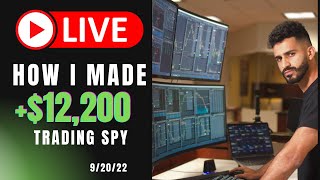
Kardec Trader breaks down two SPY options trades that netted $12.2K, showing entry and exit prices, contract counts, and percent returns. The first was a long breakout using 384 calls with staged exits; the second a short trade where an execution error actually helped. Key lesson: emotional control and proper sizing matter more than being right.
Questions this video answers
384 calls, average price about $9.37 (entered at 9:37).
About 236 contracts bought; ~150 contracts exited at $9.43 and the remaining 85 contracts exited at $9.45.
Invested about $37,000, made about $11,500 (≈30% return on capital), reported a 2.3 R trade.
Intended to buy ~300 contracts but actually entered 30 contracts at about 11:19 due to an execution/screen error; the trade produced a ~3R result and about a 20% return (≈$3,500 P/L for the 30-contract position).
Levels around 382–383 were noted as strong support; a new area at 387 was established and used as a reference for the short setup.
Chapters
Today I made $12,000 day trading spy. And in this video, I want to show you guys where I got in, where I got out, why I got in, why I got out, my full game plan and just a kind of a breakdown to show you my thought process behind these trades. So with that being said, let's go into this $12,000 day and just kind of break it down, right? So let's start off with the overall game plan. So obviously every game, every trade that we take must have a game plan. It needs to have a idea behind it, right? We can't just randomly open up a stock screen or any chart and execute. We need to have a game plan. So going into the day, what was my game plan? So I had a game plan where on Friday we had a crazy gap down on Spy on the overall market. And I started paying attention to the pre market levels and then the opening and closing levels of Friday. Now what does that mean? Now when we go into Friday, we'll see that the 382 level held very, very strong. We got the big gap down from Friday. So, so obviously for me, those levels matter. So when I look at these levels right here, the high and the low of the previous day, these levels right here are very, very important to me as a trader. So I want to pay attention to these levels. So looking at these levels, these levels once again are very, very important to me. I'm just going to make them color coded. Now right on the open, I start paying attention to my big 382 level. I'm very interested to see what happens at the 382 level. Do we hold? Do we not hold? Now the first thing I see at the 382 level is we open, we, we make a quick move up. Now obviously once we start making a quick move up, my job as a trader start identifying, will we see a continuation? Will we see weakness? Will we see a reversal? These things start playing a big role in my trading game plan. So once I see the strong opening drive and I see consolidation, I start seeing that we have a pretty Strong hold at 383 on spy. Spy is looking strong. It looks like it has another leg. Up, up. So that's where my first trade came in from. So my first trade, I took about 200. I tried to get 200 filled, 250 contracts, I got about 236 contracts at the 384 calls, right? Same day expiration at 161, about average price at 937. So when I go to 937 right here. This is where I took my initial position. So I go in, I buy about 200, what was it, 236 contracts. And I'm looking for this continuation move up. Now, my whole thing was to play the breakout. As soon as we see any slow mint in the breakout, I will exit. So I exit. I mean, I enter right here at 937. I accidentally sold one contract. A minute later I hit the sell order on TOS for people that used to know that but got in a 937 stock starts making a nice move up. My setup was an opening drive play. Once it starts making a strong move up, I am now looking for weakness. I'm looking for price action to slow down. I'm looking for action to start decelerating so I can take some off. So after getting in at 937, I exit my first 150 contracts at 943. So going to 943, this is where I exit over 50% of my position. Now, the reason I exited 50% of my position or more than 50% here is primarily because I started seeing price action slow down. So I was like, listen, I'm up strong on this. I'm doing pretty well. Don't ride it out. Don't make. Don't go for a bigger move. The main goal is to take a small piece and keep taking a small piece over and over again. I've been on a nice momentum run. Keep that going. So take some money off the table. That's exactly what I did. So I took about 150 contracts off at 943. And then in 9:45, I took the remaining 85 contracts off. And this was 945. Right. When we saw the consolidation, I was like, hey, if we get another push up, I'm going to get out. I'm not looking for any crazy moves again. I'm just going to go cash. So I took my final position off right here. Now, looking at it, if I held, maybe I could have made a little bit more. If I held longer, I could have made a little bit more. But that's not what I'm trying to do. Right. And that's the mindset I kind of want to talk about for a second. Me as a trader, I always say I'm trying to capitalize on small moves here, maybe small moves here, maybe this rejection, maybe that rejection, whatever the case is. And I'm trying to go in with size. That's essentially it. I'm not trying to buy here. And sell there. That is not what I personally do as a trader. Other traders may do that, but that's not what I'm looking for. I got an opening drive play after getting a nice move up, some consolidation, a breakout. I'm trying to play this breakout with size now. Going back to the trade, looking at the trade details, there's a 2.3 R trade made, about 30% on this trade, right? When I look at the percentages, when I look at the numbers, these are numbers that I as a trader care about. This number checks off for me. This number above 2 checks off for me, essentially, meaning I risked about 4,900 to make 11,000. These are good stats, right? These are great stats for me that I actually had within this trade. Now, these numbers are just kind of adjusting to how much I'm investing. So I invested 37,000, made 11,500, about 30% of my capital, and a 2.3 R. This is what I care about. These numbers will adjust accordingly, right? They will work out. These are the numbers that I really, really care about, depending on the security I trade. So that was one trade that I took. Now the second trade I took going to the second trade. Let's go to the second trade right here. So this was my ideal setup. So if you guys have seen the recent trades, I've taken a lot of trades, had the same setup. Now, a few things went wrong here. On my end, I left money on the table. Obviously, I sold early, right? I didn't size accordingly. Like that was my mistake. I thought I had 300 contracts. I hit 30. I didn't realize I was at 30 until I started exiting. And even when I exited, I could have gotten in again, right? So I left a lot of money on the table here.
This is just. I look at this and I'm like, oh, man. It's one of those things where we as traders, we will make mistakes. And I made a big, terrible mistake here, right? So let's look at this overall, right? So this is the setup. So for. For. Once again, if you guys have seen my videos in the past few days, you guys know about the setup by now, you should know about it. Morning, top reversal. I look for some rejection at a key level in the morning, maybe the hour, two hours in. Once I see continuous rejections and unable to hold that level, I will possibly look to short, right? This setup I was looking for here as well, I was, okay, we're going up again. If we're unable to hold this, I will look too short. We established A new area at 387. So once we established that at 387, I started looking for the short, started looking to play the downside. Now, essentially, when I'm looking to play the downside, if we go at 11:19, which is right here, I get in 30 contracts. Once again, I was trying to get in 300. I did not see my order. Execution screen didn't adjust. I thought I had 300. Once again, stupid mistake and my fault. But once again, we'll put that aside and we'll look at the trade metrics, which is what I ultimately care about. Looking at the trade metrics got in this trade, 30 contracts, about at 117, 1119. So right here and then, because I thought I had 300 contracts, 1121, I was like, you know what? I caught a nice move up, nice move down. Execute, get out. Now, essentially, I had about $3,500 in the trade. 30 contracts, not the trade I was looking for in terms of size, but looking at the metrics, 3R trade, great. About 20% return on the trade, great, right? These two metrics I care about, especially when I'm trading options. I had a good setup. My setup worked great. I did make mistakes. I sold early, obviously, and then my size wasn't like my execution had an execution issue, right? I didn't look at my size. I didn't look at that. I had 30, not 300. My mistake. Now, essentially, if I did have 300, this would have been a $6,600 risk, right? This risk, I mean, this would have been $2,100 risk, right? And then that, you know, once you start adjusting and you do this by 10, you know, this would have been what I can't even do. I can't even do basic math right now, right? So I'm just doing it essentially just because I'm curious. I haven't done it but 638 times. Let's say 10. Okay? This would have been about 6k. This would have been a 6k trade just on this. If I held this trade, a lot more. And by the way, don't do this, right? It's not a good thing to do. I'm just showing you what happens as a trader. That's why I haven't done it now. And I was just curious to look at the numbers. Would have been a 6k trade if I went in 300 contracts, right? If I held this all the way, probably a 20, 30k trade. But hey, we as traders, we take this, we go on to the next day. And we say, listen, I care about the execution. When I say execution, I care about, hey, did I have a setup? And I'm trying to implement this with everyone watching because I want you guys to understand the right way of trading, right? And once again, if you have seen the last four or five videos I posted with breakdowns and everything, you guys will understand these setups show up. But when they show up, make sure you have a setup. Make sure when the setup hits, you have a good R multiple. Make sure you're making a good percentage, right? If not the R multiple, whatever you want to kind of focus on, make sure you have a stop that makes sense. Make sure you have a good trade setup. And if you are repeatedly able to do that over and over again, you will give yourself the best chance to succeed in any market, right? Any market at all. So, yeah, that was the trade. Two trades I had for the day, keeping my trades very minimal. Not kind of forcing trades at all. Not trying to, you know, take 20, 30 million different trades. And also another thing I want to share with you guys, right? You will have trades where you will have days where you feel fomo. So when I. When I took this trade and I realized I had 30 contracts, I wanted to go in 400, 500 contracts and short again. The reason I didn't play this again, because some people may be like, maybe, maybe like, hey, why didn't you play this again, right? Why didn't you take another trade? Was because the moment I felt that fomo, I was like, listen, I can either try to trade through what I'm feeling, or I have the power to close my computer, shut it off, and walk away. So I get to decide what I want to do. Do I want to potentially make more money, which obviously everyone does, but do I want to potentially make more money while I feel the way I feel right now? If that makes sense, right? And me trading for nine plus years, I've gotten to a point when I start feeling those emotions at key times, especially, you know, it's already 11 something. I don't even trade around this time, typically that much. But at this point, I'm like, hey, I think I need to walk away and just call it a day and not destroy my confidence or mental capacity over.
Kind of a stupid mental error I made. So let it go and walk away, right? I take that, I go into tomorrow, and now I essentially prepare for tomorrow, and I hopefully try not to make the same mistake, but I don't carry it over into the next day, right? With that being said, I'm going to end the video right there. I hope you guys found this valuable. Thank you for watching, everyone. I will see you on the next video.









