Keeping a Disciplined Mind when the Pressure is On
Randy Howell explains why traders chase losses under pressure: stress hijacks the brain's limbic system, triggering shame and greed that override disciplined decision-making. He teaches breathing techniques, mindfulness, and emotional training to rewire your response to market pressure.
Questions this video answers
September 3, 2020.
September 10 (year implied same cycle as the talk).
10‑week course, five meetings.
$1,195 full price or payments of $239 every two weeks for five payments.
A free emotional regulation workshop if you sign up by the stated Saturday.
Chapters
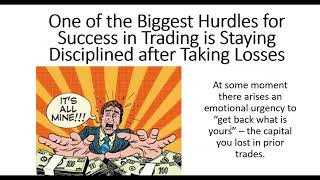
Welcome everyone. My name is Randy Howell with Trader State of Mind. And we're here to really explore this mysterious part of trading called trading psychology. And in particular, we're looking at a specific moment. This time we actually want to say, you know, once pressure gets on and what you'll discover in this, in this particular webinar, it's really about after taking losses, how do you stay disciplined and not just fall apart and start doing stupid things? That's what we're going to be looking at today. And a couple, just a couple house cleaning rules is that I hold questions to the end of my presentation. However, that doesn't mean you can't ask questions as we go. So we'll actually have some questions to go instead of sitting there and oh, shucks, I don't know, are these people going to have a question? So just write your questions as you have them and just type them in and at the end we will cover them. Okay. And with that, let's take a look and really begin to look at something. Let's take a look at this particular image. Okay. How many have you ever felt this after you've taken a loss, after you've taken two, three, and all of a sudden you see all that money draining and you're going, it's mine. No, it's mine, it's mine. I can't let it go. I can't let it go. And suddenly, at particular some moment, an emotional urgency to get that money back occurs.
And it can go either just making up for prior losses where you feel a sense of desperation, or it can be revenge trading, where you feel anger, you actually want to punish. This is one of the biggest hurdles that I find with traders ever. It's not really the fear. That's something that can be mastered with pretty. It's not, it's not easy, but it's certainly not on the same level as this. And it's what separates a pretty good trader to one that has become consistently profitable. If they can solve this problem of not trying to make up for prior losses or revenge trading, they would be able to launch their, their trading into another level. But it doesn't happen. Okay. And what we want to do is say, what is going on here really? Is this something wrong with the trader's mind? Is this psychology or exactly what is this? Well, friends, making up for prior losses or revenge trading is rooted in our evolutionary psychology. It may take over our present psychology that we bring into the trading game. But the truth is, if you take a look at this image, take A look at what this guy's doing. He's ultimately trying to defend the wolves from taking something that's really valuable to him. He's already got. He's already taken the loss, and he's sitting there and he's got number of wolves sitting there and they're looking for food. There is a biological threat here to this caveman, and yet you also look up above him and you can see what he's fighting for. He's trying to ensure that his family, his clan survive, and he doesn't. If he takes a loss, he's going to fight even harder to make them pay.
This, friends, is literally what's at the very core of it. And this is where. What we say is, this is where the ancestral reflective emotional brain and that reactiveness to emotional situations.
Is literally in conflict, is duking it out with that part of the brain, the neocortex, that part of the deliberate brain, the part that thinks through things. Ultimately, this fellow right here didn't really have that part of the brain. It's all in the immediate moment of now of survival.
Let's find out something. Can everybody hear me? Type in a yes into your chat box and just let me know if you can hear me, because one. One person says he can't hear me, and we need to decide whether or not it's me or whether or not it's them. Yes. Yes. We're getting a bunch of yeses. So. Yeah. And so Dolores will handle that. So what we're looking at, what I want you to look at in this image, is the foundations of making up for prior losses. This is the instinctual nature of the emotional brain, and it's coming in conflict with the deliberateness of the thinking, of the impartiality required to trade. Now, who do you think is going to win that? This particular caveman doesn't really have the neocortex there, which has been around about 50,000 years. To be able to literally think into the future and think, you know, the truth is, I may have to take a loss, but back then, a loss was not psychologically discomfort, like I'm taking a money lot. Taking a loss was getting truly hurt. And taking a loss might be having someone hurt or someone taken, eaten alive. That's. That's where the. That's where this stuff comes from. And ultimately, that caveman brain, that residual. That ancestral reflective reactive brain was never designed for the probability management required in guess where trading. So here we go. What we're doing here, we are dealing with our evolutionary psychology.
We're taking traits that were built long, long ago, even while we were not homo sapiens. And they're incorporated into our emotional brain, into the limbic system. It's riding there as instinctual reactiveness to changes in the environment. Taking a loss is a change in environment. Taking a second loss or a third loss often ends up triggering, triggering.
Triggering, okay? And that triggering ends up producing a reactive brain rather than that reflective brain needed for trading. You know, again, caveman didn't know about probability and risk management. It was like all or nothing. Threat was real, was imminent, and now we still have those caveman instincts with us, and that's what we're bringing to trading. What do you think happens when you add uncertainty and risk to that equation? Well, there you go. What we do is the moment you add the challenges of stress with real uncertainty and real risk, there's no reset button here, friends, is you trigger to that old primitive part of the brain that just absolutely bypasses thinking. Remember, emotional response happens before thinking, okay? Thinking is not required for the emotions to trigger and to act on the environment. And this is what's happening not just in. When you take a loss and you have an urgency to make up for that loss, but it happens when you're. When you get into profit and all of a sudden you want to take that profit now rather than hit the target. It happens when you first get into the trade and you're locked in and order fill. It's there, you're there, and all of a sudden the trade just starts going wham, wham, wham. All around you, just touching, almost touching. That stop out and you get freaked out. These are all instinctual urges that are built into the emotional brain. And when that stress is there, that's the uncertainty and risk is it takes on another game plan and all of a sudden we revert back to the instinctual reactiveness of the emotional brain. And if you're going to be successful, this is going to be something that you are going to have to master. There's no way around it, okay? And here's what it would look like really graphically. You know, here you have this modern looking fella and he's driving the brain, he's driving his life, and he looks like he's in control. You know, he's got all this modern technology, but in the back seat, remember, there's no stress. Right now in the back seat is this very primitive brain. This. We can call it caveman brain. We can call it the emotional brain. We can call it the malian brain, we can call it the ancestral brain, is sitting back there, and the moment that they start running into trouble, what do you think happens? That trouble produces stress. And at some particular moment, that stress is going to trigger the reactive brain to take over the thinking brain and friends. That's where. That's where you're going to have to make friends with your inner caveman. We're going to have to figure out, literally, hmm, he's being triggered. That aspect of my being is being triggered by perceived threats. And that caveman brain, friends, cannot tell the difference between a psychological discomfort like taking a loss and a physical threat that you were seeing that caveman face with the wolves and his family behind him, and you're going, wow, it's that fast. That's how emotional hijackings happen. And what I want to do is, I want to illustrate this is what you're looking at right here is a graphic representation.
Of how the limbic system, the emotional brain, that Capeman brain, and the sensory cortex, what we would also call the neocortex, are the deliberate mind. What you're doing is you see emotional stimuli coming in to what is known as the thalamus. Okay, they that thalamus. The best way to describe the thalamus is that it's a traffic cop at a really busy intersection with lanes and lanes of traffic going either way, and he's directing the traffic based on circumstance. Let's just say that cop sees something dangerous going on, suddenly he's going to route traffic in a particular way based on his learning that has been taught before this ever happened. That triggers what is known as the short route, the low road to the amygdala. That means the impulse, it hits that sensory thalamus, it is fired at rapid speed because of the traffic cop over to the amygdala. The amygdala, the emotional center, is going to say, oh, my God, this is lightning fast. And by the way, this is nanoseconds. If the sensory information is even going to the sensory cortex, it's going to take 0.25 seconds, at least, for it to get to the brain to be able to start going through the deliberations that the thinking brain is going to do. Do you see the problem here? That sensory cortex grew out of the emotional brain? It's a tumor that grew out, and it's not independent of. It's actually slave to the emotional brain. And all of a sudden you're looking at it going, okay, there's a threat there. The cops rerouting it without just based on experience, not on thinking based on experience has become implicit memory. It has become implicit thinking. That just happens just like that. In nanosecond, it gets over to the amygdala, and all of a sudden it goes to. It hits the fight flight. It will have other memories that's captured in hippocampus that basically say, oh, yeah, this is a really big threat, and they're fired like that. And before you know it, the amygdala has driven the whole thing to fight flight. And if it's fight trying to make up for prior losses or trying to revenge trade, what you're doing is you're aggressively going after something. But in truth, when you're trying to make up for prior losses, there's a desperation there, there's an urgency to make up for those losses because, you know, I'm being hurt. You know, my plan's being hurt. I need to make up for those losses really fast because before we lose somebody. And so it goes to fight, you want to. You want to take the. The market's ability to make hurt you down a notch or two. If it goes to revenge, where there's aggression, you know, you're out to punish the markets. And the thing is, it's all happening. That's all happening so lightning fast is that. That's nanoseconds.003 seconds from the traffic cops saying low road to getting to the amygdala, to firing up fight flight. And meanwhile, it's taking a microsecond, 25 seconds to even get to the deliberations of the sensory cortex. Wow, friends. That's what's happening when there's no reset button, when the risk is real and you can lose money because that money truly represents the biological threat that our caveman ancestors had. It can't tell the difference. It lives totally right here in the nail. Now let's break this down even one step further. Okay, what you're looking at, this is actually a mapping that I did with a client last week, and here it goes. There's at first this expectation. It's an expectation that really needs to be changed. And the guy's thinking, I want to win. I'm going to win today. This is going to. I'm going to control that outcome.
Interestingly, is by now, people in this class should know that you do not control outcome. You do not control whether or not you're right or wrong, and you do not control prediction, all those three things. The caveman wants to control all three things. And whether or not that caveman takes control of the thinking brain is really up to that traffic cop. Okay? That traffic cop basically trained in a way to perceive sensory information coming in. And unless we retrain that traffic cop to the way it evaluates the memories of all that information, you're going to have problems always getting to be and to be disciplined when you really need to be, when you're under the gun. So here it is. You've got the expectation, I want to win.
Which you don't control, by the way. You're already putting yourself in a lose, lose situation. If you don't control winning, what you do is you control performance. And that, friends, is a big thing. We'll talk about that a little later. Then the belief winning will prove my value. It will show that I'm a top notch guy, that I'm an alpha, that I can make things happen. Okay? And that is another very dangerous thing. All of a sudden your sense of mattering is being, saying, well, it totally is in compliance with my sense of winning or losing and you don't have control over that. And then there comes this bias, says, I'm going to make it happen. I'm going to make it happen. That's that alpha mentality that says, I'm going to make up for prior losses. I'm scared, I'm desperate, I need to make up for those. I'm going to make it happen. I'm going to make it happen. I'm going to push, push, push, or the revenge, I'm going to really make them pay. And every casino knows this happens. And when they start seeing the gambler move into that, I'm going to make it happen. I'm going to make my money back. They know they have him. Matter of fact, if he's losing too much, they'll slow him down because they want to drain him. They don't want to get him to the point where he's, he's lost enough and he's going to back away. They want to slow it down so that he doesn't come to the fulfillment of the emotional parts. Then what happens is he takes a loss, or several for that matter. Whoo. And what the market is telling them, okay, the evidence, the evidence is showing.
Whatever the expectation was, whatever the belief was, whatever the bias was, I'm going to make it happen. It's calling it into question. No, you're wrong. Ooh. Suddenly what happens there, and this is something that traders really don't grasp, is a big component of being able to build a mind that can Trade effectively is to deal with your own personal shame. I'm a loser. I lost. I can't let people see that I have to win or I feel like I'm a failure. I feel like I feel shame. And what people don't recognize is that shame from an emotional intelligence standpoint is an emotion that disorganizes the potential of the self. And it's saying is that this potential has not been organized for the good of the whole. It's not working. And the shame is disorganizing the self. The person who's brave, who knows how to maintain discipline, uses that and also has compassion for self, uses that moment to reconstruct the self. That trades reconstructing the potential, the totality of the potential of who you are, and organizes the beliefs of the self into something that can trade in probabilities. And the key belief there is. What I control is the mind, the performance mind that I bring to engage uncertainty with that, my friends, I can control. I'm no longer trying to control things that ultimately I can't control. I can't control the outcome. I can't be right. I can do everything right and still be wrong. And I cannot control the prediction. All those people trying to find that perfect time to get in. Think about it. So that shame arises. Then the fear of loss comes out of that. And what that really means, that limbic belief is being revealed now on a very. On a very visceral level. The traffic cop routes it right to the amygdala. Fight. Flight is on, man. The game's on. You're gonna fight. You're gonna fight. You're gonna fight to make up for the. To get back, to break even. You're gonna fight to punish. And there you go. It's already done, man. You are so gone by this time. The thinking brain just simply no longer has been ellipsed. And it's gone for a while. And what happens is those learned instincts have taken over of that reflexive, instinctive brain. And it's ancestral. That's the one we inherited from our caveman ancestors. And in this particular case in aggression.
It'S more about that attack motivation that revenge trading or making up for prior losses. And ultimately, what you're looking at is the hijacking of the thinking brain by the emotional brain. There it goes, friend. This is the pathway that you just saw in the other slide of where we've symbolically represented the limbic system and the thinking system. This is kind of the process that happens within that, and this is happening in the flash of a second, you take that first loss, you might be able to handle it, but the second and third produces that urgency to get back to break even, to make up for those prior losses or to revenge trade. This is the process that goes through that your brain's going to go through, and you don't even know it's happening. It just, it's there and all of a sudden you're off. What we want to say is, you know, is that really the best way to trade? What we're beginning to recognize is this.
Is the brain that you brought to trading is not going to be the brain that's going to produce success in trading, okay? They're built for very different things. That old brain, that mammalian brain, that emotional brain, the limbic system, the caveman brain, wants short term instinctual reactions to dangerous circumstance. It's not thinking about the future, it's thinking about survival now. It's making decisions like that, like, particularly with fomo, like fomo, where you hit the, you get in the black and all of a sudden you became scared that you're going to lose that money. If you wait for it to go to target, you want the money now, that's the old brain, okay? Instead of waiting with your carefully planned trading plan for it to go to target, to give it a chance to go to target. And often it does. And what happens though, is that you have not regulated, you have not built an intentional mind to deal with that moment. You keep believing all this knowledge is going to save me. It's kind of like I'm always amazed when people, they write me and tell me, God, Randy, your work has really changed my life. And it's just, you know, it's just made me a different kind of trader. And I always say, I want to ask, well, are you profitable? Because ultimately, what I understand is that that knowledge, the knowledge that I pretty much give away here seems like, boy, what a great deal. Why is he giving all this away? Because ultimately this is about training. You have to train the emotional brain to react differently to uncertainty than the way it was built for. By evolution, you had to become the designer. And it's training, friends. It's not knowledge, it's training. And it's the difference between knowledge and performance in the clutch. That's what the difference is. The training is necessary. So now we look at this and go, oh, and after it's all, after the smoke clears, there's a dejected trader, okay? And what you've really seen as you fall into the revenge trading the over trading and the making up for prior losses. What you've discovered is your survival instincts have taken over, blown out. The ability to think, to reason, to deliberate what you should, you know, that's what you need to. To be a consistently profitable trader. And what you're seeing is, wow, the, the main thing that's happening here is pretty simple. Then.
What'S happening is that I'm not managing the mind. I don't even. I didn't even understand. What most people, as they work with me, began to recognize is I didn't even understand what was going on, on underneath the hood of my brain. You know, I lift it up and all of a sudden, oh, my God, I had no idea this, all this was all going on. Yeah, most of this stuff, the emotional brain, you're not going to have awareness of it until it's hijacked you and you wake up later going, what just happened? What was I thinking? You weren't. What you were doing is you were, you were hitting the emotional brain. It hits a danger spot where there's a. Appears to it to be truly a biological threat. And it's hijacking, bypassing the thinking brain. You're toast by this time and you're running into instinctual behaviors, instinctual responses to threat. That's what's happened. And that's one thing you do not want in trading. So.
What are we going to do about all this? And this is, friends, what I would really.
What I really want you to understand is there's really, there's really not a choice here is that you're going to have to do something about it. Even you're not doing something about the way the, the emotional brain and the thinking brain work together.
You can pay for it by staying in purgatory for I don't know how long in your trading or having your trading account just absolutely blowing you up or just bleeding from a thousand tiny cuts. But ultimately, there are a few people that go through this, learn, and become successful traders, but they are few and far between. There's a reason that only around 5% are actually profitable and only 2% really make good money.
Those are people either won the genetics lottery or have learned. But if, you know, if you had a 98% chance of failure, would you think that maybe you need to change the way you're approaching the problem? Well, that's what we're looking at here. We want to develop a model of emotional intelligence. And that's the antidote, Friends. As you begin to understand your emotions, you learn how to use them. And you discover it's the antidote to the survival instincts that have driven you to just do some really classically stupid stuff. As you look back, once the emotional brain has given back control of the mind to the thinking brain. So that's what we want to do. We want to start building an intentional mind. Okay, that depends on your understanding. You know, the thing is, is that you need to learn how to use emotions. You don't have a choice about whether or not you're going to have emotions. There are biological action potentials that are triggering when there is any kind of perturbation in the environment. You're going to have an emotion begin to surface, to grow, to start getting into the bloodstream and interacting with your belief system. So the key is, what are we going to do about it? The first thing you learn is very simple, is that most people have been thinking about emotions in a very limited way. They think that emotions are psychological.
There's something wrong with you if you have emotions under pressure. Well, it's just not true. Emotions are biological, they're not psychological. They take over thinking and psychology. And what you discover, very simple, is all thinking is emotional state dependent.
That's really the thing in neurobiology and in cognitive psychology, it's called something a little different. It's called motivated reasoning. And what you discover is that reasoning, this thing that you want to be while you're making decisions and trading, is literally serving the beliefs of the emotional brain. That's the motivated reasoning. Whatever classic beliefs are there, and I'm going to tell you the ones for people struggling with their trading, there's really only five police friends that really need to be looked at. There's no rocket science. And also, if you're not going to master these, you really shouldn't be trading. The first one is a sense of inadequacy. You know that voice inside your head that's to say you're not good enough, you're never going to make it, blah, blah, blah, that a sense of mattering. The second one's a sense of mattering in which when you equate, when you equate the amount of money you're making with your sense of mattering as a human being.
Just I want you to understand, is that that need to matter, you are literally giving something you can't control.
Dominion over your value as a human being. Okay, it's really crazy. The third one is worthiness. There's lots of traders who do not feel worthy enough to make quick money. A lot of Money, it triggers a whole sense of beliefs about the puritan work ethic. And, you know, how much money should, should I, you know, it's for those other people. It's not for me, though. And you know, they think, oh, they never knew it was even there until they start trading. The third, third one is scarcity. That's the one that you hold that whatever you have is going to be taken from you. Okay? So you end up scared. I was working with a trader today, he says, oh, my God, you know, I'm even scared to talk about this. If I start talking about how good I've been doing recently, then, you know, it's going to probably trigger me to lose. And I'm going, whoa, there's your scarcity. There's your scarcity. And what we're doing is we're turning toward that scarcity mentality and confronting it rather than trying to pretend it's not there. But what I want you to understand as you trigger these things, oh, and the last one is the powerlessness. And if you've ever been in a trade that started really going wacky on you and just bouncing around on you, you know what powerlessness is. When you go, aha. When you lose your stuff, ultimately, if you keep calm, you have access to your sensory cortex. You have that thinking brain that is, that can really deliberate. If you don't stay calm, what happens? The amygdala starts directing traffic and suddenly you're in fight flight. And. And your higher cortex is your ability to think and reason.
From impartiality and from a disciplined state of mind is blown out. So this is the way it is and it's powerful. So then we go to the next stage and the real question is, how do you begin to regulate an emotion? And I give you this, is that the thing is, you know that being in this game is up and down. It's like a roller coaster. Up and down, up and down, up and down. It's whether or not you're taking those perturbations going on in the market. Is the market telling you, Are you listening to the market? Are you trying to force yourself? And here's this guy saying, oh, this is just a correction and there's nothing there. Ultimately, what you discover is that you realize you're not in control. But what you can do is you can start disrupting literally that emotion from growing and revving up and taking over mind. And it starts friends with breathing and muscle tension. And these are parts of an emotion. Remember, the emotion is biological. The way you Breathe is absolutely complicit into the emotional nature that's rising and showing and acting. And also the muscles. For instance, in breathing, if you're in this particular case, particularly with.
Trading and having revenge, trading or trying to make up for prior losses, where there is a mix of desperation and aggression, it will have a particular way of breathing, and you'll notice that it's holding your breath, or you'll be using the very top of your lungs. What you're doing when you're breathing that way is you are stopping oxygen from getting to the brain, to the neocortex, which desperately needs it to make deliberate decisions, and routing it to the bodies, to the body, preparing to fight or flee. And then when you feel the tension, you know, that jaw, the shoulders, the gut, the chest, what you're doing is you are feeling. You are feeling the muscular tension that's associated with emotional arousal. Again, getting ready to flee, run, or getting ready to fight. That's what it's doing. And ultimately, you can manage these literally by the way you breathe. And I teach bellows breathing to be able to interrupt that process. And people are amazed, particularly when they start letting the tension go. They're really amazed at how much control they can get back over their mind. So.
Just remember, the emotion is a. Literally is in action in microseconds, and it bypasses the deliberation of the thinking brain. So the thing is, is this is your first line of defense. And it. It's something that you just have to. You know, in both my courses, you are learning. You're taking the first part of the course to retrain the body and the way it physically responds to stress, to stressors, to challenges, to putting risk on. And how do you do that? What I want you to see is this. I want you to try this. What I want you to do is imagine that there's a bellows down there where it says, number one, belly out. And the bellows is expanding. And what you're doing is you are literally pulling air into the nostrils, down the windpipe, into the belly. Okay? The nozzle up is up there at your nose, and you're pulling it in as your belly expands. Then it flows into your chest, you hold, and then you release. What I want you to know, just do that a few times.
And what you'll notice is that the agitation in you goes down a notch.
Just take it. Let's just try it for a moment. And I'm going to shorten things. You've got your Bellas and you're Using your abdominal muscles, like the bellows and the abdominals, pull the handles apart. Drawing down from that, the needle nose down into the belly, expand the chest, hold, release. And when you release, let the tension in your body drain, drain, drain. Do it again. We're going to cut a lot of the words out. Air into belly, expand the chest, hold.
Release. Let the air drain, drain, drain. As you release the tension in your body, let that tension drain, drain, drain. One more time, air into belly, expand to chest, hold, release. Slowly.
Let the tension drain, drain, drain. Now what do you notice?
What the vast majority of people notice is that it feels alien to draw air into the belly, expanded chest. That's because we live in an anxious world and it's constantly drawing air to the chest, only to the higher lobes of the lungs rather than the lower lobes of the lungs. And you're not getting the full containment of oxygen that's possible. That your brain needs to be able to function in a deliberate fashion. This is the first stop that you have to do, and it is powerful. But what you also. And by the way, what do you notice about your mood? What do you notice about the emotion as you're sitting there right now? Notice the difference. And that's just with a little bit of training, a little bit of direction. Now, the trick is to be able to learn to do this under the combat conditions of trading, where there's real risk, there's real potential loss and all that. That's part of the training that we do. And the key is you come to this relaxed state. But there's only one problem.
Emotional regulation is not a game changer. It's. It's something that if you can't regulate the emotion, you never get to the door of the mind, okay? Because the mind's already wiped out before, before anything. So regulating that emotion is job one. It has to be done. But the thing is, is that it gets you the door of the mind. And at this particular point in time, another skill is necessary. What we have to develop is mindfulness, or mindfulness is a new vogue word that we use in Western society to talk about this phenomenon of awakening the observer itself, the observing self. Or in neurobiology, we would call it metacognition, primary metacognition or secondary metacognition. The point is that it is through mindfulness that we open the door of the mind. We climb up there and this is where we get to look into and start finding the subconscious biases and limbic beliefs that are all part of this caveman brain of Yours that you bring to you, literally to you when you go trade. And it's. It is what's holding you back from performing in the clutch when the pressure's on. Okay, this is where we're really looking here. And we're going, okay, what, How, what, what are we doing here? Well, ultimately, in mindfulness, what you're doing is you're stepping back out of thought. Look at this illustration on the left. The guy is totally immersed in thought. His observer has fused to thoughts, and he thinks he and his thinking are one and the same. And I hear that all the time with clients, even clients who should know better by the time they work with me. And yet at the same time, in observer mode. What you're learning as you develop this observing capacity, you're stepping back out of thought and you're observing them, recognizing that you and your thoughts are not one in the same. You and your beliefs are not one in the same. In fact, you're not. You don't have thoughts and beliefs, friends. They're having you. They're creating your experience. And unfortunately, the observer that you are has fused.
Fused, identified with those thoughts and beliefs. And they think, oh, well, that's me. No, it's not. It's one potential organization of the self. That's all it is. There are many other organizations of the self that are possible, but this is the one that happened while you weren't looking, while you were growing up in your family and everybody was downloading the family rules and the beliefs that you inherited from, you know, those original hypnotizers, mom and dad, and from your culture and for the circumstances of your life. This is. This is where most people just have. A profound part of this work is they begin to go, oh, my God. I've been living in the belief that these are my things. And all of a sudden I've been identifying with, I can't do it. I can't do it. I can't make it. I have to make money. I have to make money or I'm not going to matter. Nobody's going to respect me if I don't make money. And also you're going, oh, my God, I'm not. These thought thoughts, and I can reorganize them. This is powerful. But the most. Probably one of the most amazing parts of the work is that it's what we call what I call second order metacognition. This is when you start discovering that there is an observing faculty that can observe the primary observer, that primary observer are all the biases and beliefs that you project onto the world.
That second order metacognition is watching those biases and beliefs in action, creating the world that you're participating in. And let me give you an example about this is I worked with a fellow who is a master trader and works with a huge account and can actually move markets and do stuff like that. And one day we're working on Skype and he's showing me a chart and he says, randy, what do you think I see right here? And you know, Christopher, I really don't know. I'm not going to second guess like you. He says, I'll tell you what I see. I see blood. I see people getting boxing canyons they can't get out of and I'm going to suck them dry. Okay? Now that's very different than a lot of people when they start talking to me, they start looking at their charts and they start having these technical explanations for all these little terms and stuff like that. When in fact what you're looking at is representations of emotions, of desires, of greed, of fear, of lust. And what Christopher could do is he could discern those and he could get people sucked into a particular area and then pull the rug out underneath them. And he saw that as blood. So he's seeing things very differently than a lot of people. He has trained himself to do that originally, 35 years ago. That's not the way he traded. He had a different set of distinctions that allowed him to see the world that he saw. Now he used the distinction seeing blood. Okay, and this is actually beginning to recognize that, oh, we all have this observing faculty and we can really recreate the potential of the self to become some. A self that can deal with the uncertainty calmly, disciplinedly, and with precision rather than reactively. That's the big deal.
And what you discover when this is going on is that there is always a constant commentary going on in your head. Have you ever heard it? The commentary always has opinions about things. It's criticizing, it's got judgments, it's just telling you should do things, you should do this, don't do that, blah, blah, blah, blah. That's the internal dialogue, friends. And what, in this particular case, most of it is pointing to something called shame. Who you are is not going to make it if you're a struggling trader or if you're a trader who has reached a particular threshold, but they can't get past the next threshold, that glass ceiling, into the next level. And what you discover is, wow, you know something? I need to really start looking at these self limiting beliefs that are running around rampantly in my head. And I have just been asleep at the wheel. This is where we really start doing some house cleaning. And what you discover really quickly is there's a lot of trash running around in your brain. Now I call this the committee of the mind. And what you discover is there's some very destructive elements, aspects of the self that are in that committee. There are some really positive, constructive parts of that. But the thing is, the observer of that committee, what I would call the chairman of the board, has been asleep at the wheel and he begins to wake up and he realizes he's got a mutiny. He's got a company called you that is being pulled in various directions without his leadership. And you begin to go, there's a lot of stuff I'm going to have to throw away. But what happens is I also need to start reorganizing the mind that trades. Rather than taking the mind that I inherited from history, I need to create the mind that I'm going to engage uncertainty with. And this is where it really begins. Becomes very interesting.
What you discover.
Is that there is potential living in you that is waiting to be developed, but you just simply haven't figured it out. This is the totality of your potential. This would be something like the, the quantum mechanics boys will say there is neither mass nor energy that exists. What exists is potential. It's the observer of the potential that brings forth the form. And if you're looking at your trading account, which is not going to lie to you, it's telling you what organization of potential that you have. Whether or not it's effective at extracting capital out of the markets, or whether or not it's equally effective about plowing money back into the markets. Okay, it's up to you. And all of a sudden we have the tools for you to be able to train and work with the thinking brain and the emotional brain into a new partnership, into a new way of working with one another. And we're beginning to go, I can do this from observing. And it begins as you observe. You begin to be freed from fearing judgment. And what you discover is this, is that this observer, your potential, suddenly is in a position to say, you know something? The potential that I observe is just the tip of an iceberg. There's also this unobserved potential that lives within me. And here's the kicker, friends, is in the same way that that judgment, I gotta, I gotta make money today. That criticism, you're never gonna make it. The fear, oh My God, what if I lose the aggression? I'm gonna get that back. And the overconfidence that leads to overtrading thinking. Boy, I'm gonna be on a run. I'm gonna make this thing happen. Is these are one or two. Organization of potential, but in the same way.
As a possibility. The discipline of ruler, the courage of a warrior, the self soothing of a caregiver and the impartiality of a sage exist as emotional programs in the brain in the same way that judgment and criticism and temptation do. The difference is that you have not located them by observation and learned to pull them forward and to get them to become a working part of the thinking mind that you bring to the management of uncertainty. And that's what we teach, friends. That's what we teach. And how does this look? Well, I use. I use a combination of neurobiology and a process that I call emotional remapping of a memory to get access to emotional programs and also use Jungian archetypal to be able to demonstrate that what fundamentally the emotional programs exist in the brain. When the brain, the miracle somewhere between brain and the mind, suddenly those emotional programs are given voice. And you hear that commentary in your brain, the internal dialogue, and what you discover is that in those voices, in that committee of the mind, there are heroic, constructive parts of the self. You think about Frodo here in Lord of the Rings. Who would have thought that he would have been this gigantic hero that could actually selflessly hard, I might add, throw the ring into the lava and have it melt down and bring things. There's the wisdom of Gandorf, there is the leadership of the new king. There is the compassion of a number of people in it. There are the warriors that have the courage to follow that king and go up against what are seemingly astronomical odds. But what happens is there is an intentional mind that is brought and very interesting is that.
Oh, gosh, Strider who becomes.
Huh, Strider becomes the new king. And what happens is he's at. He's at this crevice between two rocks. And the crevice between the two rocks leads to the lost kingdom, the lost army. And what he says is that I fear greater not fulfilling my destiny than facing my fears. That, my friends, is how you get to the aspect of saying, I can glue the archetypal symbol to the emotional program. They're one in the same. The emotional program is a brain thing. The archetypal symbol of that emotional program is a mind thing. And you realize they're all living within me and they're very doable. They're there as potential. It just depends on whether or not you're going to become intentional about their presence. And ultimately, as you emphasize this, what I do is I use contextual memory where, you know, the thing is we have to find memories to draw things from where you really truly faced pressure. And we're able to do pretty darn good. And what we do is we reconstruct that back into experience and then basically force the observer, the encoding brain, to form it into a very different memory that you have access to. And you know, suddenly what happens is you can maintain calm in the midst of a lot of pressure. And that's when you need it. You know, you take a look at this image right here and you're looking going, you know something? These guys are in a face off. What happens, you have two, you have two type of leaderships going on in the committee of the mind. And the question is, who's going to prevail? Who's going to take the committee of the mine into the match with uncertainty? Okay, we know that the old way.
Through the emotional brain, caveman brain is not going to work well at all in trading. And what we know is that we can develop the discipline of ruler, the courage of a warrior, the self soothing of a caregiver, and the impartiality of a sage. We know that that is the emotional cocktail that produces the intentional mind that can deal effective with the, with guess what? Uncertainty. And that is literally what we're out to do. So when it comes down to it.
This is the committee of the mind that has to be managed to be able to bring forth the probability based mind. And I want to, I want to talk about a quote from Louis Pasteur. And I don't know if you know who Louis Pasteur is. If you've heard of the word pasteurization, think about it. If there weren't pasteurization, there wouldn't be grocery stores. Our world would look very different without Louis Pasteur. He's also one that came up with the germ theory of disease. He's also the one that found the first antibiotic. He started a whole revolution. But hey, and for those of you who like to drink beer or drink wine, he's also the one that isolated the clones of yeast that gave particular flavor profiles to both beer and yeast. And it revolutionized the German brewing industry. And so you're looking at it and going, boy, this guy's a genius. Okay? And what he says is, fortune favors the prepared mind. And my question to you is what mind are you bringing into the game of trading? Is it providing you fortune or is it providing you a dangerous situation? It's really up to you and friends. This can be taught. And from my standpoint, how do you become the change? You become the change, friends. And something I would like to propose to you, invite you into is we're having a group course that teaches these very skills that I've outlined here. But not teach like knowledge, but drill like skill into you so that you have the tools to rebuild the mind that engages uncertainty.
In the group course, Basically it's a 10 week course, five meetings. And what you're taught is these basic skills from emotional regulation to mindfulness to the basically the bad side of the internal dialogue and understanding that yeah, there is a very destructive part of the self that if you, if you keep ignoring it, it's going to eat you alive. At least it's going to eat your capital alive. And there's also this potential of organizing the empowered part of the self. It teaches you step by step how to do that, to pull those up and also to recognize that life is always challenging. There is always uncertainty, there is always risk. And what you control is the mind that you bring to manage that risk. That's what creates fortune, friends.
That starts the first meeting, starts.
September 10th. Yeah. And you get a review, you get recordings.
Okay. The deal is this is when you get to that first meeting, it is assumed that you have already started the course. The emotional regulation piece is there. And what we want, we want you to start working with the emotional regulation piece now in anticipation of going to that course. And the way that's done is we will give away an emotional regulation workshop to you if you sign up by this Saturday. Okay. It's not, I'm not trying to induce you to whether or not you're going to take the course or not. I'm saying for the people who go, my God, this is necessary, I need to do it. I'm telling you that it takes a while. It's rote training to get the emotional regulation down. And when you get into that class, I'm spending the half first part of that class talking about the emotional regulation that you're supposed to already study. And I'm into mindfulness and a lot of people will find I'm behind already. Yeah, you are. I want you there a week or two before the class starts so that you can start really honing down on this and doing the job that you're looking to do. Anyway, that class starts Like I said, soon. We've given the free gift. And what's the cost? It's 1195 or payments of $239 every, every, every two weeks for five payments. It makes up the same thing. We will finance you. Okay. This is, this is a powerful course. It teaches the basic skills and it's the one. Since it's coming up, this would be a great moment to start saying, you know something? This fall, my trading is going to take on a different edge. I'm going to actually learn how to build an edge. Then there's the individual course. What are the differences? The individual. It's more expensive. But the thing is, the individual course is highly.
Comprehensive. There's more in it than in the group course. And it's also highly personal. We get inside your head and it comes with consults with me 10 that are done on Skype. So we literally are in the same room with each other and we're following a process to teach you this stuff. And what people discover is that boy, their adapted voice. That thing that the limbic system adapts you to while you weren't seeing is a very powerful force, as is that inner critic. And it's nice to have a mentor to get you through. Okay. If you're interested, you can't decide what to take. Get a free consult and meet with me and we'll talk about whether or not first of all, is my work right for you? Because it's not right for everybody. I'll be the first one to admit it. I'm saying no. You're going to have to redesign the brain that you're in. The mind that you bring to the management of uncertainty. There is no magical thinking. There is no special knowledge that's going to make you a traitor. But friends, that's what I encourage. And we have time for just a couple questions. And if you have them, let them rip. And here's. Okay. This is from Theresa. After reading your book, I remember a near accident. I was. I was in as a teenager and I realized that I have the same out of control sense of danger each time I click the buy button. I bet you do.
Why would my brain want to associate a defined risk I choose to take in a trade that I really can't afford with a very dangerous, decades old experience. The answer is pretty simple. Your emotional brain can't tell the difference.
It sees it as danger. The risk you found yourself in as a participant in that car and the risk that you take with the anticipation of a loss. Okay. Is one in the same to the emotional brain. It could care less what the thinking brain is considering and deliberating. It's already hijacking that and it's already moving it into fight flight before you ever have a thing. And that's why. And you're going to literally have to interrupt that. Okay. And you're going to have to say, well, you know what? I'm going to have to actually go back into that memory and I'm going to have to rearrange the way my brain initially encoded the memory that became access to working with uncertainty, working with chaos, working with danger. Because understand your brain is going to interpret your risking capital as danger. It sees it as a sailor tooth tiger bearing down on you. And until you learn to reroute that to re change the meaning. And you're not going to do that by a few glib affirmations and visualizations, I promise you those fall apart under stress. You have to train the brain as it approaches that uncertainty. That's why. Hi, Randy, I'm Samuel from India. Hello. Student of Urban Fortex Forex. Okay. I read your book Mindful Trading. I have good trading methodology and I know this methodology has an edge. How do I handle greed in trading? Because of being greedy, I'm unable to follow risk management rules. It's like, yeah, I know to take an ideal position. I know what's going on next. So I need to take the ideal position size suggested by risk management. Always over, over leveraging. When it goes against me. I'm having a huge drawdown in my account balance. I would be happy to hear your advice on this. Well, I can give you advice, but you've got an enormous amount of training you're going to have to put yourself through to do this. Is that you know, ultimately what you're doing is that you're having a loss of discipline and you're actually, I would not necessarily say greedy, I would say lust. I think you need to redefine is that all of a sudden you start seeing that money on the table and you start going.
You start having lust for that. You start having. And out of that what you do is you no longer are in the disciplined, impartial mind needed to be able to do that. And it's literally seeing, depending on what your circumstances are. If you say if you grew up in poverty and all of a sudden you saw trading is a ticket to get into really wealth and is that you start noticing yourself having oh, I have that lust to do that. That lust is going to create thinking that just Absolutely blows you apart. The key is in the trainings I do with people when lust or greed are getting them to do dumb stupid things that they see in hind testing, first of all they develop the fundamental skills needed to be able to rearrange and walk into that lust moment, walk into that greed moment before it's happening in real time and start rearranging the way the brain is engaging money. Because ultimately you don't control whether or not you make money or not. What you control is the mind you bring to the management of the uncertainty. What you've got is an edge in a method way. What you have in a psychological way is a destroyer. You don't have an edge in the, in the observer, you're bringing to the trader, you're bringing to manage your methodology edge. And until the psychological edge is there, there is no edge. Basically if you look at trading as a three legged stool from with platform, with risk management and psychology, most trading is done without even thinking about trading psychology until damage has really been done. And so you get a stool that's literally on two legs, it's already unstable. Where do you think that's going to go as you start realizing that this is all a particular mind that got organized most likely before you were able to think and you bring it in and what happens is you have expectations of making a lot of money and you have a belief that I have to make money. It's not a belief about performance.
It'S a belief about making money.
Performance is the key. Money follows. Okay, but you're gonna have to train literally the gap between where your mind's okay at one moment and then you see the potential and you start getting lustful, you start going for thing and you lose that rational, that famous rational Indian mind of yours. Okay? Because I, Indian engineers have got to be the best engineers in the world, okay? And what happens is they, they think they're in control. They think they can make their mind work for 12 hours. The brain can work for about an hour, an hour and a half at a pot. So you could also be over tiring your brain and you lose control because your brain is just out of juice. So anyway, that would be the. Let's see. This is John. Dear Randy, thank you so much for all your contributions. You're welcome. And thank you. Your videos and your insights are a true game changer for me. Bless you with health. Thank you. I don't know if anybody knows here, but five months ago I had a heart transplant. So health is a big deal for me. Okay? For many years to come. I certainly hope so. Also, I find myself emotionally hijacked while trading welcome to the human race and other the usual revenge trading, fomo, regret and other toxic destructive behavior follow following losses. My attempts to breathe and be mindful of my limitations are not enough. When it takes over, it takes over. No kidding. Exactly. It's a hijacking. I intend on signing up for your personal session soon and hope to learn more then. You will, I promise you that. But I just wanted to thank you for all the free material you make available. You're welcome. And it's for folks like you that I continue doing it is that I really want people to understand the challenge that's in front of them. I don't see anybody teaching and saying, guys, get a grip. This. You do not understand what you. You're asking a caveman brain trying to control outcome. You're asking it to trade where it requires a probability mind, where you have to let go of the illusion of control and you have to learn to control the performance that you are. That's the edge. So I thank you. And as people grow with that, of course it does benefit me. I'll be the first one to admit it. But what it does is it makes people better, better consumers of emotional intelligence material. And also it teaches them how to develop the self. Okay, final question. Have you had Indian students, Randy? Yes, I have. Most of the Indian students that I've had have been highly westernized. They've gotten their educations in India from all these really incredible great engineering schools. And they come over here in Silicon Valley or someplace else. And so.
There'S a degree of western hood there. And they have. Several of them have been enormously successful. They've done very well with my work. Have. Have I actually worked with an Indian that is native to India, Doris, do you know if I've done that? Oh, we haven't. Yeah, we have a good bit of them in the group course. And part of that is the problem of money is that.
You know, the cost of my courses to. To a typical Indian is. Is going to be really expensive. And you know, here in the west, they're pretty moderate. In Brazil, my course guy put it this way, Randy, your course is how much money I pay for a car. And what an Indian said is, Randy, your course is how much money I pay for a house. So you can begin to see the. You can begin to see the. You can begin to see the problem. Okay. And unfortunately, I'm caught in a place in the world that I live in that I've had to make the best decision I know how to make.
My courses are actually less expensive than we saw that they rightfully could cost. But the problem is that if I raise the prices, then what happens? I get worthy people, people that I want to be able to take the course that can't afford them. And so I've put myself in a position where, you know, to some people these things are way too inexpensive and they're not interested or they aren't going to write a check. Hey. And other people, they're a struggle. I mean I had a guy today saying, randy, I can't take your course because I couldn't get my uncle to lend me the money to take the course and he couldn't afford it. And he's, he's a fellow, he's a, he's a deserving fellow. And you know, and what I know is that the cost of my courses is incredibly reasonable and they should be higher. But the thing is I'm trying to find that balance. And so.
That'S my explanation. I do appreciate it. And we're going to, I'm six minutes over and I wish you well. And tomorrow I want you to go over and I want you to look at yourself trading, want you to practice and just use the bellows breathing and see it. By the way, if you're from India, you got a head start. That's what Indian yogas teach, okay? Use a mirror and if you have a video feed that you can watch yourself use that. What you'll do is you'll go, oh my God, I can't believe this is happening. But anyway what you'll see is, you'll see in my. And Dolores has put in the boxes our website and registration links and all that kind of good stuff. And if you're, if you're looking to develop the mind for trading, I really truly wish you would take a look at this because we get a lot of accolades coming out of it. It's highly effective course and regardless I, my, I wish only the best for all of you and I will, by the way, I will have this back up on the website tomorrow. I want to the recording of this, of this presentation. So if you want to look at it again and study it again, it'll be on my website. It'll also be on YouTube. And so anyway friends, I wish you, I wish you a great life, okay? And if I can help you, I'm here. Take care my friends.









