Keeping Emotional Control when the Money is Real
Randy Howell explains why traders fail despite knowing the mechanics: real money triggers your limbic brain to chase or panic. He teaches breath work and mindfulness to rewire emotional responses, and argues the best traders think like ambush predators, not desperate alphas chasing every move.
Chapters
Mode.
Welcome, everyone. My name is Randy Howell with Trader State of Mind, and I am delighted to have you with us this afternoon. And here this title, Keeping Emotional Control. When the money is Real. That is what separates people who want to become traders and people who make the decision about how do I do that? Because a lot of people can trade successfully when the money's not real, when it's paper and there's a reset button. They know how to play that game, they've done videos. But suddenly when you add money to it and it's risky and it's uncertain, suddenly everything goes apart. You can have a system that truly gives you an edge, but suddenly when the money's real, you can't use it effectively. Powerful. That's what we're going to be exploring today. And to get started, I just want to let you know one of the major things is I hold questions to the very end. Okay. And I also need to know if you can hear me, if some of you would just simply type in a yellow a. Yes.
Yeah. What did that come from? Did. Let me know. Thank you, thank you, thank you, thank you. So I know that I hate it when I'm talking off into space and realizing that nobody can hear me. So here we go.
My question is this.
What is it? What is it? Okay. Why don't you have emotional control when you're trading and, you know, it happens in the darndest of places, is that I normally work with people who have their act together. They have a plan, they know what they're supposed to be doing, and then they get into the heat of the moment and suddenly they don't do what they said they were going to do, what they plan to do. What they do is they do the exact opposite of what they did. That's what they keep doing over and over and over again. And they go, I don't understand it. I know how to trade, Randy. I know how to trade. I just can't trade when the money is real. And to this, what I'll say is there are two fundamental aspects, because having knowledge of trading, it's just simply the price of admittance to the game.
Being able to use that knowledge under pressure is the difference between an amateur trader and a profitable trader. That's the big deal. The profitable trader has figured out how to manage their psychology, their emotions, their mindset, so that when risk is really there, really there, and winning and losing is there, that they can manage that mind and maintain the psychological edge that drives their psychological edge.
Oh, I'm sorry. They're a method edge. There's two fundamental aspects that we really need to examine. People really don't comprehend. The force called your emotional brain. It's making 95% of your decisions.
And you don't even know about it. It's already activated and it's your partner whether or not you like it or not. And when is it activated? When the risk is real. Because that emotional brain can't tell the difference between a real honest to God threat, biological threat, and a potential loss that can happen. The other aspect is your beliefs, your psychology about winning. Many traders come to me who have done very well in business, very well in corporate life, and they're used to winning. But when they get to trading, it falls apart. They can't seem to get it together. It seems like the rules that govern trading are different than the rules that govern victory and winning in business and athletics and everything else. So we're going to be looking at these two aspects and where we start. So let's just start, let's just start with this whole thing of people being seduced by trading. They can make a lot of money, okay? They can make a lot of money. They, man, you just, you ratchet it up and you see the scale and all of a sudden you start getting, oh my God, this is incredible money. And it happens, it just so happens. A friend of mine runs a trading room and he has made in excess of $100 million in the last couple years. Really big time money. And even in that room where they know this guy, they still say they talk to him in reverence and reverence and why can I do that? What is, how can he do that? And what if you notice is that winning and losing for him are irrelevant. He's just, he's just calm all the way down. But most of us see that potential and we get seduced by it, okay? And you start going, you start counting the money, you start going, wow, wow, wow. And before you know it, what's happened is guess what? You just start thinking about taking all that money to the bank and how it's going to be. And you got. All you have to do is find the right system and you'll defy the odds, right? When I used to do trade shows, I discovered a long time ago that trade shows were really a worst, just the worst case scenario for Dolores and I to attend. Because trade shows attract young traders or newbie traders. And they come in, they're looking for the holy grail. They're looking for the system, they're looking for this and all they have to do is find that and they will defy the odds and they will be able to make a lot of money.
And so one of the reasons we left that is because that's all who's there? People who had already gone through this, had gone through the piece of where realizing that no, the deal, the deal is not about a system. You got to have that. But there's lots of systems that can produce profit. The big deal at the high end of performance in trading and athletics is the mindset that you're bringing to the performance. Okay? You get blinded by that, by that, by that money and by the right system. And a lot of people sell that right system. And at the same time, there's only, I only actually know of one trading group who actually teaches as part of their programming, trader psychology. Okay? I mean really does because I'm the one doing the training and I know it's good trader psychology. And I've been working with trading groups for a long time and every once in a while they do this and that the other. But the thing is they don't take psychology seriously. Why should they? They're renting space. As long as you're in that room, they wish you do well. They tell you to trade your psychology. But the truth is you have to understand what do you do to work on. So what actually goes wrong? Okay, what really goes wrong, what you think is that first line on the left. You think it's going to be this direct line going all the way up and this wedding attitude that you have and the right system that you have is going to be really good and you're going to have a really positive focus and you're going to have all that stuff, positive thinking and you're going to do all your ralphing, you're going to do all your tapping, you can do all that stuff and you're going to get your mind right. You're going to, you're going to visualize success. You're going to have your affirmations. You use all that stuff, you get in there.
And what happens is this is when you need to learn, when you're making mistakes, traders freak out, okay? There's a whole reason behind that. But the thing is, when you make a mistake, what the truly good trader, what the truly good student trader is doing is saying, where did this mistake come from? And what you do is, the first thing you do is say, is this a method mistake? Is this something wrong with my trading rules and the way I execute? If that's not the problem. Then you look at, say, well, maybe it's psychology. I need to be able to retrain the psychology that engages uncertainty. Because my promise to you is the psychology that you brought to trading is not going to produce success in trading. Your psychology is built on winning and losing and survival in the short term. We inherited that with over six and a half million years of evolution. And it wants control. It wants to control.
The outcome. You get into trading and you've done this control. All these alphas have done all this controlling stuff and they made winning happen. Then they get to trading and finding out the trading gods are so much greater than the stuff they've been playing around with. They start dealing it and they realize that they have no control.
Over whether or not they win or lose.
And they gotta win. Do you see the problem here? You have no control over whether or not you're gonna win or lose. And you gotta win, and particularly not lose. And so you start hitting that, you start saying, I need to re examine the way I view winning and losing. I need to re examine what kind of mind, what construction of mind do I need to bring with me to trade in probabilities where losing is just part of the game? I know we talk about that like, oh, yeah, man, it's just part of doing business. Well, you know, that's talk. The real action is when you're taking losses and you realize, okay, I go through this. No, that's not a method mistake. No, it's not a psychological mistake. No, I just landed on the wrong side of probability. It happens.
And you've designed a system, hopefully that minimizes losses and maximize the gains. And yet at the same time, when you get in there and you get frustrated and it goes against you, or if you win, you start getting excited, Suddenly you ditch your plan.
That's caveman brain, friends. That's caveman praying. And so much of the success that you've had in other areas simply is useless in trading because it works on very different models. Here's what success is built for. You see this right here is you're looking at primitive man, where they've already hooked up with canines and they're out hunting together.
What happens is that wolves became dogs because dogs and humans found out that they needed each other. They were better hunters. But what I want you to think about right now, they're looking for dinner right here. And you're also looking at an animal that can absolutely tear them apart. And if they get too close, will those guys have to be so Juiced up on testosterone to be able to kill that cow in order to be able to feed the family, to feed the clan. We are built to see something like that and attack it. We're, we're. We're built to look at that thing and say, you know something? I'm just going to have urgency to act. I'm going to. I'm going to make things happen. They were rewarded well, too. People that could do that.
They had high status and they had first privilege to breeding. So you can. You can see how it's all about projection of the genes. But here also, there's another side to this thing, is that that's the alpha side, where, you know, you get. You have an urgency to act, to make things happen. But there's also the other side where all of a sudden you say, oh, my God, what if I lose? What if I lose? And at entry, that's more and more confirmation, more and more confirmation till it passes you by. Or it could be that scarcity thinking could be when you finally get into the green.
After all the travails that you've gone through, all of a sudden you start thinking, oh, my God, I better take my profits now before they take them from me. That's caveman. That's caveman. If they can escape.
Danger, they will. So we've gotten this thing, we're going, wow, this is what we're bringing to us. And all of a sudden, wow, you still stalk opportunity, okay? And Alpha, in my training, what I'm doing is I'm building a ritual, a process that they use to get into the trader state of mind before they start trading. I call it preparing the mind for the day an Alpha. An Alpha prepares that mind for the day. They get the charts up, they start looking, that mind is good for about two to five minutes. They start getting bored. They start seeking. I gotta be doing something. I gotta be finding something. I need to make things happen. And before you know it, the very instincts that serve them so well in caveman times and even serve them well in athletics and business, become a ball and chain around them. They see, okay, I'm just going to keep pushing. I'm going to make things happen. And what happens is, boom. It just absolutely tears them apart. But this psychology of trading really worked. Manly guy that James Bond really is, and it got worked. And then you think, okay, well, it became a familiar pattern. It became a way of going, you know something, I'm going to win, I'm going to win. That's the whole feeling. When I was a therapist. I often had attorneys and their spouses as clients. And it came down to understanding that the attorney was built to win, to win the argument. And he or she would be in the therapy room wanting to win the argument and the deal. If they won that argument, they were heading toward divorce. If they opened up and began to listen and listen and be able to take new perspectives and change, they ended up being a repair of the marriage. The thing is, it's familiar pattern. You've got to make things happen if you're alpha, okay? And if you do that in trading with an alpha mine, you're good for about two minutes and all of a sudden you start looking for things and you blow up accounts. Ooh. So what I want you to see here.
Is the very traits that produce success for you in the business and corporate world are turned against you in the trading world. It requires a very different mind. And that mind comes out of the brain. So somehow, if you're going to be a long term, systematically successful trader, you're going to have to rework your brain and its relationship to uncertainty, its relationship to winning, getting prestige, its relationship to losing, getting eaten, or, you know, taking a hit in your ego. So what you're doing is you're saying, how do I do this? The rules of success are so different. I work and I keep my head down and I plow down. I don't give up. I'm relentless. I'm relentless. I'm relentless works. But then you get into trading and you get relentless. Relentless, like revenge trading or you blow things up. Do you see how the worlds have been turned upside down? And what I'm hoping you're seeing is that we're not judging that your mind's not right for something. It's just, it would be the genetic slaughtery if your mind happened to be built for trading right off, right off the shelf. It's what. And that's also why about, oh, 98% of traders either lose money or marginalized, and only 10% actually make money. 95% simply lose. This is simply because they refuse to learn, they refuse to adapt. They're comfortable and they much rather continue failing and keep hard pushing because that's what they know for success. And that's going to produce devastatingly poor losses. And one of my. Actually.
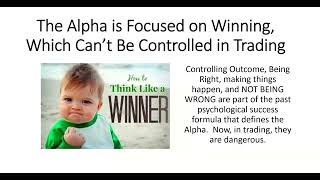
The big thing is the alpha along with the caveman, he's focused on winning, okay? He wants to control the outcome. He wants to make things happen. And in trading, the problem is you don't control that in trading. And it's really hard because it's wired. It's been very successful. It's in the comfort zone. It's literally in circuitry. And it doesn't want to change. It's been successful in the bath. Why should it change? Why should your limbic system change its approach to uncertainty when it's been a winner all this time? Well.
Until you do, you're going to lose. That's the big thing. And then.
The urgency to act, the need to seize opportunity and the urgency to make it happen, it becomes really replaced. And you want to win, and you have to seize that opportunity. You have that urgency to act. Get there first, give it, do it with all the gusto you can. And yet what it does in trading is really tear you up. So the key is, is what I want you to see, very simple. The mind that you brought to trading is not going to be the mind that. That produces success. And then, okay, in this excitement and all that stuff, you see opportunities outside of the plan. Okay, you say, well, I'm sitting here bored. I've been hitting there. I've been watching this. I've been watching my charts now for, God, 10 minutes. When is something going to happen? Then, you know, it just starts, you know, your curiosity just starts going everywhere. I'm just going to check a few other markets, I'm going to check a few other instruments. I'm going to check. And all of a sudden, before you know it, you're there. You don't have a plan for it, but you have that overconfidence bias. You're going to do it. And then after, when it blows up, you go, what was I thinking? You ran into an old program that if you do not reprogram, is going to continually. Excuse me. It's going to continue to happen. Okay?
Is a lot of people become really overconfident. It's a good way to set a trap. You have them thinking, oh, I'm confident, and boom, they're dead. So now the other thing here is what you're doing.
You are projecting your beliefs onto the market without ever projecting them. And those beliefs understand, from a neurobiological standpoint, a belief is not the truth. A belief is something that your brain has organized.
And it comes to be the truth.
It comes to be the truth, and you feel certainty. That certainty is chemistry, friends. When you're feeling certain about something, you should. You should look at that and say, danger, danger. Because that certainty is a flux of chemistry, and it's making you believe that something is true, really true. Like this one, I'm going to get this one. I'm going to make some money now, which you have no control over emotionally, it feels right and it leads you down the wrong tree. The only thing that you need to really believe is your trading account. Okay? Now my question here, my question is this, what are you going to do about it? The truth is, it's not your fault.
Blame evolution, basically. Evolution wasn't, evolution wasn't concerned, it didn't sound like it. The organism wanted to live and it started pre selecting for certain things and it gets there. What we have to do is like our friend Plato is here saying we can change our reality by changing our mind. This is where it starts getting really interesting because we're not asking you to stop being.
An alpha predator. We're asking you to say to rejigger your brain and mind so that the way you are an alpha, the way you are as a traitor actually works. And here's what I mean. I want to give you this example. These two animals right here, the African lion and the North American cougar.
They are both apex predators.
And if you take a look at it, that lion is chasing a pretty serious animal. And what happens is those lions get kicked, they get gored, okay? And they have a very high cost to their hunting style. They're alpha though, man, Everybody, everybody's got that big lion, tough, tough, tough guy. But at the same time, they are st. They're stalkers, they're chasers. And I'm asking you, do you chase in your trades? Alphas do. Yeah. What I want you to do is see the cost of them because they take heavy losses. The reason a pride has to constantly be breeding, breeding is because they're constantly having to produce new capital for the chase because their method, their method gets injury. So you can say, well, I want to be an alpha like an African lion. Well, in the environment that he lives in and the adaptation to being able to take really heavy losses, yeah, they, they have produced a successful lifestyle. Now let's take the guy on the right, the cougar. The cougar, it's not a stalking hunter. He waits, he climbs a tree, sits out on a limb. That may take him quite a while. Okay. Or it could be a rock, anything. But he's, he's above the scene and he knows the pattern of the white tailed deer. He waits very patiently. And he also knows that the white tailed deer can't look up, it can't clean his neck up. So it sits there very patiently, very calmly in Watchful wakefulness, waiting for the deer to show up in the trap, in the setup, okay? That's his hunting style. And then when he actually comes down, the deer never saw it coming.
The deer is sitting there. The cougar goes down, takes his arm, hits the deer in the head, snaps its neck, and the deer falls on the ground dead.
Wow.
Think about the difference in danger and difference in exposure losses that just happened here. Also, if he doesn't hit that deer, right, and the deer gets up and runs, the cougar doesn't chase. He just accepts that loss, climbs back up the tree, sets up again, waiting for the next setup to show up.
If you've ever seen a cougar up close, you realize that this is. They're alphas. They will kill wolves, they'll kill anything else that are competitive with them. They're very serious animals. And at the same time, you're looking at. Well, they have a hunting. They have a hunting style that minimizes losses, okay? And they're. But it's based on patience rather than urgency to act and stalking. What I want you to see, do you see the need to evolve here? Do you see the way. Okay, I can see how a cougar would fit in. And by the way, if you took that African lion right there and you put him in North American forests, he'd starve, okay? He's not equipped to hunt in the area of the forest. Now, if you took that, if you took the cougar and put him in the Serengeti, he'd probably die, too. The point is, though, is the environment that you operate in, the markets, is much more like this forest that the cougar operates in than surrogating plains where. Where the lion can do the stalking and do the chasing, take the. Take the horrible losses and stuff like that. So we're not saying that you don't need to be an alpha. You can be an alpha, but the point is you're going to have to be an ambush predator rather than a stalking, hunting predator. Completely different animals. This is where you need to evolve.
And where do you first start? Where do you first start?
You start right at this moment called urgency to act. This is where it has to be. This is where you have to be able to say, I'm not going to get sucked into the urgency to act. And you look at this graphic. The money's just knocking at the door. Come and get it. Yeah, yeah, yeah, yeah, yeah. No, that's what happens is that, you know, this is youth deciding to become a cougar and say, you know something? I played that game before. I know if I open that door and walk into a strange area, pass my rules past my plan for the day, I know that I'm going to be an area that I'm not suited for. Okay? And the question is.
This is where the very first part of building a resilient mind for trading starts in. This is where emotional regulation is required. As you start seeing a trade setup coming and you start getting juiced, or when you're bored and start wanting to look elsewhere, what you're doing, you're saying, I need to start regulating that urgency. The deal is this, is that you are not a rational being that has some emotional problems. You are an emotional being who rationalizes whatever the emotional brain has already decided to be able to break that cycle. What you do is you start noticing your breathing, okay? You start going, how do I. How do I actually learn what an emotion is and how do I start working with it? Well, here's the deal. To a neurobiologist, an emotion is a biological action potential that coordinates action between the organism that's you, the trader, and the environment that's the markets. That's what it's doing. It's biological, okay? You are in the embodiment of emotion while you're pretending not to be an emotional creature, which turns you away from being able to manage the emotions that give rise to the mind. But the very first thing is, okay, I define that as, oh, an emotion is not psychological at all. No, it overwhelms psychology, but it's biological, okay? So you have to learn to slow down. How do I do that? How do you do that? You start with breath.
The first part of my work, whether or not you're in my group, whether or not you're in my individual work, is that you are going to train yourself. Rote training. That the breathing and muscle tension that you feel in your body when you're training, if you don't believe you have it, tomorrow morning when you're trading, just notice. Take a mirror. Better than that, take a zoom and put it on a personal meeting and record yourself trading. It's. It's embarrassing. It's. It's like, whoa. What you'll see is you have tension all over your face and your eyes, in your neck and your shoulders. You will be holding your breath. You will be breathing rapidly. Yet if you were to start breathing diaphragmatically, bellows breathing, if you were to release the tension in your muscles, that's the emotional arousal that you would be knocking down a notch and you'd be slowing the emotion down so that it would be manageable rather than getting sucked into the treat of getting in and seeing that pile of money. What you do is you calm yourself down. It's not in a place where it can overwhelm your psychology.
That's the very first step, friends. The second is you're going to have to. Well, you don't have to. You can stay the same. This is the tank, this is the change technology that I teach. And most people recognize that if they do not incorporate this that they're going to have a very long trading, very short grading trading career. You have to develop mindfulness, okay? To catch the urgency before it happens, you're going to have to be able to learn how to realize that you and your thoughts are not the same.
In fact, you're not even having thoughts. They're creating your experience. You don't have emotions, they're creating you. You don't have beliefs, which by the way, it's what your trading account is measuring is how effective those beliefs are about your managing uncertainty. Those beliefs have you, you're a unique being that can produce mindfulness and begin to organize the mind so that you direct the beliefs that interact with uncertainty, the thoughts that interact with uncertainty and the emotions that give rise to mind. Okay, this is what you can do and it starts with mindfulness. So you can just step back and recognize that I do not have to go in there. I don't have to take that step. I don't have to move into the urgency. I don't have to make up for other losses. I can be here and I can reorganize myself and I can focus on the things that I can really truly control. Me. I can't control the outcome. And one of the best, I believe that we have certain emotional programs, that we have just an absolute slate of emotional programs that very few people use except for fight, flight or reason and anger. Here in their movie Inside Out.
Disney Pixar is demonstrating what they have is you're inside the mind of a little girl right now and what you're looking at are the emotional programs. Closest to the round faced is the sadness.
The one in the middle is joy, the one has green all over is disgust. And the one, the weird looking guy in the background is anxiety. These are resident emotional programs in anybody's mind. They have control over the panel, the control panel. Oh, and don't forget that little red guy. He's the anger. These are all primary, primary Emotions. And they went to the extent of getting neural, neural biologists to help them understand this and to be able to put this thing so that it shows pretty accurately what happens in the creation of a mind. You're looking at what happens in a brain. It's a community of rival emotional programs duking it out for control of the construction of the self. When it becomes mind, those emotional programs are given voice. And all of a sudden you start hearing thoughts and stuff like that in your mind. You start having opinions. But the key is what happens is that you have emotions running willy nilly around in your head that you may think, oh, well, I have them all down and I, I got it down, Bob. But you do not. What happens is this is where you have to choose the kind of emotions. We're going to talk about that in a little while that actually give rise to the mind. Right now you're not choosing those in an effective way or you probably wouldn't be listening to this broadcast. Okay, so what we want to do is what happens if you just keep doing it. Here's a good illustration. The heart, the emotional brain. Basically, when.
When the thinking brain actually gets in the way, it gets hijacked. So the whole key is if you want to use your brain, your cognitive skills and training, you're going to have to be able to calm down this little red heart guy, okay? Now the rational part of you knows better and knows to stay within the rules. But the heart, the emotional brain is that caveman brain.
And it's going to go for the gusto or it's going to be very scared. Here it's beating the thinking brain into submission. Bet the house. This is what you have to learn to control, okay? It's happening all the time. And until you learn to manage it, you're going to stay stuck with knowing how to trade, but not being able to trade with the money's real. This is the difference. So out of that, when this brain emerges from all these emotional programs, this is what it's like. What you're looking at is you're looking at two alpha type guys squaring off. You're looking at all the support cast in the mind, but you're actually looking at the governing board of the mind. And what you really discover is that when you begin to wake up in mindfulness is the CEO has been asleep at the wheel. He's waking up and he realized his board of, his board of directors, the governing committee of the mind, is in rivalry and it's in mutiny. And you have to get it under control when money is at risk. Until you do that, you're going to have problems. If you don't think that you don't have this kind of stuff running around in your head, just think of the last time when you took a loss and you. I don't want to. You're having an argument between different parts of the self. Some parts of the self know that no, taking small losses is part of the game. Others say, I'm not going to take that loss. So you begin to see the argument between them. Have you ever. Have you ever just beaten yourself up after a bad trade? Yeah, of course you have. There you go. You have different parts of the self being in control when that's not the group you want in control. If you've ever been tempted to jump into something, it's the same thing. You got set up. This is an uncontrolled mind. And so you're looking at it and going, whoa. And you'll. The way you would notice it, it's very simple. You would notice it, is that, you know, I know I should follow the rules, but I don't. I really do. I know that if I follow the rules, chances are I'm going to. I'm going to have the best chance of winning. But what happens is somehow in the moment, in the nanoseconds, it just jumps and I hit that impulse and I jump into them. Well, this is what happened. This is an unregulated governing committee of the mind, is the wrong emotional programs are running. The mind that you're using to engage uncertainty, you've been able to get away with it, okay. And the careers that you've had before, but in trading, time is so compressed. It's like instant karma versus regular karma. And the consequences happen so immediately rather than in the real life. You know, the consequences may happen down the road a while and you can make up a new story when those results come back in. You can be in denial in trading. You can't. You can't be in denial. Okay, so we get it. Okay. Wow. This is really about managing the emotion, acknowledging emotions, managing the motion to get the right mind, and then learning how to construct the mind from the emotional programs that are best suited for trading because it didn't come that way.
So the next. Oh, I'm sorry. Yes. The next thing is this. Is that what I want you to notice? Human mind. The Cherokee Indians of southeastern United States put it this way.
Man's mind is composed of two wolves. A dark, destructive wolf and a light, constructive Wolf. They also believe the wolf that won the man's mind was the one that created the destiny of that person.
But even more wise than that, they also believed that the wolf that won was the wolf that you fed. And I'm asking you, which part of your nature are you feeding the temptation? That sense of like, you're never going to make it, or at a higher part of your nature that says, you know something, we can perform, we can control one thing here. We can't control outcome, but we can control the mind that you bring into the moment of performance.
And friends.
That'S the psychological edge you need to make your method edge work. Until you can control the mind in performance.
You'Re just gambling, okay? And it shows. You might have good days and bad days, but truly good traders, they're not gambling. It's just like if you, if you happen to play really good poker players, they're not gambling, you know, they're. They're playing a game of risk. But probability is on their side and they will lose 40% of their hands, but they're going to be winning 20%. And over the course of a night, they're taking your money. It's the same thing with trading. It's like getting the mind together so that it's the right way. So this is part where you don't necessarily like to acknowledge it, but the thing is, is that behind the aggression, that urgency of the alpha is a need to prove themselves. You know, I, if I make a lot of money, I'll. I'll. People see how important I am, how much I matter, and they, they think that I'm going to make some money today. A lot of people do that. And the other thing is you make this declaration, I'm going to make money today. And you have no control over that. Do you see the setup for failure there?
You know, the thing is, if you decide, you know, what I'm going to do is I am going to manage the mind. I am going to have an excellent performance of mind, okay? That would be a powerful thing. And as Jung said, is that, you know, there is far more enlightenment to turning toward your darkness and mastering it than basking in the light of glory. And here you're going to meet your demons, okay? There's no doubt about, really depends on whether or not you're going to learn from the demon and master it or whether or not you're going to keep running, keep chasing until your capital's over. The markets really don't care. Okay? And so the whole key is this is really about discovering your hidden strengths. This is about really recognizing that what most people call subconscious is actually the emotional brain, is actually the limbic system. And what happens is that with all the fear and the anger and the greed and the lust that drive a lot of your trading.
What'S also in there is the discipline of a ruler, the courage of a warrior, the compassion, self compassion of a caregiver calming you down and the impartiality, the clear thinking of a sage that's there. And the deal is, is that this is also the mind. It sits its potential. It's always, it's part of the human genome. And the key is, is that the potential that you initially got organized as by basically natural selection and just your home life and all that stuff is not the kind of organization of your potential that's going to work. If you start moving that out and say, you know something, I can increase the potential of myself as a trader by working on these particular facets and recognizing the inner critic and recognizing that orphan nature of mine and learning have a, have a very different game plan. That's the deal, friends. They can be taught that's the weirdest thing. And in top, top athletes know this. Everybody on like a PGA tour, all of them can drive the slop out of a ball, they can putt like crazy. But there's only about 10 really good moneymakers in golf at any one time. And what the ones that are on that edge, what they know is they cannot control outcome. They can't control whether or not a guy's having a great day. They can't control the weather, they can't control rowdy fans, they can't control any of that. What they can control is the mind and that moment that's doing that putt, okay? That's what they can control, not the outcome. And to do that you have to marshal discipline, you have to marshal courage, you have to marshal self calming, you have to marshal laying it down and keeping it really saying this is what I need to do, keeping it as a plan. This is what's possible. And in my work, what I'm looking to do is this is, I'm looking for you to be able to find. And these are in Jungian talk, these are archetypes in neurobiology, these are emotional programs, okay? But the thing is within each of you is the discipline of ruler. Now Aragon was a guy who was reclaiming in the Lord of the Rings. He was claiming his past glory. Then you start taking a look at something like Gandorf, he's the sage. You take a look at Frodo, he's probably the most powerful warrior there. He's fighting something that nobody else wants to get near. That ring. People have to have the courage to work through their fears. There has to be compassion. All these things come together to be able to produce a particular way of being in the world. Not the one you came stock with friends, but the one that you learned how to do. And it's kind of like this, you know, you think about. You think about George Washington.
He had just a pipsqueak of an army. If it weren't for the French, he would have never had the money to pay anything. And yet he is right here going on Christmas Day to attack the best soldiers in the world at that time. The Haitians, what they're doing is they're doing a dawn raid and catches them off guard and they win the day. But the thing is, those men believe in the leader, okay? In the discipline of the ruler. They believe that. And what they're doing is they're willing to become their courageous selves. They're having to calm their fears and they're having to stick. They're having to think very strategically about what they're doing. This is a high risk endeavor, but what happens. But it has a skyrocketing reward. It's worth the risk. And that's what they did. That's exactly what they did. This is something you can do with your own mind. You can develop it. That's one of the major things we do, is we're going in and finding these traits, emotional traits, and learning, teaching you how to pull them forward. Then we're finding ways for you to build symbolic representations of those traits so that you can remold the mind that you bring. Not just to trading, because most people recognize when they get into this is. This is a lot more than trading friends. This is about your life. This is about your relationships. This is about your businesses. This is about who you are in the world. You begin to recognize that I can call on these forgotten hidden parts of myself. I can nurture them. I can bring them into full so that they're working parts of my mind. And that's when reality changes. That's when reality changes. Now here's the deal. You can stay in the past, okay? And you can continue doing the things that you're doing. You will always be able to do that. You can continue doing the same things that you're doing. That's the comfort zone. That's the emotional pattern that has become.
That'S become standard, regular way of doing it. And you will resist going outside of that comfort zone zone even though you're seeing losing is happening. In order to be able to, you do that instead of saying I need to go about and change. I need to. I need to find the courage within me to disrupt the way I have been currently organized and to reorganize myself so that I can function in the trading world. Okay. The key is do you want to be right or do you want to be effective? Okay. The trading gods really don't care. But I can promise you is that you're going to have to get past being right.
Winning and losing. Because ultimately what happens is you don't control them. You control the mind you bring into that moment. Once you get that, you say, how do I build that mind? Well, let me help you. Okay. You know, if you have. If this first time you've ever been to one of my workshop. Ever heard of me, get the free book. Read all, read the articles, go to my web. Go to the go and yeah, that's. That's my website, www Trader State of mind. Go there. But more than that, go to the go to my YouTube channel. Well over 200 videos there. Okay. And really explore and start really going. Oh, this guy is talking about how you go about building a new mind that is built for the challenges of trading. Yeah. Once you get past all that, then there's really two ways of engaging and going after this is that the first one is a group course that we will be starting in March. And what happens is has five sessions. You're taught all the skills that I've been talking about. You're taught them. You learn how to build the mind that you use for trading. It lasts over. It lasts about five times for 10 weeks. And it's done in a group, a group setting. It's very powerful. Okay. And I encourage you. There's information there and it's a virtual classroom. You have access 24 7. Okay. And it's something where we want you to do that. And if you sign up early because you'll find out that you better. We're expecting you to hit the ground running. If you sign up before March 19, you get a free gift. It's a $200 value. But one of our emotional regulation workshops. The reason we're giving it to you is not to entice you to get into the program. I hope you already see the need for that. We want you to start early because those are the people that benefit most. Other people Are saying, you know something, I like that, but I'm really interested in individual work. What would it be like to work with you? Well, a lot of people just simply want the mentorship that I can provide them and they want an individual relationship with me. And we do that through the individual course. It lasts three to four months, maybe a little more. And we take you through. It's very personal. You learn a lot about your stuff. Okay. And you also learn.
It'S highly comprehensive and you end up learning not only how to build a mine, but how to, how to really micromanage small amounts of time that you need to be able to work with. In trading. Very powerful. But the main thing more than anything is that understand this, is that if you haven't convinced yourself already you haven't traded long enough that your, the mine you brought to trading is not going to work. In trading, when you come to the moment of where you realize, it's not like I'm trying to sell you something like that, but I'm telling you the truth. And as long when you get it and saying, you know, I don't want to be One of these 95, 98% of people that blow through in three years lost their capital and their spouse has had enough and all that kind of stuff. No, what happens is like top end athletes, top end performers, they know that it's a mindset. They know they have to build the mind. That's what separates good people from the people, the elite. And in good, good in trading does not make profits. Elite makes profits. So I want to thank you for being here and I want you to recognize that these are the tools, okay? These tools are there and they can change your life. You have to work the program. If you just look at it, look at it and say, well, okay, I've seen them and that's all you did. No, it's not going to help. But if you put yourself.
Put yourself in contact with it in work, this is powerful stuff and I want to thank you. Okay. I want to thank you. I love talking about this stuff and working with this stuff. And if there are any questions, we have a few minutes. If you have any questions, ask me and I'll be happy to answer a few and we'll just see what happens from there. But meanwhile, if nothing else, I wish you a really great life. Okay? It's, it's, it's what you discover is you're the one creating your own destiny. And trading just makes it really straight. Okay. Okay, we got a few questions. I can See this one right now? Okay. You always raise, you raise the issues. Alphas being successful in other endeavors but not in trading because they can't force, force the market to bend to their will. Yeah, I do. How do you explain lack of success to traders that aren't alphas? Just. I lost my place on here, honey. A lack of said aren't alphas and have no.
Meaningful. I can't read anything, honey.
We'Re having issues.
What is the difference between the alpha and the non alpha trader who have one thing in common? Lack of success in trading. It comes down to fight flight. The alpha has aggression. Okay? And aggression proves pretty dang good because you intimidate people and do something like that. But when you face threat and aggression doesn't work, what happens is you turn to fear. And fear is our most base emotion. Our, our central nervous system's organized around it, our amygdala is organized around it. So the alpha is coming. And this one actually was done for alphas. But the thing is, if you're having problems pulling the trigger, what you're doing is you're seeing there the sense of loss. Understand caveman brain can't tell the difference between a loss in trading and a loss of light, where you become somebody's dinner. And so it's really, it's really response to threat from either aggression or from fear based stuff. That's what the difference is. Okay, here's Nick. Hi, my name is Nick. I hope you are doing well. I am, thank you. I've had a heart transplant two years ago and I feel great. And thank you so much for this webinar. So my question is, whenever I perform trading, it feels like I'm going to miss this opportunity, so I should take it. But on the other hand, I don't feel comfortable giving that higher or lower price, current price for that opportunity. So why are there two minds confusing? First of all, again, it goes back. You're thinking the mind's monolithic. No, what you have as a mind is a board of directors. And they're having conflict and different parties, different parts of that board of directors wants to go one way and other people want to go the other way. And so it's an internal struggle going on within your mind. Now, you can call those voices that's coming what I do, but frames of influence, spheres of influence is what they're known as in neurobiology. But the key is what you're doing is you're actually seeing the debate between two different parts of the self. And you will have Multiple parts of the self, we call them brain regions, is that if you were to look at in the brain, you would see clusters of cells that have. That literally produce thinking. And they become a member of that board of directors. Okay. And they become, they're competitive with one another on the level of brain. Your brain is a community of rival emotional programs that duke it out control of your mind. On the level of mind, it becomes a board of directors where everybody's arguing for direction. What's required here is for you to develop the leadership, to be able to reorganize that mind, that committee, to be able to self direct and follow the rules that you know to work. But meanwhile you're having, you're having temptation show up, you're having fear show up. You're having all sorts of things that you need to silence that. And you need to be leading from the discipline of ruler, the courage of a warrior, the soothing of a caregiver, and the clear thinking of a sage. Those are emotional programs also that you can end up giving space in that committee. But you have to bring them out of the dark first. Okay.
So are you saying without emotional regulation, trading be unsuccessful? There are some people that are born with just the right constitution. I know several that just simply. They're just flatline all the way through. Okay. What I'm saying is, is that we're emotional human beings and that you're always in an emotion period, unless you're dead. And the key is, is can you manage the emotion? Because out of the emotion comes the thinking. All thinking is emotional state dependent. So if you can't regulate and bring forward a particular emotional cocktail. Yeah. You're going to have one heck of a time trying to be successful in trading because you're going to veer the standard policies to go fight flight whether or not it's aggression or whether or not it's fear. But to be able to be coming from a disciplined, impartial, patient mind, that's something that you manufacture. Okay. This is Mike. Hello, Randy. Thank you for the webinar. I have been trading for some time. For some time.
I've been trading live. Okay. You're actually risking capital for some time. And my issue is stop management. I have a problem with accepting my stop when I should take it. I move stop back to unacceptable places. And this is always. Eventually leads to disaster. Absolutely. Especially with the blown accounts. What do you think of this and do you feel your course would address it? Yeah, it would definitely address that. That's one of the. That's one of the big things that people have is, you know, what happens is your brain. And this is not just your brain. This is not just your caveman brain, but this is also the socialization and process of you being born into a family and downloading all their programs from what is success and who you are and all that kind of good stuff. And, you know, what you're looking at with live money in particular, is that, of course you're not going to want to take a loss. Okay. That, to the caveman, means death. You. If he particularly say, if you were to. Actually, I was working with a client on this today. He came from a very competitive family where they expected them to be number one in everything. If you came in number two, that was just not good enough. And so he hates to lose. And he's done. You know, he's quite wealthy. He's retired. He has a charity and stuff like that. And he's trading. And what he's discovered is that something he doesn't want to take, the loss that's learned from his family, that exacerbates.
The trait from evolutionary psychology of not wanting to lose because it meant death. So you're hung on this thing, and the key is.
As you're moving toward that, is that as you're moving to that stop, then you move it because you want to give it more room, because you don't want to take the loss. Da, da, da. If you're this guy I was working with today, because you would be ridiculed, and you would be shamed in your family if you took the loss because you were all winners. You had to be a winner. And the evolutionary psychology is that you don't want to take a loss because it means your life. So you got those two components going together, and they're taking you. And basically, you got real money now. So there's a real loss there. There's no reset button. And it triggers all this deeply primitive evolutionary psychology. And also, basically, the way your family shaped your potential into the being that you are. And most people find they have to reshape that. Okay, this is Pamela. Cougar lion picture. I recognize. Oh, cougar. I recognize myself in that analogy. Good, good. You know, women. Women don't have to deal with testosterone, which is a really advantage for them. Okay. It's easier for them to see that they're a cougar. And remember, the. The female cougar has to raise the kids alone. So they have to be. They're. They. They gotta be tough. They gotta have courage. They Gotta be disciplined and they care deeply for their children and they're, they're methodical hunters. So, so I actually have a lot of people. I have one trader, proprietary trader that she actually has a statue of a cougar at her trading desk. And what she does is she actually strokes it, including the tail, they have long tails. And she uses that way of staying calm and staying focused on cougar. And then when the opportunity shows up, she strikes. But she's actually using a three dimensional object as a way of calming herself down and keeping herself focused on the mind. The cougar mine, the ambush predator to do that. So good, I'm glad you have.
Any rate, that's it. Friends.
I want to thank you for being here. It's been a lot of fun and I hope you've, I hope you found this beneficial and I encourage, like I said, is that for me, I look at people who aren't ready to train their mind in trading is. They just haven't got enough experience with realities of trading yet. And until that time comes, I look at it and I wish you well. And I also wish, I wish, I wish that you come and become a student of trading, a student of the trader's mind and realize that like any elite performer, it's mindset, okay? You've got to get the mindset. I'm reading a, I finished a book basically by a sports psychologist who worked with Russell Wilson. You know, he's 5, 10, what's he doing being quarterback in the NFL, you know, that kind of thing. And the ritual that he went through before games to get into that mindset for 60 Minutes, he took it dead serious.
They would go over different particular formations, they would go over different things, problems, areas, all that stuff, and prepared for that game. And he had it, you know, he had a professional sports psychologist with him to prepare. He's no fool. He's one of the best quarterbacks has ever been too. So he's got the, he's got the rings to prove it. So anyway, I wish you well. Okay. And if I can help you check it out, go to the website, really check it out, go to the YouTube stuff and if I can help you, let's do it. If you're ready, if you're ready to say I need to become a student of the trading mind, let's talk. Okay, thank you, thank you, thank you very much.









