Learning to Deal with Failure Differently Building a Winning Trading Psychology
Randy Howell explains how the amygdala hijacks your thinking brain under market uncertainty, causing under-trading, revenge trading, and FOMO. He covers mindfulness and breath work to retrain your nervous system and build a probability-based trading mind.
Chapters
Welcome everyone. My name is Randy Howell with my Traders State of mind and I am delighted to have you here and I just look forward to our time together. But before we get started, let's ask that critical question. Can you hear me? Please type in Y into your, into your. To your box there. And just let me know. Chat box and let me know that you can hear me. Okay, that would be great. I hate to, you know. Yep, good. We're on it. Well, also, and there's the thing about questions is this, is that I hold questions toward the end. You can write them in as you come along. And if you have a burning question, I really wish you'd go into the chat box and ask that question. Okay. I really do. I'm going to get to it at the end of the session though. I have found that it. A lot of questions are answered in the course of the presentation and there is a, there is a process to my presentations where I link. I go from one thing next to the other and questions kind of sometimes steer me off course. So that's the main thing. Okay, please do ask the questions, write the questions in and we'll take care of them as we get toward the end. Let's get started. People get into trading as a career, wanting to be successful. They're going to be hard work. They know it and they're ready for it. They're going to pay their dues. And the one thing you bet that they don't want to do, it's fail. Yet there's a lot of failure going on in trading. Even with very successful traders, there's a lot of failure. How, how do you deal with it? How do you work with it and how do you start really going, you know something, what defines, what defines failure for me and what can I learn from failure? That's what we're going to start with. And you go, whoa, wow, failure. Why are we starting with failure? Because it's really important and this is where we start. You know, you begin to ask the question, what? Why does a gap exist between my potential and the results that I get? You know, I know how to trade. I've got the mechanics down. I've got all that. And I really want to know what's really missing. Is there something in my mind mindset about winning and losing and success or failure that impacts my capacity to trade effectively? That's what we're going to be exploring and what I want to do. I want to tell you a story about Shaq o'. Neal. This is. He was recently on the today show, and he was talking about failure. Now you think of it. Shaq o'. Neal. What in the world does he know about failure? It's one of the greatest NBA stars it's ever been. He's 7 foot 4, 350 pounds. He just was everything. Yet he said, you know, that was one of the things I had several bouts of the fear of failure when I was in professional ball. And he said, and he gave one particular one that really made a difference. Now, understand, this is one of the best players that's ever been. And what I'm about to tell you is something Michael Jordan told him. They were playing the Bulls. Shaq's team was playing the Bulls, and they got swept. And Shaq said, you know, I just had a horrible game. I just wasn't up stuff. I just wasn't playing to my potential. And I just meant I'd worked my stuff up and I. And it looked bad. He said, you know, after that game.
MJ came up to Michael Jordan, came up to me. The great Michael Jordan came up to me and said, you know, Shaq.
You'Re gonna need to really learn how to lose well if you plan to be successful in this league.
And then Michael Jordan walked away. Shaq sat down and took this earnestly. He said, you know, michael Jordan went out of his way to come over me and say this to me, and he clearly saw that I was upset about losing, upset about failing, particularly in my potential. And here he is, and he's telling me something that apparently he's gone through. Well, if two basketball players like Ashaka Neal and Michael Jordan have to go through this and they have to really look at their failure and learn from failure, then you know something? It moves us also. It behooves us to really take a look and go, what. What actually is going on here? What. What happens to get to the point where I know how to trade and I don't. I can't trade. I'm scared of failing. And, you know.
It'S interesting is two guys are looking at their trading potential. These two guys I worked with, and they both say, you know, I've got mechanics, got that ass psychology. That's not a problem at all for me. We got that down. I've got the right mind. And they had taken a couple stupid tests that you can take, and that just showed them as being just having the right mind for trading. And both of them were not successful. They were still failing at trading. And initially, then small hedge fund, they had. And it had success initially. And then it went down. Then self doubt arose, okay, and one of them in particular, finally one realizes that he is afraid of failing. And he said, oh my gosh, that's what's hurting me. I'm so scared of failing that I'm not there in the right mind to be able to take advantage of what's right in front of me. I can't take what the market's willing to give. I'm so, I'm scared of failing. What if I fail? What if I fail? It ended up causing him to under trade, causing him to over trade. And we get to this thing going, well, what is it about? We throw these darts trying to become more successful, but are we really throwing darts in all the wrong places? Or is it something.
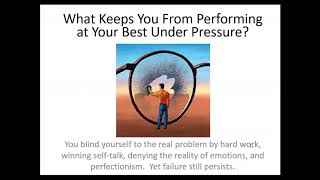
Or is it really something about blinding ourselves to the real problem? We think that hard work, we think that winning self talk, we think denying the reality of emotions and perfectionism. If I do everything right, I can't fail. And yet failure's there. Well, if we start cleaning that lens, you know.
Point is we can feel confident so that we think we're confident. But that's only a feeling, not the truth. That's the big thing that people don't understand about feeling. When you feel an emotion, it's causing you to believe something and it feels, feels right, even though it may not be right. The truth is revealed in your trading account. So we want to clean the lenses of our observer. And in that the trading account.
Will make you an honest man or woman or it will force you out of trading. Just like Shaq, you have to come to terms with your fear of failure in all its forms if you're going to experience success. And have you ever noticed that at some moment you really do begin to suspect that you're the problem? You know, the lineup and you go and say, you know something? The only thing that's common here is me. You know, I've blamed this, I've blamed that, it's that and that the other. But the truth is, is that I think it's me. I think it's the me that shows up to actually trade that's causing the problem. This is where insight really begins to happen. And you start going, you know, I, I get it, is that trading once you learn the skills is really a mind game. It's really about what kind of mind can you produce to engage uncertainty. And this is where it gets tricky, friends. Your brain does not like uncertainty. As a matter of fact, it absolutely loathes uncertainty. Unfortunately, the brain you brought to trading never going to produce the mind that brings success in trading. You have a brain mind that is exactly opposite to what you need in trading. That's right.
What goes on is this, is that limbic system does not want to fail because back in the time that it was generating successful human beings, failing meant death. And you were already in a really dangerous world. You didn't have to worry about probabilities, you had to worry about whether or not you got past the next lion.
So our culture even ignores the primitive emotional nature of the limbic system and believes that we are rational human beings and friends. Nothing could be further from the truth. What you'll discover is this, is that your rational brain, you see this equilibrium going between the rational brain and the limbic system, your neocortex or your thinking brain and your emotional brain. And what you discover is this. The rational brain simply makes up alibis stories to support what the emotional brain has already decided. Okay, now what we've noticed already, if you happen to evolve normally like the rest of us human beings, is that you, the brain that you brought to trading is not going to produce the mind that you need for success in trading. Uncertainty makes your brain yield control to the limbic system. That's your survival instincts, that's that fight, flight stuff. You must engage your rational brain to keep yourself on track. We have to learn how to produce that rational mind so that the limbic system is in partnership with it, not taking control of it.
You have an emotionally reactive brain.
That evolved to control outcome for short term gain. And when put to the test, the thinking brain loses every time.
It chokes or is hijacked when exposed to uncertainty. And the stress of uncertainty when you're putting risk. That's the difference between proactive and reactive. You need a proactive brain mind, okay, that is comfortable with managing uncertainty for long term success. That's what you need. But what you've got is a reactive certainty based brain that's looking to control outcome. And what you're doing is you're putting it into a situation where it does not in fact even remotely control the outcome. No matter how great your system is, you never really know you don't control outcome. And yet this is going to freak your poor emotional brain out and it's going to take over the thinking brain. And there you go doing all the things that traders do when they don't have management of the mind they bring to trading.
And friends, this is the very brain you trade with, whether or not you like it or not. You have that caveman brain back there, and you have that new brain up there. And the new brain guy thinks he's in control, he's got the steering wheel. But what he doesn't realize is that once that caveman brain acts up and experiences uncertainty with risk, it takes over the whole shooting match. You bring your primitive, emotional, reactive caveman brain with you every day. You trade under distress, it simply shuts down thinking. That's. And.
Do you need evidence? Well, what I'm going to show you is exactly what your problem is. And by the way, it's not just you, it's everybody that has a typical emotional architecture. And what I mean by that is that you will find some people that are high functioning autistic. They get into trading, they have an architecture, emotional architecture, that simply doesn't connect fear and risk together very well. And they could become really good traders. They don't make very good husbands and wives, but they make really good traders. And also, you find some people who just simply have a high risk tolerance that is completely uncommon. And they do well. But what I want you to look at right here.
Start way over there on the left bottom side. And what you're looking at is something that says external input. Those are all the data entries coming in from your eyes, from your ears, all the sensorial data coming into the brain. And what it does is it stops at the sensory thalamus right there. That's called the traffic cop. Based on very primitive limbic beliefs about your ability to manage uncertainty, it makes a decision about whether or not that information represents something dangerous to the self. Saber tooth tiger bearing down on you, Real threat, or something that's not really dangerous. And it could be sent up to the thinking brain that's a sensory contact cortex and can be thought about. Well, that traffic cop, okay, makes a decision right then and there. It could take the low road if it perceives it as risky. And think about it, we're already talking about uncertainty with money at risk. So the traffic cop is already on alert. You trigger it. And what it does is it just absolutely doesn't even send the signal to be reviewed by the thinking brain. What it does is it bypasses that and sends it to a very low and dirty road over to the amygdala for fast, hot action that can save your life in the moment. Like not getting in the trade. Like you're sitting there trying to get in the crate. You got the confirmation going on and you don't get in because you want more confirmation. And it sees that as a Victory because you didn't get in and risk capital. That's fight flight. That's that. This is the traffic cop. This is the limbic system in action. Hijacking, hijacking the thinking brain. This is what's happening every day, day in and day out, whether or not you're impulsively trading, revenge, trading, or you can't pull the trigger. And this is what has to change.
Oh, and by the way, the speed.
When there's a hijacking and the traffic cop sends a signal, I'll call that low road to the amygdala. Okay, that's the fight flight response. Deal. It takes nanoseconds, like 003 seconds to get there. If it goes for the high road, it takes over a quarter of a second to almost half a second for that information to get to the thinking brain. If, if it were to go both ways, the alert would already be there for hijacking because it's over there in nanoseconds where it's taken microseconds to get to the thinking brain. That's what you face every day. And you wonder why. What happened to me? What happened to me? This is exactly what's happened to you. The traffic cot decided on the low road and thinking brain got shut down and it went to the amygdala. It went to fight and flight. And there's your revenge. There's your over trading and there's your, there's your not trading, there's your freezing and not getting into entries. That's what it is. Friends, how do you experience this? Well, let's start, let's talk about it. The first thing.
Let's start. Let's start with.
Failure. Okay, understood by your emotional brain is very different than what you think about what you think you think. Not getting into a trade is a victory for survival. When you're sitting there and literally you're getting the confirmation. Okay, that's a real live setup there. I need a confirmation here to say yes, it's I'm within a go period. And then you need another confirmation to enter that trade. Well, what happens is you get hijacked. This is where you have to learn to be able to say, how do I stop the hijacking? More about that later. Because otherwise you're going to keep looking for confirmation. Before you know it, your finger is frozen on that trigger and you cannot pull it. And again, to the limbic system, that's a victory. To the probability mind that you need to develop, it's a loss because it was a Good setup. You should have taken it to make probability work for you. Okay, that's the first one. Then let's think about revenge trading. Okay, again, this is actually the fear of failure in reactive pattern. You failed and all of a sudden what happens is anger shows up rather than fear.
And suddenly.
You have to make up for prior losses. You need to take the markets and set them down a notch. You're going there and you're absolutely in fight flight.
That's what the traffic cop looks like in that case. But let's go over one more. Okay, let's look at overtrading or what I like to call impulse trading. It's actually an escape from the fear of failure by feeling confident. Now remember, as you develop an intelligence about emotions, you discover that emotions are tricky and often what you call confidence, really just a feeling states that makes you believe that you're confident. It doesn't really mean you're confident. And you make, you make huge mistakes like seeing something. So you know, if I make that trade, I'm gonna make a lot of money. And behind that, boy, I'll tell you, if I. Besides that is, I'll never have to worry about failing again. I'll be such a big man, I'll be making so much money. And just think about.
In the Olympic system way of viewing this thing, if you're making a lot of money, then you're not failing. And then you buy that dream and then the real reality kicks in and all of a sudden you discover, what was I thinking? What happened to me? And my personal favorite is the fear of missing out. Okay? And you know, you take a look at this, boy, talk about the fear of failure. Just really being exposed. Fomo, all that money that you missed. You know something? I didn't, I didn't. I missed. I missed that one. You know something? If I'd only gotten in, if I'd only stayed in, if I'd only this. If only, if only, if only. And suddenly there's this dream of all this money, all this money, and all of a sudden you find that urgency, okay? And you end up going, you know something? I was kicking myself. And now I'm making myself get in. And before you know it, that fear of missing out has turned into just, just a horrible yoke that you carry. So we've looked at this and we've seen, okay, this is what it's like. We see that fear of failure and we, we've seen it in act, in action. We've seen it in a lot of different situations. And what I'm asking you to recognize is that the brain really doesn't want to experience failure, is that it really, truly is a survival thing to it. On the survival instinctual level, the emotional brain, that's who's controlling what you think, this is what's happening. You're going to have to learn how to manage that so that you can learn from failure. So to the limbic brain, failure means loss of lice or loss of status. And by the way, that's your raging 600 pound inner gorilla. Have you ever had him? If you've ever done any impulsive trading, if you've ever really just lost your stuff, if you've ever just absolutely turned emotional, this is part of you that's going on in there. Remember, the traffic cop makes the decision, not the thinking brain. You'd think if the primitive emotional brain, particularly this thing called the thalamus and the traffic cop is so important, you would think that you'd be going, you know, that's the one thing I need to be looking at. But the key here is this, is you don't think about it until you redefine your beliefs about failure. Success in trading stays a dream rather than a reality.
The truth is that there's a lot of failure in trading. You talk to any really good, profitable trader and they, they will fail every day. However, their notion of failing is seen in the context of probability, not just as talk. Oh yeah, well, you never, it's really just a group of traits that you're looking at and it's a probability that's talk, okay?
And it's kind of like this. What I want you to do is in looking at failure, look at baseball. You know, if you hit 300.
Get base hits, three times out of 10, you're gonna be in the hall of Fame, great hitter, yet listen to that. In baseball, the failure rate, 70%.
Okay? They're having to get used to failure. You strike out, you hit into double plays, you do all sorts of things and there's nothing that got away. This is just what happened. There's a failure that you have to really get used to to learn to be good or otherwise. If you don't use failure to build a self that performs, what happens is that you end up fearing the failure. So we want to redefine our beliefs about failure and success, okay? That's what we're looking to do. And we're also saying, you know something, it'd be easy. You're looking at this graph and it's really about here's modern man. And what it's doing is he's looking at the primitive brains and the primitive forms that we've existed in saying, quit following me. Quit bringing that emotional brain here. Let me just be rational. Well, the truth is that you have an emotional brain that you've carried with you through evolutionary history for millions of years. It's with you. As a matter of fact, your thinking brain grew as a tumor from has hard wires going out into the thinking brain. So it's got a lot of communication between the limbic system into the thinking brain. But guess what? There's only two little skinny telegraph lines coming back from the modern brain into the limbic system.
The truth is, is it's not following you. You're following it. And this is the thing needs, the failure needs to be accommodated. Yet our own biology, and then your psychology is so totally against it. We want to win, and yet at the same time.
You'Re gonna have to learn to lose. And every time you engage uncertainty with capital at risk, there's that little switch, that hijacking switch, the traffic cop. You activate the fight flight switch and silence the thinking brain just when you need it for managing uncertainty. And you do it again and again and again. The thinking brain cannot see the emotional brain taking control. It doesn't see emotion. Yet the emotion gives rise to the quality of thinking. It's this switch that you're going to need to learn to control if you're going to produce successful trading. So.
And there's a lot of this belief where you know something, I'm just going to pay my dues. I'm going to do that 10,000 trades. I'm going to. You know, the thing is, I'm just going to keep re exposing myself to all this and I'm going to learn from this. I'm going to finally get the moment where my mind no longer does that. We call that re exposure therapy. And we discovered 15 years ago, if you're not teaching skills along with the re exposure that all the re exposure does is traumatize and create much worse things, ultimately you're looking at this. Your beliefs about failure, your beliefs about success are killing you, okay? In trading they are. You can't man up the emotional brain. You have to change it. You have to change the limbic learning that keeps it into old patterns, okay? And that's what the real key is, is you really have to go into this old primitive brain. You have to understand that it's adapted beliefs about your performance in the moment of stress in the moment of where you're challenged by uncertainty and you have capital at risk. This is what has to occur. Now.
Fortunately, you and your brain can be retrained and that brain stuff we call a neural plasticity. From its original purpose of certainty of survival to managing uncertainty with emotional discipline. That's what needs to happen. And the question really becomes, how do you rebuild the brain mind from reactive to proactive when faced with uncertainty? Well, friends, I'm going to show you how we do it and I can tell you it works really well.
What the traffic cop believes can be changed, but it's not going to change because you have a visualization.
It's not going to change that you've got some really cool affirmations. It's not going to change because you start having some positive self talk. It's going to change because the very core belief you have about your ability to perform.
In the midst of uncertainty with risk involved changes. Okay? Fortunately, the beliefs that lay at the center of your reactive emotional mind can be rebuilt.
Failure can really take on new meaning. The certainty based mind worked well for human survival when failure meant death and there was just uncertainty and the potential of death all around you.
For probability based success, a new mind has to be constructed where the ancient emotional brain does not trigger to reactive emotional responses. It's like breaking through a barrier. And this, this guy right here, where you look at him breaking through a barrier, this is where most traders stay and it's why they burn out their capital in three years. They go in and they think, you know, I'm not going to deal with this fear of failure stuff that I know is in the back of my mind. I'm only going to think success, I'm going to stay in success. I'm going to stay in, I'm going to stay in prosperity thinking. And they do that and they do that and they do that and they realize, you know, something dark's going on here. But I want to ignore the darkness. I don't want to change the darkness within me because you know, I would rather stay in the light. I'm going to just, I'm going to, I'm just going to program my unconscious mind and you never have a breakthrough. You keep failing in the same way. Again, you don't learn from the failure. Now we're going to say to break through, you're also going to have to deal with that fear of failure.
The emotional and thinking brain have to build a new partnership. Friend, what I want you to look in this illustration. You're Looking at the conscious mind and choice as a thinking brain, that's stuff that you have access to and stuff like that. And what I want you to notice is how little itty bitty that is in the overall size of that iceberg you're looking at. The unconscious mind programming is the emotional brain. It's huge. It's taken care of in Gladwell's book Blink. What you discover is that there is so much going on beneath consciousness and decisions already made before you ever start thinking. The decision's already made and then suddenly these explanations about it, this is what has to happen. And in here, there's some big moments in these four items that are the cornerstones of emotional intelligence. For traders, all thought is emotional state dependent. You don't have rational thinking. You have rationalizing thinking that supports what the emotional brain has decided. Emotions are biological, okay? They take over psychology. They are not psychological friends. The third one, emotional beliefs drive encounters with uncertainty. That's that unconscious beliefs at the traffic cop level. And what you're doing is you're seeing them play out in your trading account. Not what you think, not what you talk about. You're seeing them play out in the barometer. The truth meter is your trading account. That's how you start going into it. Well, I have got some failure stuff, beliefs going on that I need to take care of if I plan on being successful in trading. Last thing, there is no such thing as freedom of emotion. There is no leaving your emotions at the door unless you're dead. By the way, the key is what you have. You have freedom of emotion.
There is no freedom from emotion. There is freedom. That's a typo on my side. You have freedom of emotion. You can train the brain to call forward emotional programs that are different than what evolution has given you.
To meet uncertainty. That's what we're talking about. Where do you start with emotional regulations, friends. You have to start there. And you start with emotional regulation. The mind and the body are one. You discover that because emotions are biological, they will also have a signature to them. The emotion does. Part of that signature will be the muscle tension and it will be the breath. The way you breathe, both those support the emotion and the negative emotions like fear and anger, will or lust or greed. What you're doing is you're looking at it and going. You're realizing that the breathing, all that stuff is there, you don't know to stop it and it ramps up and suddenly it takes over mind. Yet if you were proactively breathing and keeping tension reduced what you would notice is that the emotion would never get intense enough to take over mind. That's the first level of our training here. And believe do this tomorrow. I mean hey, market had 500 point day. Tomorrow when you go back in, I want you to look at the way you breathe, look at the way you hold tension and start recognizing, oh, that's not my breathing, that's not my tension. No, that's the emotion expressing itself. And you're seeing it at the arousal stage. You might not say I'm having an emotion, but your body is telling you you are and you need to get alert to it. So the first thing is you learn how to regulate the emotion. Second thing.
Mindful mindfulness is a tool that we use to explore your thought and your belief world. And in mindfulness what you begin to recognize is you stop identifying with thoughts and beliefs as you and you discover this other thing is that there is no I, there is only an organization of potential that represents itself that you keep projecting onto the markets. The development of mindfulness allows you to step back out of thought and recognize that there is an observer of thought and belief. The thoughts are not you. When you think, oh, these are my thoughts, you're just simply saying my observer has fused to thoughts and has swept me away. And I'm going to tell you something, if you're going to be a successful trader, that's a bad thing. You need to be in control of the emotional programs giving rise to the mind that engages uncertainty. You do not want evolution, natural selection to be the be the one that dictates what emotional states show up. When you experience uncertainty, that's a bad deal.
This awakened observer, this is where it gets really cool. Friends can direct the building of the probability based mind. When you start realizing I'm really becoming a, I'm becoming a detective here, I can start looking at the thoughts and see that they're tagged into emotional programs. And I can again begin to see that these are emotions are the ones that are really guiding my trading. And beneath those emotions there is beliefs that really just zero in about what I see as the truth. There's no reality out there. You're experiencing, what you're doing is you're seeing through your beliefs. And really what you're discovering is you do not see and then believe. No friends, you believe and then you see. That's the great thing that you're learning about trading is you're projecting your beliefs right there onto the markets and you're seeing about whether or not they're Effective or not. And your trading account, you're not seeing the truth, you're not seeing reality. You're seeing a virtual representation created by your beliefs and it's being graded and its effectiveness of being able to extract capital from the markets by your trading account.
This is where it gets really interesting. So you're getting to this moment. You're going, wow, I need to really tune in. I need to be really aware of what I'm bringing to the game. Yes.
And in mindfulness, what you also discover is this.
Is your brain that gives rise to the mind is actually a neighborhood of rival emotional programs that duke it out and form a self. The winners take all. And if you want to see this in action in a very realistic way, look at the cartoon movie Inside out by Dixie Pixar.
And what you'll see is exactly the neural scientists describe the emotional program showing up, duking it out, working cooperatively to create the mind of a little girl. It's really cool stuff. And the real cool part is this is when you move from the biological aspects of thought. That electrical current running between synapses and it becomes mind is that neighborhood of emotional programs becomes a boardroom. And you become the observer and you begin to wake up and you realize, oh, my God, I have a mismanage. I have a, I have a, I have a board. Totally out of control there. You know, this is. Everybody's trying to control the company. Call me and I need to start, I need to sit there and I need to redefine the emotional programs that get rise to the mind that trades. Oh, boy, this gets, this is when it gets really interesting. You start realizing, wow, I can become designer of the mind that I bring to trading. Okay, no tricks. Designer.
Then with observer, you begin to say, well, I'm going to get to know this boardroom, these forces, different players in this, in this boardroom. And the first one you discover is the historical internal dialogue. Have you ever had that little angel and devil sitting on your shoulder and one saying, oh, take it, take it, take it, take it. Oh, you're so stupid. You never can trade what that judge, that criticism, that temptation that lives within you. Yeah, that's not your thoughts. That's what we call the inner critic. Then on the other hand, you might feel the voice of intuition telling you other different things. You might find the voice of reason, you might find the voice of discipline, but yet you haven't built it up. And what you do is you end up in self doubt or you end up in overconfidence. Because you don't know how to manage the emotional programs that give rise to the mind that engages uncertainty. This is where it's so interesting.
This mind, this historical mind here was adapted to avoid the potential of failure because the outcome was fatal. That reality is not true in trading though. But you came to believe.
You begin to fear failure. I can understand it. But the thing is, if you're going to be successful in trading, you have to learn that failure is actually one of your best friends. It's going to teach you, okay? It's going to teach you. Your brain does not learn from success. It learns from failure. Now you become designer of the mind along with just tweaking little things inside that brain of yours. Rather than just natural selection. This is freedom of emotion. You can't choose to deny emotion in the presence of uncertainty, but you can choose which ones form the mind that engages it. Friends, this is where we want to look.
You take responsibility.
For what failure is telling you. And in the same way that fear and overconfidence became associated with uncertainty.
So can discipline, so can courage, so can self soothing and impartiality. Those emotional programs are the base of the probability mind.
Okay? That's what you want to be able to build that probability mind. These are all potentials living within you and that you can learn to bring forward in times of trouble. Okay? This is what can be done. You can in fact face your fears. You can face the fear just like Shaq. Just like Michael Jordan had to do is they had to face their failure. And their failure taught them how to be successful. With Michael Jordan, when he first went up the pros, he was small and he was just getting beaten to death. He had to put on weight to be able to stand with those big huge guys. Shaq had other things to learn from his failure that allowed him to become one of the greats of all time. The question here is, do you want to learn from your failure? Do you want to become who you could be? In trading, you are constantly triggering the survival instincts of the emotional brain. That's that left side. You have that anxiety and foreboding mind and that anti just anticipating the future. Oh my God, what if I fail? What if I fail? Failure is always present.
Okay? It is about who shows up to meet the potential failure. That's what's important. Friends, changing your beliefs about controlling outcome as a condition of success will not happen. In trading, you cannot control outcome. You are confronted by this belief in controlling outcome all the time. On the right side, you have this calm, disciplined Impartial mind engaging uncertainty. You don't know where it's going to go. But what happens is you realize that you can deal with it, okay? No longer do you have that primal fear of failure being associated with death. Now that's just psychological discomfort. That's all it is. And you can learn how to manage that.
Now.
Who is constantly looking at their P and L statement while trading? Does anybody in here is. Most of the people I talk to says yeah, it's just sitting there and it really freaks me out. I see it going up and down, down and down, down. And you know, it just really, you're, you're, you're little. If you do that, and most, most people do, most retail traders and particularly do is what you're doing is you are triggering the, you are doing everything under your power to trigger the fight flight response.
The possibility of failure does not change, but the mind engaging uncertainty does. Take a look at this sailboat. I'm going to tell you something, these guys are in a, this is a situation. Is there uncertainty in this moment? Absolutely. Look at that water. What I want you to notice though, do you think those guys are trying to control the outcome or do you think they're controlling their performance?
They're controlling their performance. You have a captain, you have a ruler sitting there. He's barking orders, he's telling what men need to be doing. He's got people who really have the knowledge of sailing. He's got, he's soothing people down, he's calming people down and they're having the courage to face water like this. And they have each other at their back. They trust, they trust in their team. Same, same with the team mind. You have to engage that in trading. You're always on the edge of failure. How do you respond to the failure? How do you respond to the moment? This is the big question, okay? Focus on performance and not on outcome. This is the big thing that happens with traders and it's the point of where they either start learning to be successful or they start learning to continue to fail.
From failure, you will find and repair the emotional beliefs that drive performance and change them.
And what you've learned to do in this process that I'm talking about is the emotional brain gets calmed down. So the fear of failure is just not cranking it up into fight flight. It's just discomfort. You can deal with that.
And the door to success in the long term through probability is achieved with the thinking brain. Suddenly what you've done in the failure, you've learned that the old brain just simply doesn't work. And that the new brain that you need is rooted in discipline, rooted in courage, rooted in self soothing, rooted impartiality. That's the brain that manages uncertainty. That's the brain that brings success. So what does this really look like? Well, let's take a look at it.
What I have is a diagram. And this would be Emotional Intelligence 201.
The big deal starts right there. Engaging uncertainty and your regular life. You can, you can pretend not to engage uncertainty long periods of time and get away with it. You know, you think I'm in control, I'm in control, I'm in control. And then I'm not in control. Doris and I have a long term friend who is always in control. He controlled his business, he controlled everything about him. Just a very, he's controlling guy, but a really lovable guy. And he had a very successful business, in control. Then one day he discovered.
That he had stage three cancer, became stage four and he died. He discovered that he was no longer in control. And even into two weeks before he died, he was still looking for a miracle. He was going control life and death. Only finally did he come to a moment where he realized I'm not in control.
And letting go of control. Wonderful. I would say mountains moved in those two weeks. His beliefs about engaging uncertainty change radically.
The next thing is this is there's an automatic appraisal. You remember that traffic cop, the thalamus processing area? Yeah. It's right there. It goes and kicks that right there. Beliefs arise that are going to determine whether or not the low road to fight flights taken or the high road to thinking solutions happens. You feel the vulnerability and discomfort of an emotion arising. That's what happens. The moment that your body, your brain is subjected to uncertainty, it feels vulnerability. Out of vulnerability, an emotion is going to occur. The emotion triggers. And friends, this is the big thing. If you let fight flight, if you let evolution take its course, which is what most retail traders do, they never think to think, you know, I can change the emotional response to uncertainty. Suddenly you act from fear or anger, its cousin, and before you know it, it's seen as a threat to survival. Oh my God, you know, if I take this trade guy, I could lose. Oh my God. Or you know, I've got to take this, I've got to take this woolly mammoth down right now. Boy, I'll be able to feed the tribe forever and they will think I'm a hero, I'll have great status. It's a threat to survival. And you go into fight flight or take a look at this right course. Instead of fear, you trigger to concern. You need to be concerned. You've got capital at risk, friend. But at the level of concern you have not activated the fight flight. You do have psychological discomfort, but it's not a threat to your survival. And out of that psychological discomfort you have trained yourself to pull forward discipline, to pull forward courage, self soothing calm your fears. And this dispassion, you pull that forward and you create the performance mind. That is exactly what you need to manage probability of trading. That's something that can be trained, friend. We do it every day.
What I want you to look at is this, this is the missing piece.
You know, I'm asking you to embrace your failures rather than trying to pretend they're not there and point out where you rebuild the mind and that can actually bring the success in trading. Are you ready to learn from your failures like Shaq and Michael Jordan and build a successful mind, the successful performance? That's the whole thing. When you put that missing piece in, suddenly you start writing a new history of the self, a new way of being, a new way of engaging the uncertainty of trading. You are constantly creating reality and trading friends, you know, it's. And you can't talk yourself out of it. You can't talk yourself into, you know, saying oh well it's really a victory and I'm just to ignore this and sweep this under. No, that it's, it's, it's there. The trad account tells you the truth now it's taking responsibility for the reality that you're creating. And now it's time to start actually doing that. And how would you become the change? Well, you know, if you've never, if you haven't been introduced, my work, my goodness sake, go to my website, that's it down there. And get the free stuff, get the free books, start reading the articles, start watching the videos, really get into it and begin to understand what this wonderful brain you have can be formed to do. But after you've gone through that and read my book, what I want you to do is start saying you know something? When it really comes down to it, I get it is Randy has two courses, he has a group course and he has an individual course. In those courses I actually teach the mechanisms. The way you go about rebuilding the mind, it's very different than anything you've ever done. We don't get into positive thinking. We don't get into.
All the affirmation and visualizations and lp what we do is we get into the neuroscience of the way emotions build meaning and how you are, how you learn to become an intelligent consumer of emotions. Powerful stuff. Okay. And if you're, if you're interested, you know, if you get a free gift, if you sign up early. This is a long ways now it's after Christmas. The group course literally is a 10 week course. We meet five times and you, you go to a virtual classroom and you learn. And then in the, in the times we meet, we go through this stuff and you're taught all the stuff you need to be able to build a mine for probability mind. It's, it's a great course.
The other thing though, it's the individual course. This is highly comprehensive and highly personal. And probably the big thing is that it comes with 10 consults with me and that's what makes it so personal. And those consults are done through Skype. And we're literally sitting in the same room with each other. It's, it's literally, it's kind of scary. I have a, it's very common for me to work with the person where they have a large screen and I can look at myself on that screen and I realize I'm life size. My goodness gracious. She's having, she's in the same room with me and there, what you're doing is you, it's, it is.
My goodness. It is for the people who say, you know something, I'm really ready to take charge of this. And I know that having a mentor to teach me and a coach to coach me, it's the fastest direct route. It's a great course. Okay. And it takes three to four months to go through. So friends.
I have a question. You know, I'm glad you asked this question because I was about to say I'm be really happy.
This is from John. In most walks of life, we don't default to accepting failure. How do we switch to letting go of control when trading and our capital is so important? How do we really let go of control.
And accepting failure when we are so invested in the process? You learn. Ultimately, John, I'll tell you it's this way. Your limbic brain, when it engages, when it's first learning to engage uncertainty and it's building a belief that guides your engagement with uncertainty is called alembic learning. And those are wired in. And they are wired in at a synaptic level. What I do is I teach people how to go into that limbic brain of yours and literally to unglue those synapses and to reorganize them into higher functioning.
That's on a neurobiological level. What I'll say is, is.
That'S what I teach. I teach people how to do that. I'm very clear that you walk with a mind that doesn't want to lose and wants to be victorious. And what you discover is that mind is not going to work in trading.
What's going to work in trading is a mind built for probability. If you want to, if you want to learn. What I would do if I were you is I would ask for a consult and talk with me. It's a lot easier to do that. You do have to challenge yourself and you do have to challenge. But what you think is, oh, this is some truth out there. No, it's not. It's a limbic learning. It's an emotional learning in the limbic system and it can be undone and it can be reformed. I see that every day. I work with people who have horrible PTSD type symptomology when exposed to, when exposed to uncertainty of trading and they learn how to master it. Is it easy? No. Does it create some psychological discomfort? Yes. Does it produce a threat to self? No. But it can be done. And I have a lot of experiential work that I, that I, that I use to be able to do that. It's a good question. Okay. Okay. Friends, I do not see any other questions. Let me, let me see.
Okay.
What I'll say is this, is that when you take responsibility for the brain, the mind that you bring to trading, that's when magic can start happening.
Yeah. And what Gloria just said is we're going to be sending the link once we get this, once we get this rendered, we'll be putting it up on our website and tomorrow you'll be getting an email that allows you to be able to link back to that. And watch this. Watch this again. I realize that a lot of people, the first time they get exposed to my work, it's like, whoa, where did this come from? And they really need to study it and need to take a deeper look at it. I want to thank you for your time. I know that, I know that people really want to become successful in trading and I also know that they bring a mind that's not going to produce success in trading. And the really key is no matter, it's not about hard work. It's not about, you know, more information. It's not about the right technology. It's not about magical knowledge. It's about getting the mindset built for probability rather than certainty. That's what it's about. Friends, I wish you luck and do your. Do the exercise tomorrow where you become witness to the way you breathe, the way you hold tension in your body and start seeing. Oh, my God. Yeah, I can see that this emotion is just absolutely rifling through me. And I never knew that it was physical. Yeah, it's physical before it becomes mental. Okay, so, friends, I thank you, and if I can help you, then I'd like to explore that with you. Take care. God bless.
You.









