Maintaining Emotional Control When the Money is Real
Randy Howell explains why traders succeed on paper but fail with real money: the emotional brain treats losses as survival threats and hijacks rational thinking in milliseconds. He prescribes diaphragmatic breathing, mindfulness, and habit training to rewire responses, with noticeable change in 3 to 4 months.
Chapters
The broadcast is now starting. All attendees are in listen only mode.
Welcome everyone. My name is Randy Howell with Trader State of Mind and I welcome you here. First thing is let's just make sure that you guys can hear me. So some very kind folk would just simply type in a Y. Yep. Thank you, thank you, thank you. We're good. Okay. And for the rest of you who don't know who I am and what I do and kind of the process that I use when I do my presentations is I hold questions to the end. Okay. That doesn't mean that you can't.
What?
Okay, only one person put a Y. So I'm assuming that everybody can hear me. Correct. Just put a Y. A couple people put a Y there. I would really appreciate it because I hate to be talking into the ethers and everything's not there. So.
Yeah, nobody's answering. H. Let's see.
Am I not muted?
Yes. Okay. Okay, we're good. We're good. We're good. Good. Okay. Now they've got that out of the way. What I want you to think about is when you were looking at trading and beginning to see the possibilities and really beginning to recognize, you know something, I can have a lot of freedom of time. I can. Financial freedom. And I don't have to, you know, this is just me. And trading just presented an opportunity that's really hard to resist. And then you do what other people do is you go in and say, now I need to educate myself on this. I understand it's difficult, but the thing is, is if I go in, I educate myself, I'll have the knowledge and I have the winning attitude. I'm going to go in, work my tail off and I'm going to make this thing happen. You find a teacher, you go however you do that, then you start paper trading. Because you really have to get. You have to get your system down. You have to be able to demonstrate that you know how to do the functioning of trading. And guess what? I, a lot of people there go, wow, boy, I can really see this is working. And then they move from paper to live trading. And that suddenly maintaining emotional control, it's not as easy when the money is real.
So what happens at this moment? Well, we're trying to get a slide changed here. There we go.
It's, you know, it just, it makes so much sense. And all of a sudden when that money goes real, you know, you've gone from where you're just nurturing the money and seeing the paper profits go up and stuff like that. And Then all of a sudden, boy, I'll tell you something. It's like scared money shows up, and all of a sudden, is that money just kind of scares you? So you go, what actually just happened? What happened here between me and without any real risk. And then I put risk into this equation, and then everything.
Changed. What happened when the money came real? That's a very interesting question. That's we're going to be looking at, because at that particular moment, it's when scared money shows up. What people don't recognize here is that you have a very primitive brain. Generally. It's called the limbic system. I often call it the emotional brain. It's known as caveman brain. It's known as the mammalian brain. It's also known as the survival brain, and it sits underneath. If you were to take a look at your brain and all that really thinking hardware that we have in our neocortex, that's the new brain. Well, in the middle of it, surrounded by this big glob of thinking brain, is a very small unit called the emotional brain. And it is very different than the thinking brain. It does not think. It does not do any of that. It literally is built for survival, and it doesn't understand money. It doesn't understand the concept of legal tender. And all of a sudden, what you're doing when you go live and you're risking real capital to your caveman brain, what you do is you are threatening its very existence. Hence, scared money. And that's where it begins. Now, what happens next in the intensity of moment? You know, that thing, there's this triggering that goes on, and all of a sudden, you know, on. On one level, you have no idea why this is happening. I have the knowledge to trade, but then, you know, what happens is I try to trade, and there's risk there, and then the trade goes against me and oh, my God. Oh, my God. Oh, my God. To the caveman brain, what you've just experienced is the caveman is now fighting for his life. Because money is not understood as legal tender. Money is a representation, a symbolic representation of your power to survive.
Now, the deal is the caveman brain and ours. This unit underneath the thinking brain is built to control outcome, to control environment, to make things happen. Otherwise, it would have been died out. And the one thing it did not want to do was lose.
Loss meant you were somebody else's meal. This triggers, and all of a sudden, the money just starts going down the drain. The edge that you had in managing risk is blown away, because what You've discovered nobody, when they were telling you about trading, told you about this little critter, your.
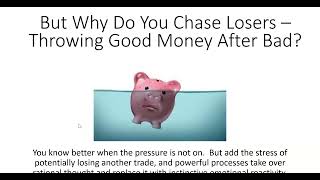
Private partner underneath that brain, that cool, thinking brain. They never told you about the survival instincts of the emotional brain. And this, friends, is what makes training so difficult. You think about it. Why do you chase losers? Why do you throw good money after bad? When you see, oh, my God, it's got to turn around, it's got to turn around, it's got to turn. I'm going to fight for this. I'm going to get it back, I'm going to get it back, I'm going to get it back. That's caveman. That's not you anymore. That's not the rational guy who thinks that I'm a rational human being.
No, that's actually the emotional being that you really are under stress when there's actually a threat or a risk to your capital, which means threat to your life, to that part of the brain. And all of a sudden you don't want to take that loss, because if you take that loss, you're dead. So you're going to fight for your life.
How many accounts have been absolutely cleaned out because that triggered okay, and they had no choice at that time because that emotional brain has hijacked thinking. And what you discover is thinking follows the emotion. It starts making alibis stories up to support whatever the emotional brain's done. And this is the problem, is that the emotional brain doesn't think. It emotes, but that emotion is really something else. So all of a sudden you have been thinking, which is kind of a problem. You've been thinking that you're in control. You've got this stuff down. You know, this is probability on an intellectual level. And that you know they're going to be losses. You know this, you know that, but you don't know it. In the context.
Of not being in control.
You know it thinking, I'm in control, therefore I have all this. I know how, I know the game, I can talk the game, I can talk the talk. But when you get under stress, and that's real money that can be lost, and there's pretty good probability that you will lose it. You know, you have to become an extraordinarily good loser in trading to be a consistent winner. However.
The moment that you put the capital at risk, you have then activated your caveman brain, your emotional brain. It's thinking about short term survival. It's not thinking about probability. This, my friends, is the brain, the mind that you brought to trading. And my Promise to you is by itself. No matter how successful you have been in other businesses or whatever, the brain that, that alpha brain that you brought is not going to work in trading because you're not in control and your brain is built for it. And the truth is you just don't see it. You don't see it coming. But it's highly predictable. I mean, I see this stuff every day and it's, it's. There's only about three or four variants to the story that a traitor is telling me. And you don't see it coming. Yet. If you understood the emotional brain and the way it responds to risk, particularly when it's been untrained, when you don't understand the power of the emotional brain, what you do is you're setting yourself up for failure and you don't even see it coming. And this is. It was predictable. Yeah. It's the power to survive. And that power is being taken away from you at your. As you look at a potential loss. Yeah. And understand the emotional brain's job is to survive. And flight, flight takes over. This is the problem that you have. And what are you going to do about it? This is the really big question. What actually are you going to do about this?
You want to. You really, you really. It's like, you know when you see that thing going against you and you've already taken a couple losses and you see it hitting a soft exit, a soft stop, but you say, I didn't. You start rationalizing that if you just give it some room, you know, it would start playing out. You're not looking at whether or not that trade has the juice there to actually maybe do that. No, what you're doing is now you're in wishful thinking. You're in. You're gambling, and now.
Boom. Then you start saying, I can't lose, I can't lose. And before you know it, by doing that, you exited a big loss. So it comes down to it. Did you skip two?
Yeah, you did. Okay, so here's the deal, friends. That emotional brain of yours, the one that I also call caveman brain, it wants to be in control. Okay? It had to or it was going to die. So it was very, very interesting, very interesting thing 12 to 40,000 years ago. The second thing it wanted to be is right. How many times have you sat there and says, you know, I was so right about this. I was so right about that. I saw it coming. I saw it coming. No, what you're really saying is that you had a prediction, you had A guess. You had a hypothesis and that it happened to be right. And you said, you know, I can do that, I can do that. Yes, you can. As long as you're able to manage the fear, instinctual response to uncertainty. And the one thing that you don't want to do is be wrong. And then this is when it really starts happening. In trading, you want to be able to predict causal relationships. That's when you can say, look, I can see this is going to happen. I can see the cause and stuff. I've got this explanation. And sometimes it works and sometimes it doesn't. So what you're doing is you're going, wow, this is what my emotional brain, the one I inherited from my caveman ancestors, anywhere from 6.5 million years ago to recently, as far as like 20, 15, 14, 15,000 years ago. Okay, so now you've got it. You're going, oh, I have a brain that wants to control outcome, which is not possible in, in trading. I want to be right. I want to win, and I don't have any control of that. I do not want to lose. You don't have control over that. And you want to make and you want to think that my ability to predict a future event is really there and I've really got it. It's a guess. Really great traders recognize they're not invested in their predictions. It's a guess. And they, of course, they hope that it works, but they're not, they're not cleaving to it. They recognize that their guess may or may not be right. And if they're, if it's not right, they're getting the heck out of dodge. Because at that moment, if they don't get out at that moment, they're gambling. So here's the deal.
And what you have to be able to acknowledge is the little driver there, that geeky looking guy with the glasses on, that's that modern man. That's the man who has forgotten. That's the human being that has forgotten that the limbic system, the caveman brain, literally lies at the center.
Of the thinking brain. At one time.
The limbic system, the caveman brain, had a tumor beginning to grow out of it, and that's what became the thinking brain. It got all involved. It started making all these great twists and turns, and it started engulfing. It started engulfing the emotional brain. But at the core, as it was growing, lots and lots of communication wiring was going from the emotional brain into the thinking brain. Lots of wiring. However.
Coming back from the thinking Brain to the emotional brain was two 19th century telegraph lines. Do you see the problem with our biology that you face? Every time you risk capital, your old brain's gonna think you're risking life. And your thinking brain really has very little control, particularly if you don't know what you're doing about how to calm the emotional brain, the caveman brain, down. It's sitting there waiting, and if you ignore it, it will hijack you. You become a sitting duck. So in here, and what I want to do is this is actually a really important graph. This really will tell you how things totally get blown off. And it may be a little neurobiological for you, but you really, really need to get this, because the moment that you start trying to separate your biology from emotion and cognition, you're making a vast mistake. They're inseparable. The first thing that happens is that you get data, information coming in from all your senses, and it's going into something called the thalamus. At thalamus, if you were to view. If you were to view the thalamus as.
An area like a very busy intersection in a major city at a time when traffic cops did the steering of the. All the traffic, you know, the traffic cops just doing his deal, Everything's going fine, everything's gone. And that's you scanning the horizon for trades and all that stuff. And then an emergency vehicle approaches. This is new. Excuse me, this is new data.
And besides that, it's coming in with alarms going on. Something danger, danger, danger. Something really serious has happened. What happens is that traffic cop starts all the traffic, all the thinking, and lets that emergency vehicle through. And it's heading not to. What I have here is sensory cortex, your thinking brain. It is heading toward the amygdala. And fight flight, it will have a memory in the hippocampus that just activates all this stuff. How long does that take? That low road, that short road.
From the stimuli from the data coming in, hitting the thalamus, to the decision made to send it to the amygdala, and getting the impulse to the amygdala in fight flight can take as little as.003 seconds. Okay, this is what you're up against. However, if that traffic cop also let the signals go up to the thinking brain, it would take at least 0.25 seconds.
Okay? Microseconds. Not nanoseconds, microseconds. And you can begin to see that the emotion, that's chemistry already in the bloodstream, impacting your thinking. That's what's happening. And then if it's really an emergency, like you're seeing that thing hit the stop and it's. It's just crashing through, and it looks like you're going to really burn up an account. What happens is that the thinking never even gets to the thinking brain. I mean, the data never gets to the thinking brain. It immediately gets to the amygdala in Fight flight and has an emotional response. And that's when you just. You go crazy. That's when you go tilt.
This is an. Until you train yourself to interrupt this process and to have a different set of emotions that arise when something happens, good or bad, you're going to have problems maintaining consistent profits and trading. You may have good spells. But what's common in my practice is that the first thing is they say, randy, you know, if I could master this fear that I have, everything would be perfectly fine. I got it. And what happens is that that happens. They start really beginning to master the fear. And it doesn't get so bad that it destabilizes everything. But then they find the second monster. The second monster is Euphoria, or what we would call overconfidence. They would start winning and they got the big head. They would get overconfident. They would start feeling really good. Oh, my God, I got it, I got it, I got it. And that is dangerous thinking for a trader to have. You don't have it. We. I build a workaround with a very old primitive brain, because that's exactly what has happened with your biology, is that an engineer would never design a brain like we have now, because it was. It was a design bill operation, and it happened on the fly. This emotional brain just started having this thing, and then somehow it just went crazy and started doing this. It started having cognition, which is something that, you know, the lower just the caveman brain doesn't really have. And so you've got this. And the question is, really, as long as you. As long as you're just fat, dumb and happy, this isn't going to change. But here's. This is what happens when you chase a loser. Okay? Okay.
The key is, is that you're getting all this information moving in. It hits that traffic cop, but it also in that hitting that traffic cop. What you're really doing is you're experiencing your deepest survival beliefs about your ability to manage uncertainty. Not the ones you talk about, not the ones you beat your chest about, but the ones that actually happen. Now give me an example from Vietnam is that I have a friend who when he went to Vietnam, first of all, he went on jungle patrols and stuff like that, where the Viet Cong used to pick a few people off at a time, particularly the radio guy, and get them pinned down and then back off. And just. They lived in a state of fear. But this guy also flew the gunships and he, you know, he understood what it was like. And these new recruits come in and they're all macho.
And they're just big, beating their chests and stuff like that. And they did that until they got on the patrols and they found out that underneath their bluster was deep, primal fear or instinctual fear. So you've gotten this thing where there's a. Suddenly they found that, oh, it's a threat to survival. And then all of a sudden, there it goes. The information is being routed directly into that low road to the amygdala and the high road just gets cut off. That's it. And the instinctual. When you are scared money, you are experiencing fear of loss, actually fear of life. You're not experiencing the loss of money. You're experiencing your brains, your brain interpreting money as your power to survive. And yes, that's right. You all of a sudden believe that you're in a fight for survival, and decisions are made on that. Okay.
So you're fighting for your life, and that's a very, very bad mind to trade from. And that's why this is going to have to change. And the real key is, how do you go about disrupting this primal, instinctive process? It's not going to change. I mean, I have a saying in my practice and it comes out of Thomas Jefferson, and it's, this is the price of freedom, which is what everybody wants. When they get, when they feel the allure of trading, they want the freedom that trading can really provide them. It's eternal vigilance. The price of freedom is eternal vigilance is. Guys that I've worked with, I know it's predictable. When they start doing well, they're going to get the big head and they're going to have a. They're going to have a severe loss. I tell them it's going to happen. And it's just like, you still have to do that. And you finally get it, oh, my God, I have to be vigilant about what mind I am bringing in. Whether or not I win, whether or not I lose. You can allow yourself to, to start being confident, like overconfident. I've got it. I got it. No, the truth is this. When you win, when you make money. All you really did from a trading perspective is land on the right side of probability relative to you. When you lost, you landed on the wrong side of probability relative to you. And you have this universe of traders moving money around, making bets, and you have this exchange going.
And if you cannot manage the emotions that give rise to the mind, the exchange rate's not going to be in your favor. So the key is.
We know this instinctive process is there, but the good news is this is. The brain is also primed for neuroplasticity. And.
It blew up in neurobiology when.
Neurobiologists started being able to train patients who had strokes where part of the brain was knocked out. They were actually able to train another part of the brain to take over those functions. Really cool stuff. And that's the neuroplasticity. And what we can do is we can retrain the brain, but you have to work at it, of course. And what that might look like, okay, is this, first and foremost is that, you know, emotions are actually biological action potentials. Notice I said biological and action. They're not feelings, friends.
When you see a perturbation, a change in the environment, the markets, automatically an emotion is going to come up.
And in a case like this, when you're running this and you see all the uncertainty flaring, what you're doing is you're seeing, oh, this thing, this thing is just popping up and down. Yeah. These are emotions doing their jobs. The key, though, is if you came with stock genetics and stock learning, you're going to have the emotions of fear and worry in and around uncertainty and risk. You're not going to have.
This calm, patient, disciplined mind that has to be built. It's alien, it's very different, it's unnatural. But if you're going to be successful in trading, you're going to have to build a very unnatural mind while it's being exposed to uncertainty. So now we're beginning to get this. And the major thing that you need to really grasp is this, is that all thinking, all thinking and behavior is emotional state dependent. In fact, what happens, you discover this, is that thinking on. If you. If. If this emotional complex were a train, thinking would be the caboose. It'd be the last. The last guy didn't know anything's going on. The locomotive driving the train is your emotions.
Okay. Your beliefs are the engineer managing the emotions. If you grasp that, you start going, whoa. And you're telling me that all thinking is emotional state dependent. Yeah. So this isn't about Trading without emotions can't be done unless you're dead. Then you don't need to trade. No performance trading is about creating the emotional cocktail from which thinking, probability, thinking rather than survival thinking arises. And the other piece you have to have is that you don't have emotions. They have you. They're the most primitive. Emotions that ride within us are over 600 million years. The one that we call human. Six and a half million years. Thinking, depending on who you talk to, probably showed up 40, 50,000 years ago. So thinking is the new kid on the block who doesn't know that he's the new kid on the block and thinks he's really smart. But underneath all that, there is a powerful instinctive brain that you have to learn to manage.
So now let's actually talk about water, emotion, the components. We've already defined it as a biological action potential whose purpose is to manage the relationship between the environment, the markets and the organism, the trader. The first thing, once you get past that, how does emotion operate? And I want you to look at this. The first piece. The first piece is arousal. Now, you will notice arousal and do this tomorrow morning, okay? When you're sitting there watching a trade. I will. In my work with my, with my individual clients, we actually videotape the client. The client videotapes themselves at the trade. And what we were looking for is the way they're breathing. Usually they're holding their breath or panting, making sure that the bottom lobes of the lung don't get any oxygen, which means the brain's being oxygen starved. And muscle tension, you know, they squint their jaws, they squint their eyes, you know, they get their backs, all that stuff, their guts tight, all that stuff that's all emotional arousal. They're revving up, they're about to get hijacked.
That can be interrupted and it has to be interrupted. And that's why I use the video. I want people to see what they're up to as they move into a particular kind of moment.
And the videotaping does a powerful thing. If you don't want to do that, use a mirror tomorrow morning and watch yourself. Trade. And I can promise you it's not a pretty fight, but it'll give you the idea, oh, my God, emotions are running all over me and I'm the one who's been a fool. I haven't even seen them. I didn't know how to see the emotions. You got to learn that the second piece of the emotion is the feeling. The feeling is not the emotion. It's a very small component. The feeling is the subjective experience that you have of the chemistry, the emotion in the body. You know, that sinking gut feeling that, that energy flush, all that stuff, that's the feeling. And it's telling you that it has gone beyond arousal. Now it's actually activated in the bloodstream, running in the brain. And if you don't get it under management real soon, you're cooked. The next part is motivation. That's what the emotion is telling you to do. And what you discover in neurobiology is you discovered that there are three major motivations. Fight flight. Those are the ones very natural for us to respond to, to uncertainty. But there is also what is known as approach motivation. Okay, that's the curiosity that's approaching, that's approaching.
Something that could be dangerous, but it may be really great. Who knows? We have to find out. It's that motivation that you also have to come down to and recognize. Okay, I see that way, I'm wired, I see the patterns. Now I'm going to have to change it. The biggie. Belief. The belief. The belief is not something where I declare I've got some affirmations I use and I believe this. I believe that that's wishful thinking.
The limbic beliefs that I'm talking about are the ones that drive performance based on your, its belief, your belief about your ability to manage the uncertainty, the challenges of living. And then if you think you can really manage them, then you find out you can't control outcome. You start really realizing I'm going to have to change the beliefs I have about my ability to manage uncertainty. Okay, they're going to have to be performance based beliefs which you can control rather than outcome based beliefs which you can't control.
So then the last one is predisposition. You get a genetic heritage. We also call that evolutionary psychology. You bring a lot of stuff with you. Okay? You, you know, some people are more nervous than others, more risk taking than others. But the thing is, is you need to know about it. You need to know your tendencies so that you can kind of cut it off at the page before it just dumps on you. So those are, those are elements you need to be looking at about the way an emotion works in your body, your brain, emotion and cognition.
Now, and how do you do it? How do you. It's pretty simple. The Hindus figured this out 4,500 years ago. Okay, is diaphragmatic breathing or bellows breathing is done just like this illustration right here. You are looking at a guy and what's happening is you are using your abdominal muscles to pull air in your mouth, down your windpipe, into your abdomen. That's actually the lower lobes of your lungs. And then you expand the chest. Okay. Most people.
Only use the expanded chest, a third of their lungs. And they wonder why they're nervous. They wonder why they're prone to triggering, to outbursts and stuff like that. Well, this is it. You're not doing one of the most fundamental things that can be done to be able to interrupt the arousal of fear or anger or greed or lust in the trading mind. And most people are pretty amazed. I had no idea that you just calmed down. Yeah, this is a management tool. This is you're working directly with the emotion because the emotion is biological and you're interrupting the emotion at that level. That's the first thing that's really necessary. And you know what it does is it allows you to calm down, for God's sake. Instead of just sitting there picking up change and than just getting steamrolled, what you're able to do is you're able to keep your mind in a disciplined, impartial place that provides the kind of mind that reads charts in a way that's going to allow you to have an edge with your psychology to complement the edge you have in method. Because there's nothing worse than all of a sudden look up and there it is, you're about to be flattened and you no longer have the edge because you could not anticipate that and you didn't know how to train yourself. But this is the necessity of emotional regulation. It's so easy just to get swept away. And then you have to. The second skill that we teach is awakening the observer of the self, which is generally called mindfulness, is that in this illustration, what you're looking at is a guy totally identifying with his thoughts. Okay, I, this, I'm losing, I'm losing. I'm, I'm, I can't win, I can't blah, blah, blah, blah, blah, or I'm going to make a lot of money. I'm going to like a lot of money. And then you're looking at, as you learn to observe, you're stepping back out of thought and recognizing that you and your thinking are not the same. You stop identifying with thoughts and beliefs because you realize you're not the thoughts and beliefs and you don't have them, they have you. So to develop this latent skill, and by the way, this skill has been around for 20, 2500 years. It's the Core of what the Buddha taught to create Buddhism. Okay, so mindfulness started 2500 years ago. So we haven't gotten into the new age. But what we also have to do is recognize a powerful thing from quantum mechanics that we exist as potential. We don't exist as bodies and stuff like that. We exist as potential. And the observer of that potential is what brings forth the construction of the self that you bring to the man of uncertainty. So right here, what you're looking at is an awakening. You're going, oh my God, I thought there were objects out there. And I thought there were all this stuff. And all of a sudden I'm realizing this is neuroplasticity where I can take the potential of myself, of the being that I am, and reorganize it into higher functioning that can work with probability rather than get triggered into the primitive survival strategies. This is what the trading minds built from.
And when you're doing this and you learn how to observe, the very first thing you run into is what I call the historical organization of the mind and what you will discover.
There is an inner critic living within all of us. And it's the one that beats you up. It's the one where you know, it's the one that tempts you. Get in, get in. Boy, that thing's. If you don't get in there, it's going to get away. Okay. And the thing is, is most people, particularly Western Christianity, have been so afraid, they so uncomfortable at having the inner critic around that they ignore it and pretend it's outside of the self. No, that destructiveness is inside the self. It's part of the human condition, part of human potential. And by trying to ignore it, thinking, I'm just going to think positive, positive, positive, you're ignoring the power of the destructiveness that also lives within you. And you better, you better master it. And then what you do is, there is a. It's in a dance, a tight dance with something that I call the adaptive voice. And that adaptive voice, literally is how your brain organized you to survive through aggression or fear. When something out there triggers and you find it fear based, you're actually. Or aggression based, you are working with your adaptive voice. And the Jungian term for that is orphan other. It's also known as wounded child and others. But the thing is, is it's real. And what you discover is that there is a dance going on between that inner critic nature potential within you and that, that adaptive voice, part of yourself. And you have to retrain this, this is very Important. We spent so much time trying to ignore it that it just walks in the back door of the mind and you never saw it coming. And what I'll say is the price of freedom is eternal vigilance. That's the price. And then beyond that, you start observing the potential living, living in you as just part of your inheritance. Because I would actually consider you to be conscious, conscious creation. And I don't mean that necessarily in a spiritual or anything way, but the big bang created creation. And other people would say, well you know, there was this cosmic desire to produce the world doesn't matter to me. But the thing within the potential, what you discover is that.
There are areas of your, and it's really genetic, but it's expressed both biologically and cognitively and emotionally. There are parts of you that simply have not been developed well for managing probability. So focus we are on winning and survival. This is what has to be brought into, up and nurtured and worked up. And what we need, what we need is the discipline of a ruler, the courage of a warrior, the self soothing of a caregiver and the impartiality of a sage. Remember, these exist as potential within you.
They're on your genome. Whether or not you have developed them or not will be evidenced by, by the health of your trading account. If you found yourself, you make undisciplined trades, you do this and all like that and fall apart. What you're saying is the ruler part of you, the one that leads, the one that, the ones that ties things together, the ones that really are able to pull it together and keep things going under stress, that's what needs to be done. Courage of a warrior. That courage is not the absence of fear, it's acting in the presence of fear. Because unless you act in the presence of fear, you're going to stay stuck in the old pattern. And that's not going to work in trading. So that courage to face your demons, face your dragons and to recognize I have to have the courage to master parts of myself that I don't want to know about but are showing up and cropping up in my trading. Even more important is the ability of self soothing. To have self compassion of the caregiver, is that beating yourself up? You know, I've been doing this for over 15 years and I have not found one trader yet that became a better trader because they beat themselves up after a loss.
The key is the ticket is the self compassion. Because self compassion is really.
Really the only emotional state that will take a self limiting belief Detangle it and reorganize it into higher functioning. Okay, so.
Here we go. One person said they lost sound, but I think everybody else has sound. Okay, let me know if people have still have sound. Please say yes or why.
We have a person. Okay, we've got it. Yeah. Okay, thank you. Thank you. And the last part of the self and understand this is potential living residing in the self that you're going to have to develop to be able to produce the. The trading mind, not the mine you brought. The trading mind that produces consistent profitability is the. If you're able to manage those first three, what you do is you calm fear down, you calm the urgency to act down. And what happens and what arises there is that incredible human part that is impartial, that is rational, that is logical, that can actually show up and work with probability. But you have to do the other three. You have to have a good ruler managing the shop. You have to have courage to take risks, to turn toward your fears and conquer, master them. And you have to be able to have compassion for yourself because that's the ticket to soothing anger down, soothing fear down and recreating the self out of that. What you get is the gift of being human with a probability based mind rather than a fear based mind. There you go. That's the probability based mind necessary for trading. And the good news.
It'S innate. It can be developed. I use a process called memory recursion. Consolidation is actually the way the term and what you discover is memory. It's not out there. It didn't happen that way.
When you have an experience, your brain encodes it based on its beliefs, its biases and assumptions. And once it encodes it and it's stored in the hippocampus, you think that's exactly what happened. Well, that is not what happened at all. Is what I do is get people to find places where they have experienced these very powerful emotional programs in reality under stress. Because then we know that's there and it's not affirmations anymore, it's not wishful thinking. And you learn how to strengthen them and to develop them so that Lily begin to see the thinking brain and the and that emotional brain begin to come together as a working unit. And this is the memory consolidation. I actually call it memory enrichment is a huge difference between visualizations because you're visualizing what you would like to happen. I'm actually getting people to visualize what did happen in affirmations. You're again, you're saying this is what I would like to be. I'm actually saying, no, this did happen. It's a fact, it did happen.
After that, you can use affirmations and visualizations far more effectively than the stuff where you just make up. You make believe and you think you're going to train the subconscious just by blabber, blabber, blabber. It doesn't work that way. Okay, so you've got that, you go, wow, this is pretty interesting. And then what you do is you begin to say, I can begin to redesign what mother nature has given me and you begin to replace that instinctive, fear based mind that wants to survive. You start replacing it with a different intention that has been designed by you. This is where, this is where. This is what's missing. In most self development programs, you get cranked up, okay, and you feel really good and you think, wow, man, I'm ready to go, I'm raring to go. And then you get out in two or three days, two or three weeks later, that emotional charge is gone and the beliefs that weren't really gotten into re establish themselves, creating the truth again. Because you know, ultimately truth is in the eye of the beholder and beliefs create the eye of beholder. So you have to be really careful about what beliefs you're bringing into the game and they're revealed in your trading account. So this is, this mind that we're talking about is what is built to manage and engage the uncertainty of the markets. You have to build it though. It's not natural. Okay, but you just don't see it with traders. You also see it with high level performers. Whether or not it's athletics, whether or not it's pianists, what you see is that yeah, they don't really great athletes just aren't sitting there and you know, rah, rah, rah. What they're doing is they realize that this is a game, they're looking long term and they're, they're having themselves so that, so that they're ready when the moment appears. Like with a golfer, somebody on the tour, you know, they can, hey, they can putt and drive. That's not what separates them. There's only gonna be about 10 money players that are really big money players. And what they recognize is they can control the crowd, they can't control the weather, they can't control.
That another guy's having a great day. What they can control is the mind that's hitting that little stupid golf ball. That's what they can't, that's what they focus on. They don't focus. Sure, they want to win, but they know to win that they have to perform. And so they stay focused on keeping that performance mind there. And so traders, you have no choice. You've got to do this. So winning and losing takes on new meaning when you do this. Because winning, there's no reason to get all cranked up. It's just landing on the right side of probability. You have to train yourself to think this way because it's so easy to get sucked up into the euphoria of the moment. And losing only becomes landing on the wrong side of probability. It doesn't say anything about you as a being. Alphas, in particular have the problem that in their development, they begin associating making money with mattering.
And when they come into trading, they want to use the same success formulas that they had in business. And they come to trading and they think it's going to be a breeze. And all of a sudden they discover that the trading mind is very different than the, than the business mind. And this is where it is. It's not about winning or losing, it's about performing. That's the ticket, friends. That's the ticket. Once you grasp that you don't control outcome, what you do, really do is you start saying, like a surfer. Now you take a look at that surfer right there, it's very obvious he doesn't have control over that monster wave, but he does have control over the mind that he's performing with that wave with. You know, if he's in control of that mind, he gets a really great ride. Most likely, if he's not in control of it and that wave overwhelms him, he takes it deep. But this is exactly what it's like with trading is you don't control the wave, you don't control the markets, you control the mind that you bring to engage the markets. That's the key.
So.
This is the new winning that every trader is going to have to learn. If you're thinking in your goal for that day is, I'm going to make some money today. You have set yourself up to fail because you do not control outcome. Yes, over a goal is, yes, I want to make money. I can't stay in, you know, I can't stay a trader if I don't make money. But the key is, how do you get to that point of winning more than you lose? You do it by the performance mind. You control performance, not outcome. Once you grasp that, you've got it. Now, for those of you who just say, I'm kicking tires. I don't know very much about Randy, and I'm just looking around. What I ask you to do is go get my free book. Yeah, It's a free ebook, and it gives you a lot more in depth look at what we've been talking about here. And it's free. You know, it's. There's no risk, there's no. Nothing. Okay. However, if you're really getting it going, you know something, Randy's on to something here that I just simply haven't seen elsewhere. And I'm beginning to grasp that. Yeah, this is. We've. We just simply don't understand our neurobiology. And we understand that out of that neurobiology comes our mind and that we need to really focus on how we build the mind through emotional regulation through basically learning how to manage emotions. What I would suggest is go to my website, okay, and start really exploring and take a look at all the. I've got well over 200 videos on YouTube and a lot of people just spend a lot of time with Randy Howell and his videos out there. Do that to you. Kind of get a sense of this. Then read the articles on the website and read my book Mindful Trading. And then at some moment, if you've really come around, you've been. If you've been looking at this a lot and you've been, you know something that Randy makes sense. There are two ways. We have two ways of actually learning the skill sets that I'm talking about. One is through a group course, which happens at June 16th. Okay. But you have to sign up by 6, 10, that's tomorrow to be able to get the Emotional Regulation workshop for free. And I'm not. The Emotional Regulation workshop is really a motivation for you guys to get in earlier rather than later. Because most people realize that retraining the brain is a lot more involved than hocus pocus and affirmations and visualizations. It's actually training where you have to retrain what neurons are firing together to wire together. And you're having to learn how to breathe and you're having to do all this stuff. Yeah, it's a lot like sports psychology, you know, it's just that those athletes work, okay? They practice and they're ready for game day. So that's the first thing. Okay. And the second thing, if you're looking at it and going, you know something? I've been. I've been watching Randy for a while, and what I recognize is that he's. He's onto something. And I'M I'm coming at the moment of where I need to. I want a personal relationship with him rather than a group relationship. I really want the mentorship. We have a group core. We have a personal course, individual course. It's very personal. It's very comprehensive, too, and takes three or four months to go through. And the thing is, that's for people who are really serious. If you're looking at that individual course and you're serious about it.
Ask for a free consult with me. But we don't want people who are just kicking tires.
Yeah, yeah. It's for. It's for people considering the individual thing, because I also want to check you out as much as you want to check me out, because I. There's certain things that I just know that probably it's not a good fit, and I want to make sure that this thing is. Can be optimized for you. So that's the deal. Friends, I.
There is an enormous amount. You. You have chosen one of the most difficult cognitive performance arenas that you could possibly ever imagine. This is really something else, because you really, truly are going to have to overcome millions of years of programming in order to be able to rebuild a mind that can handle the probability and uncertainty of trading without going bonkers. So what I want you to do. Do we get a money tree, too? I love that.
You know something? When I was in advertising, I worked. When I. When I. When I was in advertising, I worked with the bank. And one of the things that we actually did. We had. We did an advertising campaign where we actually sold what we gave away is money tree seeds. There's actually a tree called Money Tree. Okay. And so I thought that was pretty funny. Good for you. Anyway, what happens is I want to wish you all well. And if I can help you, I would love to find out if we can do that. And if you have questions, I'll be happy to take a few. Because we have a few minutes. And.
Here'S from Sammy. It seems as if self observation is a major key element in disciplining. Yes. Our emotions. Yes, it is very much the destructive. Whispers come, but that's. It's about haunting it.
Once recognized. Yeah. What I'll say is this, is that most of us. There was a study done in Denmark a couple years ago where they asked people to spend 20 minutes in silence, but they gave him an owl. It says if the silence, if it becomes uncomfortable, you can use this button to shock yourself with electricity. 66% of the men in that survey shocked themselves a number of times within the 20 minutes. They didn't want to, they didn't want to sit in observation, say, what's the discomfort? Yeah, they didn't want to be bored or they didn't like the discomfort. And 24% of the women did the same thing. So, yeah, the self observation is the key because in self observation you begin to step back out of thought and you quit identifying with it and you begin to realize that I can rebuild the self very differently than the way it is right now. Good point. Okay, this is Kendrick. I just failed a prop firm challenge for the fourth time. And I noticed that I cut a lot of my winners short. Please help. Well, Kendrick, what I would say is that to begin with, the group course is a. It's where the skills are taught. And I've worked with a lot with the firms where basically you can get an account and stuff like that. And the whole key is, is that you do in fact have to. You, you truly have to be able to get the mind under management. And I've been with people who have taken those things 10 times, and I've been with people who have successfully gone through them, failed, come back and realize that they let their trader psychology go by the wayside and they had to reassert it. So you can do it. Okay, Kendrick, you can. This is William.
Is the learning curve required to develop a trading mind similar to the learning curve that we all have when it comes to everyday or classroom type learning? If the learning curve is so steep in the scholastic area.
Will it be steep in the trading mat? Absolutely, it is. What I have basically found is that.
On the group course, it goes by so fast. There are five sessions over a period of two months. And what we do is we invite people to take the course again for free. Because what we want to do is we want to have them go through it and kind of get the shell shock out of the way and then get to the point where they can start learning. And we also give them access to the virtual classrooms pretty much virtually forever because we want them. We know this is tough. This is the most difficult things you can do. And.
Unless you can get your mindset right.
You can have a great edge on paper, but you can't deliver it. So, yeah, the thing is, is that it's.
It. It is a learning curve. And I find that.
I, I see people turning around in three to four months. Okay. And I actually see people in the groups turn around pretty good too. But I'm talking about consistent profitability. But what I've really Basically discovered is that it takes about six months to get where, you know, it's actually beginning to feel natural. And it takes about a year to actually have it. This is with practice, consistent practice and stuff like that. A year to where it becomes normal.
Do we become addicted to our feelings, emotional responses? Marie, here's what I'll tell you, is that.
We all form habits, okay? That's just simply what the brain does, is when it has a problem and it solves that problem, it gets a fix. It gets either a dopamine fix, an opioid fix, or an oxytocin fix. Those are. That's the reward chemistry. And in that, you build. You can build very positive habits. Like, I have a habit of walking an hour a day while I'm lifting barbells. And I do it pretty darn consistently. It's a habit now. I just don't feel right without it. However, there are also people with addictions, real addictions, that the problem is, is that the reward is not internal. It's external. And, you know, cocaine, alcohol, whatever, becomes the reward. And this emotional brain can't tell the difference. You can't tell the difference. It'll take the alcohol or the cocaine over the internal resources anyway. And a compulsion is another kind of habit. And it's the ones that really have you chasing losers and over trading and stuff like that. And it's based on the same thing, is that you build a habit, and what you do is you. The thrill, you know, the thrill of the hunt. I call that lust, by the way. What happens is that it fills it, and that thrill produces dopamine, which is very similar to cocaine. And so what happens is that what you do is you set up a habit that's done behaviorally. You do something to create chemistry, and instead of becoming an addiction, it becomes a compulsion. So you really have to. You really have to mind the habits that you're forming. And I take habits very seriously. But I also understand that the core is you have to really check out the beliefs that are built around that habit. You know, it's kind of. There's a saying in the recovery community is.
Everybody stays addicted, but what happens is they get addicted to things that don't piss people off so bad. And that's the way I would kind of really say that. Okay. So, yeah, but, yeah, you're gonna have to be really in management of the habits you form.
Okay, here's Victor. You, whoops, you control, but you don't control outcome. Correct. You control your performance. You just don't you, you control performance. You don't control outcome. Tom Brady doesn't control outcome. He controls his performances. And he's probably the greatest quarterback that's ever lived in the National Football League. Okay. I bought your book Monday. I just received it today. I can't wait to read it. It's got. Lays this stuff out. My main issue is fear of setting the trade. But I have been working very hard on the mental parts and listening to your YouTube videos. Yeah. And I can already see the difference. You are such a big help. Thank you. And you know something, Kelly. And that's Kelly. And it's really interesting is that I am amazed how much email I get from my YouTube stuff and my articles where they, they tell me, thank you, Randy. Thank you. You have made a huge difference in my trading. And you know, I.
I am under the. I am no saint and obviously I'm a capitalist and an entrepreneur and I put materials out like that to help people's knowledge base. Because what I realize is that people start listening to me, they'll really begin to understand the problem on a totally different level. And they realize it's pretty complex. And I thought out, well out of that they'll have to come see me. But I found a lot of people get a lot of help from a lot of my free materials and good for them. Good for them. Okay. Okay, friends, it is time. I am about to. I'm about to close down shop. I want to thank you for being here and basically investing your time listening to me. And I hope that you came away with good purchase and tomorrow watch your trading. And out of that.
Ultimately you're going to have to make a decision about whether or not you're going to build an unnatural mind to be able to become an effective trader.
If you say I'm going to have to do that, I understand that. Then.
We have a journey that we can continue together. Okay. If not, I wish you well. So anyway, I thank you for your time and we will see you in the future. And my favorite thing, when I was a little kid, I was a big fan of Roy Rogers, a singing cowboy. And when he. When he and his girlfriend Dale left the. At the end of the TV show, they always sang a song, happy trails to you. Until we meet again. I wish you the same. Thank you very much.









