Mastering the Brain Glitch that Turns a Good Day Into a Bad One
Randy Kardec Trader explains how traders' emotional brain hijacks decisions under risk in milliseconds. Your amygdala reacts in 0.003 seconds while your thinking brain takes 0.25 seconds to catch up. He teaches breathing and mindfulness to build what he calls a probability mind, and offers a YouTube library, free book, and paid coaching programs.
Chapters
The broadcast is now starting. All attendees are in listen only mode.
Welcome. Welcome everybody to Trader State of Mind and our monthly webinar. Just to let you know a couple quick ground ground rules. First, let's find out if you can hear me. If some kind person would simply write into the question box a why I would greatly appreciate it. That would be really cool thing for me. And the other thing while we're waiting on that, There we go. Thank you. Thank you, Ivan. Thank you. Thank you, all of you. Thank you. Okay, the other thing that you need to know is that when I make my webinars like this, I'm doing a presentation and I'm holding questions till the end. But what I would love is for you, when you find questions in here or comments in here, go ahead and type them into the question box so that when we get to the end, we've got something to work with. We don't have that. We don't have that little while between, oh, what kind of questions do I want to ask and writing them down and getting them all that stuff done. I would appreciate it. So from there, let's take a look at this. What we don't recognize about trading is that our brain that we use, a primitive part of that brain, comes from another time and another place where the rules for success were completely different than what they are today. The problem is success in the ancient world really got wired into us. And we bring what is known as an evolutionary psychology into the modern game. And back then, understand.
We were juicy little morsels for big cats, big bears, and all sorts of animals that saw us as a very small matter to deal with. And so we have a tendency to have some survival instincts that we're going to be talking about really as glitches and that they were really good to have back then, but they no longer serve that purpose. So we're going to be starting there and we're going to start really taking a look at what happens in trading. You know, what is it that kind of has you stirred up and all of a sudden you go into trading and you just got to get there. And apparently we're having a problem moving the.
Okay, there we go. And tell me something. How many, how many of you have dreamed something like this? Anytime you say, you know something, I'm going to make some money today. I've got my target of X amount of money that I'm going to make, and I can see it already. I can. And I'm going to visualize it. I'm going to taste it, because that is part of visualizing success. And so the thing is, they fall for this dream. And what they don't realize is that trading is a very different animal than what they thought. The very rules of success.
In trading are completely different than the rules of success for everyday life. You know that formula success is equal to persistence and hard work. You know, just that, never give up, really focus on it and work, work, work, work, work hard work. Yet if you apply that to trading, all those dreams will vanish and you're going to have a lot of problems. What we want to do, though, is go, oh, wow, it is so easy to get sucked into trading because, oh, man, the upside is just fantastic. You have financial and personal freedom that truly is right there in your mind, okay? And all you have to do is work hard, be persistent, and never give up. And you're going to be successful just like in other endeavors. And yet.
In this moment of enchantment going, oh, yeah, I can see myself doing that, suddenly all These numbers of 90% of traders don't make money, blah, blah, blah, all that just kind of blow away and you start seeing this enchantment. And because you want to believe. And as Ted Turner said, life is a game. Money is how we keep score. If you bring that into trading, you can lose.
Trading can be seen as a game, but it's really about a way of measuring how effective the beliefs that you hold about your ability to maintain emotional sobriety during pressure. That's what it says. Because if you can maintain the beliefs, then you extract more money out of the, out of the markets than you put back in. So the thing is, is money is no longer how you keep score. Really, if you keep score on money, what you're going to do is you're going to find yourself losing. Because suddenly what you discover in trading, it's really more about performance. Performance. If you perform well and you have that edge in your work, you have to build a psychological edge to be able to do it. So now we're going, wow, this is really interesting, is that a lot of the reasons I got into trading are not going to be doing, being able to do that. And this desire, this desire to make money, to be honest with you, it is something that absolutely kills people. You do not make money in trading. Actually, to me, trading, making money in trading is really.
The money shows up as a consequence of you recognizing an edge doesn't mean you're going to win over time, but recognizing that you have an edge, that if you follow that edge, produce that edge you're going to extract more capital out of the markets than give back in. And that's the way it works. As long as you're trying to control the outcome, you're actually doing something pretty reckless. Now.
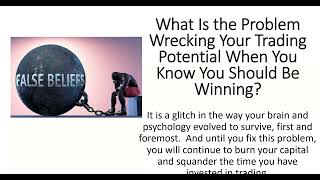
Here'S the deal is what actually is wrecking the potential of your trading and ultimately what it really comes down to, it comes down to beliefs.
Beliefs about your ability to maintain and maintain yourself under pressure and that you have this edge, that it's going to pull a certain amount of capital out of the markets more than you put back in. But the problem is beliefs we like to think are true. How many people in here have one or the other going? You end up thinking you have this inner critic show up in your ear, you take losses and you know it's saying you're never going to do it, you're going to fail. Why did you think you could do this? That's revealing a belief. It's a belief about your mattering, a belief about your worth, a belief about your competency, even a belief about your lovableness. It's an assessment being made. But the thing is the brain ends up wiring it so that it takes on the power of truth. And suddenly that assessment, okay, becomes a belief that is true. You have to be really careful because the brain is going to create beliefs. And you would have brought beliefs from your family, from your community, from your culture into trading about your ability to manage uncertainty. It's these beliefs that you're really going to need to just absolutely look. Because the deal is it is a glitch. And the way your brain and psychology evolved to survive, you know, it's kind of like you have to win. Because if you don't win, you're not producing, you're not producing short term survival. If you lose, my God, it's like having a saber tooth tiger running around after you. And so you begin to develop these beliefs about your value and all of a sudden people put a dollar value on it. And it's these beliefs that we have to find, we have to change. Because the belief create the reality you're in. Let's do it this way. In quantum mechanics there is a saying is reality is neither rooted in mass or energy. It is rooted and is potential. The observer of that potential is what brings the shape forward. When you're saying that, what you're saying is the observer that you are are the beliefs that you see from, you observe life from. And what you're doing with your trading account is, your trading account is telling you how effective Those beliefs are about your ability to extract capital out of the markets larger than the capital you put back into the markets. That's the deal.
In trading. It doesn't matter whether or not the beliefs are true or not. It matters whether or not the beliefs are effective or not. That is the operative word when you're working with probability. So now.
Then you get to this thing where you're trying not to lose. And have you ever noticed that is you're trying not to lose. And what's the belief behind that? It's really about going unwilling to take a loss and believing that, that you can make a losing trade turn around by willpower, magic. You know, I'm just gonna, I'm a double down on this. It's gotta happen. You're seeing that belief in a fantasy world, and those are not beliefs that are going to produce an edge. So you're beginning to see it going, wow, wow, wow. So here's the deal.
You see that little critter on the very far left end? That's actually the silhouette of a chimpanzee. You see that fellow sitting over there in front of the computer? That's a Homo sapiens. Do you know how much genetic material that we share with one another? I'll tell you, 98%. Now, that chimpanzee does not have this big gigantic thinking brain that we do. He has a enormous and highly effective emotional brain, the primitive brain that is all about surviving the moment. It's all about having prestige in your tribe. It's all about having power, okay? It's all about literally controlling the fruit trees in your territory. That's the money to a chimpanzee. The deal though, he's not thinking long term, he's thinking only in short term survival. And each step of the way, as that chimpanzee and us having a common ancestor, as we started moving away, moving away and we started moving into becoming Homo sapiens, we still carry a lot of that evolutionary psychology that is wired in and state traits in us. So the deal is, is that we're going to have to take a look at our monkey brain, our big ape brain, and we're going to have to start really saying, you know something, What I'm beginning to get is that primitive brain, that primitive emotional brain has a lot more say so about my trading success or failure than my thinking brain. And unfortunately my thinking brain, to be honest with you, doesn't even know how to talk or be in the presence of the emotional brain. It's, everything's fine until the emotional brain fires up, whacks out the thinking brain and takes over your trading. And before you know it, horrible, horrible things have happened. So we have a brain that is built not for here and now, but back then, and we have a problem with that. Okay, and how. How do you do it? Like, for instance, this right here, this is where all our alphas came from, okay? The ones that want to win, the one who wants prestige, the one to want all the babes, all that. Now, what I want you to imagine, you have 1, 2, 3, 4, 5, maybe 6 people there trying to take down a mastodon, okay? Now, the deal is, in order to do that, there is high likelihood that somebody's going to get hurt and killed. But.
But if you were to get that mastodon down and it were to feed your clan, it's for a month. And what you do is you get leadership in the clan, you get prestige, okay? You're honored. And then you also get first you first dibs for breeding.
That's a lot of energy. And our stuff gets us where we get all bent out of shape, and we want the prestige, we want the money, we want the look, we want the cars, we want the power, we want the babes, we want all that. And we're willing to do flashy things to get it. Well, this is where it comes from.
They got rewarded. But the problem is, is there was a high failure rate. And when you look at alphas today, they come into trading and they're the ones who blow up net worth, okay? They don't blow up just an account. They blow up net worth. Because what happens, they want to win.
And they want power and they want that. They want the measuring stick to be money.
So what we're looking at is going.
Risk and reward was just so different back there, okay? And.
It kind of seemed like a. Like a random world. But what happens is what we realized, like with those. With those mastodons, it was dangerous. It was dangerous. People got hurt, people got killed, and they all did it for the reward. Do you see that? Ties in. These guys will take big, huge risks, and then they'll double down. When a losing trade happens, they're doing that same thing that's rewarded them so well in another time, in another place, but it doesn't work here. So you've got all this stuff coming with you, okay? And this is just evolutionary psychology. This is not what you learned about yourself and your family of origin, your community and your culture. You walk into. You walk into trading, like as an alpha or if you happen to have been one. Oh, I can't do that. Well, what happened is you didn't, you were kind of back at the pack. You weren't the ones who were doing the leadership. You weren't doing like that. Along come trading and these alphas just run right in and what happens is, guess what.
They were, they were doing for certainty of the survival in the moment. And trading is about probability management. Okay? This is what the mind is required to do. So fundamentally, the rules change, but the old survival brain was still making the decisions. And that's the problem. Under pressure, your thinking brain is pushed out. And what happens to that old survival brain takes over. And that's where all things go crazy. Okay, so what does it really take? What did it really take? What I want you to understand is trading is more than just a machine.
It's more than just looking at slides and stuff like that. Fundamentally, if you take a look at success of your, of your account, what you're realizing, it's a synchrony going on between your trading system, that platform you have, and God knows how many times I've talked the trade traders where the platform's not working, you know that you can't, you try to, you're, you're trying to get into a trade, it won't let you in and stuff like that. And then trying to get out and, you know, it just runs around. You need a lightning fast, very good trading system. And then what you also need is a methodology ta and a way of managing risk so that though you're risking capital with a high degree of potential of loss, but also a degree of, of winning, what you're doing is you're protecting your losers so that they don't become big and huge and kill you. You're protecting yourself so you can trade the next day. And you have to be able to follow that. How do you follow that? That's where the trading psychology is. What you're doing is you're saying, how do I develop a psychology that allows me to be, to be in the zone, to be able to make rational decisions under pressure where money's at risk and the more zeros you add. Don't believe that stuff. Oh, it's just zeros. The more you risk, the more capital you risk, the bigger the, the bigger the, the bigger the charge, okay? And you're looking at it going, that psychology has to be able to handle that level of stress, that level of uncertainty. And it has. That psychology has to move from trying to make things happen to being in A position of seeing what the markets are willing to give you. That is the big deal. So.
The deal is this is believing that you are separate from your platform and your methodology. That's actually stopping you from being able to develop the you, the psychology that can actually use those things. It's to going kind of like this. Have you ever seen Formula one cars? Have you seen the kind of speed, the power? If you put a guy like me in one of those cars, I would be a danger to me and I would be a danger to the self. I'm used to driving regular streetcars. I'm not used to driving stuff like that. That driver has to have an edge that allows them to be able to manage that kind of speed. And you have to be able to get there and say, you know something.
Body, brain, emotion and mind are inseparable. Living in the belief that you are separate keeps you focused outwardly and keeps you blind to the real enemy. The real enemy, okay? And.
The truth is, is we have hardwired responses to the way the brain engages uncertainty. You know, and the deal is, is how do you change, how do you change the way the brain's been operating, okay? Which what you realize is that by you staying ignorant of how the brain operates, what you're doing is you're setting yourself up for failure and trading and probability stuff. Because there on the left, what you're looking at is, you know, you have information coming in, it's calm. The information goes, goes and goes up into the thinking brain and it makes decisions. You think, oh, I can do this all day. That's paper trading. And then you put risk in and substantial risk at that. Suddenly what happens is that.
The thinking brain is compromised, it's disabled and it's no longer in charge. That's just simply because you're facing risk and you're exposing the beliefs that basically are saying what you believe about yourself to be able to manage that reality. But how do you do it? It really begins with understanding that your emotional nature very differently than you currently do and to be able to use it as an advantage. And you're also going to have to learn how to communicate with a thinking brain that doesn't even know the emotional brain is even around. You have to learn how to find it. Advertisers today know that they don't care about thinking to talking to the thinking brain. They want to talk to the emotional brain. That's where sales are made and they talk to that. If you think about it is, I live near a Lowe's where there is a parking lot that has a bunch of 80, 90, $100,000 pickup trucks in it. And you walk in there and you look at all those pickup trucks and they're nice trucks and you'll notice something. They don't have a scratch on them, they don't have a dent. That truck, built for rugged duty, is just being, just taking a guy that looks like me, a middle aged guy, and making him feel like he's got testosterone. He wants to feel that old charge. And that's what those trucks are built for. They're big, they're imposing, they make you feel the testosterone going through there. And you become, you'll pay a ton of money to be able to get one of these because it makes you feel masculinity again or power again. So now we're going, whoa.
We'Re biology. Yeah. Because the deal is this is all thinking, all behavior is emotional state dependent. In fact, behavior is the output from a series of emotional programs duking it out with one another and deciding what the behavior is going to be. And then it moves into action as behavior thinking is along to produce an alibi, to produce an explanation of why the emotional brain did what it did. That's how glorious your thinking brain is, particularly under pressure. And if you're going to be successful in trading, you're going to have to learn to deal with pressure.
And here is the glitch, Here is the glitch that you're going to have to solve. First of all.
In the Stalinus there is something called the traffic cop, okay? And that traffic cop is sitting there watching neural information come in from all the sensoral modalities. And it's deciding, okay, it's moving this way. Okay, now we'll move this one. We're moving all along. But then there's an emergency vehicle that approaches. You can hear the siren, you can hear all that stuff. And what happens is that cop stops everything, the flow of information to the thinking brain and it stops everything. The emergency goes by and it's going fast. Everybody else has stopped, okay, that, my friends, the emotional stimulus coming in, it hits the thalamus. The cop makes a decision if it's considered dangerous or an urgency to jump into it. Right now. It takes the short route, the low road to the amygdala and all of a sudden fight flight happens right there. And on that low road.
From when the cop says this is a danger or this is a huge opportunity, urgency, jump in. It takes.003 seconds.
To activate the amygdala and move into fight flight responses. Okay? If.
If the information actually is still routed to the thinking brain, the sensory cortex, it takes 0.25 seconds for that information to, to get to the thinking brain and then for the thinking brain to start deliberating about it. Do you see the problem here? Do you see the glitch.
Is that if there is risk, significant risk, it's going to trigger and it's going to take the low road because the high road just take way too much time and you've got a saber tooth tiger coming down your throat. So this is the glitch that you're going to have to solve. And, and it's between bad and good trading. So the thing is, most traders try to conquer their performance problems by defining the problem out there, okay? Ignoring that there's a traffic cop.
Ignoring that their emotions, ignoring that, you know, they think and feel. They believe all the press clippings of the advertising about what their pickup truck gives them and, and they get blinders and suddenly there's a whole world they don't see. This mentality is a form of emotional avoidance masquerading as rational thinking. Another way of saying it is that human beings are not rational. Human beings are emotional beings who rationalize. Okay? That means that you're going to have to retrain.
Your brain as it engages the challenges of living, okay? And you will do that every day when you're trading. So at some moment.
The aspiring trader has to realize that he is unconsciously writing the performance script that is limiting him, okay, is he's, he's actually writing the script that trades. But the problem is, is that it's not working. So there's more negative feedback coming in and you get, you get more and more close down, more and more close down to where it's very difficult when you see a particular common problem that it already hasn't fired before you even get there. Okay? So bottom line.
You'Re writing the script and most people don't even know that emotions are king. They don't even know that all thinking is emotional state dependent. They don't get it. And not getting it and not training for it is why they stay. Because ultimately emotions like a giant gorilla.
That you screw around with or ignore at your own peril. I wouldn't have a business if it weren't for a bunch of guys and girls who are trying to become successful traders. They're working really hard, they're very persistent, they don't give up and they don't understand why, why, why they're not winning. They're doing all the things that has produced success before and they don't, they do not take account into the gorilla brain that lies in the back of our head and has very little communication coming back from the thinking brain into that primitive brain to help calm it down, to get it right. And the truth is this, there is no freedom from emotion. However, the good news for us is that there is freedom of emotion. The moment that an emotion happens, the moment there is a change in status in your charts just like that. And the deal though is that you know an emotion is going to fire. That's just the rule. Okay, but which ones, which ones? And that's the deal friends. You can become, you can become the person who decides that because ultimately if you get it all thinking, all perception is emotional state dependent emotion drives thinking. If you were to look at it this way is that if you were to think of emotion as a big gigantic locomotive, okay, that's the emotional brain, the engineer driving that train are your beliefs.
Your thinking brain is the caboose that's along for the ride. That's where you go to do stuff like that. So the thing is is that you already know you have a brain who has a negative bias. It's a negative assessment machine. And you're going to have to be able to work with that because it will just dream up all sorts of stuff. How many times have you heard this negative assessment machine running in your head? A lot. Your brain's designed to seek danger outside of the self and avoid it or attack it. Okay, so there you go. What we have is we have a, we have.
We have a problem. But the key, this is where it starts getting interesting.
The key to self development of the trading brain starts with emotional regulation. As that emotion goes up, it will finally hit a moment where it has, it has aroused to the moment of where it floods over into the bloodstream into the brain altering your perception. And what you can do is you can actually manage that with emotional regulation, with breathing and muscle tension, relaxation. This is the piece that you need to learn if you're going to have even a hope. You have to be able to regulate the emotion. And here it's going to be the intentional management of that emotion. Here I usually use a photograph of a cougar but what we have right here is we have an ambush predator, a leopard in this case it's just sitting there waiting. And you're looking at that thing. No, that's just taking a nap. No he's not, he's Sitting there above a deer's ability. The deer can't crane his neck up and see the leopard. So he's sitting there waiting on a path that deer and stuff like that constantly use. And he's just sitting there in a passive, calm mind that's ready for action. But it's sitting there going, I'm just, I'm chilled out, I'm calm. And this is what happens is your mind has to have calmness. It can't flare up into emotional thing. You need to be able to do that. This is a mind that can be approached, okay? This is a mind that can be approached. Then there's also one thing that you're going to need to get really clear on. You are not having thoughts, they're having you. You and your thoughts are different from one another. And the thing is, most likely you're carrying, you're carrying thoughts and beliefs that you inherited from history. They're not yours. They just came in inhabited, took up shop, and they started creating your world. To become successful in trader, you're trading, you're going to have to come in and say, well, if my thoughts and I are not the same, well, whose are they and how do I go about changing these thoughts? This mind you have is just one potential organization of a self. You exist as potential. The observer of that potential is what creates the potential organization of the self. And you're going to have to take that very seriously because you're going to have to quit identifying with the historical self and begin building the probability mind. Because at the bottom of it.
Your beliefs are killing you. And through mindfulness, that is the ticket for being able to transform the beliefs that the mind has. You begin to realize that the beliefs aren't true. They're assessments that have taken on the power of truth. And you believe them because you've been told something so many times that you just believe it. And then you see the world.
You believe. And then you see, in my work, I'm teaching people to see before they believe and take on those beliefs, okay? So the deal is, is that in mind function, you begin to start being able to stop drifting mindlessly in the currents of your historical organization. And you're saying, you know something, I can actually build a new set of beliefs if I only knew what my beliefs were that were really driving me. And ultimately your beliefs are about your capacity to manage uncertainty, okay? And they are accurately reflected in the health of your trading account. The deal is, is we don't want to see beliefs that are holding us back. We Want to just not see them. We want to take blame and put it someplace else. The truth is though, it's your truth meter for getting at the self owning beliefs behind the performance that's below your potential. And you're going to have to learn to do that. And here, this is what if you were to take a look at this is that if you can, if you understand the brain to be a community of rival approaching rival emotional programs that are duking it out for control of the self, the construction of the self that you are. And if you were to take a look at the brain creating mind, that mind becomes a kind of a governing committee. Okay? And this is what happens with an unmanaged governing committee. Everybody's over here, that and the other. They're not disciplined, they're not courageous, they're not soothing each other, they're not thinking clearly. Okay? So you get it. Oh my gosh, this is where this is this. And you'll hear these programs talk to you, okay? So you've got a mind that becomes the committee of the self. And what happens is you're going to discover that there's really been kind of like.
A mutiny. And if you've ever experienced self doubt, beat yourself up, got angry at yourself, you got overconfident and jumped into things. You've experienced a hijacking of this committee of the mind.
The wrong emotional programs, the wrong parts of your personality are not running the show. And you need to start taming this internal struggle. So that what I would call the inner critic in your orphan nature are not trading. And that's who's doing a lot of your trading under stress. Someone who wants you to destruction and someone who is working on fear or aggression. And most people hear it, they hear the talk and they say, oh, I'm doing this, I'm doing it. No, you're not. The inner critic and this orphan nature are just, they're having it. And the inner critic produces the impulse to get into trades that you shouldn't be. The inner critic keeps you out of trades. It keeps you from actually letting that trade go to target. You take the skinny, profit instead. And that's how it works. So we've got to be able to observe this internal dialogue.
And in doing that.
Your world opens up. You begin to realize, oh my God.
You begin to realize there is a committee and you realize that this little. And what I like about this graphic on the left is it's just that you would never. You can actually see that the inner critic is separate from you. Or it's just one part of you, but it kind of feels like it is you. It just seems like, yeah, these are my thoughts. No, they're not. But that inner critic is the part that judges you, criticizes you, blames you, and tempts you, okay? And the deal is, is we like to project it outside of the self rather than inside the self where you. Where you realize, no, this is a part of me on the ruling committee that I need to start mastering and learning how to.
And stopping it from taking control of the mind under pressure situations. And at the bottom of it, this. In Carl Jung's work, the archetypes, the orphan was that part of you that adapts to survive from fear, okay? And here it's represented by a small child within a larger man. This is the inner conflict that is constantly going on unmitigated in your brain, in your mind, as you trade with risk, okay? And until you learn to work with that, you've got trouble, okay? So what we're doing, we're recognizing this unobserved internal struggle shows up in your trading decisions in the heat of the moment, okay? You wouldn't know it, but all of a sudden you've been fearful, you've been angry, you've doubled down, you're going to get that dang money back and you're going to show you're gonna. Or, you know, you're sitting there, oh, my God, I'm so scared. I've just lost all this money and all this is going on. And these are all manageable, okay? And the more you resist or ignore it, the more powerful it becomes, and it just ends up being able to hijack your trading mind at critical moments. And yet you truly have the ability to change all that. And in the way that I work and in your neural circuitry are also powerful inner resources, programs that can change the balance of power of the committee of the mind, for instance.
And this is all based on basically evolutionary psychology. As a small survival group, you had to have certain traits show up to produce the increase the likelihood of survival. You need a ruler. You needed a leader that had the ability to maintain order under pressure. You needed a warrior, the courage to face your fears. You needed a caregiver that could help grow and calm yourself down. And you also needed. You also needed a sage. You needed to be able to think clearly, impartially, and give good, really good advice. These are called archetypes. They're called emotional programs, and they are burned into your DNA as emotional programs. And it just so happens that, yes, we teach you how to do this. So we know that there's going to be struggle. You're going to be facing struggle. You're going to be facing challenging moments where you have capital at risk. But now we want to do revisit. You've done all this work. You've learned regulation, observation. You know about the inner critic and the orphan. You also know about what it's like to pull that empowered mind together. And here one of the most best archetypal movies that has ever been has been the Lord of the Rings. And here what you're doing is you're recognizing that you can learn to pull forward these emotional programs and train them to show up when the emotion fires. You're just not having it fire as fear. You're not having it fire as aggression. You're having it fire as calm, assertive energy. And there is a ruler within you. Very necessary. There's Aragon. He's got his sword, he's got the leadership. You also see warriors that are helping that ruler achieve the aim of freedom, of internal freedom. You're also seeing the inner critic in all sorts of horrible things and people who are betrayed, people who are sucked into the inner critic. And then you're also seeing, you're seeing.
A powerful compassion, a powerful self soothing where people are trying to take care of people who are scared, who are hurt. And also with Frodo and Sam, you were actually looking at the internal battle. His job is to take that.
Gold ring and throw it into the lava. But it's trying to eat at him too. And finally he loses that strength. And at the same time, Sam is there with his compassion to help him through that dark night.
This is the human potential built for the management of uncertainty. It is yours. It is yours. Okay, but you have to build it. And the committee of the mind.
Basically.
It'S what trades at peak performance. And it has to become intentional. It's not like you just show up, understand when you're in the batter's box like this, what he's doing, he's training his mind to hit the 100 mile an hour fastball. He's taking and cutting into sequence with the pitcher. He's going through the swings and he's getting himself ready to be in the batter's box. This is what you have to prepare for. Also, from my standpoint, people who just simply start trading and stuff like that are crazy. They are not taking the time to rigorously build a mine intentionally that goes in and has the best chance of success. That's what it's about friends.
Out of this. It's kind of like this guy on the surfer. He obviously does not control outcome. He cannot control the waves. But what he can control is the mind that he brings to the wave. You know, the probability with great skill that he's going to get a lot of really good waves and surf really well and feel that at the same time. What happens is occasionally one just wipes him out. That's the probability. The deal though is you don't control outcome. You do control the mind you bring to performance. This is what we teach. And it's something where.
You'Re always going to have to turn toward your fear. And this is a good representation of it is the thing is when you become empowered, you realize that the inner critic only has the power that you give it. And what you realize is that within you, courage is not the absence of fear. It's acting in the presence of fear. The caregiver that calming down produces a patient mind that allows you to sit patiently waiting to see what the markets will give you. That sage, that impartiality allows you to evaluate.
Your best odds. So what you're looking at is even the inner critic really becomes a teacher. Your job is to master it and the inner critic will always be there. And this you can bring the empowered mind rather than scared mind instead of aggression mind, instead of the one that wants to make money. No, you want to perform.
The money will follow. That's the difference maker friend. And out of that, this is the basically learning how to move from the survival brain to where you have emotional intelligence. That's what's necessary. And ultimately.
Go ahead. I've already. That's what's necessary. And what I want to show you is this. You're going to have to change. The markets are not going to change for you. You're going to have to change. Not by a stiff upper lip and being tough. You're going to have to change because you're adaptive by nature. Human species, that's the major reason we're so successful as we have been. We're highly adaptive. And now what happens is that you need to master the self betrayed. The mind that you brought is simply not going to work. Okay? There's no magic.
But there is a way of learning to rebuild the mind that shows up when challenging moments arise. Okay? That's the freedom of emotion. And my hope to you is that you've come to a moment where you realize that.
If I'm going to become successful in trading, I'm Going to have to retrain my brain. That's not shameful. That's not embarrassing. That's smart. And what we've discovered is if you have just.
Kind of found out about me and haven't really gone, what is this guy talking about? What I encourage you to do is go to my YouTube channel. I've got nearly 300 videos up there. And really start exploring. Go to my website and read some of the articles. Read and just start exploring around and looking deeper into how you develop potential. But when you get there, get the free book. Okay? It's. It's a good start. And after that, you might say, well, you know, I don't know. I'm just kicking. I'm just kicking tires right now. Well, you know, from there you start saying, well, there's other things. I can go to these webinars that, like you're at right now. I can start watching a lot of the videos. I can do that. And what I realize is I can also get his book, the one that really actually teaches the process that I teach. Okay. And you go, I can do that. And then at some moment, most people realize that they actually need the training of how do I use these tools? And.
We have a group course starting in January.
And the deal is, is that it starts in January, but you really need to sign up and be working on it long before then. You need to be doing it sooner rather than later. And what we want you to do is when you show up for class the first time, you will have been working with emotional regulation, and you will be able to demonstrate emotional regulation before we get started because it's. It. It happens at warp speed. Okay. A lot of people get. Wait, wait the last second they get in, and it's hard for them to catch up. So we actually give a free gift for that, an emotional regulation workshop. And it's. It's 200 bucks or you can get it for free by signing up early. Okay. And then. And by the way, the group course is five sessions of about an hour each. And they cover the process that I teach for building the mind for probability.
Oh, yeah. And there's virtual classroom that's open 24 7. And you'll be working all the stuff there. And so you have a lot of access to a lot of really cool tools. Okay. And the deal is you are learning the tools that you need to build that mind. That's what you're doing. Okay. A lot of people look at that and then they say, the truth is, is that. Tell me about your Individual course. Well, it's highly comprehensive. And basically what happens is you and I are personally working for three to four months, 10 over. 10 sessions over just a highly comprehensive program, and we really get in your head. We really find out what makes your head, what you. Makes your head tick and how you trade and stuff like that. It's possible, powerful. Okay. But it's for people who want to work with the teacher. Okay, That's. That's what that is. So this is what we've got, friends. And my hope is that you have.
That you have come and you've seen something. And what I ask is that. Think about it, okay? And if there are questions, this would be the time for them. And fundamentally, if. If there are no questions, then we get out a little early. Okay. I don't see anything yet. You knocked your mic a little to the side.
Oh, sorry about that. So. Well, I tell you what, I was just kind of start signing off, and I don't. I don't see questions, which is unusual, but. Okay. And I want to. I want to. If you want to do something tomorrow, if you're trading tomorrow, here's what I ask you to do. Get your. Get your phone. Do a video of yourself as you trade. Be sure you can get about 10, 15 minutes. Okay. And what I want you to do is I want you to look at how much tension, how just your head's almost right into the. Into the screen, how much tension you're holding, how you're holding your breath. What you're looking at is you're already in. In an emotional hijacking. You no longer have the calm, assertive mind you need for trading. You have already been hijacked. I want you to do that and say, how do I go about managing that? And you're welcome to look at the materials and find different things to do. Or you can start saying, you know something, maybe I need to check out Randy about this stuff. And if you're really serious about the individual course, we can meet and we can see if it's something that we think is worthwhile for you and for me. Okay. Because it kind of works both ways, so I don't see any questions. So what I want to do is. Oh, we got one, too.
First one is, thank you. You explained so many of the emotions that I was experiencing today. Cool. And second one, if we signed up a bit late for. For the fall.
Group course, how do we know if we received the emotional mastery item? You didn't.
I don't. Oh, you're in it the thing is, did he get the. Well, you're a lucky guy.
So we're showing that you have it. Yay. There you go. So.
Then. Okay, well, we have. We have a person already in the group course right now, so. Okay. We have a pitch checked off, so we don't see any more. So thank you for being here. It's been a lot, a lot of fun. I love the opportunity. And do get. Do figure out how to film yourself while you trade. Okay. It is eye opening. So take care, my friends, and we will see you when we see you. Take care. Bye. Bye.









