Mastering the Emotions that Engage Uncertainty and Risk
Randy Howell breaks down the psychology of trading, focusing on how emotions like fear and greed affect decision-making under uncertainty. He covers the mental discipline traders need to manage risk and stay consistent when money is on the line.
Chapters
Welcome, everyone. My name is Randy Howell with my trader state of mind. And we're here to look at some missing link that exists between.
The trading that, you know you can be doing, the potential of your trading and the trading where you are right now. And so we want to be looking at this, managing the emotions, okay? And first, let's start with just a little bit of, like, let's make sure you can hear me. If you can hear me, please type in a Y so that I can see that, yes, you can hear me and everything is copacetic and we can move. Thank you. Thank you, thank you, thank you.
And also the other thing about questions is that I will hold questions toward the end of the presentation. Please don't let that stop you from writing the questions down as they occur to you, because I like your questions and I would like to be able to answer them and give you the kind, you know, and. And really get there and let you help you to understand what in the world is going on in that simple little brain and mind of yours that stops you from trading at the level that you could be trading. So there we are. Okay? The truth is, is that emotions are not even on the radar screen until they are, until they start costing you real money.
How could we not see something so simple? So simple? And the truth is, is that it really begins. It really begins with a dream. We fall into this dream where, you know, where do you start? You know, it's from the very beginning. You have this dream of getting rich quick, of making really good money, of being financially independent and having all that time and off of two, three, maybe four hours of work a day.
You first look at trading, then you start looking at the upside. You start saying, wow, man, look how much money you can make. And besides that, you know, you might be able to make big money fast.
By the way. That's a dangerous signal, friends. But first, let's just start saying that people, good people, people just like you, fall for the dream of trading and they have no idea what they're stepping into. Then they start listening to guys like Ted Turner. Life's a game. Money is how we keep score. And you know, Ted Turner, for whatever you say, is the largest landowner in the United States. But in this moment of enchantment, no one looks at the required for success. No one sees.
You're being enchanted to believe something that is very dangerous. Okay? But the key is.
This whole notion of saying, okay, I'm going to keep score. This is where the danger happens. What we want is, we want the money. Because if we have the money, we matter. If we matter. And important we have all these things, we finally, we get to be the human beings that we need to be.
But then, you know, the paradox even gets stronger. What you discover, and this is hard for a trader to wake up to, is that the very desire to win.
Sets you up for losing.
How can that be? How can that be? And it just so happens that we're going to be addressing that in just a few slides. But how many of you have tried that positive thinking that, you know, that mind stuff where you become open to all the money in the world and it's going to arrive at your plate? All that visualization, all that affirmation stuff, all that trading of training, of the subconscious, and it's built on a model just like this guy with the magnet. And yet what people discover is it doesn't work. It doesn't work.
So the big question.
What'S really the problem wrecking your trading potential? When you know, should we. Winning, you can win in simulation.
It's not a problem there, but somewhere the equation is twisted.
When you add uncertainty.
Risk.
In a short time frame. Perfect, perfect for day trading. Something happens in that, that.
And it's really a glitch in the way that our brain has been designed over time. And what we want to do is. We would really want to take a look at that in a moment. But let's hold that, that, that whole notion of like, wow, wow, I need to fix this problem, but how do I fix it? And in the same way, in the same way that winning can be a problem, try not losing. How about all those folks out there who see that thing go against them and they just absolutely don't want to lose. You know, I'm not a loser. I'm gonna make this thing right. I, I'm gonna, I'm gonna lasso that thing. I'm gonna make it happen.
The truth is, you cannot will yourself out of revenge, trading or focusing on winning. You can't will yourself. It seems so. It just seems so right. I wanna win. I wanna make things happen. I wanna have the visions of victory there. I wanna have that. I wanna have that Ferrari. I wanna have that big house. I wanna have all those things that represent success.
And that's going to help me build a mind that produce success, the winning mind. And what I'm telling you, go find something else to do if that's what you believe, because it's not going to work in trading. So we know this, we know that, you know that you try to pull that thing back and you don't want to lose. And we call it trying to make up for prior losses. We call it, we call it revenge trading. We also call it believing that you can make up a losing trade by will power or magic. Neither work, friends. But we keep holding on to that belief and it's dangerous.
So ultimately what the problem is.
Is that we have a brain and a psychology that is built for short term survival. Winning in the moment, winning survival in the fight with the saber toothed tiger, not figuring out how to eliminate the saber toothed tiger. And what happens is trading, unfortunately requires a brain and a psychology that is built for probability management, something your brain, particularly your emotional brain, simply is not going to do. It's swimming in a sea of randomness. And what it wants to do is find a way for survival. And it doesn't know anything about performing in the moment. This is the thing and I'm going to show you something and this is about your evolutionary psychology. This is for all you alphas out there, okay? Ultimately.
That, that woolly mammoth you're looking at is actually about two times, maybe three times the size of what you see drawn there. It is a big animal. It's, it's four to six times the size of an African elephant. And it just so happens that going out and killing one took a party of men who were very brave and who had a high reward and high risk.
Assessment about killing that animal. If they were to, if they were to kill that animal, their, their tribe eats well for two, three weeks, has clothing, has all sorts of things. However.
Attacking an animal like that, there's going to be blood, people going to die, the reward, friends. And I want you to listen to this about get rich quick. I want you to hear this thing is that first of all, the community was really far. They wanted you to win. It was a big deal to fight that elephant. The second thing is, is that it also gave you access to an enormous amount of esteem in the community. You were a big dude and you also had access to the babes. From an evolutionary standpoint, this is really big. And so you're looking at it, you're going, wow, these guys did this for hundreds of thousands of years. Yeah, guys went out, they figured out how to hunt these things, but at the same time they were, they were doing a very dangerous job where there was high risk, but they also had had high reward. Then you start going, oh golly, it just translated into a state trait. And now what we want to do is we want to get rich quick. Yeah, when you get rich quick, you know, you're, you got all the esteem, you got the babes, you got all that stuff. And yet this is the basis of it. And also, by the way, this is the basis of gambling.
Next month we're going to explore gambling and trading much more deeply right now. Just notice that.
And what we discover right here is this, is that there is a certain part of us that is looking for that high, high, high return. And they will take on a lot of risk. It's very typical when you talk with some traders, usually with small accounts, and what they're doing is they will risk, oh, 3, 4, 5, 10% of an account because they see it going up and they see that and they get a big hit and they get, they might win 500, they might win $5,000. And it's a rush.
That's the danger right there. Because what happens is that they've added enough risk so that no matter how much you win right now, you're not in control. The casino is really in control. So you're going, wow. So even the gambler's mind is part of this. Absolutely. And so we get this stuff from evolution, you know, this about not losing. We get this stuff from evolution about winning for prestige and stuff like that. And boy, it's just, it becomes a state trait. It's being transmitted genetically and it's highly desirable. And then along came trading. Wow. And unfortunately, trading offered a new paradigm for risk and reward. It looked like there was a lot of reward sitting out there. If I could only grab it.
The body didn't change for probability management.
But the requirements of the mind did. The rules changed, but the old survival mind was still making the decisions. That's what led to all the financial problems. That's what leads to the problems in trading, is that you would like to think your thinking brain took over. It didn't. Friends, your emotional brain has always been in control. Beneath conscious perception, thinking just simply creates alibis, creates stories that supports what that unconscious or subconscious part of you is making decisions about. And what happens in trading.
People walk into trading having no idea what's really underneath the skin, what's underneath the hood. And they don't look. And by not looking, they're caught, blindsided.
What we know is this, if you're going to be successful in trading.
You have got to have a trading system and a platform that works and is really reliable. You have to have a way of risk management. You have to have a set of rules that Allow you with a good solid mind to be able to say, you know something, I am going to take my rules, this set of standard practices, and I am going to set it on top of the randomness of the markets. And in that randomness, you know, what we have is we have setups that may or may not work out. Sometimes they do, sometimes they don't. The truth is you just don't know. It's easy to get into a setup and think, oh yeah, well this is a high probability trade. And what does that really mean? That means it might work out. And suddenly what you discover is that the missing link tends to be the trader psychology. Because it's never been developed. We like to believe that, oh man, we've got it together. We have it together. And yet.
What happens is that the very if you take a look at your trader psychology.
And if you look at your trading platform and your methodology as a high end racing automobile is that I personally am used to driving standard street cars. If you put me into a machine that can go 250 miles an hour.
I am dangerous to myself and others. I, I don't have the skill sets, I don't have the psychology to drive that machine. And that's what we're doing in trading is we don't have the psychology.
That can drive the machine of randomness and find the edge. What we're constantly doing is tripping the survival instincts. And those survival instincts are triggering the emotions that give rise to fight flight and take over mind. That's what's happening all the time when you face risk, when you face uncertainty with real, real, real money on the line.
And then all of a sudden what happens is we get into this thing where, well, you know, I'm just separate from, from all that platform and methodology stuff. And you know, and that belief that you're separate from them, that you're using those artifacts. No, you're not. You're part of those artifacts. You know, it's going back to this race driver. Do you think that race driver sees himself as separate from the steering wheel, the clutches and all that stuff that he's working as he's driving? No, they're one, they're in a dance. They're in, they're in an intimate dance together. And yet we tend to be this, we have this belief that, oh, we're separate from that methodology, we're separate from all that stuff. No, we're not.
If there's risk, if there's reward.
If there's challenges, we're not separate at all we're in a dance with the environment.
And that's kind of where we leave it. And here's the deal.
Let'S actually take a look at it and say, you know something.
What is actually happening? What you don't know is that there's hardwired responses in your brain that override thinking in a heartbeat. You know, you may think of trying harder, but the truth is those hardwired and often hot wired circuits just simply take over the moment that risk becomes real. And then all of a sudden the mind's gone. So if you take a look at here, what you want is what's on the left side of this graph. You want that higher cortex, the neotocortex, you want it making all your decisions. It's the one that's logical, it's the one that does all that stuff. The problem is, is the way you're hardwired is that amygdala, that little, that little almond shaped critter down there, simply just absolutely disables the entire thinking brain. And before you know it, you're going in knowing what to do, you're going in knowing how to trade. And then the moment that you hit a particular stress point, you activate the fight flight through the amygdala and suddenly your brain, your higher brain is disabled and you're, you're acting on emotional impulse. That's what happens, friends. And the question is, are you satisfied? And where it starts is this, this is the very understanding is Descartes was wrong.
Descartes was that guy that said, I think, therefore I am. And he was so wrong. You do not think, therefore you are. You emote and then think and have a belief that where you are, what you discover is emotion and thinking have always been tied together.
In trading. What we are attempting to do is to separate them. As if you could do that. By separating them, you actually give the emotions enormously, even more power over thinking than they had in the first place. You know, what you want to do is use your thinking brain so that you can learn to manage and work with the emotional brain. That's what you're looking to do, and that's what's necessary if you're going to become a successful trader. What does this actually look like in real life? Well, let's take a look at it. What we're looking at here.
Is when information comes in.
To your midbrain, to your emotional brain, it first comes to the sensory thalamus, which might be likened to a traffic light trap. Well, a traffic cop moving A bunch of traffic around, and he's sitting there moving traffic, moving traffic, moving traffic. Based on his history, not based on bestly best practices, based on his history. And ultimately that information that's coming in, that traffic cop may decide that I'm going to route the traffic this way. And in doing so, what he does is he routes the traffic down what was known as the low road.
And that leads literally in nanoseconds to the amygdala, which leads to, guess what, the fight flight response, that aggression or fear based responses to uncertainty. And all of a sudden, boom, you're gone. That's nanoseconds. And besides that, the traffic cop blocks traffic going toward the higher cortex, the thinking. That's called the long, that's called the long route. And it takes as much as half a second for information to get from that sensory thalamus to the neocortex. Who do you think wins that battle? Until you can start working that traffic cop, calming him down and making sure that he's not doing some disastrous things, you've got problems. This is what's happening all the time. And it's happening on a subconscious basis, or what we call limbic learning basis. The limbic system doesn't have a belief and say, this is what I believe. The limbic system learns something, it's successful, it's wired in, and it's then automatically triggered by environmental cues. And that's what happens is that's why you keep doing the damn same stupid thing over and over and over again.
So you've got that. You're going, okay, this is what an emotional hijacking looks like. And you might notice that you're going through emotional hijackings all the time. But what happens? What happens? Do you listen? Do you listen to the wisdom of this? No, what happens is, what you do is you say, I'm gonna put some blinders on because I don't want to see that.
And I'm gonna define the problem is out there, okay? Ignoring the traffic cop. And in doing so, what you do is you keep continually blowing yourself up. You have no way of going in and calming the traffic comp down, getting the traffic cop to reroute traffic differently. Because what happens is you've decided it's got to be one way and you're looking through tunnel vision. Yeah, that's where trader, that's where traders get stuck and they stay stuck. When in fact, what you're really doing, what you're really doing is you're constantly inventing the possibility of who you are in this stuff and you're not taking advantage of literally the.
Plasticity of the brain to change. You want it to stay the same and you want trading to change. What we want to do is we want to say we need to take the brain and we need to open up to readapting to circumstance in a way that it has not, has not done first. And this is the thinking, this is when the thinking brain.
Starts going, you know, how do I do this? How do I do this? Well, the very first thing that you really have to comprehend is this is unless you do something about this, unless you begin to really work with it, emotion becomes a her pound gorilla that you keep ignoring at your own peril. If any of you has just revenge trade and blown up their stuff and had to reconstitute their account and all that stuff, or you just died the death of many small little cuts, you know what this 800 pound gorilla is like? And my question is, most people don't even start, well, what is an emotion?
An emotion is not a feeling, friends. It's not like, oh, it's not touchy feely, it's not just, just being angry. An emotion literally is biological in its nature.
And we actually call them biological action potentials. And what their job is.
Their job is to take the organism and to coordinate the action between the organism and the environment in which it's embedded. Now in trading, that would mean the trader and the markets that it trades.
So every time that there is a shift, there is a change in the environment, the markets, by definition there's going to be emotion that emerges. The only question is which one and how do you manage it? The truth is most people.
At least 95%, usually 98%, don't know how to go and reorganize the emotional responses to uncertainty. And until you can reorganize the emotional response of the brain to uncertainty, you're not going to be a good trader. You're going to be a trader who may break even, but you're going to give money to people who know how to do this. So that's where we start.
And what really has to be grasped is this.
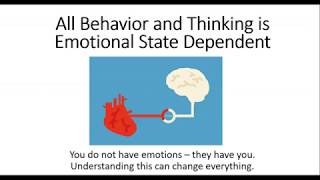
All thinking, all perception is emotional state dependent. Emotion drives thinking.
If you don't get that, just keep trying to be logical. But if you begin to get it, you go, okay.
If I start controlling the emotion, not, not, not outcome, but the emotion that engages uncertainty, I control the way I think. Yeah, now we're beginning to, now we're beginning to see it. And what you also Discover is the brain's designed to seek danger outside of the self or to attack it, when in fact the danger is inside the self. The danger is literally what emotions are you bringing in that moment to create the thinking that engages the circumstances of trading. That's really the key. Most people simply, they have no idea what they're doing. So where does it start? It starts with emotional regulation, friend. It starts with being able to calm the emotions down so that they don't hit this trip point and just race for overthinking. We do that, we train that by breathing and by muscle tension. What you discover is because the emotion is biological in nature, it does in fact have a breathing and a muscle tension signature as an element of that emotion that you can manipulate to be able to stay within certain ranges. Is that going to solve the problem? Nah, what that's going to do is it's going to put you in this situation right here. This leopard, this leopard's working. Believe it or not, that leopard's working. It's just sitting there waiting for the prey to come by. What you discover is it's not agitated, it's not got a stalking mind, it has a very calm mind. Breathing and relaxation can produce that calm mind. However, it's not going to solve the problem.
But with the emotion calmed.
The door of the mind becomes open. And what you discover there, when you open that door and get inside and develop your ability to observe, you discover that there's a lot of trash, there's a lot of junk in there and there's a lot of beliefs that you didn't even know you had. There were beliefs that your body just inculcated into the structure of the brain before you could ever even think. They were just simply there and you started thinking and they were there and they were causing you to see what you saw. In trading, you have to really go in and become a detective and really examine thought, examine belief and recognize is that you know something.
These thoughts and beliefs are killing me and I need to start tossing them away. The ones that are not good for probability management.
Not for short term survival instincts, but for probability management. Now we're getting someplace.
What you discover.
Is that mindfulness, and we teach mindfulness part of our programs. This is the transformational tool that allows you to separate identity from the beliefs that you have about yourself. Because most of those beliefs, you are not original. They were handed down from generations past. And what you're doing, you're saying you know something. The thing about trading is it's showing me whether or not my beliefs are effective or not for extracting capital out of the markets. And the grading system.
Is the trading account. It's going to tell you whether or not the beliefs are effective because ultimately you're projecting your beliefs onto the markets about your ability to manage uncertainty.
The grading card is the trading account. It's not you, it's not all the talk you do, it's the trading account. So you're there and go, wow, hmm.
Wow. I need to really take a look at this thing and be very different. I need to think differently. Because ultimately what you're doing is you're running into this brick wall of your self leaning beliefs. And as long as you continue to do that.
The markets are going to allow you to continue to do it also. This is really.
This is the real ticket. This is the trading account and not your opinion. This is literally about, wow, you know something, this is really about my capacity to manage uncertainty. It is just so reflected in my trading account. Nowhere else. I can lie to myself.
I can lie to others.
But the truth is I can't lie to my trading account. And then with mindfulness, you're also going, okay, let me take a look at the mind and what you discover that what we call the mind really is a. I like to think of it as a committee that is composed of different aspects of our being and what you'll discover. And most people have a mutiny going on.
And they had no idea. There's a bunch of rival emotional programs that kind of organize this and there's no one there really running the show. And then when you run into uncertainty with risk in a short time frame, it just all, everybody has an opinion and it just goes havoc. And you can't get everybody to talk with one another. What we want to do is get to the elements of the mind talking with one another, becoming coordinated so that they're acting in unison with one another rather than opposed to one another. This is a lot easier said than done because what you'll discover is one of the things with an untrained mind is that there's a very destructive element of the self, something that I call the inner critic. If you've ever felt judgment, if you've ever felt criticism, if you've ever felt temptation, you've experienced the inner critic living within you.
If you've ever had a bout of self doubt, if you've ever got euphoric and decided that you know how to trade and then walked off the side of the cliff, you have experienced the seduction of that inner Critic, it lives within you. But there's also another element that has, you know, there's a. There's a more powerful side that it's hard to learn how to turn on and off. The real key is.
There is an untamed internal struggle between your inner critic and this, what I would call this orphan nature. And some of you may say, huh, orphan nature. Yeah, orphan nature. What you'll discover within all of us.
It'd be nice to think that we all grew up in perfect families and everybody grew up perfectly, but the truth is we didn't. And if you grew up in a family that was okay enough, God bless you. Most of us grow up in families where what's transmitted from generation to generation is our own personal dysfunction that is revealed in trading. And in this graphic. You'll sit there and look at the inner critic. It's just whispering, whispering, whispering. And yet at the same time, what you'll notice is there is this orphan like part of ourselves that's the one that literally survived, learns how to survive from fear or aggression. And it's sitting there and it's looking for new mentors, and yet it has none. And until instead of until you learn to say, you know something, I have to build a new mind that includes elements that can re mentor this part of myself. And this is your limbic system. You want to be able to get the limbic system to begin to trust the new higher brain function. That's what we're after. And nothing else will really do because otherwise what you end up with is you end up with this internal struggle.
Who hasn't experienced the self doubt, who hasn't experienced the need to jump into trades only to discover that you're the fool? That, my friends, is the internal struggle. And you're not knowing how to use it. The key is, do you want to learn how to unhijack the mind? How to build a mind that under pressure it doesn't fall into fight flight, it stays in probability, it stays into a performance mind. Well, it can be done.
And where it really begins is that in the same way there is that criticism and judgment of the inner critic, there is that fear or aggression of the orphan. But living within you is also the discipline of a ruler. Abe Lincoln was a good example, is that, you know, the United States was literally about to fall apart and probably would have without him, but.
With him he created a bond that created a very different union. And think about, think about China, the warrior, the courage to face down your fears. Imagine the courage of that woman Facing down the tanks.
Also living within you is a caregiver that is able to nurture, that is able to self soothe the fear of this orphan nature of yours, of this limbic predisposed to fear part of yourself. But also there is something called a sage. And this is this centered thinking that can make really rational decisions. Now these are both called emotional programs because that's what they are. They're emotional programs that you can literally learn how to tap into and create the mind out of those emotional programs, out of that emotional ground, or we can call them archetypes. They're burned into your DNA. And the whole key is, is it becomes, if you're going, if you're going to produce the performance mind, you're going to learn how to produce that mind consistently, over and over again. So that what shows up under stress is something more like this. You have a ruler at the center, an eragon. And you have elements of the self. You have courage all the way around. You have the soothing. And of course you also have Gollum. You have, you have all that stuff all wrapped up into the human psyche. And what you're doing is, you're saying it's really my job to develop the mind to be able to manage the uncertainty.
Yeah, that's exactly it. Because your brain is built to avoid uncertainty, to hate, to loathe uncertainty. Yet to become a successful trader, you have to retrain that brain to be really at one ship, to be at peace with uncertainty. Because you never are going to control the outcome. But what you can control is the mind that you bring into the moment of performance. That's what the performance mind is. And a good way of looking at it is that it's not something that you just poof. If you take a look at this guy in the on deck circle, he is going through exercises that he's done since he was a little kid in Little League. He's in that batter's box. He's getting his mind right. He's watching the pitcher. He's, you know, he's getting the speed of the pitcher down and he's getting his mind ready to hit the 100 mile an hour fastball.
And he's doing it as a ritual that some people would call superstition. But the truth is, is what you're doing is he's found a way of producing a consistent mind that allows him to hit in a particular zone. Now remember in professional baseball, if you get three base hits at every 10 times at bat, you're a Hall of Famer. Fortunately, trading's a little better than that. Okay. And you're beginning to see in the same way that baseball player or concert pianist takes time to practice getting the mind right for performance.
That is exactly.
What the trader has to do also. But the right mind, the mind that can handle probability, not the mind that has to win to prove the self.
But the probability mind that just enjoys the game. That's what we're talking about here, friends. It's very powerful. We realize, wow, that's buildable. Yeah. And what's the end product?
It's really a lot like the surfer.
Do you think he controls that wave?
Not in the slightest. Do you think that he can work in concert with that wave, the power of that wave, and get one hell of a ride out of that? Absolutely. Absolutely he can. What does it require? Discipline.
Self soothing courage and clear thinking. It's the same thing. That's the kind of mind that's required for performance. Because again, what you discover is this. You are the holy grail. And what's needed is not a focus on winning or not losing, but a focus on performance.
That, my friends, you can control. You can control your performance, you can't control outcome. People like to think they can control it. They spend a lot of money trying to find ways of predicting what's going to happen. And everybody always finds themselves trying to predict, predict, predict, predict. And the moment they start predicting.
That'S when things start going downhill. No one has control over outcome. You have control over your performance.
You have control over the emotions that give rise to the mind, that engages the power of the moment. That's what you have.
And out of this.
It'S not like your dragons go away.
But you're no longer avoiding them. You have no, you have no, you no longer need to say, oh my God, I'm just going to pretend that's not there. No, what happens is you recognize this is really about emotional mastery. This is really about the empowered mind that you bring to the struggle. This is the difference maker. The uncertainty is going to always be there. Always. What changes is the mind that engages that uncertainty.
Friends. That can be taught if you're ready, if you're ready to be taught. So you get there and it's like, wow, I finally get it. I finally get it. And one of the world's better traders.
And here's this, here's this quote, you know, that's key to successful trading is emotional discipline. If it were up to smart people, you know, if it were all about smart, everybody be making money, but that's not what happens. The real truth is this is about emotional state management. This is about being able to manage the mind, manage the emotions that give rise to mind. You're never going to be able to predict the outcome. You never know what's going to happen. But what you do know is with emotional discipline, you can maintain order of the self, and you can apply religiously, the same rules again and again and again to the randomness of the markets. You know, don't fall into the idea that all these setups are good as gold and they just turn into money. No, they're a hypothesis that as you get into it, the hypothesis just may evaporate. But the thing is, if you're emotional discipline, you realize it's just a hypothesis. No one has to be right.
What you have to be is you have to be really good at minimizing loss and allowing, allowing the winners to run. That's how it works, friend. So this program that we've been talking about.
Really, truly about self mastery, emotional self mastery, and as you master the self that trades, what you also notice is those skills generalize to other areas of your life. You start noticing that you're a lot better in your relationships with people within other businesses, within a lot of different things. And you also are just simply better with yourself. You. You live in a more centered place with yourself and with the other people around you. And you begin to recognize, wow, this is pretty cool stuff. And it is. The key is.
It'S about self mastery and it's about change. It's not about staying the same. It's not about finding a secret.
It's finding out about your raw power, developing it into the skills that could be.
So how do you. How do you become this change?
Well, it starts with a couple different ways. One, if you don't know much about my work and you're just a newcomer who's just kicking tires, get my free ebook and then read all the articles that I've got on my website, watch all the videos on YouTube. There's hours and hours and hours and hours of stuff. Really get into it and really start looking it. Take. Watch more of these webinars and really start recognizing, oh, my God, why aren't people talking about this all the time? Why aren't people talking about the neurobiology of performance.
And how to get there, how to do that? I don't know. But as you do that and you've done all this reading, you've done all that, it really comes down to saying, you know something Do I really? Am I willing to risk change? Am I willing to risk capital on working with this guy? Don't know. But it's the same thing, is that it's a risk, there's probability, and I would like to think that it's a high probability. Okay. But ultimately, what we have are two routes of training. One is the group course, and that includes five meetings with me in a webinar basis that are recorded and you get copies. And basically you go to a virtual classroom and you find the materials that allow you to actually take the intellectual property I teach and start applying it and building the skills that we've been talking about that produce this stuff. And if you get in early, okay, what you also get is a free gift because I want you to get started early. Because I recognize a lot of people fall behind because they get into this material and go, my God, this guy is. He's talking about it from a totally different perspective. Of course I am. Of course I am. But there is also the individual course. And what you discover about that is it's highly comprehensive, highly personal, and we meet 10 times on Skype and we have an agenda. Both these things are agenda driven. We don't talk about what you want to talk about. We have a program to teach. It's like a graduate level course from a university. And what you do is you learn. You learn the skills necessary to be able to build the mind anew, to build the empowered mind. And to recognize is that uncertainty is not your enemy. Uncertainty, it's just simply the way it is. And learning to build a mind that engages uncertainty and can work with uncertainty. This, friends, is the big deal. So if you want to learn, I encourage you to go to our website and hit contact us, set up a free consult with me. But the thing is, Be serious. I don't really want to talk to you. If all you really want to do is talk about, yeah, yeah, yeah, man, I'm gonna do this, that the other. Blah, blah, blah. I'm interested in people who are serious about their trading, know they have a problem and are trying to solve that problem. And by the way, our. That what the. The web address should have www.my no, I've been corrected. We have, we have. My wife has changed that. So the deal is this. You've seen the tools that you need. You see the problem. My question is, what do you want to do about it? And I'm okay if you do nothing. Your trading account will constantly give you feedback about whether or not that's a good Decision or not.
What I do ask you is this, is that as you're, as you're saying you know something, I'm going to become a student of trading. What do I need to do in order to become successful at it? Start there and start asking your trading account because it's going to reveal the beliefs that you're really projecting onto the market, friends. That's the big deal. So we've just got a few minutes left. Do you have any questions of me that I can answer in the next couple minutes? I'd be happy to. And were there any questions, just type them in and we'll, we'll be ready to go and I'll, I'll answer a few and we'll see what we got. So. And I'll try to get closer so that I can actually see this. One of those things about growing older, you just can't. Your eyes just don't quite work as well as they used to.
Will this be recorded? Yes, it's going to be recorded.
And you'll be getting a link tomorrow to be able to get, get into it and really study it.
Okay. In my, in the corner of, oh, I wear a chest strap. Hot monitor, live stream it to my computer. In the corner of my trading platform. This helps me.
This helps me to know. Absolutely. Rob. I.
I actually teach that later in my course where the chest strap is, is accurate enough to be able to really see the, the start of an emotion. And I also use, I use some apps that allow you to keep it within certain ranges so that you, you, you basically find a performance mode. Okay.
No, it's not going to solve problem with getting hijacked. No, it's because you're talking about physiology versus versus belief. You know, ultimately you can regulate emotion all you want, but if you want to change the hijacking, you have to get at the belief that is engaging uncertainty. And what you're saying is the belief that it's engaging uncertainty gets there and it gets hijacked because it doesn't believe it can handle whatever is going on. But the, in the way I use the strap and stuff like that, you know, you're using it to actually find out where the emotion emerges. Okay. And then what you're doing is you're going in. And by the way, just for you, okay, Steve, is an emotion is composed of arousal. That's when you feel the building up. That's when you see, that's when you see the heart rate rise. The feeling. That's when you actually, that's when that's when there's a switch that's turned on and the feeling has taken over mind and literally.
It'S gone then. But there's also another element of an emotion called belief.
And ultimately, what you have to do is you have to be able to get down to the belief about your ability to manage uncertainty.
That's what has to change.
The. The. The strap is simply going to help you isolate and say, well, okay, this is the range that I can trade in. Or it's going to be able to show you where. Where the emotion actually triggers. That's the way I use it. Okay. But it does not change the belief behind the performance of hijack. That's the piece you have to get. And if it were so easy, everybody would just put on a chest strap and everybody would go to town and have a good time. But that's what you're missing. You're missing the technology of being able to go in and get at the belief system itself that is producing the performance. Because understand this is what you're really doing, is that when you're finding that hijacking your limbic system, your emotional brain is deciding that you can't think yourself through this, and it's going to fight flight, and it's going to either run, hide, or it's. Or it's going to attack. That's what it's doing. That's what you're calling that. And at the bottom of that is that traffic cop that we talked about earlier. And you have to get at the beliefs that it has about your ability to perform in the face of uncertainty. That's the deal. And I can help you do that. Okay. Okay. I don't think there's any more. Well, friends, I've had a great time. I love talking about this. I love educating people. And if I can help you, I would love to try. Okay. And it's something where you just simply need to come to a moment where you're looking at your trading account and you decide that, do I really want to. Do I really want to become. Do I want to reorganize the potential of who I am as a human being so that I begin to build a probability mind? Because the mind that wants to know with certainty, it's just going to keep messing you up, man. So anyway, friends, I wish you the best, and if I can help you, I would be delighted to help. So until next time, friends, take care and have a great one.









