Mastering the Self-Doubt of Facing Uncertainty
Randy Howell explains how traders can separate self-worth from trading performance, using frameworks from mythology and psychology. He identifies the inner critic as a prosecuting attorney that conflates wins and losses with personal value, then outlines five steps to build confidence: acknowledge the destructive voice, regulate emotions, practice mindfulness, claim inherent worth, and activate four heroic archetypes like discipline and courage.
Chapters
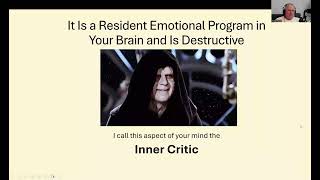
Welcome everyone. My name is Randy Howell with Traders State of Mind. And before we even get any further, I want to make sure that you guys can hear me. If some kind soul would please just type in a why into the question box, I would greatly appreciate it. Okay. Otherwise, I would hate to be sitting here talking and nobody's there. Okay. So what do we got? Yep. Yay. It works. It works. It works. Good night for us. Okay. And the only other piece of housekeeping would be that what I want you to do is to please, to please write questions as we go along in my presentation. I tend to hold them until the end, but what happens is that when you can go, if you can just simply write the questions in, we'll have stuff to do before we get there. There, we did it. This is our third time on this new system, so we're still getting a few of the kinks out. So yeah, you can see me though. That's right. That's right. So what we're here to do here today is we really want to take a look at this thing and say, you know something, nobody likes to acknowledge it, but a lot of traders find themselves having doubt. And what we want to really want to do is to take a look at that self-doubt and to say, how on earth do we go about Managing self-doubt so that it disappears and a very confident self shows up to engage the uncertainty rather than the, the fearful part of the self, the anxious part of the self engaging that uncertainty from a position of scared money. So without further ado, let's start. Have you possibly ever had this happen to you? Why on earth do I get into these things? And all of a sudden what happens is I start over and before I know it, I'm in self-sabotage again. I think I'm doing right. Everything's under stuff. I'm under pressure. And all of a sudden I violated my rules, all that stuff. And all of a sudden, all that, all that knowledge that you have of trading is inaccessible by the thinking brain. It's wiped out. And suddenly this emotional brain has shown up, your caveman type brain. And it's taken over and just doing things that are so totally out of line with what your trading plan was. The truth is, is that is very common. And what we want to do is to ask the question, what really just happened? Okay, because you'd think that we're all smart people here. That may be true, but the point is that this isn't really about smart knowledge. This is really about emotional knowledge, emotional skill sets that you can apply because ultimately at the very bottom of it, all thinking is emotional state dependent. And what we want to do is to be able to create a particular emotional cocktail that produces a mind that is comfortable with uncertainty. And you think about it, boy, you know something, If everybody could do that, there'd be people, a lot of people making money. They're not, but we're actually going to see tonight what you can do to build that mind. That's what we're out to do. Start with, let's talk about saboteur. Okay. I don't— and saboteur, the saboteur is one of the most powerful forces that a trader has to be able to combat. And it's that it. It's that which stops you from becoming the disciplined, the patient, the impartial trader that you know you could be. And what's weird, it's just when you think you've got it all together, sabotage happens. And that sabotage happens in one of two forms. One is you start winning, you start having good days, you start having good months, and all of a sudden you go, you know, I've got it, I've got it. Yeah, yeah, yeah. I know. I know how to do this. That is the kiss of death because when you're saying that and you're beginning to feel good, what you're actually doing is you are hitting the dopamine button, the neurotransmitter dopamine. You're rewarding yourself, which you, from an old caveman perspective, should be because you want to cement this problem that now knows how to trade. The problem is, is that it's fixed on dopamine, which is something— is something like cocaine, a lot like cocaine. And I hope the dickens that you would not be snorting cocaine in trying to trade too, because it's going to put you in a place where your mind is incapable. You know, you're euphoric, you think you've got it made, you think the good times are going to roll on, and that's what blows you up. You get out of the mind that actually was producing the good trading. The second path for sabotage is you start winning, you put the good weeks, the good days, the good months together, and you start thinking, it's just going too good, it's going too good, there's something wrong here, something's bad gonna happen because something, something is going to happen. So what happens is, you can see it right there, you actually talk yourself into blowing yourself up. Those are the two paths. One is euphoria, the other is the self-doubt, or, oh my God, it's going too good, something's going to have to come down. So now we see the saboteur. Let's go back here. And the truth is, this saboteur is rooted in a voice in your head, and you might think it's greed. It's called— it's called, you know, something— what do you want to do? The same thing that this guy's doing right here. Everybody in trading, what they want to do is they want to make money. They want to win today. And what they don't realize is they're not in control of winning. They're not in control of outcome. And when you start setting yourself up thinking, I'm gonna be— I'm a winner, I'm a winner, I'm gonna— I'm a disciplined— I'm gonna win, I'm gonna make money today. The moment you do that, what you're doing is you're actually now saying you're going to be able to do something that you in fact cannot control. But that voice in the head wants to believe that you can prove yourself by the show of force, by winning, and by proving yourself you matter. Friends, I do not have a business if, if it weren't for a bunch of traders trying to prove themselves, trying to prove that they matter, trying to prove that they're powerful, trying to prove they're lovable. Okay, and it's all being driven by this voice in your head, and we're going to learn more about that voice in your head a little later on. But first, what I want you to grasp is that in your trading, there is both destructive and constructive parts of yourself. Now, that destructive part of the self, in the Jungian architecture that I use, I often call Destroyer. And the constructive part is this other part of the self that maintains its cool and can actually work together and work with the— and work with the whole notion of probability. And by the way, we were recently on the Big Island of Hawaii, and we actually we were in the middle of an eruption. And the deal is that we actually started having stuff fall all around us that had been shot up by this volcano, 5,000 and 10,000 feet in the air, and it was coming down. And that's when we decided we needed to get in our car and leave the park because it was getting dangerous. So, and the deal is this destructive and constructive parts of the self are just simply part of humanness, and there's something that you're going to have to learn to deal with and work with. And we want to take a deep look at this. For instance, when we look at this destructiveness, what I want to do is I want to show you some different ways it can be done. And here from Star Wars, what you're looking for— this is what we would call the inner critic. It is the part that criticizes you. It's the part that judges you. It's the part that tempts you. It's the part that just sets you up for failure. Okay, do you know that part? Anytime you have had self-doubt, anytime that you have gotten the big head and jumped into a trade wanting to prove yourself, wanting to think, I can do this, you have experienced that inner critic. Now, it doesn't have to necessarily look like this, but he's a good one, you know, he is. Now here's the one, one of my favorites though. This is actually from the work of Stanley Milgram. And Stanley Milgram, at the end of World War II, was, uh, at the Nuremberg Trials where the Nazis were being tried for war criminal— war crimes. And he sat there and watched them, and every time the prosecutor would ask a different Nazi why he did it, And some of these guys had killed 10,000 people, okay? To a man, they sat there and said, "Because I was told to." And he said to himself, "That's impossible. There can't— you can't go that low." And so what he did as a good scientist— he was a social scientist at Harvard— he started setting up a series of experiments where— this is what I'm going to talk about— was UCLA. Where he recruited college kids to become guards in a prison system. Okay. And those guards were instructed that you're going to be— we're going to be training these prisoners to obey requests and we're going to use a noxious stimuli, an electrical shock, to be able to, to be able to get them to experience a negative consequence of lying or not doing what they were told. And there— in that way, they were going to train them to be cooperative. And you're actually looking at the actual setup of one of these, uh, one of these, one of these tests that they did, these psychological experiments. So then they recruited, uh, they recruited graduate students in psychology to be the prisoners. And what they told the prisoners is this: these guys think that they're going to be shocking you, but the truth is, is they're not. They don't— they're not going to shock you at all, but you're going to pretend you are being shocked. And besides that, what happens is that they think that they can see through that one-way mirror that you're looking at right there and that you can't see them. But the truth is, is you're going to be able to see them, and they're going to be trying to train you to be able to be compliant with requests, but you are not going to be trained. And the more, the more they up the voltage, the more you're going to pretend you're being electrocuted. Well, they set this up for 2 weeks at Christmas time at UCLA so that they had enough time to really work with this thing and see what would— see how this would evolve. The truth is, is they shut it down in 3 days. The reason they did it was very simple, is that 66% of the men— and remember, these are college students that had been recruited to pretend they're, they're, uh, prison guards— knowingly, willingly, voluntarily shocked somebody, electrocuted somebody to the point where they died. They would even have them— and understand, they can see this going on, they can look through those windows and they can see this going on— and then they would see like people with gurneys coming into the rooms, putting those people who had died and taking them in, taking them out. Now, nobody got hurt physically, okay? But they stopped it because 66% of the men actually knowingly, willingly kill somebody, and 24% of the women, okay? And it blew them away. And there are lots of lawsuits and a lot of things that like happened out of here. And ultimately what they began to realize that it was actually quite easy to shift a crowd into a mob. The Nazis had done it, and if you look at the United States right now, it's being done now. It's called propaganda. They kept being told what to do, and finally they started doing it, and they fell into it. And then they— then there was a person in there just simply saying, shock him more. And that's how it happened. So that's where they discovered is this deeply dangerous, um, dangerous destructive potential lives in all of us. And it just so happens when you're facing uncertainty and you don't, and you get kind of flipped out, it's easy to plug into that destructiveness because you're trying to figure out, you know, you're trying to save yourself, trying to kill somebody, the saber-tooth tiger, the taking all your money, all that. So then let's— another culture, we go to ancient China 3,500 years ago. They invent the concept of yin yang, of where destruction and construction coexist with one another. Okay, they already acknowledging that it's a part of the human condition, and what they're saying is that they're just simply parts simply different parts of the self. And the, the common way of explaining this is, um, the old story is, is that a farmer has a son the first time out, okay? And the villagers come out to congratulate him for having a son, and everything's really great, everything's moving along fine. And he goes, maybe, maybe not. Then years later, that boy breaks his leg and has a limp. And then all these villagers come out and say, oh, what a horrible thing has happened to you, you know. Oh, whoa, whoa, whoa. And he says, maybe, maybe not. A number of years later, the emperor comes conscripting men to become soldiers in a war. He, the son, could not be chosen because he had a limp. And so the, the people came out and said, oh, you're so lucky, your providence has smiled upon you, all this kind of stuff. And he said, maybe, maybe not. So I want you to see from the Chinese perspective, it was like destruction and construction coexist together, okay? For one to happen, the other also has to happen. So, okay, we've been building it. So we've seen how science kind of looked at it. We've seen how the ancient Chinese looked at this problem. And then the Hindus— what happens, the Hindus create a three-headed god, okay? One of those heads is creation, okay? The second of those heads is sustaining. The third of those heads is destructiveness. So you're beginning to see in the way they talked about the way they created their god, all three of these elements are there. But what you notice, create construction and destructiveness again were part of the fabric of life. Okay, they're just the way they saw it. Now, this is my most interested— and by the way, I'm hoping you're taking a good look at this because it is really important to really understand this highly negative destructive force in your head because it's not going to go away. You're going to have to learn to master it. Now, in the Cherokee Nation and the Cherokee Native Americans of the United— southeastern United States, understand, these people were smart. They had representative government. They had a really cool lifestyle. And when Europeans first came, the Cherokee recognized that they were going to have to change their ways. They were going to have to adapt because this was a lot bigger than what they had ever seen. They became artisans. They became goldsmiths. They became other business people, and they also became plantation owners. They owned slaves, which got them in trouble today, okay? But the thing is, is they, they knew how to adapt. It was very different than a lot of the other Native Americans. Yet at the same time, when gold was found on their lands, they got taken to Oklahoma and deposited, and they're back. They own casinos now, and they have finally figured out how to get white men back. So, but the point is is that in their spiritual philosophy, the Cherokee believed that man's mind was composed of two wolves. There was a light constructive wolf. There was a dark destructive wolf. The Cherokee also believed that those two wolves were fighting to end up controlling the man. They also believed that the wolf that won was the wolf that the man fed. The Cherokee put self-responsibility on the individual for the destiny of his life. And this is something that I want you to see is the destructiveness is not going to go away. But what I also want you to recognize is there is an empowered part of the self that is just as valid, and you're going to have to learn to awaken that while being exposed to the destructiveness of the force. Because if you've never noticed, you know, even the perfectionist has a problem, is that the perfectionist doesn't want to make a mistake so that it won't be wrong. Yet they get into trading and they discover that you can do everything right and still be wrong. Now, also a part I use is the Aramaic notion of Satan. Okay, what I want you to do is to imagine for a moment— these are also embedded in the Abrahamic religions, that would be Islam, Christianity, and Judaism. And those, in those religions, is this concept of Satan. And usually when I say Satan to a group, you know, they conjure up devils, they conjure up all sorts things and all this stuff. However, if you and I were to go into a time machine and go back 3,000, 4,000 years ago when Aramaic culture was the language and culture of the Middle East, and we were hearing these people talking about Sadat, Santana, Satan, and we confused by it, and we went up to him and said, can you translate that word Satan into modern English that we can understand. How do you think they would translate the word Satan into modern English? It's really tricky. Here's the way they would translate it. They would translate Satan as prosecuting attorney. No horns, no red, none of that. Prosecuting attorney. And I have a few questions, and I'm going to be directly asking him about the United States, because in some, in some countries apparently they, they're more altruistic and stuff like that. But in America, does the prosecuting attorney want justice, the truth, or does he want conviction? He wants conviction. Okay, you might say right now you're looking at this woman in this graphic and everybody pointing their fingers and she's being convicted at that moment. Now, in order to get that conviction, will they lie? Absolutely. There are so many cases where the prosecuting attorneys have lied that people get free out of these things. They get put in jail for years and years and years, and they found out that the prosecuting attorneys had withheld that withheld information that would have made a very different case. Will they deceive? Yeah, that's prosecuting attorney's job. Will they set you up for failure? Yeah, I used to have a friend who has now passed along who was the senior attorney for the state of Alabama, and he said, Randy, a prosecuting attorney is only going to ask a question that he already knows the answer to. And at the end of those questions that he asks is conviction. So you're beginning to see they're in the game to convict. They're not in the game to find justice. They're not in the game to find truth. They're in the game to find conviction. And what you're looking at right here is that comes out of a notion that was embedded into the Aramaic religions. Okay, yet at the same time, if you, if you get past the modern notion of Satan and start saying, I begin to see how they as a culture saw it, and it was really a lot more about prosecuting attorney. Yeah. And what I want you to grasp is that as a human being and as a trader, you're going to have an active prosecuting attorney inside your head whether or not you like it or not. It's like the Security Council of the United Nations is going to have Russia and China in the Security Council, okay? It's part of the programming. The deal is, how do you go about working with that? And this is a very powerful notion of when you're actually recognizing that as part of the human condition There is both destruction and construction going on. We don't like that sense of destructiveness, so we ignore it. We pretend it's not there. We blind ourselves to it. And yet at the same time, until you recognize that you are here to master that, you are going to be stuck with a very bad problem if you try to keep destructiveness out of the picture and not learn to, to work with it in a powerful way. And that inner critic, that's what I call the prosecuting attorney. The inner critic will always associate your trading performances with your worth as a human being. You know, here's this guy just made a winning goal, and it's— he feels he's being— the cheers are there, all that stuff. He's being told he's inherently very worthy, he's very powerful, he has done this. He would also make a terrible trader. Okay, the truth is, it's winning and losing become the measure of your value. I'm gonna make some money today. I hate losing. And the truth is, is if you're going to be a really good trader, a profitable trader, you're going to have to like losing. It's part of saving your capital. Losing is part of the game, and The way you believe about, I don't want to lose, I hate losing. And to be honest with you, losing is only landing on the wrong side of probability. Winning, by the way, to a really professional trader, is only landing on the right side of probability relative to you. That's all it is. And you don't think about winning and losing and making money The truth is, is what you are, is that your performance and worth are not the same. In my work, and particularly in the group course, you're learning about yourself as inherent worth beneath everything. That no matter how you perform, that's about your adequacy. That's about your skill sets. And that can be taught. You can learn, you can learn better tools, you can learn better psychological tools. But the thing is, it's not about winning and losing. It's about performing in the right state of mind. And what we're here to do is say, okay, I know that this is a game of probability. I know that this is— it's not about, you know, me by will, by sheer brute force, by persistency, by hard work, that I become a winner. No, this is about you recognizing that what you really control is the mind that you bring to the game. That allows you to build the emotional programs that give rise to the mind, and it is that mind that manages the uncertainty. And it's not natural. It's not going to be— your ancient caveman brain looks at uncertainty as a dangerous thing. It wants to avoid it either by aggression or by fleeing. It can't be avoided in trading. You have to deal with it. So you're looking at it going, oh man. And this right here is the success formula of today. You know, the thing is, is that you keep trying, you keep trying, you keep trying, you keep trying, you keep trying. You might fail, you might fail, you might fail, but you keep trying, you keep trying, you keep trying, and you find success. What my promise is, this way that everybody tries to see the success story doesn't work in trading. Trading isn't about trying hard, it's about patiently waiting for the markets to give you something. You're not trying, you're not forcing the issue. And when you take a failure, it's really, what can I learn from that? Because ultimately what you learn is that your brain does not learn from success. That locks in pattern. The brain learns when it experiences failure. Okay? And in that, you're going, how do I learn from this failure? Or as Ray Kroc, the founder of McDonald's, said, I failed my way to success. So the deal is, is that this inherent worth is beyond winning and losing. But for many It becomes the measure of their mattering, their worth, their adequacy, even their lovableness. Okay, this is the way the inner critic attacks. And the truth is, is, friends, if it weren't for men in their 40s, 50s, 60s, and 70s who are still trying to prove to someone that they matter, I don't have a business. And we have a great business, but the deal is most men are still trying to get the admiration, the approval of their dad, but the dad ended up with a, um, you know, something, it was, you, it was, it was a contract. You had to do something. It wasn't, you know, that love was just not available all the time. It was conditional. So you begin to see is that there's a lot that I'm going to have to rebuild in my mind to be able to handle probability. So the truth is, is that, um, the idea of I need to be in control— the truth is, is you are not in control of outcome. You are in control of the quality of the mind that you bring, bring to the management of uncertainty. That's what you control. That is when you recognize that your beliefs are reflected in your trading account about your ability to manage uncertainty. If you are extracting more capital out of the markets than you're putting back in, you have a more effective belief system for managing uncertainty. If you are— if, if you are giving back more money than you take out you are not having the effective beliefs that are required to be able to deal with the management of uncertainty. And a lot of it is, I'm not good enough, I'm a failure if people actually knew me. So this is what you're going to have to learn to deal with. And the truth is, the trading account is not going to let you lie to yourself anymore. You have to actually develop the courage of a warrior to look at that part of yourself that you don't really want to see yourself, but you know, you have to heal, you have to fix. And the truth is, if you begin to grasp the notion of inherent worth, you realize that these are lies. These are lies from that highly destructive part of the self, prosecuting attorney, the inner critic. You need to get it. That part of you really does exist as an emotional program in your brain. So here's the good news and the bad news about trading. The truth is, is that your performance in trading are not going to be dissimilar to the problems you have in your regular life. The difference in your regular life, you can make up excuses and so— and alibis that supports whatever your emotional brain has already decided. Like, for instance, my dad, my dad smoked Camel unfiltered cigarettes for 52 years. Okay, then one day he go, and people kept saying, Howard, you know, you really ought to quit doing that. That's gonna at least put a filter on it, man. And he said, it's not bothering me, I'm good. And finally the doctor sat down with him and said, Mr. Howell, You need to get your affairs in order, okay? Because there's nothing we can do now. We can slow it down, but it's there. And my dad got really religious about stopping, and he, you know, but he had— he, he could not convert. He could not extract oxygen out of the air that he was breathing. So he was— yeah, he— that's the way it happened. He refused to see that In the same way that a lot of people refuse to see what's causing them problems in trading, it will be at the level of belief, okay? Not just emotions, but at the level— because the belief is part of your emotional nature. So what we're asking you to do is recognize that you can't hide from your beliefs like you can in the other part of your life. Your trading is just going to show you what beliefs are going to work or not, okay? And you're going to have to do it. And what I want to do is let you know that this is not rocket science. And I, I don't know, I'm hoping that people get this. Um, I'm showing you the problem that you are going to have to solve if you're going to become a successful trader, okay? The first thing is that the self-limiting beliefs that I commonly see are 5. The one is powerlessness, is I really don't have the power to do this. I don't really matter. I don't really have worth, you know. I— my, my net worth is tied up with my self-worth, and my self-worth, you know, I, I'm just not worth— I don't deserve to win. Adequacy, I'm not good enough. And also lovable-ness, believe it or not, is, uh, I have a friend, Doris and I have a friend that is one of the more successful traders today. He's, he's made well in excess of $200 million in the last several years. And I asked him, I said, you know, when, when did you learn how to be able to separate this stuff? Because I've seen him lose a lot of money in a trade and not even bat an eye, just moves on. Okay. He says, oh, Randy, I know exactly when it happened. It happened when I was still a successful trader, but not anything like I am now. And that day I lost 3/4 of a million dollars in 30 or 40 minutes. And it shocked me. And once it had all happened, I thought, oh my God, what am I gonna do? 'Cause that was a lot of money to he and his wife at that time. Then he started making up all sorts of ways of keeping it from her, lying to her and stuff like that. But, but he finally came to the moment of recognizing he had to tell his wife. So his wife got home from work, sat her down and told him, told her the truth. And he was waiting, er, waiting for the talk of divorce, waiting for, you know, just the yelling, the screaming. She didn't do any of that. She got up, she walked over to him, held him, and they cried together for 15 or 20 minutes. And he says, Randy, out of that, what I got, that come win or lose, I'm loved. And that's a big driver with this guy. He says, I know that I'm lovable now. I know that I'm loved, and that allows me to just trade, because come win or lose, I'm still loved. I've got I've got that. So the thing is, is what, um, none of these beliefs are true, but you believe they're true. And by believing they're true, you build a certain certainty about it. You feel certain that this is true when in fact it's just a belief, an assessment that's gotten hardwired And it's creating your world. What I'm asking is that in this course we're talking about, you will be learning how to establish very— not beliefs like I'm talking about, I believe I'm a disciplined trader. No, you're going to learn how to change belief at a cellular level. You're going to learn how to do that and begin to develop much more powerful beliefs about your— and starting with inherent worth. And the truth is inherent worth is always there. You are inherently worthy. It's the way our species— we're social mammalians. Everybody contributed their talents to the survival of, of that group. That's where the original stuff comes. It may get spiritual, but the original inherent worth comes from biological survival. So what we want to do is, how do you go about changing a self-limiting belief that holds you back? The very first and most important thing to do is for you to acknowledge that it's there. Oh, many of the traders that I work with initially are not acknowledging it's there because they don't think that's manly of them or, or womanly of them. They don't want to acknowledge that part of themselves. They don't want to believe that, oh my God, I, I don't want to see that. So if I ignore it, it doesn't exist. And then it keeps showing up in their performances and their— and causes them to no longer be able to trade effectively. Okay, so we want to look at the false beliefs that drive the way we work with uncertainty. The second thing that has to be done is you have to develop emotional regulation. You have to be able to recognize that your breathing and the muscle tension you hold in your body are actually part of an emotion. Okay. And when you're feeling an emotion in the body, you're actually saying, oh my God, I realize the emotion is triggered. It is building up and it's about to hit a flip switch where the chemistry of that emotion is going to go to my brain and my body, and it's going to take out my thinking brain. That is the value of emotional regulation. Okay, but understand this: if you grasp that an emotion is probably not what you think it is— an emotion actually is considered in neuroscience to be a biological action potential. It's not emotional, it's a biological action potential that triggers automatically to manage the relationship between trader and market between animal and environment. That's what they are. They're lightning fast. They working on instinct. They're not working on thinking. And that's why you keep missing them because you're not looking for the instinct. You have to be honest with yourself and look for that. So that second thing you have to, and by the way, emotional regulation is not going to be the game changer. However, if you cannot manage the intensity of an emotion, you're never going to get to the mind where it gets very interesting. Okay. So then, then the third thing is you have to develop, and by the way, that's me. If anybody wants to know what I look like, if— Well, they can see you now. Oh, they can see me now. That's right. That's me though. The thing is, the third thing is you have to develop mindfulness. You have to develop the concept that you and your thoughts, you and your beliefs are not the same. You are not having thoughts. You are not having beliefs. They're having you. They're creating your experience. All your thinking brain really does is make up a good story, a fiction, an alibi for what the emotional brain already believes. That's how powerful emotions are, friends. You— the only time you don't have them It's when you're dead. So we don't want that, but we do want to teach you how to build different emotional responses to uncertainty than the ones that are programmed by your evolutionary psychology and your family of origin. That's what we want to do. Next thing. Um, this comes from a concept of monkey mind from the Eastern Eastern philosophies. The deal is, is you're going to learn how to deal with this inner critic and with these voices running around in your head just trying to get you to the point where you don't have confidence in yourself and stuff like that. The thing is, is you're going, you're going to learn that you're not all that, and that you can, by your breathing, by, by sitting there and actually saying, you know something, I can bring forward an empowered nature that allows me to deal with this stuff in a much more powerful way. And I'll be honest with you, and that's me again, and I can be honest with you, I have voices like that in my head too. I have torrents of them that I recognize that can pull me down and take me out of the mind that I need to be in. And I have trained myself in the very techniques that we teach in the group course to be able to manage that monkey mind so that I can, I can decide who runs the committee of the mind. It's a powerful thing. And out of that, and the fifth thing is you actually have to going to claim your inherent worth as the ground of your identity. In this particular case, by the way, that is my granddaughter and my daughter. And one of the things that's special about my daughter, my granddaughter, is that I learned that my daughter was pregnant with her when I was dying. When I was in the hospital, they didn't know what the heck was going to happen. And when I found out that my daughter is pregnant, I just said, I've got to live. I've got to see my granddaughter. Understand, she was so inherently worthy, even when she wasn't you know, born, that I rearranged my psychology to say, I am going to live to be able to see her. That is the power of inherent worth. And the thing is, is that lives within all of us. Most of us get it trampled a little bit. Most of us, um, don't know how to find that inherently worthy part of myself. Happens all the time. So the 6th thing, you're actually going to awaken, you learn how to awaken those empowered heroic parts of the self. And my work, what you're going to be doing, now understand you've already awoken this inherent worth part, you begin to notice about that orphan nature of yours that really needs to be reparented, that really needs to be mentored. You've also learned about the inner critic, all this stuff that you should have known by the time you got out of high school or out of college. This should have been taught— from my standpoint, should have been taught for you so you wouldn't have to be at this webinar tonight. But here we are. The deal is, The Lord of the Rings is the most archetypal movie that I have ever seen in my life. And in it, what you're discovering is that in order to be able to defeat Gollum, that evil. What happened is a group of people had to come together with special talents. There's Aragorn, and what happened is he is the ruler. He is the one that maintains order. There is also Gandalf, the one that gives wisdom, okay, and magic. There also are— you'll see, you'll see people who are compassionate, can love and can show the concern and love that's necessary. You can also see that you have to become an incredible warrior to be able to face the demons in you, to be able to face those fears. And Frodo is a very good example of all of them happening at one time because he's got the ring that corrupts, and under— Gollum got corrupted by the, uh, ring that he wants it. He doesn't want to throw it back into the hell that it came from. And it's Sam that helps him through that. So everybody, even though these forces are there, you really need— you have to have that deep compassion to be able to drive it. But this is the mind right here, rooted in discipline of a ruler, rooted in the courage of a warrior, rooted in the loving kindness of a caregiver. And rooted in the crystal clear thinking of a sage. This is the mind from the emotional programs that can deal with the uncertainty of the markets. The deal is the talents are there. They're part of just simply part of the genome and just the human condition. They were developed even before we were mammals. At the same time, what happens is most people have to develop them if they're going to become successful traders. Otherwise, they rush into things and get slaughtered. They get fearful, they don't do things, or they just get taken over and become, um, people that just do unkind things. But this can be learned. This, this is all there. And the deal is, the final thing that you learn in my work is that The destructiveness is not going to go away, but you're going to develop yourself into the human being that can stand to your fears and to recognize that your fears can never really overtake you. The demons in there only have the power that you give them. That's what you learned about the inner critic. The only power that it has is the power that you give it. You're the one that falls for the stupid lies. You're the ones that jumps into trades. You're the one that revenge trades. You're the one that overtrades. You're the one that doesn't get into trades. And what happens is, this is a whole course about not controlling outcome, but controlling the mind that you bring to the game, the mind you bring to performance, the mind that you bring to your psychological edge that drives your method edge. This, friends, can be taught. And what most people discover is that it's— it moves far beyond trading. Most people discover this kind of work prepares them to live a much bolder, a much more holistic, more powerful life. They get along with their spouses better. They get along with business partners better. They get along and they do better in tennis. They do better in golf. All over the place. Their lives improve because what they're doing— they're no longer stuck to the historical organization of the self that you got born into. They have learned that you are captain of your own destiny. You can build the mind that engages life in a new, powerful way. And the reason I can say this with such authority is I have done this. I'm supposed to be dead. I went to China, thought I was making a lot of money, and ended up breathing their air and getting really sick to the point where a year later I have a pacemaker. Two years later, I'm in heart failure. My heart is turning to leather. We spent two years with me basically sitting on the edge of death. I got to know death really well.. And I can tell you that in facing it, I came to recognize that it's actually a really good partner because you cut out all the BS and you say, what really matters here? Like, is my daughter, my granddaughter, my wife, my family, the things that are really, really important, my relationship with a greater whole. Okay. So that's the deal. It's you really learn how to manage yourself, how to create a self that can gauge the challenges of living. That's what we're out to do. And the truth is, there's always going to be challenges. You know, you look at a baseball player, if he gets 3 hits, 3 on bases a game out of 10, he ends up in Cooperstown, he ends up in the Hall of Fame. 3 out of 10. It's the same thing with trading. It's what happens is you learn to build yourself to be able to deal with the uncertainty, and losing is part of that. Striking out is part of that. Hitting home runs is part of that. All that is there. But again, when it comes down to it, you're in control of the mind that you bring to trading. A baseball player, you know, he's sitting there And he knows that he can be, be a .300 hitter. He just doesn't know when it's going to happen. Sometimes he wins, sometimes he loses, sometimes he's walked, whatever. But the deal is he develops the mind that can hit that ball with regularity. That's what he does. Now, the truth is, is, um, what I have finally come to understand is that most people are never going to do anything. They're going to wait, and they're going to imagine that they're going to, by their persistence, by their hard work, they're going to conquer trading. And I wish them well, I really do. I know that only about 2.5% of people who actually take up trading become consistently profitable traders that are building wealth, okay? And the deal is, until you get your emotional nature working for you, your thinking brain is going to have a very difficult time. And I have an offer for you, is that we have an upcoming group course. It's 5 group sessions with me. I'm the one who does the teaching. And it's on Thinkific. It's really a really nice program. It has a virtual classroom that Tons of materials. You get all, that's where the materials are. The, it's, it's accessible 24/7, all that stuff. And the deal is, there's the schedule and for more right there where it says for the schedule and more information. This is something that if you, I guess in the next 2 days, if you were to say, I'm gonna do this because I realize that, you know, Randy's actually telling me the truth, whether I'm willing to listen. Is another thing, is that if you sign up in the next 2 days, we're going to give you something we sell for $200. It is an emotional regulation course that is a recording that we've done that people use to train themselves for breathing and doing that whole thing. We're doing that to get you started because this thing really requires you practice. You know, just reading it a few times is not going to do it. That's just knowledge. We want you to practice it so that you get it into your very bones. And we want you prepared when you show up. So check it out. Okay. If, and if you're not ready for that, get the free book. But the thing is really begin to look around, go to my, go to my YouTube thing and start really looking and saying, does Randy make sense? Is he telling me something I really need to hear? Because ultimately what I'm doing is I'm talking about the emotional intelligence of building a mind so that you can do something that your brain was not built to do. And that you're going to have to consciously in awareness, know how to build that mind to be able to engage the uncertainty. Okay. So I invite you to that. Okay. And I want to thank you for being here. And if you have questions, type them in, okay? Uh, and I will answer them live. But, um, let's see, I don't see any questions, and I, I'd hope that you— ah, look at this! Okay, this is Fabian. Just to be clear, there is no one way to turn off those emotional triggers, but instead we must learn to calm emotion and remain partial to the strategy at hand. More than that, Fabian, you have to disrupt the emotional program. That can be done. That's called thought stopping. You then have to say, this is— these are the emotional programs that have created the mind that I currently bring to trading. You just don't calm them down. You have to decide that you need to have the discipline. You need to be able to create that discipline. You have to create the courage. And I do it through memory work, where you go in and you access through memory moments where you were there. It really happened, but what you're doing is you're manufacturing the emotional mind that engages that uncertainty. That's the real deal. Okay, let's see, is there anything else? Okay, this is Felipe. How do you deal with a moment when you are doing well in trading with your emotions balanced, but there is still that inner voice whispering that at any time you could sabotage yourself. This is an example of sabotage. What happens is that what you're basically saying in the lingo that I speak is that the inner critic has entered the committee of the mind and you have not developed the other, these other internal resources, the ruler, the warrior, the caregiver, and the sage. And what happens is that inner critic has full access to your orphan nature. That's the one that has fear. That's that caveman brain. And what you're learning to do, you're a perfect candidate of why this course is here, is that I'm teaching emotional intelligence that allows you to say the uncertainty's there. The uncertainty does not have to trigger my ancient instinctual survival instincts. What I can do is I can practice with this work, and I can bring a mind that is rooted in discipline, rooted in courage, rooted in self-calming, so that I have a patient mind and can think, and can think clearly. That's what you have to do, and that's actually the answer. Is that the first thing you do is you start, and in my case, you learn how to see a stop sign, flash, flash, flash in your mind. Then air to belly, you pull forward, you're calming, then you're draining the tension out of your body, and then you pull up this empowered mind. And what happens is that mind will have very different things to do. The ruler's job, that discipline, is to maintain order of the integrity of the group. The courage is there to face your fears, to act. Okay. The loving kindness, the caregiver is there to produce a patient mind to calm down fear. When you do those three things, what shows up is this incredible part of the self called sage. That's the clarity of thought. Right now you're being hijacked early on. And what you're talking about is exactly what I teach people to do. How do you interrupt that? I build the tools that allow you to do that. I hope that's a good enough answer for you. Okay. And I'm going to, whoops, go the other way. No, that's it. Let's see. Just to be clear. Well, I don't know. Somebody might've started talking up here. That's it. Okay. Well, we've gotten the questions answered and my, my, my, my hope for you is this. My hope is you have a great life. Okay. My hope is that forever and ever that you learn to recognize that you are creating your reality based on the observer that you currently are. And my hope is that you come to a moment of recognizing that that observer can be created. It can be built so that you walk out with a very different mind that engages the challenges of living. I have found that trading is about the best self-mastery journey you could ever invent, because the truth is that trading account is going to tell you the truth whether or not you like it or not. And you're going to have to build that mind, build the emotionals, the emotions that create the trading mind that you bring to the management of that uncertainty. I know the mind you brought is not going to work. You might get lucky, you might be able to do it. That works for me. But if I can help you, if you're thinking about this, this would be a wonderful time to say, how do I create some game? How do I go about creating a mind that gives me an edge, not just in trading but in life? I wish you well, my friends.









