Mastering the Skill of Taking Losses
Randy Howell explains how stress hijacks traders' brains, triggering revenge trading and poor decisions. He prescribes diaphragmatic breathing, mindfulness training, and staged exposure from paper trading to live accounts to rebuild emotional control.
Chapters
Welcome, everyone. My name is Randy Howell. Traders State of Mind. And I welcome you to this particular webinar. First thing is, let's find out if everybody can hear me or I'm just talking into cyberspace. If some people would just simply type in yes to that if they can hear me. Yep, good. We just had a little technical snafu just before we came on, and I'm going, wow, it's nice to be heard. Okay, well, today.
The reason that we're doing this presentation is because in the last couple months, I cannot tell you how many traders I've worked with and talked to where they. They've got their act together, except for one powerful aspect. And that hump that they're missing is literally taking losses. And so I said, you know something? What I need to do is I just simply need to do a special program on this so that we can really look at what, what, what's going on with this, this hate to lose. And even though we know that, you know, taking losses is simply part of the cost of doing business and trading at the same time, you know, it. It ends up being really personal. So what we want to do is we want to take a look at this thing and work from there and kind of see how this works and what has to occur for you to redesign a brain to produce a mind that can take losses and work the program and actually work your edge so that you have a psychological edge that doesn't blow up. Blow up what losses happen and you just don't go getting. Throwing good money after bad. Okay. The only other thing in terms of housekeeping is.
I keep questions, answering questions to the very end. I don't interrupt my presentation as I do that. It just doesn't work out well for me. Okay, so you're welcome to write in questions, and Dolores will simply be there and she has them. And as you write them in, we will get to those at the end of the presentation, or you can wait to the end of the presentation, but that's the big deal. So let's get, let's get started here and let's start with this big thing.
Do you remember the optimism that you brought to trading? How you know, you look at it and says, oh, man, look at this. All I have to do is learn this strategy from this very smart guy who's most likely successful, and I'm just going to climb the stairs to success and that. Oh, my gosh. And man, can you just imagine as I size this thing up just the sky's the limit. Do you remember that? Yeah, of course you do. All you have to do is get that knowledge, that secret knowledge that somebody's got, and you're gonna. It's gonna all be great, okay? No one told you about how instinctual emotions and patterns are tested and fired under stress, though therein lies the problem, my friend, because before you know it, things are looking pretty good, okay? You're doing some winning, you know, you've got that stuff. And then you take a loss, and then you take another loss. Then you start feeling attacked and you start having this urgency to fight back, otherwise known as trying to make up for prior losses. And you start fighting back. And all of a sudden, before you know it, it's taken over. And what you're really experiencing is in our animal nature, I call that caveman, caveman, brain. Caveman has taken over a perfectly modern human being, you. And suddenly it's thinking from instinctual emotional responses to threat.
And that's where you are. And all of a sudden you start going, I'm, I'm. I'm panicking. I get a little desperate here. I'm going to fight back. I'm going to get angry. I'm going to get, I'm going to get it back. When you darn well know that you can't make up for prior losses. This is a random event. Each. Each. You can't predict the randomness of when losses and wins are going to occur. But here you are, ready to fight. Whereas minutes ago, moments ago, a sane human being sat and was managing this trade. And all of a sudden, before you know it, you're moving stops. You just, you know, your thing is, is you're throwing good money after bad. You're just absolutely thinking it's going to turn around. And all of a sudden, guess what, friends?
This is the moment between knowledge and instinct. And everybody has a game plan. Or as Mike Tyson said, everybody has a plan till you get smashed in the mouth, okay? And that's the same thing here as everybody has a plan. They know that plan, it gives them an edge. If they could only keep to that plan, they take that loss. And usually most traders can take the first loss, but when they take the second loss, then the third loss, that that triggering happens. And this is the knowledge, oh, yeah, yeah, yeah, I know about that. That need to being able to lose as part of the game and the instinct of survival, of instinctual survival. And all of a sudden what happens is that thinking brain just gets pushed away and you fall into revenge trading. You fall into that desperation of Trying to get your wins back. And the sharks are there, they're ready to eat you up. And what happens is that you're no longer in the psychological condition to be able to trade effectively, not at all. And you believe that you can get your money back.
One of the most powerful things that's occurred in neurobiology is that in neurobiology, what we would say is that you have never seen the truth. You have never seen reality. What you have seen is a virtual representation that is created by the brain and the eyes and cahoots with it based on your biases, based on your limbic beliefs. That means you don't know they're there. You're just acting from them. And also just your. Just the assumptions you hold about basically your abilities. You don't ever see the truth. You see through your beliefs. There's a very wonderful saying, and that it's. This is. The brain only believes what the eyes show it.
However, the eyes only show the brain what the brain wants to see. Do you see the conspiracy? Okay, this is what's happening with you on. You can call it a subconscious level. It's happening on a limbic level, an emotional brain level. And you would never see it from a cognitive standpoint, from the thinking brain. It's just simply below that threshold. That's why we call it subconscious. But you think, you believe that you can make up for prior losses, and suddenly in that desperation, in that anger, in that emotional mix that you have, you see that as the truth. You see it as reality. In truth, it has more to do with what Stephen Colbert called truthiness. It feels true. Is it true? No. No. But it's at this very moment you believe this. And this is when the kind of the magic happens. Because at this moment, you've become a gambler.
You've left. You have left the rules of engagement that you have, that if you follow those rules, probability ends up on your side and that you're going to extract more capital out of the markets than you give back to the markets. Okay, that's the profitable trader. And yet in gambling, all of a sudden you're saying, I think it may turn around. I'm going to move my. Stop. I'm going to. I'm going to give this thing some room to do. I'm going to. You, you've gone beyond your trade, that the moment you move beyond those rules of engagement, that's the moment you become the gambler. You know, you're no longer having a consistent way of applying a standard pattern to the way you work with uncertainty, and that's when that casino, the house, has the advantage. So you see that.
And at some moment, the really tough part is you have to recognize that you do not have control over whether or not you win or lose. But the thing is, is your mind, because of the brain's instinctual urges, truly has its convinced that it can fight and win. Okay, to do this.
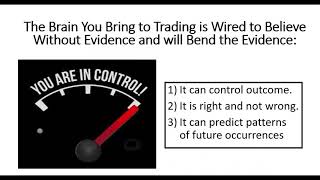
Friends, this is when it gets really tricky. Because ultimately your brain that you bring to trading is wired for particular things, okay? You are wired literally from six and a half million years ago to be in control over outcome, to control the environment, okay? You are also wired to see and perceive yourself being right and not losing. And absolutely, if you lose that back then that meant death and you didn't want that. And it also is. We, as a mammalian, we see we're going to. We have a bias to literally make a causal relationship where we think we can predict all those fluctuations in the market, stuff like that. We actually think we can do that and we think it's true. That's what your brain is built to do, okay? That's what it's built to do, to be in control. The problem is the moment that you do this, you discover something. This is when it starts getting control. Because what happens is this, that control is an illusion. And suddenly what happens is that it's busted, not by you, but by your trading account, okay? You will lie to yourself. Because ultimately, what happens, if you notice in this graph right here on the left, what you're looking at is a brain not under stress. And what you're seeing is, okay, that higher cortex, that prefrontal cortex, that neocortex truly is contributing to the way that reality is perceived. Ah. But when under the stress, taking that loss and that urgency to make up for the prior losses kicks in, literally, the thinking brain is disabled.
It's hijacked. You've seen it. You've seen it. When the smoke clears, you go, what in the world was I thinking? That's what's happened, is that you weren't. The thinking brain was wiped out and fear or desperation has taken over. And that's what's guiding thinking. This is. This is the primitive, primitive, primitive instinctual urges that take over the brain and engaging the danger of losing your life, okay, to the emotional brain, to the primitive brain, that's what it's seeing. This is happening every day. When you trade, particularly in this particular instance, we're showing a very specific moment how to take losses, and we see that loss and what Happens. It's not falling into the pattern, the habit of making up for those losses or revenge trading. That's caveman brain, man. Okay, so we've got this thing.
And ultimately what's happening is this, is that the primitive emotional brain cannot tell the difference between biological threat. Like in this particular illustration, you know what you're looking at? These are actually depictions of Diantro thoughts, not. Not Homo sapiens. But what you're looking at here is you're looking at literally, a man trying to protect his family, his clan. And if he doesn't beat back those canines, there's trouble. There's real trouble. That is what losing was built into you about. And the thing is, is that it's the biological threat and the psychological discomfort. The wolves are no longer after you. They're long gone. The lions, tigers, and bears are long gone. The same with these. Tigers are long gone, but we have a brain built for them, okay, that still sees danger, biological threat, threat out there every time. You risk capital to an uncertain future. And you can't lie to yourself in trading because you have this instant karma machine called your trading account. That was a very successful brain that got developed and it habituated. And that's the brain that you bring to trading friends.
So what actually happens, okay, when you actually revenge, trade, or you start trying to make up for prior losses, first of all, right here, okay, start with the expectation. You have an expectation of making money or winning.
Okay, you might think, well, what's wrong with that? A lot. You can't control making money or winning or losing trading, okay? It's a. It's a. It's a very random. It's a random thing in that jungle.
And yet you're making an expectation that you're going to win. And so you're already revving yourself up, whereas you darn well know that you don't control that. Instead of saying, I have an expectation of performing well, okay, that it's a big deal, you know, your expectation of performing well under pressure, that's something you can control, that you can learn to do. You can't control outcome. Then you take a loss or successive losses. And that's what would be. In neurobiology, we would call the cue of habit formation. It's the one that triggers this stuff. You take the loss, and what happens is that, huh, you get this thing of, oh, my God, oh, my God, and you start feeling that desperation, that anger swelling up, because what you're experiencing at the loss is powerlessness. That's the emotional response. To loss. You feel the powerlessness. I'm not in control. Exactly.
It's evident that you're not in control over outcome. And you've lost control of the one thing that you could have control over. The mind you bring to performance.
Then at powerlessness, you then experience vulnerability. Now you're in danger. Now you're in danger. And friends, vulnerability is directly linked, directly linked to fight flight. There's an emotional hijacking that occurs that I'm going to show you I think in the next slide. Okay, but all of a sudden there's an emotional hijacking. You're vulnerable and stuff like that. You're just losing it. And then there's the activation of the fight flight response. This is how in trading and in taking losses and doing what we're doing today, you're going to have an aggression. There is an aggressive response to it. You're going to revenge trade or you're going to desperately fight back and try to get your money back to break even. Okay, then that hardwired habit, aggression to protect itself. Do you remember our Neanderthal offense friend trying to protect his, his family from the wolves? Yeah. That's what we're talking about. That's the response. That's the part of the habit, the response. It's already automatic. You didn't have to think about it. As a matter of fact, it's pre thinking. You've already knocked out your thinking brain. What happens is that the, that that response is literally automatic. It is subconscious. It didn't need to go to thinking brain. It just, it was already in habit and fired. Then.
There'S the hard. There's a hardwired habit. Aggression to protect the self. And then all of a sudden you start thinking from aggression or desperation. Then you start moving your stops and you start doubling down. It's going to come back. I'm a bit more money. And then the smoke clears and everything is gone. Okay? And you've blown a chunk. That's how it works, friends. That's literally what's happening and what I just described happens in a millisecond. It happens in a millisecond. Your brain from an electrical behavior standpoint is operating at 200 miles an hour. All that electricity is flying around in that noggin of yours. And this happens in milliseconds. The signal never got to the thinking brain because you don't know how to regulate. You don't know how to produce the mind that can handle that kind of stuff. And it's not your fault, friends. But it's your responsibility to be able to build the brain that you need to be able to manage losing, to manage winning, and to manage just the sheer uncertainty of randomness. Okay? That's the big deal.
And that's the next piece is what you discover is this is when it really gets to. We're having a little trouble. There we go. Is that we tend to believe. Now remember we discussed having beliefs really is basically.
A mental representation of reality produced by the biases that are going on underneath the hood of your mind. You don't know about them, but they're there. And what happens is they lie to you, okay? They just simply. And you have to truly begin to say, well, how.
It's the very beliefs that you hold about your ability to manage uncertainty that's being revealed in your performances and your trading account friend. The deal is, is that in most life, in most endeavors outside of day trading is consequences show up pretty long time after actions, okay? And what happens is it gives enough time for the brain to make up stories, to create alibis, to lie to itself. And you just walk around thinking, okay, well I've got. It's like my father is. My father smoked Camel unfiltered cigarettes for 52 years. Throughout time, people would say, howard, don't you think you really ought to just stop smoking? They're not good for you. And he would look at it, engineer that he was as he would look at it and says, I'm not dying. See, look, I'm fine. Finally, when you know, you know, the emphysema. Not the emphysema, just the, just his lungs came to a moment where he went to the doctor and it really started looking at it. And basically what the doctor said is, Mr. Howell, you need to get your affairs in order. And after that, dad got all bent out of shape and it had caught up with him. The karma that he was able just to ignore for years and years and years and years and listen to the lie, everything's fine. Finally busted by the doctor saying, get your affairs in order. And by that time his lungs were toast, you know, and he couldn't, he couldn't extract oxygen out of the air. You know, it's just. So he had a buildup of carbon dioxide in his lungs and eventually he died. However, in trading, it's instant karma as you get there and you realize within moments you will see, you will see the results in your trading account. You'll see that PNL.
And you may have been lying to yourself. You may have been adhering to A very convenient lie. But the trading account.
Demands that you look at an inconvenient truth. The beliefs that you're bringing to trade with are not effective for extracting capital out of the markets in a jungle of randomness. Okay. That's what you're learning. And this is where you really have to decide. Well, do I want to believe the lies running around in my brown brain or it's kind of as Groucho Marx said, who you going to believe? Your lion eyes are me. I'm not sure which one I would brilliant between those. But what I want to show you is what's actually happening. Okay, we have a graph here and down here where it says the sensory thalamus. Thalamus is part of the limbic system. And you're having neural information come into the thalamus to make an evaluation about, you know, what are you interacting with out there in the environment. Okay. And there is a traffic copy or a controller sits there. Based on history, on past history of learning, limbic learning, it will make a decision about whether or not that that information coming in is dangerous or whether or not it's. It's really good, you know, whether or not you see really good food source up there or whether or not you see the saber toothed tiger looking for you as a food source. And what it does, normally what happens is that you'll see the information shot up to the sensory cortex, your prefrontal lobes, and it takes a quarter of a second for it to get there. It's slow, very slow. And then the debate occurs about whether or not it's a good decision. All that kind of stuff. I would call that in my work, Sage. However, down there at the traffic cop level, if the information that's coming in, I'm being hurt, you know, I'm losing. I've just been hurt. Something I have to fight back if it's there. And remember that traffic cop only thinks in terms of biological threat. It doesn't know about psychological discomfort. It says, no, this is dangerous. What it does is it route. It stops routing information to the sensory cortex, routes information over to the amygdala. That's called the short road, the low road. Okay, and where the what the thinking brain gets involved with it. That's the long route, that's the high road. Okay. When it goes into the hypothalamus, that's really about memory and learning. And it's locked in. Yeah, the hippocampus. I'm sorry. And what happens is that that's where all these Memories are stored and they tend to better not be the good memories, okay? They tend to be the fear based memories or the aggression based memories of threats. And all sudden that compounds on the amygdala. The amygdala simply fires up the fight flight system and an emotional response moving your stops, doubling down, just all that stuff ensues, okay? And ultimately you're thinking from aggression or desperation at that particular time. And friends, the deal is this. You are primed for this circuitry right here. You have to forget for a second that you're a human being, that it's not flesh and blood. You have to go, you know something. No. The truth is, is I'm flesh and blood. And unless I begin to understand how to manage the flesh, your neurobiology, then what happens is this particular circuit, this particular habit is going to continue all the time. And that's why 95% of traders blow out, they lose money and in three years they've, they've blown out their, the capital they have and they've run out of time, okay? And they, they refuse to look at this. And maybe the truth is, is that maybe they're just ignorant of it, is that, you know, I was talking with a trader just literally before I got on here, and this was like revolution, Rev. It was a revolution to her. It was revelatory to her. You know, it's like, oh my God, I had no idea. And what she did is she acted on it, much to, much to my benefit, I might add. But the thing is, she said, oh my God, this has been going on and it's not going to change. I mean, she's a trained accountant. She's thinking, you know, I mean, she's safe, safe, safe, safe stuff. And all of a sudden she's being compounded by the stress of uncertainty and trading. And nobody told her about that when she got into trading. And here we are, here we are, friends. This, this is the bugaboo that you're going to have to master if you're going to move to the level of consistent profitability there's there. And don't let me be the person who says I'm the expert telling you the truth. I'm asking you to look at your trading account and look at your performances. And you tell me now, how many years, how long do you have to undergo this till you say, you know something, I need to retrain the brain. I need to retrain the brain. I'm just not going to, you know, keep exposing myself to this and exposing myself to this. And that's not going to normalize it. No, that doesn't work. Exposure therapy does not work. If you're going to expose a person to, to something like stress, you're going to have to give them new tools to work with to may be able to manage the stress better. For the stressor to have a different reaction. Okay. For you to have a different reaction to the stress. Okay. And that's what this training is all about. So let's take a look at this. We get that. Whoops. Go back.
Go back one more time. I think we're missing. I think I'm missing a slide. Believe. Okay. I'm showing.
That's weird. I'm showing the slide after. That ought to be. There it is. Okay. So how do you go about working with this?
The very first thing is you have to recognize that what you're currently doing is just simply not working. Okay. And you can have a really thick skull. I'm okay with that. I'm okay with. I get traders all the time that they say, randy, this psychology stuff's crazy. I have no reason to even talk to them. They haven't run into the brick wall enough. I understand that. I'm comfortable with that. And what I know is ultimately, once you really get into it and you actually have the knowledge of trading, the mind has to be built to be able to apply that knowledge under stress. Because the deal is, is that everybody's a good Monday morning quarterback when they're in the armchair. Okay? Very few people are good in the midst of the battle. That's the whole deal here. And until you learn how to perform well under stress, that's the only thing that matters. It's doesn't matter what you talk about, it matters about what you perform form. So you're looking at that and you're going, that's the very first thing that has to happen. And then.
The real thing is don't blame emotions. Emotions are just doing what they were built to do. Okay? They're, they're built for short term survival. They're actually in the neural biology. We actually call them biological action potentials. They're not psychological at all. They're biological. They created psychology because we're psychological creatures. And the deal is that those biological action potentials are what they do. What their function is, is to coordinate action.
Between the markets and the trader, the environment and the organism. That's what they're built to do. Now what we want to do, particularly in this training that comes out of this stuff is we want to train For a different set of emotions to emerge when you engage uncertainty, okay? Because all thinking is emotional state dependent. And we want a certain set of emotions that will provide a particular kind of mind that can engage uncertainty and be calm and patient when doing so. That's what we're looking to do. We know that evolution has given us that. We tend to be built around fear or aggression. You know, basically aggression is just another form of fear is that, you know, if you've ever seen. I once saw a dog chasing a raccoon and the crackoon was trying its best to get away from the dog by running. Fear. Then it got pinned, literally. There was no escape.
That fear turned into aggression.
There was a threat. Instead of running from the threat, suddenly the raccoon was attacking the threat and it tore that dog apart. Okay? Same thing happens to us. And the more willpower you try, the worse it gets. Because this is not about willpower. This is really about the beliefs about your capacity to manage the uncertainty of trading. And where you start, friends, you start from the beginning. It all starts with breath. And the very first thing I ask you to do is tomorrow when you're trading, I want you to get a mirror, a video feeds even better, and record it and watch yourself as you trade.
It's not pretty. You will see the tenseness of the body. You will see you holding yourself, your breath. You'll see your heart racing. You'll see all that stuff going on. What you're doing is you're triggering emotional arousal. And what you discover is breath, tension and heart rate are parts of eliciting emotion and also maintaining the emotion.
If you do diaphragmatic breathing, bellows breathing, what you would be doing is you would be pulling air into the belly with your abdominal muscles. You'd be pulling it like a bellows pulls with the, with the, with the arms of the bellows in your belly and the point of the bellows where your throat is.
You breathe that way you expand into belly expand, then allow it to go into chest. What you do is you alter the emotional signature that supports or doesn't support the emotion. Fear cannot maintain itself in the presence of diaphragmatic breathing. Okay, so that's the very first line. Breath. This is a lot of, a lot of the spiritual traditions of the world. It all starts with breath, you know, and it's called, wow, maybe it applies to trading too. Now, trading by itself, it's not going to do the trick. It's not going to solve all your problems. There has to be another true skill it would be called mindfulness, which I call awakening the observer. I also call it metacognition. But what you're doing is you're beginning to say, you know, what I need to do is I need to start noticing what I notice. And I start. Need to. I need to. I need to understand is, you know something, I'm seeing representations of stuff out there. I'm not seeing the truth. And I need to really clean the lens of my observer so that it's seeing how it sees. It's beginning to see the biases that drive the way he sees. He's beginning to see the implicit below conscious threshold beliefs that are driving your reactions to uncertainty. And you're beginning to go, okay, I can actually see how my potential as a human being got organized, set in place, and concrete often. And it's producing the results I'm producing. I need to observe that. I need to observe it. Okay, this is just simply. This is the historical organization of the self. I can begin to observe that. And I can also start observing for the good and the bad and the ugly that goes on within. Within this. Because ultimately what you discover is this, is that you use that observer to find the inner commentary. Have you ever. Have you ever noticed that inside the head there's always a talk going on about. And it's very critical, it's very judging. It's telling you to do this, get in here, get in, don't do that, do that. You can lose. And it's also characterizing you. It's negatively assess you. And it's doing all that stuff. Friends, that's the inner critic. It's part of our human nature. That inner commentary is what I call the historical internal dialogue. It's dangerous to leave unobserved. Okay. And uncomfortable to acknowledge, because all these. So we can go, you know, I have this self image that I want to project to the world. I would like to even believe my bs. Yes, I would. And then all of a sudden, you know what you're looking at? You're going, oh, my gosh, this inner commentary is I've been hiding from. And that hiding is. That's exactly what it is. You're hiding from it. It's there, okay? Even with alphas who want to win and have made things success, they're trying to prove that they matter by conquest, by making money. If you are, if you're. If you. If making money is part of who you are. Trading is an incredibly terrible path to follow because you can't control whether or not you make money or not to prove your value as a human being, you have to be able to see there. There is inherent value in me that I need to really zone in on. So I separate performance from my being. This is the. One of the first steps of freeing the self. Then what happens is you're going to discover that there's a negative assessment machine in your head and you believe it without examination because it's always been there, okay? And it's just part of the landscape of your mind. But that's not true. You have to learn to master these global assessments, masquerading friends, as truths and beliefs. That's what you have to do.
Ultimately, they are simply unexamined characterizations of the self that the observer has been sleepy, gone lazy on you, and basically locks in, fuses to it. And suddenly you think, well, that's just me. No, it's not. It's just one particular organization of the self led by this inner commentary going on inside your head.
And, friends, that's where you're going to find the inner critic and the adapted voice in this commentary. And it locks you into that bubble where you can't understand, why do I keep hitting these things? Why do I keep doing the same stupid thing all over again? Well, you have a habit there that triggers. And you have an inner critic that is out to destroy you. It is out to criticize. It is telling you that it's not your performance, it's you.
And it judges you. It tempts you to do stupid things. And you have an adaptation from that with the limbic system, with the emotional brain that basically is trying to prove its worth, trying to do anything. It's desperate, but unfortunately, it's very poorly mentored. It's just got the inner critic sitting there. And, you know, it's. It's. There's no escape from this destructive part of ourselves. It's learning how to work with it and learning how to basically cut it off at the pass and confront it, that we begin to open up possibility for something much greater than that. So ultimately, the organization of self that you brought to trading is, unless you won the genetics lottery, friends, is not going to work for success in trading, okay? And.
Ultimately, though.
In the same way that there's judgment going on inside your head all the time, there is self condemnation, there is criticism, there is temptation.
Those are emotional programs, friends. Those are emotional programs that are duking it out for control, organizing the self. There is also discipline. There is also courage. There is also self soothing rather than having to beat yourself up for mistakes. There is also impartiality, clear thinking that can be trained to come forward in moments of stress. Okay? And by the way, I had a heart transplant six months ago. And these things that I'm talking about right now, I am a consumer of these skills. I'm just not person who preaches them. I actually, you know, if you go through a heart transplant and I promise you, you will be challenged severely. Okay. And you need to be in control of the mind that you bring to bear to that. The same thing with trading. If you begin to see, oh my gosh, the mind really is a committee. Yeah. Now you're beginning to think, you're beginning to think in terms of possibility. What you want is you want to redesign the committee of the mind. And what you want, you want the discipline of a ruler, the courage of a warrior, the self soothing of a caregiver, and the impartiality of a sage to become the emotional soup from which the trading mind emerges. Now, in the work that Dolores and I do, we call that trader state of mind, or we call it the intentional mind. You can't control outcome, but you can control the mind that engages the uncertainty. That, friends, is the big deal. And out of that, as you begin to get mastery over the community in which players with which aspects of the self have presence and are part of the working mind, as it engages uncertainty, that's when the psychology develops an edge that can drive your performance. Edge, okay. That can, that can drive your statistical edge. And you break the chains.
Of the past historical organization. This can be done, friends, and it's really learning about how do you summon those particular emotional programs under stress? And guess what? Of course, I have particular trainings that I send my traders through that do just that. Okay. The key though, is that you can build the intentional mind to do just that. And what I want you to look at, to me, Lord of the Rings was one of the most powerful archetypal movies that I have ever seen in my life. The other one that is incredibly powerful in that way is the one with Russell Crowe in it.
The Gladiator. You begin to see archetypes, brilliantly acted. And in there, you know what happens is that you have a king that is on the journey to reclaim his kinghood. You have elves who are giving up everything out of love. You have a person who faces the deepest evil in the world, but finds the heart to be able to manage it.
You find a warrior in the guise of a woman who is able to kill some of the most horrible creatures in the world. Because she's a woman and you have a Gandorf character who sees beyond the normal. These all exist within you as potentialities. You just simply have not been trained to be able to bring them up during moments of stress. And that's the whole thing with taking losses. So you're sitting there and you can learn to build that mind.
Rather than having the mind that you arrived with. And out of that, your ability to discern between self limiting and enhancing potentials grows strongly and you begin to learn how to say, you know something, I can actually train myself. Which is what we do in these work. Train yourself as you approach and move into those moments that create the stress. You prepare the mind not for ignoring the information that this is, you know, you better be concerned, this is really uncertainty. But you steal the mind so that you have a particular kind of mind that can work with uncertainty, can accept performance because they have already accepted that they have value of an inherent nature, okay? Whether or not that's from literally beginning to recognize as a social, mammalian, a lot of people go out of their way to help you or on a spiritual way where you begin to see yourself and as an expression of the divine. Either way, you develop a really different mind. And this is when it really comes down to it, friends, is this is when you truly control.
The mind that you bring to uncertainty. You discover that life has always been uncertain, always.
You know, for instance, in my heart transplant, understand, they looked at me and says, randy, we have no idea why your heart's doing this. We just simply know you went to China and we're doing speaking tour over there and you came back and you got sarcoidosis, okay? The immune system attacking the heart. And it just so happens that when exposed to.
Pollution on a superhuman level, that's what triggered, you know, my life was just going along just fine, thank you. Everything was under control, blah, blah, and all of a sudden I have heart disease on a massive scale. You're not in control. What you're in control of is the mind you bring to the uncertainties of life, okay?
This is the mastery, this is the self mastery. It's about performing under stress.
And ultimately what you very much learn. And I'm going to use basically a parable out of the Cherokee Indian tribe. The Cherokee Indians and their spiritual philosophy believed that there were two wolves that lived within man's mind. A dark wolf and a white wolf. If you followed, if you followed that dark wolf, okay.
Your life is just gonna just absolutely fall apart and become highly destructive.
If you followed the white wolf.
Then you were going to produce.
A wonderful life, a life of where you found love. You found literally you accepted your nature and it was wonderful. What the Cherokee Indians also believed was that you were totally responsible for which wolf you fed. And it was the wolf that you fed that was who won. Okay, so they held man totally responsible for the wolf that built their lives.
They held that you are captain of your own destiny. Which wolf do you feed? And this is the key, this is the key to trading, is that if you see what you're doing is not working, then ultimately you have to say, well, I probably have been feeding the wrong wolf, running around in my head. I've been feeding a destructive wolf unknowingly. I didn't mean to Randy, but I didn't know that I was actually feeding my destructiveness. Or you could start feeding your constructiveness. And it just so happens that's what we teach. And the question would be, you know, after, after you go through all my videos, after you go through all my articles, do all the reading, the pre book and stuff like that, maybe even, gosh, you know, my book, you come to the moment and you realize that, you know something, this is not specialized knowledge that I can just plug in like a computer into my brain and suddenly I magically transform myself into a psychologically sane person. When trading a depression pressure. No, friends, this requires training. And what I would like to do is give you two opportunities.
We have a group course coming up in January and most people actually sign up much earlier than January. They will sign up.
Two months early so that they're really prepared when they get to that group course because it flies.
It moves at a big fast pace. And people who sign up that day are, they're already two or three weeks behind by the time they, by the time I open my mouth because I'm assuming they've already worked. That group course teaches the fundamental tools you need for this kind of transformation. For being able to really build the mind from, from a brain that was focused on instinctual survival in the moment to a brain that provides a mind that is looked at long term, long term benefit and working with probability. That's what the mission is. And when you do this, it's five sessions. It covers a lot of territory, group sessions and you know, it's all done virtually this virtual classroom you go to. And it is, it is, next one's coming up pretty soon and I invite you to that. Okay.
Through January 9th, not through September. You can tell when our other course, yeah, free gift and the free Gift is a seminar about emotional regulation. And we sell it on our website for $199. We're giving it to you free, not to entice you to buy, but we're enticing. We're saying we want you to get insert in this course early so that you get maximum benefit.
Through January 9th. Okay. And there. This individual course, okay. It is highly comprehensive. It is highly personal. Okay. And fundamentally, I become your personal mentor. That's the big difference is that a lot of people look at it and say, you know, the truth is, Randy, I want you. That's. That's what I want. I want you as guy teaching me. And so that it. That's the way it works. And if you're interested about which one of these would work for you, I asked you to ask for a free consult. You just go to the website. There's the website down right there. And go and look for the free consult and say, let's. Let's talk. Okay. And you just hit the contact us. But okay. That's the deal now.
And if you have questions, we have a few minutes for questions. I'll be happy to answer them. There's.
Okay, I'm. Yeah, I'm trying to read through my classes that no longer work. Well, to work. Okay. I'm confused because if my beliefs change based on my emotions. Emotional beliefs.
I'm trying to read it. Taurus. Okay. Change based on my emotions. How do I not let my different emotional beliefs from driving my actions? You can't. Belief is part of an emotion.
It's not cognitive. In neuroscience, we would call it a limbic learning that when you get cognition to it. We say we have a belief, an emotion is composed of arousal. That's the motion, the emotion triggering and getting ready for action. It includes feeling, which is actually not feeling touchy feely, but it is the subjective experience of the chemistry of the emotion, the body revving, you ready to go. Motivation, which is telling. Basically the emotion is telling you what to do. You know, do you. Do you fight? Do you flee? What do you do? And then the next piece of an emotion is the meaning is the belief that basically the beliefs that you engage the environment with, that's what you're reading, that's what you're seeing. And the last part of an emotion is the genetic predisposition. Some people are born anxious, some people are born much calmer. But the major thing is that the beliefs are part of the emotion.
Are there drugs? I can. I love this. The answer is, boy, you're in A sad place. Are there drugs I can take to not have an emotional response to winning or losing?
Literally anytime I brag to someone about winning day, my next day wipes everything out. Of course it does. You've produced euphoria. You produce overconfidence when you do that. And that euphoria, all that testosterone in there and just gets in there and what happens is of course you blow it. There's not a drug that I know of. I'm sure that some doctor would be happy to give you some SSRIs like Prozac, that'll flatten things out. But the truth is that ultimately this is about what the Cherokee said. It's about taking responsibility for who you feed. And what you're saying is that when I brag, I would actually call it fraudulent fraud. Is that you're saying, look at me, look at me, look at me. The truth is that you did not control your winning or losing. It was always a probability. Winning is only landing on the right side of probability. It's just not that big of a deal. Losing, once you get your act together is only landing on the wrong side of probability relative to you. So that's what I teach. And that's a distinction that has to become internalized in your bones. But no.
You have to train yourself to do that. You have to take a brain that really knew a lot about status and about the sense of mattering you got from bragging about a good winning day. And you have to realize, oh my God, that bragging is the kiss of death. It produces euphoria, which most traders discover after they master fear. They had no idea that they get cold cocked by euphoria because oh, I start winning, I've got it, I've got it, I've got it. You never have it. What you have is you have a methodology that allows you to produce a mind for a period of time that allows you to work in probabilities. That's what you have. At what point does the course address the fear of placing a trade at all after a bunch of past trauma has already been caused from losses? Well, you know, it's really interesting. I will begin this answer by saying is that when I was a card toten therapist, most of my work was in and around post traumatic stress disorder, traumatic memory. Okay. And it just so happens it fit really well with working with traders because they did these things that just absolutely traumatized themselves. You start learning it right off the bat. The first and by the way, I teach you process and I just showed you the process and then the tail end of it is the very first thing is you have to recognize when you're triggering to that habit that produces all the disaster. After you've bragged about yourself, what you're really doing is you're saying the first thing I have to do is I have to cool that down. That's done with diaphragmatic breathing. That's done with later with safe place. You calm that down. After that, what happens is ultimately you learn how to pull up a discipline, courageous, self soothing, impartial state of mind and you no longer need to brag. Okay? That's the whole thing that, that can, that can be easier said than done, my friend. Hi Randy. I've been day trading for many years now with ups and downs and no real success, although I know my actual system works. Well, that's good news. I reverted back to paper trading and still have difficulties due to fear. Can you explain why? I experience fear of losing even in paper trading, especially after some winners, this fear leads to mistakes. Thank you. It's a very complicated answer and I'm going to give you, I'm going to give you a global answer because I don't know you. Okay. Generally what happens is that there's a lot of people that have the same experience in paper as they do in real with live money. But the main thing is when you build, when you, when you build, when you experience trauma, okay, the up and down, up and down, up and down, ultimately you build a habit. And once that habit has its cues, trading, entering trades, turning the computer on, that habit fires. And it doesn't matter whether or not you it's real money or whether or not it's, whether or not it's, whether or not it's fake money. I have a client right now who has just moved from paper trading back to micros. Okay. And it was planned move. We wanted to go to micros so that we weren't, you know, we weren't. But he mastered his paper trading woes and then he said, okay, now, now we're going to live trading where we can now take that success and we're going to add, we're going to add money to it where there can be real losses and not a reset button. But we're keeping them small because now we want to train what he's learned in paper trading to a small amount of risk. Okay. And once we establish that and then we'll go to larger risk until he's trading at a level that can support himself. Okay. But the thing Is, is that you basically you created a habit, okay. And you didn't take care of it. You kept exposing the limbic system to the same darn pattern. And I hate to say it, but I'm going to take guy. I'm assuming you're a guy. Is guys just simply, I don't know, they, it's hard for them to learn until they really experience pain. But your job was if you, if you're triggering, if you're triggering on paper, then that's where you start. If it's producing the emotional response already at that level and then we, we get, we build a mind for that and then we move to, then we move to where you're adding small amounts of, you know, like I said, I like micros simply because, you know it. You know, when you have a really bad day, you know, you Maybe lost maybe $100, you know, but it's not like you just crashed a whole bunch of money.
Okay. Once learning how to use a probability mindset, this becomes part of the rewiring of the mind. Will the survival mindset be weakened? No. Or under particular circumstances outside of trading, will it be ready to act?
I have a position in the way I understand this is that in the same way that evolution built workarounds to the structure that was already there, in the same way that my wife used to work for high technology companies that basically during all this merger mania that went on with banks is that she worked for a technology company that basically oversaw the conversion of where different banks merged their technology systems. And basically what happened is they never started over. What they did is they work around things to build a system that works. It's not what you would do to build one from scratch, but it's a workaround. What I in the same way do is I do a workaround where I know the old habits are there and they can be triggered under certain stress. But also ultimately what I have learned is that you have to be very vigilant. You have to become as a practice of vigilance. Because the moment like the guy who brags and didn't see that he was producing euphoria. Okay. It's the same thing is that it's very common for a trader, even with a lot of experience with me, that will say, Randy, I had a great day. Now understand great day means something very different to me than for most traders. And I said, what do you mean by great? I says, I made good money today. And I said, well, how did you trade?
How was your performance? I'm not Interested in if you make money or don't make money. I'm interested in the mind you bring to that moment. And that, I know that, that mind that you bring into the moment, even as a skilled trader, that mind is good for about an hour and a half. And then you need to take a break and let the brain refuel itself. And then you need to have the vigilance to be able to say, I need to reconstruct the mind again. And yeah, I teach this in my courses. Okay. The thing is, is that you have to have that diligence, you have to have that vigilance to be able to recognize that that destructive part of the self is going to sneak into the trading committee mind and it's going to raise havoc if you don't. If you're not aware that it can potentially do that and.
You'Re in vigilance, or as they said, is that the price of freedom is eternal vigilance. That's true. Okay. Do you think it is okay to take some rest from trading once every sometimes just to get out of the habit and calm down the emotions? Yeah. Goodness gracious. You know what I teach, I often refer to.
I refer to my teachings as cheap Jedi tricks. Okay. But the truth is, is once an emotion has taken hold, it generally takes about an hour to an hour and a half to work through that emotion. Which means from, from my standpoint, like for instance, at the end of my courses, I'm teaching people how to use a heart rate monitor and an app to be able to keep their heart rate at particular levels that are associated with peak performance, that are associated with marginal performance, disastrous form performances. Okay. What happens is that if that emotion kicks hard and gets there and suddenly gets you out of peak performance, that mode of performance and moves you into danger zone, the only thing you can really do at that moment is shut your computer down and exercise, take a walk, get on a machine, do something to burn that chemistry out of your body before you return to trading. So the. And even really good traders do that. It's not. This is not. There's no magic that suddenly your brain's just absolutely in sharp stuff is you will fall out of your practice and all of a sudden you'll get knocked. You get like Mike Tyson hits you in the face. The thing is, is, yeah, you need to be taking breaks just simply because of the biology. You know, your brain is running on glucose and trading is.
It is just an enormous. Has an enormous appetite for glucose and cognitive function. And when you burn it out, an Hour and a half is. It's going to take you 20 or 30 minutes to replenish the glucose that's been lost. So yeah, you need to be taking breaks. Absolutely. Okay.
Yeah. Okay, friends, B, I am.
It's time for us to go. It's been. I've really enjoyed myself and I want to thank you. And again, remember, the free consult is really for people who are really looking at this and going, you know something, is this for me? Okay. It's not. It's not for you to come and just talk with me and blah blah, blah and just chew the fat. However, the recording of this is going to be on our website tomorrow. Not promising that it's going to be there at 7am Eastern time. It has to get rendered and tomorrow I will have to find time to put it up on YouTube and stuff like that. But you'll be getting. It'll be on the homepage. Okay. Sometime tomorrow.
And you'll get a link to it. Okay. So I want to thank you friends, I really do. And my hope is you have a much better understanding of what's going on inside your brain that produces a mind that falls in that has a really hard time taking losses. And as you take the losses and if you don't have the skills to be able to really truly understand loss in a very different way than the way you came stock with. Okay. Is it. I'm hoping that you find a way through it and if I can be of help to you.
Come, come and just really take a serious consideration of the courses that we offer. Okay? The cheap stuff works fine to a point, but ultimately this isn't about specialized knowledge. It's about training to the bone. Okay? So take care. I care for you and good luck in that trading and take a mirror to work with you tomorrow. And watch yourself. Okay? Take care.









