Mastering the Uncertainty Monster that Kills Your Potential
Randy explains why traders fail: an evolutionary survival instinct that treats uncertainty as a death threat, hijacking your decisions with fear and self-deception. He maps four cognitive traps and four internal archetypes to cultivate, teaching emotional regulation and breath work to rewire your brain's response to real money at stake.
Chapters
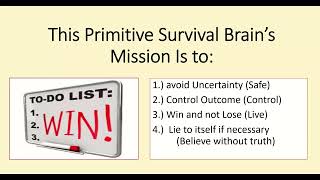
The broadcast is now starting. All attendees are in listen-only mode. Welcome everybody, welcome to this particular Trader State of Mind workshop. However, what I want to do first though, it's just make sure that you can hear me. If some people would simply write in a Y into their question box and let me know that yes, you can hear me, I would greatly appreciate it. Oh, triple Y, okay, we're on to it. Okay, there's a really big interesting thing is that how we— it's really about, we all know that trading is about uncertainty. I mean, you have volatile markets, you know, if you don't, if they're not volatile enough, if they're stagnant, you complain there's not enough opportunity. Yet at the same time, what we don't do is we don't recognize what exactly is going on here. Because how many of you have recognized something? Have you mastered the uncertainty monster? Okay, have you ever? And I'm representing this as an image, okay? And in a second, there we go. And I want you to recognize, okay, in your trading, you know, let's just say this, here's what I generally meet. People know how to trade. If they're trading paper, they could be Minning, okay? And they're sitting there and they know how to trade until it really catches them. There's really uncertainty, there's real money on the line, and suddenly everything changes. That everything changes is the arrival of the uncertainty monster, okay? The deal is, We have been working with uncertainty and the uncertainty monster since long before our mammal relatives showed up, long before the great apes showed up, way before the social mammalians. Back in a primordial sea, even an ameba had some serious stuff. The whole deal is every life form is going to avoid uncertainty. Uncertainty to it is risking death. Okay? And it doesn't have a really huge gigantic brain like yours. It has a very simple brain like the fruit fly, Drosophila. It has a brain that has 100 neurons. And it still avoids uncertainty. Okay, now what does this mean? Well, what I'm asking you, if you know how to trade, I'm guessing that you have not met your instinctual brain. Now, for people who have listened to me and stuff like that, they know I call that the emotional brain or the caveman brain. It is what's making your decisions under pressure, under the stress of uncertainty, not your rational mind that you want to be— that you want in charge. And the deal is, until you can build a new partnership and take that uncertainty monster, kind of domesticate it so that it's not taking over thinking mind during moments of uncertainty where there's real risk, you're going to be stuck. So the first thing is, I want— just think about this, we're all traders here. And what I want you to do is to recognize, okay, how do I experience the uncertainty monster? Because what I'm asking of you is to recognize that the uncertainty monster was there a long time before trading, a long time before like fear of missing out, you know, or, you know, need to get back all those revenge, all that revenge trading, all that exuberance, irrational exuberance. It was the uncertainty monster was there before we were human. And it's not recognizing that it's part of what you bring to the game and you ignore it expecting it to go away on its own. So, the first thing is I want you to notice is that how many people experience that uncertainty monster and self-doubt? Are you sure? You know, what happens? Scarcity thinking. Oh my God, what if I lose? You know, what if this is taken away from me? And also, when you take losses, oh my God, I need to get those things back. Hurry, now, now, now. When everybody in a sane set of mind knows you can't do it, that doesn't work. But we're ignoring the presence of this big, huge part of our trading life, the uncertainty monster. And then how many people have used self-deception? Friends, I don't know if you have noticed it, but your brain will tell you lies. It will create stories that support whatever the emotional brain has already decided. And it will flat lie to you. It prefers a lie, a reassuring lie, than it does to an inconvenient truth. Have you ever been really bravado? Yeah, yeah, yeah. And then you get in the trade and it's going crazy and stuff like that, you freak out. Yeah, that. And this need to win, the amazing thing to me is this need to win. You know, ultimately what I teach is very simple, is you're, as a professional trader, your job is to extract more capital out of the markets than you give back. It's not about winning and losing, it's about being able to have an edge, theoretically, that if you follow that edge you will extract more capital out of the market than you give back in. Okay? And that's a profitable trader. So you're looking at this and then now, "Are you sure?" Are you sure? The fear of entry. Oh my God. What if I get in? Oh my God. What if I— what, what, what, what if the uncertainty monster? And what I'm asking of you is to sit there and say, well, how do I experience my uncertainty monster? You know, it's the major thing. I don't have a business if it weren't for a bunch of guys. 95% of my clients are guys that want to win. And besides that, they have learned to win since the get-go. No matter what culture that you grow up in, you know, the Olympics clearly shows you that all cultures are very competitive and human beings had to be incredibly competitive to become the survivors that they have been. So this thing of wanting to win, wanting to survive, wanting to live another day, wanting to take somebody else's energy instead of someone taking your energy— you're dead if they take the energy. Because ultimately, life is really about— it's an energy exchange. The original energy, the sun. Before there were living beings, living stuff, inorganic chemistry aligned itself up to be able to take the energy and, and to grow. The plants, when they came around, they figured out that chlorophyll could take that energy and put it in form that it could start growing plants. When animals arrived, they figured out that they could eat the plants and the animals that ate the plants for concentrated energy. So you're seeing that this is an energy exchange And the deal is, if you're a winner, you're getting more energy than you're putting back into the thing. So, the point is this, that primitive survival brain of yours, what it wants to do is to avoid uncertainty. Now, I'm not talking about recently in the last couple million years, I'm talking about down to the petri dish, that it wants to avoid the uncertainty that it sees as death. Oh, by the way, I hold questions to the end, okay, because I kind of get on a roll, I get focused, and it's better, it's better, okay? But what happens is I would love to see your questions as we go along, as we're going here. If you have a question or something's piqued in your mind, write the question or the observation down and I'll get to it. And the deal is, I'm opening up a whole joint here and asking you to recognize that you biologically are part of life forms that have uncertainty, a bias toward uncertainty, of avoiding the heck out of it. Okay, and what do you do, smart animal that you are? You get into trading where there is nothing but uncertainty. You want, you want You want the amount of uncertainty so that you can get into things, you can short, you can take gongs, you can do all that stuff. And you don't want choppy. There's no money there. And all of a sudden we realize that we are actually engaging with uncertainty. And yet we have taken the thinking brain and its self-deception and believing that if we If we know what we're doing, if we have knowledge that we can win this game. I'm here to tell you that doesn't work. There are plenty of highly knowledgeable traders that if it were about knowledge or winning on the paper game, there would be a lot of rich outstanding traders. There aren't many. About 2.5% of the ones who are consistently profitable and generating wealth. Okay. So you're looking at this going, I'm asking you to take the blinders off your eyes and start saying, yeah, this is kind of crazy. I am an animal that avoids uncertainty like the plague, yet I am actually engaging uncertainty as a way of making money and living. And I want you to see the irony there. The second thing, in our evolutionary psychology, We learned to control outcome. Now, back in those caveman days, we would call that control environment. We wanted to be the dominant species rather than saber-toothed tigers. And over a period of 10,000 years, we eliminated them. Okay? So, and by the way, saber-toothed tigers were here about 12,000 years ago. So they're not gone too far. So you want to control outcome. And then other thing is that you are bent to win and not lose. God forbid if you take a loss. And yet at the same time, what's interesting, the only time the brain becomes open to learning is in failure. So the main thing that you're trying to avoid and getting all hot and bothered about and going into revenge trading, trying to get your money back, you're not learning from the exposure to the mistake, to the failure that can lead to something great. So now what you're seeing is you have a locked-in mindset, okay, that you bring to trading. And believe me, this is not like you're at fault. This is just the human condition showing up in a world that that brain of yours was just never meant to engage. And the other thing that it does that brain will lie to itself. Okay? Believing without truth. It will do that. It will. I have actually had guys who saying everything was going great, telling his wife everything's wonderful, blah, blah, blah. And the only time that we found that something wasn't right was when they foreclosed on the house. He had been living as a fraud for a number of years. And the thing is, you keep lying to yourself, you keep lying to yourself, you keep lying to yourself, kicking the can down the way, thinking that I'll make up for this, I'll get this, I'll get all this stuff done, and it catches up with you. So there you go. You've got these 4 things. And what I want you to recognize is this. Why is this such a powerful problem? You've got this kickin' piece of cognition in your brain. You have a neocortex that has billions and billions of neurons in it. There's nothing remotely like it. Okay? And yet at the same time, as cool as that is, the moment that you take all that knowledge and just firepower and put put all that stuff at risk because you're about to recognize and play the game of uncertainty in its real form, not in the story that you tell about it. Like, I'm gonna push really hard, I'm a winner, I'm gonna push and make it happen, I'm not gonna lose, winners, I'm a winner, I'm gonna make it happen. In trading, you do not make it happen. If you want to know a good way to fail in trading is make it happen. The work of trading is not the urgency to take action and make things happen. The work of trading is patience, patiently waiting to see what the markets will give you. Not something where you can go and say, I'm going to make some money today. No, really good traders don't do that. They, they think, I'm going to be very patient and see what opportunities present themselves that markets are willing to give me. That's what I'm gonna wager on. And it just so happens that they have a very concise strategy that they stay within certain rules that allow them to not jump and start gambling. Because most people, if they miss a trade and it goes good on them and stuff like that, they say, oh, it wasn't in my plan, but my man, I could have made a million dollars on that. The truth is, is that if it's not in your plan, the moment you break your plan and do something, you're gambling. Okay, do you see how fishy this is? So trading is built from uncertainty. There is no certainty. And what happens is this is a freak out to the untrained brain. They freak out to the untrained brain. So there we are. And the truth is, somewhere along the line, we went from being a really smart Grade A to being something that the world had never seen. And let me give you an example. A number of years ago, this woman, for some unknown reason, decided to have a pet pet chimpanzee. And worse than that, it was a male and it was very medicated. It was on Prozac. It was all this stuff. And the chimpanzee is— understand, we are only 2% different in our genetic structure than the chimpanzee. We're close but far away from being kissing cousins. That chimpanzee figured out that it could steal the keys could get in the car, it could crank the car, it could put it in reverse, could go down the drive, go out into the street, but that's where the sequencing stopped. It could not figure out how to put it in gear, okay, and go forward. God forbid. That's a very smart animal. The deal is, is that caveman, before this big huge brain took over, Most of our decisions were made like the chimpanzees. Okay? This new brain shows up and, you know, we walk differently, we do everything differently, and we begin to actually think and see impossibilities and uncertainties. But the thing is, it's our primitive caveman brain. That's the instinctual part that reacts to the uncertainty. And remember that the entire brain's modus operandi is to avoid uncertainty. Do you see this? So the deal is uncertainty is a threat. And when that trade goes against you, what do you— without training, you're that caveman and saber-toothed tiger is trying to jump on you. Ancient survival instincts take over and just absolutely wipe out the cognition required to trade. Trade. And all of a sudden, you may do that once, maybe twice, you can get with it. And that third time, man, it just snaps and you got to get that money back. You got to make up all those— you got to make up for those prior losses. You have to do all that stuff. And you ramp the engines of revenge trading when in fact you're trying to win, get your money back, because you're scared that, say, the tiger's about to devour you. Yeah, you're fighting for your life. You're not fighting for a little bit of money capital that you've already said that I can afford to lose this. No, you ramp it up. So, now we get it is that what are we going to do? The deal is our caveman ancestors didn't have money. They didn't know what it was. And The thing is, if this right here, these guys were out finding dinner, you realize how dangerous that is right there? But at the same time, what I want you to also recognize, these men who are hunting that woolly mammoth, they actually know how to take down that woolly mammoth, lay it down so they can kill it, okay, and feed the village. But out of that though, there is the uncertainty of, who in that little crew is also going to lose their life? Because you would much rather live in the deception that not me. It's kind of like teenagers. They understand that drinking and driving can cause really problems, but they don't think it's going to happen to them until it does. It's the same thing that we've got here. So the moment you put skin in the game, the emotional brain takes over decision-making. And your thinking brain is no longer a good servant. It's a poor, poor master and gets wiped out. That's what we're looking for. And if you want to really take a look at this, is that this is kind of the way it's set up. Is here we are, here's Mr. Gee thinking he's in control, everything's fine. He's got his plan. He's got the best. He's trained with the best. He knows how to do this. He can just plan his day. You know, he can spot trends, he can do all that stuff. And meanwhile, there's caveman. There's our primitive ancestor who is instinctual about responding to uncertainty rather than thoughtful. And suddenly what happens, the uncertainty shows up and the geek doesn't happen to notice that caveman brain is getting activated. It's beginning to go, oh my God, that thinking brain is putting me in danger. I could lose my life. I could take— he doesn't think in terms of taking a loss, a protective loss. He sees he could lose his life. And so there you go. When you experience uncertainty under stress, translated, you got skin in the game, your brain is hot-wired lightning fast to choose fight-flight over a rational response. Okay, and until you learn how to manage that response and change it so that it becomes instinctual, you're going to have a very hard time in this journey toward mastery of trading. Because ultimately, to become a master trader you're going to have to master yourself. Because ultimately, all those internal strengths get hijacked, blown away. And what you're really left with is recognizing that we human beings occupy a very special place. You know, my dog, when we go out, he just dogs around. He's not thinking in terms of possibility about what's possible. You know, me, I'm thinking about what could be different, would be this. How can I rearrange who I am, the way I think, to become a different person? They don't do that. No, what happens is this, is that you get to the moment of where you realize that head knowledge and emotional knowledge have to work together to produce success in trading. The truth is, is that if you grasp that your brain is organized around avoiding uncertainty. Translated, it's organized around the fear of death, okay? What your brain doesn't know and the way it responds to uncertainty will stop you from accessing your needed strengths. The thing is, is how do you actually recognize that, you know something, are those elements that could make me a better trader Are they actually there in my brain? I promise to you the answer to that is yes, but it's going to require rigorous training on your side for a while, and you can't just let it off. It's kind of a game. You, you build a set of practices and you recognize that you can create a trading mind that lasts between an hour and hour and a half at a pop. Okay? And after that, the glucose that goes in the brain as fuel starts getting— it starts getting on running on empty. And also, the brain no longer— at an hour, it starts losing its focus. It starts losing its edge. And you really need to rest that brain. You need to do something other than cognitive functioning. You need to go take a walk, pet your dog, do the dishes, whatever. To get away from the idea of cognition. So we've gotten that. We kind of need that. And what I wanted— this actually is one of the most important graphs that you will ever come across because it explains what happens. First, you are in the midst of uncertainty where things, you You know, you think things are gonna be one particular way and they're not that way. It's uncertain and it's fluctuating and you have to find an entry point within this area. And you're hoping that it has enough energy to maintain that and go all the way and you can really get to make some money on this. What happens is that's before you actually assume risk. And then what happens is if you were to view the mammalian brain, the emotional brain, the caveman brain, as kind of like a traffic cop, the thalamus, okay? Information, emotional stimuli is coming in from there. It's electrical. And it's taking feeds of all these things going on in the environment. Now remember, your brain's never been out there in the environment. It's been in a dark, dark, black place in your cranium. And all this particular information's coming in, and the brain is making up stories about the uncertainty monster. Okay, and so the information gets to the, to the thalamus, and if it happens to be an emergency, like there's a big fire and fire trucks are coming through, the traffic cop stops everything, everything, to be able to let the emergency vehicles through because they're danger. And out of that that information does not go to the sensory cortex. That's the long road. It gets hijacked into the short route, the low road that leads to the amygdala and the hippocampus where the memory, traumatic memory is stored. And all of a sudden you get an emotional response rather than a thinking response. That thinking brain has just been wiped out. With exposure to uncertainty, with stress, when you've got skin in the game. This is what you need to understand is that down there on that low road, that is the instinctual nature of your caveman brain reacting to— it doesn't know you're risking money. It thinks you're risking life, and it will never know that. You're going to have to learn to calm it down and domesticate it so that it's not taking over everything. So we've gotten this idea, and I'm— what I want you to really do is recognize every day when you're trading, this stuff I'm talking about is happening to you. The real key is I want you to start watching how your brain is currently trained to deal with the uncertainty of risking capital. Okay, but with effort, you can train your brain to respond differently to uncertainty. Okay, I see it. I've seen it done numerous times. I know that it's possible. I know that it's not highly likely. In my own practice, what I've discovered is that— now, this is the baseline, it's understanding at about 2.5% of traders actually become really good, consistently profitable, wealth-generating traders? 2.5%. Okay? I'm more like baseball. What we've discovered is that our percent of having people become consistently profitable is around 30%. And you go, well, Randy, that's a bummer. God, is that all you can do? And what I will say to you is this, is that if you happen to play baseball and you happen to be a major leaguer, If you hit.300 for a lifetime, you're going to be in the Hall of Fame. They're working on excellence in batting at getting on base 30% of the time. So we can begin to see that you can change this. The good news is this is simply the way evolution shaped the way you respond to uncertainty. While you weren't there. This thinking brain was not around when all this stuff was going on. It didn't have any part of the negotiation. And the deal is it doesn't mean it has to be that way. You can in fact change it. And I'm going to show you what we do and stuff like that and how we go about changing that. You can learn to engage and respond to uncertainty not from that caveman way of everything being instinctual response to uncertainty, avoid it like the plague, to uncertainty. Okay, I can manage it. I can manage the risk that I have and the opportunity there. And what I have is I have an edge that what I know over time will extract more capital out of the markets than you give back in. That's a jump. To be able to put the brain to the point where it's calm enough that it recognizes that it can deal with this. But believe me, your thinking brain's gonna have to do some really, it's gonna have to do some training, it's gonna have to be some mentoring to calm that mammalian brain of yours down. That's what has to happen. And the deal is, it will really start— is when you take a look at your trading account, what you're really looking at, you are looking at the beliefs about your ability to manage uncertainty being projected onto the markets. And the feedback you're getting, the health of your trading account is how effective those beliefs are. I want you to understand that I said effective beliefs, not true beliefs. In the work that I do, I don't hold that there are beliefs that are truths, absolute truth. I recognize that I have a human brain, and that's way past my pay grade. I do know that beliefs are assessment that take on the feel of truth and you become locked in. These are the beliefs that you have to start ferreting out. And they're not going to come up and say, "Hey, I am so glad you're here. I've wanted you to come and discover me for a long time." No, you're going to hide from your own beliefs that are causing the damage if you're human. So the deal is you are going to lose in trading. You become a loser by default, but that doesn't mean that's who you are. This is your emotional brain building a, an emotional-based belief, and the truth is, is it has no business weighing in on your worth as a human being. One of the major things that I do in my work is I am interested in helping you to discover living within you what I call inherent worth as a human being. And defining it, it can be done from a biological standpoint, from a spiritual standpoint, doesn't matter to me. What I want is for you to be able to get in and to find this inherent worth that is just simply part of your being, not your performances, part of your being. And a friend of ours is enormously successful trader. And, you know, and he'd never used this trader psychologist and stuff like that. And I said, "Well, how did you do it?" He says, "Randy, I'll tell you exactly when it happened is I lost $750,000 really rapidly because I really fat-fingered something and made some really dumb, stupid mistakes after I made the first mistake. And I lost that. And that was at a time when $750,000 was really a lot of money for my wife and I." And, you know, he's He has intergenerational wealth now. So, it's— I've seen him lose $5 million in a day and never batted an eye. But the thing is, he said, "I lost that money and I knew that my wife was going to leave me. I just knew it. I just knew it. I just knew it." What he's really saying is, "I believed it. I believed it. I believed it." And what happens when he sat down and told her, what she did is she got up from her seat She came over to them. She held him and they cried for about 15, 20 minutes because it was going to be— that was a monster loss and they were going to have to really get together and really work with it. But the thing is, he said, Randy, in that moment, what I learned is that my winning and losing is relevant. I know that I'm loved. I know that I'm lovable. And winning and losing no longer have meaning about my worth as a human being anymore. That's what the major, one of the major pieces in our work is about, separating belief from truth. Okay. I look at people, it's a quantum perspective is that all reality is observer generated. What there is is potential. The observer of that potential is what congeals that potential into a self. And what we want to do is give you the tools that allow you to start working with that and change the potential that you exist as. Okay. I don't mean like Neri Ferri, you know, mind over matter stuff. This is very different. So we're on this thing. So what you discover very quickly is that it is your beliefs about managing uncertainty that are being revealed in your trading account. You know, the thing is, is that you talk to one person and, you know, here's a woman trying to pull up a reality. Remember, your brain is creating. It's not taking photographs of what's out there. It's creating experience and based on your biases and your beliefs and your assumptions, the brain is creating a world out there. Okay? It's not the truth. It's crazy. But in trading, you're forced to work at this. And what you discover, mattering and worth cannot come from winning. There's always more. It makes you happy for a moment, then you need more, then you need more, which is need more. What we're looking for is to be able to find this place of being. But what happens, you'll discover that self-doubt's gonna pop up. And what you're going to discover is that there is a part of the self that I call the inner critic. The inner critic is when you are acting from self-doubt, acting from exuberance, irrational exuberance and jumping in urgency and jumping into things. It is the part of you that tempts. It is the part of you that judges. It is the part of you that criticizes, that sets you up for failure. Okay, this is part of the human condition. And what I'm asking you is— most people are going to try to find some fix that shuts that up so that you escape from it. What I'm telling you is you have to master it. You have to be able to develop the interior strength that the discipline of a ruler, the courage of a warrior, the loving kindness of a caregiver and the clear thinking of a sage to be able to master the self that you bring to the management of uncertainty. The inner critic is a very destructive aspect of your being. It really thinks it's going to convince you about your limitations, and it's going to keep you small. It's going to keep you locked in to where you might be safe, but you give away your life. So we know that is there. So we really need— we need a new vision of your worth and your power. And you really begin to realize that winning and losing just simply demonstrate your competence as a trader, which can always be improved. Okay, a loss or a win is only about falling on the right side or the wrong side of probability. It's not about you. That's what Mitch learned so powerfully in his big loss. It is not about life and death, nor is it about your human worth. It's just a trade. You have to change the vision, how you see, what you understand, if you're going to create something very differently. Because friends, this is what you are actually trying to do. Up until, up until, um, the guy at the computer and maybe the guy with the jackhammer, understand before then, this was really about living on instinct and recognizing the world was a very dangerous place. Remember, we came down from trees. Our ancestors came down from trees because it was safer in the trees, but there was more opportunity on the ground. On the ground. And out of that, the brain had to adapt us to survive. Okay. And what we're having to do is take that same adaptation, deconstruct it, and organize it into higher function. That's what we're out to do. Now, for those people who have never seen me, this is actually me, OK? And what you're looking at is a bunch of baboons in Australia. So at any rate, what I want you to hear is with your uncertainty monster calmed— and we teach you how to do that. We actually teach that you do not have to engage uncertainty from the uncertainty monster. You're going to engage it from a new construction of the self, an empowered, an empowered construction of the self. And those, all that noise, all that monkey talk going on in the background kind of goes down and you take fear offline. Okay. You discover the inherent strengths hidden within you. This is what we want to learn how to do. And one of the best ways I've ever known to actually understand the brain as emotional programs, this is from Inside Out 1 and 2, the Dixie, Dixie Disney picture. This movie is about the emotional programs, how they coordinate together in rivalry. To control the brain of a human being. And they all have their own agendas, and most likely they're at odds with one another. This can't happen. If you begin to see the brain as a community of rival emotional programs, you begin to say, oh my God, I can begin to all hear the chatter now. I can also hear why I've fallen to self-doubt. I would— I could understand— I can understand how I could fall into grandiosity. I can understand how I can hear this and others and all this stuff. And before you know it, you don't know what you think. However, when that community of rival emotions becomes the mind, I see the mind as a governing committee where different— you can actually choose what emotional programs are going to show up there to create the mind you bring to uncertainty. And what we want, what we teach, is we want the discipline of a ruler, the ability to maintain order under pressure. Understand, this is an emotional program that is wired into our DNA. Of course it's there. As a social mammalian, we all bring certain gifts to the game for survival. We also need the courage of a warrior to be able to face your fears honestly rather than to run from them, to lie, to self-deceive and pretend you don't see what's there. This is powerful, okay? And to be able to harness the power of an emotion like shame— shame's not bad, friends. It's got a bad rap. Shame, from the emotional intelligence perspective, is an emotion that is telling you that the way you're currently organized is not working for the good of the whole. You need to reorganize. And what shame does is get the party going. You have to become that warrior, that ruler that can pick up the tool of shame and reorganize yourself into higher functioning. Okay. You also need the self-soothing of a caregiver, that loving kindness. You know something? How many of you have found that beating yourself up for making mistake has helped you to become a better trader? I've been asking that question for 20 years. And I have not found a person yet that says, oh yeah, it makes me a lot better. No, it makes you the worst trader. You're scared to even get anything. You're gonna get beat up by yourself. If you have those 3 emotional programs up and running, you're going to have the impartiality, the clear thinking of a sage that can actually do the trading that you want done. These— understand, these are simply parts of your potential. They are there. And it so happens that I've developed techniques and processes that allow you to access the memories of where you had the discipline, you had the courage, you had the self-soothing and the impartiality at a moment where you were facing uncertainty. And what we're gonna do is we're going to remanufacture, deconsolidate the old, bring in a different way of understanding it so that you can start focusing on this piece that is actually there. It's not hocus pocus. It's not visualization. It's not affirmations. It is something where you're going in and you're saying, oh my God, this was there. I have seen it in action. I know it to be part of me. If you know that, you're sure. You know that you can bring this up with work. It does take work, though, okay? The problems, these are not the ones right here that the brain has selected and hot-wired as your response to all these threats, all this uncertainty. First, you're gonna have to discern that. You're gonna have to be able to do it, because the thing is, what is a ruler? What is a discipline? I humbly submit Abraham Lincoln as a guy who was able to get the United States through one of the toughest things that's ever existed. And before then, he was not that big of a dude, but the same— he found the discipline of a ruler in the same way that Winston Churchill, after World War II, and he had done this wonderful stuff, He got unelected. But the thing is, is this is a trait living within all human beings. And what you're looking to do is you're looking to pull that up, and it can be pulled. Okay, I do it from memory enrichment, and I do it from symbolic representation. Now, what happens is that you also need to be able to find access to that warrior, that instinctive warrior that was right there with the caveman and had to defend the clan. There were real lions, tigers, and bears. You had to defend it. In this case, that lion, tiger, and bear is showing up as a dragon. We all have our personal dragons. They are there to be mastered. And to claim the glory that you are as a human being, you are going to have to master the dragons to be profitable. You're going to have to master the dragons. So now we're beginning to see, ah, and the next thing is you're going to have to find the compassion of a caregiver. And it just so happens you're looking at an image where a person's holding a heart. In my office, I've had a heart transplant. And when they give you a heart transplant, your sternum gets cut open. And the one thing that you do not want to do for 2 to 3 months is laugh or cough. And what they do is they give you this big pillow that you hold and firmly hold your chest in place as you sneeze. Okay, it lessens the pain. And what I discovered when I was going through this process is that I really enjoyed self-hugging myself. I know it sounds weird, kind of kinky, huh? But the thing is, is what I really discovered is that I was— I found it where I was actually Hugging myself out of love, hugging orphans, nature's part of myself that they just didn't get loved the way they should have gotten loved when the first time through. Okay, but these are things that you can summon. They can become instinctual as a response to uncertainty rather than the way that you, you came to be organized. And in my own head, there is the clear-headedness of a sage. Now, I use Albert Einstein, not when he was a boy genius, but when he's older and he developed wisdom. I began to really see that you really— impartiality only comes once the fear of your orphan nature— that's the adaptation to a broken world that everybody does. Is calmed down. And that part, you experience protection and leadership. That's there. You've gotten the warrior. You've gotten the leadership. You've gotten all that there. And then you start putting this together. And it's what the deal is. It's there. Now, I use a representation out of Lord of the Rings. I think it is the most powerful archetypal movie that I've ever witnessed. And, you know, you have people that are brought together for a task for some reason. You know, Gandalf shows up, Aragorn shows up, Frodo shows up, and they're both out fighting all against all the trolls. But Frodo has to fight inwardly. You know, that destructive quality of that ring was there eating him alive, eating him alive. And he needed Sam to be able to go that last length. What I want you to recognize is that this is the kind of whelp that lives within you also. You know, is that I cannot tell you how many men in particular look at the movie Gladiator and Maximus And that is who they see as their ruler. It certainly is what I see. So now we begin to see how we can develop this. And in this system, the mind is like a governing committee. You begin to say, who is going to run the show? Left to your own devices, the instinctive brain with all the organization and adaptations around your beliefs about uncertainty are going to take over under pressure. What we're looking to do is say, I can take this committee and I can start working with it and I can start calling up the empower and I can start recognizing there are destructive forces in me, but there are also constructive forces in me. And I can actually build a mind for an hour, hour and a half, which is all you should be trading at any one pop, that can be pulled together and it can be put together so that you're trading from your empowered mind rather than the historical mind that you inherited from history, that instinctual mind. That, friends, it's where the real fun comes because at that, what you've really done is you have beginning to develop the tools for reorganizing the way the brain produces mind. This is pretty much what we do here. We're teaching you that no, it— the mind is, is something that comes out of the brain. And so what happens is you have to really begin to understand not all the whiz-bangy parts of the brain, but how the brain functions to produce mind. That is how you come to the moment where you realize something very important. These skills can be taught. You can train your brain. What we do is the first thing we do is we teach emotional regulation. Until you can regulate the intensity of the emotion, nothing is going to stop you from tilting. But the thing is, that's about your breathing. That is about the tension you carry in your body. And you'll learn that breathing and tension in the body are actually parts of the emotion. You can volitionally control the way you breathe. The way you let tension go, thereby decreasing the intensity of the emotion so that emotion does not swell up, kick you out of the— kick your brain out of the way and just overwhelm you. That's the first thing. And they can be taught. You also then go through mindfulness and recognize that, you know something, I and my thoughts are not the same. My beliefs and I are not the same. You are not having thoughts and beliefs. They're producing your experience. It's called— you're going to have to wake up and start controlling this incredible gift you've been given. Okay? It takes some work. You learn how to discern that historical organization of the committee. And to reorganize it. That's what you learn how to do. And I'll tell you, it is powerful because it's not what you really learn. You're not going to dominate. You know, this guy's surfing. That's a pretty serious wave he's going. Do you think he controls that wave? No. But he does control the mind he brings into the moment. That wave could knock him out. And just absolutely take him, or it could actually give him the experience of a lifetime. The outcome's uncertain, but what he can do is he can build a mind that engages that uncertainty from an empowered way. And friends, that's what we teach. That is exactly the way a thinking mind needs to be behaving under this stress of uncertainty of trading. It can be taught. Now, um, be doing your questions, okay? The thing is, is, um, if you're— if, if you've just met me, and I, I would— I'd encourage you to go to the videos and watch all the— some of the videos and be— and really begin to understand that we're talking about a completely different way of observing your biology and how the brain produces mind. This is emotional intelligence. This isn't cognition. And then, you know, if you're really into that, you know, start kicking some more tires and get my book. It lays out the way I teach, okay? And then at some moment in time— and get my free book, for goodness' sake— at some time though, most people realize that they really need to learn And our group course is basically a 10-week process of where we're teaching the very skills that we've been talking about. Okay, we also have an individual course who are for people who really want to take a journey with the teacher, you know. And there, there's 10 sessions of, uh, where we're on Zoom and it's a process that I'm teaching all the way from understanding what an emotion is and is not, to recognizing what emotional regulation is, to producing mindfulness, to producing inherent worth, to producing the dark side of the internal dialogue, that destructive part of yourself, then building up the power, and then finally teaching you how to engage the uncertainty from a position of power. That's what people, a lot of people do. Our next, our next virtual classroom is, uh, first review meeting is June 18th. Got some time. Most people— we already have people signing up because what we want is we want people to get in, we want them practicing with the emotional regulation materials so that they are practicing as they trade and are beginning to be able to see that they can in fact manage their emotions. That's really required, okay? So if you go to the website, you can find out a lot more about this course, okay? The main thing about the individual course, it is highly comprehensive and very personal, okay? So if you folks have some questions, we've got a few minutes, and if not, I guess we'll take it, uh, we'll, we'll take it in 5 minutes early. Um, I see one. Yeah, the one in blue. And I'm sorry, I have no idea how to begin to pronounce your name. Okay, I'm sorry. That's— yeah, my wife is much better at this. But what you say is, hi Randy, I am a great admirer of your work, especially your mountain lion analogy. Thank you. I am blown too many funded accounts before I came across your material. Thank you for sharing this with us. You're welcome. You're welcome. I'm glad you found that. By the way, I use the analogy of a cougar. A cougar is an apex predator, but he does not stalk. What he does is he's— and understand, this is a 225, 250-pound cat— climbs up a tree 15, 20 feet, or or rock ledge. And what happens is he waits for the forest to give him something, a white-tailed deer. And then when it's set up, that cat drops 15, 20 feet, hits the deer, hopefully cracks its neck and the deer falls down dead. If it doesn't happen that way and the deer gets up and runs, the cougar doesn't chase. It's highly patient. It climbs back up the tree, waits again, for the— for it to give. He is not a stalker, he is an ambush predator. And the deal is, we want you to be ambush predator, okay? That's what we're looking for. And hello to everyone. I don't see any more questions. Shout out to, uh, Lee and John. Oh yeah, this is just quirky. Today, um, Dolores talked with a person by the email by the name of Lee out of Chapel Hill, okay? And it just so happens this very morning, we called our son who graduated from Chapel Hill to wish him happy birthday. And suddenly we've got two Lees from Chapel Hill. So what a quirk, it was beautiful, okay? Always countertrend. Well, Jeffrey, what I'll say is you have a habit that has been established that at one time, uh, countertrend was something that you fell into that worked at another time in another place. And what happens is you're not seeing the skills of how to break that habit of dealing with the uncertainty. Okay, and sometimes that is a lot about— when I talk about orphan, that's a Jungian term, and it's also about what I would call the inner child. And what happens is our inner children can be highly destructive and can fall— and we can fall into some really crazy ways of thinking about trading. And counter trend can be one of those. You know, some people just— they, they end up having to— they end up having to learn how to deconstruct the process, the habituation of self that has taken over and it looks like that's who I am. The deal is, is no, you're not. That is just simply one organization of itself. And if I can promise you, if I can come out of the background, the childhood and all that stuff that I've done, and, um, and be as gung-ho about life and stuff like that as I am Anybody can do it. Anybody. So I want to thank you folks. I've thoroughly enjoyed myself, and if we can help, let us know. Meanwhile, the deal is tomorrow, get your phone, videotape yourself trading, and notice how much tension is in your body, how much you hold your breath, and you had not noticed it before then. That's the first journey that has to happen. Do that and start noticing, oh my God, I didn't even know this was there. Yeah, it's there. And now you've become an observer who can see it. That means you can impact it. So I will see you next time. I wish all of you well and happy Mother's Day coming up for everybody. Okay. Be well. Take care. Bye-bye.









