Mastering the Urge to Over Trade
Randy Howell explains how traders' survival instincts trigger overtrading, and shows how to rewire that ancient emotional programming into a probability-based mind. He teaches breath work, mindfulness, and internal dialogue mapping to build emotional control and break the urge to trade too much.
Questions this video answers
December 13, 2024.
Five group meetings.
10 weeks (minimum needed to change a habit).
January 16 (Thursday) (start session).
10 sessions over three to four months (individual course).
Chapters
Broadcast is now starting. All attendees are in listen only mode.
Welcome everybody and happy holidays. I'm Randy Howell, trader state of mind. And the first thing is let's find out if we're talking to one another. Please let me know if you can hear me. Just put in a Y. That would be great. Yep. Thank you, thank you, thank you, thank you. Well, we're here to actually look at one of the more perplexing problems in trading. What we're doing is how do you go about, you know, you know what your rules are, you know that you really, really follow them and yet at the same time we find ourselves our cant. So we're about to get started but one couple quick, quick little rules. One, I hold my questions till the end. Okay. And what I'm going to ask of you is if you have questions as you're listening this presentation, put them already, put them, put them in so that they're there in the question box so that when we get to the end of the presentation there's not that uncomfortable lag between are there any questions? And waiting for questions to come in. I personally would really appreciate that. So the deal is this, we got it. We're here to look at the thing and go and say how do you master the urgency to over trade? How do you, why in the world is it happening? Let's take a look at that. And where it starts is here, is that we don't really understand.
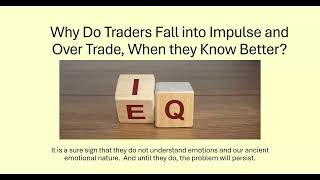
Emotional intelligence. We have a lot of iq. That's what all the people do, they do all this studying, they know their charts, they talk their charts, they learn these things, they get a lot of coaching about how to interpret and they finally get the moment where in the state of mind that they're in a coaching session, they know those traits. When they know they're in a situation where there's not risk, they know how to execute, they know their process, they know everything. They have great knowledge, they have a great iq. But what they don't have is EQ emotional intelligence. They don't know how to use emotions to create a mind to engage a moment in time. And ultimately that is the big, that's the big breakdown ultimately in the lack of emotional intelligence which fortunately can be learned. We take all that knowledge and render it useless in a moment of passion, in a moment of fear, that really critical moment. So what we're doing is say, well how I know how to trade and I know better than to fall out of my process. I know to trade.
My edge. I do, I do. But then what happens is. I don't know what happens, Randy. All of a sudden I'm jumped into a trade and I can't stop and everything goes crazy and I have blown up. I've blown up whatever I hadn't protected. And so we want to do is say, how does this happen? And in particular.
What we want to do is recognize that we've got to understand emotions very differently than we currently do because they're the key to our ancient emotional nature. Unless we know about that ancient emotional nature, it's going to, the problems can persist. It's going to gobble us up. So what we're doing is saying the very first thing. When you look into a mirror, you may be seeing a human being in the 21st century, but what you're actually also looking at, if you know what to look for, is something that has only 2% difference genetic makeup between you and chimpanzees. That part of you is present too. And what we want to do is say, okay, are you saying there's an animal part of me? I'm saying not only that, but I'm saying is that animal part part of you? That reactivity from an ancient brain that has no idea what thinking or is that gets in the way and particularly overtrading is a problem for the Alpha. And a lot of people say, randy, how can that be a problem for the Alpha? Man, that Alpha wants to win. He's making things happen. He's already, by sheer will, he or she has already created a lot of wealth from either businesses, corporations or athletics or whatever. And you would think, oh, man, he's really got the, he knows those success rules. And yet at the same time, when you take that same success that has been used by those success rules, you move that mind to trading and you discover something. The rules of success in trading are very different than the rules of success in ordinary businesses and ordinary life. They're very different. And unless that Alpha is willing and ready and willing to do some emotional lifting, it's nearly impossible for him to develop a particular mime that is probability based rather than certainty based. So the Alpha, the Alpha just doesn't have a few problems with blowing up bad trades. He blows up accounts, he blows up worth. So we're getting there and now we're going. Okay, what I get is the Alpha. What Randy's saying is the Alpha inside me may be part of the problem. And understand.
This isn't saying that you weren't born and raised in a perfectly okay, enough family. You know, most Alphas Grow up in competitive families. And it's natural to be competitive. Yet that same competitive spirit brought to trading will get you in trouble. So we're beginning to look at it. What does the alpha need to do in order to be able to make some corrections in the way that he brings a mind into the moment of trading? What happens? Because ultimately there are really incredibly deep roots for this problem that blindsides alphas in most of us. We've talked about that ancient brain, and what happens is that in this illustration, what you're looking at is kind of a geeky guy driving a car, and he thinks he's in control.
You know, he's out thought himself. But then what he doesn't recognize, he has detached himself in a superficial way from his emotional nature. And that emotional nature has not only been there since we were Homo sapiens 200,000 years ago, not even when we became humanoid, oh, 6 or 7 million years ago, maybe 8, but all the way back 120 million years when we were little scurry little creatures running around with dinosaurs. We're social mammalians and we tend to look at the world through that and we're fear based. And ultimately the geek is okay with all that thinking until there's trouble. And all of a sudden that caveman brain of yours activates and just shuts down. The thinking brain. That's what's happening. And it's nature and nurture that's contributing to this surprising thing you've got. You carry all this caveman stuff from our ancient survival brain, and it's seeing you risking capital as something dangerous to life. It's seeing, taking a loss is really dangerous. It's like being attacked by a tiger. And also the thing is, is that the thinking brain does not see that brain sitting in the background waiting to be activated. And that's why you get hijacked. And what we want to do is say, you know something.
We see the genetics, but we also have been socialized that way. So we've got, we've got this problem. And the deal is understand human beings and every other animal on the face of this earth, including plants, is highly competitive. That's the one thing that, that's the one thing that happens in evolution. Evolution is going to put the pressure on you and you're going to have to compete for adaptability to be able to survive in the world. It's not the fittest, it's not the strongest, it's the most adaptive. And what we've got is we come, we carry that ancient brain from the hominoid, the one that kind of looks like that chimp on the left end of that illustration. And it carries us all the way to where we became homo sapiens. And it came us to where we became into the computer information. The deal is that hominoid is very much sitting in the same seat.
As the human. And when things get really tough, when things get risky, when things aren't happening, that part of the self takes over. This, at one time was a way of surviving because we lived in highly competitive world, we had to figure out how to adapt to survive in that world. And it hardwired in and it's passed on genetically. And then it gets socialized into us from in our families. And then it so happens, all that success, then you go to trading and you think, oh, I know how to be successful. And you get there and you find out that all that engineering that nature has done and that maybe you have done is now a liability. So now we're saying, okay, understand.
If our human ancestors did not control outcome, he and the whole clan became somebody else's meal. This right here is cavemen 40, 50,000 years ago going shopping for dinner. And all of a sudden you realize, man, it's dangerous. It's really dangerous. You can begin to see that a few men looking at that mammoth going, you know something? All we have to do is take this thing down, and then we've got food for the clan for a month. It's just going to be a glorious thing. But look at those tusks. Look at the size of the animal. People died every day trying to procure food. And that caveman had to believe in his heart of hearts that he was going to survive and was going to win against formidable odds. It got to be so successful that it wired in its trait. So we really, truly believed that we could win against all odds. And that's the same thing, is, you know, when you look at a really successful trader and you look at him and go, well, he's, you know, look, he's just, I can do that. I can do that. I can make myself do that. When in fact, only 2 or 3% of consistently profitable traders, and only those 2 or 3% are actually making, really making the kind of money that everybody dreams that. And yet we think we're going to go do it against all odds. You know, some. Some expert traders simply were born with the right genetics. Other people learned, okay, most humans are not going to come equipped. This is what the alpha came equipped with. He's willing to risk his life. Because if he takes that mammoth down, he gets enormous prestige, he becomes a leader, he's got respect. And he also gets the first dibbies, and he also gets is first in line to project his genetics into the future successful evolution. And out of that, what you do is you get a guy or a girl that wants to win, wants to make things happen, has a will that says, I can make this happen. And they're wired that way and it's produced success. And then you get into a situation like this where the very success that you learned back then then becomes a liability now. But you can also see how it got genetically encoded into us and passed on to generations. And here you are. The good news is this, you are the animal, the Homo sapiens that can actually go about changing very core genetic patterns and beliefs into more functional, adaptive ones by choice. Animals like my dog, my cats, this woolly mammoth, they can't do that. They can't think about it and then say, well, I'm going to set a program up and I'm going to be. I'm going to re habituate my. The way I perceive the world. No, can't do that. Humans can, though. So now.
The other thing about Alphas is they want to make money. Not just money, because, yeah, I like to have money. No, it's power. It's the power of safety. It's the prestige, actually. Your caveman has no idea what money is. If you just put a zillion dollars right in front of it, it wouldn't know what to do with it, except maybe burn it to start a fire. But all of a sudden, when we cross that thing between the ancient brain and the modern brain, money is about your power, your personal power to manage things to. It's about your power to be safe. It's your prestige. It's your standing in the community. Yeah, that's what you're looking at. And suddenly money becomes a big deal. No wonder people freak out. Money and life itself have become linked. Your power to survive is linked to money, and you're risking money. And whether or not you believe you're going to win or not. Okay, this is where we've gotten so out of this. We see some problems, okay? And the main thing is that all this programming, what happens is that in trading, you do not have control over outcome of winning and losing. You want to win. And some of the biggest mistakes that people make, particularly alphas, is they say, I'm going to make money today. You have no capacity to control whether or not you make Money or not, if you're a really good trader, you have an edge that is going to extract more capital out of the markets than it gives back in over time. Whether or not you're winning or losing, you know, you can have everything go right and still be wrong and lose money. You can do everything wrong and still get lucky and win. But that's between gambling and fear. Now this is a bias built into us. And the Alpha continues to believe that he can control outcome and yet understand he has every right to. He's proven he can. By sheer will, he's created this world. And so if you were to give him proof to the contrary, it wouldn't, it would just bounce off of him like a, a rubber bullet. So this is the tragic flaw that is going to, has to be corrected for you to become a successful trader. And it's not like I said, I want you to understand this is not something bad. This is something that at one time the brain organized and adapted you, your potential into a self that could survive in a particular world. It was that successful. Now what you're doing, if you're smart, if you're emotionally intelligent, you're recognizing that the mind that got molded for success in one domain now has to be re molded, re engineered for the success in a completely different world with way different success rules. So that's where we're at. And you know, out of that.
The other thing is that Alphas believe.
That they have the power to make things happen. What you're looking at is a statue in Lisbon, Portugal. And it just so happens that this guy in the 16th century brought a lot of reforms and he was thought of. They associated him with the power of a lion because he was able to change. And what happens is it may have looked like he changed things, but what happens is that in trading, again, that doesn't work. You may have that lion in you. And certainly in the work that I do with archetypes, a very common archetype for the power of a ruler is the male lion. With that big, huge mane, it looks regal, it feels regal, it has power. And we certainly can understand how we would want to associate ourselves with that kind of deal. But the thing is, what you're looking for a different kind of lion. Instead of the line that you, the African line here that stalks, attacks and takes on big losses, what you're looking for is something like a cougar, the North American lion that hunts from trees, waits for the prey to get beneath him, drops down 15, 20ft, tries to snap the neck. And if he doesn't, he does not chase. He climbs back up the tree, sets up for the next setup. He's willing to take small losses. He's a solitary, he's a solitary hunter. He's not a group hunter that can repopulate capital supply. But this is the thing is you've got this idea is I can make things happen. I can, I can do this. I have the power. And the truth is what happens is in trading, no, you don't. In trading, much like the cougar, you take what the forest, you take what the market is willing to give you. You don't go making things happen. It's a completely different thing. And you can see how that type of trait, making things happen, can become the big, the albatross around somebody's neck. Because ultimately in trading, you truly are humbling yourself. And you're saying.
I'm an ambush who hunter. I'm waiting for somebody to show up in the setup. And if it's not right and I've already pulled the trigger, then what I'm going to do is I'm going to take the small loss, get out and going after and keeping, I'm keeping that up because I know that if I put the numbers up, the edge will be there. So now we've gotten this thing and going, okay, we begin to see that. And ultimately here's the deal is the alpha at first, if you're looking at an alpha trade, this is a. I hear this. Variations in this story I'm about to tell you all the time is that the alpha has a plan. He knows exactly what the, his edge is. He's ready to execute that edge and he starts trading and perhaps he gets one early and he does really well, makes money. Oh, he's got, he's there. That right there is an emotional trap that he fell into. Now he's feeling good and he's sitting there waiting and then waiting and then waiting and waiting and darned. The setup just is not going to form, you know, and he's just sitting there and he's getting bored. He wants to make things happen. And so he says, I need to back off this thing. I need to, I'll get, I'll get some emails, you know, I'll talk to people, I'll do some other things and I'll go, I'll go surfing while I'm at it, I'm just going, oh, you know, here's another market. Let me just see what's going on there. And before you know it, zoom.
The alpha has slipped, okay, into overtrading. Just like that. It happened in a nanosecond, at the blink of an eye. That's how fast that caveman woke up, took over thinking mine and took over the direction of the mine in trading. And all of a sudden he sinks. That's the deal, friends. And what I just explained to you, if it's happened to you, just think of yourself as a normal alpha Alpha. You don't even have to be an Alpha of this to happen. But the thing is, I want you to recognize. Wow, it happened that fast. Yeah. In the blink of an eye. In a blink of an eye. So the deal here is, what we want to do is say we have to reshape the alpha mind into a probability mind. Okay? And the alpha mind, understand, the alpha mind, what does it want? Wants to control outcome, wants to control winning and losing. It wants to make thing happening. And it also believes money is mattering. If I make money, I have power. I matter. You know, at the same time.
Until you convince yourself that alpha mind is not going to produce success in trading, no change is really possible. But what I'm asking you, most of the people who work with me have been trading four or five years and they've discovered that they know how, they know how to trade. They just can't trade when winning and losing is real. When you know, when it's got tread, you know, it's really got, it's got traction on the road. And so that's when they say, well, how do I start trading? Then they, of course they do all the visualizations, the affirmations, all the more willpowering and writing things and just trying to believe, believe. And that doesn't work.
Something like that might work, but the thing is, is that you have to get into your internal strengths. You have to find the beliefs that are driving. You have to be able to change those to produce a completely different mind, the probability mind. That probability mind, you control process through your edge. You have an edge that you're replicating. When you see a setup show up and, and it's one that matches your criterion, the professional trader is taking 70 or 80% of those. Okay, you don't know. I'm only going to take a few because your edge breaks down. And then what you also have to do, you have to accept, you have to come to acceptance of limitations of power. You do not have power over outcome. What you do have power over is the mind that you bring into the moment.
Of acting and trading. That's what you have and that's a big one. That's a huge one. Okay. So if you do that, you can drive your edge. It's kind of like if you took a Formula one car and put somebody like me in it and said drive it, that, that it's not going to happen. I'm not going to be able to. I'm not going to be able to do a Formula one car. That's why the driver is part of the racing team. It's part of the car and the driver become one. And that's what we're looking for. By accepting those particular limitations, what we realize is that, oh my gosh, I see that I've been trying to force things to happen. And what I need to do is go into a patient state of mind. I need the patience to wait.
For the markets to show me what it's willing to give me. I know, but it's so far against this thing of like, make things happen, urgency, make things happen.
Different rule, different universe. As a trader, success is that of a cougar. It's not that of the stalking lion. If you took the, if you took the stalking lion and put him in North America, he'd starve. However, and they're both built for these environments. It just so happened the environment called trading requires patience. And the massive thing that you have to do, you have to separate your performances, winning and losing, from your being one of a close friend of dwarves. And I is one of the more successful traders in the world today. Well, in. His net worth is well in excess of 2 to $300 million. And I asked him, well, Mitch, where did this happen? He said, oh, I can tell you exactly what happened. He says, back when three quarters of a million dollars was a lot of money to me, I blew everything and I made some mistakes and I blew three quarters of a million dollars. And that was rent money, that was food money. That was a lot of money. And I knew that I had to tell my wife and so I went to tell her and I, I tried to not tell her, but I did. And I thought she was going to kill me. I thought she was going to leave me. I thought she was going to just get angry at me and all that, but she didn't. What happened is she started crying. She hugged me and we cried together. And Randy, what I got out of there. It's come. Win or lose, I'm still loved, I still belong, I'm okay. And that's where he was able to get past the alpha mind that needed to prove himself by Performance to the probability mind where he knew that the real power lie in the mind he'd bring into the moment. Okay, that's the deal. So now we see what that, what we need to do and the deal is what we want to say is you know, what we have to accept. And if you haven't, I'm okay, keep trading and spend another year or two people will find that brick wall and they're either going to figure out how to crush through it or they're going to understand that there's an easier way. The truth is that the mind you bring to trading is not going to be the mind that's going to bring produce success in trading. That has to be, that has to change. Your alphaness has to be able to face reality. Because the truth is, understand we have this bias in us that even we, we believe we're going to win against all odds even though the odds are really stacked against us. And that comes out of our caveman days. The reality check is your trading account. It's going to show you as a constant reminder, you know, whether or not the beliefs that you're projecting onto the, on the, onto the markets are actually effective at extracting capital from the markets or not. And in the same way is that if it's not extracting capital then you have beliefs to, to be able to burrow down to, to find, to reconstruct into higher performing beliefs for probability mind, for probability success. So ultimately this is all about your beliefs about your capacity to manage uncertainty. That's the missing piece in the puzzle of successful trading. And the real question is.
Are you motivated to change this? Because what I want to show you.
This is a graph that everybody, a chart that everybody should know like the back of their hinds, is that ultimately trading is a three legged stool. You have to have a trading system that works. You can't have a platform that keeps failing you and stuff like that. You have to have that, that's part of trading. You also have to have a methodology of managing risk to be able to have to have an edge in the markets that allows you to extract capital more than you put back in. The thing is this is where people get stuck. They think if I have these two, there's nothing wrong with me, I've got a good successful mind. I can ignore that. But the trading psychology, that's the deal is again, what I'm telling you is the mind that you brought to trading is not going to be successful in trading. You're going to have to tweak it you're going to have to really change some of the fundamental beliefs. Yet men folk in particular, alphas in particular, have a hard time accepting that there is something amiss. They will cover it up. They don't want people to see it. I would say it's their vanity. At the same time, they want to see it. And I've actually had people say, you know, Randy, I was trying to get some people to talk to you, but they said, oh, no, I can't do that. I'm not going to have some shrink find out there's what's wrong with me. No, I'm going to hide it. And what happens is, boy, is that a good strategy or what? But this is it. Trading system methodology. And then your trading psychology, it is going to have to be developed. It is because you do not by sheer force of will.
You do not control outcome by force of will. And intelligence of working with charts is not going to do it too, because that caveman is sitting the back. Sitting the back of your vehicle in the back of your mind waiting to trigger to either opportunity. That's that woolly mammoth, that. It's an opportunity, all right, but it's a dangerous one. Or to fear. Okay, this is what we have to do, is we have to look and say, how do we change that? And you know, out of that, what you discover. This is when I always like this illustration, is that, you know, at some moment you finally wake up and go, oh God, Randy's talking about this evolutionary self coming up through evolution. I want you to stop, stop, stop following me. I want to disconnect myself from all that evolutionary history so I can trade. It doesn't work that way. It doesn't work that way, friends. What happens is that the programming that has been inherited from ancient times has to be disrupted. It has to be rebuilt for you to be able to trade well. And until you accept that, this ancient brain of yours has enormous impact.
Over your mind, particularly in stressful moments when money's on the line. That ancient brain immediately goes back to think that sabertooth tiger is just on your tail and that you're going to have to fight for your life. That's what that caveman brain thinks when you're risking capital. It doesn't see the capital, it sees the risk to life. So this is what, this is what you're up against. And this is what has to change. Now what happens is that this trading mine truly has to be re engineered. It has to be rebuilt and in its organic substrate. It's not like you can just put in a missing part and then that's that. No, this is organic substance. You have to grow neural networks and you have to learn how your biology, your brain, emotion and cognition work together to produce the trading mind. That's emotional intelligence. You also have to learn how to effectively develop your mind for trading. That's a big one if you grasp it. No, your mind's not going to be right for trading. You're going to have to really develop it. Even great athletes learn that they find the best coaches they can. I'm a big fan of the Georgia Bulldogs. And what happens is a lot of people go there because they know that they're going to be put into a system that teaches them how to play at a professional level. And that's why one of the big recruiting things that they have there. So the thing is, then you're going to have to have the courage to change and to recognize that. I may be comfortable believing this reassuring lie about my alphaness, but the truth is that I need to face the inconvenient truth that I have to rebuild. And then you have to take responsibility, friends. You just truly have to take responsibility. Because ultimately, if you were to take a look at this, you're sitting there in the trading mind, okay? And emotion, it's a biological action potential. It is biological. It is not psychology. It takes over your psychology. And that trading mind comes forth from the emotional programs that drive you. And remember, all thinking is emotional state dependent. Your beliefs and the belief is at the very core of the emotion. If you're feeling threatened, you believe that you're being threatened, then what happens is one set of emotions grow. If you see opportunities showing up, other emotions start getting there. And then what you believe is find that it's also connected to your biology, your brain. And out of that biology comes the brain. Out of that brain comes the trading mind, that space of where the beliefs and emotions come together and act like the trading mind. This, friends, is what you're going to have to learn to do. It's not easy, but at the same time is that it's the way out. And I have found it to be a very successful way to get out. So how do you change them? How do you change this? You know, our process is pretty simple. The very first thing is you begin to understand emotion very differently than you had learned previously. You know, emotion is biological action potential. It's not a feeling. A feeling is one small little part of an emotion. And we try not to have emotions. Well, that's impossible. Unless you're dead. The deal is, how do you use emotions to create the mind for the probability mind? Very first thing though, you have to learn emotional regulation so that you can disrupt fear and impulse and you can stay in a cognitive state rather than an emotional reactive state. You have to develop mindfulness as a tool to open the door of the mind so you can courageously look inside and see what's wrong.
You're going to have to wake up to that internal dialogue. You're going to find an inner critic living within you. You're going to find an adaptive voice living within you that are doing your trading, not the empowered parts of the self aren't doing it. You're having problems in moments of stress. That that internal dialogue, that orphan nature, that adapted voice and that inner critic that is egging you on to make a mistake is there. And you're going to have to first see it because most of us have trained ourselves not to see this dark side of ourselves. And you're in trading going to have to go master it. And then you're going to have to, you're going to have to find the empowered elements of your personality. You're going to bring them into awareness. I call those the discipline of radio ruler, the courage of a warrior, the self soothing of a caregiver, and the clarity, the clear thinking of a sage. Those are all emotional programs that have been with us before we were human. Okay, the last thing is you're going to have to start intentionally developing the internal, internal dialogue for people, performance trading. You're going to have to, you're going to have to confront old beliefs that strongly hold you in certain patterns. It's a struggle. I call it the internal struggle. That's what you're going to have to do. So out of this, well, how do you start doing it? And actually using your trading iq, okay, that's all that knowledge you have begins with developing your emotional intelligence. And that's when you start managing the link between your biology, your emotion, your brain and your mind. Okay, this is it. And your emotional intelligence has far more impact on your life than your IQ. All that knowledge is useless. 90% of that iceberg is below conscious level. You're going to have to dive in there and you're going to have to rebuild stuff that you're blind to. And that's all. Now to do this though, how are you going to work with this stuff that you just heard about? The very first thing, if you understand the elements of an emotion, you really begin to understand how you can approach this problem and how you can master it. The very first thing, the element of the emotion that grabs people, the one that really notices arousal, the emotional arousal, the body is cranking up all of a sudden. If you were to look in the mirror, you're holding your breath, you're sitting there and you're tense all over and stuff like that. You're, you've already compromised.
You already compromised. You're looking at the tense muscles, you're looking at the holding of breath. That is the emotion having triggered is already beginning to develop energy and ready to explode onto the scene. The second thing is you're going to need to understand emotional motivation. Does it want to attack, avoid or approach? I promise you, if you're trying to avoid, that would be fear based trading. If you want to attack, that would be the opportunity. You know, attacking like oh here's a bunch of money or attacking like revenge. The approach is what you want. You have curiosity.
The phenomena is not triggering you one way or the other. You're, you're in a patient, disciplined, impartial mind as you approach opportunity or potential loss. The meaning, the meaning is a self feeling belief that gets associated with the emotion. And I can tell you this is that they're really easy.
You don't have to horse around with them. They're about mattering your sense of mattering in the world, your sense of worth in the world, your competency in the world, your sense of belonging and your sense of being loved. That's what's triggering all the problems in your trading friends and you're trying to ignore it, it's not helping. So you're looking at it and going, oh, that's the I can't win, I have to prove myself. All that stuff, that's belief and it's infesting the kind of thinking and the emotional nature you have when you hit all that stuff. The flak of trading, the next thing is feeling. Now that's the subjective experience of the emotion in the body. It's actually the chemistry of the emotion in the body altering the way you perceive reality. Remember, all thinking is emotional state dependent. So that feeling not only is the emotion in the body as chemistry. And the last thing I really don't deal with very much is temperament. That's your genetic predisposition. There are some people that have a really anxious potential temperament and it's best that they not trade. There are some people who can't get past the gambling gene and they don't need to trade. So we've gotten this now we understand the elements of an emotion, then comes the skills. The very first thing is we are looking at to interrupt the emotional arousal that comes with emotional regulation.
You would look at it as when you hold your breath or you breathe very rapidly. When your muscles get tense in your neck, your jaws, your shoulder, you become fixated, you can't see anything else. You're in tunnel vision. Okay, that's dangerous. When your pulse is pounding, it's increasing, you have increasing energy. I gotta act. I then react to thinking, oh my God, what's happening here? That is what you're learning to do in our program is you're learning to use breath and tension reduction to slow that down so that it doesn't get intense enough to flood into the body, altering the mind. You bring to the management of uncertainty.
It's not going to solve the problem. But if you do not have emotional regulation skills, you're never going to get to the door of the mind and you're going to get stuck there getting shot up at the OK Corral. But this is how you do it. Okay? That first thing is emotional regulation. Learning how to do bellows breathing. Do it as and habituate it so that you normally. The normal way to breathe is diaphragmatic breathing and relaxing the tension in your muscles. First thing, second thing, second skill. You're going to have to develop.
You're going to have to develop the observing self. I don't know if you've ever noticed this, but you and your thoughts are not the same. Most people's observer has merge fuse so much to their thinking that they think their thinking is their thinking. It's history, friends.
If you step back, you can start getting this sense of separation and you can begin to say, you know something? I begin to realize that my beliefs and I are not the same.
My emotions and I are not the same. My thinking is not the same. And what you discover is that all reality is observer generated. And what you need to do is you need to develop the observer first by waking it up and having it active. And I can tell you in a consumer society, the chance of somebody wanting to awaken your observer is slim and ain't nothing. Okay, is that I'm from the advertising industry and the one thing we didn't want was people actually becoming observant of themselves. They wouldn't need all the stuff we were trying to peddle to them. So we've gotten this now we've gotten to the point of where, where we've gotten observation on board. Then the third skill that I teach is actually observing the internal dialogue. You open up the door of the mind. You're looking in and all of a sudden you're realizing that the mind, the space called mind, is really more like a number of voices within the self and they're special interest groups and they're electrical in nature. It's weird. And I call it the committee of the mind. Sometimes that committee can be good, but sometimes it can be very destructive. You're going to need develop it to be able to look and start discerning who's running the show under pressure. Okay. And most likely it's not the good guys, it's guys that you're going to. It's fear based thinking, it's aggression based thinking that you're going to have to alter. Those are actually emotional programs that have been given voice in your mind. If you want to see a demonstration of that. Inside out, an old Disney Pixar movie, does a perfect job of being able to describe how this emotional programs give rise to the thinking brain and gets the little girl in a lot of trouble. But more than that, once you open that mind, start looking in, I want to tell you, you're going to find something called the inner critic. That's that voice that judges you. It's the one that criticizes you. It's telling you you never measure up. You're not good enough. It tempts you. Need more. Get greedy. Come on, take more. Take it. You can do this, you can do that. Yeah. And it's constantly predicting doom. Oh my. If I get in this trade, it's going to go and you'll hear this. It's not like you, you know, you have to be absolutely deaf not to be able to hear the voice of the inner critic. You probably just thought it was you. No, that's the biggest deception of all. This is a voice within the committee of the mind that is highly destructive. And it's not going to go away. But you're going to have to master it. Then there is what I call the adapted voice. Carl Jung called it, called it the orphan. And it goes from a victim. Oh, can't it win? The doubter. Oh no. Godly. Everything bad's going to happen. The gambler. I'm just going to. I'm going to win against all odds. The perfectionist. You know something? If I do everything right, I won't be wrong. The entitled one. I have spent so much money training myself, it owes me to make me a successful trader. The con. That's when you lie to Yourself, you don't take any personal responsibility for your results. And that in fact is what you have to do. The fraud. That's when you begin lying. Not just to yourself, but to others. You pretend to look good. The orphan. That is the manifestation of your aggression or your fear. The saboteur, that's the one that blows up things just when it's beginning to look good. Happens all the time. That's when you blow things up. You've been on a big good run, you know, you made some good money and then you give it all back and then some. The alpha, the one that we've really been discussing, that's the one that wants to prove it's a winner. Wants to prove that it has the stature, it has the will, it has the power to control destiny. Friends.
Everybody has those running around in your head. The problem is most people don't recognize them. The fourth skill is using mindfulness to develop those indwelling resources for your potential. And what I want to do is I want to show them to you. In you. The ones that we teach in our group course and in our individual course is the courage of a warrior. Instead of running from the inner critic, instead of running from what you don't want to see, you have the courage to turn toward that dragon. Only by turning toward the dragon can something reveal itself that you can learn how to work with. You have to develop the discipline of a ruler. The ability to maintain order under pressure and then or nothing happens. The ruler. The discipline is the baseline emotional program that has to be developed. You also have to develop the self soothing of a caregiver. You have to be able to calm that fearful self down so that it doesn't just become an 800 pound caveman gorilla and taking over stuff. If you do those three things, if you develop those aspects of your being, what you will start having is the impartiality, the clarity of a sage. And that is who you want.
Deciding what trades to work and to move and stuff like that, that's what you want. But it has to be done with impartiality. It has to be done with clarity. These other elements have to be there. Friends, this is the.
This is, this is the mind that has to be developed. It's the minimum stuff. It's what we teach in our group course. It's what we teach in our individual course. And the deal is, I don't know why this isn't taught. I really don't. It has been, you know, from my beginnings of training, working with violent criminals and Doing emotional control for them to what I'm doing today. I have never seen people use the archetypal biological program approach to do.
Makes a lot of sense. It helps you to really recognize it. And the truth is that these are aspects of your being that are there inherently. And what we do is we have a specialized way of teaching that you do not dream them up or visualization or affirmations. What you do is you experience the knowing, the certainty that these emotions have been there in crisis and you're just learning how to route them so that you can pull them up at will. So it becomes a skill, powerful. So, friend, the deal is this skill five, it's for lasting change. You have to intentionally build the committee of the mind, okay? And.
It'S a struggle. You have to acknowledge that there is a lot of bad stuff running around in your head that you're going to have to deal with and basically reconvert and to rebuild into a powerful mind. It's in you to do that. And the real question, it really comes down to it.
Who are you going to have in your committee of the mind? Okay? Who's going to populate your trading committee? Are you going to be mindful about it and develop the potential that's there? Are you going to be mindless, stuck in.
Adaptation from another time, in another place that is hopelessly outclassed now? It's always, you're always having the power to say, which of these am I going to take? What I love is when people say, well, Randy, when I start making money, I'll come talk to you. And that's the biggest joke because you're deceiving yourself if you don't grasp that you're going to have to rebuild the mind for probability thinking. You're not going to produce the success and trading that you're looking for. I encourage you to find the mindful approach where you begin to say, you know something, all this stuff dwells within me. I'm the one who's going to have to develop the observer in me to be able to populate my mind with that in challenging moments. It can be done. I see it done every day. That's the trick, friends. Now.
How do you become the change? Is it going to happen just sitting there listening and getting more knowledge and going, okay, I've got Randy's knowledge here. I'm going to go out, I'm going to do that. Believe it or not, I actually, we get emails all the time saying that I've never met these people and they've Done the videos, they've done these things, like here, and they've made good change in their lives. What generally happens, though, you have to be able to start saying, you know something, I need a teacher who can teach this particular material and help me develop these qualities living within myself, so that I have a fighting chance, a real serious fighting chance. That's our group course, Friends. It includes five group meetings with me. It's webinar format and the meetings are recorded because we work internationally and God knows where the people are going to be. And so you're going to be receiving all the recordings. What happens is we go through each of these steps that we've outlined here. In the course of.
How many weeks is 10 weeks? In the course of 10 weeks, that's the minimum needed to be able to actually change a habit. So you've got that. And the class is going to be starting in January 15th. It's going to be a Thursday, 4:30. And friends.
If you're looking at this. Oh, 16th. I'm sorry, January 16th. Thursday.
Yeah. That's the first meeting. That's. That's session one. However, when you sign up, you're going to start really right at that moment. I want you to have three to four weeks of working with Emotional Regulation training before you get to that moment. That is a big key for success. In fact, it's so big for us that we will give you a free gift if you sign up early of Emotional Regulation Workshop. That'll give you. It'll get you so that when you show up, you're not already behind. Because I'm assuming when you show up that you're ready to go, that you've already got. You've already started to habituate the way to breathe under stress. You've got. Bella's breathing down so that you. Yeah, I'm developing this. Yeah, yeah, yeah. Not. Hey, what's he talking about? What's this? What? What courses? I. Am I in? No, we want you prepared. Okay. And we want you to become successful. So if you do that early, you'll get this free thing. And that. I think that's January 1st. Okay? So, yeah, so the thing is, I encourage you to do that. We also have an individual course, and that's for people who are dead serious about this thing. And ultimately, what makes the individual course so powerful is that it is 10 sessions with me over a course of three to four months. It goes through the same programming, but at greater depth as a group course. And it gets into your personal stuff. It's powerful. It's highly comprehensive and personal. So the deal.
Is that.
This is something that if you really want to, to build the trading mind, I encourage you, I encourage you one, if you don't know who I am.
I've got 290 or so videos on YouTube. Watch some of them, start getting in it, get my book, just cruise around and start looking. But ultimately the change mechanisms happen in the group course, they happen in the individual course. That's where the true stuff is happening and you're learning. So what I want to do is I really want to thank you for being here and I hope that you're having a great holiday and I'm hoping that things just work out real well. But.
This is from John, former student. FYI, I have experienced positive results with David Dube and Polaris Trading Group, per your suggestion. Compliment. And David Debay is a friend of mine. Okay. And he's also a world class trader trainer and he's one of the few people that I trust to train people. Okay. So. And John, I'm very happy that you found David because he also have elements of emotional regulation. Oh. Continues. In trading patients, it's paramount to avoid getting carried out on a stretcher.
And then be the patient. Yeah, that's exactly what it is. You have to start with emotional regulation. It all starts with breath. You have to calm things down so that you have a fighting chance. Okay. And this is Thomas. I can't. Oh, Dave. Oh, David Hughes. The market moves based on popularity rather than values, which is the opposite of how I think. Can that mindset be reversed to discourage value? Yeah. The thing is you can move from one mindset to the other if you teach yourself how to do it. The thing is, you're going to have to decide whether or not you want to be right or you want to be successful. If you want to be successful, you're going to have to change.
The motivations that generate stuff. But yeah, you can do that. No doubt about that.
Tomas. Okay. You talked about a brain that is geared to recognize patterns, that is technical analysis, no threats. How do you bridge things like charts, supportive resistance trend lines with probability programming around these concepts or is it not how your program works? First of all, if you recognize that when you're looking at charts, you are not looking at what you're looking at. I had one guy who Christopher is trades with an eight figure account. He can move markets, he can do all that kind of good stuff. And basically one day he's showing me a chart, he says, you see all these lines and Stuff like that here. He says, yes, those are scared traders. And what I'm going to do is I'm going to shake them a little bit. And what I'm going to do is I'm going to set suck their money. So I'm seeing blood right now. What I want you to recognize is that when you look at a chart, you're looking at emotional natures of a market and you're looking at people wanting to make money. Whether or not it's popularity or not. I would actually say it's more like herd mentality. Okay. Rather than popularity. But the thing is, is that. Yeah. I mean, if you want to become a successful trader, you're going to have to. It's up to you.
Okay, here's from John. Hi, Dolores and Randy. Question. For years, I notice a constant background noise in my head. Does the brain's electrical activity actually generate a vibrant. Yes, it does. Yeah. It is called the neural symphony. And what you are actually listening to is understand you have 30 watts of electricity going through your brain at all the time. And what you're listening way back in that. Not tendonitis. Now, what we're talking about. Yeah, we're talking about the neural symphony. And you will hear it. I mean, I can hear it right now. And that is your. That's. That is. That is electrons moving at 225 miles an hour in your brain, whizzing past synapses and dendrites. But you're dead on the money. Yes. Okay. J.C. hey, good afternoon, Randy and team. I'm grateful to the trader mindset.
Community. What are some ways one can correct a bad reaction after a trade loss? I grew my small account 41% yesterday in 607 spy calls. I gave it back and then some in another Karl Marilla traits. And I lost my emotional currency. I want to do this long term, but I have an emotional connection to the money that needs correcting. Yeah. Another way of saying this is that your caveman brain does not recognize money. Your caveman equates money with living, your power to survive. And what happens is when you're the money sitting there and it turns out at risk, and particularly if you've made some money, you know, suddenly you're scared of either losing that money or you're all hopped up on dopamine, which makes your mind putty. And so you're going to have to learn how to control all that. No doubt about that. Amanda. Hi, Randy. Thank you for this opportunity with this webinar. Does your program focus on recognizing and disrupting the primitive emotional mind in real time are preventing the base belief that triggers the primitive brain emotional response. You cannot separate the body from the beliefs that are held. The belief is actually a part of the emotion. So it's a glob that's fully integrated, not separate. So ultimately, what you're doing is that you are learning how to bring a particular mind into the moment. Okay. That.
As long as you're in that state of mind.
You are calming that orphan nature of yours through what I call the caregiver. And you're calming it down. You're also protecting it by the warrior from the inner critic. So what you have is you have a much calmer mind that you can move from attack, avoid motivations to approach. But the thing is. No. The belief and the biology are all happening together. Okay, here's Nicholas. Today I noticed when I was in a trade and Price would pull back even a little bit, my thoughts instantly went to questioning my decision to enter the trade. I would question if I missed something or. Yeah, I've got all the things. The deal is this. This I business has to stop, Nicholas. You know what you're saying? What you're saying is that, Randy, I don't have control over the mind that I bring. I don't have control over the committee of the mind that I bring into the moment. Is that my observer has totally fused the historical self. And I call it I, because I don't know any better. I can't see that I think these are my thoughts. They're not your thoughts. The deal is for you. You're going to have to be able to separate who's who in your mind. Okay? Martin Heidegger, great existential philosopher, once said, man is born with a thousand voices, he dies with but one. What we're asking you to do is to take the I away and start recognizing. With emotional intelligence, you can decide what mind is going to engage those moments. And you'll quit talking about I. Okay. Why do you think my mind would quickly turn to blaming and doubting myself? Because you're trained to be that way. It's part of your evolutionary history. It's probably what you learned in your family of origin. And what is an internal dialogue that I can integrate into combat? My way of thinking, Nicholas.
I would go to my website in particular.
If you've gotten my book. Read it because you're glaring. Got some stuff you really need to see there. Okay. Is that the internal dialogue is just special interest areas of your brain, Emotional programs that are competing with One another for dominancy in your mind. Okay. That's what they are. Now I have a more poetic language I use but that's ultimately what it is. And yeah, you're going to have to learn to sort that out. You're going to have to be able to say, okay, you know something, I need to sort.
All this information that seems to be happening and I need to find out what mine needs to be there. Okay. This is Bill. Hi Randy. First, a merry Christmas to you and Dolores and family. Thank you and Merry Christmas to you. When I am out of practice trading, I will sometimes place small trades knowing in advance that I will likely make only a small profit or loss. I do this to reduce the fear that a trader. Well, since when they haven't been doing their recent best. Yeah, that would be a good thing. Do you think that this way this will at least partially help a trader keep that fear of trading under control? Yeah, I do actually. When people start working with me, I encourage them to move to micros and so they can't take pounding because I know that these psychology that I'm teaching them is going to be just like really tough for them to get.
Excuse me.
And so, but once you do that, what I like about your idea is that you're coming back, you're rusty so you're putting, you're making sure that you're not, you're not risking your arms and legs. You know, what happens is you may only lose a finger or something like that. But the thing is in doing that, yeah, you get your, you get back to practice, you start getting the game, you get back into the, you start elevating the mind again. Good plan. Here's okay. Leonard. Hi Randy. I just signed up and paid in full for the group course. Good for you. Any advantage in preparation for the group course? Oh my God, yes. That's why I hope you. That's why I hope you. Well, first of all, you get the emotional, emotional control workshop. But the main thing that you do is I want you to when you get there, the whole deal is to have your breathing so well trained by January 16th that you can see the tension in your body. You can see that you're stopping breathing and you can notice it long before it becomes problem. And you're sitting there as you trade, you are practicing the diaphragmatic or the bellows breathing so that you, as long as you're doing that, you can't go to fear and anger and you have a much better chance of maintaining the mind. And that is Key it is rote training. You have to habituate it. You'll have decades of doing it a different way. That sets you up for emotional hijackings. So yeah, man, jump on the stuff. Practice.
Yeah. Just focus on the emotional regulation. There's no reason, if you bought paid for the whole thing, you don't need to go forward. I want you to learn to breathe. And I can promise you, if you're a trader and are not already consistently profitable, your breathing is part of the problem. Okay. This is. Rachel.
Is dopamine in my body that caused me to over trade? If so, how do I manage it? Rachel, dopamine is reward chemistry that is set up to reinforce, start and reinforce habits. And often when we use an external reward, we call that addiction. When we use thinking process to that, we call it a compulsion. So what you're doing is you're saying.
I'm not sure. Let me, I want to read that one more time to over trade. Oh, yeah, yeah, yeah. That's definitely actually what you. Dopamine has a very strong.
Familiarity with cocaine. Okay. So ultimately, as you trade and you start winning or just start getting up there is what you're doing is you're snorting cocaine. Okay, that would be the poetic way of saying it. You know, what you're doing is you're activating the dopamine that is saying, oh yeah, you've got it, you've got it. Yeah, go, go, go. Yeah, yeah, yeah, you're going to win, you're going to win. Whoa. And what happens is dopamine is not allowed to very much of extent in a trading mind. Okay, here's Troy. Hi, Randy. If someone approaches your program seriously and diligently works to complete all the exercises in the program, what is the average time you have seen for your students to internalize and recognize these changes? That's a great question. I have seen people that, well, these are guys who were not married, didn't have children and had enormous time. I have seen people.
In two months completely rearrange their trading mind. Don't think that's a norm. We set our individual program at three to four months. We set our group at two and a half months because what we know is that's enough time to start the habituation process. We also know that the group, we, we actually, when you join the group, you pretty much have access to the, to the exercises and to the program.
For the foreseeable future. And it's available 24 7. We know the first time you go through the course, it's Going to seem like it's going 150 miles an hour. We want you to. You'll also get a free audit because we want you to take it. Later after you've really worked on this, you'll notice that it slowed down considerably. But it takes, I think if you really look at it, three to four months is. I base that on an addiction model that I would have from my therapy days because it took about three months to get the brain clear so that you could start teaching it. And I'm wanting four months to be able to have a month where you're laying down good stuff with you. The thing is, is that. Let me read that. Exciting the program every time. Oh, I actually, what I have found honestly is that it really takes a person diligently working this day stuff about six months to affect that kind of change. And what I do is with my individual people, I have a follow up in two months. And it is very often that they have stepped off the wagon because they get lazy. They start. Yeah, the diligence is everything, man. If you can stay diligent, stay the practice, stay the course and realize that you're taking an organic substrate and you're, you're getting it to change beliefs, that's all happening at organic basis. But those are numbers that I give. Last question from Joseph. Okay. Hi, Randy. Thank you for your time and sharing your knowledge. I appreciate you. Thank you. What kind of inner dialogue can I adopt in order to get over self sabotage? Well, self sabotage, first of all, the, the wound in there, that self limiting belief is going to either be that I don't deserve to be making this money, okay. And that's what we're going to have to get at, or I am, I'm going to hit the jackpot. And that causes you to have a dopamine brain that's going to do terrible things. So it's the, it's the struggle. It's. You have to develop. You need to find the self limiting belief and the orphan nature that's behind there. And most people, they learn it in their families, you know, it's no big deal. Okay. And ultimately you will have to develop the ability to have tremendous compassion for yourself. And at the same time you're going to have to be able to say, you know something, I am going to attend to this arrested piece of development that keeps sabotaging because understand the sabotage is there because at one time it was a successful solution for a problem it was experiencing in living in a family, living in a culture, living in a community. So you have some. You have some work to do. Okay. We are out of time, folks. I do want to thank you deeply for showing up. And I love to be able to basically have the opportunity to spread the word on this, to be able to show you that there. Once you understand neurobiology and the impact of emotional intelligence.
Building, the trading mind starts making a lot more sense and doable. And what you've got is you've got some great opportunities here.
Hey, there you go. And what we endorse, Doris and I, is that you give yourself a big, huge Christmas gift. Get this course, and recognize that it's going to pay for itself for the rest of the your life. Friends, happy holidays and Merry Christmas. Take care.









