Mastering the Urgency to Over Trade
A webinar-style presentation by Randy Howell (Traders State of Mind) exploring why traders overtrade. Howell argues overtrading is driven by evolutionary and cultural “alpha” impulses—boredom, urgency, and the need to matter—then teaches psychological skills (emotional regulation, mindfulness, metacognition, and building an intentional mind) to develop patience and performance. The talk closes with information about group and individual coaching offerings.
Questions this video answers
Randy Howell (Traders State of Mind) — identified in the transcript as Randy (Howell/Cowell) and presented as the webinar host.
Taking trades that are not in your trading plan.
1) Emotional regulation (breath and muscle tension control). 2) Mindfulness (observing thoughts).
A 5-session group course (biweekly meetings, virtual classroom), an individual 10-session program (~$4,000), a September cohort with limited slots, and a free emotional-regulation workshop (stated $200 value) for early sign-ups.
Chapters
Welcome, everyone. My name is Randy Cowell with Traders State of mind. And the first thing I want to do is I want to check to make sure that we can all hear each other. Please type in a Y into the type box just to let me know that you can, in fact hear me. Okay, let's see. Do we have anybody? Let's see. Why, yes, I can hear you. All right, thank you. Well, Finn friends, we are here to take a look at the phenomenon of over trading. It's like, you know, something you think about.
Just sits there and you go, why is this happening to me? I know better. Okay? And we're going to be taking a look at this. One thing about my presentations for those of you who are new, is that I don't answer questions during the presentation. Go ahead and write them in into the chat box and we will actually get to them as we. As we end it and we come to the question and answer period. That's pretty much it for housekeeping. So let's take a look at this thing. What on earth is behind over trading? You know, on the surface, trading really should be easy. Practically everyone by this time has learned how, has worked under either a trading coach or. Or they've figured it out that what you do is you've got to be able to plan your trade. And that planning really kind of boxes things in. And it's one of the big, big first things that stops you from getting over exuberant in gambling. You start there and you go, it's pretty easy. All I have to do is plan my trade and then trade my plan. But almost always, particularly if you happen to have a hint of the alpha, that's the person that wants to win, that's the one that wants to make something happen, and you know what to do. But the moment you get in there, everything falls apart. And before you know it, you're over trading. So what is actually behind this? Well, let's start. Let's start with something where we begin to recognize the problem is just not you. Okay? And your personal psychology, though, that has something to do with it. A much bigger part of the problem is your evolutionary psychology. And you go, what? Yeah, basically what's happening is your evolutionary psychology absolutely primed you for over trading. Your caveman brain. That's another way of saying that. And you think about it. Our ancestors had to jump on opportunity, and we had to jump on pretty risky opportunity at that. And that would be called big game. And despite the risk, it was necessary for survival. And the behavior of attacking those Big huge animals for food for the clan was highly rewarded at the same time. That's our caveman. The problem is that caveman nature of ours. And our modern man, that guy thinking he's in control of the machine, the driving, going and stuff like that, doesn't realize that actually 95% of the decisions you make about taking action in some domain are to do with the caveman brain, not the thinking brain of that urbanite looking fellow driving. And you realize, wow, yes. Just simply by my very nature.
I am primed for over trading. If I am particularly of the alpha. Alpha bent. Yep, that's. That's what it amounts to, my friends. And then out of that. And here I want you to imagine what you're looking at is a depiction of a group of hunters and they're. They found a buffalo or a big cow like thing and they're trying to, they're trying to bring it down because the clan knew needs it. You've already seen one injured. You're looking at people trying to get out of the way. You're looking at all this and these guys are, these are, you know, they're, they're dying, trying to find. To really get up with big animals. The key though.
Being the hunter, being the one that really made things happen. The food supply. There was great reward in the area of status and also access to the babes. Being able to breed and project your genes into the future and from evolution. That's what matters. It's kind of the same reason, like if you take a look at where I'm in the U.S. so you know, when the U.S. is recruiting people into the army and stuff like that, they don't recruit people like 25 and 30. They recruit guys like 16, 17, 18 and 19 because they have that, they have that testosterone. They have that thing of where, yeah, it's kind of really cool to go in there and get into some trouble and really work with it. Yeah, that's what you're looking for. That's those teenage guys about that age were the warriors, were the hunters back in our caveman days. And so you begin to see that this is a setup that we, we, we needed that kind of person built for the hunt, that would chase the hunt, even though there was danger of getting hurt. Losing capital in today's work. So you can. We're primed for it. Wow. Now the thing is, is caveman certainly needed this bias for species survival. But.
There is also something that else came along over time. This became alpha who started wanting to win and not Lose and wanting to believe that you can control outcome. This becomes like a modern man. It's that guy who's our girl that has been successful in business and in corporate, they've been the big guy. They've wanted to win, they do anything to win. They, they hate losing. And you know something, they're not going to take a loss. They're going to push, push, push, they're going to win. It has been greatly rewarded by salary, by status and all that kind of stuff. And so you can understand in that winning they see, yeah, this is the way to win. And they get into trading saying, I'm going to do the same thing, I'm going to do the same thing in trading that I have done in the other thing. And then we can get it. Then what you discover, this is when it gets complicated. This is the way they learn to matter. What you'll discover about alphas in particular.
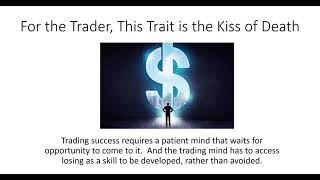
When you really boil down to it, they have to win, they have to act in order to matter. They say, if I make a lot of money, I will matter. And that is what drives them into trading. And they start looking at the money as winning. I can build this stuff, I can take on the risk. And yet at the same time, they don't see that in trading. That's a very dangerous way of doing it. In fact, with the people that I work with, you know, what we're looking at is preparing the mind for the day before you start trading. And a fear based trader, getting that mind prepared is good for 20, 30, 40 minutes. As you move into the trading, the same preparation for the alpha, the one that wants to win, wants to make things happen. That preparation is good for about 10, 15, 20 seconds. So you can begin to see it. Wow, they've got this hook between their performances, winning and whether or not they matter or not. You know, it's the same thing in caveman days. And you're also looking that they begin to develop an urgency where literally 15, 20 seconds, if something's not there and they start getting bored, they start looking elsewhere for things to do that would be the alpha. And for the trader, this trait is the kiss of death. Because what happens is that you do not control outcome. You do not control whether or not you win or lose. You do not control this other thing called prediction. What you do is in trading with a good system, what you have is you have a system that has an edge in it so that you're extracting more capital out of the markets than you're giving back. But it's actually a fairly small percentage percentage. But that's what gets, that's the setup. That's the setup for over trading. It's you. The alpha thinks that they're in control and they can make things happen. They think they're going to win and they do not like losing, which by the way leads to a lot of revenge trading, blowing up accounts and such. And they also believe that they can predict the future with accuracy, like certainty rather than like probability. Now you're beginning to see the really the damage that can happen. Okay. And then trading success really requires a patient mind. And that patient mind is a form of action.
That is alien to the alpha mind. And that patient mind needs to wait for the opportunities to come. Very different than making things happen fundamentally, particularly in day trading. Day trading is the worst nightmare that you could have forced your brain to experience. And you're asking to do it and you're not even trading it, training it so that it can do it. And this is a kind of like, this is really where a way of looking at this would be to understand the difference in hunting styles between someone that attacks, stalks and attacks and another that waits and ambushes. Let me give you the example of the African lion and the American cougar. Both are alpha predators. They are apex predators. The African lion hunts in Africa on the plains and they have large game, they take horrendous losses. You get kicked in the jaw or, you know, impaled by an impala. You know, the thing is, is you're going to have, you're going to die. And what happens is they're constantly losing capital. But what happens, they keep breeding more and those extra lionesses are all. That's the, that's the new capital being created. And so you see that they have built a system that allows them to be alpha, but they take heavy losses. Okay? And we all want to be a lion. It's almost always the symbol of the leader, the ruler, the tough guy and stuff like that. Yet if you took that same lion and placed him into the American forest, the North American forest, he'd starve. Yet there's another big cat, the American cougar, that hunts as far as well, but it hunts differently. It's not stalking, it's not chasing.
Like the lion. Instead what it does is it climbs a tree, sends out on limb about 20ft up and waits. If you were to look at a American cougar hunting, what you would look at and say, God, it's a really lazy cat. It's just laying around no, it's not. What it's doing is watchfully, wakefully waiting for the forest to give it a setup.
That cougar knows the setup. It knows the habits of the white tailed deer, and it's waiting for one to spring into the trap. It's not stalking, it's setting an ambush. More than that, though, he patiently is waiting there, unlike the stalking lion. And you realize, okay, when the, when the deer gets in the trap, in the setup, what happens is that cat comes down, it actually hits it in the head and snaps its neck and the deer falls on the ground. If that doesn't happen, it's a small loss. The deer gets up and runs away. The cougar doesn't chase. What it does is it takes the small loss, climbs back up at the tree, gets out on the limb and starts again, patiently waiting for the next setup. What I want you to look at is both are alphas, both are apex predators, but they have very different hunting styles. And what we're saying, if your hunting style has been like the lion in the past, it's not going to work in trading. However, developing an ambush type of approach like the cougar, it's going to reward you handsomely because you're going to be patient waiting for the setup. And what happens is that when you do take a loss, it's going to be small. Sounds like a trader, doesn't it? Yes. Well.
This personal psychology stuff starts really getting equated with winning and mattering and the blinders. Come on. We start saying, this is what it's like to be a man. This is what it's like to be successful. This is what it's like to be that alpha. And out of this you start saying, okay.
The traitor really wants to win in the mistaken belief that winning will make him matter.
Now, in the old times, it would produce prestige. Okay? I mean, everybody, oh, man, he's a really great trader. Look at that. It also allows him all sorts of stuff. It allows him power, it allows him to feel secure. I've got all this money around me. It doesn't necessarily give you the babes the way the big lions do, but that's another matter. Okay, but the thing is, you notice that you start getting these blinders on and all of a sudden this optimism bias occurs and you really believe you can do this. And there's that thrill.
When you saw those hunters hunting that buffalo. What you're also looking at is they are in that thrill, they have thrilled themselves, adrenalized themselves enough to attack a Much bigger animal. And they're doing it out of that thrill. They think they can win. They have an optimum biases. And in trading that friends is a very dangerous cocktail. This, this anticipation of the thrill of chase that gets the, the trader in trouble. And what does that really look like? Well, when you start anticipating.
Here'S kind of what happens. You first sit there and you're waiting. There's nothing there. You know, you've got your plan and you're sitting there, and you're sitting there, you're sitting there and you start, your mind starts wandering. You get a little bored and you say, well, maybe I'll check out some other, other market, some other instrument, just maybe. Okay, that's the actual right there. You will have rationally known, boy, you can get hurt doing that. But the key though is that sitting there for many people equates to getting bored rather than patient. And boredom is dangerous for the trading mind because you're going to start looking for things that maybe aren't even there. Okay? So you get there, you got the anticipation factor, and all of a sudden you get bored. You get boredom literally is the in the act of doing nothing while anticipating action. You're sitting there and you go, yeah, yeah, I want it, I want out. And so you're sitting there and you don't see anything happening with your hypothesis and your game plan and the trade plan you have. But then you start kind of going, well, you know, I'm getting kind of bored. Let me check out some stuff. My mind starts wandering and it starts looking at other markets because you're anticipating marketing, you're anticipating that action. And the caveman hunting mind wants to be doing something. It wants to make things happen. It wants to feel the thrill of the chase. It wants to hear the crowds cheer it on.
Think about how what athletics are today or what corporate warriors are like. And then you start looking at cavemen. You go, wow, I see it. The key though is boredom is also experienced as discomfort. Okay, again, because you need to be doing something to make that goal. You just can't be sitting there not doing anything. Let me give you an example. I literally, before I came here and giving this presentation, working with a very successful serial entrepreneur who has somehow decided to trade. And in many ways I've had a really good trader say, why on the world would you waste a perfectly good entrepreneurial mind on becoming a trader? They are so different from one another. He's right. The thing is, with this particular entrepreneur, she has built successful multiple businesses.
And yet at the same time, she also holds very strongly that it's her responsibility to hold her entire family up. And if she doesn't do that, there will be failure. And failure to her understanding the limbic system means death. She can't allow that. And she can't allow herself to be idle because she thinks, if I'm being idle, I should be doing something. I need to be doing something to make sure we don't fail.
This is her conversation going on as she's looking for setups. And of course, it's just been, you know, it's been brutal because that kind of thinking is going to get you in trouble.
So what we need is we need something. Do we need to be able to break that? Doing something to be good for, make something good happen. We need to disrupt that. Okay.
You'Re really, you know, when you're sitting, bored, it exposes the uncomfortable internal commentary, okay? And that commentary is going, oh, you're not good enough. You're not doing this. You need to be doing something. You know, you're just sitting here, what are you doing? Blah, blah, all that stuff. You want to escape from that. And what happens instead of facing that discomfort within the boredom, the trader acts to escape the discomfort of boredom. And if you want to be successful in trading, you're going to have to say, oh, that's discomfort. The boredom is a sign that I'm trying to avoid discomfort. I need to turn toward that discomfort, master it in the same way that the entrepreneur that was just talking about is having to do that, because she really believes I've really given her an assignment of spending 15 minutes in boredom and having what I call the inner critic, that negative, that part of you that criticizes you all the time, saying, you should be doing something, you should be doing something. Everybody could be looking for you. You could be failing people if you, you need to be doing something. And what happens is that I'm asking her to begin to recognize. No, the truth is she deserves, she deserves a break. She deserves rest. Okay? It's really. It's difficult.
This is the big deal is once we begin to accept that patience is one of the most essential skills of trading. It is a form of action, you know, when you doing something to be being able to get out of doing nothing. Patience, you're actually trying to escape the discomfort found when trying to practice the patience. You can't willpower this in a way. You can't muscle through it. The more you persist in it, the more it becomes bigger and stronger until it finally overloads. And takes you down the ride.
That's what we're looking at here now.
Almost always below. Boredom is a need to make things happen and to prove the sell. Everybody wants to be a winner in real life, you know, something, I want to win, you know. You know, when I look at my favorite football team, I want them to win. I'm there. I don't want them to lose. I want them to win. I want them to, you know, and out of that, out of that boredom is covering up a conversation that you're not in control and that you need to be doing something to cover it up. And so really, when it comes down to it, wow.
It's so seductive that because the busyness of doing something rather than sitting there watching patiently for stuff to form, takes you away from the discomfort of just sitting there.
If you believe that just sitting there, it's not doing anything. If you begin to believe that just sitting there is in fact the practice of patience. And what you're doing is you're waiting for the markets to give you something, for the forest to give you a white tailed deer.
It's not winning that matters, it's performing that's going to be the big deal. Is that really? Your job is not to win and not lose. Your job is to perform.
And part of the performance of trading.
Is doing nothing.
Waiting, watchful, patient, waiting to see if the markets are going to give you something. If not, you just move on by.
And then the mind thinks you need to be doing something. To be doing something. Yeah. And why, boy, I want to tell you something. You're in. Your job is to make money as a trader, right? Wrong.
Your job in trading is to perform. Your job in trading is to say you know something. By performing expertly, consistently over time, it actually makes the edge that I have in performance in the markets actually come true and extract more capital than I put back in. Most people when they get up, what they're thinking is, I want to make some money today.
Do you have control over whether or not you make money? No. Do you have control over whether you're going to win or lose? No. And yet you're sitting there and you're saying, I'm building everything up to win, to make money.
And you're doing something you can't control, but you can control the mind. You bring into the moment performance, that is the psychological edge that drives.
Your rules. Edge, your system's edge. And that's what you need. Yet nobody looks at it and they just say, yeah, I want to make money. I don't want to lose. I want to make money. And, you know, the thing is, and you're splitting yourself up because you can't control it, and you're going to begin to really get frustrated. And you get more and more frustrated, more and more frustrated. You get more and more bored, more and more bored. That urgency grows. It grows, it grows. And before you know it, patience is just staying thrown away. It's not sexy. But, boy, that urgency, it starts building. I need to be doing something. I need to be. I've been sitting here a long time. I need to make things happen. I need to make things happen. And all of a sudden, you discover as you start scanning for other instruments or markets and stuff like that, then something amazing happens. The desire and urgency build silently. Yeah. And then.
What I want you to do is to notice that the desire to make money, to matter starts priming you for the sequence that we're beginning to get into and look at. And it's whether you make or lose, money is not under your control. Again, but your mind doesn't know that. Caveman brain doesn't know that. You know, it lives with an optimum bias that it's in control, even though it wasn't. But to believe otherwise probably would have been a dead end for this species. So you're looking at it and you got to think that you're going to win. You got to think you're the winner. Yeah, that's what you're going to do. And all of a sudden you get tunnel vision. You're looking at all these markets, and all of a sudden, and you are looking for an opportunity to make money. And guess what? You find what you're looking for. You find opportunity. And it's definitely not necessarily in your trading plan that you made for the day, but you see it and the urgency's there and the desire to act is there. And the bias starts having you believe, Wow, I can jump into this. I suddenly see this thing. Okay, so there you go. You see the opportunity when it's not even really there. And here is exactly. Here is exactly when the emotions of winning improving to self trigger.
You know, suddenly it's like, okay, I've been sitting here being a good person, and the truth is, I want to win. I want to win. That was never. It was not held in check. I want to win. I want to win. Instead of, hey, I want to perform, I want to perform. I'm staying focused on performance because if I win, I make a lot of money, and if I make a Lot of money. I really prove myself that I'm a man. Look at me, look at me, look at me. That's not how to do it. In the twinkling of an eye, your attention has been removed from patiently waiting for putting set up to emerge. And then it turns into saying, I'm jumping into something that my literally my mind made up. It created this stuff. And later, after the drunk is over, you wake up and go, what was I thinking? That's not a valid setup, but I jumped in it anyway. It was because you were looking to get out of boredom by doing something and your brain found something. That's how it happens. And at this particular moment in time, you crossed over from being a trader who manages probability and risk to a gambler who is playing on luck. Luck, okay? The emotional ambush happened quickly. You didn't even see it happen. And again, for mini Alpha, this is like 10, 15 seconds. But this is the game, friends. This is what you inherited from your evolutionary psychology. This is also what our culture has us about winning and losing. We really want to win. And that's not the game in trading. The game in trading is performing. And yet we do not train ourselves for that.
The key, though, is this is all happening below conscious threshold. And if you're going to correct it, you're going to have to recognize that literally 90 to 95% of your trading decisions and what you do are not being done consciously. They're being done on a subconscious level in the emotional brain. And you don't even know about it as a thinking self. But they're happening and you're not knowing about it is dangerous to your trading account's health. The skills have to be developed for you to be able to interact with uncertainty very differently than the way you evolved, your ancestors evolved and you inherited. And also probably the way you developed your psychology about winning and losing in whatever family, whatever culture, whatever circumstance you were in. But this is the deal. You've got to begin to see the invisible. And how do you do that? How do you do that? How do you start seeing what you have been absolutely missing? How do you go about slowing down time so you don't get sucked into bad trades and just before you know it, just jump and just start seeing trades where trades aren't there?
The very first skill is emotional regulation. You have to develop the idea that emotions are not what you think they are. They're not psychological.
They are biological. In fact, emotions from a neurobiological perspective are biological action potentials that coordinate activity between the organism that would be you, the trader and the environment. That would be the markets. Anytime there's a change in status in the markets, by definition there's going to be an eruption of an emotion to be able to handle that. And it's being handled instinctually. And most of it, if it's threatening, like dealing with uncertainty, it's easily triggered to the fight flight. And fighting is over. Trading fleeing is not getting into the trade or fomo. Okay? So it gets here. And the very first thing is that in emotional regulation you discover that the emotion is biological. It's for your short term survival benefit, it's not for your thriving. And it can be managed, the intensity can be managed by the way you breathe and the way you hold tension in your body. Yeah. Interesting, isn't it? If you were to watch yourself tomorrow trade, what you will notice is this. Get a mirror. Better than that, get your phone and just put it on you and put it there so that you can watch yourself. Even better than that, put a video camera on you and have a, have a really good sized screen showing you as you trade. And what you're going to notice is you're not breathing or you're breathing so shallow in the top of your lungs that you are absolutely cutting off oxygen to the brain so you can't think and diverting it to the big muscles so that you can fight or flee. That's the first thing. Breathing, breath, tension. What you're going to notice is that tension when you feel tension in your body. That's not tension in your body, that's your body ramping up.
For action, for fleeing, for fighting. That's what it's doing at that moment and you need to relax that because you don't need to ramp up to go into fight flight. So this is the whole point here.
All thinking is emotional state dependent, okay. And it takes over the mind. That's what happens with emotions and thinking. Your job is to be able to calm the emotions down from a biological perspective. That's the bellows breathing and the muscle tension relaxation. And you know, I teach diaphragmatic breathing, bellows breathing as to become habitual so that literally, literally you are learning how to calm the emotion down. This is the first skill. This isn't how you become a seasoned masterful trader. But the thing is you can't regulate the emotion. You're never going to get to the door of the mind where the action is. So this is the first step. You learn to regulate through your breath and through tension reduction. And again tomorrow put A phone on yourself, Put it on video record and watch yourself. And you're going to see yourself not breathing. You're going to see yourself with all sorts of tension. It's not a pretty sight, but I want you to watch it. That's you are not catching yourself and disrupting this right now. There is no hope about further things. This is where you start, friends. This is where you start. Then the second skill is mindfulness. The key to mindfulness is to begin to recognize that you and your thoughts are not the same. In fact, you're not having thoughts, they're having you. And ultimately, you get down to the moment where you realize that beliefs that you have, okay, create what you think is true. You feel the certainty of that truth because of the belief. And what we're doing is we're tying the beliefs. We want to look at the trading, the trading account performance, because that is actually revealing the beliefs that are actually trading you. They're rarely the ones that you spout off with your mouth. They're the ones that you demonstrate with your action. And what you'll discover is those beliefs, really, they're simple. They come down if you're having problems in trading. They're about your competency. I'll never be good enough. They're about your mattering. I got to make money to matter. They're about your deserving, I don't deserve easy, easy money. They're about scarcity. They're about, oh, it's going to be taken away from me. Anything I have can be taken away from me. And they're about your powerlessness. If you've ever been in a trade and it starts going sideways on you and you feel that, you have felt powerless. It's one of those five beliefs, friends. Those are the beliefs that color what you see as the truth.
Okay? And those beliefs literally are. You are trading your beliefs. Again, not the limbic beliefs or what we call the implicit beliefs, not the ones that you talk about, but the ones you actually see from performance.
And further, when you think about it, this is a good illustration to understand mindfulness or observation is that at first, on the left side, you see this guy totally consumed. He's identifying with his thoughts. He's identifying, what if. Oh, my God, what if it's wrong? What if it's, it's too much, I'm never going to be good enough. All this, he's identifying as if this is me on the right side. You start realizing he stepped back out of thought and he's realizing, man, there's A bunch of crazy thinking going on inside my head. And at this particular point, he's separate from those. Those thoughts are not him. And he begins to have say so about what thoughts, what emotional programs can in fact start showing up. This is powerful. And this is literally just noticing what you notice rather than being swept away by it. But then in the work that I do, we go into what is known as second order metacognition. This is called observing the observer. And all of a sudden you realize that there is an observer that's trading, and that one was built by the emotional brain while you weren't looking. It doesn't know that it's not seeing the truth. But when you build observation on the second order, what you begin to see is you begin to see how that initial observer was constructed.
And you also begin to realize that identity, your beliefs are fluid and that those beliefs can. You can go in and you can restructure them and you can have a different emotional response to uncertainty than the one that you actually experienced in the first place. And by the way, for those of you who want to know what I look like, that's actually a photograph of me that I did. Okay, so that's. That's me. So now we've gotten, oh, wow, this second order metacognition. Yeah. And then what we want to do is we want to take that and start at that level. We want to start exploring the brain. And the brain.
Suddenly becomes a community of rival programs duking it out to create the self. And this image is actually from the movie Inside out by Disney Pixar. And this is what's showing is the emotions at the control panel of the Mind Inside Us. A young girl who's been forced to move from Minnesota, where she's been very happy, to Silicon Valley, where it's just a big, huge piece of concrete. And she loses her center. And these emotions start taking over. They start becoming competitive again and they start having alliances and alliances break. And it all plays out in the girl's life. That is exactly what's going on in your brain at this moment. You have emotional programs that are duking it out for control. And in this particular, this one over on the left, the blue is actually sadness. The girl with the arms up is joy. The red guy, guess what? He's anger. The green girl is actually discuss, a very primitive emotion. And the little critter on the right is anxiety. And these are primary emotions. And they duke it out to build the potential that you are and organize it into a self that can Live in the environment. That's what it does. Then when we go from the biology of emotions and cognition, we go to the mind. Somehow.
A mind rises out of this brain of ours. And what I do is I envision the mind as a governing committee of the self. And those same emotional programs are there, but now they have been given voice in your mind as thoughts. And what you discover is that governing committee that you have. There are different pensions, different forces that are trying to take the company call you in different directions. And the difference though is that you have been asleep and you've begun to wake up through mindfulness. And you realize that your mind is in disarray, it's in mutiny. And there's a power, there's a power grab going on. And you have to reorder the mind in order to be able to trade effectively.
Whatever the emotional brain organized you as for survival is not going to be the mind that is successful in engaging uncertainty and working with risk. Because fear is the primary emotion, the most basic, the mother of all emotions, and it's linked to fight flight. It's easy to get to fight flight as over trading, revenge, trading, fear of loss. All that stuff demonstrates. And what you have to do is you have to build a mind around very different emotional programs. That's the whole key. And what happens is here's, here's what your old mind is going to do, okay? And there's always problems with what I would call the dark side of the committee.
You will notice that you have an inner commentary and it's mostly negative. It's constantly criticizing, it's constantly having judgment, it's constantly doing that. It's constantly telling you you're not good enough, you're not going to make it. What in the world. Stupidest thing in the world. And that's what I call the inner critic. It's just simply part of our nature. It's inescapable. But by ignoring it, you give it absolute access to the committee of your mind. It's able to take over the composition of that committee and direct action. Okay? And in over trading, it's saying you got to do something to be doing something. Make money. I would. You show, show how cool you are. Show, show, show them what you are matter. And then of course, when you blow things up, it laughs at you. And all that kind of good stuff. On the reverse side, if you're having problems with fear, it's a thing you're not good enough, it's never going to work out, blah, blah, blah. The other part of that dyad is the adapted voice, that which I call orphan. That is basically the way that you respond to uncertainty, usually from fear and aggression. You know, you're scared to do anything or you aggressively get into trades you shouldn't be in. What you're having to do is you're having to pull the inner critic away from that orphan nature of yours and to rementor it. That's the nature of it. And how do you do that? Well, I use this illustration from Lord of the Rings, is that ultimately that is the best archetypal film I've ever seen in my life. There are primary characteristics of being human that are demonstrated there. Argon, there is the latent ruler. He's having to reclaim his throne, he's having to do that. Gandorf, there is the sage. It's the one or even a magician that is trying to help show the way, giving good advice. There's also elf princesses that love that care, that see the king within Allergorn. And then what you see is you also see Frodo, the ultimate interior warrior. He's given the hardest task of all. He has to master himself in order to get rid of the evil that's about to take over the world. Then there are warriors that support this. There's all sorts. You see the leader, you see the warrior, you see the caregiver, you see the sage. Those are all emotional programs. The discipline of a ruler, the courage of a warrior, the self soothing of a caregiver and the clear thinking of a sage. Those are elements that exist as probability within you, but they have not been located, they have not been nurtured, they have not been brought up so that they become a dominant part of the self. So you know, ultimately you're looking at that. And what Frodo does, by the way, is trust.
That's the innocent. These are all probabilities, potentials that live within us. But certainly you're going to have to develop those. And I have a specialized method of doing it through memory enrichment and some really cool stuff like that. But the major thing is this can be built. This sits as potential within you. And you have to take the responsibility as a human being if you want to move from being a really smart animal into the potential of being human. You have to be able to take the beast that lives within you, that flesh that just takes over and you have to be able to calm it down. That's working with the emotional brain. Then you have to be able to take that thinking brain and you have to start Saying I need to develop it so I can develop these specific elements within myself so that I have an intentional mind, not the mind that I came with, the historical mind. Because the historical mind is not going to work in trading. You're going to need an intentional mind rooted in the discipline of a ruler, the warrior of courage, the self soothing of a caregiver. You have to calm that fear down or it's going to take you over the impartiality of that sage. Those are elements that can be developed. Okay? And a lot of people, let me give you an example. And a lot of people, when you're doing that, you're saying the main thesis here is this. You do not control the outcome of an event. However, you do control the mind that you bring to the moment of the event. This is the psychological edge you need. That brain of yours is not going to do it by itself. You as kind of an independent from the brain. This mind that somehow has got created, that can look back at the brain has to start involving itself in the development of that brain to bring forward the right emotional programs that give rise to the forces that really can deal with uncertainty and probability much better. And what I would say is this, is that living within you. These are some of my favorites is Winston Churchill. And this is actually a photograph of Churchill by Johann Karsch, one of the most famous famous photographers of that era. And what he had just done, this is typical, typical Churchill that what he's doing is that he was smoking a cigar and Karsh gets everything ready and he looks at Churchill and says, get that damn cigar out of your mouth. The instant after Carr spoke, that is when that photograph was taken. Okay, Churchill was a bulldog, that was his nickname. He put the free world and Britain on his back against the greatest air force army that had ever existed on the face of the earth. He was also not only that, he was also able to take 2d highly opposing forces, Roosevelt and Stalin, and get them to become partners for a while. I probably would be speaking German if it weren't for this man. He exudes the leadership, the discipline necessary to maintain order under pressure. The second warrior, this is actually Sitting Bull who made the statement, it's a good day to die. He was both sacred leader of the Sioux and he's also the guy that took out Goldilocks Custer. He was very wise man, but what happened is he knew that he was fighting for a purpose much greater than himself. It was very pure. He was, he was saving the Sioux. And by the way, the Sioux translated Into English would mean human being. He was trying to save the human beings of the earth from this scourge of white people. Essentially. Caregiver and caregiver. What you're looking for is that part that sues.
And I actually brought this because I worked with a, with an Indian one time where it was very typical. He's very smart guy. He was trying to get into engineering school in India and they had a proctor there. So when he got home from school, there were proctors there. They fed him by hand and nobody understood him except for his grandmother. And his grandmother would wake him up in the morning by just, by just rubbing, just pressing his arms very, very gently and just loving up on him. Okay. It's the only way he knew how to calm himself down. Sage, the impartiality, the clear thinking of Spock. A lot of people use Spock as that. These are inherent aspects of your being. These are emotional programs that are there but most likely haven't risen into working awareness and are part of your intentional mind. They're there. They require one thing. They require you to build it. They require you to take the unfit self you are for trading and to begin to chisel an intentional self built.
For the world of trading, built for uncertainty, built for risk and being able to stay focused. So you're making calm, authoritative decisions in the midst of risk. That's the big deal. You have to construct the self that engages uncertainty. And friends, this is self mastery.
And the question really began is really more about which one of these parts of the self do you feed? Do you feed the stuff that you're still doing and trying to find excuses, which is known in Cherokee spirituality as the dark wolf? Or do you find the white wolf living within you and feed it and develop these aspects of your being that are there but they haven't been developed? If you want to become the consistently profitable trader, you're going to need to develop these aspects and understand the struggle. The struggle is always there. Both wolf want to be fed. You have to choose to feed the empowered side of the self. You know, excitement feels good in the moment. Euphoria feels really good. But it's dangerous for long term training. When you win, you can't get excited friends. Excitement produces euphoria. Euphoria has you believing that good times are going to roll on forever dangerous. And you start making dumb, stupid mistakes. Your job is not to feel good but to be effective in the management uncertainty. It's a choice you make. Which wolf do you feed? If you want to learn more about how to change the wolf that you feed.
I have some news for you. The first is we have an upcoming. It's in September, right? We have a group course starting in September. That, by the way, it's already it. There's only 10 slots left. People have got in. A lot of people get in early because they want a good head start. They want access to the virtual classroom and do the practices. So when they meet with me and start the group start, it's not going 150 miles an hour.
It's five group sessions with me. And what we do is we go to, we go to a virtual classroom where all the materials from guided meditation to materials all over the place where you learn from these materials and videos and PowerPoints, all that stuff, and you learn. And we meet two times. Every two weeks we meet for five times and we go over the entire curriculum from emotional regulation to mindfulness to the dark side to the empowered side to the internal struggle. So that you've planned yourself to. You've begun develop the tools to create the mind that you need for successful trading. And what we like is, we like for people to sign up early and get started. Because I know that this is going to be. People go, wow, I had no idea. So what we want to do is extend a free gift to you for signing up early. It's the emotional regulation workshop. It's. And you have to do by 9, 10, and by. Basically it's $200 value. We're not giving it to get you to join the course. What we want is, we want you to join early, at least two weeks early, because we want you to be practicing. Because this course hits the ground running. It's not, it's, you know, you need to be ready. I will have assumed that you have been working with the emotional regulation elements already for two weeks. And we move right in to mindfulness.
Oh, and by the way, it's also the last one for this year because we hit, we hit that Christmas stuff. And this is the last one, folks. There's also an individual course. It's highly comprehensive, it's personal, and it's with me, you have personal access to me. We meet 10 times, we go over curriculum that is much more involved in the graduate root course. And it's for people who are dead serious and can afford $4,000. Okay? That's what it's for. And it's, it's, it's powerful. It really is. It's something where people's lives change. Not only their trading mind changes, but they discover they equip themselves. The tools that they say, randy, I had no idea. This is, this has really impacted my life. Now, if you're at a point where you've just said, well, who is this guy? I'm just showing up and looking what I. But I. One other thing is, if you're truly considering the individual course, ask for a free consult. The thing is, is we used to just get way too many, you know, people are really thinking about it because also I want to check you out too. I want to make sure that we are a good match and I want you to come become comfortable with me because we're going to have a really, we're going to have a tight relationship there for a while. Okay? And that's a three or four month course. Okay. Now.
Depending on where you are.
Is that if you have. Not if this is your first time, you've just run by me. What I encourage you to do is to get the free ebook. And then what I would do is I would ask you to start looking at the videos. I've got over 200 up on YouTube, the book. I ask you to start exploring all that stuff and start getting an understanding of what I'm teaching and opening up for you as a way of observing very differently. Okay?
Now from there, what I want to do is, I want to say it's, it's really. This is how you choose to feed the wolf that you feed. So what I want to do is say, I want to thank you for being here. I invite you to really deeply consider this. If you're really thinking about building the psychology of being a consistently profitable trader and you see the website down there, go to it, really explore it and look at it. And so I want to thank you for coming. And if we. We have a few minutes for questions, if you have them. So type in a few questions if you have them. If not, we'll get off a few minutes early. It works both ways for me. Okay?
Okay. Here to be realistic with yourselves. How much time should we give ourselves to develop this patient mindset? Jose, I'll tell you the truth. I got an email the other day from a group course person who had taken the first group course. And what happens when you take the group course? I invite you to take it again for free. We call it auditing. Okay. That you also still have access to the classroom materials 247 for an infinite number of time.
She had been to the course.
She had taken the audit, she had gone through the classroom several times. And she said, randy, I'm Almost there. It's been a year. Okay.
And it's about the. With the group course. About 30% of my clients reach consistent profitability in four months. The rest takes a lot longer. It's, it's, it takes work. Okay. I bought your book. Did you say you have videos on YouTube? Oh God, yeah. I have well over 200 videos on YouTube and I, it's, it's like people, people do Randy Howell nights on, on YouTube. Okay. But yeah. Is there a number which you would consider over trading number? Let's get out of the number. The main thing, if you're taking trades that are not in your trading plan, you're over trading. Okay. That's the way I would do it. Did you ever practice.
For relaxation meditation? No, I haven't. I have great respect for them.
My training really has been out of Herbert Benson's relaxation response and deep meditation and from there. And my mindfulness practice has come out of Zen Buddhism. Okay. So that's where I've come from.
I have a strategy to act on, but I do not act on the strategy. Over many months and years, I indulge in over trading each and every, every day. What would be suggestion for this problem? Train yourself. You know, there's no magic words that I'm going to tell you that's going to change the belief. Understand, this whole workshop has been about you getting to what boredom is and you getting to believing. The believing about jumping in and making money so you can prove yourself. What has to happen is the belief that you hold about your ability to manage uncertainty has to change.
Is that better to have a number profit goal or better a performance? A performance is that you can have a number all you want. But the thing is, is if you can't perform, nothing's going to happen. That being said, I, you know, I'm along with anything else is I'm looking for people to say, yeah, I need to be trading at a particular level and what do I need to do to organize myself so I'm doing that. And the answer is always learn how to perform. Just because you set a number goal doesn't mean you have any idea how you're going to achieve it. And you're not going to achieve it with the mind, the brain that you brought to trading. You're going to have to retrain it.
Would you say that we are using mindfulness to achieve trading success.
Or to indulge us to mind? If the universe is using trading to indulge us to mindfulness? You know, this is a really Good question. What I'll say is this, is that this many years ago, the foundation, this is the course was actually spiritual in nature. And what I discovered, it's really. That didn't work out. And what happened is I ran into a hedge fund.
Owner and things took off and I ended up over here. What most people discover is that my work is not really about trading. My work is about self mastery. And the deal is there will always be challenges, whether or not they're in trading, whether or not they're in the real world. The only deal is in the real world, you get a lot away with lying to yourself. And in trading, your trading account stubbornly refuses to accept your lies. So I would actually say that, yeah, I think it's a cosmic joke. It's kind of like who would have believed that trading could be an avenue for self mastery? Okay, how do you pay for the whole course at once instead of installment payments? That's called at your own pace. My wife is telling me you go and you just look at at your own pace and you, you purchase that option, the group course at your own pace. That's how you do it. And that's literally we, to be honest with you, several years ago, we didn't offer that.
Group course at your own pace option. Okay. What Dolores says is to keep drilling down and you will find at your own pace option there. Take that one. Okay.
And email Dolores if you can't find that. It happens a lot and there's a lot of information on our website. So there you go.
Let's see. Would headspace meditation help to get closer to an emotional control? Well, I don't know what headspace meditation is. I know that meditation. I work with a lot of people who practice yoga and they say, well, you know, I meditate, I do this breathing, so I probably don't need to do what you're doing. The truth is, unless you learn a skill in the environment that it's going to be used, you're not learning the skill. So you can have a different meditation practice and it may be very successful. And the problem I have with meditation practices is a lot of times they're actually using it to avoid life. Okay. Rather than to encounter life. That's why I really like mindfulness type oriented meditations, because you're dealing with your stuff all the time.
So anyway, I think that's it.
Anything, any kind of meditation is going to help you make movement. But the thing is that again, what I'm looking for, the meditation that I'm, what I teach is not pure mindfulness where it's in Buddhism, what you're doing is the witness is watching thoughts arise, having a life and then receding back into the nothingness from which it came. And the form of mindfulness that I teach as that thought arises, you're going to be very interested in the content, what it says. You're going to be interested in the emotional base that that thought arises from. All thinking is emotional state dependent. And you're going to start saying what is the emotional program that comes from who is in control of the mind that I'm bringing into this moment? That's it's a big shift and it's kind of like sets mindfulness on its head. But I have found it to be very successful. Okay, friends, I want to thank you for being here. I've had, I find great joy. I love doing this. I love teaching and spreading this news about this good news about what could be. And if I can help you, please check in and find. We give a lot of material away. We want people well educated about what the mind's actually composed of and how it works. And yes, we have skill sets that we can teach about. How do you begin to master the mind that trades? Meanwhile, tomorrow morning, take a look at yourself on the phone. Watch yourself trade. Just see how much tension, how little breathing you're doing. And you begin to see, oh my God. This is just step one of six or seven processes in Randy's work. And I need to start getting this stuff. So I thank you very, very much. Okay. And have a good life and may happiness find you. Take care.









