Mental Self Mastery: the Missing Link for Stable and Consistent Performance
Randy Kardec Trader explains why traders fail: the brain treats uncertainty as threat, triggering survival emotions that sabotage decisions. He maps five belief patterns that derail performance and prescribes four fixes: understand your emotions, regulate them through breathing, develop an observing self via mindfulness, and rewire your trading identity through neuroplasticity.
Questions this video answers
January 8, 2021
Five meetings over two months, delivered in a virtual classroom with recordings available.
$1,195 (or $239 every two weeks in five payments).
Chapters
Welcome everyone to 2021. How on earth did that happen? We're here to discuss mental self mastery. And it just so happens.
It'S just not isolated to trading. But it's necessary in trading because what happens in trading, you really truly have to have a stable and consistent performance to become a consistent winner. But before we get started, let's just ask that big question. Can people out there hear me? Okay, if you will, just type in Y if you can. And I used to say that. Yep. Thank you. Thank you very, very much. Okay. And the last thing, very little, very little housekeeping here, is that I hold my questions to the end of the, of the session. Okay? That doesn't mean that you can't ask them. I encourage you to ask questions. Just type them in and we'll take them after the end of the presentation. Because to be honest with you, it just messes me up. Okay, Is that I get, I start with a question, I forget where I am in the presentation and I kind of lose my flow. So this is the way it's evolved. So let's start here, friends.
What literally stands in your way in your journey as a trader? Okay, you know, you think about it. What gets people started in trading? That financial freedom that is just so out there right up in front of you. Just do the numbers and you can see it. And the personal freedom of not having to work for the man, having to work in organizations, having a lot of freedom to, to do what you want with your, your family, it's just great, and travel and blah, blah, blah, all that. And then they just say, okay, I'm going to learn, I'm going to take some courses, I'm going to learn this stuff and I'm going to be able to do it. But what we don't recognize is that what we have to do is we have to take along our brain with us. You know, it's like what stands in your way? It's real simple. Your brain. Your brain that creates the mind that you engage uncertainty with and risk with. That's what's in the way. And we want to take a look at this and.
You know, and see, well, what is it? What about this brain? You know, I thought I was kind of independent from it. Descartes did us a disservice many years ago when he made this statement. I think, therefore I am, that separated mind from body and ushered in the age of reason. Today we know better. We know better. And yet the thing is, it's so stuck in that tradition and we don't want to acknowledge that, you know, our brain is built for very different purposes than what's necessary for trading. So my promise to you.
Is the good news is that the brain can be trained to play a different game. Okay, but we still start with, with that thing of going, well, what happened along the way? Okay, well.
Then you just get a little stuff that the brain itself just absolutely hates. Uncertainty. And what do you think you're working in and trading uncertainty. Even really great traders, you know, the thing is, is they're not controlling the outcome. They're actually, they're actually controlling a sense of the randomness. And they realize I'm going to be losing a lot. So I really need to be able to manage my losing so that when the, when the randomness just shows up in the right direction on my side, that I can take advantage of it and I'm keeping my losses small and I'm learning how to stay in trades, not get out too easy from some FOMO or some scarcity thinking. But yet the moment, just like in this photograph, you know, you're looking at it and you're going, you know something? All of us are faced with this thing. We have prepared for trading, we have bought so much junk. You have, how many closets have you got full of stuff for trading? And yet the problem persists. You get into trading and something falls apart. You have problems with entry, you have problems with trade management, you over trade, you under trade, all that stuff. And you think about, wait, I'm educated man, I have spent a ton of money on education. Yet you look at your P and L statement and it's not showing that you're very well educated, at least not in the way of consistent profitability. Profitability, you may be educated in knowledge, but a knowledge, but applying that knowledge under conditions of stress, that's a different deal. You're no longer so sure at this time that your path to victory is really just a sure thing. And self doubt starts creeping in. That's where it really begins. What happens? And I can tell you right now, this actually, this graphic was actually sent to me by a trader. And everybody, everybody's been steamrolled before. Everybody has chased the holy, the Holy Grail and found a groove or found a particular indicator or found a particular way that's going to set you free. And believe me, the trading industry teaches this. You know, if you only do this and follow your rules, you know, and it's as if you could.
As if you could. Yet all this stuff, all the money you spent, all that Stuff you get still steamrolled and the problem still persists. What's going on here? Now we've given you the hint. It's the brain. It's the brain, silly. But we're gonna, we're gonna follow through with this. Okay?
And you still think there's a fix, right? I recently had a guy.
He saw my stuff on YouTube, I'm well established on YouTube. And he, and he says, well, what are the techniques you use and basically what you'll discover. As I give away a lot of head knowledge, I want people to know what the problem is they're facing in trading. It's, it's, it's just a dramatic struggle to take the brain design for one thing and to ask it to do something completely different. It's worst nightmare. And everybody's trying to solve the problem, but they're not trying to, they're not solved. They're trying to solve the problem as if it's out there. Okay, the fix is out there. But the truth is, is that as long as you try to fix the problem of your trading out there, you're going to miss where the problem really is and where is that problem.
This is the piece that people get squirmish about. I can remember recently where a trader came and says, Randy, I am so happy having found you and working with you. My trading, my life has really changed a lot. And you know, I have a really good friend that I kind of my trading buddy that I talk to, we talk trading all the time. And I was telling him about what I've really found with you and how I've, how my games approached and would he be interested? He says, oh no, I'm not going there. It's not about psychology.
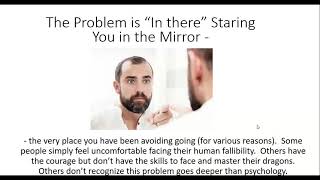
And yet it is. If you take a look at the trading account versus what your opinion is, the trading account is going to not lie to you. It's going to tell you the truth. And ultimately what you discover is the problem and the solution. It's in there and it's staring you in the mirror.
Yeah. Where do you go from here? Well, you know, it's what you discover.
This is the part that starts getting spooky is that we are actually many different people in our mind. There are many different voices competing for attention, competing for dominance. And I don't know if you, have you ever heard that little commentary that goes inside the brain? You know, it's yakking around and it's mostly negative. It's really questioning this, questioning that, questioning you in terms of self doubt and Stuff like that. Don't worry, everybody has that. And in my work that's what I call the inner critic. But there's that constant chatter of that inner commentary going on in this graphic that you're looking at. That's just one of the representations of self that this person is seeing. But she gets focused on it and it becomes her reality. Therein lies the problem. You're actually a cacophony of many different aspects of yourself inside your head. And it just so happens the one that you adapted as the one that was produced by natural selection, the one that was produced and formed and forged in your family of origin in your culture and the circumstances of your life, the one that is really built around survival in the moment, that's the one that is going to be totally counterproductive in your career in trading. And it can be changed, but you have to decide to change it. Why is this necessary? Well, to be honest with you, the big problem again is your brain. And you have to look at the brain on uncertainty, what your brain wants. And this is six and a half million years of this programming going on. So it's deep, deep, deep down inside your brain is it wants control of the environment or what we would call control of outcome. It wants to be right and not wrong. Because back then if you were wrong, you were dead, you were somebody's meal. And you also, as the human being this smart, smart, smart hominoid, you wanted to be able to predict consequences and take advantage of them. We're the ones who figured out that you could run buffalo over the side of a cliff and they'd fall down. And the consequence is that you had an easy meal that you didn't have to, you didn't have to tangle with a bison twice as large as the bison that we have now in Yellowstone.
So you can see that's what it was built for. And what you're doing is you're bringing that same, same, same thing as you're bringing it into a world where there is no such thing. Now as lions, tigers and bears, for the most part, what you have is you have uncertainty and you have, you can't control the outcome, which wigs the brain out.
And the moment that it can't control the outcome, it gets confused. Like this guy right here in the image and in confusion generates vulnerability. Oh my God, the saber toothed cat's coming toward me somewhere behind one of these bushes. And before you know it, you have triggered to fight flight. You're either going to see things as a threat and Aggressively try to downplay them or you're going to try to avoid them by running, by hiding, by freezing or submitting.
That's fight, fight friends. And it's so easy to be there. And this is when you really discover that.
This survival strategy, because ultimately what the brain does is it actually produces what in neurobiology we would call limbic understandings, limbic learnings. And all it's looking for is a solution to a problem. Okay? And that's the learning. It locks it into neural pathway and then it begins to fire. The more frequently you run into that stressor. The, the more frequently it fires, the more frequently it fires, the more insulated that circuit gets until you start. You just rapidly fire automatically without having to think. And then what happens? Those beliefs look out there and see a truth based on those beliefs. And in trading friends, it is your beliefs about your ability to manage uncertainty that are being projected onto the screen of the markets. That's what's being projected. You're seeing the effectiveness of those beliefs in your trading account, and you see those beliefs as truth. Okay? Not that they're true. But the thing is, is the belief, if you don't, if you're not seeing, and this is the big deal in trading, is that true? That trading account is not going to lie to you. It's not going to do that. You can't, you can't warp, you can't stretch, you can't stretch the truth here. Those beliefs want to see certain facts. If the facts aren't there, the brain's going to fabricate the facts to support the beliefs. And for those of you who saw this thing happening in Washington D.C. yesterday, what you're looking at people who sincerely believe there's conspiracy when there are no facts to see it. Okay? That's the powerful thing. So you're looking at this and you're going, wow, my survival emotional brain. Oh, my gosh. Is. You're saying it's mandated to view uncertainty as a threat to life? Yeah. Yeah. And you're seeing the beliefs that it is created to deal with that in your performances as reflected in your trading account. Bingo. We've got it. Now how does, how do, how do humans like to conquer this thing? There's inherent danger out there and all at that. And what happens, say, with the Alpha? He wants to win. He wants to control outcome. He wants to make things happen. You've got to be trading to be trading. I'm out to make some money today. How many people say that?
A lot. I'm going to make some money today. You know, in my work, what you learn is that you don't talk about money, you talk about performing well. You don't have control over winning, making money at all. You have control over your performance, which gives rise to an edge that extracts more capital out of the markets than you give back. That's what you got. And this whole notion of winning or losing is one of the biggest traps that happen with traders. If they want to win, and that's what's driving their. They'll end up doing things like revenge trading, trying to make up for prior losses. They start over trading because they want to win, win, win, and then they get shell shocked and suddenly they have even problems, even entering trades. That's post traumatic stress disorder. So you can see this thing and boy, we brought a brain through the job that just is not fit to do it. You're right. You're right. So how do we go about working with this?
The first thing is there is a neuroscientist from Chile who coined the word autopoiesis. And that's another way of saying self organization. Right now you're looking at a starling and you're looking at a self perpetuating organization of a crowd of starlings in the background. My wife and I, when we lived in California, in the Sonoma Valley, we would see vast flocks of birds larger than this and these. You would see them fly and they would be taking shapes and stuff like that. But what you realize is there was a definite organization to the way they flew. The individual was part of something much bigger. And ultimately that was the self that they're stuck in. You and I are much like that starling. You're looking at. We are in a crowd, a herd that has been taught a certain amount of things that has been hardwired into our circuitry and inspired every time we encounter uncertainty. The whole key is that starling will never get out of that crowd mentality. Human beings are given that opportunity. You are an organization of a potential self. It's interesting that Albert Einstein said, you know, there is no such thing as matter. With this E is equal to MC squared formulization. However, it's a very persistent illusion. Then came quantum mechanics, who, by the way, Einstein saw as spooky science. The quantum mechanics boy said, you know, it's even worse than that. There is no such thing as energy either. There is not mass nor energy. What there is is potential.
And the observer of that potential is what gives shape to the self. And friends, what you're looking at right now in your trading is the organization of potential into a self that trades. And you're seeing in terms of the world of trading whether or not that's an effective organization of potential. And by the way, that's what you've been calling I.
I is just simply one organization of potential that you could be. And what you're discovering trading is it does not work in trading.
That's why the vast majority of traders, first of all, they lose money. And the second thing is they're out of trading in three to four years because they burned through their capital, burn through their time. That's what happens if you stay the way it is. And how does that deal with us? Well, what I want you to look at is that what I call the emotional brain, the mammalian brain or the instinctual brain that we carry, that guy sitting at the computer is still carrying that brain from that hominoid way on the left side, we carry that brain. They've done a lot of workarounds. And what you discover is.
I stare, I still carry the caveman with me in my brain and I try not to recognize him because I'm this real smart new brain thinking guy and I'm ultra metropolitan. No friends. The moment that you enter stress all about trading. That hominoid brain that a mammalian brain takes over and it's all about, it's all about short term survival to it. You not getting into a trade is a survival victory because if you can't get into the trade, you can't lose.
The problem is obviously you can't, you can't manage in that generate consistent income if you're not getting into trades. But it works across the entire spectrum from not getting into trades over trading, trying to get, you know, trying to make up for prior losses. All that stuff that mammalian brain takes over, that emotional brain takes over, blows out the thinking brain that's working the computer and thinking since in charge. And you have a reactive brain that's not conscious that you don't even know is there controlling the way you trade friends. That's what you've got. So.
Your brain was built for one job, but trading demands another. That brain was built to control outcome, to be right and to predict outcomes. That's what it was done. And yet at the same time, what you discover in trading is that, well you, you don't control the outcome. No, no, no, no. You can't control winning or losing either. As a matter of fact, even really great traders lose a lot. And you have to be really wary of making predictions about where that thing's going to bottom out, where that perfect place to entry is, the perfect place to exit is, and all that stuff. So this is really, really, really.
It's the problem. It's an inside job, friends. The sabotage, the lack of managing and bringing forth what trading can offer. It's not. The problem is not out there. No one else is to blame. The responsibility is in there with the way the brain that you have was formed in the first place. It's not your fault, but it is your responsibility to rebuild the brain, to restructure the brain itself if you're going to be successful in this particular trade. And fortunately.
There is an enormous amount of neural plasticity that your brain has. And we are very different than other animals. My dog cannot write his own story. He cannot change. He cannot change that he's a dog, that he's going to chase deer whether or not I want him to or not. He's gonna dog and he's gonna dog around. However, we humans, if we begin to awaken and begin to start recognizing, oh my God, I have the ability of writing a new script for myself. And here you're looking at an Escher print. That's exactly what's happening, is the human is rewriting the script, rewriting the narrative of his life. This, this is the great thing. There is no final. You, you literally are potential that has been reshaped by the forces within you, okay? For short term survival. And you're at a point, a fork in the road of recognizing that historical organization of the self. The historical self. I is not going to work in this new environment called trading. And you have to decide, am I going to reshape those forces in your mind so that it can work with the environment called trading? How do you do that? This. And by the way, this form of neuroplasticity that we're talking about is called by one of the eminent by David Eagleman, who's an intimate neurologist in the actually neurobiologist out of Stanford. He calls it live wiring. Because you can intentionally reorganize the self that trades. Because ultimately the brain you brought to trading has been shaped by history, by what you inherited by past events, by family of origin and history. And it's not going to produce success in trading.
You've survived, okay? But the thing is, the same way you're looking at this painting, this illustration right here, he is reshaping himself. You have the same capacity to reshape the potential into an organization of self that works with uncertainty and randomness in a successful way. Very powerful stuff.
So your job, should you decide to accept it, is to reorganize inherent potential into a self that produces success in trading a completely different environment than what evolution through natural selection organized you as. You got to go beyond that. But fortunately you'll notice in this illustration, you'll notice that there is an I there that's an observer of the organization itself. We humans are the ones who can reorganize ourselves to reorganize that potential and become very different human beings than we started out with. And that's what we're going to need to do. Your emotional instincts are going to always fire to fight flight.
When encountering uncertainty and biased toward threat. And I hope you recognize that's not what you want. You know, you want to train the brain to respond very differently to encourage countering uncertainty. But take a look at it because ultimately you probably don't even know what beliefs are driving your performances. Unfortunately, it's not, it's not rocket science. If you look at your trading account and see what's happening there and start seeing where the breakdowns are in your trading, it becomes pretty easy. There's only five of them. One is a sense of not mattering. Let's start first. A sense with inadequacy. Who, who, who in here has not experienced occasionally at least a sense of like, I'm not good enough, I'm never going to get this. Yeah. All the time. A sense of mattering where the, the guy who's going, you know, something to matter. I need to make a bunch of money and then people will see, boy, I'm a big dude. Yeah. A lot of people, a lot of alphas in particular, successful in business, successful in corporate, come to trading with that attitude that it's been very successful. Doesn't work. Other people are driven by the self learning belief of unworthiness. They really don't believe they deserve to make good money easy. They have to work hard and struggle for it. And they manifest that. They manifest that in their trading. The other is scarcity. Thinking is that that's a belief that whatever I have can be taken from me and will be if I'm not careful. How many do that? If you want to see it in trading, take a look at fomo. Take a look at when you finally got into profitability and that things just Rankin heading towards your target. But you get out early because you're scared that that profit might not happen. And if you take the profit now you have it, you could lock it in. But you miss the potential. Yeah, that's the trick, friends. And that's where you're going. Okay, I'm beginning to get Randy where.
Where the problem lies. It's not like you personally had. The problem is that you inherited this through generational natural selection into the person you are. And then you inherited it from your family through what? In family systems therapy is the intergenerational transmission of dysfunction. And if you're really lucky, you only walked out. And from a family that gave you scarcity, thinking that is scared to get outside of the job and try something new because, you know, what if I lost my job? What if, what if, what if, what if, what if? Oh my God. You can just see that working in trading. So we've gotten that.
Now. How do you, how do you change this? How do you organize your potential into a new self that can work with probability rather than stick with certainty, short term certainty of survival. It starts with this four elements friend. You've got to learn. Understand your emotional nature.
It's not an option. You are not a rational being like Descartes would have proposed. You are an emotional being who has the capacity to reason. But mostly you're an emotional being that rationalizes whatever the emotional brain has already decided. And once you grasp that and you realize, well, I can work with my emotional nature. Now how do I do it? The very first thing you have to do is you have to be able to regulate emotions. You have to be able to sit there and not let them fire up and reach a high potential threshold and then start pulsing down your blood because you're cook. Then most people don't even know that they're being hijacked emotionally until after the fact. And they go, what just happened? I could see that, I could see that I got hijacked. But how did that happen?
Well, you're going to have to learn. And it just so happens I teach that. Of course I do. The third thing is you're going to have to awaken the observer, the self. You're going to have to become mindful. You're going to have to start noticing that you know something. You can notice what you're noticing rather than get sucked into it. My dog simply dogs around. He doesn't notice anything. He does things, he acts. Meanwhile, as a human, I have the capacity of sticking back and saying, you know something, let me observe that. I can notice that. I'm noticing my dog getting all worked up of the deer that he's getting locked in on. He's not noticing the car barreling down the road.
No, Buddy, can't do that. That's my dog's name. I can, I can observe the self. The last thing though is that using this observer that we'll be talking a little bit more about to reorganize the potential into a trading mind that actually works. That's what is necessary and that's what I teach. Remember we were talking about that potential that you have. It requires observation to be able to find these other aspects, these underutilized aspects of your self and bring them into prominence, to bring them into working awareness so that they're working as you engage uncertainty rather than the things that just trigger to short term survival instincts. And where I start. And this is from inside out. It's a cartoon for Dixie. Pittsburgh.
Pixar. Yeah, excuse me.
And it's a cartoon about a little girl in Minnesota and her family gets a big raise and they go to Silicon Valley and the girl has all these friends in the country setting and she's just really flooring that. She's being taken on. She's grieving, okay, she's sad. But her mom and dad don't want her to feel the sadness they wanted. They want her to be glad and happy and all like that. And ultimately what happens is this movie, you know, it's got neurobiological consultants in it that are helping them understand the role of emotion and thinking and perception and acting, I might add. And here what you're looking at on the far left is sadness. It's a basic emotional program. Then you're looking at that little critter right there. Next to sadness is anxiety or fear. Okay. Then you're looking at joy. You know, that's the one that's taken the joystick and stuff like that. The next one is disgust. And disgust is a very primal emotion. It's necessary. If you have not been around people that you've instantly disliked. You don't know what I'm talking about, but everybody has. The far right is anger. And you're looking at him and you're going, these are, these aren't necessarily all the emotional programs that I work with in my work because I'm looking, you know, I'm actually looking for D discipline. I'm looking for courage. I'm looking for self soothing and I'm looking for impartiality as emotional programs to offset these primary ones. But what you're looking at is that these are the emotional programs that are just simply wired into our most primitive selves and they're going to be around just like your mammalian brain is. Your emotional brain is whether or not you like it or not, it's not an option. So now we get that and we go, okay, why is it not an option, Randy? So because once you hit a threat, and again as a trader, that's exactly what you're doing. You're hitting uncertainty. Your primitive brain is going to realize that as a threat and what you're going to see is what's happening on the right. Information is coming in through your brain stem. It hits the amygdala part of the emotional brain. It makes a hot wired decision that it's a threat and goes into the, it goes over into fight, flight response. And suddenly you're either scared or you're angry, you're aggressive, or you're just trying to avoid. What you want is what's on the left. You want information coming in through the brain stem, going through the emotional brain. It not triggering to survival, threat and going to what I call the thinking brain, which allows you to deliberate and to make the kind of decisions necessary for probability based success. But this is not what you're equipped, you are equipped to do what's on the right, okay? And that is not, that is the worst nightmare for trading success that you could possibly imagine. And the way we can explain this is, I'm going to use, this is kind of an old metaphor and we now know the brain is far more integrated than this particular model. But the triune brain model does a very good job of helping us understand kind of the dilemma that a trader has. This first thing you have, the brain stem, that's things like you don't think about your heart beating, you don't think about a lot of just stuff that's going on all the time. But that's, that's where all your instincts lie. That and it's often known as the reptilian brain. You know, when a rattlesnake strikes, it does not fly, feel fear, it strikes the, the emotion is a biological action potential. It's not a feeling. Okay? And then what you see is from that brain stem grew the emotional brain. That's the one that we share with other mammalians, social mammalians. That's the one that has us emotionally responding to the environment rather than reactively responding from instinct. But the emotions become instinctual too. And out. And here's the big trick friend, is out of that emotional brain, I don't know, five, six, maybe six and a half million years ago, started growing this tumor called the thinking brain. It grew and it grew and it grew. And basically the emotional brain laid down a very vast communication network going into the thinking brain. However, the thinking brain did not lay down a communication network going back into the emotional brain. It's like the best of communications networks from the emotional brain out, but only two skinny 20th century telegraph lines, or even 19th century telegraph lines coming back into the emotional brain from the thinking brain. Friends, this is the problem. And you know, each of these things.
We want the emotional brain to be in harmony with the emotional brain. We want them into a new partnership.
Okay.
Wants that.
So why can't we just do it? Because of the power of the emotional brain over the thinking brain. Remember, the thinking brain grew out of the emotional brain. And therein lies the problem. Unless you can, unless you can control that, you got a problem. And I'll make it more very specific. This, friends, is where you have problems. Right here in this little graph.
On the left side, you will see the words emotional stimuli. That's data coming in from the, from the outside, from the markets, okay? And going in. And it's hitting the, The. The emotional brain, the. The thalamus in particular. And there's a traffic cop there who is making decisions. Is this information dangerous? And I need to react immediately like the saber tooth tiger in the bush next to you. And all of a sudden, if it has that happen, and this is based on experience and memory from the hippocampus, what will happen is that a low road is taken where. Where that information, the triggering macula action, goes from the thalamus to the amygdala to fight flight in nanoseconds.003 seconds. Okay? Now, if it's not threatening.
That information, the traffic cop allows that information to go up to the thinking brain. Or what here is showing as the sensory cortex and deliberation occurs, it takes a long time that it may take just to get there. A macrosecond. 0.25 seconds. Meanwhile, what I want you to understand, even if, Even if both fire at the same time, the information actually gets to the thinking brain, that the, the emotional brain is already in activity long before the information even gets to the thinking brain. And all of a sudden you're. That's the hijacking that's happening. Whether or not you're freezing an entry, whether or not you're getting out with a skinny profit, whether or not you're over trading, whether or not you're trying to make up for prior losses, where you get the big head and think you're gonna just Go on forever winning all that. That's how this happens right here. And it has to be stopped. It has to be arrested and disrupted. Otherwise what happens is that it's literally emotional regulation is what we're talking about here.
How do we stop that guy from that really sharp pin from hitting that balloon called stress. How do we stop that?
You have all this instinctive and reactive emotional responses just queued up.
And you don't know the primers that are causing it to happen. You don't know the triggers that is actually triggering that. And I'll tell you, if you're going to trader, that's just not going to, that's not going to work. The whole key though is emotional regulation allows you to calm the emotional brains.
Reactivity down. And how do you do that? How do you do that? Well, we teach emotional regulation out of Herbert Benson's work. Relaxation response of where we're first teaching diaphragmatic breathing, where you're pulling air directly on the inhale directly into the belly. You're using abdominal muscles, pull air down into the belly to the lower lobes of the lung, then expanding to chest and then you exhale. The deal is, is every emotion has an emotional signature to it. And it just so happens that the signature you're looking at on the left is the signature for calm mind. Angry or scared mind is going to either have holding breath or shallow high breathing panting going on. So air would never get to the lower lobes, the lungs. So therefore oxygen never gets to the brain and it's shut off.
Okay, that's what bellows breathing will do for you. It will, it will take the intensity of the emotion and bring it down so it does not hit a threshold where the emotion is no longer revving up, but suddenly has entered your synapses, it has suddenly entered your bloodstream and you're red hot or scared out of your mind and you're cooked. This is what emotional regulation can actually do. So we get that. But then essential to being able to build a trading mind.
Is to produce a mindfulness practice right here. What you're looking at is very much these are, this is tunnel vision. Most people literally only can see through that tunnel and they don't experience the reality around them. They don't. They're not open to the potential around them. They get locked in by the by basically an observer of the self that is asleep. You are conditioned to see this way by your culture, by your family of origin, by history. However, if you're going to stay this way, you're Going to. You're going to be in caveman brain when you get under stress. That's not what happens. We need to generate an observer of the self. That is the whole point. And in doing that, you recognize something. And this is big, friends. This is really when things really begin to change is what you recognize. You're going to turn that slide there. Thank you.
It has. Now what you recognize is something big, and it's called you. And your thoughts are not the same, friends. You are not having thoughts or beliefs for that matter. They're having you. They're creating your experience as. As you engage things and whole key. As you take a look at this on the left, you know, this is. People get caught up there identifying I, this I, that I'm, this I. I'm, I'm a loser, blah, blah, blah. What happens is that, you know, as long as you don't have an observer, you. You are just caught up in those thoughts as you produce the observer. And of course, that's what we teach how to do that. You begin to say, oh, these are thoughts happening in my mind, but they are not me. I'm observing these, and I'm observing these. These are limbic learnings. These are things that I inherited from history. And you know, the thing is, I didn't even know they were there because, you know, shoot, this stuff was plugged in, ready to go by the time I'm three to five years old. And, you know, I didn't see it like I did. I don't see the air in front of me. I don't smell it. I don't have any of that because the air around me is so. It's just so. It's so, so there. It's so familiar. But if you were a fish brought into the air, you would interpret air very differently than we do.
So ultimately, thoughts are simply the emotional programs of the brain given voice in your mind.
Think about that one. Spend some time with that, and it'll really help you out. And the real key is this.
There we go. Your thoughts are but one potential organization of the self, okay? And they locked in a long time ago, and you didn't even notice it.
Yet. If you start developing an observer, the observer starts seeing that organization of the mind. Because at this moment, what we're doing is we're asking you to recognize that your mind really is more is best seen as a governing committee of where the observer has been asleep. The CEO has been asleep at the wheel and wakes up and recognizes there's a mutiny going on. It's a very unruly crowd in there. Then that. That ruler, that, that CEO starts reorganizing that governing committee to be able to take a different path than the chaotic one they've been taking under stress. That's what's happening. Because you do, it's easy to. To identify with your past limbic learnings and to say, you know something, I'm losing, therefore, I must be a loser. And ultimately, what you learn to do is separate the act of losing, which is about competence or lack of it, and being a loser, which is a manifestation of your being. They're not the same.
Being and doing are very different from one another and at a state of being depending on where you are. You know, I see myself as something, a part of a much greater hold. I don't see myself by myself. I see myself like a cell in a much greater body. And then you begin to say, wow, how do I go about reorganizing based on that? Well.
As you separate.
Your being from the core of this historical self, you begin to start noticing that one particular thing that you have is inherent worth.
Your winning or losing is immaterial to the being that you are. And this is something that, either one way, from a humanistic or from a spiritual standpoint, that we're going to have to find a way to find and for you to experience that being that is beyond performance. And then we can say, well, now let's take a look at our performances. Because this is about competency. It's not about me as a being. It's about my competencies under stress, which can be worked on. And it's incredibly freeing. At this moment, you begin to recognize, oh, my gosh, what. What have I been doing? Well, what you've been doing is your brain has become a community of rival programs. And in here, we're back to inside out. You're looking at each of these characters now activated. You know, you're looking at, wow, sadness, really roaring. You're looking at Joy doing her job. You're looking at anger just taking over the whole program. He's got the steering wheel now. And you're looking at disgust going, this whole thing disgusts me. Then you're looking at anxiety just going, oh, my God. Oh, my God, what's going to happen? What's going to happen? What's going to happen? How many people have an inter commentary like that? Almost everybody. Well, this is who's governing the Committee of the Mind. And what we want to do is we want to start saying, you know, something I recognize that this was an organization of self that was built for my short term survival. And I have to acknowledge it got me to where I am and so I honor it. But what I recognize is I've outgrown it and it's time for me to reorganize who I am as a human being. And, and in the case of trading, you have to do that in order to be able to build a probability based mind rather than the certainty based mind that is going to be governed by survival and natural selection. So we've gotten that. And so ultimately what you'll discover, some of these, like the anger and the fear are very destructive.
And here's where it gets interesting.
Here'S where it gets interesting is that you discover, yeah, some of these are destructive. Some of these programs are highly constructive though. It's like in this image there is a light wolf and a dark wolf. And it's really, it's really, this represents both sides of the force from Star wars fame. And what you have to do is you have to decide which one you're going to feed, which one you're going to focus on. Because ultimately what we're looking to do is turn toward our darkness and master it. Because I can tell you is that the light coming out of the darkness is the most glorious light of all. It's there. The darkness cannot stop the light from being there, but it can convince you to feed the dark wolf. Okay? And yet your job is to learn to feed that light wolf and to empower the self and to develop the self into a greater expression of your potential.
And as an observer, you begin to develop this capacity. Remember, you take a look at the inside that guy's brain. What you have is you have an observer of something going on and he's creating that situation. The brain has never seen the light of day. It's getting these feeds all the time and creates a world out there. Okay? And by the way, it doesn't exist. It's created a representation of the world out there is what it's done. It's not reality. And what you're doing is I need to be able to start creating a better representation of the reality out there. And we're using the trading account as the gauge for how effective that representation is. This is what can be done.
With an observer. So at the, at the chase of the moment, what you get is you can build a mind that is disciplined, courageous, patient and clear thinking. This is what's needed for trading. The mind that comes with you to trading is Going to be, is going to be fear based.
You know, we had to have that. It has served us well. But the thing is, is it's, it's built around the mother of all emotions, fear. It allowed us to survive. It's not bad, it's just that it's no longer useful. The world of probability that fear needs to be ratcheted down to concern so that you can act, still act from a disciplined, courageous, patient and clear mind. That's what's needed. And again, that's what we teach. It can be done and is necessary. In trading, you end up having to find the discipline. I would actually say it's already existing in you. You don't have to create it, you have to find it and nurture it. You have to find the courage. It's there and you have to nurture it so that it's part of the working mind. You have to find self soothing in particular self compassion. Because you're going to be making a lot of mistakes, you're going to be losing a lot. And you need to be compassionate about that, not beating yourself up. I've never had a trader tell me that. Well, you know, beating myself up has really helped me. Well, it doesn't. And my question is, is this natural? No. It is not what the natural world has built the brain to be. However, it's possible. And this is the missing link. Friends first, calming the emotions, using the observer to construct a new organization of the self is the pathway. It's not natural selection. It's done as design, self design. And out of that you recognize that the emotional brain and the thinking brain can work together.
And friends, there will always be conflict. There will always be challenges of uncertainty. Like in this case, what you're looking at is you're looking at two guys square off in a the board meeting of the mind. Which wolf do you feed? This is the point going, you know something, I could back down off this thing or I could move forward. I could negotiate, I could be diplomatic, I could attack. There's a decision that needs to be made and it needs to be made from a sense of calmness.
Discipline and impartiality. That, friends, is what's going to be the ticket when this happens, when this happens. At the very core of your being you find calmness, you find patience. You find it's not no longer scared, it's at peace with itself. This is where you're going.
Do I seize this opportunity or do I let it pass like everything else that says I'm going to have to do some work on myself. It's okay with me. I do know that if you don't work on yourself, you're not going to make it as a traitor. I've seen that abundantly over the last 15 years. And what we do is we produce a science led approach that by the way, has spirituality in it. If that's where you want to go, where literally you begin to recognize that the brain has never been separate from the mind and you begin to work both together. It becomes self mastery and the key friends.
How do you take advantage of this? Well, guess what? We have, we have an offer that.
I invite you to consider if you're serious about working with the mind that you trade with. We're having a group course that actually teaches you how to do this stuff that I've been talking about my outreach work. I don't tell you how to do the changing. I do give some hints about the emotional regulation work, but I don't teach how to redesign the mind. That's done in my group course and in my individual course. If you don't know anything about it, start with a free book, start reading my articles, start. Go to YouTube and go crazy with all the videos I have out there. But people will do video dump nights where they're watching for, I've had them 10, 12 hours at a pop. As you do that, start recognizing, well, do I do, do I just want to like tap tires or do I want to actually take action? And I would encourage you to look at the group course starts real soon.
Yeah. First meeting is a week tonight. And if you register in the next two days, what we're going to do is we're going to give you, we're going to give you a free program called the Emotional Regulation Workshop. I'm not doing that to incite you to join. I'm doing that to help prepare you to recognize that if you wait to the last moment, you're going to get in and you're going to discover something. This course is not for chickens. It's not for the squirmish. It starts out fast, it hits fast. We will be you. We will have expected you to be studying emotional regulation before you get there. We're going to go over it. We're going to start with mindfulness. I've crammed in a lot of stuff into this course that prepares you to be able to literally redesign the mind that trades. And I encourage you to take a really good look at it. And if you're a praying person, pray about it. If you're a thoughtful person, think about it. Okay? And we also have the individual course that is really 10 sessions with me over a period of three or four months. It's very personal, it gets into a lot of stuff and it's very, it's very comprehensive. Okay? Meanwhile, if you're just kicking tires, get the free stuff and then get my book, Mindful Trading. It's only available on my website. And more than anything, friends, I wish you the best. I know that you came into trading with the idea that, wow, I can do this, I can do this. And truthfully, people get into trading and realize, oh man, what have I stepped into? Well, I've just explained to you what you've stepped into. It's not hocus pocus, it's not magic. I've taught you. I've shown you what you stepped into. Now. Now the next question is, what are you going to do about it? My invitation is take this group course really seriously. And if you're looking at saying, you know, I really want personal mentorship and you've been around my work enough to say, yeah, Randy's probably the only one who can do this, then hit contact us, get a, get an interview with me and we'll talk about your stuff. It's free. But be serious about.
You know, you need to do something about the brain, the mind you're bringing to engage. Okay, so that group course does include five meetings over a period of two months. Group meetings. Okay. And you work in a virtual classroom. It's 24 7, it's open all the time and.
You get copies of it. We, because we through work through so many time zones, we have to do that. A lot of people actually can't show up in person because 4:30 in the afternoon and eastern standard time is sleepy time in other parts of the world and we're operating in other parts of the world too. So I want you to look at this, friends, this is the new year and it could be the new you. And I'm asking you, I'm inviting you to really consider this and say, yeah, it's time that I invested in me.
The organization of self that I am. Are there any questions, friends? Here's one. Okay, I probably have to change glasses here. I am one of those people where their eyes are just not what they used to be. Okay. Will the fear based mindset always be the default mindset that we have? No matter how much retraining of the mind that we do, will the retraining always need to be worked on? Absolutely. Basically the Way evolution works is that it starts with a product that it's already got and it starts getting stressors from the environment and it starts finding a solution. It builds a workaround. Now we still carry the same mammalian brain that's in my dog or in those primitive hominoids and the programming's there and it's etched in stone. What we can do though is we can begin to get the emotional brain to learn different things and believe different things about its ability to engage in uncertainty. But. And it's not like I don't want to see that show. This is some downer. If you take a look at, hey, look at a concert pianist, if he takes a week off, it's going to take him four weeks.
To get back in playing shape. If a world class tennis player takes off a week, it's going to take him two to three weeks to get back under, you know, under the coaches just really on top of him to be able to get back to where he was. That's just kind of the nature of the way it works, you know. And if you're really into something, you're practicing it and you're maintaining the skill sets and I can tell you right now you can learn it on different levels too. Is I've been teaching and doing this for about 25 years and, and it's grown a lot. And less than a year ago, nine months ago, I had a heart transplant. And I want to tell you something. Heart transplants are really challenging situations to go through. And I can tell you that I had to relearn my entire course that I teach because this originally was done for me.
But I had to relearn it. And it's made it much deeper than just, just a workaround. It's coming straight for me. Okay. So yeah, it's. You have to keep working.
What's the cost? The group course is $11.95. You pay all up front or $239 every two weeks during, during the, in five payments of that. And you know, if, and what we actually recommend, if you do that, get the, get the first thing real fast and get to the first, the first class. So you get the emotional regulation stuff before the class starts. Okay. What singular thing can a person do to get through the fear barrier? The singular thing is you reach inside you all the way down into the very core of your being and you find the courage to master that fear.
That's. To do that, you're going to have to do the emotional regulation. You're going to have to Find that, you're going to have to find it. I, there was a woman that I have an enormous amount of respect in and she and her husband were professional adventurers. And I first heard it and said, what is a 54 year old woman going to teach me about professional adventures? And she gave the example of she decided to walk to the North Pole, 200 mile trip for her.
With, with the same equipment that a newit would have rather than all the Gore Tex and stuff like that. And while she was training about 200 miles from the North Pole, an elder of the village came to her and says, you're going to need this dog. And the dog is called a bear dog because this woman was going to hike there and not carry a gun or anything. And there are polar bears up there. And it just so happens polar bears do not fear humans. They see them as treats. And ultimately what stood between Helen and three times three polar bear events was this dog. And the dog doesn't attack the bear. You know, These bears are £400. They're big animals. The dog keeps circling the bear looking for the Achilles heel to snap. Because the bear knows and the dog knows that if it snaps the tendon, it will not have enough energy to survive healing and the winter.
When asked about this, Helen said, yeah, of course I was scared. Do you know what it's like to have a bear who wants to eat you 10ft from you and the only thing separating you is a dog? But she said, you know, fear is like a door. You have to have the faith, the courage to go through that door and the belief that on the other side you're going to find the resources you need to handle the situation. And that's what I say. You reach deep down inside you, you find that courage and then you turn and you face your darkness. That's what you do.
Okay, I'm curious about why you decided to focus your practice specifically on traders.
Versus others for first of all, it's just not traders. I work with a number of people that have hired me for whatever professions, whatever, whatever they're doing that are seeking performance. We're currently reorganizing our material for the self development audience rather than just traders. But the way this happened a long time ago in a place far, far away. This is actually a funny story, at least to me is that I was actually part of an Episcopal spiritual retreat in which I found out that Episcopal spirit retreats are spirited. And what you discover is that they drink a lot whiskey and stuff like that. And I was blown away. By how much? And we had to leave the party much early because I had to get up at 8 o' clock in the morning and deliver my piece at this retreat. And I did it. And of course, there weren't very many people there. They were recovering recovery. But one guy was there and he went through my seminar, my workshop, and he said, you know, I understand that you're a performance coach. And I said, yes, I am. And he says, well, I'm having problems in my business since I was wondering if you might help me. And I said, sure. What is your business? He says, Well, I have two partners in a hedge fund.
15 years ago. And I said, well, what's a hedge fund? So that's the level of ignorance that I started my, my work with the audience of financial people. Okay. Ultimately, what fascinated me is one, the money's a lot better, okay, I'll be straight up and honest about that, is that it's not working with clinical problems where they just want the problem solved, they want it to go away. Traders were highly motivated, they wanted to work. And they were asking me for more homework than I was assigning. And I thought. And I remember going to my wife one day going, doris, these people, these people are crazy. They are actually making me work. And I just. But more than that, I thoroughly enjoyed working with population and I'd worked with a lot of different populations. And this is the first one that I genuinely thoroughly enjoyed working with because they wanted results and they didn't mind working for them. The second thing is that what really occurred to me is that, oh my God, this is all about the brain on uncertainty. And if it hadn't been for traders, I would have never have found that out. I would have, it would have never occurred to me. And now my entire work is based on that. So it started out, it started out literally, I was working with mostly bankers and stuff like that because Charlotte is a banking center in the United States, you know, and before I knew it, you know, this guy, you know, and he was just fascinated me and, you know, he ended up referring people to me. And one day Dolores and I woke up and realized that more than half our business was traders or portfolio managers or fund managers, active traders. And we just started going, well, let's commit ourselves to this. And that's how it happened. That's it. Okay, well, that's pretty good. I only went seven or eight minutes of saber this time. That's pretty good for me. I want to thank you people, you know, I really do. I enjoy this. This is outreach. For me, it's something where, you know, I. I love seeing people see potentiality light up, and they see that spark of potential in them, and they go, oh, my God, this guy's talking directly into this. And is it applicable to a lot of things other than trading? Oh, yeah. Trading is just a place this stuff got focused on. But no matter what, I. I wish you guys fortune, great fortune in 2021. And if I can help you.
I'm here. Take.









