Mindfulness in Trading Building the Emotional Self Control to Achieve Your Potent
Randy Howell (Trader State of Mind) presents a webinar on 'Mindfulness in Trading' that diagnoses why traders fail despite knowing probability rules: an emotional (limbic) brain wired for survival hijacks rational decision-making under uncertainty. Howell uses analogies (addiction's 'white elephant', 800-pound gorilla, iceberg) to explain how limbic beliefs and narratives drive fear, revenge, impulsivity, and premature profit-taking. He outlines that trading success requires retraining the brain via neuroplastic methods: a six-point process (emotional intelligence; emotional regulation—breathing and muscle relaxation; mindfulness/observer skill; identifying and owning core limiting beliefs; cultivating empowered emotional programs; building an intentional mind that masters the moment). He contrasts trader types (fear-based, Alpha entrepreneurs) and recommends simulation to test edge before addressing psychology. The talk ends with course offers (group and individual coaching), program logistics and Q&A.
Questions this video answers
January 10, 2019.
Six steps: (1) emotional intelligence, (2) emotional regulation (breathing and muscle relaxation), (3) mindfulness/observer training, (4) locating/owning self-limiting beliefs, (5) developing empowered emotional programs, (6) building an intentional mind to engage uncertainty.
Group course: five group meetings (webinars recorded); virtual access 24/7; course starts 'next week' (relative to talk); promotional offer: if you act by the 12th you receive a free emotional-regulation workshop (priced $199 on the site). Price mentioned: about <$1,200 (payable in five payments of roughly $240 every two weeks).
Chapters
Welcome everyone. My name is Randy Howell with Trader State of Mind. And I welcome you to 2019, believe it or not. I hope you've had a great, great holiday.
I hope you have a wonderful New Year's and I'm hoping you have a prosperous new Year. So here we go. The very first thing before we go anywhere is let's just make sure that we're talking to one another. If you can hear me, please, a few of you type in a yes into the chat box so that I know that I'm not talking just into the ethers. Okay, I'd appreciate that. So let's see here. And yes, yes. Okay, we've got that out of the way. So the last thing, bit of home, not homework, but kind of control here, is that I save questions toward the end of the session to answer. But as we go along and you have questions, please go ahead and type them in because it gives me, you know, I can go straight to those questions. And so that's kind of the way it is. So let's get started here. Mindfulness and trading. Building the emotional control, self control to achieve potential.
Sounds like it ought to be pretty easy. What I want to do is I want to take an analogy between the trading industry and, believe it or not, the addictions recovery industry. In both of these, there is a problem that is ignored at great cost. And in the, in the recovery industry, it's called the white elephant in the living room. That white elephant, that addiction is sitting there in the middle of the, of the room. It's creating messes. People have to step over it. It's just hard to negotiate. But the main thing is the people involved refuse to acknowledge at their own cost, okay, at their own peril. In the trading industry, we bring a brain.
That is absolutely incapable of managing uncertainty, the uncertainty of trading. But we refuse to see it, much less do anything about it. And we're going to be learning about that today. And let's hit, let's start in the beginning. You remember when you were fresh and you were in there and all of a sudden you started hearing about trading, you started doing the numbers of trading and you know, it was, wow, you know something? This is pretty easy. You know this. Can I just do the numbers and just do the sizing and man, you can see what's going on here. And the truth is.
Just plan your trade and trade your plan and accept probability. Everybody knows that and it's simple math. But if I could only follow my rules.
That's the lament I hear here. All the time. And what stops you?
Why is the failure rate so high when everybody knows that trading is a probability game? Think about that. It should just be manufacturing cash from you. And conceptually it's so easy, but when you try to do it, it's so hard, suddenly you find the exact opposite. Suddenly money takes flight and you start noticing that knowledge and doing are completely different. You know what to do, but you can't do it when you need to do.
Seems like it's this little thing that stands in your way, but it keeps stopping you like a thief in the night. Puzzling, isn't it? You know, you're so smart, you work so hard, you have this winning attitude. And then you try and you try and you try. And no matter how hard you try, you either keep blowing up accounts, you bleed, or you stay stuck at levels and have a hard time getting there. And when you start getting there and having great days, darned if you don't give it all back. What's, what's behind this? If you could only get past that little thing.
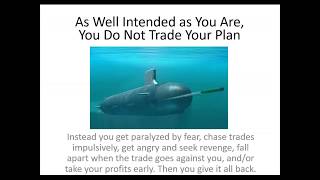
It's like the submarine that torpedoes your brain. As well intended as you are, you don't trade your plan, you don't see it, that submarine. But your trading account suffers instead. You get paralyzed by fear. You chase trades impulsively, you get angry and seek revenge. You fall apart when the trade goes against you and. Or you take your profits early and then you give them all back. That's what people keep doing in trading. And yet at the same time, everybody knows this is probability and you can't take any one trade. And blah, blah, blah, blah. Everybody's read Mark Davis. Okay? That's not the problem. The problem is what's going on here.
So what is missing in your grand plan to evolve into consistently profitable trader? Okay, you remember that white elephant analogy from a little bit earlier? It's him. And you don't see him in the living room of your trading mind. That's the deal. You spend years chasing solutions though, that don't work. You try harder to win and you try to trick your emotional response to uncertainty and submission. And yet you're going, well, what is the problem? Well, let's take a look at this. And I'm going to quote my, I love my fictitious expert here, Jack Sparrow. Okay, the truth is that you don't understand the problem very well. Okay, I want you to hear that. And, or as Jack Sparrow says, the problem is not the problem. The problem is your attitude about the problem. Okay, Fundamentally, you keep trying to solve the Problem from your thinking brain. That's what you know. Rather than by looking at your ancient emotional nature, what you have pushed to the side. So now we know you're not even supposed to trade with emotions, we're supposed to trade without emotions. Truth is, that's crazy talk. You can't trade without emotions. The only time that you do not have emotions and trigger to emotions in the face of uncertainty is it's when you're dead. And we don't want that, friends.
So you have a mammalian brain. That's what I often call the caveman brain. That's that guy sitting in the back, just sitting there, kind of. Okay, the guy, the thinking brains in charge, he's driving the machine. At least he thinks he does. Until I get bored. Until something happens and then boy, watch out. Happened there. Because you have this mammalian brain underneath your thinking brain that is rooted in survival and sees uncertainty as dangerous to survival. But why? It's just probability game, right? No, the first problem is the biology of your brain, friends. We're going to be talking about that right now. Then we're going to be talking about the psychological beliefs that you bring into the act of managing the uncertainty of palatable risk. I mean, you know what I mean by that? Have you ever felt that risk? Have you ever felt your gut when you see that trade going in against you or when you're about to say, you know something, I've got five contracts, I'm about to enter this trade. My God, what if I lose that? The palatable, the pallableness of risk, that's what we want to talk about. That's where the, that's where the action is. And then before you know it, boom. Thinking is seductive, but highly overrated. It acts more like the Hulk. Your emotional brain does, like this 800 pound gorilla. It erupts in the face of stress. And all of a sudden, where there is supposed to be a rational mind making decisions, this 800 pound gorilla is there. And what you need to understand, your emotional brain, that primitive part, your brain that your thinking brain evolved from.
Okay, absolutely. Hates, hates, hates uncertainty. And what it's wired for, it's wired to have control. The opposite of uncertainty. It wants certainty. It wants to be right. It'll lie to itself just to feel right. It hates losing because that means death. And it will lie to pretend it's in control. Okay? That's where we've got, that's what we've got, friends. Now you think about it. Here you are right up front. You bring a brain to trading that cannot achieve success and you don't know it. And you ignore the signs that point to the problem. That's that attitude thing that Jack Sparrow was telling you about. Then in trading, in trading, you have to give up control over outcome and become comfortable with the ambiguity and losing the very things your emotional brain evolved not to do. So literally, you take a look at this graphic right here.
You're at a fork in the road and on one side there are storms, on the other side there is good news that can happen every day, every time you trade. The key though is what is happening as you face that uncertainty and start walking the walk of trading. Are you triggering to a mindset rooted in fear and foreboding? Are you triggering. Well, I can tell you this, is that you have, or have you designed your mind, your brain to maintain calmness and discipline and impartiality as you engage uncertainty. This is the big deal, friends.
So you know, it wouldn't be so easy in this picture. We could just trade brains, you know, be so easy, just go pick one off the shelf. Your brain was designed for short term survival in a dangerous world where literally being wrong meant.
That world was still there 10,000 years ago. The blink of an evolutionary moment. We're still wired for that. And yet we're coming into a world where there's just not big bears now, they're not big. There's not the big cats that were there back then. It's not a dangerous world, but we're ready for it. We'll built for it. Our anatomic nervous system is built for it. Fight flight so in trading you need a long term probability mindset where you can take advantage of patterns and the randomness of markets. You have to take a brain like a product designed for one thing and rebuild it to work in the exact opposite environment for which it was built for. That's what trading is asking you to do. And most people walk into trading and are clueless, mindless about the minefield that they just walked into. They don't realize that no, your brain's just not going to hack the program unless you happen to won the genetics lottery. And there's a lot of talk about that. There's very few people who actually do that. Most people evolve and they finally learn how to do that. Well, most people, the few that survive.
The, what do you call it, the workout that trading gives people. So your thinking brain only creates a story or an alibi that supports what the emotion has already decided. This is crucial for you to take to Heart. If you want to survive and thrive as a trader, most of trading is done below conscious threshold, friends. And you don't know how. You don't a darn thing about how that unconscious threshold, the emotional brain, limbic learning and limbic beliefs work. And yet you're throwing cash at it. And talk about it, just talk about a recipe for the disaster. Yeah, and what I'm doing is saying, friends, let's wake up. Let's wake up.
So what we're doing here is.
So you are triggering your version, a fight, fight response to danger. Every time you put money at risk, every time that brain is going to keep fighting, following you. Okay? It, that's what it does. It was designed to avoid the uncertainty of chaos. The question is, what are you going to do about it? Your brain, survival instincts are seeking short term survival even when you're sitting there playing a probability game. And the problem for you is that the emotion hijacks reason. Every time when you sit there and freeze and you can't pull the trigger. That's emotion hijacking reason. Every time you get in the trade, it goes against you and you fall apart. You know, you know, you've got these hard stops, you've got all this stuff, you got this plan going and then it goes against you and you wig out and all of a sudden you're no longer thinking rationally. You're thinking from fear, thinking from revenge, thinking from impulse. That's, that's what the primitive brain does, the rational mind. So it's not going to stop following you. Okay?
And the emotional brain is just simply below.
Threshold. What we want to do is we want to start getting the point where if you're going to thrive, most of you are going to have to start working and understanding something below conscious threshold. You're going to have to figure out how to do it. And as we do it here right now in my work, I talk about the limbic brain, the emotional brain, when it interacts with uncertainty, it's really not making, it's not using a rational way of understanding it. It's just simply finding. Based on its experience. It starts finding something that responds favorably for short term survival and it turns that learning into a belief. And that belief is below conscious threshold. You're not, it's not a thinking belief, it's a belief that compels your performances.
That's the key. Your limbic brain's core implicit beliefs about your ability to manage uncertainty have to change. The ones that you're seeing evidence of in your trading account. Those are the ones always in your trading account.
If you have a fear of loss, fear of missing out, a fear of judgment, a need to prove yourself.
What do you think the primitive belief, the limbic belief at the level of performance is behind that fear? It's not that you have a fear. It is the belief that your organic neural networks have built into a schema, into a mental model that triggers instinctively, survivally, at the onset of uncertainty. And understand you are sitting there engaging uncertainty all the time. This is like, this is just like it's happening all the time. And you're, you end up really blowing out the circuits. Your brain can't work with this kind of information all the time. Your brain was used to every once in a while having, having a threat to survival and then it would run, hide, fight, whatever, and then would rest for a long time. But it wasn't like this continual thing that happens in trading where you're facing uncertainty all the time. Stress friends. Stress friends. And what I want to show you, this is what I want to show you right here.
Here is why thinking never wins this game. Between the emotions and logic left to its own, its own original designs. This is a slam dunk. What I want you to look at, I want you to look at this thing where it says external input. What that's really saying is information is coming in from the five senses and that information is already tainted by the observer that you are the emotions you're in. And then it says, you know, that information goes to the sensory thalamus. That's a traffic cop that makes a decision about which way should this information go. It's really quick and dirty. It's going to decide whether or not is this a threat? Well, if it is, and understand by the nature of uncertainty, the brain sees uncertainty as a threat. Just look at that. I want you to hear that you already primed to say, okay, that sensory thalamus is going to shoot that down the low road to the amygdala and fight flight. So there you are, you're off impulsively trading, you're off fear based trading, all that. Meanwhile, if you had been able to slow that process down.
And even more gotten to those limbic beliefs and changed them, that information could have gone to the thinking brain or the sensory cortex here. It's slow, but it's accurate. And that's the rational part. That's the part you want training. Can you see how until you solve this problem right here.
You'Re not going to do it as a trader. This has to be solved. This is the place where if you want to build a probability mind from the certainty based survival mind that you got, this is where the actions at. This is where you have to go in and you have to take literally what evolution or fate or whatever you want to call it has given you and that you take to trading and you realize, oh, I can understand now, Randy. I understand why it's not going to work. This brain that I've got evolved one way and it's not, it's just simply not got what it takes to go probability. However it can be, it can be, fortunately, it can be retrained. Okay, so we look at this.
And it's these limbic beliefs. What I want you to look at is at that place where you have that external input and it's coming into the sensory thalamus. Friends, that traffic cop, that right there, that's where your limbic beliefs are, right there. Those are the ones that basically are deciding.
Well, what do I really truly believe about my ability to engage and manage uncertainty.
And by the way, that's not what you think. That's not what you talk about. That's when you look at your trading account and you say, well, trading account, good buddy, what are you telling me? Not the lies that I tell everybody else. I'm working with a guy, it's really interesting, he's out of South Africa. He says, well, Randy, I don't know how all these other guys are making money. The people I work with, I'll say, yeah, yeah, I'm making money, I'm making money. And I said, they're not. They're lying. They're making it look good. But if you ask for audited P and L statements, you'll discover that 99% of the people telling you they're making money are in fact not making money. But it feels good. You know, they have this virtual presence where they can feel the testosterone, the masculinity, the winner. But the truth is, is they're lying to themselves. And this is where you have to really get there.
And then.
Your brain creates fictions, stories called narratives that explain your responses to uncertainty. That's the place where belief and the explanation, that's where you start recognizing, oh, all thinking is emotional state.
Emotional state dependent to uncertainty. They, they are not true.
These stories, but they feel true. And when you have the feeling of truthiness, you actually believe your brain believes it's true, whether or not the facts are there or not. And what you're looking at is Homer sitting here and he has you know, he's pretty dim witted already, he's pretty, pretty ignorant of self, he's mindless. And you listen to two natures going on, a destructive nature and a constructive nature going on with him on simultaneously. What most people will refuse to acknowledge is that they do in fact have a highly destructive nature living within them.
And, but you know, it feels so terrible, I don't want to deal with that. I want to do my positive thinking. And yet by ignoring that destructive nature, you give it free reign in your mind. At the same time you have a very constructive part of the self too. And the key is how do you learn to enhance that, to empower that, to be able to be the dominant force that makes decisions. Well, fortunately that's what we're going to be talking about. But before we get there, let's talk about this. I want to make sure that we're out of just theory, that we actually understand how this thing goes. I want to tell you the story of a fear based trader. Okay? This trader has already lost before he starts trading, okay? His beliefs.
Create emotions of dread, of fear, of anxiety that he then starts thinking and taking action from and creating his reality. His psychology is organized to tell a story of danger and the need to avoid that threat. And if you've ever not been able to pull the trigger even that I have folks when I first start working with him who can't turn on their machines, they can't bring their charts up, or if you're a person who has, has scarcity thinking and you start getting marginal profits there and you say I better take the profit now before it, before it's taken away from me and you take it out of fear of loss, then you see it hit the target, go, why didn't I stay in? Why didn't I stay in? Or if you're sitting there and you're watching your screens come up and you're looking at it and you're beginning to populate your screens, all of a sudden you start jumping into trades. What you're doing is trying to prove your worth by action, indeed. Not by your sense of being. This, this is the place where it happens, friends. This is what it looks like in the Trader. But let's go to the alpha. This is one of my favorite Alpha characters of all time. Confronted.
By the ever wheeling confidence that a lot of Alphas bring. You know, the thing is they come into trading, they've done well. Whether or not it's business or corporate, they've done well. And what they've Learned I'm a winner, I don't like losing. I make things happen. I'm in control. I can really make things happen and I want to be right. Well, that attitude, that attitude you keep projecting onto another world and it works. You may have a lot of influence over the outcome in another world. If you can sell real well or if you're whatever, okay, you make some really good decisions at investing. However, when you come to trading, that very desire to win, that very need to link winning and your sense of worth is going to blow up in your face because you do not have control over winning, you do not have control over outcome. And the story of the alpha is basically impulsive trading. They jump into trades because they want to make things happen. You got to be doing something to be doing something right, wrong. Not in trading. Not in trading. Patience is a far more powerful skill than the urgency to act. In trading, the Alpha needs to decide whether or not they're going to change the way their brain operates about being right, about being in control. So they can build the probability mind. It's not going to probability mind, just simply not there yet. He has a very certainty based mind and he's moved to another environment where his old tricks do not work. This is the key that you're looking at.
And if you get this, okay, if you get this.
And you see it in your trading performances, then you're at a door of hope that can open in your trading. The good news is that your brain is very plastic, it's very malleable. Neuroplasticity is the word that you can take a brain that was designed for one purpose and you can redesign it for another purpose. The people that particularly working with strokes where part of the brain is killed or deeply injured, they actually teach the brain how to work around things like that and come back to functioning. They really, it's really magical almost, except you're realizing there's no magic here. They're training neural circuits to behave differently. And that's what we're looking at to do here. Now how do you do that? Well, trader state of mind, we have a, basically a six point process that we teach both in our group course. We teach in the individual courses. And if you buy my book, Mindful Trading, you see it laid out, you see the process I lay out. The key is this, is that the very first top of that ladder starts with emotional intelligence. You have to come to a very different understanding of what's going on in your brain and your mind and the interconnection between Biology, emotion, brain, mind and engaging uncertainty. That's the first thing. And you really begin to understand that oh, emotions are not anything like what I thought they were. I thought they were like feelings. No, they're biological action potentials that are going to fire whether or not I like it or not. And the second thing that's going to happen is you're going to have to learn how to regulate the biology of that emotion. More about that later. Then if you want to redesign the mind that trades, you're going to learn mindfulness of where you begin to really recognize that.
You can observe, step back out of thought and not be the thoughts that you thought you were. Powerful stuff. More about that a little later. Then the probably the hardest job, particularly for men and their pride is actually locating and owning their self willing beliefs. Instead of all the bravado about look at me, look at me like the guy from Acro I was telling you about where everybody's saying that they're making lots of money and I'm going no they're not. And there's about 3% of people who actually make money and about 5% of people who break even and make money. So there's a very skinny amount of people who make money trading. The fifth thing that this is where it becomes powerful is you start developing empowered aspects of yourself. I would actually call them the emotional programs. Okay, more about that later. Then.
You build an intentional mind where literally you build a mind that engages uncertainty in the moment. The uncertainty will always be challenges. However, what you do control is not the outcome, but the mind that you bring into the moment of engagement. You want to master the moment, master the mind in the moment. That's the big deal, friends. That is the big deal.
And it starts here. It starts right here. Is putting things in the proper place. When you look at a being, say a human trading what you realize, it's the very tip of that iceberg of the human being is rational.
What you realize is the vast amount material the human being is, is emotional. That's where it starts, friends. You start taking the mystery out of what has been happening to you. It, once you understand it, it makes a lot of sense.
And it gives you a way to understand the problem that leads to better emotional skills in the face of stress. This is the big deal, friends. So that's the emotional intelligence.
Now the emotional regulation. The way we teach it, what we're doing is we're teaching you to understand the biology of an emotion has two major components that you can impact very easily. Breathing and Tension. When you see that you're holding your breath. When you see that you have tension in your shoulders, your jaw, your gut. What you're doing is you are feeling. You're not feeling stress, you're not feeling tension. You're feeling the arousal of an emotion. And if you do not change that arousal, it's going to kick into high gear, into a feeling where chemistry pulsing through your body and you're toast. So it starts with, okay, I'm going to start becoming an observer of my body, and I'm going to start noticing this tension. And I'm going to use diaphragmatic breathing and muscle relaxation as skills to calm the emotion down so that it doesn't hijack mine. Yep, that's just what we're gonna do. And that's what we teach. Then comes mindfulness. You and your thoughts are not the same. Weird sounding, isn't it? There is awareness outside of thought.
This talent has to be developed. There is no I. There is only an organization of your potential that may or may not work in a given environment. And that's the big deal, is that I give an example of a lion pride in African savannas, and they. They're stalking creatures, they chasing creatures. And it just so happens it works really well for them. There's a lot of injury, there's a lot of loss, but they build big, huge prides. If you took that same lion and put him into an American forest, he'd starve. The stalking and the chasing don't work. However, you could take a look at the cougar, the American, the North American cougar. He hunts by patience. He hunts by stealth. He waits. He climbs a tree, waits for the deer to come underneath him and then springs. He ambushes him. His weapon.
Patience. You learn that. Okay, I can redesign this. Yes, I can redesign it. That's exactly what I can do. Then you start using mindfulness to observe your historical internal dialogue.
If you're honest, you'll notice that your mind is a busy neighborhood inside and that bad guys have way too much power inside. If you've ever experienced self doubt, you hear that neighborhood and you hear something called the inner critic. Telling and judging and criticizing you or even tempting you. And you hear something, that word, the doubt there. The doubt's there. Oh, my God. What happened? I'll have to prove myself. This is the key, friends. Here, this is what we call inner critic and orphan. I use orphan as a name that describes the limbic beliefs about your capacity to engage uncertainty. And it has to be treated As a very primitive part of the self. But this is what you. The first. The first stop on this journey in using mindfulness is to discover this historical internal dialogue going on within you that you had pushed to the side. Can't do that. You have to transform it, friends. Then what we're doing.
Is we have to start beginning to find and cultivate the power living within you. I perceive mine as a boardroom that runs a company called you, this thing called I. Your job as this newly minute observer.
Is to develop other emotional programs in that. In that boardroom or aspects of the self is what we call it neurobiology. So that they become dominant in decision making when challenged by stress, when challenged by uncertainty. We know the old way that goes to fight flight with the inner critic and the orphan taking charge and you having to prove yourself by impulse or you just absolutely falling apart, not being able to take action by fear. You want to change the committee of the mind. You want to rearrange who influences what that, friends, can be done, okay? And out of this, as you start really working with this organization itself and realizing that, oh my God, it's moldable. Just like those guys working with stroke victims. Yes, it is. And as you do this, you start noticing that the self evolves.
Okay?
And you take it. And suddenly you're able to have clarity and emotional discipline to engage the uncertainty. And what you notice is, yes, you can. You can plan your trade and train and trade your plan.
The stress of engaging the challenges of facing life are going to always be there. In trading, they're unavoidable, whereas they can be avoided on big levels outside of trading. In trading, you have to recognize, no, they're going to be here. Every time you try to trade, there is no option unless you want to stay in freak out mode.
And ultimately.
The result is emotional self mastery coming from being the designer of the mind that trades. When you take a look at this sport, this sailboat right here, understand these guys are really challenged. That's real serious seawater they're moving through. Each one of them brings with them a certain set of skills. They have the skills of discipline, that of a ruler. They have the skills of courage to face their, excuse me, their fears.
They have the capacity of calming their fears down so that fight flight doesn't take over and they go walkers. They also have the ability of thinking clearly under stress with all that there. They control the moment. They master the moment. They don't know what the outcome's at, but what happens is they have a strong leader Strong discipline. And this is how it's done.
Emotional self mastery. Suddenly you realize instead of the inner critic and your orphan nature controlling the mind that engages uncertainty.
You have the discipline of a ruler, you have the courage of a warrior. You have the soothing and nurture of a caregiver. And you have the clear thinking of a sage. That's the traitor's mind. Those are the emotional programs that are latent sitting there waiting for you to bring them forward and to. And to evolve them so that they appear when they're stressed. It can be done, friends. This is the training. This is a very training that we use to teach that.
So either you take responsibility for designing the mind, for engaging uncertainty. Are you down? You kind of like stay in that. Maintain that false hope that something is going to happen, the ship's going to come in, and by sheer determination you're going to push through this boy. What? What? Mindlessness. Or you start tinkering with your brain, you start tinkering with your mind, and you start using your mind.
To change your brain.
Powerful stuff. What stops people is usually their pride and their fear of judgment. Oh, my God. What if somebody finds out that I'm just a human being, a fallible human being inside my skull? What if my looking good suddenly. Suddenly people discover. It's like these guys in Africa. They're not making any money, they're just looking good. This is the key. Do you want to look good, have a talk again, or do you want to deliver in the game?
So I view it, there's a couple pathways here. Beginning traders. And that usually, usually you're still hung up on the idea of what trading can be and all the potential, and you just think you're gonna roar through this. When you started, when you're really getting the point where you've been humbled several times and you're beginning to recognize that.
Everything that sparkles is not gold and that there is going to be some real reckoning about learning how to be emotionally disciplined. Start exploring my website. There's tons of free videos and articles. I encourage them. Get to my book, Mindful Trading. Get my other. Get my free video book too. PDF book also. But if you're serious, you've been around a while and you've already hit the wall enough to know there's something missing here. And Randy, you know, you're talking sense to me and you're ready to do something about it. Ask for a free consult. There's my website. Hit it. And ask to contact us. And you know, ultimately this leads to once you go through all the materials and you come to the moment of going, yes, okay, I'm committing myself or not to a self development of a mind that engages probability and can handle, can handle the stress of the uncertainty. And when it comes down to a group course or an individual course. But if you're just getting hired, read the book and start looking in the group course and just really begin to ask the question, am I ready to develop my mind?
And.
What I've noticed is that most people spend an enormous amount of time on YouTube watching videos of mine. It's not unusual that they will watch 30 or 40 before they talk to me. That's even more popular than the articles that I write. I encourage you to really immerse yourself in this and really get with it and understand that this is a lot. The biological brain that you brought to trading, it's not its fault. It was designed for survival in another world. And you're putting it in a world that it absolutely doesn't know anything about. You need to take responsibility. So how do you become the change? Well, my friends, I invite you to a group course where it starts pretty darn soon.
And what I want you to recognize is that in this group there are five group meetings and it's the webinars recorded and you're gonna receive copies of them. So you know, world, we work with people all over the world and all sorts of weird time zones. And you have virtual access to the virtual classrooms on a 247 basis. It starts next week. So you need to get on your gear. Okay? And right now, if you act by the 12th, okay, that's Sunday, you'll get a free gift. An emotional regulation workshop that we sell on our website for $199. You can get it free. We want it so that you will get started in this and get ready for what's going to happen. Because I'm going to tell you the course is serious and it teaches you these six skills that we've gone by, gone over. That's what it does.
And it's probably the most cost efficient way of learning the skills for redeveloping the brain and the mind for probability thinking. It's not going to happen by itself. There's others who choose the individual course. It is highly comprehensive and it's very personal because you've got 10 consults with me, personal. And this is through Skype. So we're looking at each other over a three or four month basis. And it goes to a much greater depth into this process and Most people will say, what I want is the mentorship. Because in the group course, you really don't have. You know, we show up for group and I lecture, I talk, and I answer questions. But in the, in the individual course, it's a personal relationship that you and I build. And if you're interested, hit the free consult, go to the website, hit contact us. That's how you do it. And I want to.
Yeah, I was gonna say I want to first. I want to thank you. I mean, I'm need to get some of these questions, but I want to thank you guys for coming. This is, I. I get it. You know, this is. People get into trading and they have no idea. And this is one of the big areas. And I hope. I hope you learn. I hope you get it. And if I can help, I really want to. So let's look at some of these questions. This is from Bill. In theory, there's no difference between theory and practice. In practice, there is.
I don't see the rest of that. I would say, is this.
Is it being recorded? Yes, I want to talk about this. A lot of people.
A lot of people read trader psychology and they say, oh, I see what the problem is. And they have a theoretical understanding of it, but they don't understand how to change it on a limbic level, on an emotional level. And what happens is a lot of people can.
Monday morning quarterback in their armchair. It's very few people think quarterback on Sunday afternoon. That's what you got to learn here.
Okay, are there any other questions?
Are markets random or mathematically structured? What I have basically discovered is this. And where I find is there is enormous randomness that exists in the markets. What we call the rules in building a methodology. There are patterns that exist within that randomness that don't always show up, but there is a pattern to them that occasionally shows up. What you're doing, what a skillful trader is doing, is he's acknowledging the randomness.
But what he's also acknowledging is the possibility and probability of a pattern showing up in that he's not trying to force an outcome. What he's doing, he's saying, I have a higher probability of this showing up. Are they entirely random? No, there's patterns within that.
Are they. Are they. Are they. Are they highly mathematical? No.
I'm sure you can put math to it. At the bottom, though, is that this is. This is really an exercise in engaging randomness. It's kind of like quantum mechanics. You know, it's what you learn in quantum mechanics is that everything exists as potential. There's neither mass nor energy.
The observer of that potential is what brings forth the form out of the randomness. So what I would say is that you have a really good observer. The markets start making a lot more sense. And if you read about George Soros, you realize he was an enormously. Is an enormous successful observer of markets and he understands their randomness. But he also understands that there are certain things that happen within markets that happen within nature that you can look at and gives you a very favorable probability. That's, that's the really key. You still need to learn to survive in trading even if there is no physical threat. Yeah, well, you know, tell that the limbic system. The limbic system sees uncertainty as a threat and that's what's triggering. So yes, you need to learn how to survive. You need to learn how to manage the survival instincts because they're there and they're not going to go away. And until you learn to manage them, cool them down and then to start saying, I understand that there's some. There are certain limbic beliefs about uncertainty and basically impending death that are going to. Are wired from God knows how long. It's just like when you stick your hand and near a snake. You know, snakes are. We're wired to have a reflex that is deeply biological. Okay. It's that same thing. I find holding on to my winners tough thinking that the market has moved loads. Even if it is 5 pips and it will reverse 150% the other way before continuation. Yeah, that, that's real. Then he says, how do I overcome this? Well, take my course. That would be a better, shorter answer. How you overcome this is recognize what you're doing is you're falling into a pattern that has been successfully laid out by your limbic brain. And until you learn how to master or to manage that limbic brain in under the stress of I've got some profit here and I'm scared, that's firing part of that. It goes from emotional intelligence, it goes to emotional regulation. Then it goes to observer. Recognizing the fear and acknowledging its potential, but also having a completely different crew in your mind managing that. That's what's missing for you right now.
Okay, Vadim. How do I know if the problem is psychological or my strategy simply has no edge? In other words, do you need to first develop an edge prior to worrying about psychology? I would if I were you.
What I can tell you is this, is that most people I work with, they can trade and just make boatloads. Of money in simulation.
What they've done is they found a methodology that does have an edge and they can drive that methodology really well when there is not the uncertainty of loss there, when you can just hit the reset button. What I like to see is I like to see people who can work in simulation so when they go into live, they understand that it is their psychology.
I know that a lot of people will back test and at the same time I find if you trade in simulation, that's the one that I know. And it also, what it does, it pretty much lays it out black and white. You know, without, without the threat of uncertainty and threat and risk, I can trade well. Therefore I know that I'm having a fear based psychological response to uncertainty. And it's not just psychological response, it's a biological response that gives rise to the psychology. But that's what I would do first. I would make, I would make sure that I actually had had to do that. How to avoid bias based trading there's no way to, you know, even if you have a logarithm and what happens is that the, the biases of the program are going to show up in there. In neurobiology there is a, there's a saying is that you have never experienced reality. What you have experienced is your brain creating a virtual representation that is based on the observer you are the emotions you're in and your biases that cause you to see reality. So you're not seeing reality, you're seeing a virtual representation based on your beliefs and biases that you then project onto the screen. What you're seeing in your trading account.
Is the truth meter telling you if is if that virtual representation is effective or not. So there's the biases. You're going to have biases and it just so happens that really good traders have good biases and bad traders don't have good biases. So you're looking for the virtual representation that extracts capital out of the markets more than it gives capital back to the market. That's what you're looking for. Who has more difficult time adjusting to trading? Alphas or Betas? Orphans? I think the hardest thing in the world that I see, Alphas just have it, they've been so darn successful.
And they, they get into trading and they just ram that thing and they blow up lots and lots of money. I've actually had.
An Alpha and this was a.
Incredible case is that this man, when he graduated from college, sold a bar business that he created while he was still like 18, 19 couldn't drink, but he could build a bar business and he sold it for half a million dollars when he graduated. That's pretty darn good. And then he went on to a series of buying businesses, turning them around. It was just a very successful cereal entrepreneur. And then he decided that he sold a business and he recognized that he had a heck of. He sold a business for cash. And his brother was a trader. And what happened with Matt is he said, oh my gosh, you know something, I'm in a perfect situation.
Trading is a capital intensive industry and all I have to do is learn how to do the business and I've already got the capital, I'm going to do it. And of course, on that kind of thinking, three to four years later he's still not successful and he finds me and he finally becomes consistently profitable. Then one day he comes to me in a session and says, randy, I want to thank you. This is the best money I've ever spent in my life. What I have discovered is that I'm not willing to be a successful trader. I'm not willing to let go of control.
Having control has worked for me entrepreneurially all these years. What I recognize now is that I would be giving up too much. I've also, when I talked to a couple really successful traders about this and one guy's response was, you know, it's a just, it's just a shame for a perfectly good entrepreneur to waste his talent on becoming a trader. You know, they're both just talents in different directions. Okay, how many years does it take to make it? Well, I know people. I have one guy that I worked with was 24 years old. In two years he was living on his own and he was, he was producing stuff. He also.
He contacted me early. He realized very quickly that he could learn the knowledge of trading all he wanted. But what happened is if he didn't get his head under control, he was never going to be successful. What I find is it takes usually around four or five years for the nonsense of a trader to finally, you know, you finally come to this senses and realize that this is a head game, it's a mindset game and that your methodology, all that, all that knowledge of trading is absolutely necessary, but it's not gonna, it's not gonna bring home the bacon. And you finally get the moment, usually somewhere about four or five years in that you're saying you've either you've blown all your capital up or you've bled so much your spouse has had enough, or you recognize That I have some interior changes that I have to make in order to make the next grade. What's very common is for me to work with guys who have come to inconsistent profitability of where they're paying their broker and they're marginal. They're not losing money, but they're not making money. And they realize they've reached a threshold and they will have been there for years. And they finally realize that it is the beliefs that they're projecting onto the markets that's the problem. It's not their methodology, it's not their platform. It's the space between their ears. And it really just depends on how long it takes for you to recognize that and to realize that the traitor's mind is one of the most.
Less probable things that you'll ever see occurring naturally. Understand your brain is just organized to hate, hate, hate uncertainty. And you have to develop a brain and a mind that engages uncertainty with really, when it comes down to it, winning or losing, that's not the big deal. Is.
Okay. For more information on the group coach. Yeah, that's a good thing. And for more information, there's in the chat box you will find Dolores has put in a couple of links to more information about the group course. And I encourage. If you're serious about trading, I really encourage this thing. And we also have it set up so that every period of 10 weeks, the. The cost is like a five bucks less than $1,200. But you can pay for it like 240 bucks every two weeks. It makes it really. Yeah, five payments. It makes it really. It stretches it out. It makes it really workable for a lot of people. And I know for some people it's a stretch, but it's just, you know, you got to learn how to develop this thing. Do you believe in trading arbitrage, taking advantages of poor broker feeds versus good broker feeds?
I really truly can't answer that question.
That's not my expertise. If you want someone who truly is a very, very fine trader, teaches trading, he's in this room. David Dube. That would be a question that I would encourage you to talk to David about on the Internet. And if you. Yeah, if you go. If you want to know where David's at, you could probably type in his name. That would get it. But also. And its name is D U B E. He's a close personal friend of mine for a number of years. He's been through my courses. He's been a student of mine. And he's got all the trappings of the success.
Over 35 years. But that guy could give you a much better. His website is Polaris Trading.
And he. He is a. He's an intuitive trader who's developed methodology because I think it drove his students crazy. Oh, David. Oh, look at that. David gave us his. I think. Anyway, the thing is, is that I am a trading psychologist. That's what I do. That's where I'm stuck. That's what I'm good at and I'm not going beyond that. But David is a enormously experienced. And he's a good guy. Okay, He's a good guy. Anyway, are there any other questions? Because I think our time's about up. I want to thank you for being here. This shows that you're getting started at New Year. You're looking and exploring and what I want you to get. I want you to get earnest with your trading account and start listening to it more than the thoughts running around in your head and start really asking what is this trading account revealing to me that I'm not willing to see because of my biases. And when you really start getting into that and you realize, okay, I get it. Is that this isn't really about pride. It just so happens what Randy's saying. The brain that I brought to trading just simply was. No, it was dead before he started. It's just not going to work no matter how smart you are. Is this. Is this is really about learning how to deal with the emotional brain, the limbic system, and getting a partnership between the limbic system and the thinking brain, the neocortex, so that you have partnership between emotion and logic. And very few people figure that out. For whatever reasons they get caught up in the lust of all this money they're going to be making, when in fact it requires a development of a mind that is not natural in this world. Okay. And what you also discover when you start developing this mind, the rest of your life gets a whole bunch better. You start having a totally different way of viewing and engaging the world. So I want to thank you, friends, if I can help you, please come see me. And I have only the best wishes for you this year. And may fate. May God be with you, however you frame that saying, and until next time, thank you.
It.









