My $125,707 Trading Week... | Full Breakdown
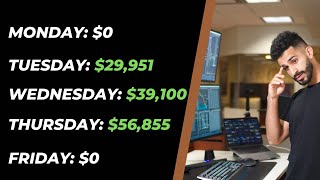
Kardec Trader made $125,707 from nine day-trades in one week. He skipped Monday and Friday, traded only when his setups appeared, and used continuation selloffs, morning reversals, and opening drives. His biggest win risked $12,000 and returned $34,000.
Questions this video answers
About $125,707.
Nine trades.
Monday and Friday (no trades taken).
TradeZella.
About $12,000 initial risk.
Chapters
I made a hundred and twenty five thousand dollars from day trading last week. And in this video, I want to break down how I did it, what trades I've taken, how much risk I put out, and just kind of give you guys a full overview of my trading week. Right? With that being said, before we get started, for the people that are new here, you guys can check out my Twitter. This is my Twitter. I post my, you know, daily P L With my year to date P L as well, because I understand people that are new here are going to be unsure of the numbers or the progress. And you can see I have a live login of me making about over $7 million from day trading alone last year. Just go on my Twitter, have the videos and everything just for the people that are new here, right? With that being said, let's dive into my trading week now. Right? So if you guys take a. If you guys noticed that last Monday and Friday I did not take any trades. Now I want to kind of address that real quick. As a day trader, you have to understand that we need to learn when to play defense and when to play offense so you, you don't have to trade every single day. So me personally, I don't trade every day. I don't like to trade every day. I only like to trade when I believe there are opportunities out there for my trading setups, for my trading style, right? And that applies to everyone watching. Everyone here may have different setups, different styles, different strategies, right? You need to understand what yours are, and you need to understand when to kind of be aggressive on them and when to play defense. Defense meaning protect your capital. Maybe be risk off, maybe not take a lot of trades. So for me, that was Monday and Friday. Didn't really like the setups, didn't really like what the market presented. So I ultimately stayed cash, right? That was my agenda. That, hey, I don't like what's going on. So I stayed cash. The days I didn't stay cash did very, very well. Right? So we go to, we go to Tuesday I had five trades. Wednesday I had one trade. Thursday, had three trades. Right? Now I want to dive into all of these trades and just kind of give you guys a recap. So this is how my trading week looked.125k. Nine trades out of those nine trades. Didn't necessarily have a loser last week. And that's not common, right? I also want to show that it's not common to not have a loser. There are times I've had big, big losers. Like I had A day in August where I think I lost 24 grand. Another day prior to that, 20,000. So there are going to be losing days, right? I don't want people to get the misconception of, oh, well, wow, he didn't have any losers. Me as a trader, I'm not supposed to have losers. You're going to have it, right? You're gonna have losers. Like, where's my losing day? Right here, 24,000. I lost in August. I wasn't really consistent. 10.2k in July. Right. So I've had losing days, and it's normal. Right? But it's how you manage them and how you manage expectations. So thank God, this week I didn't have any losing days or weeks or days. Right? So out of my trades, these are all the trades I've taken just to kind of give you guys a little update on those trades and give you guys an idea on those trades.
You guys can see these are the following trades. And now when we go in those trades and we kind of get like a good idea of the trades, we get a good idea of what is happening that week. Let's just understand. And by the way, the app I'm using here is Tradezilla. I use TradeZella to track all my trades, all my trading metrics. Post a link down below if you guys want to check it out. But here are all the trades. Right now, when I'm recapping my trading week, I like to look at a few different things. One thing I like to look at is, first, I want to make sure all of my trades have setups. So I personally like to apply setups to all of my trades. Every single trade that I personally take, I like to know that there is a particular setup that I tagged. If there is not a setup, I need to tag that there was not a setup. So, for example, this was a trade I made $8800 on. This was an opening drive play. This was my setup. So I want to make sure all of that's done. Second thing I like to look at in terms of my trades is I like to look at what my initial risk is. So my initial risk is the ultimate thing I care about as a trader. Right? Hey, was my risk inconsistent? Did you. Did I have bad inconsistency? So when I look at this realistically, yes, I did have a day where I did put on way too much risk, in my opinion. And that day was the 15th. Right now, I also want to give transparency on the 15th, give you guys a little idea of what happened that day and where that, you know, astronomical risk came from. Now, where is that astronomical risk that we're talking about? I risked about $12,000 on this trade. I did make 34 grand, but I did risk a lot. Now, what is that a lot to. That's what we want to understand. So in some people's account, a $12,000amount may be a lot. For someone else, it may not be. But I like to look at my risk based on my current performance and also my account size and how I'm trading. So with this kind of trading that I've been doing from the beginning of the week, right on the 13th, you can see where I had most of the trades. That's one day, my risk was 2700, 3700. Around 3K. Around 3K, you know, right here. And then two trades that kind of went way under my risk radar, which ideally weren't the trades that enter that radar. So radar, when I go in the first few days, was about 3K the next day. The problem that I had, right, and these are things I like to pick up on. On the 14th, my risk became extreme. Had about $8,700 risk. Now, thank God, the trade worked out in my favor. If I lost 8,700, that would have not been a great, you know, risk aspect in terms of my performance. However, the reason I increased my risk, and this is another thing we need to talk about more, is because my setup was very, very comfortable. Like, I was very comfortable in the setup I was taking. So because I was very comfortable in the setup I was taking, and I'll show you guys. On the setup, I did a whole trade recap of this. It allowed me to put on more risk. Now let's go through the risk. The risk a lot of people think is what you invested in a trade. That's not what the risk is. Right. That could be a hard risk if you're trading options. But if you're not trading options or anything else, your risk is based off your potential stop loss area. So for me, based off my potential stop loss area, my risk here, Right. Was about 8,700. Right. So based off my potential risk, right. I was risking 8,700. I made about 40 grand, 39.4 K. So about made about 4.5 R on this trade. Great trade. The setup I had, I had a morning top reversal. If you guys did see my videos in the past, you guys know when I start seeing a multiple rejection at a key zone over and over again, and I see weakness Most of the time I will play the fade. And that's basically what I played here, right? So that was the trade here. And that's why I was able to put on more risk because of the, you know, comfortability, comfortability level. Also today, traded spy made about 40k. I'll talk about that in another video. But for now, let's go through the other trades. That was one trade where my risk did get elevated. Now when we go to the 15th, right now, see, I had a good day, increased my risk, made 40k. But that increased risk level also came primarily from me having a great day. I had a 30k day. I was like, hey, I can increase my risk only if I see the setup. I did that, capitalize on it, worked out well. Next day I went in with the mindset that I need to decrease my risk off the initial trades and not be so aggressive. And that's what I did. So when we go on the 15th, we talk about the risk. I cut my risk down 4800 bucks on the trade, 4500 bucks on the next trade. Made 8k, made 13k, made about 20k on the open, right? After making 20k, I go on and I immediately increase my risk. Now I will say this risk amount was more than I should have done, right? And these are things with those traders. We're gonna make mistakes, we're gonna make good mistakes, bad mistakes, Mistakes that work out in our favor, mistakes that don't work out in our favor. Our job is to pick up on that so we don't keep making them over and over again. Because if a bad day comes, it can and will wipe us out. So when I see, you know, risking 12K from, you know, risking 4 and 4K, I'm like, wait, that's a big, massive jump in risk. That's a problem. So this should have been, in my opinion, maybe 8k, right? That could have been, you know, taken. Because if I was essentially wrong in this, I was giving away 50% of my daily profits, which.
Shouldn'T have been done, in my opinion. So that's one thing I could have done better. But now when I go into the trade and I'm like, okay, let's look at the trade, right? We got a nice continuation sell off on Amazon, right? When we look at this whole chart, when we look at, hey, what happened with Amazon? What did the chart show? What happened in terms of the overall price point, right? We got a nice, we had a very nice continuation sell off. So I had a, had a good morning, top Reversal here, you guys can see at the 130 level in Amazon, we got the fade after the fade, got the huge move from 128 to 129, played that rejection, entered, entered, entered, and then started scaling out on the way down. So that's essentially why I kind of allowed myself to have more risk. And I also kind of scaled into that position. I scaled into that position, you guys can see. So my risk levels elevated a little bit, but primarily because I've already baked a position in. Right? So that's the first thing I essentially wanted to cover, right? Talking about initial risk, how to navigate the initial risk. Now, the second thing I want to cover and I want to talk about is setups. So if you guys notice something about my setups, and I talk about this a lot, I don't focus on 30 million different setups. If you. If you take a look, you have continuation sell off, one setup, morning, top reversal, second setup, and opening drive. So essentially, I traded three setups. Now, the continuation sell off happened 1 day, 2 day, 3, day, 4, day, right? That was my continuation sell off. Then I have morning top reversal. Morning top reversal. Morning top reversal three times, right? And then opening drive one time. So I was able to capitalize off my setups. And. And even if I go into my report section and I kind of check that out and I just try to, like, kind of understand, you know, my overall setups and, you know, what setups I took, what setups I didn't take, I can get a good idea there, too, right? Let's just pick out the proper date for that week and get an idea of how I traded. You guys can see 5 of the continuation sell offs made about 48 grand on that setup. On the morning, top reversal made about 68 grand, right? Opening drive took one trade, made about 8,000. Right? And now when I go into these setups and I look at them, you'll see that they're all relatively the same price action moves, right? The same exact price action moves over and over again that are happening. We get the top morning rejection here. I'm able to capitalize on that. We get the fade, right? We go to a different trade. We'll get the same exact thing, right? We go to a different trade right here. Another spy trade. You'll see morning, top rejection, morning top reversal, same exact thing. So essentially, my setups that I am seeing are pretty consistent in terms of how I'm trading them, right? That's another thing. Now, also, when I'm going through my trades, another Thing I like to look at and something I've seen, I trade I had on September, September 13 was not really a good trade. Right? So let's talk about that. Let's understand what I mean by that. So let's go to September 13th, I think. Let me take the filters off. We had a few set of trades. I don't know what trade it was. Was it this spy trade? I think it was this spy trade.
Yeah. So this. This is a good example, right? So when we look at this trade, right? And. And this is another thing. You guys want to have an idea of what are good trades and what are bad trades, right? It just allows you to kind of get a good idea of your trading. So when I see this trade, I'll see that, hey, I made $677. Great. Phenomenal. You made $677. And what most people do in trades like this is they'll say, okay, I did a great job. I'm done. Move on. That's it. No, you want to go into all your trades and analyze everything about that trade. And what is everything about a particular trade? You want to go through your entries and exits. You want to look at what setup it was. You want to see, did you sell early? Did you hold through, you know, a massive downfall? Was your stop loss, Correct? Did you follow your stop loss? All those things. So when I look at this trade, right, let's look at this trade real quick. Based off my trade risk, based off where I put my stop loss and things like that, I was risking about 2700 on this trade. That's number one. So just looking at the trade outcome, I risked 2700. I made $677 bad. Now, obviously, we got to go into two ways. Sometimes me exiting at a $677 gain is better than losing 2,700 bucks. So sometimes it is better, but. But sometimes it could be of terrible downfall. So in this situation, I got in here, I got it and got in there, I got out right there, where essentially, if I waited maybe a little bit more, I would have made money. That's number one. Number two is right here we have the running P and L, which is showing us how this trade has done minute by minute. So at 10:19am I was down about 40 $200 more than my initial risk amount right away. What do you think that tells me right away? That is telling me that I am not following my stop loss. That is a big, big, big, big red flag, right? So this needs to be, you know, accounted For I need to be aware of this. This was a terrible trade. No matter. I don't care if it's green. I essentially, if I'm being honest, I got lucky on this trade. And we as traders, one thing that we need to do is we need to be more transparent with ourselves, with our trading, with what we did right, with what we did wrong, even if the trade outcome is in our favor, right? So sometimes you might have a trade outcome that's green, right? And you're like, wow, I did a good job just like this, but everything behind it was bad, vice versa. Where sometimes you may have a trade where it's red, but behind the scenes you did everything right. And you have to say, you know what, I did everything right in this trade. The probability just didn't fall in my favor. I need to let go and move on and learn from it. Essentially, that's all we can do. So for this trade, when I go through it, I'm like, wow, I got in here, I got, I added more. I got in as a continuation sell off. And you know, it did a quick fake to 401, faded again. Maybe I could have added faded, faked out again. And then on the first fake out, I said, you know what, let me get out. I'll take my profit and exit it. Faded. Now, I'm not going to sit here and say that was a, I did a terrible thing. I could have held and made more. I did leave money on the table. I added that in my tags. But essentially, when I look at this, the main key takeaway here is, okay, maybe I hesitated and I got scared, which is okay, right? When I'm scared in trade sometimes. And we're all going to have trades where we get scared, maybe unsure, maybe we don't know what's going on. And exiting that is a good thing. Sometimes when you look at a trade, another way to look at it is, okay, well, forget me being unsure or not, what was my risk amount and did I follow my risk tolerance? And at one point, like I said, At 10:19, right here, I was down 4200 about almost twice. I mean, a little bit less than twice of my trade risk. That itself would have been, would have knocked out my trade risk, would have knocked down my trade position and all those things. So these are things we, as traders, we need to account for. We need to be aware of. We need to understand these things, right? Just so we're like, hey, what is going on? What is not going on? So to wrap it up, to give you guys Some, you know, tips and tricks, I guess. Hate using that word, but to give you guys some insights, right. Had a good trading week, right. When I recap my trades, I like to look at the following. I like to look at how many trades. I like to look at every single trade individually, look at the setups on my trades. I like to look at the R multiple on my trades that I'm talking about, right? I like to look at how the winning trades did and how the losing trades did. In this situation, I didn't have losing trades. And once again, I'm not saying that to, like, brag and say, oh, my God, I didn't have losing trades. I'm the best. No, it's just one of those weeks. Like, it worked out in my favor, right? And now I'll have weeks where I'll have more losing trades than winning trades. One of those weeks, right? So take that into account. And when you do that, you also need to kind of on a weekly basis, you need to refresh your mind, right? So if you had a good trading week, don't let that carry into next week and be overconfident, right? So when we go to this week, right? And I do go to, let's say, the Monday for this week, and I. And I just kind of like, take a look at that. My trade risk for Monday was, you know, kind of cut down. I had a 12k day. Not great day. 2.3R, 3.4R. So pretty solid day. Tuesday, I didn't take any trades today at 40k. So you need to adjust your risk tolerance and kind of come in with like, hey, just because I had a bad week or a good week, I will not continue the next week with. With extreme level of confidence or extreme level of fear. I need to bring myself back to a balance, right? And this is what I mean by a balance, right? Just stick with me through this one, right? So when you're trading, where's the marker? Right here. So when we're trading, let's say this is zero. And then let's say this is 100, right? And let's say this is negative 100. So essentially what happens with those traders is our confidence is usually here. When we do well, it goes here. When we do bad, it goes here. What we want to do every time it goes here or it goes here is we want to try to bring ourselves back to an elevated level. No matter how good you do or how bad you do, you want to bring. Bring yourself back to that zero mark so you can think straight. With no emotions and with no biases of oh, my God, I'm so good, or oh, my God, I suck, whatever the case is. And try to bring yourself to the zero level as close as possible, even when you're here or even when you're there. Now, you won't be at zero entirely, but the closer you are, the better you will be as a trader. The better you will be able to assess trades, the better you'll be able to execute and evaluate trade positions and things like that. And that's one thing I like to do on a weekly basis. I like to bring myself to that zero, despite having a great week, a terrible week, same thing. On a monthly basis. Do a monthly recap, great month, bad month, whatever the case is, I like to bring myself to that level just so I'm aware of what is going on in terms of me as a trader. Right? And that's a great thing to do. Right. Also, just taking down notes of your weekly performance of things you think you need to do better, things that you need to, you know, kind of work on things that you are doing great. So some things that I'm doing great. Just to share with you guys, I think me focused on very minimal setups. Three setups executed on the setups. Great. Very, very great thing I did. Second thing, I'm very happy with my risk size. Now, one or two things a little bit outside of the range worked in my favorite grade. Going to work on that more this upcoming week. But overall, great risk tolerance. My risk to reward ratio, basically my R multiple. And every Trade was above 2. Right. Which is a great, great thing. Right? So here we go. See, we have a 2.783 R. Almost a 2R. 4.5 R. 3R. These trades were scrapy. Scrapy trades. 4R.25 R. So these trades could kind of be factored out. But even if I take these trades down and I count, count them as a loss, I still had a pretty strong, solid week. That's the last thing I'm going to leave with you guys. When you guys are taking trades, don't focus on the size. Don't focus on anything. Keep size relatively very small. Focus on two, three setups. Work on those two, three setups. When the market presents itself, when the market does present itself, execute on that for the next three days, you might not have any setups. Next two days, you might have setups. But first, identify what your setups are, what the setups represent, and then look at market conditions to support those setups. And the market. Once again, out of full 20 days of the stock market that, you know, we have open on a typical month, you'll get seven, maybe six, maybe five trading days that are great. The other ones are, there was like four or five that are very, very hard. Other ones that are kind of scrapy. But you have a few set of days less than 50% that give you good, good trading setups. Your job is to make sure your financial ability is in, in line and your mental ability, or your mental capital and financial capital are both in line to support these big days, Right? Because yes, if you lose a lot of money on terrible trading days, right, essentially what happens when a good trading day comes, you don't know how to execute on it. Vice versa, if you, you know, trade on a bad day, not only are you losing money, but you're also losing your like mental capital capital. You have your mental capital and financial capital and you don't want to destroy those on bad days, bad weeks and so on. Refresh, come back and you know, come back better. With that being said, I hope this video was helpful to you guys. You guys found value once again. The tool I'm using here to track my trades journal, my trades is tradezilla. And I hope you guys found value in this video and if you did, please, please give this a thumbs up and I will see you guys on the next video. Thank you for watching everyone.









