Preformance Stress
Randy Howell from Trader State of Mind discusses how traders can manage stress to optimize performance. The presentation covers the psychological and physiological aspects of stress and practical strategies for handling it while trading.
Chapters
Welcome everyone. My name is Randy Howell with Trader State of Mind and I am delighted you're here today. I'm looking to have a really great time. This is an interesting topic for me and very interestingly.
Last week I was sick and I didn't really get to work on this presentation as much as I needed to. And this morning I woke up and I looked at my calendar and I said, oh my goodness, we're having this presentation this afternoon. And I was only about halfway done. Suddenly I felt stressed too. I had this need to perform and I had some going, wow, this is going to be interesting. Is it going to be eustress or distress that dominates the moment? So friends, we're going to get started here. But one thing.
I do as a rule is that I hold questions toward the end and I'll answer them then. However, if you have questions during the presentation, please feel free to write them in and we'll hold them and then we'll get to them as, as we hit the question section. Okay, let's get to go then. Let's, let's go. So here we go. You know, what is stress? What is it really? You know, it's traders feel stress every day. Interestingly is few know how to use stress to their advantage though. But ultimately stress is just simply part about living. It's about meeting the challenges of living. And it has a component that's different, is both psychological and biological and they work together. That's the piece. Ultimately though, it is understanding how to use both physiological stress and psychological stress to the right degree that creates the mind that can do the work of probability trading. That's what we want to look at. So let's take a look at this thing and say, well let's go, let's take it one more step further. Let's say, you know, ultimately.
Stress can either be good or bad. It just depends on the way you manage it. And you're looking at this and you're going, you know something. Ultimately the body.
Was built to use stress and short bursts. When we were much, much, when we were much younger as a species, we were actually hanging out in some neighborhoods that weren't friendly. And what we needed to do is we needed to respond to threats and emergencies on a short term basis.
And then once we escape, once we have a fight, then we would need to be able to cool back down and calm down what we would call this in today's world. We would say that the autonomic nervous system would trigger to fight flight. That's that heightened Awareness, that's the body's, the big muscles being, being ready to flee a scene, flee an enemy, a threat or to fight. And then after that burst of energy, 20, 30 minutes, then what would happen is that we would find a place to calm down. Find a place to calm down. We would go into what is known as parasympathetic nervous system or rest, digest. So we'd get from fight flight sympathetic, responding to a stressor in the environment, in the short term, acting. And then we would cool down. And the parasympathetic nervous system would cool the body, the mind down. Unfortunately, and I'm going to be focused really on trading is that the key is this good part of stress is called eustress. You need stress in trading, you need to be able to respond to it in particular way. But the key is it's this short dosage, business versus elongated doses of it that cause exhaustion and then fatigue, bad things happening. So we see that stress is a response to environmental challenges. That's the main thing. And it's not lions, tigers and bears now, but it's the discomfort, the risk of losing, the risk of what uncertainty brings. And unfortunately, whether or not we like it or not, the emotional brain can't tell the difference between, between psychological discomfort and biological threat. But what happens is that we have used this in sports and in business for a long time. And what we wanted to do is we wanted to get aroused, we wanted all that energy flowing so that we could win. We wanted to be able to determine outcome, we wanted to win outcome. And what we would do is we would accelerate that stress and we would take it in, not just mental alertness, but, but what we would do is the body would kick into fight flight where performance happens. Okay, the problem, this is also where the confusion is because basically the higher levels of biological arousal that's required in sports and business to dominate, to make things happen, that alpha mentality is detrimental to optimal states of trading. It's like we miss the whole thing. And this is where we have to really look and we have to learn how to manage stress very differently than the way that we have learned to manage stress before. So ultimately what's happened before.
We'Ve been taught to win and not lose. And what we want to win, we want to win by controlling outcome. Like in the game of American football, you want to dominate the other team, you want to dominate them so that you overcome them and that you are the winner. Okay?
All those alphas and all those perfectionists, unfortunately are only creating bigger, bigger problems. For themselves. Because ultimately what we're beginning to realize is that you can't control winning or losing in trading. Okay. The key is, is that in trading, trading requires an alert mind.
Not an activated revved up body. The moment that you rev that body up, fight flight, you've got problems. So there's a problem with the alpha wanting to control outcome, win, or the perfectionist trying to not lose. What you realize there's a lot of energy there. Suddenly you're trying to control something that you can't control.
Yet paradoxically.
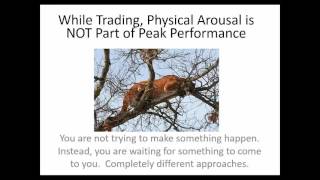
While trading, physical arousal is not part of the peak performance. I mean, you think about it, how much work do you do when trading? You that little finger, you know that little finger that's on the mouse? That's about it. Here you're seeing a photograph. An apex predator, the American cougar, lying in wait, hard at work and hunting.
Ultimately, that cougar has a different thing. It's not trying to make something happen. It's waiting in an ambush, waiting for something to come to it. Do you see the difference? Do you see they're completely different approaches. Most people use stress to conquer things. I'm going to bigger, I'm better, I'm going to get revved up. I am going to control outcome. And you do that and you start chasing trades. You want to stock and chase trades that may have worked incredibly well in a former career, in a former business. But in trading, that revving up of the physical body is dangerous. You want the mind alert, but you want the body relaxed, just like the skooker. So you're looking at it and you're going, wow. The key here, and one of the big things that happens with traders is that they need to come to completely different understanding of how to manage stress and trading. Ultimately what happens is that you will need low levels of stress. Interestingly, as I was working with a client just before I got on here, and what we're doing is we're watching his heart rate as a reflection of emotional arousal, stress. And what we're seeing is that when he misses a trade, okay, it stresses him out. And before you know it.
He'S so alert, he's so keyed that he wants to get into the trade. He finds a place. Unfortunately, he's no longer an alert mind. He is in fight flight. He wants to take back what he's missed and he wants to jump in and make things happen. So the key here is what we want to do.
It's kind of like.
It has to be just right. There's Just a small tight window of physiological arousal that's needed in training as opposed to other things. If you're sweating, if you're tense, if you're holding your breath while you're trading, you're basically saying, I am way out of whack. I've taken the low level stress that I need to have an active mind. And I'm kicking and I'm jump starting the fight flight syndrome, which is going to be detrimental to the way I think and perform in the trade. So ultimately what we're looking to do is we want to find the peak performance for a traitor. And that mind is alert and relaxed. If you take a look at this thing, it's often a lot like this martial art. Calm but alert, relaxed but ready, smooth but sharp, humble but confident. You begin to see.
That the body really does have some arousal. For the brain to be alert, it's going to need it. Okay? And I'm going to be showing you more about that in a few moments. But what happens, what I want you to see is the whole notion, the whole belief system in and around trying to control an outcome that is uncontrollable, that puts you into distress. What we're talking about is eustress is where we have an alert mind but the body's not activated. And yet you're trying to do something that can't be done. Controlling outcome, winning. And that puts you automatically in a position of powerlessness and helplessness. And there you're kicking in fight flight. Do you see that difference? Well, what I want to do here is I want to show this graph to you.
This is actually part of a strategy that I use with my personal clients. Ultimately, what you're looking at way on the left hand side of this, you're seeing what we call parasympathetic or homeostasis. You're seeing you're really calm. As a matter of fact, you're too calm to trade effectively. Okay, and then what happens though? Just imagine, okay, I'm going to be trading, I need to start being alert, I need to be ready for whatever comes my way.
Yet at the same time, my body doesn't need to be tense, okay? It needs to be there. And suddenly you have this low level of physical arousal, but a highly alert mind. You're really ready. You see that second step, but then this is what happens. You start getting ready, you start getting revved up, you're starting ready for that trade, you know, you're ready to take advantage of whatever is going to happen. And all of a Sudden, what you've discovered is you no longer do just have an alert mind. What you've done is say, let's say your heart rate at rest is 60 and that you find an alert mind is, oh, around 64, 65, 66. Suddenly what happens is, suddenly you would be looking at this. Fight flight is triggering. With your heart rate in the 70s. Okay, it's triggering. You're beginning to already have that third wedge. You're already beginning to have a compromise mind, fourth wedge, where fight flight, emotions.
Just simply take over the mind. Okay? Suddenly.
Suddenly what you're noticing, your heart rate, your stress response is higher, Your body's really kicking in. You're sitting there highly fixated on the screens. You've got tense body. You're ready to fight or flight. Your breathing has stopped and you're out of control. You've crossed the line. And then you go to the next stage. You're reactive. You have a compromised mind. You're no longer doing what you need to be doing. Like in this guy that I was talking about earlier, he had been taught earlier that he needed to be taking nearly 100% of all the trade setups, the valid trade setups that were coming his way. And really good traders, professional traders, get around 80 to 90% of those. Okay, they don't ever hit 100%. There's always, you got to go to the bathroom, you've got to do this, you've got to do that, that you're gonna miss a trade or two. And yet this guy was saying, I have to get 100%. I have to get 100%. He would miss the trade. You would see his heart rate spike like crazy. And he's looking to jump in the trade because he believes he needs to be getting in every trade. But he's getting in the wrong moment. That's what happens with the reactive mind. He's past the calm, alert mind. The body's got involved. Fight flight has triggered, and suddenly he has reactive thinking, having him doing really stupid things. So what happens is what we want to see is this. We want to be able to see and recognize that we need stress. We need the body to be responding to challenges.
You've got capital at risk. You need the body to be alert. You need for, at the same time, the body to be.
Relaxed. And so now you're looking at it and going, how? And take a look at the way you trade. How tense is your body? How are you breathing? Are you able to be able to control this reactivity? Or does it get in your way. This is what my, the training that I do, this is what's taught, okay? Because ultimately what you get really clearly is this.
Excuse me.
Is that your biology and psychology are tied together, okay? They've never been separate. Your mind, what you call mind, emerges from your brain. You fundamentally have a bunch of neurons firing so rapidly and so often that we get a mind that comes out of it and it's steady state. So what we're really, really, really wanting to do is we want to say, okay, I know that part of this is that I have to manage the physiological expression of stress. I have to get it into the sweet spot. I have to find what the zone really is. Part of that zone is the physiological response you're having to challenges and you need to keep it within a particular parameter or it doesn't matter how much knowledge you have, your physiology is just going to bump you to fight flight and you're going to lose the mind that's needed for trading. But here's what's interesting.
Fundamentally this is where a trader's beliefs become manifest in their trading is fundamentally what you're doing.
Is the interpretation of the stress. That's the kicker. When something of a stressful nature, when you have risk it, when you've, when you've got risk on, is it a threat, okay, or is it a probability you're working with? What you're really looking at is what you're really measuring is what beliefs are you holding and projecting about your ability to manage uncertainty? If you trade to win, you're trying to prove yourself. If you're trading not to lose, you're trying literally everything you can going, you know something? I'm really scared of losing. Neither works and we have to find a different way through because ultimately.
Beliefs about uncertainty, your beliefs about your ability to manage uncertainty and the vulnerability, the physical physiological vulnerability that triggers this is what triggers the fight flight response. And all of a sudden you may have been fine at one particular moment in time, but suddenly those confirmations are adding up. And all of a sudden the possibility of losing is there and you go to pieces. Or consequently, you're sitting there, you've gotten excited, you want to prove yourself, you're going to make something happen. And all of a sudden what happens is in that excitement and that testosterone and dopamine, you suddenly start making really dumb, stupid decisions about getting into a trade. This is where physiology and psychology are coming together. Or when you're managing a trade, you know something when it's bouncing around within its range, that You've established you know what's happening. You know, are you experiencing stress as a threat to your financial well being, you'll be in the poorhouse. Or are you experiencing stress as the uncertainty of, you know, something? Am I trying to control my performance or am I trying to control outcome? You're going to be in distress land if you try to control outcome, it's going to happen that way. You know, ultimately it's very interesting is that.
In trading I've all I used to do this survey and I would ask, and this is a several couple months ago and I had a couple hundred people in a webinar like this and asked the question, what are you thinking while you're trading? Two thirds of those people were thinking about winning that trade. Okay? Something that they had no power over. Okay? That's what I want you to hear.
When you're invested in winning, you're invested in something that you cannot possibly make happen. It may happen or it may not happen. So this is the big deal about traders and this is where it really begins, is that your notions of winning and losing have to be reframed. They have to be really examined and you have to ask, okay, is this really working for me? Is my notion of winning, losing really working here? Okay, that's a big deal. And I can promise you that if you happen to have brought a certainty based mind into trading, I can promise you that you are going to be either thinking about winning or losing. And if you focus on that, if you focus on not losing, what do you think is going to happen? Okay? Trading not to lose is also out of your control. Okay? This is distress. The truth is, is that you may or may not lose. You may or may not win.
What you don't control is that outcome. This is the deal. And again, what you're doing is traders have not. They've learned how to win. They, you know, I know that I need to win. I need to make things happen. I need to overpower things. They have also learned to say, you know something, I don't want to be a loser, I don't want to be a loser. Yet great traders are really good losers. They have to be. They know that they can't control outcome. And when they get into a position and they see that they're wrong, they're getting out, they're cutting their losses. Right? Then they're saying, I need to be really good at losing rather than trying to ignore losing. Okay?
Learning how to lose well minimizes losses. Friends, this skill has to be developed or you can't successfully work with probability where you know there's a probability of winning and losing and you're hoping that it's a high probability that you win. But the truth is lots of stuff can happen along the way. So here's really where it comes to. Okay, this is where this whole notion of performance stress.
This is where your actual beliefs meet the outcome, meet the uncertainty of outcome. And I love this quote by.
There are two ways to be fooled. One is to believe what isn't true, that you can control outcome.
The other is to refuse to accept what is true.
By not accepting that you don't control outcome. What happens is this is what drains capital out of your trading account and out of your wealth. You refuse to accept that, no, I'm a winner, I'm a winner, I'm a winner. Now I would rather you be a performer, an excellent, powerful performer. And suddenly what you're seeing is that you've got to start seeing about what your beliefs about winning and losing are because they're going to. This is about managing uncertainty and probability. It's not about winning a race, a football game or business deal. Completely different. So here's the deal here. Now if you listen to your trading account, it will tell you the truth. It will point out where the self limiting beliefs are. And these self leaning beliefs are not the one you talk, talk with when you're in these rooms and you're talking about the ones that got away and what was there and puffing yourself up. No, these are actually the beliefs when nobody's looking while you're there. The, the ones that pop up in your mind when managing uncertainty and recognizing you have no control over outcome. And what you can do is only manage your performance. Ultimately there are four self limiting beliefs that.
Traders really need to turn toward and transform rather than hide from. But they're tough. You have to have a deep sense of inner courage. The first one is just simply about your competence. You know, are you capable of winning? Do you have the stuff to win? Okay, are you good enough? The second one is do you matter? What many traders are doing, they have confused.
Their performance with their mattering. Okay, if I make money, then people will see that I matter and I'll prove my worth to people. Not true. Okay. And you're giving the trading gods enormous control over you. The third one is your worth. Often net worth becomes a reflection of self worth. And these have to become untethered from one another to become a great trader. Because you know, the thing is, is that every, every Trader has strings of bad traits. You know, the statistics, over a thousand trades look very different. You know, you see a straight line, but you don't see all the dots of the wins and losses and stuff like that. The last one, the fourth one is a sense of powerlessness where you know, I have to be powerful. I have to show everybody that I'm gonna, I'm gonna make this thing happen. And again, the trading gods don't care. These are the four self leaning beliefs that your trading account is constantly showing you. And if you start listening to your internal dialogue about these beliefs, you'll hear them, you'll hear them all the time. The key is, do you want to listen? So ultimately what we really want to do, we want to say, you know something, the really good news is that in learning mindfulness, which I teach in my course, you, you discover that you and your thoughts, you and your beliefs are not the same. In fact, this thing that you call I or you, it's just simply one potential organization of a self, it could have been another organization. What you're beginning to see is that, you know something, I can reorganize the self so that it is really focused on performance rather than outcome. And out of that.
You go from a certainty based trader to a probability based trader. And the probability based trader is the one that's going to consistently win. So we've gotten that. So what we've done here is, what we've really said is this, you know.
What we need to do.
Is we need to change how your body and your mind engages uncertainty.
Wrong. Next slide. Excuse me, we've made a technical mistake here. Thank you. So what we want to do is we want to change the way your body and your mind engages uncertainty. It's not going to happen by wishful thinking, it's not going to happen by affirmations, it's not going to happen by visualizations. It's going to happen by changing the very belief core of who you see yourself as in being able to manage uncertainty, your body is always going to seek certainty and it will seek a reassuring lie.
Rather than to have to be plunged out of its comfort zone. And what happens is your mind creates the illusion of that control. But this is what gets you in trouble. You recognize, okay, what I'm going to have to do is I'm going to have to refocus my mind. I've always wanted to be in control. Everything I've seen about success tells me I need to be in control. I need to have a winning attitude and I'm saying no, actually what you need is you have a probability. You need to develop a probability based attitude where winning and losing are simply saying things to matter. And what you're looking for is what are the markets going to give you? That's what we really want to do. But until now, the mind that you brought to trading is not going to be the mind that's going to produce success. In trading. You really do have a mind.
That really truly wants to avoid uncertainty and wants to have certainty and is just absolutely wants to win and not lose. And yet at the same time in trading, you get into this struggle because you don't have control over winning. You can't not lose. You don't win by not losing. And so you're going, you know something? This is the very condition that creates distress. I'm putting myself into a lose, lose situation. And rather than the eustress of being able to say I need to have an alert mind but a calm body, what I've got is I have an alert mind that goes, go gone bonkers. It's too excited because the body has triggered over to fight flight. And I'm trying like heck to either control by revenge, I'm going to make that happen, I'm going to punish the markets for taking money from me, or I'm becoming so scared that, you know, I'm just going to hibernate and freeze here and take a hit. So ultimately what we're doing is we're saying, you know something, the old way just hasn't worked. There has to be something different about winning and losing that will allow me to open this jar of pickles and enjoy the treat inside. What do I need to do? Okay, ultimately.
Letting go of winning and losing, you know that P and L statement that you have right above your platform that's constantly telling you if you're winning or losing, think how destructive that is. You know, if you're looking at it, things are going bad, you're going, oh my God, oh my God, what's happening? I'm gonna lose all my money. If you're doing really good, you're going, wow, look at me, look at me. It's not helping you maintain a very stable mind to engage uncertainty with. That's the piece. And suddenly what happens is when you try that, the body is just triggering. It's perceiving threat. It's not perceiving a calculated risk, it's not perceiving that I need to be concerned here. No, it's perceiving a threat and you're either going to fight or fly. This is what this is. You may have that at particular moments like pulling the trigger. You may have this when you finally get into the green where all of a sudden you go, oh my God, what if the markets take away suddenly scarcity, thinking takes over and you want to take those profits and run. Yeah. So.
This whole need for conquest or fear of losing revs up and takes you out of the kind of mind that you actually need for trading. This is the problem with stress. A little stress is good. You need to be, you need to have an alert mind. At the same time, how do you control the physiology of fight flight so that you, you become the architect of the mind that you're bringing to the management of uncertainty? Okay.
You know that it's uncertain. You know that you're going to be wrong a good bit of the time. And the key though is what you can control is the mind that you bring to the performance of trading. You could do that by managing the emotions you bring to uncertainty. You, you can't change uncertainty, you can't change the challenges of risk, profit and loss. But you can change the mind that you bring to that. This is powerful because ultimately this is when you're beginning to manage the psychology of trading. You're beginning to say, yes, I know that I have to be concerned. I know that I have to have a certain amount of stress that allows me to be alert, ready and focused. And at the same time I can't allow that stress to go from eustress to distress because at that particular time I'm cooked and I give all my money away. This is what we're doing. And you know, ultimately, if you take a look at it, you see this straight line there and you think, oh well, that's reality. You know, I should be able to win so many dollars a day and stuff like that. But then you take a look at the splatter pattern of all around there and you discover that statistically there's a straight line. But the truth is, is that straight line is composed of this entire splatter pattern of being up and below loss and winning up and, and that's where you have to learn how to trade well, learning to control losses, not allowing fight flight as fight to get a hold of you and revenge trading or fight getting a hold of you and wanting to chase trades. What you do is you no longer are letting losses get out of hand, you're keeping them small. Yet when with a calm mind, with an alert mind, what you're Doing is you're, you're seeing that, okay, I'm in the black and you have targets and you're no longer, you're managing the stress at Eustress, where you have a concern mind. You have a focused mind, but you don't have a mind that's turned to fear of missing out on profits and getting out of the trade early. This is where the whole thing revolves around beliefs. You are literally seeing, you are projecting a virtual representation based on your beliefs, not the truth upon the markets. And what you're doing is, is you're reading in your trading account how effective that virtual representation is. Okay? This is where keeping your wits about you, keeping fight flight at bay, and keeping a clean mind, a stable mind is required. You learn to lose well, you learn to win well, you learn to lose stress incredibly well. So.
The key is this.
When the mind gets focused on performance rather than winning or losing, it means everything. Suddenly, that's where the magic happens. And what you discover is that yes, you do have a comfort zone. And you have to inoculate that comfort zone so that it's comfortable with uncertainty. You let go of the illusion of control and you begin to recognize, okay, what I can do. I can't control the uncertainty. But what happens is that I am freed from fight flight as a response to uncertainty. And remember, evolution, that's a trait for you if you're human. That's the trait. The other part of that trait is to jump into trades, to over trade, to revenge trade. What we're doing is we're saying, you know something, what I get is that I need to actually work with my comfort zone and I need to start testing it and I need to start growing it from where it is now because it can't tolerate the risk that I need to be able to, to trade with a stable mind.
So that's really the key. That the real key is, okay, I have to get out of my comfort zone. Well, how do I do that? How do I do that? Ultimately, I'm going to tell you in a moment, but ultimately you come to an enormous reframing of what winning and losing really is. Ultimately, winning really.
Is only about landing on the right side of probability.
Okay? There's no reason for excitement, there's no reason to get a big head. Okay. It has nothing to do with you as a human being. Interesting. I have a client who worked really hard and in four months, what he did, he became profitable and had two really great months. He made more money in those two months. He had ever seen in his life. And then he said, randy, I'm going to take a break. You know, I need. He had some problems at work and what he started doing.
He started not attending to the process that he had learned that allowed him to control the stress level.
Basically, he allowed himself to get too worked up. He got too excited. He says, look at me, look at me, I'm winning, I'm winning. I'm going to have to start thinking about sizing up. I need to be thinking about quitting my job. No, no, he didn't. What happened is what he needed to do be looking at his performance and recognizing that he was not winning.
By managing process, by managing the mind that he brought the mind and the body that he brought to trading, he had found the edge that his methodology and platform and mind gave him. And indeed what he was doing. By not messing up the edge, by bad psychology, he in fact had extracted far more capital out of the markets from than he had given back. And then he got excited and started thinking, look at me, look at me, look at me.
That's when sabotage happens. So you're looking at it and you're going, you know something? I need to develop an observing self that steps back out of thought and recognizes I need to observe what part of me is really doing the trading here.
Okay. Then you start realizing, oh my God. What happens is the mind, this thing that I call mind is actually a number of emotional programs in the brain that have been highly competitive with one another and has organized me into a particular self. That's the mind that I brought to trading. I need to control my physical self too. If I don't control that, if I don't control the emotions of the physical body, then I'm never going to get to mind anyway. So you start seeing.
Developing the state of mind for trading in probability takes work. It also takes work maintaining it. Okay, so winning only means landing on the right side of probability. Well, guess what? To a really proficient winning trader, losing only means landing on the wrong side of probability. He could have or she could have done everything right and still been wrong. But the thing is, when you're focused on performance rather than winning or not losing, a whole new world opens up for you where trading becomes a lot easier. There's none of this up and down emotional liability that goes on. You know, you're just not up and down, up and down. What you're doing is you're realizing, okay, what happens is I'm not in control of, of whether or not I win or lose. I'M in control of my performance. And when I'm lucky enough to land on the right side, I'm going to maximize and hit my target. When I'm not so lucky and end up on the wrong side, then what I'm going to do is I'm going to minimize that loss. That's trading mine. I'm performing. I'm not worried about winning and losing. You take that mind, that level, that, that window, that really small window of physiological arousal and emotional competence and mental competence. What it does, it puts you in the zone for managing probability. So there you go. So ultimately, how do you go about developing this?
How do you actually develop a mind for embracing uncertainty? My first promise to you is this. It doesn't come natural.
Your brain has evolved over many, many, many eons.
As a way of preserving yourself long enough for you to breed into the species and continue the species. It wants certainty of survival. It wants certainty of control. And its first choice will be to avoid threat, avoid discomfort. That's why people have such problems pulling the trigger. That's why people have such problems staying straight. Okay. Oh, there's a typo here. It says it does come natural. It does not friend. Okay. It does not come natural.
Your brain is a certainty based machine. It wants it, it'll lie to itself. It'll do anything. The key is that you are going to have to work to change the neurocircuitry of your comfort zone. Otherwise your eustress is going to become distress and you're going to have problems. So how do you do it? How do you do it? Well, this is the what I teach friends. And it's not like I teach it both in my individual course, I teach it in my, in my group courses, which by the way, it's starting pretty soon.
The first stop always is emotional regulation. I don't care if you know how to do diaphragmatic breathing and pranayama and you're really good in the yoga studio. The key is, can you use diaphragmatic breathing in the environment of stress, of trading as a skill? Unless you can do that, you don't know what emotional regulation is. I work with a number of yoga teachers who, who are very good at regulating with breath and tension in a yoga studio. The deal is they go over there and that's a very calm, very sedate environment. They go over to trading where it's unpredictable and suddenly it falls apart. The first thing is emotional regulation.
It just so happens that's the first thing I teach in my group course. The second thing is mindfulness. You're going to have to separate your awareness from your thoughts and beliefs and recognize, no, you are not your thoughts and beliefs. Then you start going, well, what are all these funny thoughts running around in my head if they're not my thoughts? Friends, you were born, your brain was born into a history. It started with the family of origin, your culture, your community and circumstances. What happens is what's running around in your head are thoughts having you. From your history, you learned a particular way of dealing with uncertainty in your families and through circumstances. And that, that is the mind that you brought into trading. And no matter how good it was back then, you're having to ask, is it good now? So mindfulness of literally being able to step back and recognize, oh my God, I can observe the emotional programs running around in my head. I realize that those emotional program programs in the brain are the thoughts that are given voice in my mind. And this is where you begin to say, I need to learn how to manage who's showing up in my mind. And you can do that. The third thing is you're going to have to learn applied mindfulness. You're going to have to reimagine the brain and the mind. You're going to have to get a hold of this. Actually, your brain is a community of rival emotional programs and your mind, where these rival programs are giving voices your mind. And you're going, oh my God, there's a multi self in here. Yes, there is. Your brain is a complicated neighborhood. And unfortunately, because you've been asleep, because you haven't been mindful, basically whoever won, wrote history and say, oh, that's me. And now you're in trading and recognizing that self does not work. And you're going, I need to reimagine this. I need to reorganize. I need to reorganize the emotional programs or what I call archetypes that are meeting the uncertainty of the day. And that's the first thing you learn. You start developing these emotional programs for probability management. You start discovering that as long as you're working from alpha, working from trying not to lose, you're working from fear or need to prove itself against something you can't control. What you need is a mind rooted in an emotional cocktail of discipline, courage, self soothing and impartiality.
Later as you learn those are emotional programs that you in fact can learn to pull forward as feelings. And that's important in my work because I'm not usually visualization and affirmations. What I'm doing is I'm having you go back into real experience when you've been challenged by uncertainty, but you were able to get through it. And we are isolating the discipline that had to be there, the courage that had to be there, the self soothing that was there and the impartiality that was there. And you're going to learn how to produce that emotional feeling because that feeling is the actual chemistry of the emotion altering thought and mind. You get that powerful, powerful stuff. If you hear that clearly, you learn to do that and suddenly what happens, you get it. Okay, I understand it's gonna be struggle. I understand it's gonna be challenge. But now I am not master of winning or losing, but I'm master of myself. I am master of the mind that I'm bringing to perform. Friends, that's the holy grail right there. It's always been inside of you. It's just that it's in the rough and you're going to have to learn to develop it. The fifth thing, even when you do this, the challenges of uncertainty are always there. You have to become intentional. Just like this guy that I was telling you about, Tim, the one who had done so well and then fell on his face. Is that what happens? He quit being intentional? He started taking shortcuts in the same way that a concert pianist doesn't play for two weeks. It's going to take him a month and a half to get back in form. The intentionality of a trader. Once you have the zone, once you have that mind, that mind that can trade in probabilities, you're going to have to work the program. Every day. You get up, you practice, every day you make sure that you have the right mind there to go trade with. That's how you do it. Friends. It's not that hard. And this is exactly what our group course teaches. Okay? Exactly.
So.
The truth is this.
You may be the one exception in the, in the huge ocean of probability, but the mind that you brought to trading, that sought certainty and control.
No matter how successful it was outside of trading, is not going to be the mind that brings success in trading. Okay? What happens is a probability based mind is required. It has to be built. You have to be open to it and realize you know something. There's nothing wrong with the mind that I brought to trading. It's done very well in other domains and other times. It's just that in trading, this is about uncertainty and probability. I have to build a different mind to work that program. And that is a requirement. Friends and Understand is that most people burn to their capital in three years. All those people said, ah, I've got the right mind. It's all about, I'm going to find the trick out there. No, it's not. What people discover in the end is that all the knowledge you want doesn't make you money. It's using that knowledge with a stable mind in trading. That's the trick. You can learn how to do that or you can keep fooling yourself.
So if you want to learn how to do this, to produce this mind that can engage uncertainty and manage probability, I have an invitation for you. I invite you to the fall group course that we're going to be giving starting September 15th. It's a powerful course.
It's a course that literally meets five times over the course of two months. And what you're going to learn is literally how to emotionally regulate yourself. Key skill. It's what a lot of people really fail at. You're going to learn mindfulness. So you begin to step back and you realize that you're not stuck with the mind that you brought to trading, that you can redesign that mind for the management of probability. You're also going to learn what absolutely is actually the obstacles in the way. And you're going to learn how to be able to language it in such a way that you can see it and you know how you can work with it. Then you're going to learn how to develop the mind, how to develop the discipline, how to develop the courage, how to develop the self soothing and the impartiality that is required to build the mind ready to engage uncertainty. Ultimately, your mind is always rooted in emotion. And what this course is teaching you is you don't have freedom from emotion, but you do have freedom of emotion. You learn how to create the emotional cocktail that generates the mind that can manage probability. And that's the way it works. Here it goes. A lot of people sign up early for this course. They'll sign up two months early because it is a very fast paced course. And if you're not, if you have not practiced for literally three to four weeks before you get there, you're going to get there and you're already behind. So a lot of people, they will set up two months in advance to take the course. So when they get to the course, they are ready and they are fueled and the doors open for them and it's a much better way of doing it. So and if you do that, if you sign up before September, what we're going to do is we're going to give you free $199 gift about emotional regulation. It is a webinar that teaches you the fundamentals and just extends what you learn in the course. If you go to my website, you can buy that thing for $199 or you can get it for free by signing up for this course early. We're doing it because we want you prepared for this course. It is fast, it is at a serious pace. And what's interesting, when you're taking the course, yes, you meet five times every two weeks, but you also have. You have a virtual classroom that you're going to be having access to 24 7. It's powerful. And then the actual cost of the program, the total cost is $11.95, but it can be broken down into payments. The five payments of $239. A lot of people take that simply because it allows them to pay $239 every two weeks and they're kept up with it. Very powerful thing. Friends, if you're in a place where you're recognizing that you truly are going to have to work on your mind and build that mind to be able to engage rather than stay in reactive mind mode, I invite you to this course. So I look forward to you. My hope is that you come to it and what you see on the screen for the schedule and for more information, you can see the. You can actually see the. Where you need to go. You have the link, you can go there. And we also have an individual course for people who really are one level beyond that. They really want the personal touch. They want that personalized touch. But for most people, people who are really money conscious, this is a powerful course. I invite you to it. And I'm asking you to say, you know something, it's time for me to step out. It's time for me to be ready to engage and develop the mind that I need for trading rather than wishing something different were going to happen. So, friends, I want to thank you. I want to thank you. I've had a great time and I'm looking forward to seeing you in September. If not, then my hope for you is only the best. Have a great time and see you in September.










