Preventing Scared Money from Bleeding Your Capital Dry
Randy Howell explains how fear hijacks even competent traders when real money is on the line, tracing it to ancient brain circuits that override rational thinking. He teaches breath work, mindfulness, and archetypal psychology to retrain your mind for disciplined trading under pressure.
Chapters
Foreign.
Welcome everyone. My name is Randy Howell with Trader State of Mind and I am delighted to see you here. And first off, can anybody, I'm hoping everybody can hear and see me. Okay. And if you would go to the, go to the question back and just write in a yes to let me know that you can hear me so that I know that I'm just not speaking out there into the ethers, please and thank you. Let's see, is there anybody.
Communicating that they can hear me?
I see. Question? Yes. Okay, thank you. Thank you. Thank you, Eric. So now I'm assuming that everybody can hear me and we're in good shape. First of all, I would like just simply to say to the people in western North Carolina, if there's somebody here that our hearts are with you and that is a major deal that you're working with. It's just mind boggling how towns can disappear and end up in the bottom of a lake. I just don't get it. The other thing is for those of you, if you're, if you're been from Florida, been around Florida, you are in the midst of the trial of a lifetime. And our hearts go out with you and all your families and friends and stuff like that because these are, these are, man, this is a hopped up hurricane. So I'm hoping that everything goes well. That's what my hope is. We're here to take a look at scared money. We're looking to go in. You know something, how in the world, if you are investing energy into learning how to trade and you've got a system that works, all you have to follow is the system and then you get into trading and suddenly you move from a confident person who knows how to trade to scared money. How does that happen and what are you gonna do about it? What are you gonna do about. Well that is what exactly we're going to be exploring and where we're gonna start.
The word scared money actually comes from a colleague of mine who is a profoundly successful trader who commonly takes 10 to $20,000 a day out of the markets. And what he looks for, the way he's built, his rules, his methodology, he looks for scared money. Now what that generally means to him is a bunch of retail traders following some plan and he see us in clustered there and he's waiting for, for institutional investors to do something for him to go in, snatch it and come back out. But the deal though is what actually creates scared money mine. Because ultimately before you start trading, you know how to trade. Okay, you can talk the trick you can talk the game and you know what to do. And then you get into the game and you have real capital at risk.
And suddenly you become scared money. And all of a sudden, everything just changes. To start with, your brain is not out there, outside of your body, disconnected from your body. Your brain is organized around the emotion of fear. And fear is an emotion, and we define that as a biological tendency toward action. And what happens is fear is one where it is perceiving imminent threat to life.
Your caveman brain cannot tell the difference between money, capital at risk, and a charging saber tooth tiger. You know, it's a big, huge difference. There are no lions, tigers, and bears, but you carry an emotional brain around with you. That would be on the left, as you're looking at this illustration that is basically been with us as human beings for the last 6 to 8 million years, as social mammalians for about 120 million years. And all of a sudden, you realize it's organized around fear. Yeah. We were little critters.
In the midst of some big, huge giants, and we learned fear was the best way to survive and has followed us.
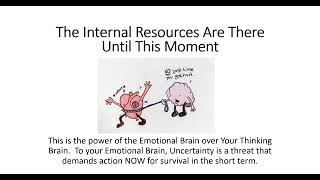
And caveman did not understand money. He didn't. He didn't understand money at all. If you put money in front of him, he wouldn't know what it was. Yet he understands life and death and associates that money with life and death. If you lose money to the caveman brain, your emotional brain, that is the threat of death. So now we can get to see how scared money got built. You have a brain that is built for survival, and you are asking it to work in probability, friends, without a whole bunch of reshaping, that brain is going to be highly resistant to that change and what we want to do. And this is a good way of illustrating it, we don't see the emotional brain. We see this mind in control of things. Here. Here's this little geeky white guy driving, driving the brain like a car, and everything's fine and dandy in the back seat, pushed away, being ignored is this mammalian, social brain that I'm calling caveman brain. And it is built on instinct. It is not built on logic. And what happens is when, as an emotion, when there is a trigger, when there is a change in status in your chart, there automatically is an emotional response in you, whether or not you recognize it or not. Most people recognize that fear, that scared money showing up way too late, and they can't do anything about it. But the thing is, when experiencing uncertainty, okay, it's going to create stress. That stress is Hardwired to choose, fight, flight over the rational mind. Now, what do you think is going to happen to this geek? He's going to get blown out of the water. Suddenly, you thought you were in control. You had this thing, you were thinking everything was fine, and then something happens and the trade turns against you. That may be that, oh, my God, I finally got some profit. Or you took a loss, or took a profit, and all of a sudden you're experiencing.
All your strengths that you need for trading are being hijacked by this process. So the thing is, we're sitting here and going, huh, the internal resources are there into that moment. You know, the thing is, is that that heart, that caveman brain, the one that's on the leash, it seems so tame. The brain's in control. No, last time you got hurt. It's going, give me, give me, give me. Or it's going, oh, I'm scared, I'm scared, I'm scared. And that is ultimately hijacking the thinking brain. And all of a sudden, you turn from a rational mind that knows how to trade to an emotional mind that is rooted in fear or aggression. Remember, revenge trading looks like it's about aggression. It's the fear of loss that triggers the aggression. So the thing is, is that that fear may show up first as fear, then it can show up as aggression. So now you're looking at it going, wow, this is what's happening to me all the time. Yeah. This power of the emotional brain over your thinking brain is there on a permanent level. What happens, it's easily hijacked, and the geek goes away, and suddenly you're scared. Money. That's what my friend Jeff wants to take advantage of. Now, to your emotional brain, uncertainty is a threat that demands action now for survival. It's not something that has patience to see if it's going to follow the rules. So here we are. We've gotten this thing. We realize that.
We think the beast is so very tame. We've got the emotions under control by willpower. Not going to feel him. You're stopping them. And yet, at the same time.
This illustration right here is one that you really ought to commit to memory. You ought to be able to say, I now understand what's happening. Ultimately, down in the bottom left, where it says emotional stimuli that creates sensorial information flowing to the thalamus. If you think of. If you think about the thalamus as a busy intersection with a cop directing traffic.
It'S going, everything's fine. The geek's in control. But Then an emergency vehicle enters that intersection. It could be, you know, it could be a police chasing it, could be a fire engine just blaring and horns and stuff like that. Suddenly the traffic cop, based on this situation, changes everything, stops traffic. That's the hijacking. And reroutes. Reroutes the emergency vehicle to go in his way. That is the short route. It is called the low road. And basically what happens is the thalamus sits there and it's checking it out. It makes a gut reaction about whether or not it's danger or whether or not it's business as usual. And if it's danger, it automatically stops the information from going to the thinking brain, the sensory cortex. Instead, it goes down this skinny thing called the short route, the low road. And it takes nanoseconds to get to the emotional center of the amygdala. And suddenly there's an emotional response kicking in to fight flight. And it's all being aided and abetted by the hippocampus, where memory, really emotional level memory of, like, suddenly you. You see you. You remember a traumatic event of where, you know, that thing that's came against you and it just sucked you dry. Well, you have that memory of that. It starts playing into the decision that the traffic cops making. Now, it could be, though, the way. The way we talk about it.
Before we start talking about really the emotions of trading, is that. Oh, yeah, well, that emotional stimuli is information goes up in the thalamus. The thalamus routes it to the thinking brain. And what happens is my thinking brain, all logical and stuff like that, makes a decision, and I follow my rules, and what happens is I extract more capital out of the markets than I put back in. And of course, I don't have any catastrophic type of traumatic memories that the hippocampus is holding there for immediate reflection. Except you do if you're a trader and if you're learning to trade. We all have had traumatic things happen to us where we've lost a lot. We've lost. You know, that thing turns against you. It hits that stop, and you don't. And you say, no, I can get this, I can get this. And all of a sudden you have a big, huge loss. Or you sit there and you say, you know, I'm not getting in trades, I'm not getting in trades. I'm not getting trades. More confirmation, more. And all of a sudden you realize that you've lost all that money that you could have had. And then you go, oh, FOMO kicks in. And then you Jump into the next trade. And it wasn't even in your plan. What you're looking at is for that information to get from the thalamus to the thinking brain takes about a quarter of a second.
Meanwhile, to go the low route takes nanoseconds. Do you see? That's why you will be sitting there trading. And you'll go, well, okay, I'm in control all of a sudden. And all of a sudden say what happened? And the trade blew up. That's an emotional hijacking. And suddenly the thinking brain is no longer around at all and everything is flowing out of the emotional brain. That's that. The very serious thing of where you over trade more and more and more and more and you get into a frenzy as if you and some guys were killing a mastodon. You know, a dumb thing to do. Some people are going to die, but it feeds the community for a long time. Or you're coming in there and you're beginning to take a loss and you don't want to take it, and there it is. It grows and grows and grows. And it blows your account out. Or in some cases, it blows your net worth out. I've seen that too. And a lot of that is held by that hippocampus with a memory, an emotional memory of a flashpoint. Just like that. Oh, it happened again. I need to be on the alert for that. And suddenly the whole thing, the traffic got cop goes crazy. Finns. This is happening daily in your trading. This little schematic is happening daily. And what's happening is, it's interesting. It's all electricity.
That's the other thing. Is, Randy, you telling me that my brain, there's electricity in memory? Yeah, 30 watts. 30 watts. It's driving all this stuff. It's an electrical system. You can change it by magnets. You can do a lot of things, but that's how this thing's working. And the question is, if you didn't know this, well, congratulations for learning that this is something you better learn. This graph shows you basically that willpower is never going to be enough. It also shows you that just tough, mentally tough is not going to work. When that traffic cot sees the emergency vehicle, all bets are off. No matter how tough you think, suddenly that emotional brain triggers in the and that saber tooth tiger is on top of you. That's how fast it happens. And it's here, it is here in this very midst, right here, that we cannot allow that. We have to interrupt that process.
We have to learn to interrupt that. And we're going to be talking about that. And what we're looking to do is anytime the brain encounters uncertainty, it's programmed to experience the vulnerability. Okay? And that vulnerability is powerlessness, which leads to survival instincts triggering. That's your fear and aggression routes. And all of a sudden, that compromises the rational thought. And this is hotwired. This isn't just. This isn't just, oh, I've done a few guided meditations, I've done some hypnosis, and I have a light little wiring of a new network there. No, this is myelinated. This is, this is insulated so that it fires like crazy. That's what you're up against, friends. What we have to do is we have to bust through that to get to the internal strengths that reside within you all the time. But unless you learn to control the intensity of the emotion, they're going to get hijacked. And only instinctual fight flight processes show up to do your trading for you. This is a dilemma that we are going to have to solve. And the deal is this. Out of this.
You can actually begin. If you disrupt the traffic cop when the information is coming into the thalamus at the traffic cop level and before he blows the whistle and puts and stops everything for the emergency vehicles to come through, if you can interrupt that.
That is where you can train yourself to respond very differently to uncertainty. The way evolution shaped you is to respond to uncertainty with fight flight. What we have to do is we have to retrain that response when it hits uncertainty and there's risk involved. And remember, the risk the brain perceives is not about money, it's about life and death. Symbolically, money and life and death have been your power to survive, have become linked. So now we need to really take a look at this because ultimately.
The problem is we're wired to control environment, to control outcome. And, you know, suddenly what happens is that until we can rewire ourselves to where we recognize that we don't have control over outcome until we come to that moment and say, well, what is it we do? Control. Until you come to that moment, the resources that you need for trading mine are not available to you. So out of this, the very first thing that you really need to grasp.
Is that you are going to have to take the sense of worth that you have as a human being, and you're going to have to separate it from performance.
And the truth is.
I know everybody in here is saying, oh, but I have great worth. I have a real sense of, oh, yeah, yeah, yeah, man, I've got worth. Your trading account is telling you whether or not you really have inherent worth operating or not. Your trading account is telling you what emotions, how effective the emotions are that you're projecting onto the markets about extracting more capital than you put back in. The truth is, is guys like Jeff cannot maintain making the kind of cash they're making if you were to project your beliefs and they didn't get scared to become scared. Money, once, once the deal's on. Once, once, once it's on. So the deal is this what that trading account is revealing are your beliefs about what is true.
If you find yourself not being able to get into trades, more confirmation, more and more confrontation. What you're talking about is you're seeing a foreboding of the future and you're questioning your competency. You're questioning, you know, really, you know, can I do this? Can I handle the. You're questioning whether or not you have the power of doing that. You're not seeing the truth. You're seeing where the limbic system has organized. Basically a short term way for you to survive in the flux of uncertainty. It wires that assessment in and it becomes the truth. The brain sees that as the truth. I don't really have competency. I'm not good enough. I can't, you know, I'm a loser when it really comes down to it. Not letting anybody hear you say that. And the truth is, it's not true. But the thing is, is once that, once that belief has been set.
You'Re going to defend that belief no matter how much information to the contrary shows up. And so you're, you're cutting a, you're, you're locked into that and you don't question your beliefs. Oh, you think you're right? No, that's just an organization that has occurred that either expands possibility for you or shrinks possibility for you. But the truth is, is you're going to have to really truly take a look at your beliefs about that are revealed in performance, not about what you look in the mirror and go, huff, huff, huff. No, what happens when you are trading and whether or not you're able to maintain yourself or whether or not it goes off, that is the revealing the beliefs that we need to be looking at. Okay, so we begin to understand the beliefs are not true, but they take on the certainty of truth and they become resistance to change. Now what we want to do is first and foremost we want to start really approaching this whole idea about winning and losing. I hate losing. This is the most common Phrase I hear from traders every day, I hate losing and I want to win. I want to be a winner. And the truth is, is that from my perspective, is winning or losing is just simply what side of probability did you fall on? Okay? I mean, even if you execute flawlessly, that doesn't mean you're going to win. That just means that you have a degree of an edge that's going to allow you probably to land better than if you had just done it by tossing dice. So now we're beginning to say, wow.
Most people, though, particularly Alphas, Alphas who want to be the winner, they want to control outcome. They want to make things happen. They're doing that to matter, to demonstrate to people around them that they matter, that they have prestige, they have. They have the stuff, they have all that stuff.
You're going to have to recognize that.
Your performances do not represent your worth or mattering as a human being. And that, my friends, is the number one obstacle that you have in your trading. That is it, believe it or not. And most of you, if you really were honest, you would say, you know, something I have been denying, actually, looking at that, I have been in a point where I'm also just absolutely not just in denial. But I do not refuse to see this, this belief that keeps popping up that tells me I'm not going to make it, I'm not going to do this. You're not really worth it. You know, really something you, you're not, you're just. You're just going to lose. That's the inner critic. But the thing is, is if you insist on not seeing that part of yourself, then you don't get to be able to change the beliefs that are driving your trading. That's where we're looking at now.
From there.
I want you to look at this. Hello, I'm in control. Practically everybody I know, they want to be in control. A perfectionist. A perfectionist is doing all that perfection to be in control so that they're not wrong. The Alpha wants to be in control to prove that he's the big deal, okay? And all the theft. So you're looking at this and going, hmm, how do we separate. How do we separate winning and losing from your human worth? It's a big deal. We're gonna be talking about that a little more. So we've gotten that you're winning or losing just simply demonstrates the competence of you as a traitor, which, by the way, can be improved. And that brain only learns from failure. For you guys who hate to lose, what you're doing is you're actually cutting off the ability of the brain to learn and to grow into becoming the mind that can in fact.
Be at an empowered stage to be able to handle uncertainty. It's like Ray Kroc, the guy who started McDonald's. He is very famous for the saying that he had is, I failed my way to success. And here we're doing the same thing as trader. You're saying, okay, as long as I am very focused on controlling, then what happens is I am not in a place where I can actually learn about how to build the trading mind that can handle uncertainty and not flip out on me. And suddenly that thalamus just takes me into another world where fight flight's there. Now, the truth is, when you win, when you take a loss, all that means is that you landed on the wrong side of probability. And the question that you really ought to be looking at saying, seeing that loss as a reflection of your health, self worth. What happens at the very first thing is saying, you know something, Is this a method mistake or is this just probability or is it a psychological mistake? And you go through the message, no, I would. I know that I followed my plan all the way down. And then you go, well, is this a psychological mistake? No, I was good all the way. So this loss is actually just probability.
You're going to have to retrain your brain to see that as a victory. You followed your rules, okay? That's the only thing that you control. A win, by the way, is only landing on the right side of probability. Okay? That's all it is. You could have done all sorts of stupid things and still landed well, just by luck. But what we want to do is again, you ask the question, you know, is this a method mistake, Is this a psychological mistake or is this just probability? And then you ask the final question.
All things being equal, would I take this trade again?
If you say, yeah, that's a good victory, you have actually demonstrated competence in executing your plan.
And if you do that, and if you do have an edge in your methodology, then what you're going to do over time, you're going to extract more capital out of the markets then you put back in. But the truth is, as long as you have the winning and losing beliefs, I have to be a winner. I want to win. And I hate losing. I hate losing, I hate being a loser. As long as you hold on to those.
You'Re building a wall to using failure to create success, a successful mind. And remember, victory to the brain just simply myelinates insulates the circuit even more so it keeps firing, keeps firing more rapidly, not to your long term advantage, but to your short term advantage. You know, if you don't get into a trade and it passes you, there is a moment where you go, who? Then you go, oh my God, I just missed a great trade. Well, that's being in control. You didn't get into the trade, so you couldn't lose. Now, now you're really beginning to see this really isn't about if I'm making money or not. It's really about what is my inherent worth. Am I trying to make money to prove something, or am I in a game that I'm playing about probability? And I'm fascinated by this game. Now, if you are to take this fear offline, then something really cool happens. This is when you can start developing the inherent strengths that are living within you. And you might thinking, randy, this is kind of weird. From my perspective, you have a community that exists as your brain. And there are emotional programs that are constantly duking it out for control of who runs the self. That's what you call you, that you don't even control yourself. What happens there is these emotional programs are in control and they want to, they want to control the construction of that self. What you have is you have enormous empowered ways of being in the world that sit as potential in your brain. You also have enormous destructive tendencies within you that will shrink your ability to trade well. And what you're needing to do is once you take fear offline, you can begin to say, hmm, we can now discover these internal strengths that are hidden and we can start doing something about the mind that you bring. And what is it we want? What is it we want? The truth is, most people trade from scared money. They don't trade from disciplined money. They don't trade from courageous money. They may be impulsive money, but I'm talking about courage. They don't trade from patience, they don't trade from impartiality. If you're scared, money, by definition, anxiety or fear are driving the brain to think thoughts that make fearful decisions. What you're looking to do is you're looking to find these internal resources that live within you. And they have been living within you for as long as you have been a social mammalian. Friends, that's about 120 million years ago, okay, as human beings, 6 to 8 million years ago. So in social mammalians, you need the discipline of a ruler. Somebody has to maintain order under pressure. You need the courage of a warrior. You have to turn toward your fears. You have to turn toward that saber tooth tiger that's coming toward your family. And you have to take your sphere and say, I have the courage to face my fear now. You also have to have the self soothing of a caregiver. It's the one. Let me ask you, for all those guys, when you make a mistake and you take a loss and beat yourself up, I want to ask you, has it ever helped, that coaching up football mentality, has it ever helped you win? No. You know, and also starting, oh, I'm just going to get tougher. Does that help? No. The orphan nature, that adaptive self, that caveman brain, when it ignites and fires in the back seat, remember the geek and the caveman, when it fires, it becomes a 600 pound gorilla. No strong man is going to impart that. If you work those three programs, the ruler, the warrior and the caregiver, what happens? The impartiality, the clarity of thought aspect of a sage, that's what you want. Trading starts, making the decisions under the same challenging conditions. But you have taken what you have willfully done is you have pulled up these other emotional programs to create the mind you bring into that moment. And friends, that is what you control. You do not control outcome. You do not control outcome. The truth is you have to disengage the way the brain has been taught from evolution and from the way you learned in your family, in your community and your culture. You're going to have to unlearn all that. And the question is, tell me something, why is emotion so important?
Well, very simple. All thinking is emotional state dependent. All thinking is emotional state dependent. If you thought of emotion and cognition as a locomotive, a powerful locomotive that has an engineer driving that locomotive and a caboose. Okay, now it so happens if in this analogy, the emotions are the engine, are the, is the locomotive, the beliefs that are driving that locomotive is the engineer.
The thinking brain. All that cognitive stuff is in the caboose. That's all it's doing. It's along for the ride. It's making up alibis, it's making up narratives and stories to suit what the emotional brain has already decided. And you think, oh my God, well, I have this brain, I have this mind that's separate from my body. No, it's not.
It started as a tumor growing out of your emotional brain. It's still connected. The infrastructure, communications infrastructure going in to the new thinking brain from the old brain is extensive. It's extensive. But the communication structure going from the thinking brain Back into the emotional brain is like two 19th century telegraph lines. You see the problem, you're going to have to be able to focus on that because once emotions take over, it literally boxes what you can see. Suddenly a lot of the world just simply disappears and you're looking through blinders. That's how important emotions are. And it's also you can use them from emotional intelligence. As you produce emotional intelligence, you find out that oh my God, I can use emotions to my advantage. You don't ever have freedom from emotions. What you have though with training is you have freedom of emotion. You can choose the emotions that arrive in the uncertainty and do the work of engaging uncertainty. That's what successful traders have learned. Now the natural emotional response is easy, is that nobody wants to go pet that kitty, kitty, kitty doesn't want to approach it. What happens is they may freeze in fear or they may run. Or it could be that they choose to fight because behind them is a clan that depend is depending on them. But this is the instinctual response to uncertainty, to the threat. Because your brain sees uncertainty as the threat of annihilation. That's just, that's why you hate to lose and it throws you into annihilation. And all of a sudden you're going to do anything but that. You're going to fight this save the tooth tiger all the way to your last breath. And that's holding your breath will do that to you. So you're looking at it. You have, we have to develop a very unnatural emotional response to uncertainty to be able to come over this. This is why discipline, impartiality is so key as the emotions to trade from and out of it. Though the key is though, when you take a look at this.
Courage of a warrior is needed to be able to face your fear. Okay. The truth is nobody really wants to look at their fear. They much rather find some way of avoiding it, of denying it, of repressing it or running from it or whatever, or projecting it onto other people, blaming other people. But the truth is, is that you yourself have to have the courage to turn toward your fear. Not to conquer it like beat it up, but to master it so that it's no longer fueled by the same beliefs that you bring to the management of uncertainty. Yeah. So if you can't have this particular ability to turn toward your fear, you're going to trigger to avoidance or aggression. Now the key though is how do we go about actually saying that? How, how can we stop it? Here.
Here what we're looking at is that probably the most underrated emotion in trading is self compassion. In self compassion, you're looking at this a woman kind of giving herself a hug and what she's doing is she's self soothing. You know, those of you who know is I had a heart transplant four and a half, five years ago and I was on death's doorstep for a while. Okay. And you know, out of that, what happens is then I did it at Duke University in North Carolina, where believe me, if you're looking at an operation like that, you need to get someone as good as Duke and you certainly don't need to be local. They, I just about died under those terms. But what happened is they gave me a pillow that shaped as a heart and it was really dorky when it said Duke University and it had this really stupid looking heart in it and stuff like that. And you used, initially you used that, you used that heart because it fit right over your chest. Yeah, it's a pillow and it's shaped like a heart. And you put your arms over the pillow and you put pressure on your chest because after you've had your sternum cut and after you've had your chest opened up and clamped open.
The healing process is extraordinarily, the neural information coming in is extraordinarily easy for the brain to interpret as very painful. And what they would teach you to do is to use this pillow. And if you felt like a sneeze coming on or a laugh coming on, you'd take this pillow and you would hug yourself. And that would allow you to work through it without damaging the repairing sternum. That heart I tried to throw away in the last five years, God, eight or nine times I've even taken it out to my garbage can, put it in and said, I finally got rid of you. But later that night I went out, I got it back out, dusted it off, and I can't get rid of it until finally you will see me in my office. I will hold that pillow. Because what I found out is that when you, you're hugging yourself and with that big heart sitting there, it's really easy to imagine yourself hugging yourself with self compassion. I do that daily. I do that and I'm leaning on that pillow and I will hold it and I just, I really like the feeling, you know, and this is a guy who tried to throw away the pillow for I don't know how long. It's finally wheedled its way into my life as a way of actually activating self compassion for myself without self compassion you do not tease apart the neural networks that hold the instinctual pathways that are just obliterating your ability to think clearly under pressure.
Compassion.
Not sorrow or pity, compassion. And let me tell you, compassion is. You've got to have. You have to have courage, you have to have faith to be able to use compassion in a very powerful way. And what I mean by that is also, it just so happens that I committed my parents to a mental institution many years ago, okay? And I did it out of compassion. I did it out of. Because my parents were what is known as tertiary alcoholics. They were drinking to die. And I knew there's far behind. It was far beyond me to do anything about it. And ultimately the advice I got was to commit them. And at that time, it was really easy to do it. There was no training, pro drug training programs that were available back then. And ultimately they had 17 years of sobriety out of my act of compassion. But compassion does not have to be for the squeamish, okay? It can be very soft. What you're doing is you're soothing yourself and taking. And by lowering that, what you're doing is you're lowering the brain and that traffic cop from saying, this is an emergency situation, keeping it calm so your thinking brain can do its job. And after you do that, this is the emotional regulation so necessary. What you still have to do is you still have to build this brain and root it in very different emotional programs or archetypes.
And I use the archetype and emotional program, some just simultaneously with meaning the same thing, okay? And the movie Lord of the Rings is probably the best archetypal film I've ever seen in my entire life. And then what I want you to do is you take a look. This is Frodo that you're looking at. This is the guy who had evil in his hands on his finger that was constantly tempting him, constantly drawing his power of being able to stay the course. And he is at a point where he's really beginning to think, no, I'm not going to throw that ring into the molten river. I'm going to keep it myself. Mine, mine, mine. An evil destruction would have won. Sam, his fateful sidekick, had great compassion for him and helped him through that ordeal. And you're already seeing, oh, okay, I see that your brain produces a mind that works as a committee. You have to have the discipline that Frodo had. You have to have also the discipline that the king had, the would be king. He had to re earn his throne. Eragon had to Re earn it. You had to have the wisdom, Gandorf. You had to have the compassion of a lot of the women. The woman who killed one of the things that couldn't be killed by man, she did that because she was acting from compassion. You also have to have the courage of a warrior. You have to go into the face of fear and master it. And it shows you that these emotional programs are always present within you. The real question is how do you awaken them? Okay, because the deal is, what I want to show you is that your brain really acts like a committee. What you have is you have different, different emotional programs that are resonant in the brain. And the brain itself is very desirable real estate. And there's constantly rivalry going on that, you know, if, if one part of your brain's not used, it shrinks. If you use it, it starts growing. And if one part of your brain isn't being used, other parts will grow into it. The theory right now is that for instance, your, your visual cortex has dreams because if it stayed silent for eight days while eight nights where you slept, there would be emotional programs taking over that territory and we wouldn't be able to see like we do. You're beginning to see this. You're saying, no, I need to get, I need to get these aspects of my brain. Whether or not you call them specialty regions, whether or not you call them archetypes, voices in your head, there are a lot of them and some are destructive, some are constructive. And you are going to have to wake up in mindfulness and begin to learn how to put these together so that you're feeding the empowered side and can produce the mind that can engage uncertainty. That's the discipline of ruler, that's the courage of a warrior, that's the self soothing a caregiver, and that is the impartiality of a sage. Those are the ones that have to come forward. Okay, you experience this, this quandary between these different parts of the brain every time that you have self doubt, every time that you're of two minds, you can't, you can't maintain discipline in the face of uncertainty impulse. Those are all battles going on between these particular emotional programs in your head. One of the best movies I've ever seen about this is the digs are Disney Pixar movie Inside Out. The early one though, the early one that is showing a little girl in trouble. It actually shows emotional programs basically controlling the girl's behaviors and stuff like that. So what we're doing is saying, oh, you're Telling me that I have to create the program. Yeah, because this is what you're going to listen to. Otherwise, who in here hasn't experienced the inner critic and the adapted voice? The inner critic is the one that criticizes you. You're never going to make it. What do you think? How'd you think you possibly could learn how to trade? Golly, no. Prove yourself. Come on, prove yourself. Prove yourself. You can win. Come on, do it. You know, really stupid types of thinking to be able. And then there's that adaptive voice, that orphan nature going, oh, I don't know man, this is, I might as well give up. You know something, it's just. Or I'm going to fight back. If you've ever, if you've ever revenge trade, you know, the orphan, these, this inner critic is this destructive aspect of your being. It's not going to go away and it convinces you of your limitations. You begin to believe the self limiting beliefs and you hide from them where they are really difficult. The thing is, it's there and you're going to have to use this new committee.
To recognize it and to stop the insanity. So your job as a trader to get past scared money is to recognize that you're going to have to disrupt all this. You're going to have to take the inner critical way, just absolutely invading the mind. You're going to have to take the fear or the aggression of the, or your orphan nature and you're going to have to calm it down. You're going to have to become a champion for it. You're going to have to be able to mentor it and not shout and scream at it. Because ultimately I had one guy trader tell me this. He says, you know Randy, when I was young, my mother used to scream and yell at me, all sorts of insults and things like that. She, she no longer needs to do that. By the way, this is a very successful pit trader that I'm talking about. She no longer needs to do that. I'm doing it to myself now. This is what has to stop. This is what has to stop. Ultimately.
What your job to become a successful trader is to reorganize, to reorganize the committee of the mind around your strengths, not around your, your history. Your brain arrives very unfinished. It organizes itself and you get locked into that and it's not for thriving, it's for short term survival. You bring that mind to trading. No, it's not going to work. But what happens is you're a human being, friends. You have the power living within you. To reorganize who's in control of the construction of the self. You exist as potential. The observer of that potential is what gives the form out. And what you observe through are your beliefs. So getting at that is necessary and these skills can be absolutely taught. The first skill we teach.
In the group course or in the individual course is emotional regulation where you learn to use breath as an aspect of an emotion to calm down so you don't get hijacked. Then you use mindfulness so that you step back out of thought and realize that you and your thoughts are not the same and they've been ship shot running all over you and you thought you were them. No, no, you got hoodwinked. And then you finally learn to discern the historical organization, this committee, and start reorganizing it. You're not leading under stress from inner critic and adapted voice. You're beginning to see that you are a captain of your own destiny. And out of that, as you organize all this, what you do is you get to understand something powerful, is that you do not control outcome. This guy that you're looking at surfing a wave, that's what a ride. He is not control of the wave, he is in control.
The mind he brings into that moment to be enjoined into that. So the deal is this, whether or not you like it or not, trading is really a journey into self mastery. If you are not willing to master the self, you're going to have a very difficult time. If you're interested in that, I invite you to explore more about my work. If you have, if you have just met, this is the first time you've gone across this. Wow, where is this guy coming from? Get my free ebook, go to the YouTube and watch I've got 240 something videos up there. There are people who go and spend hours watching videos, kind of get into this and begin to see, oh my God, I've been, I've been approaching this.
Just in an ineffective way. And then you're going, okay, well let me, I'll watch some of the videos. I'm going to, I'm going to reduce some of the reading. I'm going to watch some of the articles. I'm, I'm going to, then I'm going to, you know what happens? I'll buy his book. And then, then you start thinking, well, and then I'll get a few guided meditations and things like that. And then finally you come to a moment saying, do I really want to commit myself to saying, okay, I need to become a Student to be able to learn these skills, he teaches them. Am I ready to learn? And if you are, I want you to think about the core, our group course. I want you to think about our individual course. And the thing is, is that the individual, I mean the group course, the next one that starts in January. Okay, we're, that's just, we find that we can do four a year. The thing is, is that we teach the very skills that you need to be able to do that. And if you, if you join early and start working the program early, we're going to give you a free, a free gift that's worth a couple hundred bucks. Not to entice you, but to teach you. Saying, man, you need to get in this early. By the time the first day arrives, you need to be able to breathe in such a way that you're in control of your emotional nature as you trade. The individual course is for people who want to take a deep dive. It's 10 sessions with me over a period of three or four week months and you dive into the beliefs that are driving the building of your life. And we go to really work them and to work with it, it's just, it's a deep dive. But friends, my hope no matter what is that you find fulfillment in your life. And if it's through trading, I'm hoping that you come, you find how to do this and you achieve these dreams. Okay, so.
Oh, California's up in smoke too. It's burning, it's burning. Well, we're, I wish we could get some of the water on the east coast over there to you guys. But if you have questions I'll be happy to answer them. I've got a little.
Same here in California up in smoke. Wow, you sound great. Looking forward to your Wealth 365 summit as well. Great. Oh, and by the way, I'm making a presentation at the upcoming Wealth 365 and if you don't know what that is, you need to go. You know, you can go to my website. You'll have a link there that you can register. Go. It has the best experts in the world. There are a lot of them really know how to trade, are successful traders. You're going to, you're going to learn what you need to know about trading. Okay. And I encourage that. Thank you. Greece. So difficult to separate. Yeah, you are correct. So I need you, I need to give you a lot of money and you will change my beliefs. No, no.
Mike, what happens is I teach you tools and I teach you and instruct you and watch over you as you do brain surgery on yourself. The fact that you're giving me money is just simply a value exchange. And here, though, is that if I wanted to, I know that my, my courses are, are less than other people. I don't do that because I'm cheap. I do that because I run into a lot of people that can't afford the 5, 6, $7,000 that can be charged. And I work with people who just simply go, okay, I can pay this, I bet, go. I also work with people where this is a struggle and they have to find. They have to create the money to be able to work with me. I like working with those people. They're highly motivated. Okay. But the truth is, what will happen is I will teach you how to change your beliefs. I will teach you how to find what I call inherent worth. Where you find that you are created, you are an aspect of creation, no matter how you want to define and create that story. And you're an element of that. And it just so happens in my belief system that the universe is friendly and has goodwill for us. We have to align ourselves and make sure that we're not doing stupid things like over trading and stuff like that. But what you're doing is you're saying I need to be able to find out how to create and nurture these elements of the self. Let's see.
Randy, I entered late with a prior schedule commitment. Was this recorded? It will be recorded. It is being recorded right now. And it'll be available on our website and on YouTube tomorrow by noon. Okay. Okay.
Wish you good health. Randy. I've been trading for four years. Two months ago I found you and struggling. Today I'm funded. Trader. Good for you. We'll get my first payout next week. Good for you. Good for you. Good for you. That's a great thing. And here's from Hector. No, Carson. First, our. My smoking temptations that I feed into a base reason why I can't control temptation in my market.
I've been, I've been. Oh, that's different. What I'll say is this is. Smoking is an addiction. And it's, you know, nicotine is narcotic, very similar to heroin. And what you have is you an addiction, by the way, is getting at the reward centers externally using nicotine rather than dopamine, your own internal dopamine. And I know people who smoke who trade well. And they've got. They have gotten used to a particular blood level that they work with. Okay. My Own preference is, you know, you know, stopping smoking is a challenge all within itself. And I wouldn't necessarily do it when I'm saying I need to be trading live money because you know, you get a little kind of weebie Jeebie there when you're doing. That's not a. That's. That's a totally different thing. What do we got here? Hector, I've been in your group course this fall. Okay. And it has been quite fulfilling and rewarding. It is literally brain surgery on myself. But I can apply it to everything, just not my trading. And Hector yet.
Eager for. Oh, oh, oh. Oh my God. Oh yeah. You're. You're only getting started. We just, we just, we just loaded the kaboom on you last time we. You had the materials and we're going to start applying them now. Hector, you're in a good place. Not just trading for tomorrow's class. You learn so much each time. Randy is great. Thank you, thank you, thank you. I appreciate that. And the truth is, is that when you see people learning in their life's change, that means that what they're doing is there's. They're actually applying themselves, they're actually doing the homework and they realize it's an opportunity they're seizing. So thank you, Hector. My goal is to attend your course in January. Thank you. Go Christopher. You'll be welcome there. This is from Timothy. Outstanding. Thanks Randy. It is so great, great to hear you're doing well. I was wondering what happened a number of years ago I stopped receiving your emails. I don't know. You're. You're a gym. Well, just simply get. Just sign back on. And by the way, the reason that I, I ended up getting a heart. Heart condition because I was speaking in China thinking that I was making the most greatest money in the world and we were. What they didn't tell me though is that, you know, China has pollution on a level that is unimaginable imaginable for an American that's never been there. And I was teaching and having to breathe the air in China for a couple weeks. I came back and had a serious bronchial problem. Problem. Within a year I had a. I had a pacemaker. Within two years I was in heart failure. And, And I have sarcoidosis, which is the immune system triggering a lot of times from pollution to attack an organ. And the organ that it attacked was my heart. Okay. It was not a, it was not a lifestyle problem. It. But I can tell you this, there's no amount of money you could ever pay me to go back to China. Okay. And this is Danila. God bless you, Randy. Good luck and a lot of years life. I have a. I have a. When the heart was put in me, I had. I started out with a 34 year old heart. I'm 73 right now, so I figure I'm gonna. I'm gonna. I'm gonna pass by something other than my heart. Thank you. Natalie. I found you a week ago and it has changed so much for me. Congratulations, Natalie. Can. It's amazing where you open up emotional intelligence and you realize that, you know, you can get inside and you can look and you can see the way you're organized and God, you can do something about it. Really Carson, thank you for your help. Randy, I'm in a tough position.
And it means a lot to see what you do to help people. God bless. Thank you. Thank you very, very much.
Yeah, just big thanks. Great seminar as always. Special thanks for sharing so much about your personal life. God bless. You're welcome. And you know, the reason I share my life is this is that if you had only known the way I grew up and who I was when I was even in my 30s.
To be where I'm at in my life is.
Is remarkable. Part of that is hard work on my part. Finding someone who really deeply loves me and also being able to find a way of being able to change core material within myself. And also I might add, finding a power greater than myself that I believe hold dear, that is friendly and is engaging and wants me to succeed. Seed not like money, but as a human being, you know, it's no matter how we drape it is that, you know, my own view is I am a child of creation.
From there I know that I'm lovable. From there I have nothing to prove and may you have the same. Meanwhile, it's time to go. Friends. Have a great evening. If it's evening where you are and we will see you next time, have a great life.









