Readying Yourself for the Emotional Storms of Trading
Randy Howell explains how fear and uncertainty hijack traders' rational decisions through the amygdala and prefrontal cortex. He covers FOMO, revenge trading, and moved stops, then prescribes diaphragmatic breathing and mindfulness to build an intentional mind that can observe emotions without acting on them.
Chapters
Welcome everyone. My name is Randy Howell with Trader State of Mind and I am so glad you're here. It's. Thank you. If here it is just a ugly day. It's rain, rain, rain, rain. We're getting, we're getting weather from that hurricane in Florida and it's just good to know that there's people out there and we're all together and we have something in common. We really want to take, take a look at what it's going to take to become the trader that you know, is possible for you. So first thing is let's just find out if everybody can hear me, if somebody would type in a Y for me and let me know that I'm being heard and rather than just talking. Okay, we got it. Thank you. Thank you. So we're here. The rules that I play by is that I have a presentation that I'm going to give and at the end of that presentation I'll be happy to take questions, okay? But I'm not going to, I'm not going to interrupt my process because I usually can't get my mind straight again. Okay. So if you have a question as you go along, just type it in. I'll be happy to, I'll happy to get to it. It'd be one of the first questions that I answer at the end of the presentation. So with that said, and there will be also, this is going to be recording, it'll be up tomorrow, sometimes tomorrow on our website. So I would encourage you to study it and to work with it and to really begin to go, you know, what is it going to take, huh? And then let's start here, let's start here. And it's actually a pretty good question. Why do emotions keep crashing the party? You know what to do. You know, you can talk theory, you can talk ta, you know your rules. And the problem is, is that when you get into trading, when you get into the heat, into the challenges of trading, you kind of lose your mind. And all of a sudden you're no longer following your rules, you're no longer doing what you're supposed to be doing in order to be able to have an edge. And yet, man, you've invested heavily, okay, You've got all that knowledge, but something happens is that emotional storms keep erupting. And that's really what we want to look at, is what, what is it about these things? It's that knowledge you have. You have it really, really good, you know how to do this stuff. And yet at the very time you need to Use that knowledge. It's taken away from you by this erupting storm coming your way and blowing up the whole deal. The key is this, is that this is about uncertainty. This is about not having control. And everything that you hear, particularly when people are getting into trading, basically saying, yeah, all you do is follow these rules and you know something, you can start printing money and it's going to be. It's going to be okay. All you have to do is just leave your emotions at the door, pretend they're not there. And then all of a sudden you. What you discover is, you know something.
You can't do it. It's suddenly all that knowledge of trading that you possess is just simply swept away, whether or not it's an entry. And you keep looking for more confirmation. Then the trade slips by, and then you get FOMO and going, oh, my God, I just missed the trade. I need to get in. And all sudden you find the urgency, Another storm cracks your head. Then you get in the trade and it starts going against you. It starts bouncing around in its range, and you start feeling powerless and you go bananas. Or you hit profit. Worse than that, you hit stop. And you take the stop off and say, it's going to come back, it's going to come back. There's that. I don't want to lose, I don't want to lose. And all of a sudden you discover, oh, my gosh, this is an endless hole that I can throw money into. I keep throwing good money after the bad. I didn't. My rules tell me to put the stop and keep that loss small, to trade another day. And yet here I am. I took that stop away and I moved it and I gave it some room. And now I feel like the gambler in a casino taking a bed. Or you get to profit, and all sudden there's this urgency that, oh, my gosh, it could be taken away from me. It can take it away from me. I better take my profits while they're here. And all of a sudden you see those things go up and hit targets and beyond. And all of a sudden you go, what was I thinking? What was I doing? Well, you were in the middle of an electrical storm. Literally, that's what an emotional storm looks like in your brain, it's an electrical storm. Your brain is all this electricity, bioelectricity, running around and connecting these trillions of neurons that have just massive amounts of interconnection with one another. And it just lights up, and before you know it, you're just taken out. So we know that's happening. And what I know is that a lot of people like to think that it's not going to happen to me. And then it keeps happening more and more and more to you. And you keep pushing, pushing, pushing, and ultimately the pushing, pushing, pushing doesn't help. What it does is it traumatizes the brain. From a brain's perspective, it traumatizes it and suddenly all of a sudden you realize, oh my God, oh my God. Then you start having that oh my God, you freeze right there before you can get in. So.
Unfortunately, those emotional storms wipe out the rational mind needed for trading. And it really comes down to cue the engagement of uncertainty, the emotional storm, which is actually the habit that you have of when you hit that uncertainty, the habit that has been established of avoidance or aggression pops up. And all of a sudden what you have is you have instinctual fight flight responses to something that you know that you need to have a very set standard practice of the way you handle things. And suddenly it's gone because the rational mind is no longer in control. What's happened, it's been hijacked, okay? And all of a sudden you're in fight flight. So most traders, even though they really, really, really want to be rational traders, what they are very emotional traders and they don't know how to reprogram their responses to perceived uncertainty or threat. The moment the brain experiences the uncertainty, it feels confused and in confusion, it just goes bananas. And suddenly what you have is you have a direct signal to the amygdala into the fight flight response and you're cooked. That's the emotional storm. Prince. So let's take a look at this. And a lot of it, to be honest with you, if you were to design the worst case scenario, the worst nightmare.
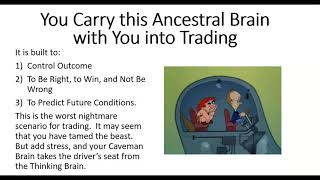
That the brain would ever conjure up to have to experience and master, it would be day trading. Okay? Think about it. Your brain wants control. It wants, it wants control over outcome. It wants certainty, it wants to be right and it wants to be able to predict consequence, catching it where that, you know, catching the bottom. Right, okay. And ultimately though, it's this combination of short time frames, risk and uncertainty, that activate very primal instinctive responses to threat, to the challenges of living, to the stress of trading. Okay? And like this graphic showing you basically all those things, other than the guy typing on the computer, possibly even trading all those things, what you're actually looking at are you're looking at the ancestral brain and mind of the human, the humans of us Homo sapiens, and we still carry that Very, very. Before we were Homo sapiens brain with us. And we carry that into trading. It's built for the jungle. It's built for danger. It's not built for probability. And that, that's the problem. And we're going, okay, the more stress, the more the primitive, primitive fight, flight responses are going to become available and more probable. And they're inescapable friends, no matter how hard you try to believe otherwise. Look at your trading account. The only friend that you have is your trading account, and it's a tough one, is your trading account is going to tell you the truth. You are actually seeing what beliefs you're projecting onto the markets. And if those beliefs are actually effective, and effective in trading means that you are extracting more capital out of the markets than you're giving back. That's the key. Otherwise, what you know, if you're looking at the health of that trading account and you're going, you know something, it's not really there. What you're looking at then is the beliefs that you need to be really looking at. Some of those beliefs are learned in our family of origins and our culture and circumstances. Others are just simply part of our evolutionary psychology. We bring cavemen with us into the trading world. There's just no way. There's no way to avoid that. And this is a good way of looking at it. Okay? Take a look at this guy, this geeky looking guy, driving his brain down the road, having a good time, thinking he's in control. Meanwhile, in the backseat, ignored, is this very primitive, instinctual caveman who has programmed responses to threats. And understand that caveman ancestor of ours truly lived in a dangerous world. There are plenty of critters much bigger than him that wanted him for lunch, and he had to be very wary. Okay? Therefore, we have a tendency toward fear and anxiety.
And when triggered, he. He went into action.
Thinking wasn't really all there. I mean, that caveman guy is not thinking like the modern human does. It's not on the same level, and yet it's sitting back there. And all of a sudden the capacity to think is absolutely wiped out. And you're working on instinct the way that a caveman would respond to emergencies and danger. Now, what does that look like? You know, and you realize that, okay, what that caveman wants in the backseat is he wants to control outcome. Or actually, if you were to do it in a neurological, neural, biological game, he would want to control environment. Okay, Same thing here. You would like to be able to control the trading environment. He also wants to be able to be right. Understand, for a caveman, our ancestors, to be wrong usually meant he was a meal for somebody else. So he really wanted to be right, and he did not want to lose, because that was death itself. And the other thing is, man was really, really good about being able to hook up.
Basically, events that happen and the consequences and to see the pattern involved, see causality, okay? And that's our. That's. That would be a traitor's tendency to. To believe that, you know, the. The potential of his setup or the potential of a particular pattern means something. Certainly, no, it means there's a probability of it. But understand, caveman is. Thinks from a position of certainty. He lies to himself, okay? Your brain lies to you all the time. And the only thing that's going to be honest is your trading account, okay? It's going to tell you, you can think that you can pump that up, you can talk that talk. But ultimately, when you're walking the walk through this dangerous jungle called trading is that the real motives, the real beliefs behind your actions will reveal themselves. And you have to be careful. You have to learn how to work with that caveman nature of yours. It is not going to go away. And.
Ultimately, your brain truly evolved to keep you safe, to keep you alive under uncertain circumstances. In the short term, when suddenly you didn't understand where you weren't in control, the brain fell into confusion. And I want to tell you something. Confusion is one thing that the brain does not like, that is its antithesis. It doesn't want confusion. It wants certainty. It will lie to itself. It will believe.
It will truly buy into a convenient lie rather than an inconvenient truth. It will do that. So you get the confusion. And what that does is it produces vulnerability, okay? And understand is that what a trader has to accept is that he knows nothing, that he has a hypothesis, but that hypothesis is a guess. It may or may not go his way, okay? And he has no control over which way it's going to go. But he does have control over, you know, if it goes the wrong way to limit that loss. And he does have the control that if it goes his way, that he can let it ride to a point where he hits a target. Unfortunately, when it hits that from go, it goes from confusion where he's not in control. The illusion of control is burst, fills the confusion, then he experiences vulnerability. If you want to see vulnerability is, look what happens when you get into a trade and it immediately starts going against you. And you can start going, oh, my God, oh my God. Powerlessness, vulnerability. Now when the brain experiences vulnerability, it is going to take the low road. Nanoseconds. It's sending that message to the amygdala. The amygdala is activating the fight flight programs of the amygdala. And suddenly you're either trading from aggression or trading from fear. If you've ever over traded, if you've ever revenge trade, if you have ever tried to make up for prior losses, you know what aggression and trading looks like. If you've not been able to get in a trade, you haven't been able to pull the trigger. Or if you go bananas and get out of trades, like when you get into trade, you see it's going around, say I get out fast with a small loss. You know fear when you come to the profitability and then take that, take that little bit of skinny money, enough to pay your broker, but not enough pay you. And then all of a sudden you see that thing just hit its targets. You have experience the fear of the future, the unknown of what, what could happen. Better to be safe than sorry. What is what the brain's saying? Then you wake up and you go, and you wake up from that ether. You go, what was I thinking? What was I thinking? This is, I don't. Well, what you've experienced is an emotional hijacking, an emotional storm. It just come by and wiped out everything.
That's the deal.
Well, wow. So here would be what it looked like right here. We just talked about.
Ultimately, there's a cue, there's something that happens in the environment that sets up you to experience the uncertainty. Then it fills that confusion and it goes to vulnerability and it goes to fight flight. Ultimately, if you take a look at this graphic here.
Before the uncertainty, before the confusion and the vulnerability happen on the left side, what you're going to look at, it says low emotion here, but it's really more like more of the parasympathetic nervous system is control. And you feel, and you feel calm, you feel okay, everything's fine. And what happens is your.
Cortex, your prefrontal cortex is part of how the brain makes decisions, that part. And that's what you want. I often refer to that as guess what, Sage, you want. You want that. You want to be able to use your TA in a powerful way. Yet when you get to this vulnerability whapping over to fight flight, what you're looking at right here on the right is that suddenly the signal, the, literally the signal to the sensorial information is no longer going to the thinking brain, it's disabled. It's literally taken offline. And that's why you go, what was I doing? What was I thinking? It's your thinking brain was taken offline and the amygdala takes over. And that's where all those instinctual processes kick in. And suddenly you're acting really from your emotional brain, or what was known as the limbic system, rather than integrating and working also with the thinking brain. And this is what the automatic response becomes. And it happens in nanoseconds. Information getting to the thinking brain takes microseconds. Meanwhile, in those nanoseconds, the chemistry, the emotion is already in the bloodstream, hacking the system apart and blowing you apart. And, you know, basically it's too late. The thinking brain can't stop the tidal wave at that particular time. And ultimately, it's interesting, it's interesting is.
What you discover is that in neurobiology, what we would say is that you have never experienced reality. Never. What you have experienced is a brain taking sensorial information of something that's never experienced itself. And it's creating a virtual representation, okay? And that virtual representation, that interpretation of that sensorial information, if it's not under stress, no problem. But under stress, it can be lethal. And suddenly you start seeing it habituates the response. If it has short term survival value. Like for instance, when you, when you take the profits early, there's actually a sigh of relief. That's a dopamine squirt or endorphin squirt that says, oh, you got out, you got your money.
To the caveman brain, that's the ticket. They survived today. But to the thinking brain, the guy who thought he was driving the car by himself, what's happened is the potential of trading has just absolutely flipping. So what happens is once these habits are set, they actually start becoming beliefs about your capacity to manage the uncertainty found in trading. And there's the ticket, friends, is that you don't see these beliefs. They're limbic learnings. They're happening pre verbal, okay? They're happening pre verbal. The thinking brain never, never acknowledges it. And literally, without your understanding, without your knowledge, the brain's locking you into a sense of reality that does not match up with the world out there. And you get locked into it and you can't even see that you're locked in. Just things keep blowing up. And why does this always happen to me? It's like my neighbor has this saying is Randy, if I didn't have bad luck, I wouldn't have Any luck at all? He doesn't necessarily see that as a reality that his limbic system has locked him into seeing. Yet that's what it is, at least from the perspective of neurobiology and brain science. So we've gotten there, and the thing is, is you never see things as they are. You see things as they are. You also. There's another thing that has to be understood, is that the brain will only believe what the eyes show it. Okay, Got that. Now, the corollary to that is the eye only shows the brain what the brain wants to see. This is where we deceive ourselves, is that the brain is being fed just simply what it wants to see. Okay. By the eye, and the brain's thinking, I'm seeing what's out there. That's what I believe. No, you don't.
Basically, the brain, from the caveman to basically that developmental coagulation of self, is in a position where it's saying, you know something? I am learning how competent I am to be able to manage the uncertainties of trading, of living, of the challenges of living. And often what you discover if you're fear based is that you don't believe you're competent. If you're more aggressive based, you. You come to believe that your performance actually is your mattering. If you make money, then you'll matter. And what if people treat. Almost everybody that comes to me initially says, randy, I want to make money. And I say, can you control that? And the answer is no. You can control the mind you bring into the performance. But right now, they see through the lens of making money. And ultimately, what really good traders discover, it's not about making money. It's not about winning or losing. It's about the mind you bring to perform, about controlling the emotional cocktail that produces the mind that engages the uncertainty of trading. That's what has to be seen. When you start waking up to that, you realize, wow, things are changing here. I'm beginning to understand how to maintain myself, maintain emotional sobriety as I'm trading and facing uncertainty. But it takes a lot. You have to begin to realize that, you know, the truth is, is what I'm doing is I'm not seeing reality. You know, I. I'm taking a brain that has biases, has assumptions, has implicit subconscious beliefs that the thinking brain doesn't know about. And it's making decisions long before the thinking brain ever wakes up to the idea that the caveman's in the backseat. And all of a sudden, boom, it's gone. This is what's been happening. How does it happen?
How does it happen? Well, I'm going to show you. I want you to take a look at this graphic and it's going to have a little bit of biology talk and a little biochemistry talk, okay? But ultimately you have, you have sensorial information coming in. That's what says here is emotional stimuli. You're seeing stuff, you're feeling stuff, you know, you're all that stuff. All those sensorial modalities are coming in, feeding into what is known as the thalamus. And here things get tricky because right here at the level of thalamus, really quick and dirty decisions are made. It's like there's a traffic cop, okay, sitting there directing traffic based on history, based on your prior experience and beliefs, that traffic cop is going to interpret very, very gut level whether or not something is dangerous or something is opportunistic, okay? And if it's opportunistic and needs some thinking, what happens is that information is then sent to the thinking brain. That's called the long road, okay? The long route. It's a high road. It's the one where the central nervous system is governed more by the new brain than by the old brain. And it plugs into the hippocampus, which is basically your interpretation of memory to be able to say, okay, this is good, and it becomes a decision that you make. And it's, it's derived from thinking. However, that takes at least of a quarter of a second for that information to get from the sensory thalamus to the sensory to the, to your thinking brain. If that traffic cop, based on his experience in the past of danger and all that kind of stuff, views the information coming in as a threat. This is you reading your charts and this is you getting into a real stressful situation where you're seeing the trade go against you or, you know, you and all that stuff, okay? And it's saying, oh my God, I'm in mortal danger. Because understand this part of the brain, this limbic system we're talking about now, friends, it doesn't think. What it does is it, it produces limbic learnings based on its experience with the environment. And it learns how to either avoid, approach or attack information things in the environment. You know, if it, if it's fearful, if it can harm you, then it's going to avoid. It also can get aggressive simply because it thinks it's a food source or it thinks it's being attacked and it's going to attack back. Revenge, trading or approach. That's when you're going, okay, I'm going to see what the trade, what the markets are going to give me. I'm going to be very patient. I'm going to be very calm. Okay. Well, in this case we're talking about, the information is interpreted quick and dirty as dangerous. The low road short circuits the thinking brain, moves it right over, right over there to the amygdala and it tracks up the fight flight response and boom, you're gone. Fortunately.
In the same way that disciplined impartiality is needed in response to encounters with uncertainty, most likely you have different programming, more like fight flight to encounters with uncertainty. The good news is that disciplined impartiality can be taught.
What we have to get over though first is illustrated in this, is that, you know, here you have the emotional brain, that's the heart, and you're looking at the thinking brain, that's the poor pitiful gray matter sitting there beat up. And ultimately.
The heart, that emotional system is saying, hey, wait, you know what happens? I took care of this. He didn't, the thinking brain didn't realize that we were in trouble. So I just, I took him out. And then you have the communication going through the rest of the body about what you're going to do with it. That's really what we're, what we're really looking at. And we have to be able to train.
The brain not to trigger to those ancient instinctive practices. It's not easy, okay? It's not easy. I do not teach magic. I teach a process that trains the brain to move from a certainty based primitive brain to a probability based mind that can handle the randomness of the markets. That's what I ultimately do. But this is.
This response stuff just happened long, long time before cognition. And it colors your thinking about effective decisions even when it's right in front of your face and you know you should be doing something else. You're not in control. You can learn to be in control of the mind, but it's not, it's not, it's not the willpower. Willpower. Willpower is, is something that tires out and the more you subject it to stress and continually, you have to continually muster up the willpower, muster up willpower. They will come one moment under stress that the willpower cracks, okay? And you have to be able to find something other than willpower to be able to hold and dampen the emotions down. You actually have to learn to manage the emotions that arise as you interact with uncertainty. That's the big deal.
And ultimately this is where we really start thinking about things differently. The point is this. Emotions are not optional.
You are an emotional being. Your physicality, your biology is part of the emotion. Because ultimately an emotion from my perspective is a biological action potential. Notice that it's biological, it's not psychological, okay? And ultimately it's going to go in different ways. But the emotion is also saying something like this is that.
Being that we're an emotional, a biological action potential, that potential is being activated to be able to coordinate action between you, the organism or the trader, and the environment or the markets. Anytime there's a change in status in the market, in your environment, by definition an emotion is going to activate. It's just going to trigger right into being. It just depends on which one. The programming that you brought with you to trading, whether or not it's fear based or aggression based, whether or not it's alpha thinking where I can make things happen, or whether or not, oh my God, you know something, if I do everything right, I can't be wrong. What happens is those are responses, trained responses, limbic learnings to your encounters in a different developmental moment to uncertainty. What we want to do is recognize, okay? What we know is that we can feel dejection when we get beat up and take losses, okay? We can now have FOMO when we start seeing all the money that we're leaving on the table and we get aggressive and go after it. Or we can fall into lust where we just start thinking, oh, money, money, money, money, and I'm going to win, I'm going to win, I'm a win. And what happens is it clouds, it clouds, it clouds up. And that clouding becomes an emotional storm and wipes out the mind that you need for trading. Just look at dumb mistakes, you know, and you can see this process happening and the emotion is going to be there. Just because you're tamping it down by willpower and trying to deny it and stuff like that. It only means it's gonna, it's gonna come and bite you in another place, in another time. And the more you try to use willpower, the less willpower you have because it literally, the tighter you get, the more drained your brain is, the less willpower there is until you finally give up and then you don't have any other skills. That's the point. So then we're going, okay.
If I now understand that emotions are actually coordinating the relationship between the organism and the environment, we can begin to see, let's see, let's see the similarity. When you take a look at that illustration on the right, you're looking at our ancestors in open territory. They are very vulnerable. Take a look at the child that the mother is working with. Take a look at the, the man on the front, the front left, you see that he's got a weapon. They're out in the open where they are most vulnerable.
Both fear is present and aggression. Potential aggression is present. If a predator happens to show up on the scene yet, you know, they're out in a field and they're looking for grain, they're looking for their hunter gatherers. They're having to get out there and put themselves into a vulnerable situation.
And then we start saying okay now let's flip that and say what is it like in modern world? And all of a sudden you're seeing the ups and downs of, of the market, you know, and that's it. And you know, oh, this is just a market correction, this and that the other. But what happens is that you might as well be activating that primitive K fan brain of yours because basically now your fear or aggression based and it's going up and down, up and down. Am I going to fight, am I going to fight or am I going to environment just going to lose my stuff. And ultimately vulnerability. The motivation, the motivation to avoidance. There's four sub motivations. Run, hide, freeze, submit. Okay. With aggression there is attack. You would know that as anger, trading from anger. The other of avoidance is trading from fear. And that's what all these perturbations happening in the market, they automatically are triggering emotions. Automatically. You don't have a choice about that. You do have a choice about which emotions and whether or not they're allowed to grow to where they take over the mind. That's where we have to recognize that we can't use that brain that those early Homo sapiens are using to explore their world. We can't use the same brain to explore the markets. It's just not going to work and it's not going to be pretty at all. So.
The question.
The real question.
Is what emotional response activates with exposure to uncertainty, which ones do that? It's easy to get the fight flight response. Yet with training, you think about the military, what they do is they train their soldiers to activate completely different emotional responses to the chaos of war. You put me out in the midst of a war and most likely I'm going to melt down and just become fodder. Yet with really proper training, literally the interpretation is completely different. It's interesting, I'm reading a book about a guy who became a samurai in Japan. He was an American who went and studied there for a number of years. And he made all the different grades of being samurai. The one thing I basically discovered is that a lot of their training had to do with during that medieval time during Japan is there were a lot of. There were a lot of assassins around. Okay. And the samurai had to develop an awareness all around him of potential assassins. He built that mind and he also built a mind that worked under stress. That was one of the big part of the big part of the training. And I said, oh, I can. First of all, I can easily see the application to the military. But in some ways you can also see we need to build a brain that knows how to operate effectively under stress. We need to become. We need to become that. Okay. So there's the cue of where we're going to be going next. And the big deal is.
How do you. How have you tried to build a winning mindset? Do you have. Do you have affirmations? Do you have visualizations? Do you have some NLP tricks that you use and work with a lot talk. You know, you're reap and trying to reprogram the subconscious mind. Everybody done that, right? Yep. And you. And you're teaching it to win. Yet what you're doing, friends, is that you darn well know after a couple of experiences that you're not in control of winning. Okay. And prosperity thinking blows up too. You want an effective mindset. You're not going to. You're not going to fantasize the markets giving you all the riches and be effective. The markets really just don't care about all this crazy stuff you're making up.
It's there. It's neither bad nor good. It just depends on what mind you bring. You're not looking for a winning mind. You're looking for a mind that wants to perform well.
It can't control whether or not you win or lose, but it can control the mind that you bring to the moment of performance. That, friends, is the big deal.
So.
What happens the moment that you start trying to control something that you can't control.
The brain experiences powerlessness and that guess what, that leads right to the fight flight response. That would be those particularly that over trading, that revenge trading, that trying to make up for prior losses stuff. Okay. Can't control it. Each trade is completely independent of the past trades and future trades. You can't make up for prior losses, yet your brain is built to believe that it's lying. So we're looking at it going, okay.
What do I do? What do I do? Do I just kind of melt down and have all this knowledge and, you know, if I could just manage my emotions by willpower, I would be able to get out of this thing? Or is there something else here? Yeah. Yeah. What we want to talk about now is how do you control.
The mind that you bring to the performance of trading? If you accept, not just unlike talk, talk, talk level that you cannot control outcome, whether or not you win or lose. Okay. Are particularly predicting what the market's going to do. These are guesses. This is your caveman brain. This is what it evolved to do. It was highly effective in the jungle which it arose. Not effective in trading, though. You need a different mind.
But if you accept the notion what I can control is myself so that I have an edge in performance.
Friends, this is the key. This is the key.
Oh, you did. Thank you. I didn't. I somehow didn't see her changing. Okay.
When you have an observer, you observe through the beliefs that you don't even know you have. And what you see based on those beliefs, you see the truth. It's just a representation. You haven't seen the truth. You've never seen reality. You've seen a representation that the brain has created of out there. But the truth is, is what you say is out there is being created inside your head based on the beliefs that you bring to your performances, the beliefs you have about your capacity to manage uncertainty. Those beliefs, okay, and you do not see and then believe. You believe and then you see. That's why people. That's why people can just explain things away. That's the craziest ways. So the very first thing that we want to do is say, you know something? Once we accept that emotions are inescapable, how do we go about managing them? How do we regulate them? This is the big key. Most people don't even know that they are being. An emotion has activated and is arousing and is about to take over the mind. They don't even know it. The first assignment and what I'm going to. What I'm going to give you is you're going to. You're going to learn to look at yourself as you trade and begin to see that emotions are biological. They literally are on your face, they're in your body, and they take over your mind. And here, what we're also recognizing is this, his emotions. Because they're biological, they also have a physical signature. For instance, when you're scared, when you're angry, you are going to either be holding your breath, cutting off oxygen supply to the brain, or you're going to be using only the top 30 of your lungs. Kind of panic like that, fueling, fueling the fight flight response. Yet if you were to do bellows breathing, which is, you know, that's where it all starts in my training is you are pulling air all the way into the bottom lobes of the of your lung by breathing air into your belly. First you're pulling that and then you're expanding to chest. It just so happens that activates the parasympathetic nervous system. You feel calm, you feel relaxed, and then you release that and you start the process ever again where air to belly, expand to chest, hold, release, and then you release the tension in your body. You let it drain, drain, drain, until you're loose and limp, loose and limp like a sleeping baby. Now you go. What? Ready? Yes. The way you breathe, the way you hold tension in your body is evidence of an emotion present and in the process of taking over your thinking brain. That's what I'm saying. It's not going to solve the problem and change the beliefs that are inside the head. But the point is, unless you learn diaphragmatic, breathing under stress doesn't do any good in the yoga studio, friends. It has to be done during trading where you train yourself to diaphragmatically breathe to keep your arousal lower before it becomes a feeling and takes over the mind. Because when you feel an emotion, you are feeling, what you're doing is you're feeling the chemistry of the emotion in your brain and in your body. So I invite you tomorrow when you're trading, get a mirror, better than that, get a video feed and watch yourself trade. And notice that you hold your breath a lot, you pan a lot. You hold tension in your forehead, in your jaws, in your neck, your chest. You know everywhere. And that is emotional arousal. And that you can in fact interrupt it. And with training you can do it under pressure. That's the first big thing. The second thing though, this is when it gets really interesting. We need a tool for being able to change and re understand who you are.
Here. What I say is that there is no final you. This thing that you call I to me is only a sliver of the potential living within you as possibility. Yet you're locked into a reality that basically keeps you jailed from greater possibility.
To do this, we're going to have to create something that is already there called the observing self.
This observing self, and this is a good way of understanding mindfulness. On the left, what you look at, you're observing, and you're totally consumed by your thoughts. You have not recognized that you do not have thoughts. They're having you. And then in the second frame, you're seeing that an observer has awoken and starts seeing all the conversations, all that internal commentary that goes on all the time in your brain. And you're going to be. It's separate from me. You don't have to be. You don't have to fuse to that. Okay.
No sound.
Just somebody said they can't hear me anymore. Would someone type in. If you can hear me, just type in a yes, and let's find out whether or not it's my problem or whether or not it's that particular person's problem.
Okay. Okay. Well, good luck with that sound. Okay? And yeah, so now we're looking at going, oh, my gosh. The deal is this, friends, is the observer, that mindfulness is actually a faculty of your humanness. It's one of the things that really, truly helps separate us from other animals. And here we can train it. We can train it so it steps back out of thought, it steps back out of belief, and you can train yourself so that you are no longer identifying with those thoughts, with those beliefs about who you are. You know, listen to the internal commentary in your head, and you will hear all this stuff going on. So that's the main thing. You have to develop this observer. And again, of course, we do that. Then.
What we want to do is observe this inner commentary, and then we want to start freeing ourselves from it, okay? Because there is judgment, there is temptation, there is criticism in part of that internal commentary going on inside. And I call that internal commentary. I call that historical internal dialogue. And I promise you is that your brain is more like a neighborhood, okay, where rival parties are trying to take over. It's, of course, you have a lot of different aspects of the self, a lot of different motivations going on in your brain. That when that brain produces mind, suddenly what you have is you have a committee with lots of different voices running. No, you're not crazy. However, you fell into the deception that if you had a bunch of voices running around in your head, that you were crazy. What a clever, clever, clever lie to tell the brain to tell you. The thing is, you need to be able to see. To me, it is really almost like you're waking up and you're really in a boardroom that governs who you are. And you're beginning to realize that, oh, my God, I've been asleep at the wheel and there's a mutiny going on. Because what you'll discover is this. You'll discover that there is what I call an inner critic living in your brain. It's destructive, okay? It's the one that criticizes you. It's the one that judges you. It's the one that convince you that you're not enough, that you, you have to make money to matter, that you're really, you really, you don't deserve good money. It's the one that convinces you to take the profit now rather than letting it ride to target. It's the one that says, oh, you're powerless, you'll never make it out of here. That one. The adapted voice is what I often call orphan. It is your fear based or aggression based behaviors, perceptions, that saying, I'm not going to make it or I have to prove myself, I'm going to do this, I'm going to, I'm going to get that money back. I'm going to show you, or I'm just, I'm, I, I'm just going to submit to the disaster that I am. I know that I'm never going to make it as a trader. Blah, blah, blah. That's going on inside your brain whether or not you like it or not. It's going on inside the mind. Because now in the movement, in the miracle between brain and mind, somehow those emotional programs are given voice in your mind almost like characters. And what you've got is you go to boardroom where two different factions are duking it out, each trying to take you, the company, call you in different directions. One's very destructive, one's very constructive and you have to wake up and start remanaging that. So the constructive elements of the self are producing the mind that engages reality, engages the certain certainties and steers you through the uncertainties of trading. And this is what I call your potential self or the intentional mind. And ultimately what you'll discover is this one of the best movies I've ever seen for being able to show archetypes, basically the emotional programs in a symbolic way has been Lord of the Rings. I mean, you think about the courage that it took to take the ring that was going to corrupt you and to take it to Mordor and throw it into lava. You think about the kind of growth that had to occur to go from a disgraced ruler family and to reclaim the sense of ruler, the leader. Think about the wisdom that was required to be able to see past what would seem obvious Think about the compassion that it actually took to be able to keep all this intake and think about the struggle that was required. That's one of the, that's. And another great movie for this would be the Gladiator. You begin to see these. You begin to see that actors and actresses are portraying archetypal emotional programs. That's what you're seeing and seeing them alive. And the deal is what you're looking for to build in your mind is the discipline of a ruler, the courage of a warrior, the self soothing of a caregiver, and the impartiality of a sage. This is the emotional elements required to build the intentional mind that you need to take to the management of uncertainty. Friends, it can be built, no doubt about it. And ultimately the struggles are going to be there. Friends, the struggles are going to be there. You can take a look at these two guys, they're squaring off, you know, all the other committee members are looking, going, well, what are you guys going to do? And ultimately you have to build that self that is prepared for the storms of life. That's what you do. The inner critic will in fact do everything under its power to rob you of that. You have to build it, you have to maintain it. And it just so happens in trading it's necessary.
So this is the brain that can be built, the mind that can be built from the brain. This potentiality, this possibility exists. Okay, it's there.
And it's literally having to say, you know something? I've been locked into this perception of reality that keeps me on the wrong end of success in trading. I need to build the mindset, you know, that intentional mindset built for probability rather than certainty. And it can be done. This is the psychological edge that I need to realize, the method edge that I already have. And ultimately.
Next please. Ultimately, it comes down to my buddy here.
There's a lot of misunderstanding about evolution. It's not the survival of the fittest, it's not the survival of the strongest. What evolution favors is how you respond to change, how adaptive you are. That's the biggest power. And what I'm asking here is you've put yourself in a situation of having to rebuild, to readapt the mind for very different circumstances than you have been living. You're going to have to learn that if you're going to be successful. Typically, traders blow out their accounts three years, all their money in their accounts in three years and are gone. They never understand. This is about adaptive, this is about being adaptive. Changing the old for the New, because the old, no matter how successful it has been, it's not anymore. And friends, we can help you do that. We can teach you the tools that you need to be able to do that. And pretty soon, ultimately, if you're not convinced already, I really ask you to stay with the free stuff. Maybe the book where, you know, I have lots of articles, lots of videos that talk about this stuff all the time. Really dig into this thing and look, kick the tires, then get the free book. Okay? Then at some moment you realize, I know that I'm kicking tires, and I know this is head knowledge. And ultimately, the reason Randy's giving me all this head knowledge is because he knows that you have to train yourself to be able to take that head knowledge and make it performance knowledge. Okay. Where it starts and what I would ask you to really look at is the. Is the group course that when we start in January, and if I were you, I would be signing up now because people make a big mistake by showing up the first day and they haven't been engaged with the materials of the course because that first, this course hits the ground running. You know, if you've just got there a day or two before, you will not have done the kind of work required. Because I'm there. And we're going over the emotional regulation stuff, and we're moving to mindfulness. This is something where most people get the group course and they do it. What's the form they take? They trade it.
At your own pace. And ultimately, a lot of people start a month, two months in advance in order to be prepared for the course starting. Okay. Those are the people who do well. And I want to reward you if you do that, because what we're doing is we will give you something. If you go to my website, it's 200 bucks. We're going to give you that program on emotional regulation. Okay? So check it out. And ultimately, it teaches you these very skills that you need to have. On the other hand, there's also the individual course. A lot of people end up taking that because they want to work directly with me. Okay. And it's a much more comprehensive, lot more personalized course. And yet at the same time, it's highly effective. Both are. It really comes down to, you know, which one's best for me. You know, do I. Do I want the personal contact, the personal mentorship, or am I a little skinny on cash? And I'm going to take the more basic course and I'm going to learn this stuff. And the good news is you can take that course over again and you will have access to the materials for a long time. So, friends, that's what I encourage you to do. And we've got five minutes and I thank you for coming. And if you have questions, type them in and I will answer as many as I can and I will try to get my bifocals working. But let's see, I don't know if there's any questions yet. Were there any questions? Okay, well, we may just simply have a crowd who has no questions. That would be okay with me. So what I'm gonna do is I'm just gonna sit here and kind of start signing off. And if you have a question, type it in. But until then, I really encourage you to the experiment that I gave you with the breathing and stuff like that, tomorrow do that. Really look at your emotion as biological and look for the signature on your body, the tension and the way you breathe as aspects of an emotion that you had no idea that you were having. Okay, you just thought I was trading. And Clint's jaws holding your breath and all that stuff. Look at that and say, wow.
Then what happens is from there I actually go to my website, take a look at these two courses we're talking about and seeing is, you know something, Am I going to be in charge of the adaptation that I need to become? What if I what I need to become, okay, the designer of the self that trades, or am I going to allow natural selection to choose if I'm going to be dead meat around around in two or three years or whether or not I want to become designer? So, friends, I wish you well no matter what. I hope that you have a great life and if you're an American, I wish you a great Thanksgiving. Here's a question, okay? What do you suggest as a prescription for self sabotage? There's no prescription. A pill that is literally learning how to regulate, learning how to observe and discovering what in the world self sabotage is all about. Because you're sabotaging yourself and you will find core beliefs that you are going to have to.
Basically buddy up to, belly up to and master. Okay. And that would best be said is take serious look at the group course of the individual course. That's ultimately that would be the two you would learn the tools to deal with self sabotage there. And can the trader's mind learn that immediate or delayed success in trading can exist even in very short trading periods? I hope so. That's what I teach you understand is unless you're, I mean, even scalping day trading is, you know, things are happening in minutes, 30 seconds, all that kind of stuff, and you're having. It is a difficult mind to build. It's just not natural. But, yeah, the thing is, yes, you can train that brain to be able to do that. And I wouldn't necessarily say you're delaying success. What you're doing is you're recognizing what in fact you do control. You control the mind you bring to performance. When you get that, winning and losing just simply almost becomes immaterial and you begin to realize you can. You learn to congratulate yourself for performing well. And when you win, you don't necessarily congratulate yourself because you can get yourself euphoric and overconfident and you can blow your. You can blow your stuff up. Okay? So, friends, I have really enjoyed it. We are out of time. And I wish all of you a really great Christmas season, holiday season. I wish you a great. If you're into Thanksgiving, have a great Thanksgiving. And ultimately, I wish you a great life. Take care, my friends.









