Retrain Your Brain for Success in Trading
Rande Howell explains why traders fail: stress triggers an emotional brain that treats uncertainty as life-or-death, hijacking rational thinking. He teaches breathing techniques, metacognitive observation, and retraining five limiting beliefs to build emotional programs that let traders focus on process instead of outcomes.
Questions this video answers
January 14th (first class question period is that January 14th).
Quoted as "$11.95 in US dollars" (one payment) and an alternative of five payments every two weeks of $239 (as spoken).
Quoted as "$3,500" or three payments of $1,200; includes 10 personal consults (each 60–75 minutes).
Early signups through "1:9" (spoken) receive a free emotional regulation workshop (otherwise listed as $199 on the website).
Chapters
Welcome and season's greetings. For people who are familiar with the way I work, what you're going to see is that I hold my questions till the end and I answer them. However, as I'm speaking and talking, if you have questions, type them in, and those will be the first that I get to. Okay. The other thing is, before we get very far is let's make sure that I'm heard. If some folks would please type in yes if they hear me or a why, I would really appreciate it. Thank you. Thank you, thank you. So, Yep, okay, I'm heard. I hate talking in silence to the rest of the world. You know, it's, you know, this talking, and that's actually happened, and obviously it becomes part of how we do this. So, anyway, let's take a look at this. You know, trading looks so simple, you know, so doable. You can see this probability stuff, and you're going, wow, you know, I like that. I can just really do that. Yet. There's a problem, though.
And unfortunately, your inner caveman is doing much of the trading when you're stressed. And that's really what we're talking about. Almost anybody. Well, a lot of people can trade paper easy and almost like mint money. The moment they put in stress, though, when they really put in risk with an uncertain outcome, suddenly everything falls apart. The game's different. Ultimately, we carry a lot of baggage with us from a time that it doesn't exist anymore. And you're literally asking this guy on the right here, this caveman, first of all, to deal with a computer, then to deal with probability and uncertainty, and it just so happens that, guess what, it does not work. Those very survival instincts that used to be so good and helpful for us as a species and, you know, actually in our corporate careers, in our business careers also were very helpful. That need to win, that need to control, that desire to project what's going to happen. And then we get to trading and discover, wow, everything goes bananas. What looks so easy no longer becomes easiest. And most people, they get so. Just absolutely mesmerized by their optimism bias moving into trading that they don't see that, hey, you know something, Very few people are successful in trading, and yet they think they're the exception somehow they carry a bulletproof coat on and. And then they get into trading and find out that, whoa, it's not that way at all. By this time, they're hooked. The question is, does it burn out all your capital? And this is my favorite quote by Michael Tyson, and it so much applies to trading. Everybody has a plan until they get hit in the mouth. You know, everybody can talk trading. And by the way, for those of you who may not know who Mike Tyson is, he was, he's a boxer. And he was probably the most formidable boxer in his time that had ever existed in boxing. He just had gigantic hands, he had an anger that was channeled and very few people could stay in the ring with him. And his heavyweight big guy, he was a big guy. Still is, as a matter of fact. But the thing is, everybody can talk trading, but few can do trading successfully. Okay? They do not see the caveman instincts that are just absolutely blowing their trading mind out of the water. We're so possessed by it. We don't even see the instinctual part of that caveman brain or what we would also call the emotional brain, the very primitive part of us. And ultimately what happens is we get steamrolled. We just walk right into it and we just don't get it. And it does. It's just like with Mike Tyson's quote. You know, initially what happens is everything's easy. Everybody's got a plan, oh, I can do this. I, it's going to be different today. I'm going to make some money today. I'm going to, I'm going to stay in control. I've done my affirmations, I have done my visualizations and success is out there and I'm going to grab it. And then they start trading and they hit that uncertainty, they hit that risk. Suddenly self doubt, doubt or kind of like a lust and overconfidence for them to jump into things just takes over the mind.
And then it's curtains again. They get blown out.
So the truth, what I've discovered over time.
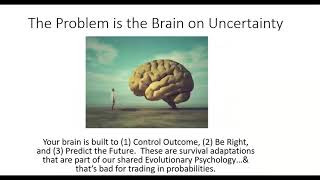
Is that traders do not understand what the problem is. We first think that we're logical and rational beings, okay? And unfortunately, that's anything but the truth. We're not rational beings at all. We're emotional beings who rationalize. And if you want to just think about the last time you were in a trading situation, it was, you know, it's stressful. You know, there was, you know, that, that you can't tell what's going to happen there. And suddenly the emotions trigger and you start having thought, but then you start thinking about, well, I need to move my stuff, I need to do this, or, you know, something, I need to double down, I need to, you know, I need to stay out of the trade, I need, blah, blah, that inner commentary. Suddenly what you discover is that, how did that happen? You're just not going to do it again and again and again and finally get through that. You're going to make the problem work. You're going to traumatize yourself at that. Then you're going to have traumatic kind of memory coming around. And a lot of traders I work with end up with traumatic memory that really just absolutely blows their mind out of the water when they attempt to trade under stress. So the first thing that we finally began to get is, is what is this deal about uncertainty? And the problem's this. It's the brain on uncertainty. You have a brain that's built by evolution to control outcome and to believe it's right and can control outcome, and then also to predict the future. When's the last time you tried to predict where the bottom was, where he had that turn, where all that, all that stuff? And yet what happens is that these are survival adaptations that are part of our evolutionary psychology, okay? And unfortunately, what we do is we begin to go, wait, wait, wait. If the brain was built to control outcome, be right, and predict the future, you know something?
None of those things are controllable. And yet we have a brain that is just hotwired to believe that they are controllable and to lie to you and to hold you kind of in that spell. And so it's really, it's the way we understand this problem that's most important. You know, if we truly think that we're just going to do some reps and finally get work through it, we deceive ourselves. So really we're looking at it and going, what really is the problem?
The problem is very simple. In trading control of all these factors, the outcome being right or wrong, winning or losing, and being able to predict the future are totally an illusion. They exist like a probability. Okay? You have a sense of probability that, okay, this risk thing is a 2 to 1 or a 3 to 1. There's probability here, there's reward and cost of that. And it's all sitting there. And at the same time, ultimately is that to the, to the emotional brain, it's like a life and death situation. You know.
If you lose those, if you lose those factors, you know, you have a tremendous threat to your being right there, same as the tigers right there. And so what you discover very quickly is this, is that your willpower, that positive thinking, all that emotional suppression, it fails when the pressure of the threat enters the game. And, you know, a lot of people say, you know, I could do it, I could do it. I can, I can take one Loss, Randy. But it's the second, third one that suddenly, suddenly it triggers. Something starts happening in me and I start feeling possessed to get the money back. As if you could do that, as if you could make the money back. As if you could revenge trade and beat up the markets, as if you could make up for prior losses. And yet you begin to believe this. And what you also discover is willpower is like a battery. It runs low. You know, you keep. You keep applying it to stress, applying it to stress, applying it to stress. It lowers and lowers and lowers to. Finally, it gets blown over. Positive thinking is really only good for a little while, okay? It's that. What happens is it's good in the yoga studio, but it's not good under the conditions of stress, of the conditions of uncertainty and emotional suppression. Boy, you want to say how to blow up an account. Keep suppressing your fears. Keep suppressing all that stuff. Oh, my God. Oh, my God. What's going to happen? What's going to happen? That suppression ends up blowing your mind out just when you need it most. So we've got this thing and it's kind of like, well, what are we going to do about it? This is the problem that has to be solved if you plan to become successful in trading. And so let's put it this way succinctly. The brain you brought to trading cannot give you the success you seek. As a matter of fact, it'll. It'll. It'll even take you to the opposite extreme. You're looking at an illustration of some of our ancestors getting lunch, okay? Even getting lunch was a pretty dangerous affair. You can see that. Even getting lunch, you're doing something that can absolutely exterminate you. Yet at the same time, you have this need to feed, you have this need to take care of your clan. You have all these needs. And what happens is that particularly males, they get all this testosterone and they think they're invincible. You have to think you're invincible if you're going. If three guys are going to take down a bison like this, okay, with some puny little bows and arrows. And so that's what you're bringing to the game, okay? That ancient emotional brain sees uncertainty as a threat. Friends, everything.
Everything.
Was dangerous and a chore for our caveman ancestors. That's the brain you bring to trading, and it's activated by stress. There's your deal. And it just so happens that if you define stress as the meeting the challenges of living, okay, that's stress. Suddenly you look at it going, boy, I'm going to tell you something. I'm highly challenged by uncertainty all the time in trading. Yeah, no wonder. If you're a human being, you're going to have problems because you are just, you're asking.
You'Re asking your brain to endure its worst nightmare.
And you're good for nature where survival was really had to be instinctual. But it's not good for the artificial world of trading where probability has to be worked with. This is why you have to retrain the brain. This is why friends. And so how are you going to do that? You know, fortunately the brain is highly, highly, highly adaptive. Highly adaptive. And with it what happens is the brain literally is, can change. You know, it's, it's, it's like it's sitting there. It's never static. It adapts the organization of the organism. That would be you as a trader for survival success, not for probability success. And David Eagleman, who is a just a top drawer neuroscientist who I have imminent respect for and has helped me understand the brain on uncertainty more than anybody else, basically calls this adaptiveness of our brain live wiring. Literally the brain is wiring you as you go along. It can shift. It can be at the neuroplasticity, it can shift as you move forward. Particularly if you know how to teach it. This is what the big problem is. You can't do it with the affirmations, you can't do it with visualizations. Those collapse under stress. The thing is, is there a way that we can teach the brain to become receptive while engaging uncertainty? And the truth is, yeah, we can. Yeah we can. And ultimately what you discover with this teaching the brain.
Teaching the brain to do this is what we, what I would call emotional intelligence. Eq. What we know if you're trading the, you have got all sorts of knowledge out the yin yang that you've learned and probably paid a good penny for it too. That's the iq. The problem is, is that knowledge only is workable under the right conditions of emotionality. So ultimately that left hot left brain of yours that is full of knowledge has to somehow integrate back into the limbic system, the emotional brain, what I've also been calling caveman brain. For them to work together. And friends, emotions just simply are not optional. You are an emotional being, okay? And actually from a neurobiological standpoint, emotions are not psychological, they're not feelings, they're not touchy feely at all. They're biological action potentials that literally coordinate the action between you. The organism and the environment, the markets. Anytime there is a change in status in the market necessarily, there is going to be the activation of an emotion in the organism called the trader. They're unavoidable. This is the relationship. This is the relationship that you're going to have to learn to make. That caveman brain of yours just is not prepared for this probability management, it wasn't built that way. And you're going to have to find a workaround to be able to change it.
And right here on this graph, right here, what you're actually looking at is what happens to you is when you're, everything's copacetic, when you're not stressed, all this information goes to your higher cortex, that thinking brain of yours. And you get the vibration, you get all that stuff that would be paper trade, okay? And then though, under stress.
Suddenly what happens is that there is a kind of almost like an air traffic controller at the thalamus that's part of the emotional brain, that sensory information is coming in and it makes a quick decision based on past learning about whether or not that information presents a dangerous situation or one that's not so dangerous. And in that case, what it does, if it's dangerous and understand, you've already got it gun loaded. You know, it's uncertainty. You got capital at risk. You might as well have a dinosaur, I mean a saber toothed tiger behind the bush that you're approaching. And what happens is it makes the decision to send that information directly to the amygdala and on to fight flight. What happens is that thinking brain of yours is disabled.
Disabled. And even if it weren't disabled, that information sent from that air traffic controller to the, to the amygdala arrives there in nanoseconds, the blink of an eye. Whereas the information getting to your thinking brain takes at least a quarter of a second to get there. And then the thinking brain has to process it and think through it and stuff like that. A lifetime. Meanwhile, the emotion has already been triggered and is growing. Wow, this is the problem, friends. And it has. And understand, you're already wired to perceive uncertainty as a threat. This is the deal, man. And the caveman brain is just there waiting to be triggered to instinctive behavior. That would be freezing and not getting into the trade. That would be just going bananas. When the trades going against you and you're almost being stopped out, that would be you moving the stop, that would be you sitting there going, I'm just, I'm losing control. And I get to, and I get to profitability And I jump out because I'm scared that the money's gonna be taken from me. That's, that's your thinking brain being disabled.
And fight flight taking over and putting you into aggression or into, into fear. And again, all it takes is guess what? The uncertainty which triggers vulnerability. Vulnerability produces confusion that the brain can't handle, that suddenly it's not in control. And all of a sudden you're often running to the fight flight response. That's trading. That's why more than 95% of traders don't make it. They blow up their capital. They don't know how to deal with uncertainty. They want to be in control, but they can't be in control. They have to learn a new game. And unfortunately, we don't come stock that way. Our evolutionary psychology did not build a human human that way.
Yet.
Because emotions are biological in nature, they can also be worked with initially through the biology. This, friends, is the first step. This is the first step. Okay. And right now we are beginning to go over. Basically I'm giving you a preview of what's taught in our group course, also in our individual course. But the individual course is a lot more complex. It has more moving parts and it's. But this is the material that's covered. So we're looking at this. We're going, oh, okay. We're wired for fear. Yep, that's it. That caveman brain of ours, we want to control. Yep. Can't control. Can't control the, the randomness of trading, though. You got to be right. Yet good traders know as well as I do that they're going to be losing 50 to 60% of the time. They're going to be wrong. The brain doesn't like that stuff, man. Then they keep trying to predict what's going to happen with technical analysis. That's, that's really what you're doing, you know. And of course, what happens, you get in there and often you find out that you're hypothesis, your guess just simply isn't right. And you don't want to be wrong. You want to make your predictions right. And yet we're going, ah. And that activates. Meanwhile, you think you're in control, like this little egghead guy driving the car, driving the brain. And yet in the back seat, guess who's there? Caveman. Caveman's there. And ultimately.
Ultimately your friendly little caveman.
Takes over under stress because that cognitive self was not paying attention to what he needed to be paying attention to. He thought he was in control. No, he's not, he's not working with the emotional side of the brain. He's trying to pretend it doesn't exist. Remember Descartes? I think, therefore I am. How wrong could he have been? Yet it seemed really great.
So this is where it starts. Emotional Regulation 101. The first part of my courses start with a relaxation response. It's by Herbert Benson, been around since the 80s. And ultimately what you're doing is you're discovering that breathing and muscle tension are part of an emotion. It's part of the emotion as it arouses called emotional arousal. And you discover is okay, an emotion. Okay. What happens is that when it first triggers, it starts arousing. And then it comes to a moment of where it's no longer arousing, revving up, it starts flooding the body with chemistry. That is the feeling component of an emotion. The problem is when you feel the emotion, the damage is already done. It's already taking control of the mind. Then the next part of an emotion is the motivation. Is it telling you to attack the threat? Is it telling you to avoid the threat? Or is it teaching, trying to tell you to approach the concern you have? Now, obviously what we want to do in our course is cool down the motivations, attack and avoid. And what we want to do is promote this patient, calm mind that approaches uncertainty. Okay? And that again, it can be trained. And until you learn to control the intensity of an emotion, friend, you're never going to get to the door of the mind where all the goodies, where all the beliefs are that you're trading reside. This has to be done if you plan to get the. Get it under control. And what I want to do, and this is something, and I'm not giving away really anything here, friends, I'm a capitalist. I acknowledge that this information has been around for about 4,000 years. And what Herbert Benson did, he invited Hindu yogas into his, into his laboratory. He wired them up because they were making these claims they could do respiration, they could control respiration rate, they could control heart rate, they could control blood pressure. They were saying things that Western science said, no, you can't do. But they were thinking from a separate mind and body perspective. He got them in there and what he discovered is, yes, they could do this stuff. And what he did, good scientist that he is, is he. He stripped the culture and the religion out of it and said, well, what's actually going on here that's producing this? And he found diaphragmatic or bellows, breathing and muscle tension. And what he discovered Is that an emotion has a biological signature. Okay. Anger is going to have tenseness in the body. It's going to have holding or rapid breathing, as is fear. All of these emotions have that emotional, that signature, biological signature. And if you start bellows breathing and muscle relaxation, what you do is you disrupt the arousal of that emotion before it takes over the mind. That's what he taught, and he also taught how to do that in the presence of stress. So he would call it the relaxation response to stress. He thought that solved the problem, but it didn't. Okay, but however, if you breathe into your belly, using your belly muscles, the abdominal muscles, to pull air from the mouth and nostrils down into the lower lobes of the lungs, that would be your belly breathing, and then expand to chest, hold for a moment, and release slowly. What you'll discover is that fear and anger cannot exist. With that breathing style, you will automatically produce the rest and digest the parasympathetic nervous system. Calmness, patience, okay? That's the very first chore that has to be done. And it takes, you know, depending. I will take the people in the group course, hopefully start about a month in advance or at least two weeks in advance, so they can be practicing this and beginning to change the old habitual patterns and habits that they've established over decades of use. But it takes that kind of persistence, it takes that kind of desire to be able to start changing the self and producing self mastery. Most people get a mirror tomorrow and just put a mirror there. And I actually have people have video feeds them what, and they watch their faces. They watch the way they're breathing and what they do. It's not pretty. And you begin to say, oh, my gosh, Randy, I just thought it was muscle tension and breathing. I didn't realize that was an emotion. Yeah, emotional intelligence. Yes. So we start here, but then we move forward. That is not going to solve the problem. Okay, but if we. If we don't emotionally regulate the emotions, you never get to the door of the mind.
The next thing I teach in this course is literally observation, the ability to be mindful of self. Or in neurobiology, we would call it metacognition. Most of us are totally fused to our thinking and our beliefs. That's illustrated in the left side of this thing is that you're caught up in those thoughts. You know, what happens is that, you know, is that, oh, this is your. My thoughts. And yet on the right side, you start going, hmm, this guy's in observer mode. He. He's noticing the same things but he's not identifying or in my language, he's not. His observer is not fusing to those thought clouds and being taken away, swept away by them. He's going, no, wait, I'm separate from those.
My thoughts and my beliefs are not me. They are separate from me. In fact, I don't have thoughts and beliefs. They're having me. They're creating my experience. They're creating. They literally are creating. They literally are creating my destiny. And unfortunately for most people, they're not even aware of it. That's the lack of mindfulness. And they go, why? Why do I go to the slaughterhouse? Why do I give back everything that I make and more in trading, this is why you're not mindful of what's going on in the mind. You totally identify with the beliefs and thinking that drive your performances.
There you go. You do not have thoughts and beliefs. They're having you. And friends, they represent only one aspect of the potential of your being. And I would call it the historical past adaptation. You didn't even know it was happening with happening. It just kind of happened to you. That, friends, is what has to change.
So we've got this observer and all sudden we begin to see this adapted self that I currently am, that I'm calling me and I. And these are my thoughts. This is my bible. It's just simply one potential organization of you.
The truth is, you know, ultimately like these wolves, I use this as an illustration of what I would call the dark and the light sides of the force. Is most people feed that dark wolf. And because they feed him, that's what they become. If you choose, if you choose to feed that constructive white wolf, what happens is you begin to channel that part of yourself too. It really depends on which of these aspects of yourself, these potentialities living within you. Do you want to feed and to grow and to take over the self? Most people don't even know what I'm talking about at this point. The first time they hear this and they start going, whoa. The truth is you are completely responsible for your destiny. You're responsible for which of these wolves that you're feeding. And your trading account is going to tell you which one you're sticking to. Okay, so from there, and the little goody here.
Is that learning to become the observer of your thought life separates thought from self. And suddenly what you believe, what you discover is this, that you do not see and then believe.
You believe and then you see, your beliefs form what you think is true. And we're not talking about the beliefs you talk about, we're talking about those instinctive beliefs, those very deeply instinctive beliefs that drive your performances. And the ones that drive poor performances are less than. Less than stellar performances. There's only five of them, friends. This is not rocket science. But the thing is, we avoid dealing with this destructive part of our being so much that we look to the light and we don't grow as we need to grow. And here they are, friends. The first one, a sense of inadequacy. I'll never make it. You know, this is just too complex for me. I just. You know something? I'm not good enough. Yeah. A sense of mattering. I matter if I make a lot of money. You know, I've got to win. And if I win, I really show that I matter. And here you have the classic problem of letting your performances define the being that you are. As long as you do that.
Ah, boy, it's going to be so hard. But I believe that I matter only if I make money. The other one is I'm not worthy of making easy money. I have to work hard for my money, and it becomes something where, oh, my gosh, I'm not worthy of making the money. Yeah. That happens a lot. Yeah. The next one that I really locate is scarcity thinking. And this is a belief, really, that what you have can be taken from you. This isn't prosperity gospel we're talking about. No, this is a belief that what you have can be taken from you. And you think about it quick, comes right out of caveman days, is that it was so easy. Things could get taken to. You could get killed. And think about farming, particularly small farmers that used to be 95% of the United States population, is that, you know something.
Things could easily be taken just taken from you. Trying to earn a living and build wealth off of 40 acres on a mule is really hard. And so we begin to see. Oh, our beliefs create what we see as true. Yeah. And what we're doing is we're actually checking those beliefs out for their effectiveness. We're not saying that beliefs are true. What we're doing is we're saying we want effective beliefs. And those effective beliefs will show up in your trading account as increased roi. You begin to say, okay, what I'm getting is that P and L is actually a reflection of the beliefs that I'm projecting onto the market and particularly their effectiveness. And the last of these beliefs, it's a sense of powerlessness. You will have experienced powerlessness. It's when you get in a Trade. You're locked in and it starts going sideways on you, up and down, up and down, gets really close to that stop, pumps up and goes back toward that stop again. And you feel that powerless. You feel that. Yeah. Powerlessness. Yeah. And it just absolutely has you doing dumb, stupid, crazy things. Those are the five beliefs that control your performances in trading. If you're looking at less than what you want in your trading account, then these are the suspect areas. It doesn't have to be rocket science. What it has to be, though, is you have to find the courage.
To be able to face that demon, to face that dragon that lives within you.
Now beginning to recognize that the brain is a neighborhood of emotional programs that are duking it out for control of the creation of the self. And when that brain produces the miracle called mind, those emotional programs that are duking out are given voice in your mind. And that's why I like to picture, I like to picture the trading mind as a committee, a group of people. And I've actually updated my slides. I now have a zoom meeting where there's an expansion of the sense of group, the sense of that community committee. And ultimately what you're doing is you're waking up and you're recognizing that you as the CEO of this trading, of this trading mind, have been asleep. The, the, the observer has not awoken and doesn't understand what's going on. And suddenly it wakes up and you start seeing that this committee isn't, is in a mutiny. There are positive parts of it. There is that constructive part of the, the self. And then there's destructive elements trying to take the company, call you in another direction in a destructive area and waking up. See how powerful it is to produce an observer of the self and not, and not keep identifying with thoughts. So you're sitting there and you're beginning, okay, the mind is a committee and I've got some bad dudes in there trying to take the company in destructive ways. And I've got some good people there that want to take it into constructive areas. The problem is, is I have not been a good ruler. I have not been a good CEO. I have not been a good chairman of the board of the mind. So it falls back to you, which wolf do you feed? So we've gotten that far. And then once we get this thing, we have understanding of this committee effect, we start saying, well, let's take a look at that inner commentary a little closer. That inner commentary is also called the historical internal dialogue. Have you ever encountered self doubt? Yeah. Trying to decide if you should get anything. Do I need more? Do I need more? Do I need more confirmation or self doubt? Oh my God. What's going to happen with this trade? You know, is it going to peter out on me and am I not going to make it to my target? There is always a voice in your ear, okay? Listen to that inner commentary. That inner commentary coming from what I would call the inner critic. That would be, by the way, that's actually me whispering into my son's ear. Okay? But he was a model. That's not what I did to him as a child. Okay? The thing is, is that you're hearing the inner critic speak self doubt. Also speak the temptation and the urgency of getting into traits that are not in your plan. Yeah, that's the inner critic part of your being. And most likely you have tried to ignore it because it just is uncomfortable. Yet because you ignore it, you leave the door to the mind wide open. It can come and go as it pleases. Not a good deal, man. Not a good deal.
So we get this thing and we go, okay, this is where the emotional programs in the brain are given voice in your mind. You begin to see, wow, there's all sorts of voices within me. And this, friends, this is where a lot of people say, randy, look, I'm going to take this voice stuff you keep talking about. I don't, I'm not crazy. I don't have a bunch of voices running in your head. Yeah, you do. You have a thousand voices in your mind. It just depends on which one you feed and what lies you believe. The inner critic will have you believing that you've got to be crazy to be listening to voices. And what I tell you is that you're crazy not to tune into the voice voices and the emotional programs they're arising from and find out whether or not they're destructive or whether or not they're constructive. If you can't do that, you do not get to reorganize the mind to move from certainty thinking of the caveman to the probability mindset required for success in trading. Okay?
And you were taught from almost the get go you don't have voices in your mind. Yeah, you do. Have you not had self doubt? Can you feel the internal battle going backwards and forwards? Have you ever felt the tension? You have. You're of many minds. The question is which one is driving the mind in critical moments under stressful moments, which by the way, trading is. I mean, you are encountering uncertainty, you've got a risk on and you don't know the outcome stress and you've got train the mind to have the right group of emotional programs giving rise to the mind.
To create the probability based mindset.
So.
What we have, what you hear is that historical internal dialogue. This is where the inner critic has been having just absolute free willed on you. And it sits with what I would call the adaptive voice. That's that limbic system of yours producing survival strategies that lock into place and other. And I also call that the orphan. It's also known as the wounded child. And I don't use wounded child nearly as much but they're really great. It's a great orphan and wounded child are a beautiful poetic metaphor for the way the limbic system ends up organizing you into victimhood, into perfectionism. Thinking that if I do everything right then I'm not going to be wrong and I'll win and just really not good. Effective long term ways of dealing with uncertainty. It leaves the person confused and of course it tries to lock off the confusion and it just makes, it makes it worse.
This friends, is how your brain initially learned to deal with uncertainty. That's what the adaptive voice is. And understand uncertainty to the brain is a threat. And I don't mean just a threat like to your psychological comfort. No to it. To the ancient emotional caveman brain, it's a threat to life itself. So you can understand uncertainty is a big deal.
So we get it. The brain that you brought to trading will not be comfortable with trading. And it has to be retrained. It has to be retrained. And where does that go? After we can cool things down, emotional regulation. Observe and then begin to populate the mind with different aspects of our being, aspects of our potential self. And what we do is we run into that wall of self limiting beliefs, friends, that's what's being measured in your trading account.
That's where the inadequacy, that's where the mattering, that's where the worth, that's where the scarcity, that's where the powerlessness comes in. We're not talking about what you would admit to another human being. I'm talking about what you have to admit to yourself.
You have to have the courage to turn toward this darkness, this part of the self that keeps you from achieving what you could be. Okay, that's the piece that we have to look at and we've got to figure out a way around it.
But there's good news by the way. That's what I call the bad news in my course. Nobody wants to know about all this crazy stuff running in the brain, and yet at the same time, what we do. And by the way, that historical internal dialogue is both a product of.
Your evolutionary psychology that you inherited from our cavemen ancestors, and also your family upbringing. Basically, the attachment stuff that happens, the culture you grew up, the community you grew up, circumstances, the brain is constantly alive, wiring all that changing and adapting itself to meet those circumstances.
And that's what you get stuck in. And suddenly you start seeing reality through those eyes when it's just one gentle organization itself. That's all it is. The next thing is the good news. You can intentionally awaken the emotions needed for uncertainty management. This is the potential self, okay, that has to become the intentional self, the intentional mind that you bring to training. It starts out as potential, okay? And with work and with training, it becomes more than potential. It starts becoming the habitual self, the intentional mind, or what I call the traitorous state of mind. And within that, what you do is you discover the discipline of a ruler. You awaken to this. It's already there as potential, living within you.
The courage of a warrior, absolutely necessary. And it's not, it's not the war out there, it's the war inside your head that really the warrior is needed for. They have to have the courage to confront their own inner conflict. You also have to have self soothing of a caregiver. You don't need that damning yourself and cursing yourself. You know when you do that, when you self flagellate? I ask traders all the time. Well, tell me something. Beating yourself up, did it help you trade better? And I live doing this 15 years and guess what? I've never had a person ever say it helped. No, it won't. It'll take the problem deeper. I mean, it's a tough enough problem you got, believe me. Retraining and rerouting the mind for probability management is a tough. Is a tough thing to sell the brain. Yet what's needed is the self compassion, the self soothing of a caregiver. That's what most traitors really have to develop because they like to beat themselves up. They don't realize that the observer has fused.
To the inner critic. And the inner critic is having a heyday. And it goes along with the impartiality of a sage. These exist as a potential self, knowing quantum mechanics. What is said is that there is no such thing as mass nor energy. They don't exist. And it's an illusion. However, reality exists as potential.
The potential of the self. It's the observer of that potential that brings forth the form of the self. So what you're doing is saying, okay, the organization itself that I inhabit right now was something that I fell into without before I could even think for myself. It was already established and it was so ubiquitous that I never noticed it as something different from me. And yet what we're saying is no. Look, within that potentiality, there is. There is the discipline of a ruler, there is the courage of a warrior, there is the self soothing of a caregiver, and there is the impartiality of that sage. But these have to be developed. You have to learn to have access to them under stressful conditions. And you have to move it from being a potential self into an intentional self. This is where the money is made or lost in trading.
So memory, we use a process that I developed many years ago when I was. I used to debrief victims of violent crime court. And what happens is particularly, it's very easy for people who are debriefing victims to kind of lead the witness and create false memories. And what I did is I realized, golly, memory is really fluid. You have to be really careful. Because what the brain is doing, the brain, based on its biases, beliefs and assumptions, is encoding an experience into memory. And then after that memory is encoded and consolidated, you no longer have access to the experience. And you think that's what that memory, that experience meant, when in fact it was just the way the brain encoded it in that moment. And by the way, that's why eyewitnesses are about the worst kind of testimony in court. So what we're looking at this, we're going, okay, what we teach is being able to go into memory and to be deconstructing that memory into elements where we can access real discipline that happen, real courage that happened, real self soothing that happened, and also real impartiality, Being able to think clearly under stress. And what we do is we build that memory so that you have access to those emotional programs. Friends, that is, it is.
It's up and beyond visualization and up and beyond affirmations. You meet may still use those, but suddenly what happens is it's not something you're hoping for. It's something that really did happen. You have evidence that this exists as part of your potential as a being. That's where it gets really interesting. And with training, these programs.
Can be habituated to be the ones that deal with uncertainty rather than the historical ones. A movie like Lord of the Rings, what's happened there is you begin to see the braveries of the warrior. You begin to see. You begin. You see Strider turning into Eragon. You begin to see the magician really as a sage who has wisdom and good counsel. You begin to see the self soothing of some of the women who are enormously powerful warriors. And you begin to see what they've done. In this movie they had made representations of these emotional programs. And those representations are called archetypes. The living embodiment of those emotional programs. And this is what we begin to build. And right here what you're looking at is you're seeing emotional programs being expressed as archetypes. It just so happens my favorite probably is Winston Churchill. I darn well know that most likely if it weren't for Winston Churchill, I would be speaking German today. Yet he was somehow able to unite Roosevelt, the United States and Stalin of Russia into allies that eventually brought down the Germans, the Nazis in particular. So you begin to see that there are the. And he was called a bulldog. He put London on his back. He was compassionate, he was determined. And you begin to see, yeah, he embodied that. And yet after the war he just. Those, those archetypes showed up when they were necessary.
You can do the same. This is the difference maker. You can, you can summon them up to produce the mind that literally.
Is no longer needing to win or control outcome. And what you discover is that patience is really a form of action, but it takes a different perspective. It's no longer urgently jumping in to be trading to. Because you have to be. To make money. I have to be trading and be trading. I have to be trading. I can't be sitting on the sidelines. Yeah, you can. Particularly if your mind's not right. And you move from the deception of controlling outcome. Okay. To the realization that you can control something, but not the outcome. You can control the mind that you bring to performance. That's the psychological edge that's most missing with traders, particularly the evolving trader that hasn't found the happy land yet.
The struggle of managing this randomness. And your instinctual emotional brain represented by the Hulk here, is going to always be there. It's always sitting in the back seat of that car. Yet what you're looking at in the personification of this woman is she is calming down the anger.
Might I add, fear of the Hulk so that he can become human again. These are doable things. You know, you can have that beast within you, yet you can train the brain to bring forth a different mind to engage those uncertainties. It doesn't have to be. It doesn't have to be like the Hulk. It doesn't have to be impulsive. It can be calculated. It can be powerful. And in that. This is probably the hardest thing that a trader will ever have to learn is that winning only becomes landing on the right side of probability. It doesn't say anything about you as a person. It just means you landed on the right side of probability. Losing to the professional trader is just simply landing on the wrong side of probability. He will look at his trades and he will say, are there any things that I would change about the way I manage this trade? No, I did a pretty good job. This one just simply fell on the other side. And he congratulates himself. Listen, that. He congratulates himself for performing. Well. He can't control the outcome. What he's doing is he's moving away from winning and he's moving to performing. That gives him a performance edge so that his method edge can show up. Yeah. And his trading account grows. He's trading very different beliefs about himself now.
And friends, this is a. This is really. If you take a look at this surfer, that's a pretty good sized wave he's on. Do you think he controls that wave? No.
Do you think he's working in cooperation with that wave and taking what it's willing to give to him? Yeah. This is the trader's state of mind and it can be taught. And this is exactly what the group chorus and the individual course teachers. What we teach is a process of interlinking skills that I've shown you here. From emotional intelligence to breathing, to observation, to the historical internal dialogue to the empowered mind and then training it for performance under stress. That's the deal, friends. You build step by step until you end up when you face the stress. You. You have the mind equipped to be able to focus on performance rather than winning. Completely different animal at that point. And this mind operates from an indisciplined impartiality. That's the only mind that really works in trading. And.
This is really the deal. You're either going to learn how to control this thing or the markets are going to constantly trigger you and the emotions are going to control you. And the real question is, are you ready to learn these skills? What I have found is that it takes most traders four or five years to realize that it's not the knowledge he has at all. You know, the thing is, I'm going to take some. Knowledge is simply the price you pay to become a trader. The real thing, to become a profitable trader.
It really is about designing the mind for probability rather than historical certainty that it wants. And it's not going to happen by osmosis strengths. It's going to happen because you work at it and train it. And yet I know occasionally you find the traders who after a number of years, they become profitable and everything's fine. Well, if you want to work a number of years and blow a number of accounts, I guess that's a pretty good deal. What we're offering is something where you accelerate that learning curve and you get to. You get there sooner rather than later. Okay, so, my friends, what I. What I ask of you, if you're really, truly interested in evolving yourself as a trader.
I invite you to the group course. What's it about? It's five meetings, about an hour apiece every other week. So it goes on for about 10 weeks. And what you're taught is the very skills that I've demonstrated right here. And if you go ahead and I would encourage you to sign up early simply because.
Signing up early allows you to start practicing in the virtual classrooms that we offer. As this course is, you will have access to the classroom 247.
For an indefinite period of time till.
Dolores and I are no longer with this world. Okay. And so the thing is, what you're doing is you're saying, oh, I get to go in and I get to. If I start early, wow, I can be prepared for the first class. Because my promise to you is first class assumes you've been practicing this stuff for a couple weeks and you've really been able to work with your breathing and your tension and your body. Okay. And.
Okay, by the way, the first class question period is that January 14th. That's. Yeah, that's the review. The thing is, this is get there, be prepared. Because the moment we get there, I'm reviewing emotional regulation and I'm opening up, and then I'm opening up observation. Okay, so what we do is we give a free gift for the early signups for this through 1:9. And it's an emotional regulation workshop. It's done with professional traders in there. It is also $199 if you go to my website. I'm giving it to you to motivate you to get started. Because what I know is that a lot of people wait last second, they get in and get overwhelmed in this course because this is not for the faint of heart. This. This moves at quite a clip, and it is going to be introducing information to you that is in many cases just absolutely counterintuitive. But it's all neurobiology and doing that, that's why we offer it to you and we want you to take advantage of it. Okay.
Yeah, I'll get to them as soon as we finish here. So the thing is, that's what I encourage you to do. I encourage that. And the individual course is for people who really want me as an individual mentor. And I understand that. But what we're doing is this is, we have the, we have the group course coming up. I know that we have 12 people already signed up, but that shows you how you know, that shows you. And by the way, when you take the course, you can take it another time for free and you have access, full time access to it for a long time. So it's, it's a win, win situation. So I want to thank you for showing up here tonight. Okay. And there's some questions and this is where my bifocals fail me.
Let me put on my reading glasses here. I'm telling this aging business sometimes or parts of it, it just are not fun. That's not going to work. I'm gonna have to go back to my, my regular bifocals. Okay. The fear response has been my biggest problem in trading. I didn't even realize I had a fear problem until I read the Trader's State of Mind ebook. Yeah, well, then you're, you've made good advancement. The thing is, is the real question is that are you ready to say, you know something, what am I going to do with this fear response? Understand at one time it was a perfectly good response to threats in the environment or to the anxieties an existential self in trading. It's just not a good effective way of doing it. And the question is, go now. You have knowledge. But knowledge, knowledge by itself is not going to solve the problem. I invite you on this one. But I can understand should or can someone who is schizophrenic become a patient, Invest in trade?
Well.
To be honest with you.
I would. It's possible.
You know, the thing is.
There's a lot of work because what happens, stress triggers a schizophrenic to, you know, trigger to a whole dimension that's up and beyond anything. And I would say that you would need, you need to be in association with a good psychiatrist. And you would have to be medicated in such a way that you're still alert. And if you can manage that, then yes, it becomes possible. But the thing is that what you're looking at is a good, basically a lot of Medical compliance because a lot of schizophrenics don't really want the medicine. But what happens is they. They really need it. So I'm not dodging, but it's an iffy situation that you're talking about.
Okay. The price of the group course, It's a. It's one payment. It's a $11.95 in US dollars and it can be broken down into five payments every two weeks of $239. Okay. And that takes you through. And so what happens is that we finance you through the course. And most people, a lot of people take that option simply because they don't have to come off the hip for 1200 bucks.
All at one time. All at one time. And it works out well for everybody. So what I want to do is I want to thank you for showing up tonight and really opening your minds to new possibility and just simply recognize is that your identity, your sense of who you are is fluid. It can be reorganized. Your brain does that all the time. And the deal is we've developed technology.
That allows you the tools to start re sculpting the person you are under the conditions of stress. So I invite you friends, I wish that you would really think about it. And.
What is this question here? Cannot understand what is the benefit or subscription early to get the free self regulating module? Well, it's pretty simple. It's pretty simple. Okay. It's just that what I want you to do is have enough time, particularly with the emotional regulation stuff. Is that it's rote training. You are teaching yourself how to breathe because I promise you, the way you breathe right now supports anxiety or fear or anger. It does not support a calm, patient mind. And what I'm doing is saying it takes at least two to three weeks to be able to get that mind in the process of being retrained so that you're no longer triggering to fight flight and the holding of breath, the shallow breathing and the tenseness of the emotion triggering. Okay. And what I'm doing is, I'm saying, look, if you will. If you will do yourself a favor and come early and get your practice done and be ready for it. I'm willing to give you a gift because I know how important this is for Overall success. The first class is a review of Class 101. The first meeting is a review of Class 101 and introduction. Yeah, Dolores said that. Well, is that when you get there? I'm assuming that you've already been practicing with the emotional regulation skills. And I'm reviewing it and I'm moving on. So the thing is that this course has so much compressed into it, that's the only way I could get it to fit. And what happens is I'm. Like I said, I'm just trying to get people motivated to start early and get as much as they can out of it. But understand this, you can still go back and review it again free. Okay. You can be another group in the whole nine yards because we find that a lot of people do that because it really helps them. The first time, the concepts just flying past them. The second time, it's a lot slower. Does the class allow the other students to interact with each other? Yes, it does. Or will we be in webinar floor mat? Sometimes it's helpful to see other people's comments.
You know, what we do is it is gotowebinar. Okay. And what happens is during the, during the, during the course, during the session, you can actually type in questions. You can also ask with a mic and talk to me directly. Yeah, and talk to everybody directly. And what happens is that we, we. What we do is florists will be sending you stuff that also asks for people who want to link together and start basically having study buddies and partners in their trading. And we encourage that. And we find that some groups just take advantage of that and they build lifelong relationships so that they really have a common language of basically building the mind and they both are supporting each other's back. It's the greatest thing in the world. And they stay in contact and they work with one another, but it's voluntary and other groups just hardly do it at all. I just think the more. The more you socially learn, the better. Okay. Do you give invoices for a company in Europe? Sure. Yeah. Dolores can. Yeah. And we can provide that easily. Absolutely we can. It'll be stated in US Dollars. Yeah, it'd be stated in US Dollars because we aren't familiar with all the other currencies and stuff like that. Okay. I think.
I think that's it. We see one more.
Okay. That's it. I think.
Okay. Friends, no matter what, I wish you well. I wish that you evolve as a trader and be able to find your dreams and to bring them into fruition. I really do. And in this time of these holidays, may. May you be blessed.
Yeah. The recording of this will be on the website tomorrow and it won't be on real early because it'll render tonight and I'll get to it tomorrow morning sometime. And it will be. It will be up on our website sometime tomorrow. How much is the individual course? It is $3,500 or three payments of 1200 over. And the major thing is it comes with 10 consults with me that range between an hour and 75 minutes that are completely personal, just you and me. And it allows a lot more. It's also more comprehensive. It's got stuff in it that just is not in the group course. And it's also much more personal because a lot of the things that stand in your way from expressing more of the potential of who you are, you don't want to, you know, you want to broadcast to the public. And it comes up in the group course.
Is that that is a table rock in North Carolina. Okay. And it's one of my favorite photographs. And the Linville Gorge. It sits on Linville Gorge. And Linville Gorge is my most favorite place on earth. It's really wonderful thing. But any rate, go there. It's a beautiful place. Anyway, friends, thank you. I appreciate everything and may you have a great holiday season. Good night.









