Scarcity Thinking The Real Problem Behind Fear Based Trading
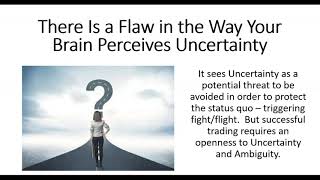
Randy Howell explains how scarcity thinking drives fear-based trading decisions. Traders' brains treat market uncertainty as a survival threat, triggering fight-or-flight responses. Rewiring requires breathing exercises, mindfulness, and emotional regulation to shift from seeking certainty to thinking in probabilities.
Questions this video answers
October 18, 2019
$1,195 (or five payments of $239)
$3,500 (one payment) or three payments of $1,200
Only 2% of traders make money; 98% never make any money.
He mentions another group course starting in January.
Chapters
Welcome everyone. My name is Randy Howell with Traders State of Mind and we are here for a webinar on scarcity thinking. Before we get started though, being that we just had these weird little signs that showed up on the Gotowebinar, we want to make sure that you can see and also hear me. Okay, not see me, but see the screen. So some people please type in yes if you can see me and I'll be assuming that if you can't, yes. Oh, that's a good deal. Thank you, thank you, thank you, Carl. Okay, so here we go. Let's start in the very beginning.
You know, truly we like to think all sorts of things. We define, well, you know, we say it's fear and greed. We talk about fomo, we talk about fear of getting in, fear of loss and all this stuff. But what I ask you to do is to recognize that we are evolutionary creatures. We come with a deep history of survival for at least six and a half million years as hominoids and 200 plus thousand years as human beings living in the wilds, much like this guy right here out in the Serengeti and his little, and his little float thing. What happens is that we faced as a species a lot of serious problems and where we would go, you know something if we try too hard, if we push too much, you know, if we get something, it could be so easily taken away from us and it got bred into the very depths of our genes. Nobody noticed it, okay. And then it, it just something that seeps in and we don't recognize that we're bringing this brain that allowed us to survive many years ago into this new brave world of trading. And we think, oh, what could possibly be wrong here? We have a brain that's acclimated when exposed to stress, the challenges of living. That's a way of defining stress to trigger, to fear, to that scarcity thinking and to become vulnerable as it approaches uncertainty. And out of that vulnerability we trigger to a short term survival strategy of golly man, I'm fearful I could be taken away from me. Yeah. This is what I want you to look at is that.
Your brain has an adaptive history. The real key is, is that to become successful in trading, you're literally gonna have to change the brain that evolution gave you to a very different brain that you're going to have to design for this new world of trading. And I will say it's no you don't. You can lose all your money or you can spin your wheels for a long time and people do it. They blow out, they, they blow out accounts, they blow out time. And they have this idea they're going to get rich. They have this idea that they're going to think and grow rich. And yet at the same time, the trading gods just don't seem to care. What's worse, and this, and I'm talking directly to traders who won't have a chance. The guys who are still going, you know, it's all a numbers game. I got this stuff and I'm going to, I'm going to get this methodology and I'm going to make this thing. And I just understand this is, I'm going to learn how to win this game. Guys like that, their mind is, I'm not going to waste my breath on them. This is really something where you've, when you've really learned, okay? Because ultimately.
We don't even see the scarcity thinking when it's sitting there right in front of our face. We make a lot of alibis, we produce a lot of explanations. And like you see in this graph right here, you know, you're getting two guys arguing, you know, are there three or four boards there? And the thing is, is we don't see things as they are, friends. We see them as we are. We actually have a brain. What it does is it takes all that sensorial information that you're inputting to be a good trader, and it's organizing it right into its biases, which, by the way, you don't know about. That's the reason it's a bias. And your beliefs about your ability to manage uncertainty that you also don't know about, it's happening on a subliminal level. And then you project it onto the markets, thinking these are the facts. You know, when you're looking at numbers, when you're looking at charts, you're not looking at facts, you're looking at interpretations of emotions. That's what you're looking at. And so we're looking at this and going, okay, so what you're seeing is your brain is creating a virtual representation of the world based on your unseen beliefs and your biases that you've been carrying around for six and a half million years. And, and maybe with a little luck over the last couple hundred years, you've begun to wake up and you've begun to really question about the way this human animal that you are perceives reality. If you're, that there's a chance you can become a traitor.
The key though, is that the way our brain perceives uncertainty, understands.
It sees Uncertainty as the enemy. Your brain, from a survival standpoint, from a caveman standpoint, from an emotional brain standpoint, wants to control outcome. It will believe a reassuring lie over something that the truth that just doesn't want. You just don't want to hear it. Like, for instance, I have. I have. It's really interesting. A guy the other day says, you know, Randy, I'm trying to talk a couple of my buddies into coming see you, because they keep losing. And I talk to them about it, and they just will not do it.
Even though they're losing, they keep saying, I'm going to turn the corner. I don't need it. I don't need that. The truth is, they're scared to look at themselves and they're scared to say, you know something? I don't want to see that which is standing in my way.
Of becoming a great trader, because I'm going to have to change who I am. And so you get this, okay? This is the brain. This isn't you as some master of the universe. No, this is you as a simple emotional brain not wanting to see what you don't want to see. When you see that uncertainty, that triggers the vulnerability. That vulnerability freaks the brain out. It wants control. Suddenly vulnerability demonstrates that it doesn't, and it goes straight over to fight flight. And that's when you start going, oh, my God, I've won some money. And you know what? Oh, my God, though, you know, if I don't take it right now, it's going to be taken away from me. That's just not what you learned in your families, which you probably learned that too. But you also learn from evolutionary history. That's natural selection ensuring that you're going to survive. So we've got certain uncertainty. The brain on uncertainty is your enemy if you want to become a good trader. And then this is also really worrying about particularly money, because it's really equated with your power. It's linked in there. And suddenly what happens is that, you know, your ability to survive into the future just starts going out the window if you start risking that capital. I've got some right now, but if I just hold onto it, then you know something? I can survive. But it's not telling you that. No, what happens is you're going to be rowing in place. You're going to be treading in place and not making progress. You're giving away the potential that you're actually trading for. The thing is, in the moment of heat, your brain does not allow you to see that and the truth is, you're not looking for it. You don't know how to look for it. And you're so. And this is very interestingly, is that what you discover very quickly, this is a lot about failure, is that nobody wants to fail. You know, you go to Traders Expo or something like that, and you see all these people saying they're guaranteeing what the win percent is and stuff like that and all this kind of stuff, as if you could do that.
Ultimately, people are scared to fail. That failure triggers their own shame and they don't want to face that. And God almighty. What happens is you need to face your shame, you need to face your demons, to reorganize and to master that. That's how you become the traitor. It's interesting. I was talking to a guy that I worked with, with is just one of the better traders around today. He, he regularly pulls 10, $15,000 a day out of the markets. And he's, you know, he's been doing this for years and years and years, and it's a really good life. And what happens? He says, you know something, it's just crazy. I quit even trying to get people to come into my rooms and stuff like that because they weren't worth having them there. They were just sitting in the seats. They weren't doing anything. They weren't learning, but they were trying to look like, look at me, I'm looking like a. I'm looking like a success. But the truth is, is they would not risk failure. They would not risk failure. And the truth is, is a really great trader comes to recognize that you're going to be doing a lot of failing and that you have to come to terms with it and begin to see failure is not about a flaw in you as a human being. It's just simply a flaw in evolution. You know, there's lots of failure, and the deal is, can you adapt? The one who ignores the fear and pretends the fear is not there and avoids failure is the one that doesn't adapt. We're looking for people who want to adapt. And that, that's really what Jeff was talking about. He says, you know, I just got tired because they really don't want to change.
And.
Hold on, I didn't, I didn't see that. I get notes all the time. It's kind of like this. If you take a look at baseball and you take a look at a.300 hitter, a lifetime.300 hitter, you think about it, wow, what a great hitter. What that really means also is that 70% of his time is spent failing. And yet for the 30% of the time that he actually gets base hits, he ends up being in the world, in the hall of Fame. It's the perception though, he's striking out under conditions. He's doing this, he's doing that, occasionally getting hits during pressure and stuff like that. But what you're doing is he's come to a moment of where he's okay with the risk, he's okay with the failure. It's not about him, it's about the performance. This is a big deal. And what I want to do is I love this, I love this thing. Here's this guy and what he's doing is saying, you know, the healthiest part of a donut is the hole. Unfortunately, you have to eat through the rest of the donut to get there. And the real key is how do you go about explaining things? How do you go about explaining leaving money on the table?
A client of mine, proprietary trader, comes to me and says, randy, I am a proprietary trader and my bosses have basically said, nancy, we really like you a lot and stuff like that. You're a pretty good trader. The problem is that you leave a lot of money on the table and that if you keep doing that, you can't work here. We're not going to pay you to take these small profits that you're doing. And you know, for Nancy, that was like, it was like it woke her up. And yet when she looked at it, she said instead of creating a story about it, she created another way of looking at it, thinking, you know something, they're right. What I'm noticing is that I'm taking my profits, I'm leaving a lot of money on that table. And you know, for her, as she worked through the problem, she ended up having she from Seattle and she had a home in Seattle. And as she got over that problem, she also got a home in Palm Springs. And if you understand, if you live in Seattle, I can understand why you would want to have a home in Palm Springs also. It's nice and warm and dry. So what we're looking though is that we create a story that covers up, okay, the, the whole thing about this fear based trading and we want to look at it and go, you know something, if I'm leaving money on the table, that's my trading account telling me that it does not care whether or not what, what story I'm telling. Interestingly, I work with a guy who used to work with one of these very expensive organizations where you can spend $50,000 and get your education and still not be a successful trader. Yet people believe they're going to be successful traders if they pay all this money to this firm. And what Jeff ends up doing, he says, you know something, Randy, I did this for a long time and I finally got profitable under you. And then I got all excited because all these people were talking about, yeah, what I want to do. I'm going to learn how to become the first millionaire, I'm going to make my first billion. All this stuff, all this story, they're not talking about rebuilding the mind for probability management, they're talking about conquest. They're talking about not having to master their fears, they're talking about in running around them. And yet what Jeff goes is, you know something, Randy, I've finally come to the moment where I've become profitable and I've discovered that I'm leaving all that behind. And I don't want to really be around those people because what they think and they talk about, they're not addressing the real concerns of the kind of mine that's required to produce profitability. This is the fear based trading that we're talking about now. Or are you one of those people who. You don't bite. You don't bite. You're scared you might lose. You're scared you might lose. You're scared you might lose. So you don't bite. Then you see all this money going by and then you jam it into. Do you jam it into the. Well, I'm gonna make up for that. And ultimately what you do is that because you were scared of getting in and potentially losing money, you held back. Then all you saw, oh man, I'm really missing out on profits now what I'm gonna do is I'm gonna force myself to jump in. But now you're forcing in from a sense of like pushing. You're not doing, you're not being rational. You're not necessarily taking the valid setups.
You're taking trades to make up for the money that you've left on the table. You're not taking valid setups. You're a totally different game. Totally different game. A scarcity mindset, or this is one of my favorite, is that here's these guys and they're sitting here. I don't understand why we aren't seeing any sales growth. We've been practicing it this very way for years and years and years. That's the same thing. Have you ever noticed in trading is that you have this. You say, well, I've okay, I've got my plan, I've got my rules. And what happens is, I've been using these rules, I've been doing this. And the truth is I keep doing it, but it never goes on. And this is the guy, the very successful trader I was talking to, and he says, randy, what do you think? They're using indicators that everybody has. It's very common knowledge. And all the smart money knows exactly what those indicators are doing and setting people up. Do you think they're going to make money with stuff like that? They have to have better. They have to have better tools. They can't do the same old things over and over again.
But they do. But they do in the anticipation that, well, it's safe, it's safe. If I don't go out on a limb, I can't lose much. And yet what they do is they basically, they cut them, they die the death of a thousand many cuts. This is scarcity thinking, friends. And the question is, is do you see, if you take a look at your trading account, not the talk that you talk, and particularly not the bravado that comes out of traders when you're in a room and somebody strikes at a really good one, and all of a sudden he's, yeah, yeah, but I just got this one I've got. Boy, look at this spread that I've got, man, this is great. But he's not telling you how many good trades he's dropped, how many. How much he's lost because of his inability to manage. He's just talking about a snapshot. He's not talking the movie of his trading. And you listen to it, and you listen to that one little blurb out of. You think, oh, my God, he must be doing so well. And it goes back to a number of years ago when I was in advertising. One of my clients started a bank, and he's a really good banker. And he and I were together one day with his wife. We're driving down the road and.
A car passes us with this really incredibly expensive car, passes us with someone that we all knew in that car. And his wife said, oh, man, he must be doing so well. Look at the car he's driving. And Perry the. The banker said, you never know how he's got it financed. Yeah, a true banker, okay? And that's the big thing is we want to. We want to take a look at this thing and go, you know something?
We get it.
When we get to the finish line. One of the biggest things, one of the hardest things in the world is to acknowledge that we're going to experience a lot of failure. We try to stay away from that. We become scarcity traders because we don't want to experience failure. We'll take those little profits. But when it comes down to it, what we've done is we've paid our broker, we've kind of got this count that goes just a little bit, a little there. But what we realize is that it's never going to make us a living.
And we're scared of the finish line. We're scared to say we're going to be a failure at the end. I'm going to hide it. And ultimately that's what happens in trading is that people are so focused on hiding their shame, their, their inability to produce that, that skill set that produces consistent profitability that they, they don't see what to work on. They don't see that the, the trading psychology has to change. And there's nothing wrong with the psychology, most likely that you brought to trading. It's produced success over many millions, millions of years. It's just the thing is it was based on a certainty based mind. And what you're looking for is a probability based mind, completely different animals. So.
Really, when it comes down to it.
If you want to become successful about trading, what you're going to have to do is you're going to have to take a hard look at your mind and you're going to have to say, how do I go about redesigning, reprogramming the mind that I've got to be able to handle probability.
With comfort, not triggering to uncertainty and vulnerability, but triggering at that moment of vulnerability to concern, not fear. This is where we're at. We have to start really noticing who's really talking in our ear. Who's really talking in our ear. Okay, and this is where it starts. You bring a caveman brain with you and you bring a high thinking, a high thinking brain with you. The problem is, is you don't know how to manage that caveman brain. That caveman brain literally is your subconscious. It's literally 95% of the decisions you make come out of the emotional brain, the limbic system, and they're happening literally before you even know it and they're gone. And then the thinking brain makes up an alibi to support it. That's what you've got friends. And what we want to do is we want to start saying what is it going to take to be able to rebuild that mind and to really start moving it forward. And this is where there's a little, there's a little bit of this bad news before we get to the good news, friends. And the key is scarcity. Thinking is all about the parasympathetic nervous system. It's all about you engaging uncertainty. That's that what you do in trading with risk, real risk, real money under the stress of time.
Given that all those affirmations, all those visualizations, all those things that make us feel good, prosperity thinking in the midst of that stress fall apart. What we're doing is going, how do we calm this system down? And that's where we want to start looking. We want to start saying, hmm, ultimately it comes down to how do you master the beliefs that you trade? How do you master, how do you come to actually observe, really reserve the beliefs that you're projecting onto the markets that you're finding, whether or not they can extract capital out of the markets consistently in your trading account. Not by what you say, not by all that bravado stuff, but literally, as you look at your trading account and a lot of people sit and look at a trading accounts going up and down, so are their emotions. But if you're doing that, you're going to take a look at this guy right here, you look at it and going, there's a risk here, there's uncertainty here, yet there's a confidence that he has that he can land that. Of course, we don't know the end of this photograph, do we? Well, that's the point is that we know that in probability he can make it, but he has to build the mind to act on probability rather than to act on survival. And then the very first thing that you're going to have to get rid of to get to the good news.
You'Re going to have to get rid of your abundance thinking. Abundance thinking is really control in another way. You're thinking, okay, what happens is that I can use my mind and I can open myself up to the universe. I can goodwill myself into success. Well, that does not make a good trader. However.
Probability mindset is very adaptable and it gives you an edge in the ability to trade. This is where you start going, which door am I going through? Okay, one of those three doors. I have the options here. One of those three doors is accepted, two of them aren't. So I know that I have 33% chance. Okay, how do I go about managing my risk to walk into those doors?
That's probability thinking. Now, it's not like I'm just going to think my way into believing that that door is going to be the right thing or nor am I going to have scarcity thinking and never get anything done.
So let's really take a look at this thing and say.
Well, how do you rebuild.
A fear based brain and mind into a probability based mind? How do you go about doing that? And in friends, it starts with acknowledging what you're doing doesn't work. That's the first place. It's kind of like this super trader I was talking about said, you know something, A guy that I tried to refer to you a year ago, it would not refer to you, he finally became profitable. He's been profitable now for three weeks. However, it cost him 50, $60,000, okay, in that interim. And he said, you know, I don't know why in the world he would not say, you know something, what I'm going to do is I'm going to learn how to manage emotions, build a mind and cut this learning curve short. No, the guy didn't do it. Now he's saying, you know, I really wish I had done it because, you know, I really just, I blew a lot of cash that's sitting there, you know, trying to learn. But this is going okay.
If we can say, okay, we're having some failure here, what do I learn from that failure? One of the very first things is you learn that you're going to have to manage emotions. Right now you're looking at what is called the Yerkes stress quota. Okay? It's been around for, since the 1890s. And what they noticed even back then is that stress on one axis and performance on the other, you'll notice for a while, they actually enhance stress, actually enhances performance. Now this is something in trading we would say, no, we don't want to have fear or our aggression. But what we do want to do is we want to have stress as a function. Either we call it eustress or we call it concern. We want the brain, we want the brain really fired up, really ready to go. We want it ready energized and focused. That's what we want. And then what you do is you discover that, okay? Doing that allows the mind to focus and it stays in the moment. It doesn't stay in the future, it doesn't stay in the past, which are dangerous to the trader. It stays in this moment. But as you increase the stress.
As you increase the risk, as you increase the, you know, like I don't know really what I'm doing. What you do is you move from, you move for this increased concern and performance, mind, you move it into anxiety. You start going, oh my God, what if, what if, what if? And all of a sudden you start saying, you know something, I could take my profit now instead of waiting to see if it'll hit my target and you know, I'll at least make some money before it's taken away from me. That's when stress has taken away the mind that you need. Okay? And then you get to the complete meltdown where you start revenge trading when you start just flipping out. This is what it's like we're saying we need to be able to manage this, friends. And ultimately what you are going to need to do.
And this is not something that I recently discovered, this has been going on the vendetta. Hindus have been doing this for 5000 years. The Jews have been doing it about 4000. The Buddhists have been doing it for 2500. The Christians did it for a long time and then got rid of the people who were doing it. But what they started learning is that by breath and by calming muscle tension, they could actually cool emotions down. As a matter of fact, the relaxation respond. Herbert Benson's gift to the 1980s and 90s came out of his work with yogas because they were saying they can control things that western science was saying, no you can't. And he got him in the lab, hooked them up and discovered yes they could, yes they could. And when he extrapolated past the religion and stuff like that, he found that it was the breathing style and the muscle relaxation that allowed them to get to do what they did. And he invented what we call the relaxation response where you're being taught to engage uncertainty instead of triggering distress, you would trigger to relaxation. This is a great gift, not so too much relaxation. But the thing is you can learn to manage it. That's what if you tomorrow, if you're trading tomorrow, I want you to start noticing how much stress, how much tension you keep in your body, how little breathing you do when you're doing that. What you're saying is, well, Randy, what I'm really doing is I'm revving up an emotion, usually fear or anger. That's what you're doing. If you're not breathing correctly, that calms you down. If you're holding tension, you're producing emotional arousal, getting that emotion cracked and giving you a lot less control over the mind that engages uncertainty. So this element is absolutely essential. However, it's not a game changer. And that's what happened with relaxation response. I thought it was going to be a game changer. And they discovered, oh, there are these things called beliefs that, you know, you have to get to. You have to learn how to readapt those beliefs because it's the belief in encountering uncertainty that creates the potential of a life. That's probability thinking, not abundance thinking. Okay, so we've got that. We go, well, what are we going to do about that? Well, what we know is emotional regulation is not enough. What we need is, we need a door into the mind.
Okay, you have to learn to manage emotion or you'll never get to the door of the mind. However, once you get to the door of the mind, you have to learn how to say, what's going on in here? What distinctions can I use that allow me to see the mind in a way that allows me to design the mind very differently than the mind that I've brought to trading? Well, friends, this is when it gets interesting because this is where mindfulness comes in. And you start recognizing when you look at this, when you look at this illustration on one side, what you're looking at is a human being that has become fused to his thinking. He thinks his thinking is in fact who he is. On the other side, what you start seeing is that the person can be an observer mode. He can step back out of thought and recognize, oh my God, these are not me. These are running through mind. And what happens is I have an untrained mind and it's easy for my observer to fuse to these thoughts. And they just take me away. They take me into aggression, they take me into scarcity thinking. They take me wherever they want to because, hey, I've been asleep at the wheel. And.
Being asleep at the wheel, I might be able to get away with it in my normal life, but in trading, it's going to bite you.
You can't do that. All these alibis you've told just simply don't work. So then you go, wow, okay, I'm not my thoughts. No, you're not your beliefs either. You're just one potential of an organization that came to be and by the way, that was shaped by history, both physical and also familial. And that's really the big thing is you're going to have to take responsibility rather than just waking up and saying, well, yeah, I have family, I had all this stuff and I'm just a regular bloke. No, you're not. You're the product of evolution. You're a product of social evolution. You're the product of a family.
And you come Stock with a bias about the way you see and do things. And I spent a lot of my time working with clients and getting them to get beyond the kind of thinking they learned, their families of origin.
And this is when it gets really interesting. Because what you discover is that there are many different aspects of the self.
There is no monumental mind in there. There is not. I am the mind. There are numbers, and numbers of different voices are in neurobiology, they're called spheres of influence, you know, and different kinds of psychology. We'd call it voices within the self, our internal dialogue. You know, who's managing your internal dialogue? And all of a sudden you realize that you're not crazy if you hear voices in your head. You're crazy if you don't pay attention to the voices running the show called your life. This is where the traitor gets really smart. And what you discover very quickly is the brain is a community of rival emotional programs.
Powerful, literally different emotions duke it out for control over who you are. Sometimes anxiety wins. Sometimes a deep sense of calm and patience wins. Sometimes a sense of discipline wins. For most of us though, it's all fear based or anxiety based. And that's the voice you start hearing inside your head. Oh, I don't know, man. What if you're wrong? What if you're wrong? What if you're wrong? You know, you could be, you could lose. Well, you may, you know. And as a matter of fact, in trading, you are. And your whole key is, are you good of a trader to be able to minimize that loss? So you trade for another day. That's really what it amounts to. So you realize, oh my God, not only is my brain a community of rival programs, your mind, this thing all is doing all this thinking, this precious thing of yours is actually the space, the territory that those emotional programs are given voice. So they go from biology, they go from electricity, biological electricity, to psychology.
Between the mitigation between the brain and the mind. And this is where it gets interesting. And you as a trader are going to have to become very involved in this.
Because under the stress of uncertainty, history is what you hear in your brain. It's what you hear in your head. It's not you. You've become so sucked into it, you've become identified with it, that you see it as you. And some people just simply say, you know, it's just not built for me. You know, it's something I just can't win. Other people say, it's just around the corner. It's just around the corner. It's just around the corner. I'm going to keep fighting. I'm going to keep this abundance positive thinking going. Neither work. What we want to do is actually change the beliefs.
That allow you to engage in certainty differently. That's what we want. And where that really comes down to it. What I want you to do is take a look at this photograph. Well, manipulate photograph of that.
What you're doing is you're recognizing that every surfer when he gets on a board has to be cognizant that he's in the ocean and there's a chance that there's a shark around. The probability of that is enormously low. Now, the news will produce all these shark attacks, but it's much safer surfing or being in the ocean water than it is driving a car. People don't have a problem driving a car. And yet at the same time, there is that scarcity thinking that says, you know something, I have to be really careful. I have to be careful. You know, I can't take risks. I can't take. I could have it taken away from me. And this is literally on the lifeline. This is where scarcity thinking comes from. My very life could be taking taken from me if I risk too much, if I want more than I get. So you're looking at it and going, these are the very primitive beliefs and primitive drives that you're going to have to master as a trader, okay? Because my friend, that primitive emotional brain, it's hardwired Fight Flight, okay? No matter how you try to.
Reprogram the subconscious, the unconscious, it's still programmed that, that caveman brain of yours is still wired around Fight Flight. And you're gonna have to learn how to cool it down. And if you, if you build a new mind, you get new results. So you can train this thing. That's the whole key. You don't have to get, you don't have to stay stuck.
Okay, and pretend that you've got an alternative story that can get you out of it. No, what happens is that you can become designer of the mind. And I use. This is a, this is part of the movie Inside out from Picture Disney. And what you're looking at, this is actually the inside a little girl's brain. And what you're looking at in this movie, they're working with neurobiologists. And what they're doing is they're taking five primary emotions. Over there on the left is anxiety. The green girl is disgust. The yellow happy, happy, happy one is joy. The one on the right, the red one is anger. And the blue one lying down is sadness. These are just five basic programs. These aren't necessarily the ones that I work with, but these are the ones that that cartoon was about. And they showed you how these there are constantly in competition with one another and constantly reorganizing. And in this movie, what happened is finally they start acting in concert with one another. They start bringing in the sadness, the need for sadness.
They begin to be able to change the way the girl is integrating into life. This is really what we're talking about in trading. What we're saying is it's not like what you've been doing is wrong. Understand you're at the apex of evolution. It's really a fantastic thing. However, that evolution never prepared you for probability thinking.
It prepared you for certainty based thinking, for survival in the moment. This is where we have to redesign the mind that trades. So we're doing that, we're going, okay.
Which are the emotions that we want to use that give rise to the probability mind. Okay, And I'm gonna, what I'm do is I'm gonna say this is where the thinking brain, the left brain and the right brain, the caveman brain need to start working together and they become partners with one another. Because ultimately the deception is to actually believe that your thinking is independent from emotion. It's not, as a matter of fact, it's dependent upon emotion. What we want to do, if you want to become a successful trader, we want to build a mind, a brain around the emotions of discipline, of courage, of self soothing or self compassion and impartiality. Clear thinking as a base, as a ground for thinking to arise out of.
We know, left to its own devices, that's not what's going to come out of you engaging uncertainty, getting vulnerable and experiencing stress. What we want to do is train you so that when you become vulnerable, when you experience that stress, instead of firing to fight flight, you fire to disciplined impartiality.
It can be taught, friends.
The thinking brain and the emotional brain have to work together though. They have to work together and they can be taught. And when you start constructing that, we're back there, we're back to our skiing buddy is suddenly you're looking at something that, you know, I'm 68 years old, there is no way I'm going down the side of a mountain like that guy's doing. But at the same time, if you look at it from probability management, this guy's in control not of his outcome, he's in control of the mind that he brings to performance. He has a mind rooted in discipline.
Courage, self soothing or patience.
And impartiality. This is the probability mind that's required for trading. It can be taught friends you do not come stock with it unless you won the genetics lottery. And I know very few, I've met two of them in the time that I've, that I've actually done this job. And.
What I'll say is I wouldn't want their personal lives, but they make fantastic traders. But the thing is, is that this, this can be built when you do that, this is the power. And I want you to think about. This is a, it goes back to. Often I get clients who will say, randy, I'm trying to talk friends of mine and seeing you, but they won't do it. It's just like. It's just that they're scared. The truth is, is they don't want to face their dragons. They don't want to face their demons. They want to, they want to keep pretending that their ship's going to come in, they're going to turn the corner and everything's going to be fine. And they keep, they keep wishing that, they keep wishing that, they keep wishing that. They keep looking at their trading account and it doesn't work. But they continue on the reassuring lie. There comes a time though, if you want to become consistently profitable that you say, you know something.
This brain of mine is mine to reorganize into the mind that engages uncertainty.
Every human mind is pretty messed up, okay? Every monkey mind, every one of us have that. And we pretend as if, oh yeah, well we don't have a caveman brain. Well, we do the smart money. What they do is they recognize that and they say, you know something? Trading is really about self mastery.
And this is really the time that you have to decide whether or not you want to produce self mastery or not, or whether or not you want to continue telling yourself the stories that don't produce results. That's what we're looking at. And to be honest with you.
It doesn't matter whether or not I care or not.
What matters is whether or not.
You have the internal courage.
To say, I've had enough of this. I'm gonna look at the very stuff that I've been avoiding. I'm going to master, I'm going to master the mind that I bring to trading. That's what I'm going to do. I'm going to finally do it. I'm fessing up. You do that and things change. Now does it mean that everything Is rosy. No. What I want you to do is take a look at this boat. These guys are in serious. This is serious water, friends. And the truth is, it is really uncertain. We don't know if they're going to make it through this particular situation or not. But what I want you to notice. Take a look at that. There is a captain. He's under. He's got. He's disciplined. There are workers that know what they're doing. They have highly specialized skills that they're working on. And what they're doing is they're staying focused on their performance.
And by doing so, that's the greatest chance for success they have. Is it a guarantee? No. And what I'd like to do is I use an analogy. A couple years ago, the Atlanta Falcons and the New Orleans and the. And the New England Patriots were playing for the super bowl. And Atlanta had them on the ropes. As a matter of fact, it looked like they were digging a grave to bury him. And they were up 28 points this third quarter. And Atlanta was over there celebrating. And at first, you take a look over the New England bench and they're kind of like shocked. What you see are their coaches getting in their faces, and they're not shaming them. All they're doing is they're saying, just do your job.
Just do your job. They weren't asking them to be heroes. They weren't asking them to do anything. They were asking them to block and tackle. They were asking them to catch a pass. They were asking them to throw a pass. They weren't asking miracles. Just do your job. What you're looking at here, these men are just doing their job. And one of the better traders I work with, that's what he does. That's what he's gotten out of my work. He says, randy, what I down do is that I know this is all. There's an ambiguity everywhere. I know that nothing can change about that. And what I do is very simple, is I just do my job. I know that there's ambiguity. I know that I can't, you know, I can't nail everything. What happens, though, is that I'm going to do my job. That's. That's what it is. Okay, so what happened in this football game is pretty simple. What happened is the Atlanta Falcons started playing not to lose.
And they were playing a team, the Patriots.
That were just doing their job, and they understood that. They never controlled outcome. They controlled their performance.
Friends, the same with you.
The same with you. And the Patriots did win, folks, if you will remember that they won in the last minute. Now there's where we are. You can build that mind, or you can stick with the mind that you've got now and hope it's up to you, friends. If you choose and you say, you know something, how do I become that change? How do I actually, you know, I actually had a guy today say, randy, I've read your book, I've seen your videos. When does the change happen? And I'm going, he's read my book and he's seen my YouTube videos. Everything pretty much free. The guy's got 34 bucks into his education and he's thinking that this is going to change the way he trades. This is like crazy thinking. Ultimately it requires education.
If you don't know me very well, look at the free stuff, read about it, you begin to see, oh my God, this is all about neurobiology. This is about neurobiology. This is about uncertainty. This is about risk. This is about stress. Yeah, that's about the human brain on stress. This is what this is all about, friends, and managing the mind that engages that stress. But once you get past that, you go, well, how do I actually train myself? Well, you train yourself. We have two ways. One is the group core. It's an incredibly great course. It teaches the basic skills that you need to be able to build a mind that engages uncertainty. There's also the individual course, which is a highly comprehensive, very personal course that is really built around 10 consults on Skype and a much more comprehensive material. And what we're doing is, yeah, you learn these skills of emotional regulation, of mindfulness, but what you do is you get in and you begin to realize that you can redesign the fear based mind to accept and to engage uncertainty with a very different way of engaging. That's what you can do. And if you really get to it and you say, you know something, I'm ready for change, I'm ready to do something about this, and I just want to know, well, what do you think I really ought to do? Hit free consult, go to the website, hit contact us, schedule a consult with me, and let's talk about it. And this is something I, it's not glib. People who do this need to be really thinking about, you know, do I really want to make a career out of this or am I going to keep fooling myself? Do I really need to personally develop, professionally develop the mind that I'm engaging.
This uncertainty, or am I going to be like the 98% of traders who never make Any money are already marginal. Only 2% of traders make money, friends. Okay, so what I ask is this, is that what you discover is I want you to look at the group course, take a look at it and see when it next starts. We have another one starting in January. Okay. And a lot of people will be registering because they're going to be doing it at their own pace and when they get to January, they're going to be on fire and ready for the course. We discovered people will take this course two and three months in advance, get a lot of the work done so that when they engage the course with everybody, that they have a head start. Powerful stuff. So I want to invite you to recognize that this is a developmental moment for you that can take you from where you are now to a completely different place. It's really something, it's really about self mastery.
Trading is going to demand that just knowledge is not going to ever work. Friends. People prove that every day. Developing the head, the psychology that uses that knowledge, those are the guys who succeed. So do you have any questions? We have a few minutes before we ought to sign off and if you do, type them in and I'll be happy to answer a few of them. I see a lot of yeses from when we began though.
Are you.
Are you live or are you Memorex? Oh, that's very funny. Hahaha. You know, that shows you that I used to use Memorex a long time ago and now everything's MP3s and you know, we, but no, I'm live. And the truth is, is that.
When you are engaging uncertainty. So are you. Okay, let me see here.
Thanks Randy for the webinar. Is your course also good to help traumatize traders to get out of pdsd? What else?
Yeah, yeah, absolutely. The thing is, if you're going to do that, please don't take the group course and think that you're going to use the group course to get over ptsd. Okay. I have a very long history of working with PTSD from long before I became a trader, psychologist and a personal consultant. Is that that was basically one of the major things that I did in my professional career is work with ptsd.
It's hard to, to be honest with you.
A lot of people in trading have traumatized themselves pretty significantly. You know, you, you blow up half a million dollars, you blow up a million dollars and it traumatizes you and your brain a lot of times just won't let you jump in trades. And I have the, the, the, the skills that I teach, to be honest with you, are very similar to the skills that I taught with P.
Also, the work that I do with ptsd, we would call it the traumatized inner child, is the way I describe it. And that part of the self, not only it needs to be shown that the mind that's developing, the mentorship being developed around it, is there for its protection and for its ability to move forward in the world. Yeah, I do a lot of that. Okay, what are the prices on these two different options? The group course is 1195. Or it can be paid in five segments of $239, I believe is what it amounts to. And Dolores handles all that, and a lot of people take that option. Okay, the group. The individual course is $3,500 and one payment, or it can be broken down into three payments of $1,200.
We find.
PTSD. Somebody doesn't know what that is, boy. Post Traumatic Stress Disorder.
It's basically PTSD is when the brain has been overwhelmed and it cannot integrate an experience. Okay. And it blocks it. And there's. There's held pay, and traders do it all, you know, really. You know, golly, people will do some really foolish things. They will blow up chunks of net worth and stuff like that, and they. They truly produce trauma. It has to be worked through. So are there any other questions? That's it. Okay. Well, friends, my hope for you is that you have a great life. And if I can help you develop the mind to be able to engage uncertainty on a much better level than you're currently doing, I would be honored to be able to do that. I. That's. That's my mo. That's what I enjoy doing. And if not, then I wish you well. I do. I hope you have a great life, and I hope you find what you need and, you know. And may we meet again someday. Okay? So take care. Enjoy, enjoyed you guys here, and we'll see you maybe next month. Take care.










