Scared Money Knowing Better, but Still Chasing Losers
Randy Howell explains why traders sabotage themselves despite knowing better: your brain treats financial losses as survival threats, triggering fight-or-flight responses that override logic. He covers the emotional drivers behind chasing losers and offers tools like breathing work and mindfulness to rewire these patterns.
Questions this video answers
March 19, 2021
About 2 to 2.5 to 1 (examples: 2, 2.4, 2.5 to 1).
About 1.75 to 1.
Somewhere between 95% and 98% of traders lose money.
4:30 pm Eastern (New York) — sessions are recorded.
Chapters
Welcome, everyone. My name is Randy Howell, Trader State of mind. And I welcome you to this presentation. Before we get started, let's just make sure that you can hear me, okay. Is someone would just simply type Y into the chat box and let us know that. Okay, we're good, we're good, we're good, we're good. Now for those of you who haven't been to some of my. Some of my workshops. What? You realize that I hold questions till the end. Okay. You can write them in anytime you want to. And I want to, you know, please do. Okay. But I'll handle them at the back end simply because it helps me keep my mind straight. And out of that, you know, we kind of make sure that we get the pro presentation done and many of the questions would have been answered in the presentation. Fair enough. Well, let's get going. Okay. Scared money. Who has ever been in the. Basically in the jaws of better, just scared money, you know what to do. You know better. And you see that thing getting close and just move that stop because you want to give it some room. And then you chase and guess what? The likelihood, it's the loser. You know that at the same time you do it. What's going on here? You know, ultimately it starts. It starts with trading and getting into trading.
It starts right there. You think about it. You know, people get into trading really ultimately for two reasons. One is they see the financial green. They start seeing that, you know something, they can grow money. They can just, you know, all they have to do is learn a system. And in that system, that's going to give them the freedom that they want to be able to live the life the way they want. So they get personal freedom too. That's two gigantic things. And everything's fine. You go through training, you get yourself right, you get yourself a SIM account, you really start taking that demo account and really start proving yourself. And you develop some confidence and you keep nurturing, keep watering that. You could just see the money growing on that money tree and then everything makes sense. And the tool, the money becomes live. Suddenly nothing makes sense. You chase money, you jump in and you do some really dumb, stupid things. And yet at the same time, after the eruption's over with, you go, what was going on? What caused me to just stop? Why couldn't I just follow my rules? Why did I chase that thing? Why couldn't I do that? Well, we're going to be answering that. We're also going to be showing you. What are you going to have to do to be Able to train the brain to produce a mind that can work with the challenges of trading. Okay, that's where we're going to start. And there it is. There's that scared money. It happened today with a client of mine, is that she went into a trade, she had it right. Everything was really great. And, you know, it started going around there it was almost at the stop, almost to stop. And she just kept hoping, kept hoping that it. It was going to turn around and it was going to be okay and she was going to be able to make her money back and she was going to go on. And it didn't do that. It moved lower. And what did she do? She moves her stop lower, thinking, oh, it's bound. It's bound to do this, it's bound to that. And then boom, there you go. You end up being scared. You get traumatized. And that's where it just kind of gets. Gets started. You start seeing the money just absolutely draining. It just starts draining and draining and draining. And suddenly if you're one of those people and what I do, we look at the ratio of winners to losers, really heavy duty looks. And all of a sudden, when a really great trader is around, they're going to be 2, 2.4, 2.5 to 1. Their winners are literally that much bigger than their losers. A successful trader is somewhere about 1.75 to 1. Okay. And you begin to see that, okay, they don't let money drain.
Okay, somebody said that they can't hear. Please let me know if you can hear simply by typing the Y. Okay, let's see what we got. Of course, nobody's gonna type. Yep. Okay, so we can hear. We just can't. I'm okay. Somebody couldn't hear. I would check my own equipment. Okay, so we get this money drain and we start noticing that ratio of winners to losers is not in good shape. It's not even one to one. One to one. You're losing because you're still paying your broker. It's 0.81. It's 0.5 to one. And you start noticing that literally your losers are twice as big as your average winner. And that is little. You have wonderful days and all of a sudden you see these big, huge drawdowns. The drawdowns are where literally you're chasing. Okay? So we know, we know it's there. And the question really remains is why do you throw good money after bad? Now, we have another way of saying this. When the pressure's not there, it's not there to do it. You know how to trade. But then the pressure comes on. Then you, oh, my God. Losing another trade. Oh, my, I can't lose this one. You know, what would you know what's going to happen. And all of a sudden that thinking brain gets replaced with emotional reactivity, and you start throwing the good money after the bad. We know that's kind of what happens, but why does it happen so much? We're going to be talking about the caveman brain here pretty soon and actually what happens when with caveman brain and why that caveman brain so useful for our survival. From the African savannas through the jungles to the caves. And then it was very good up until the moment you started trading. And suddenly that caveman brain just became the faucet that drained capital. We want to take a look at that.
So.
The very first thing that brain of yours really truly wants to believe that it's in control, but it's not. Don't you want to be in. Everything in your caveman brain wants to be in control. It was built that way. It was built that way by natural selection. If they weren't in control, then they were falling apart, and that's not what you wanted. So literally at that very moment of losing where it becomes real, your caveman brain, that's the emotional brain, hijacks reason. That reason based mind that you need so much and all of a sudden you're cooked. And what's left to do your trading and to see that thing, to see that thing that lost growing and growing and growing and you're throwing more good money at it. Is your caveman brands taking over? The problem is you just don't see it coming.
Well, you can see it coming after the fact. You can look at the chart, you can look at the timestamp, and you can say, you know something, why didn't I just do it here? This was crazy. This was an acceptable loss right here. Then it grew and it screw and it screw and it screwed. You can so you can see it. But that caveman brain of yours is doing something that's stopping you from being able to do you what you need to do to be able to trade effectively. And that's really what we want to be exploring tonight in this workshop. Okay. And by the way, just to let you know, just before we came on here and I'm in Charlotte, North Carolina, we were having this massive storm system come in. We didn't know if we're going to be on or not. Trees were moving sideways, pelting, rain was coming Down. And we're going, whoa, this is going to be interesting. And then just before this, this webinar, it all cleared up. It's just like, whoa, look at that. It was for you. Okay? So we've gotten there and we go, well, something's manipulating you, okay? You're moving that stop in the hope that the trade is gonna turn around. Okay? This is not a statistical edge that you have anymore. The statistical edge. If you have a statistical edge that you're actually operating from the moment that it hits a particular place, you're cutting it lost right there. It doesn't matter to you what that trait does. Okay? At the same time, though, is that survival brain somehow takes a look at that loss as something very dangerous. You end up taking what was a small loss and magnifying it into a big loss. And it's all because of what's going on in the brain and your beliefs about what literally you believe about your capacity is to manage uncertainty. But we know that this is an inside job, okay? That's the big deal here. This isn't the market's doing it to you. It's an inside job. It's happening inside your head. And from there, that caveman brain we were talking about, there are three things that it is built for six and a half million years to do. It wants to control outcome. Okay? Now, traders want to control outcome because that brain comes with them from the African savannah, or what someone called today, savannah brain, and it wants to control the outcome. The problem is, is that no matter how many times you expose it to the reality of probability, it doesn't learn. Of course it doesn't. It's not wired that way. If that brain's going to learn it, you're going to as your mind going to have to teach it. So that's the first thing. Control over outcome is an illusion. And as long as you practice the illusion, you're going to end up chasing trades. The second thing that your brain wants on a deeply primitive level is to be right, and particularly not wrong. Because back in caveman days, being wrong pretty meant, pretty much meant that you were somebody else's lunch. And so it's that deep. And whether or not we like it or not, money represents your capacity to survive. If you're losing money, you're losing the capacity to survive. Now, if you want to crank up the fight flight system of the emotional brain, that's how you do it. The third thing that your brain wants to do is it wants to predict causal relationship. You know, you want to Hit that entry point. Perfect. You know, you just want to have the perfect entry. You want to see where it's okay, it's going to happen right here. I'm going to. It needs to be. And rarely does that really happen. And most traders finally figure out that it's really a range, it's not a point. But at the same time, it wants to predict that causal relationship. It's so deeply embedded, not just in us, but in almost all life forms, is that they did an experiment with pigeons a number of years ago where they took a group of pigeons, they had them in there, they had them sitting there, they were all in together. And what the scientists had were hands of grain. What they did is they videotaped this and they threw the hands of grain into the crowd of pigeons.
What happened is that the pigeon brain was going to make a causal relationship about the position of the body that produced this gift from heaven, this mana from heaven in the form of grain. And literally every time the humans would show up, the pigeons would assume the positions causal relationship that they were in where the grain was thrown to them. And it took a while to extinguish that behavior. Not, not saying that you have a pigeon brain, you have a much more sophisticated brain than that. At the same time, just like the pigeon, just like anybody else, we wanted to be able to predict the causal relationship. And at the same time as you, then you don't want to admit that you're wrong because you want to be in control. You see, the problem that we're having here.
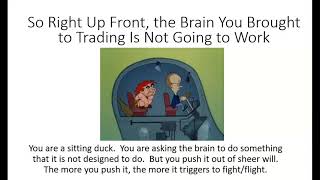
And this is where it gets, is you think you're in the driver's seat, okay, you're up there and caveman brain is just kind of calm, everything's cool.
You tried to regulate him to the back seat and he's just, you know, most of the time, 90% of the time, your, your emotional brain is in kind of rest, digest mode. But when it gets cranked up, about 10% of the time, it's just in control and takes control of the steering wheel. The problem is that new brain, that smart, dapper looking guy driving the brain there. The problem is this. He thinks he's in control and he doesn't see the predictors, he doesn't see the clues that would allow him to see that he was about to give way to the, the emotional brain. Because ultimately when you're in. And again, we're looking at this chasing losers is when the chasing loser is happening and the losing of capital is happening. Your primitive brain is thinking loss of life and limb. Okay? Money. Each will equal capacity for survival. You see the money draining and what you're doing is you're alerting the amygdala, you're alerting the fight flight and you're fighting, you're fighting to make sure that you don't lose your life. That's what's happening in the primitive brain. And by this time, friends, the thinking brain is gone. And what I want to do, I want to show this to you. This is literally why you're having problems. Not just chasing losers, but also fomo, getting out of trades. I mean, I had a. I was working with a trader from Barbados today where she hit her target and then got out, made her, took her money and then that trade just shot up.
And she's complaining to me, oh my God. I just. There was so much money. Blah, blah, blah, blah, blah. That is caveman brain. That's the. Oh my God, there was so much more. I could have grabbed it. You could call it greed, I would call it lust. The key is a professional trader, when they take that, they take their money and they say they have sized in and they've done their last thing, that last sizing has hit and they're gone. And then it shoots up. It doesn't bother them. It's just, you know, the thing is they got their money, they followed their rules, they're moving on. There is no talk, there is no fishing story. And here's ultimately what happens, friends. There's. At first there's a priming situation that occurs, okay? That's an emotional stimuli where. Let's just say that that priming was literally. It has been bouncing around on you. It's getting near the stop, okay? And it's fluctuating, it's hitting there, that stop. You're primed because you're already going, oh my God, oh my God. It's getting so close. It's getting so close. I don't want to lose, I don't want to lose. I don't want to lose. Meanwhile, if you have a really well trained mind, you're saying, okay, is this thing going to hit my hypothesis, My guess, if it's not going to hit, my guess, and I need to get out early with a very small loss rather than moving on. So you're watching from a totally different perspective. So anyway, the retail trader here with the problem of chasing losers sees this thing bouncing around, bouncing around and all of a sudden it hits, it hits that stop. And all of a sudden, bam. That information, that data, information is taken to what is known as the thalamus. The thalamus. If you look at. If you. Part of the thalamus's job is almost like a traffic cop or an air traffic controller. What they're doing is they're routing traffic based on conditions, based on urgency. And it'll see this thing where you know, there's an emergency vehicle coming. I'm taking a loss. I'm taking a loss. And it will stop all the traffic around, so it'll let the emergency vehicle through.
And when it does that, it cuts off.
You'll see where it says information's coming into the sensory thalamus. Then it has on the left side going up to the sensory cortex, that's your thinking brain, okay? And what. What happens is that traffic cop, when it sees that emergency vehicle coming, cuts off that communication route. Cuts it off. And what it does is it routes it through the short route, the low road, which is, by the way,.003 seconds, nanoseconds to the amygdala. And that emotional response at that moment in time is going to go fight flight. You're going to try to save that trade. Meanwhile.
Even if the sensory thalamus had let the signal go to the thinking brain, it would have taken a quarter of a second. So literally, the chemistry of the emotion on the. On the short route, the low road is already in the body, already in the brain, already altering the way you perceive and think before it even gets to the thinking brain where it could be deliberated. Boom. Then when you take this loss, then the hypothalamus gets involved. That's your memory. And all of a sudden you have this memory of chasing losers and what a freaking it is, and you're creating the circuit. So this thing even fires faster. So the traffic cop even fires faster to the low route. Friends, that's happening in your brain every time that you chase a loser. And this actually model is every time you make emotional decisions that are not rooted.
In impartiality and discipline. This is what's happening to you, okay? And my work is all about being able to set up and retrain that traffic cop, okay, so that it doesn't freak out and go emergency on you. And it allows for you to be able to anticipate problems coming. And the thinking brain starts preparing so that the. The emotional brain doesn't get upset. That's really the thing. And you end up really going back in and mastering the kind of memories of the loss of life to. To the. To the caveman. It's the loss of life when you're, when you're losing that money. Because remember, money is survival value. It's the capacity to survive. That's what, that's what it deals. So there you go. That's what we've got. And the. It's not, this is not going to change just because you learn. Go to this lecture and hear me talk about, oh yeah, this is circuit. Now that I know this circuitry and stuff like that, I can just will it into being by snapping my finger. No, it has to be retrained in the same way that.
That an athlete over time trains himself to be able to work in one arena and improves, improves, improves. Finally, he makes it to the Olympics. And even at the Olympics, he has another game he has to learn how to do. That's what we're talking about here. So now.
What I want to do is give you a graph that kind of outlines this. Okay? So what we're going to do is we're going to take a look at this, okay? When you see. And this is going to be more trader language, okay? When you see that this trade is getting close to the stop and you don't want to lose, you don't want to lose. Look at that belief, okay? And all sudden that outcome threatens your sense of control, of creating it, creating stress. Boom, right there. That's where it's at. This is the place where most people have messed up because they are not prepared for this moment.
They don't train themselves to be able to operate in this scenario of the outcome. The outcome going to be a loser. They want it to be a winner. And what happens is the really good trader, the professional trader, is thinking about, I can't really win. Or, you know, the thing is, is I don't control winning or losing. I control the mind that performs. Okay? He's not thinking about winning and losing. He's thinking about performing well, big difference. Then when that happens, there is an implicit belief.
That it concerns your capacity to manage uncertainty that appears that starts driving all this emotion. And that implicit belief, also called alembic learning or alembic belief, it's subconscious, it's not one you have. What you'll notice when you're bumping up against implicit belief is that you don't want to do something, you don't want to. You know, the thing is, I'll avoid it, I'll do something, I'll do anything, but I'll look at it. That's when you know that there's behind that fear is an implicit belief about Your capacity to manage uncertainty, that belief is sitting there and is activated, okay? When every time your brain encounters uncertainty because your brain, my friends, cannot discern the difference between fear and uncertainty. The brain is wired to experience uncertainty as fear. Now think about it. Oh, my God. Do you comprehend why trading is so difficult for most traders to grasp? Because they have an emotional architecture that's totally against being in the position of managing probability. It wants to be in the position of controlling outcome. So now you've got uncertainty and all that. The belief behind there, and by the way, and most chasing losers, the belief that's very common, friends, is you don't want to be a loser because if you. If you lose, it shows that you're a loser. And all of a sudden, what happens with a retail trader. Retail trader has a limited amount of capital over a period of time, and with each failure, without, with each time, they see that capital take drops and drops and drops, they begin to go, oh, my God, I have this short period of time. What am I going to do? I'm going to be losing all this money. I'm losing my livelihood. I mean, doing all this stuff. And that's the drama. That's the belief that has to be worked with. You're no longer in a belief that allows you to be in the present moment. You're in a belief that's projecting into the future about what's going to happen. It's called anxiety. Okay, so then it goes down to that third leg, that traffic cop, okay, that traffic cop is activated, sitting there waiting for the traffic. This emergency signal is coming in, and all of a sudden it's deemed a threat. Taking a loss is deemed a threat. Okay, now what do you think that means? That means the information is routed to the low road, the amygdala, into the fight flight, because there's an emergency you could lose and understand. The caveman thinks, I could lose my life. Because money and life are synonymous in the emotional brain. Emotional brain doesn't know what money is. And so you've got it there. Caveman feels threatened, and all of a sudden it has to act. It has to save the life. It has to fight the foe. It has to maybe revenge, trade, anger. I'm going to take it back. I'm going to make it back. Or just simply say, I'm hoping, I'm hoping. I'm hoping like a victim. So then it goes, okay, it hits that. The high road goes the high road, but that's all cut off, okay? Emotional hijacking is imminent at this Moment. And this is where training, training, training is required to disrupt this process I'm talking about this process is crazy. Then the instinctual fear of losing that life kicks in and takes over the mind and thinking just begins to serve. Fear.
Scared money, scared thinking. Literally all of a sudden, if you've ever noticed when you were in fear, all you can think about is fear, object, and all the bad things going to happen. That's not true.
You know, there's a probability of what can happen if you lose, but the truth is, is that you catastrophize it and it becomes gigantic. Wow. And all of a sudden you believe that you're in a fight for your life. Decisions are made based on fear or aggression at that moment, and guess what? You're cooked. That's the way this thing works, okay? This happens all the time. I'm showing you. Literally, when you're looking at it and confused about what in the world is going on, this is what's going on. This is the neurobiology behind your chasing losers and having scared money, okay? This, it gets interesting though, because here, if you actually go, you know something? This is what's happening to me anyway. How can I go and change this? How do I learn to disrupt this very primitive instinctive process? This is a mammalian brain. This is your flesh talking. This is where we all in polite society don't really want to believe we're animals. But first and foremost, we are higher order primates and we're still wired just like them. We can do a lot more fancier thinking than them. But the thing is, we share that emotional brain and we have to learn to live with it differently if you want different results in your trading. Fortunately, this brain of ours has enormous malleability. It's called neural plasticity. And it used to be that we thought the brain was locked after puberty and you got to be an adult. It just didn't want to change. It wouldn't. It's just like concrete. And what we've discovered, and we can thank stroke victims, okay, is that we used to think after the first couple days, you know, they're just that way forever. And now what happens is realize that even we get to the stroke victim a lot later. You can reroute stuff, you can get the brain activated, you can create new pathways and new learnings, and all of a sudden you have stroke victims returning and doing wonderful, wonderful things that 20 years ago, before neurobiology found out about neuroplasticity, that medicine usages just write off. But now we Know, it can be rerouted. Those are the same principles that we want to apply here. What we know.
Is the very first thing that has to happen is that your understanding of an emotion has to change. You know, this thing right here, you know, it's. You're going the emotional ups and downs, ups and downs, ups and downs. And there's this explanation, stay cool. It's just a market correction. The thing is, is that your emotional brain is viewing that very differently. You have to begin to understand that emotions are really biological action potentials. They are. We often think of them as psychological. We think, oh, well, you know, he's, it's just, he's just real fearful, you know, he's anxious or, you know, he's too aggressive. He's. What we don't realize is that no, they.
Fear is biology. Emotions are biology. And their job, their job is to coordinate action between you, the organism or the trader, and the markets or the environment. Anytime that there is a change in status in the market, by definition an emotion is going to emerge in the brain. It just depends on which one. Depending on how you've been trained. You know, if you, if you've taken what evolution gave you, you're going to have a hard time when things don't go your way in the randomness of markets. However, if you take the time to say, you know, I need to retrain this brain so that I have a different response emotionally to uncertainty than the way that I inherited from history, that's the deal. That's what has to happen.
And all of a sudden you realize this big truth and wow, it's hard. It's hard.
We would like to think that we are rational human beings, but the truth is all thinking and behavior that comes out of that is emotional state dependent. You are an emotional creature who pretends to rationalize. Okay, that's what happens is that your brain creates stories that supports whatever your emotional brain decides. The way we would describe that in neurobiology is the brain only wants to see what the eye will show it. And the eye will only show the brain what the brain wants to see. Now, do you see how this could get you in trouble? You'd never want to see bad news right there that you're going to have to react to. But at the same time, you need to learn how to communicate to understand this brain of yours very differently than the way you, the way you are right now. This is the deal. And you don't have emotions, friend. They're having you. They're creating your experience.
That'S the key that you really truly have to get. Now if you understand that, you begin to say, well, Randy, okay, an emotion is a biological action potential. How weird is that? Well, once you grasp it and go, yeah, I see it now is that I can see myself, you can do it tomorrow. You can get in front of your computer screen, watch those charts, watch action. When you have capital at risk and you're going to start noticing you're not breathing, you're going to notice that you're tense, all that kind of stuff, that's emotional arousal. Okay, you need to notice that, that's telling you that the emotion is cranking up, it's revving up, it's been activated. You maybe didn't see that and maybe you haven't learned to recognize emotional arousal. Well, you need to, you need to see when it begins to rev up because if you don't, the next thing happens that arousal hits a particular threshold and it's no longer revving up, getting ready for action, fight, flight. What it's doing is now flooding the body and the brain with chemistry. Aggression chemistry or fear based chemistry. That chemistry is what causes your brain to cause thinking to happen in a particular direction. This is where scared thinking occurs. You're going, randy, most of the time I'm just logical and rational. I can handle this stuff. But I don't know what happens when that thing starts going against me. I just, I start doing really dumb, stupid things. That's because you didn't catch the activation of the emotion. You didn't catch the arousal of the emotion. And the feeling has already been flooding in, altering the way you perceive and act to uncertainty. And remember.
Fear and uncertainty are deeply linked to the emotional brain. And if you've been, if you've taken the first two steps here and never noticed it, then you've already been slam dunked. The third thing, emotional motivation, once it cranks up and wants the chemistry, it's going to want to do one of three things. It's going to crank up and it's going to head to fight aggression. It's going to handle, it's going to head toward fear avoidance or it's going to head toward approach.
This is the emotion that's triggered. And if you catch it really early, if you really train yourself, you stop the arousal so that it doesn't get out of control. You keep the feeling there and then you decide where you want that motivation. It so happens that I teach that what you're doing is you're taking that fear based. What I Call the orphan offline or caveman. What you're doing is you're saying, I'm going to find other areas of myself that are much more compatible with managing uncertainty. I call it the empowered self, the disciplined mind. And you're all sudden, you're going, okay.
I know that evolution will take me down, fight flight when I'm under stress, challenges of living. But what I want to do is I want to train myself so that when that emotion starts emerging, I'm moving it toward approach. Now with approach, what you're going to find are the emotional programs of discipline, of courage, of self soothing and of clear thinking. You're going to find those activating and those are going to be the ones that cause the chemistry of the emotion that allows you to produce a mind that can deal with uncertainty. Now all this stuff gets hooked into the belief, the Olympic learning that you've learned about your capacity to manage uncertainty. And the truth is, is don't listen to yourself about what you think you believe. Look at your trading account. The trading account is your best friend. The problem is it's also brutal, okay? It's going to tell you the truth whether or not you want to see it or not.
You can lie to yourself and by the way, the brain will lie to you. It much rather have a reassuring lie than an inconvenient truth. It will do that. And ultimately when you're looking at that trading account and it's not do, it's not heading in the right direction and you have a statistical edge, you know, it's there, you're going, okay, it's friends. It's actually down to five self learning beliefs. This particular level, it's a sense of inadequacy. I'm not good enough, I'm never going to make it, blah, blah, blah. You'll hear yourself just running these thoughts in your mind or that you don't matter, you only matter if you make a lot of money. Then you'll show everybody how what a big cheese you are. And a lot of alphas, the ones who have won and really made, made their name in business and corporate and they, you know, they want to win, they want to make things happen. They get into it, that's the motivation. They slam into this thing and all of a sudden that belief is horrendously ineffective in the world of trading. May be highly effective in, you know, building a business, championing things, winning sales, but not in management of uncertainty. So we're looking at those. And the last one is predisposition. This is your Genetic inheritance. Some of us are just born more nervous, are more aggressive than others. My wife and I are perfect examples of that. I am pretty aggressive. My wife is pretty avoidant. And together we find a blend that actually helps us kind of stay on the road of, you know, basically that narrow road that we need to be on to be produced highly effective performances. So there's your deal. And this is the stuff where you're saying, well, okay, now why is Randy showing me this anatomy of an emotion? Well, now I'm going to show you how to start disrupting it. Understand, when you are activating fear or activating aggression, what will happen is the brain is going to stop supplying oxygen to the brain and it's going to start moving oxygen and materials to the big muscles for either fighting or fleeing. It requires that you hold your breath or start very panting, very low, taught in the high end of your chest, which, by the way, cuts off oxygen to the brain, which makes you a dummy. You can no longer make clear decisions. It moves out the glucose. That's the fuel. It stops operating. All that stuff is flushed down into the body for fight flight. And it can be interrupted by inhaling and pulling air into the belly, first expanding to chest and then holding and releasing.
And this is the first thing in my training, you either spend two to four weeks learning how to start making this a habit rather than the way you normally engage uncertainty. This is the first line of where you're saying, we're going to engage uncertainty completely differently. And it's something that we don't have to get at the belief yet. We can just use the body and we can calm ourselves as we approach uncertainty. Absolutely important. Diaphragmatic, or what I call bellows breathing. If you're taking yoga, it would be pranayama. Same deal. And this actually got invented by Herbert Benson, was a research cardiologist at Harvard. And what he started noticing is that all these Indian yogas were saying they could control things that western science said they couldn't control. And what he did is he what a good scientist does, he puts them in his lab. And what he found out is, behold, yes, they could. They could control respiration, heart rate, they could control blood pressure. They could do a lot of these things that western science truly didn't think could be controlled. When he factored, he took out the culture, he took out the spiritual practices. And what he discovered, it was diaphragmatic breathing. And it was also muscle relaxation, because as the motion revs up the tension in your bone. And tomorrow just watch the tension, a lot of they keep it in your, in your jaws, they keep it in your neck, they keep it in your shoulders, your chest, your gut, your thighs will be sitting there, just all flexed. As you're in these trades, that is where you're going. I'm going to interrupt that by. I'm going to use muscle relaxation to relax that. I'm going to use the diaphragmatic breathing to be able to slow all that down and to be able to make it hard for the body to trigger into fear response. What happens is you. What Herbert Benson did is he created something called a relaxation response. And I fundamentally have taken that same work and I've just simply put it more on steroids. And it was good for that. It wasn't good for changing beliefs, but it was really good to be able to be introduced to stress and instead of triggering to fight flight trigger to relaxation and the ability to approach such situation. This is level one training. You know, if you go into any of my courses, this is the very first thing you do. Okay. Now, so this allows you to calm the emotion before it runs over you. Okay? Is that. If you want to know what run over and getting run over with. By the way, this actually is from a trader who gave this message. Randy, this is what happens to me, okay, Is you're working about not losing spare change on it. What happens is though, it multiplies. And now what you're doing is you're going, oh my God, I understand. Now as that emotion takes over, the thinking is going, my plan is thrown out. And this is why emotional regulation is so important. You will get swept away, okay? If you don't learn the emotional regulation, and you know, this is. Emotional regulation has been around for 4,000 years. And Herbert Benson brought it out in more of a westernized form in the 80s. And now a lot of people teach the diaphragmatic breathing as a way to, you know, manage stress, to manage pain, to do a lot of things. Okay. But it's the first thing on the order. Then what you also have to do is you have to develop mindfulness. I am, I use mindfulness in several different ways. Mindfulness, I generally say noticing what you don't notice. Like for instance in this graphic, what you're looking at is a guy on the left is sitting there and he doesn't notice the thoughts. He thinks the thoughts are him, okay? And he gets caught up in him. The observer that he is fuses to that. Yet the other guy on the right has developed the capacity of stepping Back out of thought going, wow, these are really crazy thoughts running around in my brain. I wonder if there are any other thoughts running around in my brain. How can I do this? But I'm gonna quit identifying, fusing to the thoughts. I'm going to observe them because, well, first of all, you'll again figure out that your brain lies to you. And believing your thoughts is a dangerous thing. You have to make sure who's in charge. And out of that, what we want to do is you need to come to an understanding. Also this is. Comes out of quantum mechanics is that Albert Einstein once said that mass is an illusion, though a very persistent one. And that was his famous E is equal to MC squared. When quantum mechanics got invented, they came to another conclusion. There was neither mass nor energy. Everything reality existed as potential. The observer of that potential is what brought forth the form and producing mindfulness and beginning to say, we're going to use mindfulness not just to track thoughts, but we're going to go use mindfulness to be able to find out what in the world is going underneath the hood of my mind. And in this starts an awakening.
A vast awakening. This, by the way, is a. Is actually a sculpture I believe, in Delaware.
It's near D.C. okay. And it's just sitting out by the water. It's really amazing. Okay, so you're looking at that. And what happens is the big deal here with me is that what we want to do is we want to take the historical mind that you inherited and brought to trading, which by hopefully by now you realize is not going to produce success in trading. We want to start awakening the observer so that we can start going, okay, that brain that I brought to trading is just one organization of my potential as a human being. What I want to do is start awakening the observer, and I want to start being able to reorganize that brain that I bring to the engagement of uncertainty. That's the big deal when you do that. What most people don't like.
When you start using the observer to start getting into the door of the mind and looking around. What keeps people away from mindfulness and awakening the observer is that all of a sudden they start going, yeah, it's really uncomfortable in there. One guy told me the other day, said, randy, the reason I dropped out of working with you for a while is because I just didn't want to deal with the absolute judgment and just. Just the sheer. That inner critic just is, you know, it's. It's horrible. And said, for me, what happens is my father was really a critical, harsh human being when I was growing up. He's a great guy now. And I still have a very hard time, you know, I just don't want to go there and see how I know where I learned it. I just don't want to accept it because my dad and I are really good friends now. It doesn't matter what you are now. What we're looking for is when the circuitry got created. It has to be dealt with. The inner critic is a part of you that judges and criticizes. It tempts you. It just does all sorts of thing. It just. I'm sorry. No, I'm sorry, I'm wrong. I went pull back. Pull back, yeah. Okay, so you get that is. That's the part that criticizes and it's beguiling you, getting you to do things that you shouldn't. It just tricks you into really dumb, stupid things. Okay? And you're not going to get rid of the inner critic by thinking positive. You're not going to have a. None of that stuff works. You're going to have to learn to master the inner critic living within you. The other thing is, you're going to have to deal with is what I call the adaptive voice. Because ultimately the. Your brain's job when it's born into the world, it's really remarkably unfinished. And what you're looking to do is you're looking to take what it learned in that time because it's literally learning from the environment and adapting to the environment to be able to thrive in it. What you're doing is you're saying, I'm going to have to change that. But the thing is, at first it is fear based.
Even in a really good family, growing in a really good family, there's a good chance you're going to walk out with scarcity mentality. You're scared that you might lose something. That's what people keeps. Keeps people in jobs they don't like because they're scared. What if they lose? What if they lose? Well, you may, okay, but you may not. So this is where we're at. We're seeing that this is the first part that we have to deal with. And it's so hard sometimes to pull them together. But you can hear your inner critic when you're taking that. You can't do that. Get it, get it, get it, get it. Take it, take it. And then you hear this panicked, childlike voice, the adaptive voice. Oh, God, I don't want to lose. I don't want to lose. I don't want to lose. That's what you're looking for. The drama inside your head that impales your knowledge. That's what we're looking to isolate. Then what we want to do is say as observing. You can also begin to start finding that there are other parts of the self. There are other emotional programs in the brain other than fear, the judgment. There are other programs that allow you to produce a completely different mind as you engage uncertainty. And here's where we need to be able to find those programs, start developing them. Because ultimately, when you've been asleep from being unawake and you start waking up into awareness, mindfulness or observation, you discover that the mind is really like a governing committee and that there are various forces that constitute that committee. And the CEO, the ruler of that committee has been fast asleep. And the ruler starts waking up and going, oh my God, this is a disordered mind. I need to start organizing it. I need to start taking away power from basically parts of the committee that have had too much power and they were taking us down the wrong direction. I need to give power and authority to other parts of myself that can do a much better job with uncertainty. And out of that, what you do is. We're looking. What we teach in our, particularly in our group course is this. We are looking within this potential of you as a human being. We're looking for certain things that we want to truly adapt. Okay? We want to awaken them, we want to nurture them. We want to develop these aspects of self. If you want to be a successful trader, what you need to build a probability mind. A trader state of mind is the discipline, the ability to maintain order under pressure of a ruler. You will also need the courage.
To push through your fear and to defend the boundaries of the self of a warrior. You're going to need the self soothing, the self compassion of a caregiver to be able to calm the fears down so it doesn't override the courage and discipline needed. And particularly the last one, the impartiality, the clear thinking of a sage. Friends, these are aspects of the self that are there. They are emotional programs that are embedded in your genome. Your job is to say, well, how? How do I activate them? Well, let's begin to look at that. What we know is that these are all innate traits of our human potential. And I personally use a process.
In neurobiology. It's called memory reconsolidation. Is what I understand is that you have a memory that's fluid. It is not video memory. What Your memory is, is not what happened, it's what your brain, as it was in the experience, whatever I was, however it was able to observe. It encoded that experience into a memory and it left out a lot of stuff. Now what we're doing is we want to use that very process and go into that experience and help the brain find the discipline, find the courage, find the self soothing, find the impartiality that's already there. And this would be where it's so different than visualization and affirmation, where you're trying to make up and get the brain to believe something. I'm looking for something that's already there and you're just simply opening it up and beginning to say, whoa, it's coming alive. And I'm going to nurture it and I'm going to build it up, but I'm not going to try to convince the brain of something that it knows darn well is not true. It'll fall apart during stress. Then what you're going to discover.
What you're going to discover is this, is that when you're looking for the truth, the truth that you see is really based on the beliefs that you have. You do not see and then believe. You believe and then you see. Okay.
So whatever you're seeing, however you're interpreting it, it's not the truth. It's what Sutton Gobert once called truthiness. It feels true because it feels true, you want to believe it and you'll hang on to it because it's in alignment with what your beliefs are, not the truth. And in trading, your beliefs and the truth of being effective are going to have to be one in the same.
So when you organize, when you finally pull this discipline of ruler, this courage, warrior, this self soothing of a caregiver, and the impartiality of a sage together, what you're doing is you still are going to be engaging the uncertainty of the markets. That's not going to go away. You're not going to develop some skill where everything's gone. But what happens is you build a mind that's comfortable.
With uncertainty, not triggered by uncertainty. So, and in this, what you discover is that winning and losing take on completely different meanings. You know, this notion of, I can't tell you, one of the hardest things to break a trader of is, you know, they're waking up the attitude. They think it's a good attitude. And probably from the very trading place they're learning from is, I'm going to make some money today.
The global mistake here is you have no control over whether or not you're making any money. You have control over the mind you bring to the arena. Okay, what we're doing is saying winning really is only landing on the right side of probability. It's no big deal. There's no reason to get excited. As a matter of fact, getting exciting about winning, dangerous. It will put you into euphoria and making really poor decisions. Then what you're doing is you're saying, okay.
Losing, losing is only ending up on the wrong side of probability relative to your interests. You know, if you execute well and still lose, what happens? You've executed well and you should be rewarding yourself. Because losing, it's just simply, it doesn't say anything about you. It just simply means I'm playing probability. And I know this is near random. That edge only gives me a slight advantage in the randomness of the markets. But yet when I, I need to reward, when I follow my rules, you know you champion? Yes. Yeah, Good. And give gratitude. From my standpoint.
Winning or losing doesn't mean, say anything about you. It just means that that's where the, that's where the ball landed that time. Powerful stuff. And this is why it's so hard to trade. Because people walk in with these ideas about winning and losing and they need to change the whole thing because this is what really truly happens. You see that surfer there? Do you think he controls that wave? That one would overwhelm him. What he controls is his performance and coordination with that wave. And hopefully most the time with the skill level this guy has, he's going to get a really good ride. Occasionally it's not going to work out. Sometimes he's going to get engulfed. Sometimes the wave never pans out. But the thing is he's looking for the probabilities. He's laid in that probability. This is exactly what is possible in trading. We want you to become a master surfer. We want you to recognize you can't control that big darn wave. You can't control the market, you can control your performance. And it's out of this, this whole new meaning of winning and losing that every trader must learn. The herd's gonna go to the left, friends. That's been, that's, that's been there for six and a half million years. And it's not going to lose because that means life. What happens is you're with this kind of skills that you're being shown here is you can take the right fort and you can go down the probability based mind where you're decoupling probability from the fight flight process and you're engineering curiosity and a disciplined impartiality as you engage the uncertainty. Completely different thing, friends. This, this is what you are going to have to learn. Now.
What I want to do is say this is that at some moment.
This is the kind of materials, this is the kind of skill sets that you're going to have to learn. It may be that you get lucky and win the lottery, the genetics lottery and you just have a mind built for trading. It may be that you can spend five or 10 years and have a system and work through all this stuff and finally find success. Remember, somewhere between 95 and 98% of traders make it and they lose money. Those are not good odds. What I would propose is something that has better odds. And I'm inviting you to our group course.
Yeah. And Doris will give you the link in the chat box. I want you to check it out. Because ultimately the group course teaches these skills that I've just outlined. It shows you the theory that I was showing you and it gives you the. It teaches you the skills to produce that potential self, that probability based mind that you need to move into trading. Okay, that's the deal. And.
For a while what we want to do is we want to offer you something free. Not really to sign up for it, but to sign up early for it. We want you to sign up a month early, at least two weeks early. Because the first two weeks or four weeks you're learning the emotional regulation that it's very much rote training. And when you show up for the first class, it will be assumed that you have already worked with that and you're ready to go into mindfulness. And a lot of people who decide at the last minute I'm going to take this course, they get in it and they go, oh my God, I had no idea that I was already supposed to be in this course during the. Doing the work, doing the training. Yeah, you are. And that's why we give the emotional regulation workshop free. It's 200 bucks if you want to go pay for it on our website. And it is there to help you and entice you to start early. Those are the people that really do well in the group course. So a couple questions. Good.
Okay, I've got these glasses. I'm just halfway through between being able to see or not. Okay, it does. Is it fair to say if input or stimulus is received as information, then it's routing via sensory cortex and if received as emotion, then it is Routed by amygdala. No, it's not. What happens is that sensory information is being, coming, coming in. It goes to the traffic cop. Everything is, everything is interpreted emotionally at the level of the thalamus and it goes there, it decides whether or not it's threat. It's already plugged into the hypothalamus, its memory and fires and it is routed to the amygdala or to the, or to the thinking brain. Okay. And that's the whole deal. That is what has. You have to learn how to disrupt and change. You want the stuff routed to the thinking brain, not to the amygdala.
William Would the use of smaller size trades using real money still have a positive effect in developing traders mind? I'm going to answer that. Okay, let me finish it then. You can always slowly scale up in trading size if your trading account is showing gains. Do the sim trades have any significant training effect? What I'll say is this is I, it sounds like a real logical argument you've got going there. What I have found with traders is that when they get in at small size what you're looking for is the size that triggers emotion. And what you, I have guys who do micros and you know they're what risking 25 bucks and it triggers, you know that, that, that, that, that tread hitting the road triggers. It's not necessarily the size and what I like working with traders I like for them to scale back to a small size where they're learning this stuff that they will scale back up at another time. But what I want them to, I don't want to freak them out while they're learning a new system. Okay. However, what I also do a good bit of my time with experienced traders is actually teaching them how to size up without freaking out the central nervous system. So and I have and basically what I'm looking for when I'm talking to a person about sim trading is I want to know whether or not they're successful in sim trading to find out if they've been well trained and they have good knowledge. Because what I know is that if they have knowledge and they then I can teach them the psychology skills. If they don't have knowledge then we got real trouble because even if they have a balanced mind they don't have the knowledge to do the job.
Okay. Generally what is the size of the group sessions and how and how are they held? GoToWebinar. Yep, that's what we use. Similar to this session Zoom with personal windows. No we don't, we haven't used that yet. We use Gotowebinar. No, we. Yeah, yeah, yeah, we go to webinar. We also. Yeah, we also have a virtual classroom where all the material and stuff like that, you go to the classrooms to get access to the videos, to get access to the guided meditations and all that stuff. But we have, we have, we have. It's just like this. There's one slide and what I'm doing is I'm taking you through whatever knowledge of psychology that we're working on. Then while during the time you're going to be working on the emotional side of that knowledge. Okay, how do we become more observant?
Well, there's tons and tons and tons of mindfulness. You probably go to the web and find a zillion mindfulness stuff. The mindfulness that I teach is actually pretty strongly different than the mindfulness that that is generally taught. And I actually have a very good mindfulness guided meditation on our website. It's the thoughts as room. Okay. And what it will do is it will. I'm looking for you to not just observe or witness thoughts arising out of nothingness, having a life, and going back down. My interest in you is to develop the observer who can watch the thought arise and see the content of the thought. You're going to lose, you're going to lose or get in, get in, get in, that kind of stuff. And then to actually look and say, what is the emotion from which that thought is coming from? All thinking is emotional state dependent. And you're going to start looking for the emotional ground. Then you're going to start asking, well, what is the evidence to support this assessment? And what you'll discover is most thoughts really don't have. They don't have very much grounding. They're global assessments that have been swallowed as the truth. And then what I'm doing is I'm asking you to start saying, is it true? Because you're going to hear a lot of criticism about your performances in your head. That's the kind of mindfulness that I teach.
And.
On that, MP3 would be a good start by itself. Mindfulness or observation is not going to solve the problem. You still have to get at the beliefs and you have to be able to change neural pathways. That's the bottom line.
In group sessions, do we get to the historical organization. Oh, God, yes.
Oh, he didn't finish it. Oh. In group sessions, do we get to the historical organization of the mind? Absolutely, we do. That's the whole ticket. Is that the first part? When you're learning mindfulness and emotional regulation. These are tools that you have to have in order to work with the mind. You have to keep it regulated. You have to be able to separate from thought. And once you do that and have that observer, you start looking into the mind. And the very first thing we do is we look at the historical mind, we look at that inner critic, we look at that adapted voice, and we start realizing there's nothing good is going to happen by ignoring that internal dialogue. It has to be mastered. Okay, Whether or not you grew up in a really good family or whether or not you grew up in a horrible family. When I was a, when I was a therapist, I did a lot of couples work. And typically a couple would come in, one would sit down, the other one say, well, I had a really great childhood. My husband here just had a horrible one. And that's the problem. And my question would be, well, how do you argue? Well, my family didn't argue and I would look at that woman. It's actually happened. I said, I am so sorry that you grew up in such a dysfunctional family that you weren't taught how to fight fair. So a lot of times we think, oh, we never argued. Oh, that's not good at all. There's plenty of conflict in the world. It's using and managing that conflict and how. Good stuff. After listening to you, I set a computer timer to display breathe every 15 minutes. It helps. Yes, it would. The other thing is what I would do well, people I train, actually, they're doing the same thing. They're setting alerts every 10 to 15 minutes where the alerts there for them to check in to see what, you know, what their body's doing, what their breathing is doing, you know, how relaxed they are, but also what condition the mind's in. And by that time, you know, we're, we would be talking warrior, we'd be talking ruler, caregiver, inner critic, orphan and sage, and we would be looking and stuff. They are trained to stop and to observe for that, to see if they're organized well.
What time of day are the sessions held? Appreciate they will be recorded yet they are recorded. They're 4:30pm Eastern Standard Time or, well, New York time, whatever New York time is. That's when they're being held. And we work across the globe. Usually we, we have about 60% of the people in our classes are from North America and we get a lot of Australians and we get a lot of people out of the Middle east, as you might imagine, basically what happens is that.
It has to be recorded so that everybody has equal access to be able to these. Because of all the different time zones. That's just part of it. Based on your experience, how long is it going to take to train a new mind for trading? We can assume we are going to put our hundred percent in it for the most. What I can do is I can tell you is this, is that it takes about three months to be able to redesign and reestablish belief systems. My individual course is set up to last for three, three or four months. The group course is set up to last two months. What happens though in the group course is that group course people have access to the virtual classrooms indefinitely.
That means that after the class is over with, you can continually keep your learning going. We expect you to. We have people from 10 years ago still reviewing the classes and things like that. So it's an ongoing process. I'm going to come to a better answer to your question in a minute. And also the group course, you can take it again for free. We call it auditing. Because what we also know is that the first time around this stuff is going about 150 miles an hour and it's hard to stick. And the second time people take the class, it's a lot slower and they get a much deeper sense out of it. That being said, what I have found, I have, I would say between 30 and 35% of the people that I work with now, this is on an individual level, actually achieve the consistent profitability that we're looking for in the time span of the course. What I have found, it really takes about six months to make it solid. Okay. And it really takes a year of conscientious habit observation making sure that you're not going to fall out of basically the mind that you have. What's very common in my work is that people will leave and they're doing quite well. They're, I mean they really got this thing down. They're not freaking out. They have this very calm, assertive mind they've got. And then, you know, a year later they say, Randy, it's all falling apart. And you know, ultimately what they did is they quit practicing. And you are just like any other high end performer is that you have to practice performance. Michael Jordan did. Okay, the last question, friends. If you read the book, do you still need the course? You know what I do?
I have, I have had people read the book and it changed their trading. I mean I have people watching my videos 24 7. The free content. And what happens is they say they've become successful traders by doing that. They say just listening to your voice, Randy, the answer to me is no. What in the hell are you thinking? The book is something that accesses intellectual knowledge. It is not built to access emotional competence. The courses are built to access emotional competence. Is it going to help you understand? It's kind of like this, it's like, it's like Mark Davis is a guy that, I mean Mark Douglas is a guy that I think everybody needs to read. He has a, he, he had a really good grasp of what the mind needs to look like. Yeah, the trading mind. Now I don't think he knew very much about how to develop that mind, but people would read that book, read his book, read his book, read book and they would keep expecting they knew all this stuff, they could quote him probably better than Mark could quote himself. I get that now. People quote me off time, they correct me on my quotations and at the same time not much change. I've dealt with a number of people who have really invested heavily is their energy into that. And you know what happens is you still have to have exercises that develop the emotional side of the brain. A book by a definition is going to develop the left hand side of the brain. Useful. But you know, the thing is, is the problem in trading the emotional brain, it has to, you have to learn how to use it. That's what the courses are for. Okay. So I wish it was that easy.
Oh well. Anyway, friends, I want to thank you for being here. I'm just, I'm honored. And also, no matter what happens, whether or not you, you decide to do this or whether or not you don't decide to do this, wish you well. I wish you only the best. But in the meantime, really think about this. And the second thing is watch yourself tomorrow as you trade or early next week. Watch yourself get a mirror, watch yourself and just notice how uncontrolled the emotions are as they, as they just wash over your body and take over mind and feel. Think about what it would be like if you could manage that.
Yeah. And this recording will be on the website tomorrow. I can't promise you it'll be there at 7am because what happens is it has to get rendered and then I have to load it to YouTube for it to be, you know, be put on the website. But it will be there sometime tomorrow. Okay. So I want to thank you and have a great life, friends. Take care.
Of.









