Seduced by Fast Money: Waking Up to the Reality of Effective Trading
Randy Howell explains why traders fail: quick-money fantasies and survival instincts that hijack decision-making under stress. Winning isn't controllable, but you can rewire your brain through emotional regulation and mindfulness. He offers a five-session course starting in April, a $200 emotional-regulation workshop, and one-on-one coaching.
Questions this video answers
"somewhere between 95 and 98%"
"three to five years"
five group meetings
$200; free if you sign up for the course
low road ~0.003 seconds; high road ~0.5 seconds
Chapters
Welcome. Welcome, friends. Welcome, curiosity seekers. Okay, and what I want to do before we even begin to start, let's just find out that everybody can hear me. If you'll just simply type in a yes. That you can, in fact, hear me, I would really appreciate it because that would give me the idea that. Yes, okay, this weather is not impeding progress. It's okay. Yes. We are just to let you also know is that we live near Charlotte, North Carolina, and we're having some serious weather. We're having torrential rains. We've had a couple tornadoes, and we've had flickering lights. We've had all that. So we're going to. We're going to do this workshop, and we're going to assume that everything works out just fine. So if that doesn't happen, will be back. So let's start right here. What I really want to talk about here is the seduction of fast money.
Do you remember when you really started looking into trading and you started going, my goodness gracious, man, this is. This is really amazing. And there is. There's just something that happens. You start going, wow, this is really possible. And someday, somewhere between two and five years after you start becoming a student of trading, you start waking up to the reality of effective trading. We're going to take a look at that. We're going to take a look at it in a kind of a different way today and just get ready. And by the way, I hold questions toward the end of the webinar. Okay. I answer a lot of them along the way, but that's just my route. But encourage you to type in your questions because I want to make sure that I get them. Okay. So there you go. Let's get started here. Now, my question is this. My question is this. What's different between how a master trader thinks and how you think? Are they just so different than the rest of the pack, like what you might see in this graphic right here? Or do they operate from a different set of assumptions than everybody else, both on their conscious level and in their unconscious level? So what we. What we really want to look at is that, you know, there are substantial differences between a trader who's actually figured out what's required to be successful in trading than the rest of the pack? The rest of the pack are keeping on doing something else that may have been successful back then, but applying it to trading, it's not work. We want to look at those. We want to take a look at that and say, well, what. What is. What is this all about? The very first Thing what I want you to notice is this is people really get seduced by getting rich quick.
And where does failure in trading actually begin?
The truth is, before it even begins, the allure of getting rich quick strikes the imagination of the trader. And there are very few traders who get past this. And you can look at the numbers on that, the rough numbers that somewhere between 95 and 98% of traders are unsuccessful. They burn out their capital in three to five years or sooner. But the thing is, you're ahead of yourself. You're ahead. Thank you. And the key is that they get to this moment and they want the success, but then they fall off the cliff and they don't know why they're falling off the cliff.
So we're looking here and saying, is there something about this getting rich quick stuff that's. That seems to be problematic? The answer is yes. First of all, what I want you to recognize.
It'S really easy to get excited about the potential, the upside potential of trading.
But friends, I want you to listen this very carefully. It's not money that's the problem. It's the worship of money that's the problem.
People getting just absolutely possessed by this notion of making money, and everything's going to be fine if I make money.
Because that's where their heart's at, to the point where they refuse to see what is right in front of their eyes. They start worshiping, am I making money? Am I doing this? And you do the math. And that serious money, oh, it can be so yours. It seems so in reach.
And yet very few traders, despite how much money they spend on training, how much training they get, all that stuff, you would think, you'd think they'd be able to find it. The answer is no.
But people get focused on that potential and they want the drug, that drug called money. Boy, if I had money this, I've had money that, you know, the money, and yet they don't ask. This is the question I want you to ask yourself.
Who do I actually need to become for success to happen in trading? How do I really go about. How do I really go about nurturing me as a trader to be able to produce the kind of results that I know that are possible? There are some people making. There are some people who actually put the audited financial statements together and demonstrate, yes, this kind of money can be made, and yet we just keep falling for it. We want to get rich quick. It kind of reminds me of the Mark Twain saga where he just wanted to get rich quick and back Then it was the gold strike. It was going to the 49ers gold and it was going up to Alaska. And he did some crazy stuff, including him almost getting himself killed several times. And he finally came to realize is that people rarely do people actually get rich striking it rich with gold. They find something that they can sell to the guys wanting to get rich quick.
And in this trade and trading, it comes down to a lot of people try doing trader training and you ask the question, do they really know how to train well? Do they have audited financial statements? Are they teaching something that is consistently workable? So now we've gotten there. They want the drug and boy, Yanta makes them dizzy. And that brain is so seduced by that dopamine that, oh, that wish fulfillment that they I can do it. I can do it. Logic gets thrown out the door so you don't see the danger that you're walking into. Why does this happen over and over and over again? Well, friends, I'm about to tell you why. And here it is.
That, that, that thing, particularly within Americans. Americans have it bad. And I've discovered. I used to think it was Americans and I started getting to know people from all over the world. And it's, it's the world. It's a world problem. There is a part of the human brain that wants victory against all odds. And friends, this is part of your evolutionary psychology.
Think about it. There was a time, not too many 10,000 years ago, that you had to believe, you had to have an enormous bias that things were going to end up well, that things across the horizon there was going to be a pot of gold. Across that horizon things were going to be better. And we began to believe that. And it was survival. It was about survival. Most didn't survive, but people held on to those beliefs. And when it did occur, they said, see, it works. It works.
So ultimately, this is really about survival. Set.
And if you really understand this slide you're looking at right now, you're going to understand what the real problem of trading is. Let me read this to you. For survival's sake, we evolved to focus on victory against all odds. How many times have you started losing money but you wouldn't let the money go? I'm going to get, I'm going to turn around, I'm going to get it back. It's bound to turn against all odds. There it is, friends jumping into trades where later you look at it and go, man, what in the world I'm doing against all odds, you see, oh, it's wow. It was needed for survival in a dangerous world. We needed to believe in survival beyond our good sense, and it served us well. Now, we brought that to trading, and guess what? Things have not been working out too well.
No matter how much money you spend.
On learning how to overcome this, that dream of striking it rich is not producing rich.
So it comes down to it and you go.
That problem is that your trading camp just keeps forcing you back to reality. And it's the dead. That's all, folks. The question is how long the belief and the desire to strike it rich can push your dream of financial independence forward. Remember, three to five years. Three to five years. Three to 5 years. Three to 5 years is the big deal.
Your money's gone.
Three to five years.
The other thing, now we've talked about this get rich quick evolutionary psychology trait that came stock with us into trading, and we're beginning to see, wow, that's a problem. Well, there's another problem. There's another one is your understanding of winning and losing are killing your potential as a trader. Okay.
This is the big deal, is that, you know, you think about, this is crazy. I need to bring a winning attitude. I have to. I mean, you know, this is about winning. This is about making money, Randy. No, it's not. It's not about money. It's about performing. This sounds counterintuitive, and to the brain that you brought to trading, it is. But just about everything it takes to be successful at trading is counterintuitive to the skills you bring to trading. How many people in here have just done the prosperity thinking, the positive thinking, the affirmations.
The visualizations, all that success stuff, and then you put it under the crucible of stress, and what happens is that all that stuff blows up. There's an assumption that you can control the outcome. So what I want you to do is to imagine this.
Is that thinking like a winner will get you into trouble. In trading, your notion of winning just really holds you back. Winning is not under your control in trading. This is the big deal, friends. If you could force winning, then it would be under your control. But the one thing about it is, the trading gods will prove to you over and over again you're not in control in this. You have a brain built to want to control.
Okay, for survival's sake. But the truth is, you put all that stuff trying to control knowing what's right and what you discover is, wow, wow. And if you're trying to force a win, you're going to force something that's not possible. So what's the deal? I mean, by the way, have you ever like tried to.
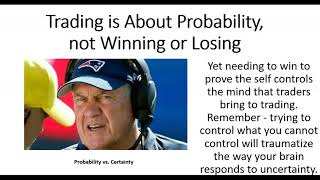
Know what the market's going to do? Have you ever done that? Yeah, it's that kind of stuff. So we're looking at this winning attitude where, oh my God, the one thing. I don't want to lose. I don't want to lose. I don't want to lose. I don't want to lose. Now you may be asking why is a photograph of Bill Belichick doing in one of Randy Howell's slide programs? There's a damn good reason. Okay, and here it is. You may want to win, you may want to make up for prior losses, you may not want to lose. And you, you definitely want to. And you think you know where the market's going because you believe.
That you will win against all odds. But the problem is trading, like championship football, by the way, is about probability, not winning or losing. Several years ago, Belichick has the Patriots in the world and the super bowl, he's playing the Atlanta Falcons. His team is down 28 points and it's in the third quarter. You look over at the Atlanta Falcons, they're celebrating and stuff like that, man, they've won this thing. Everything's great, man. They, they're in the winner's circle. They're thinking like winners. Look at us, we're winning. Meanwhile, when you take a look at Belichick and his people, what you're doing is they're getting in their football players faces, but they're not shouting something like, you stupid idiot. They're saying, do your job, do your job. It's a mantra. All they wanted their footballers to do, even 28 points down, was do the job. They weren't asking them to win.
They were asking them to do their job. And in doing that by doing their job, the possibility, the probability of winning showed up.
But they as a team did not win. They focused their mind on doing their job, doing the standard practices that allows them to, to perform well, well, well, not win, perform.
This is the difference between probability and certainty. And it's something that Bill Belichick has done incredibly well with Patriots. And it's something that we as traders can learn too. And it's just not football. The big news would be, gosh, in games like golf where you see all these people on the PGA Tour, they can, they can knock the slop out of the ball, they can putt like crazy, but ultimately it comes down to about 10 money people.
And the way they perform.
They know that they can't control the day, they can't control the fans, they can't control the wind, they can't control the weather, they can't control whether or not somebody's having the best game in the world. They can't win, they can't force winning. But what they can do is they can control the mind. They bring to the moment of performance. That's what we're talking about here. That's what we're talking about. So we've gotten that. The next thing that you're going to have to really get past is this, this need to be right, the need to prove this self to be right. You know.
You know, it's like you don't even have to be in business to get this thing right. A lot of people come in from business where they've done, they've been Mr. Right, they've, they've made things happen. They bring it to trading and they try to use that right. I am right. They force that right and they discover is the trading gods don't care. The truth is they need to be right or need to prove the self by winning. And that's what gets the trader in trouble. Again, the trader does not control winning or losing. In fact, winning is just landing on the right side of probability. Losing that horrible thing is simply landing on the wrong side of probability. The job of the trader is perform.
Then we take a look at this other, this illusion of control.
That, you know, we just think we have and we think we can have good trust this control over outcome and we see the evidence, but we ignore it and we still seek control. We buy more programs, we learn all sorts of things, we try to make it so that we finally are going to be able to control and predict the outcome with incredible accuracy. And what we discover is no you can't. No you can't. So what are we going to do? We know we've got this survival bias that served our ancestors really well. But at the same time what we've done is darned if we haven't got ourselves into a fix. Because here's the deal friends.
The brain that you brought to trading, okay, this is the bottom line, is simply not up to the game. It's just not up the game. It's not up to the task. And it's built for survival in the short term.
It's not built for probability victory in the long term.
The moment that you start pushing it, particularly under stress, when you add uncertainty, risk, money, and then you have a short duration, time is what happens is you Push that brain back into its survival instincts and suddenly a perfectly rational person who could produce profits on paper blows up when there's real money, real money in the treads. It's just amazing, isn't it?
And your trading account has got to be the final arbiter of the effectiveness of your trader. Okay? And this is where literally this is what I'm asking of you, is that you're going to have to give up the dream of getting rich, of incredibly doing well and of performing and performing and making things happen, all that winter stuff. You're gonna have to give up that dream. And at that moment, the truth of what it's required of you to become a good trader is going to show up. All that stuff of winning, of controlling, of being right are just simply limbic learnings or what we would call implicit beliefs, okay? That's all they are, that your brain is projecting onto the markets.
You know.
But what most people have come to do is they've come to listen to the excuses and cures of the thinking mind, okay? And it doesn't work. It just. That thinking mind just starts producing all sorts of crazy stuff. What we're saying is now what we have to do, we have to start managing the way the emotional brain engages uncertainty. That's where the big deal happens. And then.
Let'S put it this way, do you keep chasing the dream of prosperity thinking, or do you take. Or do you take it the bull by the horns? This is what happens when traders, when they finally get to the moment where they realize they've been blowing themselves up and they realize that, you know something, my brain is bringing a short term survival instinct and it's counterintuitive. And I know that the vast majority of people are going to continue doing that, 95 to 98% of the people. The question is, are you going to take the right turn? Are you going to take the turn that allows you to start training the brain to do something that it was never built to do.
Managing probability.
And yet, here's the deal is inside you is always going to be that caveman, okay, who's going to make instinctual decisions. That's what he does. It's in your DNA. And it's not about to give up. It's really. And what ultimately you come down to understand is that survival and money have kind of been linked particularly with status in that ancestral mind of ours. But it's not about winning or losing. It's about the performance. And so the thing is, I want you to understand, against all Odds you're going to continue firing into this toxic dream, well, that's what allowed the human race to become who it is. You need to decide whether or not you want to become a person in the human race or whether or not you want to become a successful trader. Completely different avenues of evolution. Natural selection has totally, totally voted against you. You're going to have to design the mind that you bring.
So those who understand that change is necessary fundamentally. Right now, on the right side of this graphic, what you're seeing is people with tubes on and they have tunnel vision on the left side. And what I'm asking you to recognize is that you're going to have to take that. You're going to have to take that tunnel vision down. No matter how touchy feely, how comfortable it is, that comfort zone of yours, this is the way I see reality, and this is it. What I want you to do is go over to the right side and all of a sudden you realize, oh, my God, I've got a brain built for one thing and I'm going to have to teach it to do something else. And you can redesign that brain. And it just so happens, guess what, that we can teach you how to do that. But let's start with what. The mountain you've got to climb. That first step, by the way, this is the steps I'm going to be teaching, are the actual steps that we teach in both our group course and our individual course. Okay? The very first thing.
Is taking responsibility for your brain.
This is the hardest step, the probability. Okay? This is where it just doesn't seem like it. Reality's out there. I'm looking at an objective reality out there, when in fact the reality you're experiencing is generated inside. You do not see the truth out there. You do not have charts that have information on them.
You have charts that have emotional energy signified on them. And what you're doing is you're looking at that phenomenon of the markets through a set of beliefs.
And that you didn't even have anything to do with learning. You showed up in the world, they got built into you. And those beliefs are operating on a subconscious level in your limbic system, and they shape the truth, the reality that you see. Ah, darn it. And then you go, whoa. What are you talking about, Randy? I'm talking about literally the reality of working with your flesh, of working with your neurobiology. Because ultimately in neurobiology, what we would say is you have never experienced reality. And what I know is this is really confusing for A person born up in reason to believe that reason can see the truth and to recognize that. No, Randy's telling me something really different is that your caveman brain is going to rebel against this enormously. What you're doing. And you're noticing this guy's cleaning his lenses because what you're doing is you're taking the brains biases, it's limbic learnings, its assumptions that it just fell into because it got born into a world with family and culture and circumstances and it just. That's what creates the world you're looking at. What we're saying is now you're going to have to clean that. You're going to have to produce a completely different way of looking through those glasses. And you're going to have to recognize, oh my God, what I've been seeing, it's not what's there. No, what happens is that you're looking at emotional energy. There's a wonderful book and a TED program by Jill Bolt Taylor called A Stroke of Insight, where she is a. She's a neuroscientist at Harvard and has a stroke that knocks out her left brain or thinking brain. And what she's doing is explaining to you what it's like to perceive through the emotional brain, which by the way makes 95% of the decisions that you engage in. And they're all done subconsciously. This, this is the feat that you have to learn how to do. So understand this. The first big thing is you're not even experiencing the reality out there. You're experiencing a reality, a virtual representation built by the brain from your biases. That's what you're seeing. And you're seeing the effectiveness of those beliefs, those biases for extracting capital out of the markets in the health of your trading account. Not what you say you believe, not what you quote about what you believe, but the actual functioning implicit beliefs that drive your decision making under pressure. That's what we're talking about here. That's the part that nobody wants to do because it is uncomfortable to recognize. Oh my God, I have been fooling myself around how long? Yeah. And do you want to really see how a decision is made in the brain for. For an emotional hijacking in your trade? Let me show it to you. It's really interesting. Here we are. Okay.
What I want you to look at right here is down here in the left hand corner you'll see emotional stimulus. What that amount amounts to. That's data. That sensory information coming into the brain. That's all that stuff you're looking at with your eyes, that's all that stuff that you're hearing where you hear, you know, you hear AI tell you that something's about to happen. That's that stuff. And then it goes to the sensory thalamus. Okay, so far, so good. What happens in the sensory thalamus? Something very important. It's like the traffic cop. That traffic cop has got this really busy intersection. Cars are coming and going, and that traffic cop has to decide how to route that traffic. Those thoughts, those beliefs, that information. It has to make a decision about whether or not the information is dangerous to the organism or if it's not so dangerous, it can be sent up to the thinking brain. Well, if that traffic cop decides, you know something, this is really serious stuff, he's about to get into a trade. He could lose. And my God, if he loses, oh, shit, that's like. That's like losing my life into the limbic brain. That's what it is. So what it does is, oh, my God, we're in trouble. We're going to send that impulse down the low road, the short route, into the amygdala, into fight flight, and it's going to trigger. And suddenly what. What's going to happen is your finger is going to freeze.
On the trigger. You're not going to be able to get the trade. Or even a better one. When I like is, okay, well, I finally have got some money up here. I finally, you know, something like trade went against me. It went sideways on me. You know, I. It just came close to my stop and did all this stuff. It just beat me up. But there, look. Wait, wait, wait. It's gaining momentum. It's moving. It's moving. Oh, it's in the black. It's in the black. Oh, my God, it's in the black. I better get it. I better get it right now before that profit gets away from me. That's the traffic cop, too. And your talents. Get the money now before it gets away from you.
It's down to fight flight. Aggression happens. Bamboo, you take that stuff, you don't let it go to the target. You don't even let it think about getting the target. And all of a sudden, there's that relief. I've got the money. Then you realize, my God, this had plenty of energy to get to my. At least my first target. What in the world was I thinking? The traffic cop? Friend, this is your flesh. This is your flesh. Friends, this is your neurobiology. Thinking got in its way. What you want in trading is for that to calm down so that the information can be sent to what the. What we're calling here, the sensory cortex, your thinking brain. It's a high road and guess what? It takes half a second to get there and to be processed. The low road takes.003 seconds, nanoseconds to activate fight flight process. Who do you think wins under stress? And yet you're sitting here. You do not have one skill that allows you to work with that traffic cop and to slow the process down. Except for like, I'm going to will it. Oh, that's not going to work. I'm going to force it. I'm going to put my emotions onto the side. No, this is the process that's happening continually. And once it finds success, understand, success to it could easily be getting you out of the trade. Success to it could easily be jumping into a trade where you believe that you're gonna hit the mother lobe and you're gonna win big.
Only to find out that you just got sucker punched another time.
We need a trained thalamus. We need. We need to be able to go, wow, this is a totally different thing. And I hope what you're getting is you're beginning to see the power, the difference between.
Instinctual survival programming that you came stock with, whether or not it's about winning or losing, and the probability management that has to occur to get the thinking brain involved so that you can think through things rather than react. Two things. But this, friends, is what's happening. You and your traffic cop don't have a good relationship and you're gonna have to learn how to do it. That's it. Now where are you gonna learn this? What I have done here on the left, you're actually looking from a slide, from a presentation, from a training a trader training organization. It just so happens I have taken out all information who that particular person would be. I would hate for someone to reprimand me or anything, but listen to what they're saying. How to trade without emotions.
First of all, so far, if you, if you're with me here, do you think that's even possible?
No. The truth is you are an emotional being. You are not a rational being. That's some BS that the thinking brain has had you believing. But the truth is you're an emotional being. And what happened is the rational mind, that thinking mind is just simply making up alibis to support what the emotional nature has already decided. Okay, you get it. And emotions, Friends.
In neurobiology, we would actually call them biological Action potentials doesn't sound very touchy feely, does it? And their purpose is to coordinate activity. The dance between the organism, that's you, the trader and the environment, that's the markets. There's this dance going on, perturbation stuff that's happening in the market and by changes in the status of the market automatically emotions trigger in the organism you. Because you're in this intimate dance, the more money you have, the more risk is there, the more challenge.
Excuse me a moment.
I do have a slight cough and every once in a while it gets the best of me. Okay. The key is what you're noticing is that literally at some particular stress point.
The thinking minds token taken totally out of the equation.
And because of the ignorance of traders understanding of emotion, that points pretty low. That's something that you've got to cover up. But what I want you to notice is this is a, this is a company that sells a lot of trader training and they're telling you that how to trade without emotions. Okay. Think about it.
Yeah. Oh, by the way, my wife did ask the really big question. When is it that you do not have emotions? Can you think of a time that you have never experienced emotions?
Well, I came near this point a while back and I can tell you this, you don't want to do it. It's when you're dead. You don't have emotions when you're dead. I don't wish that on you. I wish that you master your emotional nature. That that's what the difference between a trader who talks the game and a trader who plays the game. That's the big difference. But even there, okay, now we've redefined emotion. But do you even know how to spot an emotion as it's working in your system? Well, I give you these five distinctions. It's very important. The very first thing and people don't notice this, is that tomorrow get yourself a mirror, get yourself a video feed and watch yourself trade. Start noticing the muscle tension in your jaw, your face, your eyes, your body all over the place. Start noticing that you hold your breath. Start noticing that you pant. That's arousal. That's emotional arousal. The emotion is triggered. Remember, remember. It's a biological action potential. There's been a change in status in the markets. Therefore you, the organism has triggered to emotion and that emotion has triggered and it's, it's gaining a head of steam. At some moment there's a trip switch that goes off and it's no longer arousing. It is hit feeling state what that means is the chemistry of that emotion is flooding through your body now. It is altering the way you think. You have just been hijacked by the emotion. Okay, if it's fear, it's gonna be cortisol. If it's rampant, like just jumping into trades, it's gonna be testosterone and dopamine.
Then there's this thing called motivation. What is that emotion telling you to do? Is it telling you to fight? Is it telling you to flee? Or is it telling you to approach?
The motivation is inescapable. But unless you have approach motivation that you're applying to the markets, you're already dead in the water. You're gambling. The fourth piece is the belief system behind that emotion. Not the ones you say you have, but the ones that are revealed by your trading account. And friends, if you're having problems with your trading, there's only four. There's no reason for rocket science. There's no reason to get all mysterious. What generates them are a sense of inadequacy, a sense of not mattering unless I make money, a sense of unworthiness.
I need to buy my worth. You know, I'm not worth making a bunch of money. Or a sense of powerlessness. The trade's going against me. I'm falling apart. Yeah, that fifth piece, Predisposition, is beyond the scope of this, my work. That's the genetics that have been. You know, you may be an anxious type, you may be an impulsive type, and it's part of your nature and it has to be worked with. The key is when you understand this.
Is that most people, because they don't understand this, they simply get steamrolled by the emotion and they have no idea what to look for. What we want to do is teach you how to what in the world look for. And the real question is, you know something? What are you going to do with what nature has given you? Do you think nature. Do you think this instinctual survival response to uncertainty is just going to go away because you're tough? No. Everybody has been on this roller coaster that trades everybody and friends, the very first stop. Once you become aware of emotions in a very different way, is emotional regulation. Once you accept that emotions are not psychological, they are biological in nature and take over, take over mine. All of a sudden you realize that you know something if they're biological. Well, what. What does this tell me about having to. How I manage them a lot, because breath, tension and heart rate are very much part of very obvious parts of being able to see that emotion. You can control the way you breathe, you can control the muscle tension, and you can use breath to lower the heart rate, to calm the intensity of the emotion down. If you know what you're looking for, if you educate and train yourself. And that's what we do. So that second step is emotional regulation. And a lot of people say, well, Randy, is that the fix? No, it's not the fix at all. As a matter of fact, emotional regulation is not going to change the dynamics. But if you do not know how to regulate emotion, you never get to the door of the mind. And friends, the door of the mind is where it's at. This is where you meet monkey mind. And what I say is the third pillar is applied mindfulness. You just don't want to be observed thought. You want to understand where that thought's coming from, what its emotional base is. And you discover some profound truths that can be very hard to get your hands around. You. And your thoughts are not the same.
They only represent one organization of your potential.
And it just so happens that what you're working with most likely.
Was already organized, locked in place, before you could ever have an opinion about it. You just thought it was you. In mindfulness, you begin to wake up from this illusion and you begin to find, oh, monkey mind. It's just chattering around in there. It's got some really crazy ideas. Yes. The fourth one is once you develop mindfulness, once you can step back out and separate yourself from internal dialogue, all these thoughts going on in your head, you discover something. Oh, my God. There's a historical internal dialogue. And, you know, there's constantly. I'm constantly being criticized, I'm being judged, I'm being tempted. And there's a part of me that is fearful. There's a part of me that needs to be. That needs to prove himself. Yeah, this is the organization of your potential made by circumstance, culture, and family before you had any say. So, friends, it's not the permanent you, but it's the you that if you don't do something about, it's the one that sticks, and it's the one that forces your performances in trading. It's focused on survival instincts rather than managing the uncertainty of potential. Okay, you got born in this, friends, but it's not the final. It's not the final verdict. Or at least it doesn't have to be. You can go in and say, you know something I get it, is that I have this brain that's been shaped by evolution, by circumstances, by natural selection and adaptation. I accept that it could become permanent. But at the same time, if I become designer.
I can change what nature has given me. I can redevelop the mind into higher functioning. Absolutely. And this is. This can get so interesting. But the truth is, is most people step back from this because it creates temporary discomfort.
Temporary discomfort. Ah. Did I tell you that you're going to have to change and experience a little bit of uncomfort in order to be able to change the mind that trades? Well, you do. The truth is, anytime that the trader gets stuck in old ineffective patterns and they want to change to new, there's not a freeing experience where hallelujah. What happens is that you're leaving the old and you're not so sure about the future. And you're beginning to go, oh man, is the devil that I'm contending with better than the devil that I may meet on the road?
You stay locked up in prison like this guy right here. So you go, whoa. But the fifth step is awakening your heroic nature, my friends.
The thing is, you have an endowment. The potential of the human spirit is enormous. Only one small aspect of that potential has been organized into a mind that engages uncertainty.
And it just so happens in trading to become successful, you are going to have to reorganize it.
Period. What you're going to discover is this. In the same way that criticism, judgment and temptation, fear and aggression live within you as potentials in responding to uncertainty, so does the discipline of ruler. So does the courage of a warrior. And by the way, that discipline is the ability to maintain order under pressure. That courage is turning toward your fear rather than running from it. The self soothing. This is probably the most under appreciated part of your being is there is a part of you called caregiver that literally you can train to soothe the fear.
And by soothing the fear, you get the right mind back. What you end up with is a very different cheerleading squad. Management squad. Inside the brain. Seeing the world out there, it sees. It can see through probability.
Rather than instinctual survival. Friends, that's the piece.
These are all parts of the human potential.
It just really depends on whether or not you're willing to go there or not. The sixth step. You know something? I'd love to think that, you know, golly, you learn all this stuff and you can just go off into the sunset. And a lot of people do that. They say the. The hardest part about your work, Randy, is is that when you finally get there, you think it's going to be, yeah, now I've got it and I've got It. I've got it. Hey, I've got it. No, you don't have anything that you don't have to continue practicing. In the same way that a performance artist, whether or not he's an athlete, a singer, or whatever, has to continually work his game, so do you. You just don't have it. And you're. You're on easy street. What you're doing is just like this guy. You're still running a board of directors in your mind. If you looked at your mind as a committee of self, and what you're going to discover is that as you wake up and as you start building these different elements of the mind, there is still going to be conflict in there. And you realize, oh, my God, there's a mutiny going on in there. I need to wake up. I need to organize how I want to take this mind into the future.
I can't control the outcome, what's going to happen, but I can control the mind that engages the uncertainty. Yes, friends, that's the big deal.
Uncertainty becomes the new norm. Okay? And you become master of the mind that engages that uncertainty. That, friends, is the psychological holy grail that you've been looking for in other stuff.
This is what you have to have if you're going to produce the kind of success you're looking for. And what you discover about all my courses is that it's really. The course is about self mastery.
And as you master the self that trades, you also notice something else. Those skills start generalizing, creeping out to other areas. This is not magic. This is knowledge. There's teaching. You have the tools of transforming that mind.
That's the big deal, friends. You end up with the tools to transform your mind. And very interestingly, I work with a guy who did extraordinary well in my individual course and has done extraordinary well since then. He wrote recently, just sharing his good news to us. And he says, gee, Randy, I even see that you talk about me in some of your presentations. And I do, because what he did is he came to a moment of worry when he started working with me. What he discovered is that he had finally found the tools that he needed to be able to build the mind that traded. He was no longer faltering. He could use the tools to build a mine that stayed consistent in performance as he traded. That's what we're talking about here. That's the change we're looking for. And.
You know, who would have thought that trading was a path to self mastery? It's just kind of a cosmic joke, isn't It. But it's a, it's a good one. I like it. So tell me something. How do you become the change? How do you. How do you. If you accept that, you know something I'm getting this thing is that, yeah, I bought hook, line and the sinker into this getting rich scheme. I'm tired of jumping ships and landing in other people's trading rooms and getting promised all sorts of stuff. And what I discover is that it's always around the corner. It's always around the corner. Well, the key is, how do you do it? Well, ultimately, if you don't know my work, get all the free stuff first. There's lots and lots of stuff like there on YouTube and articles and stuff like that. Then get my book. But beyond that, when you actually go, you know something.
I need to take the bull by the horns. I actually need, I actually need to train myself. Whether it show venues, the group course. It includes five group meetings with me. Okay, it's a webinar. Go to webinar floor mat. It's a virtual classroom with unlimited access. And April, just April coming up. And what we do is we want people to sign up early because what they discover is, wow, there's a lot of work here. And the more training you do initially, the bigger the payoff. And that's why we offer this emotional regulation workshop that if you buy it on our website, it's 200 bucks. If you get it here simply for signing up, it's free. Your choice, friends, your choice. The other thing is the individual course. This is an enormously comprehensive and personal.
Walk odyssey through your mind and building the mind to be able to work. And the big deal is this. First of all, people get a hold of it and go, oh my God, I had no idea there was so much material here. But it really comes down to it, this is when it gets personal. You and I are meeting 10 times on Skype and we're working through this over a three or four month process and it gets really intense. It does. We find out whether or not you really want to learn and you're given. If you do want to learn, you learn the tools of transformation. This is the way we do it. If you're interested in that, go to the website, hit contact us and let's find out more about it. This is for serious people who realize that I want to make a career out of this and something. There's some roadblock sitting in between me and what I know I can do in trading. And the truth is, is that I need Help I need mentor, relationship. This is where you go. Friends, I want to thank you for being here and for us sharing this time together. And what I'd ask is that if you have questions, please, I love this. There's a comment here. Just like the American dream. Yeah, that's exactly what it is. You know, the thing is, the American dream has been built by immigrants since the beginning. They had a dream that literally, I mean, you were leaving your family, you're leaving everything. The likelihood of you ever, ever seeing, ever seeing your relatives again was slim. And just hope upon hope, you know, that's it. Today you said something. Today you said something you probably said before, but today I had an aha moment. Winning is not under my control. Yeah, winning is not under your control. I've said that a zillion times. I'm glad you hear it. What's under your control is the mind you bring to performance.
Traders constantly try to be in control of something that is so vastly beyond their ability to manage that they don't. They forget what they can control. And this is why probability becomes so important. And this is all, this is everything. What you control.
Is actually at the very core of it, your response to uncertainty, your emotional responses to uncertainty. That, my friends, is the holy grail. And unfortunately for all of us, it's going to be raw and you have to develop it. Maybe a bummer, but I'll tell you one thing, it's a lot better than living in the illusion that somebody's going to be able to find you a ticket to the game of, like, getting rich quick. This is, this is it, friends. So we've got some questions. Don't see any more. So if there are no other questions, what I, what I.
I simply give you thanks for showing up and being part of this. And I ask you to really think about what we've said here and decide whether or not you really want to become a trader and say, you know something.
What do I need to do? Who do I need to become in order to, so that I can become a successful trader? Or do I want, or do I want tools that can force success?
Okay, a lot of people have had that, so it's here. And my, my hope for you is no matter what, they have a grand, glorious life. And my hope that tomorrow when you start trading, you look seriously into this, really start looking at your emotional nature and start noticing, you know, do you really control the outcome? No.
And yet at the same time, the power is right there in front of you. The mind you engage with so take care, my friends. I've enjoyed myself immensely. If I can help you, let me know. Take care. Bye bye.









