Self Mastery of Your Trading Psychology
Randy Howell (Traders State of Mind) presents 'Self Mastery of Your Trading Psychology' (YouTube webinar). He argues trading success depends more on self-mastery under uncertainty than technical skill: evolutionary emotional programs (limbic responses, inner critic, adapted child) drive repeated mistakes when traders move from paper to live trading. Howell teaches calming techniques (breathing, muscle relaxation), mindfulness to observe and detach from automatic beliefs, and development of constructive archetypes (ruler, warrior, caregiver, sage). He offers training: an emotional regulation workshop (~1.5–2 hours), recommended daily practice (~2 hours/day), 3–4 weeks to internalize basics, a group course and a more expensive 10-session individual program (pricing mentioned inconsistently but individual cited around $4,000 and group near $1,295), next review session noted March 30, and webinar recording to be posted the next day (by noon).
Questions this video answers
About 1.5–2 hours.
About 2 hours per day (including practice while trading).
Recommend 3–4 weeks (3 weeks minimum, 4 weeks better).
March 30 (review session).
Next day (likely by noon).
Chapters
The broadcast is now starting. All attendees are in listen only mode.
Welcome everyone. My name is Randy Howell with Traders State of Mind and I'm excited to see you here. And we are about to get started. One thing we need to do is we need to find out if you can hear me. So if some kind people please put into the question box of the chat box, the question box a why or an N if you can hear me. Of course. If you can't hear me, you're not gonna be typing anything but just formality. I always like to know that we have a yes. Yes, yes, yes. Okay, we're good to go. We're good to go. The last thing is that in my presentations I hold questions toward the end. That doesn't mean that you can't present questions so that we have some answers to cover at an awkward time after I finish my presentation and before people can type in questions. So I would encourage that. Okay, so yeah, just type them in the question box. That's the whole deal. Dolores likes them in the question box. So let's take a look at this. You know.
Trading is really more about self mastery of your psychology under pressure, under uncertainty than anything else. You're going to find that what happens is that.
Success in trading really requires a very different mind than is required for success in other areas. And out of that, in doing that, what we do is we say, you know something. Okay, well let's take a look at that. What does that actually mean? And initially we're trying to move the slide forward. There we go.
Initially everybody looks at trading and says, you know something, what could be so hard about this? It seems pretty simple, you know, it's like all you have to do is realize that yes, it's about probability and there's, it's really kind of simple. There's lots of successful strategies there. And it's like even a caveman could do it. You know, remember that old ad campaign? Certainly a smart person like you, one that works hard and wants the success and is most likely demonstrated success in other areas. And so they think, oh, this is just a natural. I'm going to be, this is just going to be really great. And they buy into the program and they say, you know something? I know it's going to take me, it's going to take me a while to be able to figure out how to do this, to master this, this technology, to master an edge that I have and to develop it. So we get there and go, well okay, let's do it. Let's learn and then a magic day comes when you've learned a way of trading, you have gone through paper and you have demonstrated that you can in fact win. Hold on.
One person is having audio problems. Let's ask, ask every the rest of them. Are you having audio problems?
Yeah. Folks, is there anybody else other than one person having audio problems? Please let me know either yes or no because I would hate for every. I would hate for a garbled voice to be going along. All good, all good for audio. Okay. No, no problems. Okay. I would guess then that the problem is going to be on your side. Please check it out because I don't know, everybody else is hearing things. So I think we're good. Okay.
I will get to that question at the end. So.
We'Ve done all the paper trading, everything's going pretty good and go, you know, I can do this. Then comes live trading. Then all of a sudden what you're doing.
It becomes a completely different world. Suddenly all those question marks that you're looking at represent uncertainty and you're discovering something that your brain does not like uncertainty. When you were trading paper.
You had something to catch you, you had a reset button and the losses really didn't matter. Yet when you go live, suddenly that hard earned capital of yours is being put at risk. And suddenly trading is not so simple anymore.
Literally what has worked for you before turns against you. All that hard work, all that pushing, all that, all that's work, work, work. All of a sudden it doesn't seem to matter. And this is one of the big deals. What actually is going on here? In fact, what you discover very quickly is you keep making the same mistakes over and over and over again. For instance, one of the. I have a section where I define nine moments in trading that are so popular for mistakes that everybody knows about them, everybody knows about entry problems and you keep doing the same thing over and over again. Everybody knows about not being prepared when you put the order fill and suddenly you're not prepared for the wild swings and just the up and down action that's going to happen. Then you're not prepared for losing, you don't want to lose, you're not prepared for winning. Even winning gets in your way. So what happens is we start going, wait a minute, why do I keep making the same mistakes over and over again? That's what Albert Einstein said was insanity. Yet I don't think that is insanity. I think that's normal. I think what you're doing when you find yourself flust where you know how to Trade. You get under pressure, oh my God, I could lose. And all of a sudden, repeatedly, over and over and over again, you keep making the same mistakes. This is normal. You have just met one of the biggest problems that you will ever face in trading. That problem is simple, is that our ancestors, from cavemen to, even before cavemen were built very differently, and you are trying to solve the wrong problem. What you actually are throwing gasoline onto just a smoldering fire and all of a sudden it blows up on you.
We don't know how to move from the kind of certainty based thinking beliefs that our ancient ancestors had that was required. We had to believe that we were going to win, that we were going to survive. We had to believe that we were not going to lose, because if we lost, we were somebody's meal. And all of a sudden you realize, oh my God, Randy, are you telling me the brain that I bring from the evolutional times and all that stuff that I have brought to trading is in fact the biggest source of problems that you have? Yes, that's what I'm telling you. And the thing is, you didn't understand.
And you don't understand the nature of the problem or how to deal with it. And I see this all the day. I get a lot of people will go to my YouTube channel and what happens, they kind of just really get into that stuff and then say, golly, Randy, I finally understand what my problem is. To me, that is one of the things that you really truly have to do. Because the key is this, when you actually start seeing yourself in repeating patterns, responding to all that risk and uncertainty, you are looking at the ancient emotionally directed neural circuits that are firing on automatic. It has nothing to do with thinking at this time. Thinking is just simply overwhelms. Your whole thinking, what your emotion overwhelms. And all of a sudden you're realizing that, oh, wow, this is happening in nanoseconds. Your brain has set up emotional patterns for anything that seemed threatening and risking capital to your caveman brain is in fact perceived by that caveman brain is threatening to your biological system. So you're getting at it and going, whoa, this is what you walked into. And.
We don't want to see it. We don't want to see the world is uncertain. We want to make sure it's certain. We want to say, oh, it's here, everything's fine. And then, you know, think about all those people in Syria and Turkey, God bless them, what happens? They knew that they were in a prone area, yet you know, something it might be a thousand years, it might be 500 years, it might be tomorrow, it might be right now that suddenly things are shown to be uncertain and everything turns to hell in a basket.
The point is this limbic learning, it's not logical, it's emotional. If you take the analogy of this, if you look at an emotion, your emotional nature as a locomotive driving a train, it's powerful. It is very powerful. And your thinking is the caboose at the end of that locomotive.
Not very consequential and the engineer driving that train are the beliefs you have about your ability to manage uncertainty. And all of a sudden you start saying, oh, my gosh. What I'm really being exposed here is the beliefs that I have about being able to manage uncertainty and risk are being revealed in my performances in my trading account. Yeah, but the point is, is that we like to believe that we're rational. And the truth is we're not. We are not rational. Okay? What you discover very, very quickly, emotion controls thinking. Another way of saying that is all thinking is emotional state dependent.
What I want you to look at is when you're watching yourself trade. If you. I love to encourage people to either videotape themselves, take their smartphone, take at least a mirror, and watch themselves trade. And what you'll see around the eyes, you'll start seeing the muscles really moving around. You'll start seeing tension arise in your neck, on your forehead, body and all that stuff. What you're looking at at that particular time is thinking. That is being influenced by the biology of emotion. So the key though, is you end up when the way it works is that your brain, from an emotional level, when it runs into something, say, threatening, like loss of capital.
It will fall back, particularly under stress. It will fall back to instinctual responses to stress. It will throw out thinking, and suddenly you're acting in nanoseconds.
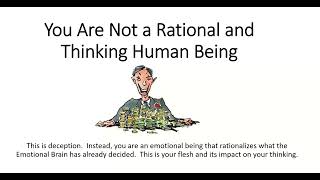
Emotionally in a reactive way. And that is what's happened to everyone. And as long as you stay here at this place, you're going to be imprisoned by your instinctual emotional patterns as a response to uncertainty. That's what you're doing. And we all like to believe that we don't have emotions. But the key is, is that the more willpower you put in, you hit a wall and it just wipes you out. The pattern becomes more ingrained. You are not a rational human being with some emotions. You are.
You are an emotional animal that rationalizes. I know that's hard to hear, but it's true. You're a social mammalian and Ultimately, it's all about getting locked up into pattern, about how you respond to uncertainty. Trading exposes the implicit beliefs, the ones that are what we would call unconscious.
That are really driving the way you perform in your trading game. So we've got that. And the real question is, how are you going to do this? How do you learn to free yourself from these emotional patterns? Because remember, I will repeat this one more time, and I want people to really hear it. It takes a while. A lot of people don't get it. They don't want to. They don't want to get it, is that you are not a rational creature.
It feels so rational. We're sitting here talking and being logical and stuff like that. But Descartes, that guy that said, I think therefore I am, was wrong. You are an emotional being who tells stories and alibis to cover whatever the emotional brain has already decided to think that you are rational is deception in neurobiology. What it said is that you have never experienced reality, true reality. What you have experienced instead is a virtual representation that your brain is making based on its biases, assumptions and beliefs. Okay?
And that is what you're calling thinking. Understand you're not rational. And then what happens is that the rational brain starts making up excuses to do this and covers it. It's called a narrative. It's called a fiction. And what you brought to trading is not going to work.
Okay? It's not going to work. A few of you will do it. Most end up out in three to four years, at most five years. They've burned through capital. They've burned through the patience of their spouse. They've done all that stuff and they haven't made progress. They're so close. They're so close.
But they don't see the missing link. They don't see how to bridge that gap that you don't understand. And this is where we go.
We have to start really. You have a brain to trading that is really all about control. It wants control over outcome. It wants control over living. And again, understand. If you understand that money is a representation of power or lack of power, you begin to say, oh, in power, you control outcome, you control making things happen, you control safety, and you also get status. That's the primitive caveman stuff. And suddenly, so if you're in control, you're good. And on this big, huge global world we live in, it appears to us that we can be in control. In trading, what you have to acknowledge, you do not control outcome. Matter of fact, if you make things happen instead of Waiting to see what the markets are willing to give you. You're going to get in trouble. Your predictions may or may not be right. That's why we call them hypotheses. That's why we sit there and go, oh, God, this isn't fitting my hypothesis. I'm going to get out with a small loss. But no, your primitive brain doesn't want to take that loss. It sees it a loss of life, a threat. And so what it does is it fights. And the more you lose it, it's going to fight hard. Now it's fighting for its life. It has to be in control. So what you've brought, the brain that you brought, I mean, this is long before family systems creates your, you know, and shapes your mind and all that. This, this is the evolutionary psychology that we bring into the game. Because this is what happens. This is what taking a loss looks like to the limbic system. This was a real fear in Caveman. Just even 10, 15,000 years ago, this was a very dangerous situation. There were still big cats like this around. And the key is, is that it had to survive. Winning.
Meant survival. Not losing meant survival. So you can begin to understand this, is that if you truly lost, you were somebody's meal. And every time that you take a loss or you see experience a potential loss, what you're doing is you're saying, oh, my God, my biology, my biological self is being threatened. To your emotional brain, yes. To your logical mind, no. But the thing is, is your logical mind doesn't really matter. You have to get the emotional brain.
Under management before you can actually start even imagining being able to control the kind of thinking that you're capable of under the stress of trading, under the uncertainty of trading, because you are risking capital, your power, your life to your primitive brain centers. That's where we are friends. So, and even when there is that, this was a typical day out hunting. And these, these, these folks are. You're talking about people who are here anywhere between 40 and 90,000 years ago. They're attacking an animal God knows how many times bigger than them. And those are big tests. And right now, if that mammoth started swinging those dust, he'd be killing several people. What happened, though? And this is over trading. This is impulse trading. This is urgency to act, is there was high reward if you overcame your fear and jumped in and took this animal down, because that, that would feed. Feed your group for weeks. And it would also provide materials needed for living spoons from us, all that kind of stuff. And also if you were One of the hunters that took that, that animal down. You got tremendous prestige. You were honored. You were up in leadership. And even more important than that, from an evolutionary standpoint, you got breeding rights, okay? You got to be able to have the right to project your genes into the future.
That's what we're talking about here. Nobody necessarily sees that.
But this is what's behind over trading. This is what's about alpha. This is the going, why in the world? And I jump into this thing, what in the world am I doing? I'm not going to jump on that animal.
So we're getting this thing going. Wow. So we have. We're carrying a lot of evolutionary baggage around with us and that we're going to have to figure out how to produce a workaround. That's the deal. How do you work this type of stuff? How do you do it? How do you go about building a probability baseline to work with uncertainty?
First we have to acknowledge that you have a certainty base mind built by evolution for survival in the short term. Now what we're doing is we're having to build a probability baseline to survive, thrive in the long term. That's what an edge will do. An edge is going to extract more capital over time than it gives back in. That's the edge. Caveman doesn't understand that.
It understands survival right now. So how do we go about doing this? How do we go about building a probability baseline? Where do you start? First? You start with understanding emotions very differently. The very big deal is this, is that most people equate emotions as being psychological. They equate emotions with feelings. Emotions defined in neurobiology are biological action potentials. Notice it didn't even say emotion. It's biological action potentials that work to automatically adjust relationship between the environment.
And the trader and the caveman. So when you're looking at that, you're going, oh, that's what an emotion is. My God. And they're built to fire automatically. Nanoseconds. The thinking mind hasn't even got to it. So the very first thing that's going to happen is we're going to have to look at that and say, how in the world do we slow the emotion down so that it doesn't work up ahead of steam and just wash us away? How do you first do that? Well, the way we teach it here is we begin to say we do it first with breathing and relaxation, muscle relaxation. When you take a look at this leopard, it's actually working.
It's waiting for the prey to show up and so it can ambush it. It wouldn't look that way. And what you're doing is once you get the body there relaxed, that's done by breathing. Because look, the thing about breathing and muscle tension, they are both part of an emotion. Remember, the emotion is a biological action potential. And if it's biological, it's going to have parameters that you can mess with. The way you breathe. If you hold your breath or you just stop breathing or start panting. My promise you is you would accelerate your movement to fight flight. If you do diaphragmatic breathing, what happens is you slow things down and you start going to what is rest, digest calm, which is what's happening here. They're in rest digest and what happens, you end up with a calm mind. So once you come. And also the muscle tension you feel is actually the emotional arousal. The more tense it's preparing your big muscles for fight flight. And let me give you an example of how subtle this is. I work with a guy who has been doing very well. Thank you. To the point where he's realizing, God, I'm making money, I'm making good money. And all of a sudden it all blew apart. It all blew apart. And ultimately it came down.
He was. And also in my advanced work, I'm having a heart rate monitor and I'm using an app that is actually helping to keep the range of heart rate in a particular range that is good for keeping in mind. And it just so happens we found his range to be in the mid-70s. That allowed him to trade in and really good area. But what happened is that he kept seeing that his heart rate kept sliding up. So the time we finally met, he had, he had moved that range from the mid-70s to 72 to 110. 110 beats per minute. Is fight flight. Okay. He, in order to stay green in the green zone, he actually.
He wouldn't take a loss. That's what he's really doing. But you're seeing it, you're seeing it emotionally. He actually changed the parameters. What he said that the mind needed to look like to trade well to include fight flight. And of course that really didn't work at all. So the deal is this. With breathing and muscle relaxation, you calm the body and by doing that, you calm the mind. So now what are you going to do there? Well, the very next thing, an observation. Learning to be able to observe the self. What you discover very quickly is this. And it's pretty profound. We tend to be identified with our thoughts. I thought this, I Thought this, I thought that if you're working with me, this I is an illusionary thing. And what we want to do is go, what is the emotional forces behind that? And how do they represent themselves in the mind? What you discover that you and your thoughts, you and your beliefs are not one and the same. As a matter of fact, my friends, you do not have thoughts, you do not have beliefs.
They have you. That's what you need to know, is that we assume, well, I'm having these thoughts. No, you're not. Historical thoughts already wired into your brain are popping up and directing activity to produce a particular destiny. That's what's going on. And then you go, well, you know, whoa, whoa, whoa. So in mindfulness, you learn how to quit identifying with your historical self. All these thoughts that run through the eye when you make a mistake and you beat yourself up, or you say, I'm never going to make it. What was I possibly thinking? Or, boy, if I make a lot of money, I'm going to be really an important guy. Yeah, well.
This is how you begin to say, okay, I recognize if I step back out of them, I quit identifying with them, and all of a sudden a whole new world can begin to show up. It's that whirl that we really want to start getting into. Because ultimately, mindfulness is a transformational tool that allows you to separate your identity from your beliefs about self. Because my promise you, if you're like 90 to 98% of the traders in the world, your beliefs are killing you. Your instinctual survival beliefs about your ability to manage uncertainty are killing you. When you've taken a loss, what do you think? When you're taking the loss, what do you feel? When you win, what do you feel?
Several years ago, I'm in China and I'm talking in a large auditorium to fund managers, portfolio managers, and traders. And I make the statement, when trading, when investing, you are not allowed to feel good. And one guy in really good English gets up and says, but I like feeling good. And my statement to him was that you can feel good, but just not when you're trading. He ended up walking out and so did a lot of other people. And basically the thing is, is they did not want to hear or did not believe that thinking is created by the emotions. What happened is this guy was feeling good. I call that euphoria. And euphoria has you believing that the good times gonna roll on forever. And it just so happens China had been on a raging bull market for 50 years. These guys could throw Darts and make money. Interestingly, as two days later the Shanghai had a tremendous correction and that guy came to me and said, I now understand if I had just, I see that I saw this coming. I just refused to believe it. So this is where you're really beginning to go. I need to be able to be able to start really learning how to observe my beliefs. It's not who I am and get so personal about your beliefs, but we really want to know about the beliefs that you use, that how can you manage uncertainty? Okay, how are they? And for good or worse, better or worse, is your beliefs that you project onto the markets are being evaluated for their effectiveness all the time. And you can believe whatever you want to, but ultimately with an edge, you come to the moment of where I actually understand now that I am, I am exposing the beliefs that I have about my ability to manage uncertainty and risk. And when you take a look at the dismal results, you discover is very few of us have beliefs that allow us to be able to manage uncertainty. Well, yeah, so we know that with mindfulness we can begin to start really getting in there and start finding it. Because ultimately what your brain and mine are really like, okay, is that your brain.
If you envision your brain as a community of rival emotional programs that are duking it out to get control of the construction of the self that trades, There is no one self. The self is very fluid. It can be recreated. And the key though is that.
In that competition, the winners win and the losers are kind of pushed aside and you start acting from a particular perspective. And people who've come in trading may have had a really good mind and it works outside of trading, but when they come into trading, they discover it doesn't work, then what they discover is this, is that when that brain produces mind.
Something a miracle happens, is that suddenly the emotional programs are given voice. You start hearing your thoughts in the mind. And this is where the mind becomes a governing committee of the self. And what happens in mindfulness, you start waking up and you look and you start realizing that there's a mutiny going on in your mind that is not going to help you in trading. And what you as CEO or chairman board of this governing committee, it has to do.
Is it has to learn to clean house and to redecide about which forces in the mind, which aspects of your, of your personality are going to be the ones that are actually doing the trading, the decision making under uncertainty, there will be others that simply, simply want your destruction. It's pretty simple. And in My work, if you've ever experienced self doubt, anger, overconfidence, what you're experiencing is this committee of the mind. And you're experiencing something that I call the inner critic. Either judging you, criticizing you, or tempting you, okay? And at the same time, there will be an adaptive self that is just scared or gets so lustful for making money because it'll feel good. And all of a sudden you realize that, oh, my God, these. These have been running around inside my head for so long that they're untamed. And yet at the same time, what I need to be doing is I need to be able to start saying, well, who's actually making the decisions? Okay? And what you'll discover is that the rational parts of the mind, the disciplined parts of the mind, are blown out of the water. And more and more, these are all emotions. Other much more destructive elements of your emotional nature start showing up to make your decisions. And this is what has to basically be retrained, because in here.
What you have.
Where people are trapped. And until they get past this, this is a relationship right here between what I call the inner critic. The judge criticizes, the tempts, the blames, is in relationship with the adapted voice, something that Carl Jung called orphan, and what is known in some therapeutic circles as the wounded child. And so you're beginning to see that for whatever worse is happening is that the inner critic has your ear. It's talking in, judging you, criticizing you, tempting you, all that stuff. At the same time, there is a part of you that so much wants to succeed but is scared. He says, you know, if I succeed, I matter, or, you know, I'm just not deserving of easy money, or I'm just inadequate. I can't do that.
That's not true. It's an assessment. And you're going to find a lot of misinformation running through the brain, through the mind, and.
What are you going to do about it? Is the whole key. This has been going on with people in trading. Every time you really get whacked up and you lose control and go tilt, this is what's controlling mind, and this is what has to really be calmed down. So you're looking at this as long as it's unobserved, as long as the observer's not there, this is just firing and going on and just sweeping away one way or the other, and you have no idea. One of the first things that I'm doing is I'm giving you a language about how to understand what's going on. In the mind and who the players are and who's got control and what you're going to have to do to be able to, you know, take those emotional natures driving your performances and reroute them so that disciplined impartiality is there doing the trading. A sense of self soothing or self compassion is calming your fear down. And there's also a courageous part of yourself who is protecting the committee from basically all this mutiny that's been going on inside your head. And you see this every day when you are put into vulnerability, put into confusion. Oh my God, I don't know what's going to happen. And this is what instinctually takes over fight flight. So we're sitting here and interestingly is this, is that in the same way we've talked about inner critic as an emotional program, we've talked about the adapted voice as emotional program that has really taken over mine. There are also other parts of you that are just simply part of the human experience, but for whatever reason have been pushed aside.
Like for instance, in my upbringing, I grew up in a military family where my father was a retired colonel and was also a very high ranking civil servant that ran a fleet of aircraft. He was the aeronautical engineer on a fleet of aircraft for the, for the Air Force. And the truth is he ran his family like you run a military unit. And there was, you know, the thing is, you know, talking to the colonel, oh my God. And for me, that option of developing that part of my personality, of my heritage just simply was not allowed. It was pushed aside because it just wasn't cool. But the discipline of a ruler is there. And the discipline of a ruler, what it will do, it will maintain order under pressure. Abraham Lincoln, if you think about him from our American history, particularly during the enormous debate that went on that led up to the Civil War and through the Civil War. And then at the same time, what you're also looking at is this, is that you also have a warrior living within you that allows you to have the courage to actually face your fears. Rather than false courage or all the bravado, boy, I'm a disciplined trader. I can make some money, I can talk the talk, but not really walk the walk. And you're realizing that that courage is not about the absence of fear. Courage is finding it within you to push through your fear in the faith that you're going to find the tools that you need to be able to work with the uncertainty. That's the power. The other part of our human experience that we need to learn to Pull forward is the nurturing side, the one that soothes, the one that has self compassion. And that's called caregiver. And it is actually the hardest one, particularly for masculine guys to be able to find within themselves. It's hard for them to be easy on themselves, to be compassionate toward themselves. And yet that's the engine of survival. The antidote to fear is not courage or bravado. The antidote to fear is courage. So you're looking at it and going, boy, these are potentials. Yeah. But you're going to have to develop them so that they're in their strongest, in their strongest archetypal presentation. This is your job. Also living within you is.
The wisdom, the clear thinking of a sage. That's the part of you who actually wants to do the calculations and actually saying, okay, I know this is what I'm needing to do in this trade. And the key is until fear is taken offline, that's that orphan nature and impartial discipline shows up. That part of you that is rational cannot be present. It is easily taken out. These are called archetypes and they are burned into your DNA as emotional programs. They are in fact, there. But you have to learn to awaken them, particularly if they were not modeled well growing up or if they just got crushed. So we've gotten this picture and.
What I want to do is this, is that I use the Lord of the Rings as an example of all these archetypes where it's easy to see them. You can see Eragon the ruler. You can see Frodo, actually, the internal struggle going on. A lot of these guys are in it, external struggle, but Frodo is in a struggle within himself. You start seeing compassion show up. You start seeing, like Sam, you start seeing all this stuff. You start seeing people willing to change their lives for the sake of another. And you, you start seeing, oh, these are the noblest parts of ourself. The internal struggle. The challenges of living are going to always be there. You don't control the outcome. You don't control that trouble's coming. What you control is the mind that engages that uncertainty, engages those challenges. And this is where.
In my work, what I'm doing.
I am teaching people first to find that there is an inherent worth living within them that is beyond their performances. Even if you lose, it doesn't mean that you're worthless. It doesn't mean that you're inadequate. It just means you need to work on your competency. Our probability was there, but the actual inherent worth that you are is about your being and it is not about your performances. That's the very first key that has to happen. And as you do this, you realize I can build this team and I can build it. I can build it so that.
I know that I can engage the uncertainties of life from position of empowerment. And right now, traders can't. I wouldn't have a business and I have a thriving one if it were different than that. So.
Ultimately.
You know, I used to play baseball. Not on a high level, you know, up to high school, but what happened is we imagined ourselves as major leaguers. My hero is Mickey Mantle at that time. Okay. The key though is that when you see a batter in a, in the, in the on deck circle, what he's doing is he's beginning to find rituals that he started in little league and has developed and have become.
Have become almost magic. Right there, he's looking at the pitcher, he's swinging with the pitcher, he's getting his mind with, with bat on ball, bat on ball. He's seeing himself perform. He's preparing himself to face the hundred mile an hour fastball. And this is where in my work, what I'm doing is that when this finally stuff comes together, I'm looking for you to be able to prepare the mine before you get to trading and to, and to repair and to reconstitute the mind as you trade. And that means I need a pause where I'm in the on deck circle. I need to pull the mind together that engages uncertainty. You cannot leave this to chance. You're already dealing with a lot of chance, my friends. You need to control the mind you bring to performance. This is what, and it can be taught. And out of that, what you get is this, is that when you take a look at this, it's pretty obvious here that that surfer does not control the wave. What happens is that wave is much like the markets. It's just happening, man. However, what you can control is the mind that sits on that surfboard. Yeah. And with that, when you have a chiseled mind, the chances of having a great ride are much improved. If you're already jittery, the chances are that that wave is going to consume you.
It comes down to this. You do not control outcome. You control the mind you bring to performance. And if you have a real edge.
The psychological edge becomes the mind you bring to performance.
With that edge, you improve greatly the odds of landing on the right side of probability more often than not. That's what happens, is that you can control the mind that engages uncertainty, okay? And it is built around patience. And it's something that all of you will need to do. This is that.
Is that you're going to have to master your dragons. There's no doubt about it. There's no way. There's no. There's no secret sauce. There is no if I only find the right system, the right this, the right that. No, this is really about. You're the Holy Grail. You are going to turn toward your fears. You're going to master them because the markets will find those fears out and the dragon will appear and it will stay that way, okay, until you master it. Trading.
Forces you into that moment. You can live in denial a long time, okay, but not in trading. So you get this thing and you realize, you know, you're talking about one of the top traders of all time. And what you're looking at is, hmm, the key to success is emotional discipline. Otherwise, you know, if it were all just smart knowledge and stuff like that, be a lot of people making money. But this is the transition that you're going to have to make. You have to become designer of the mind that you bring. You can't bring the one that you brought. Okay, that's just not going to work. It may work in other areas, but this is the area that we're looking into.
And the question is, my coursework is about self mastery. It's not about chants and visualizations and mantras. It's literally about how do you go about producing self mastery? How do you find these empowered parts of the self, build them into a thinking mind that engages the. The destructive end of the spectrum? Because ultimately all humans have both destruction and construction as part of themselves in a non dual world. And the real key is.
Which part of the self are you going to bring forth? Which part are you going to feed? Which part is going to become the working mind you bring to the moment? So this is where we're at, friends. This is really up to you. It's gonna have to happen for you to find success. And it's something I gave up a long time ago. Convincing people that they needed to. They needed to listen. What we do is if you don't, if this is the first time you've shown up and go, who is this guy? He is talking way. I have never heard anybody talk like this. Get my free book, start going to website, start looking at the YouTube channel videos. I've got well over 200 videos up there. Start really going in there and start going, oh, my God. Because, you know, Ultimately, what I'm talking about is how you go about producing foundational change. Not magical change, foundational change.
Then you can get my book, you can go through all sorts of stuff. It's. There's a lot of content on my website. The thing though is at some moment it really comes down to how do I change? And we have two vehicles. We have a group course that is five sessions with me and it's webinar. They're. They're recorded because we have people all over the world and we cover the basic dynamics of how you. The tools you need to create mine. The virtual classroom has unlimited access 24 7. And our next, our next, our next class starts in March, matter of fact. What day in March?
Well, no, that's the, that's the meeting. That's the first review. Review session.
Oh, that's the review session on March 30.
People are registering now. A lot of registrants.
Yeah, we've. We've already got people registering. We recommend you do that simply because most people, if you wait to the last second, you're not going to be able to do the rote training on, on Emotional regulation. And you, I'm expecting you to have already done that before you get to the first class. Okay.
Yeah, yeah. So the key is, I encourage you to look into this if you're, if you're serious about. I know that I need to do something. If you ever register early, we're going to give you a free $200 gift. Our emotional regulation workshop, not because we want to pull you in and sell you on this. We want you to get started early. We want you to have the best chance of creating a psychological edge that we can do. And that's the way we do it. So the other is this is we have an individual course. It is highly comprehensive and very personal. It gets the meat. It digs much deeper than the group course can and will. And people, people choose it. There's 10 sessions with me, lots and lots and lots of materials. Yeah. And it's meeting on Zoom. And ultimately it is. You really get down to the meat of the problem. Like the guy I'm working with right now who has been killing it and all of a sudden has blown it apart by making a lot of money. What he discovered is that deep inside him, in the relationship with his dad, his dad would work him to death but never pay him. And what he was told is he was not deserving of being paid, he not deserved making money. And what you're seeing is him being Successful and also a backlash from that point. What is known as an injunction from another time and another place, he started losing. This is where he has to change. He has to be able to say, oh, I get it now. Is that I am. This is Olympic learning. This is implicit belief that I can change. So I'm encouraging you.
I'm good.
And by the way, there is a guy in here, his name's Zan, who actually helped me. He actually invented one of the pieces that I use in my. In our. In our work. He actually taught. He actually taught me how to pull the trading mind up very rapidly. And he. He's a great guy. But anyway, I want to thank you, and I want to thank you for being here. I've really enjoyed myself. And now we'll take questions while they're here. And one's already here.
So this is Todd. Okay, Todd, you actually asked some very complex questions that do not have rigid answers. Just to let you know. Approximately how long does it take to cover the material in the emotional regulation bonus? It's about an hour and a half, two hours. And if you use it properly, you can start practicing with the guided meditations and the. And the setups that we've been setting up. So people would. Would be doing that, and they would be probably occupying an hour to two hours a day. How much time is recommended each day to practice the emotional regulation tools? Well, I can tell you this, is that this is where it's. This is where the squirming is that.
I would recommend that most people end up spending about two hours a day.
And they have to create time. You know, a lot of people use time in their cars. You know, we have audio books, we have all sorts of stuff that help people use things. People run with them. They do they. All sorts of things. But we. We look at it as two hours. And some people who are highly motivated. More. How much time is estimated to cover the 101 materials before 102? I want you. I want you working with the materials for three weeks. Four weeks is much better. It takes about. I'm asking you to start changing the way your body responds to uncertainty. You're not going to do that by doing a couple stupid breathing exercises and think, you got it. You're going to have to start instilling them.
While trading that it takes three to four weeks. How much time is recommended each day to practice the materials covered in 101? So same deal, about two hours a day. But I also consider. While you're trading, as part of the Time you're working with materials. What are the factors you would consider when deciding on the group course versus the individual course with Randy?
Well, it boils down to this, is that people who generally take the group course either can't afford the larger course or what happens is they want to find out if this Randy Howell guy actually knows what he's talking about. And what happens is, what it will do is it will give you a good foundation. And we, we, for nearly 15 years, we've had really rave reviews about the group course. The individual course is for those people who want mentorship. And they say, I can have Randy Howells, my mentor, going through this. And they choose that because.
I personally am of the belief that if you want to really change, what you do is you go find a mentor, a teacher, and you study with him in person if possible. And, you know, now zoom is arrived and things like that. But the major, the major movements I've made in my life have been due to me finding really good teachers and submitting myself to them. So there you go. Can we get the recording of this webinar? Yeah, it'll be available tomorrow on our website. On our website? Yeah. And I would say it'd be on the home page and it will also.
It'll probably be by noon. So there you go. I live in Dubai. We get Dubai. How can I get your book, Please? Get the e book. Please do not.
We do not ship right now.
Oh, yeah, we're not shipping right now. Get the E book. Get the e book. Okay, that would, that would solve the problem.
Thanks, Randy, for everything. I had a winning strategy, but my position sizing is wrong and I keep making the same mistakes. Please, any advice to correct it? Start taking these courses. Look, I'm going to tell you something. You're not going to find magic. What you're going to do is you're going to have to get into. You're going to have to get into the organic fibers of neural networks, and you're going to have to recognize I'm making the same thing over and over again. Obviously, there is a belief behind this repeating of patterns that I'm stuck in that you're going to have to expose. And you're going to have to learn to be able to have compassion for that, because that's how change happens. You're going to have to find the leadership. You're going to have to find the soothing. You're going to have to have the courage to face it, and you're going to have to think through it. But in terms of that.
There is no magic. Here's Charles. I'm about a month into using the meditations and I'm working with the workbook. I'm now getting all right at catching and observing thoughts throughout the day. Outside of trading, what is different about the Emotional Regulation Workshop after going through the. Oh, that's somebody else. Oh, well, thank you. What is different about the emotional reg.
From, from the getting just the individual meditation.
What happens is the Emotional Regulation workshop is a condensation of that, that covers the same thing, but it, it, it does it in an hour and a half. And I think it's a good tool to listen to, to work with. But the truth is, is I'm looking for reps. I'm looking for you to do the work of reps so that when you come in, you have at least a fighting chance of having established a pattern that we can start building it from.
This is from Bill. A trading coach will have their student use paper trading in order to master their trading techniques. Yes. The student, if they're serious about learning to trade, will treat paper trading as if it were real, which can't be done by the way. Bill, I see that trading coach like to a sports coach who expects their players to, to treat practice games. Yes. As if they are real games. Or a master machinist who expects their apprentices as if they're going to make accurate practice work pieces as they're going to a customer. Does the mind of the trainee differentiate between serious paper trading and then the direction of a coach versus someone paper trading on their own? Well, if you have a coach, at least you have somebody you can have some compassion for and give you direction. I don't, I don't agree with Bill. I don't agree with your, your premise there is that I, I personally have found there is a massive difference between paper trading when even though you juke it up at visualizations and things like that, it's the money is not coming out of your account. You're not facing in caveman stuff. You're not facing death and having to fight like hell to get live. And the moment you go to money, everything changes. You talk to any trading coach and that's the big deal. A lot of people can trade paper pretty darn good. They go to, they go to paper and they realize they go to live and all of a sudden they realize they have beliefs about their ability to manage uncertainty that have been pushed aside or.
Their implicit beliefs that have to be rooted out, found, work through and heal.
How Much is a group course versus the individual training. The group course is.
That's, that's the individual individual is 1295. 1295. And it'd be broken down into five payments. And the group course is basically.
Yes. And the, and the individual course is basically $4,000. And it can be broken down in three payments too, if necessary. And those are US dollars. So.
That'S it. Well, friends.
Yeah, we have a couple minutes. Here's from Chris. What part does Machiavellian intelligence help with your trading? I have no idea what, what Maka Valley intelligence is. I don't know what that is, so I can't answer that. Chris, here's Simone. Hi, Randy. Thank you. I've noticed after a win I regress and start using old bad habits. There you go, you get the euphoria and before you know it, your toast. Here's Kevin. What I have noticed going through your content is that I was trying to make myself large and in charge with accomplishment in trading in other areas to really cover up my sins of inadequacy. Sense of inadequacy, yeah. That's what the whole game's about. Nobody realized that the most powerful self development, self mastery is learning to trade because you're going to meet every one of your demons and you're going to have to master them if you're going to become successful. And most people just simply aren't up for it. And I understand that from Todd. I am not yet profitable on paper. Am I best to concentrate on technical skills or will this work with getting profit, getting to profitability? The deal is when a lot of people are not successful with trading paper is that they simply also are bringing their psychology into the moment. You know, if your trading coach is telling you that you're just making all these mistakes that you don't know. What I would also say is I know people who choke on paper. It just depends on.
Your personality and where you start. I have actually, with some people, I've actually started when they walk to the room because they already have a sense of dread before they turn on machines and things like that. That's what you have to learn to do.
Great session. Thanks. Do you tap, how do you, how do you tap your neural networks? I don't, I don't, I don't use that type of technology. I don't. That, that's just not relevant for me. So I think that's it, guys. I think that's it.
I have not heard anyone explaining about trader psychology better before. Well, thank you. Thank you. Very much. I. I really want people to understand what they're walking into. I really do hope you understand my concern.
The existing one is a bit expensive for me. So please give me any suggestion. Go to the group. The group is what, hundreds of.
I mean.
Is there any chance of getting the group course under 500?
No, it's just not possible. And you know what I'll do is I'll make an apology to people from India. I know that it's an enormous amount of money at the same time if we start doing stuff like that. First of all, I live in US dollars, I don't live in the Indian currency. And it's just one of those inequalities that.
I see it's there and I wish it were different. But I also, I'm a capitalist. So I have to make money to be able to spread my message. But I appreciate it. Okay, folks, thank you. Thank you, thank you, thank you. It is time for us to togitate this and think about this. And tomorrow morning when you trade, what I would really love for you to is record yourself or at least have a mirror and watch the emotional nature on your face and in your body as you trade. Take care, good luck and be well.









