Staying Disciplined While Taking Losses
Randy Howell from Trader State of Mind explains why traders instinctively avoid taking losses, rooted in evolutionary psychology, and shares strategies to stay disciplined when losses happen.
Chapters
Foreign.
Welcome here. Welcome here. My name is Randy Howell with Trader State of Mind, and I am delighted for you to be with me this hour. And what we want to do is we want to take a look at that, that problem that keeps bedeviling traders. Okay? It's call you to keep moving your stop. You don't want to take that loss. And we really want to take a look at it and go, what is actually going on here? You know that it's not healthy, but yet you keep doing it. Now, that's what we're going to be doing. But a couple quick things. For those of you who haven't attended very many of my webinars, I hold questions toward the end. My invitation to you is when you come to a question, hey, put it into the chat box and we'll have a few questions already ready to go. Okay, you got it? Well, let's, let's take. Oh, and yeah, and the other thing, can you hear me? If you'll just. If someone will just type in a Y. Yes, there we go. We've got it. Thank you very much. Thank you very much. And let's take a look at this thing. Okay? Cause.
Why does this keep happening? You know better, okay, than to expand that loss. You just think it's going to turn around. You think it's going to turn. You got to give it some room. Got to give it some room. And yet somewhere in there, you know it's not right. But then you get gripped by an urgency to not take that loss.
Yet rationally. If you were in a rational state of mind, like afterwards, you look at it and go, what in the world was I thinking? That why do I keep doing that? And what we want to, really want to do is we want to. We want to really take a look at what happens. And in this thing, we need to come to an understanding about emotions. Probably very different than the way you understand emotions. For me, they're not feelings. They're about action.
They're not psychological.
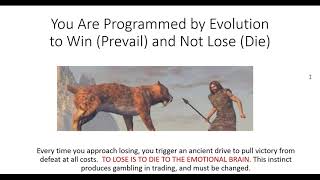
They are about the mammalian brain taking action really fast to survive in the territory. And yet, you know, the thing is your thinking mind has invested all that money and knowledge and spent all that time for success in trading. And they think they have everything they need. Yet what they discover is an emotional storm still kick them, and they don't really see them coming. They don't understand why they keep happening. Now, I'm going to give you one hint. It's about evolutionary psychology. And what I want to do is I want to point out something you Take a look at this graphic. This is something that 30, 40,000 years ago this would have been a common scene. You take a look at that guy, he's actually a little bit bigger than probably we were back then. He's got a spear and he's sitting in front of a 1300 pound cat with six inch incisor teeth. Who wants a part of him? Well, maybe all of him. What you're looking at in this particular case, this is the, this is the evolutionary psychology behind this problem of not being able to take a loss. If this man loses, he's dead. He's not going to contribute to the gene pool or the safety of his family or anything like that. If he wins, he prevails.
So when you come down to it, you begin to see.
That to the emotional brain to lose is to die.
And the thinking brain is just left out in the weather. The key though, this particular instinct, not wanting to take a loss. Oh my God, I hate to be a loser. And now you're beginning to see not just the cultural parts of it, but we are actually beginning to see basically that pre, that genetic predisposition come stocking us.
Do not want to take the loss because loss would mean death. And all of a sudden you begin to see this guy's face with a decision. He doesn't want to take that loss. And unfortunately you're doing the same thing every time. You see that uncertainty, every scene you see that thing drop on and start heading toward that stop. You, you're just like this man in this emotional brain, in this mammalian brain of his that is faced with life and death. And you just thought it was a little bit of drama. No, this is a much bigger drama than we've counted it far and it, we've come stuck with it and we're going to have to learn how to do something about it. So out of this you get these.
This is not really part of the thinking brain.
And the key is, is that it's instinctive. When you meet that emotional storm, it's not thinking that's going to get you through, it's the instinct that's going to trigger pushes you automatically without thinking to do something. What I want you to see is when you start seeing that thing getting closer to losing, heading toward the stop and you say, I'm going to move that stop to give it some room because it may turn around, you're living in hope, okay? You're living in hope. That means you're going to get swept away into an emotional need to not lose because ultimately you know better than that. Okay, we know that losing is part of trading, but then try to tell the emotional brain that. The thinking brain. Oh yeah, yeah, yeah, yeah. But it's different. And so suddenly that thinking brain just gets blown out of the water and you're sitting there facing survival instincts with no skill sets. That's why somewhere between 95 and 98% of traders lose money and continue to lose money until they drain their capital and are out. They're not willing to address the emotional needs of what is really going on in the emotional brain. When you're facing uncertainty, fear, fear of death, real palpable because that money that you're looking at has become a symbol for either living or dying. And power and disempower. So let's take a look at this thing and look at it from a different perspective. Okay, we're going to look at this in kind of like behavioral terms. And what we're going to say is the first thing is there's a Q, there's a sphere. And my friends, I promise you is when you see this guy facing this big, huge giant bear, this is pretty much exactly what you're facing. When you're facing that, coming near that stop. I mean, you know, if you don't do something right here, I mean, if you lose here, you're, you're gone. You don't want to do that. And out of that, absolutely, instinctually, automatically, reactively, an emotional storm comes. You're not thinking anymore. You're in, you're incapable of thinking rationally. You may rationalize, but you're not rational. And out of that, out of that, you're triggering into this. This is, this is a triune brain model that I like using. And that outer layer on the top is what we call the cerebral cortex, the new brain, thinking brain. It's the part that makes it so uniquely human. Right below it is the emotional brain. It doesn't care about thinking. It doesn't even know you think. What it knows is how you're responding, interacting with the environment at any particular time. Because as an emotion, it's a biological action potential. It's not psychological. It's a biological action potential that has been pre programmed a lot by evolutionary psychology to trigger when it meets uncertainty, when it meets the vulnerability that this guy facing the bear probably is feeling. That's what ignites the emotional storm. Because suddenly the thinking brain that has been talking and convincing you that you're safe, you're good, everything's fine, blows up. Because the emotional brain's sitting there saying, no, you're not. We're in a big tight state. And suddenly that big, huge, gigantic thinking brain of ours.
Is reduced to the emotional brain.
And to the brain stem. And friends, that's not where you want to trade, okay, but this is what it looks like. And this is what you guys are going through all the time. And how does this happen? Why do we have this triune brain thing? Well, long before we became homo sapiens, we were hominoids. Like the guy on the, the left end there, the chimp like character. And over time we evolved, separated from that clan of the greater apes and we became uniquely human. But what I want you to see out of that 6.5 million years that it took to get from the hominoid, the one that came down from the trees and was on the African savannah, to the guy sitting in front of the computer trading, you still carry that brain. And you want to know where it is? Doris, go back to the former slide. This is where it's at. Do you see that second layer? You see that big gigantic gray matter area called the thinking brain, but right below it, beneath it, that's the thinking brain. You share that with that hominoid, okay? It does not think. It emotes. And out of that, what happens is that you end up. You may think you're sophisticated sitting there, but ultimately that, that primitive brain is there and it's viewing uncertainty as the fear of death. Okay? And boy, if it's, if you're heading, if you've got a trade that's heading toward stop and you've taken a loss before and you're heading to that stop, man, do you feel vulnerable. That's what, that's what the trigger is for the flood of the emotional brain to take over the thinking brain. And if you took a look at it in another method, another way, this would be another way of looking at it. There you are, the sophisticated new age guy. Not new age, but that's, you know, this thinking brain guy, he's. He thinks, thinks he's in charge of the way that brain is going to drive and move down the highway. You know, he's got it. Logic. You've got your plan. You know that ta really good. You know, you have this, all that and you know these are probabilities. Yeah, yada yada, yada yada. But in the back seat, unattended to and getting pretty bored, is your caveman ancestor, okay? He doesn't know about your thinking. He just simply. He's taking the data feeds Coming in from your sensorial, from sensorial data. It's coming in and it's reading of whether or not this is a danger fight, flight, or whether or not this is something that's approachable, very different. And it's done automatically. It's done when that sense of, oh, my gosh, this is uncertain. Oh, my God. Oh, my God. I'm getting vulnerable. It's getting close. Now I'm getting confused. What do I do? What do I do? That is the instant that the emotional brain of that caveman takes over, that very sophisticated brain of your thing of the thinking fella. What we want to do and what I also want you to get.
That old brain.
To stay alive. That's its mission. What it learned to do, it learned to control outcome.
That's exactly what most traders want to do. They want. They want to control the outcome. That's what every Alpha is, is they've. They've been able to win, control outcome. They've been able to make things happen, and they think of themselves as the winner. Yet you go into trading and you discover you do not have control over outcome. You have a probability to manage. And what you do is you realize that your ideas, your. You. You're not predicting what the trail, what's going to happen. What you're doing is you're guessing, but you're making the big difference between prediction and guessing. The second thing that caveman brain wants to win. And for God's sake, what the last thing it wants is to lose. Because winning is to prevail. It's to eat well, it's to win money, to lose, to be wrong.
You not just don't eat, you become somebody else's meal. So you begin to see this and go, wow, this is what's happening underneath the hood of my mind. Yeah. This is what's going on 95% of the time when you're making, when you're making decisions in trading.
Your brain was never designed for the rigors of trading. It was designed for this controlling outcome to be right and not wrong and to predict future conditions. You want to predict that bottom. When it's a guess, you don't know it's a guess. You may be right, you may be wrong. And.
What you have done for that emotional brain and the brainstem, you have created its worst nightmare in trading, okay, you may seem to have tamed the beast like you see in this particular illustration, but all it takes is for it to go out of order. And all of a sudden you lose control. And all of A sudden that starts thing taking a dive, heading toward your stop. And all of a sudden what you're going to see, the instinction, the instinctive survival skills pop up. They just take out the thinking brain and there you are, moving and stop moving and moving, hoping, hoping, hoping, hoping, throwing a lot of really good money after bad. And before you know it, you have done some damage. You never tame the beast, okay? And when you add stress, you got, you got a lot more going on. But this is what you're going to have to learn to do. So now you get it. Your brain evolved to keep you alive, okay? Because danger meant death. And the drama is now being played out. When you trade, and I promise you, when you are confused, you are deeply stressed and the brain is jumping to fight flight. Because understand when you keep feet, when you won't take a loss, what you're doing is you have triggered fight flight. And the amygdala and its friends are making your decisions, not your thinking brain. This is the whole point. This is diametrically opposed to the needs of the trading world, okay? And again, you don't have control. What? And the thing is, what you really discover is that the only thing that you really control in any of this is you is your brain. And most people have to take a lot of losses to discover that the weakest part of their trading system is them. They talk around it, they blame others, they just want to think. It's more knowledge. But ultimately, usually after four or five years, sometimes three, you discover, you know, I've jumped from teachers to teachers, I've taught this and that, I've done that. The truth is, is that no matter where I go, there I am. And what we're saying is it's this I.
That'S got to change. And there's some good news about this. So here's the graph that kind of puts all this stuff together.
What you'll see here is that, okay, you've got this really cool higher cortex, that's your thinking brain. Everything's cool. But this is low motion, low stress, and you can think through it and stuff like that. That's when you're paper trading, that's when you're doing your charting. Everything is good.
There is no stress here. Then what happens if you take a look at this, when stress decided high emotion, when you start getting, oh my gosh, what's going to happen? What's going to happen? You've got the confusion, you've got the vulnerability. And what happens is immediately your thinking brain is disabled and Guess what takes over.
The amygdala, the seat of emotion, particularly of a primitive emotion, and the gateway to fight, fight, flight. More than that, your brain stem gets kind of connected. The amygdala and the brain stem start playing together and all of a sudden you have started elevated pulse, you have elevated tension in your body. You stop breathing, you just do all that stuff and you're cranking up and this becomes your automatic response beyond thinking to uncertainty that you inherited, inherited friends. You didn't even have to. You didn't even have to learn it yourself. You inherited genetically in your predisposition from your ancient history. And this is why so few traders make it. They're not willing to make the jump to recognize. Hmm. The way my brain has been built simply is not going to work in trading. No matter how many stories I hear about the guys who are making millions and this, that and that. The vast majority, the 98%, are not going to win the genetics lottery. And they're going to have to learn how to undisable the thinking brain under stress. This is what we're here to do, friends. And until then.
What we've really done is we've developed blinders that block the capacity to see other ways of doing things. This is lethal. You get locked into particular what is known in neurobiology as perceptual maps. You begin to see.
A potential world as the potential world.
Like for instance, when you're looking at your charts and you're looking at all that stuff, you're looking at these numbers. What you're really seeing is representations of emotions. You're not seeing numbers, you're seeing representations of numbers. And the power of those numbers indicate how much emotion is in there. The thing is, is as long as you want to see it rationally, you're not going to see the emotions at play. I've actually worked with really fine traders who've looked at charts and says, randy, what do you think I see here? And you know, this guy's really one of the better traders around. And I said, you know, I have really no idea. Tell me. He said, blood. Look at these retail traders. I am. They're going to get into a place and they're going to get scared and I'm going to suck their blood.
Okay? Meanwhile, you're stuck in this jar. You're going, why does this keep happening to me? What I'm asking you to do is I want you to see other potential worlds other than the one that you're locked into right now. That's where the magic happens. And if we were to digra. Let's. What I want to do.
Is I want to show you what happens when. And it's just not when you keep feeding a loser, when you won't take that stop. You don't want to lose because understand to caveman brain, which is highly active by this time, you've hit the certain, you've hit uncertainty, you've hit vulnerability, you've got confusion. Information.
Emotional stimuli is coming into the thalamus. And at the level of the thalamus, there is something that I like to call the traffic cop. He's directing traffic and whatever is really an emergency, if an emergency is coming on, he'll stop everything and let that one through. That's the direct route. Or we call the low road to the amygdala and fight flight. And when you're seeing that approaching stop and your caveman's thinking, oh my God, this might be my life, I may die, I may die. I need to fight back. I need to fight back. I need it. Well, this is what's happened. The cop's been activated and you're routed based on your history. And before you know it, you're off in LA la. Then meanwhile, if you were to do the same thing, if you were. If that sensory information were to come in to the thalamus, but you had re educated this biological process of the traffic cop to be able to calm down, slow down, and the urgency would drop. Okay. What happens is it allows that information to go to the thinking brain. Okay? This is the point.
We want to start being able to regulate it. So the impulse computer, thinking brain. But even at the thinking brain, we want to rebuild the thinking brain for the new, exciting adventure of dealing with uncertainty. That is really where to me, it's where it gets cool. Because until, until you're willing to. To do that, the emotions evolved in order for you to be able to negotiate the environment in short term. And trading particularly, particularly day trading, is like instant karma. It's very short term competitor to say swing trading or to longer term investing active tradition. What you're doing is in this illustration.
Here'S the thinking brain that's just been knocked out by the emotional brain. And he's saying, you know, he just didn't understand the danger. And out of that, what you're seeing, this is not a distant problem. This is something that is right here, right now. And what, what you really need to understand. If you were to think of your brain as a train, the thinking brain is the caboose that likes to think it's actually wagging the rest of the dog, the train.
The emotions are the locomotive. They're the one driving the train.
Okay? All thinking is emotional state dependent. And what you're, what you are, it's not in management of the emotions that are giving rise to thinking. Because here's the third one, the engineer driving the locomotive is your beliefs about your ability to manage uncertainty, friend. These are the ones that have to be changed on a cognitive level back down to a primitive level. And that's where a lot of my work is really built for.
So on a primitive level, when you see that money fleeing from you and you're going to take a loss, you've triggered this incredible avalanche that's been there for golly, I mean it actually happened long before 6.5 million years ago. And that's when the human humanoids became humans and they started evolving into what we are now as Homo sapiens. But the truth is, is that fight flight response has been there for over 600 million years at the inception of life. Okay, it, you know, the thing is it doesn't want to lose the capital of life. It doesn't want to lose its life. And that's what you're doing. So this is what you're associated. And by, after that you start making like this guy's trying to catch up to his money. Yeah, that's exactly what trying not to take a loss is. You're doing that. I mean, if I lose, I lose my power when I need it most. And.
If I have money, I have power and I'm safe. That's the association. And if, if I make money, then I have power and I have status, I have all this stuff. And if I lose money, I lose status, probably lose my life too. And I, I'm, I'm just, it's horrible. So now you can see what's driving this. And this is all happening on a subconscious level because this is what really, really boils down to, okay, if you understand that emotions coordinate the relationship between you, the trader organism and the environment, that's the markets in which it's embedded. When you start seeing something aggressive happening, when you start seeing market changes, you perceive that automatically as the same tiger. Our ancestors were on the African savannas and they would look out and see 10,000 bushes out there and they would make, they would make the assumption that a saba toothed cat was behind every one of them, even though only 1 in 10,000 was there. However, that helped the species to become who we are. And it's still present in our trading. So if there is a change in the environment, our market, there is going to be an emotional response. That's just the nature of emotions. And not wanting to lose is a big one because I don't think anybody has a death wish. No, I've seen some people do some serious sabotage, but that's another thing. And you're faced with this thing. Do I fight, do I flee? Yeah. You know, the man who stands to fight is the one who won't take the loss, the one who flees. Maybe they're going there and he's may freak out. He may just jump out fast and. But the thing is, what we're also saying, maybe there's another way of saying, you know something, I need to take a loss now because it's just simply, you know, it's a good loss and I have a plan for it. Maybe it's that.
And what we truly. I think you're.
Yeah, you're right. I'm sorry. I'm sorry. So the question really.
Is about.
How do you go about.
Changing the emotional responses that you have with exposure to uncertainty? You know, how do you, how do you start building a new standard for how emotion reacts to uncertainty? This is what we want. The fight flight response, not wanting to take that loss. That's. That's very primitive. That's emotional brain. What we want to look at is something greater than that. And my question is this, and I'm going to present it like crazy. How do you present. How do you build a winning mindset in trading? Yeah, I want to win. I want to make money. No, understand this. Is that your desire to make money.
You have no control over? You know, it's not like when you're in the rest of the world and you can control people, control situations in the market. You are a very, very small minnow in a vast ocean. And what you're doing is you're looking to see what the ocean will give you. You're not taking it. And so the whole notion of winning and losing really has to change. And a lot of people say, you know something, I'm going to build a mindset. I'm going to build this stuff and I'm going to use affirmations. Yeah, yeah. I'm a, I'm a discipline trader. I'm a discipline trader. And I'm going to repeat it so often, my subconscious is going to finally accept it and take us. That is such crock visualizations. I see myself as a triumphant trader. I would hope that you see yourself as a humble human being.
Positive self talk. Yeah, I can win. I'm going to win. I'm going to make money today. Yeah, that's. Sir, I'm going to make money today. If you want to know a good way to lose is to start with the preposition I'm going to make money, which by the way, you cannot control. Today. Setting powerful goals. I have to make $1,000 a $500 today and then I'll quit. Oh boy. Working harder. I'm gonna work harder at this. I'm learning more. I'm gonna learn more. I'm gonna learn more. I'm gonna stuff more down into my head. Knowledge without the emotional education is useless here.
Therapy, all that inner child stuff. And I do that stuff. But it's very different. Prosperity, thinking. Oh yeah. Prosperity is just around the corner. What I'm saying is for the health of your. Listen to your trading account. These kinds of approaches generally do not work under pressure. We have to find a way that allows us to perform.
As championship level traders under pressure. Understand? It's just like in golf.
When you look at the PGA tournament, there are a lot of golfers who can hit the ball and putt the ball, but under pressure in the big time, there's only about 10 really big money winners. And then what happens though is what the really great golfer has understood is he doesn't control outcome. He doesn't control the weather, he doesn't control rowdy fans. He doesn't control a lot of things. He doesn't control whether or not a guy is having the best day of his life. What he controls is the mind he's bringing into the moment. And friends, that's the point where you start realizing that I need to stop thinking in terms of winning and not losing. I need to be able to start thinking in terms of performing. Okay, so.
Let'S take a look at this. The moment that you attempt to control something that you cannot control. Okay? Now even Napoleon met his Waterloo. Okay. He finally conjured up storm so big the brain experiences this powerlessness. That's the big key. You're now powerless in a fight with death, which leads directly to the fight flight response. Okay? Now what we are looking to do.
Most traders have done this so often and push themselves, push themselves that they've actually traumatized themselves and they get a little. They get a little nervous when they actually start getting around the potential of losing. And suddenly you start seeing people take early their profits early and they don't let them ride. They just, they Start doing things like that. And it started out bad enough, and then their psychology messes them up. Okay, now.
This is the key, friends.
You can control the mind that you bring into performance of trading. And if you have an edge in your methodology.
You become the driver of that train.
And that edge, that psychological edge that you have, you develop.
Manages the system edge that you have with your trading system. That's when the probability starts landing on your side. But you don't control outgoing, you control how you manage probability. And if you're, if your system has an edge in it, that's what you're looking for. This is the key, friends. This is how you do it. And what I want to do is this is where we start getting in. How does this work? Because how do you reconstruct the brain and mind for that? Because what you really need to get clear on is this, is that the beliefs that you hold, okay, about reality, about the markets, becomes the truth.
Literally. You project those beliefs onto the markets, believing that they're true, when in fact they're just beliefs. They're part of a narrative the brain has created about who you are and how you can handle the uncertainty, the challenges of living. That's what they are. And what we have to do is we have to get back to the limbic learnings that have turned into beliefs and emotional responses to be able to change, to change this train and put it in another direction. We have to, we have to work on the engineer, the driver of that train, and we need to start really looking in and recognizing that the trading account is telling you point blank what your beliefs are. If your beliefs are effective, you're going to see that expressed in your trading account. If not, you're going to see it expressed in your trading account. That is what you come to and you focus on that. And what we want to know is, how do we change those beliefs? Well, it starts with something pretty simple. It starts with emotional regulation. Those emotions, once triggered, sweep mine away. What we want to do is we want to start seeing that we can actually manage the intensity of the emotion so that even though it's beginning to crank up, we can stop it from getting to a particular set point.
That erupts. And the chemistry of building the revving up of the emotion stops. And the chemistry of the emotion starts flooding through your system. That's when you start moving stops. That's when you start really having a problem. That's the first order of business. How do you do that? Well, they figured it out about 4,000 years ago. Okay.
Yeah. And it's diaphragmatic breathing, or what I call bellows breathing. And it's pretty simple. What I want you to do tomorrow when you sit down and trade, if you have a phone or if you have a video camera, I want you to tape yourself for a while. It's funny. Okay. If nothing else, put a mirror. And when you start getting tense, when you start really feeling that uncertainty, when you really get sucked into it, what I want you to do is to notice what your body looks like. I'll tell you what you're breathing. Your breathing will be either high and shallow, the very top part of the lungs, just below the chin there, or your muscles become tense. What you're looking at is emotional arousal, and you are seeing an emotional hijacking in the process. Okay? You're losing your rational mind quickly.
In Bella's breathing, you're moving air into the belly, which prompts air to move into the deeper lobes of the lung. And by doing that, it extracts more oxygen for the brain and for you to be able to use to think clearly under pressure. If you're breathing in like heavy on the top side, third, top third of your lungs or you're holding your breath, you're actually cutting off oxygen needed to think from the brain. And it's delivering down to the muscles, getting ready for fight flight. That's the point. You have to be able to do this. And I want you to see the tension as emotional arousal tomorrow and see that this is actually the emotion arising, the emotions, biological friends. And it can be managed biologically by your breath and by tension reduction in the muscle. Big muscles of your body, people. This is the first step. Is it going to change the problem? No. However, you do not get to the door of the mind unless you're able to calm the emotion down before it sweeps you away. The second tool, though, is a re understanding of who you are. Okay, from my perspective.
You have never experienced reality at all. What you have experienced is your brain, based on its biases, beliefs and assumptions, creating a virtual representation. I mean, remember, your brain's never been out there in the outside world of what's out there.
And that's what locks you in. That's what locks in itself as an adapted self. You're born. Your brain's very unfinished. It starts adapting to the circumstances of your environment, and it organizes your potential into a self that you later identify as I.
It's only one potential organization itself that's become locked in. In this work, what you're doing is you're learning how to unlock that. That potential and to expand the self and to find different emotional programs that you build into the system that interact with uncertainty a lot more effectively than the fear that has dominates everything else. So that's where we're going. And then out of this, when you start examining that, what you realize that you develop mindfulness. And the key to mindfulness is that you begin to recognize that you and your thoughts, you.
And your emotions, you and your biases, you and your beliefs are not the same. In fact, you're not even having thoughts. They're having you. And as long as you maintain that, you end up like the guy over there, totally caught up in thoughts and just, you know, his mind's just swirling with thoughts. Or you can become an observing self where you start looking at this, going, well, these thoughts aren't me, okay? These thoughts are arising and I need to start learning how to deal with them. But to deal with it, you actually have to deal with the emotion first. Because basically in neurobiology, thoughts are really a behavior. And out of the behaviors are outcomes from basically the inner, the intersection of beliefs and emotions. So you're looking at this going, huh, I need to develop an observer that can observe my beliefs. Yeah, exactly. Into. I'm already asking you to observe your emotions tomorrow morning when you start seeing the physicality of that emotion, then with that newfangled. Newfangled observer, which, by the way, we teach in our courses, all our courses, and it's particularly focused in. On, on the group course that's coming up really soon. The key, though, is this, as you develop that observer, you start noticing there's an inner commentary going on all the time inside your head. And it is learning how to recognize that. I've been identifying that within, stepping back out of it. That's got to happen. And this inner commentary is almost always critical. It's also very tempting. It will have you thinking that, yeah, that's the bottom. You better get it right now before it gets away. When in fact it's a guess and maybe, maybe not, okay? And you believe in it so much that when it's really wrong, you're going to double it down because you think it's going to be it.
What you're doing is you're saying, oh, my observer just fused to my thoughts and my beliefs, and it swept me away again. If you're happy with your performance and trading, then don't change anything. But if you're looking at it and saying, you know, I need to really start managing these emotions, and these thoughts that are occurring in my brain because they're just. They're. They're absolute tearing up my trading account and my relationship with my spouse. So what you're doing is you're saying, how do I do that? And one of the best things is you start really looking in. Got one more. You start really looking in.
That's the right one. You start really looking into what I call the committee of the mind. Because from my perspective, the brain is a community of emotional programs that are duking it out, control of the construction of the self. I encourage you to look at the kids movie Inside out by Picture Disney. It depicts how emotional programs run the mind of a girl and us too. It's really straightforward, and it's one of the best things I've seen for being able to educate people and then. But what you also see is inside your mind is something that I call the inner critic and the Kabbalah. It would be. It would be said that that inner critic is that which stops you from becoming your best. Okay. You could also say that there's a part of us, an inherent part of us, that is very destructive and it will try to crash everything, our best stuff. And if we don't know how to wake up to it, if we don't know how to build other ways of seeing potential, we stay stuck there. And this is where. This is where most people stay stuck. And that inner critic is that part that judges, it criticizes, it tempts, it tries to get you to do some really dumb, stupid things. And it sounds so convincing. That's part of it. Also part of that is the adapted voice. This is your brain adapting your potential into a self. Okay, that interacts with the world. And that organization could exist, like as a victim, a worrier. Oh, my God, something bad's gonna happen. A rebel. I'm gonna show you. Or an alpha. I'm gonna win. Or as a perfectionist, I do everything right. I can't be wrong. What you're seeing is those are adaptations.
That can be reconstructed into higher, more capable ways of performing in the moment, under pressure. That's what we want. Because also living within you. And most people find that they've been living under what I call the dark side of the internal dialogue for most of their lives. A movie like Lord of the Rings is a beautiful movie that shows you the archetypal components of the best and the worst of human. And these archetypes are emotional characteristics of people that congeal and are present in all social gatherings. Like in this One right here. You're looking at Gandorf. You know, he's the, he's. You might call him the wizard, but he's also the sage. He thinks clearly, he sees a vision, but what happened is he can't accomplish it himself. He also has a ruler that wants to reclaim his, his heritage. Okay, you start saying, oh, he's, he's got the discipline to hold this stuff out. They're warriors, okay, that are willing to face their darkness.
There are caregivers who are going to nurture, who are going to soothe the fears.
But like in this one, right here, at the very core of it's Frodo, the truth is, the war is not out there, my friends, in the markets. The war is inside your head. You have to become the warrior. You have to become the ruler. You have to become the person that turns toward the darkness, turns toward their demons and masters them. Not conquers them, masters them. So that you produce the mind that engages the uncertainty that's been fueling the fear or the aggression. These aspects of your being are all there, and it's just a matter of whether or not you're willing to develop them. And the truth is, that's what we do here, is we help you develop those.
Predispositions that you bring with you that have not been activated and nurtured and had become part of what I call working awareness. So this is part of the work of the group course.
It's something that I encourage you to recognize that this is really about self mastery. Is instead of thinking, I'm going to win, start looking at how do I master myself. What we're really looking at is the organization itself. There will always be struggle. There will always be conflict. There will always be uncertainty. There will be ambiguity. There will be vulnerability. But the truth is, what you have to develop is the person that can stand.
To that challenge. That's what you're looking at here in a group meeting. Here, you could actually have this inside the mind of where you've redeveloped yourself. Instead of backing down, what you're doing is you're standing up and you're recognizing, my job is not to win or lose. My job is to perform at the best of my potential from my best self. And friends, if you can do that, if you do that, you will find an edge in winning that extracts more capital out of the markets than it gives back. That's, that's the trading mind, friends. And the good news for everybody is that.
This, mine can be built, okay? The latent talents are actually on your Genome, they haven't been developed, they've been pushed away, they weren't called for. And basically what you learn how to do is say you know something. I know the historical way that my mind is going to react. I know what emotions are. Parts of myself are going to be called forward when there are challenges in front of me. What I want to do is change the emotional response to the uncertainty. I can't control uncertainty. That's just the way life is. But I can control the mind that engages it. This is, this is where it becomes construction. And I want to. A lot of people get, A lot of people get the evolution really wrong.
And Charles Darwin never said it's the fittest, it's the strongest. His quote. Yeah, it is not the strongest of the species that survive. It's nor the most intelligent.
But the one most responsive to change.
What I'm asking you to look at and to really ponder with yourself is recognizing that unless you won the genetics lottery, okay, very few, okay.
Unless you've done that, you're going to have to change your response to uncertainty, to change.
Trading operates on a completely different set of rules than the business world, than even your personal life. And you're going to have to learn to work with probability. You're going to have to learn to adapt to losing. You're going to have to learn to adapt to winning. You're going to have to learn to adapt to perform.
This is how you become captain of your own destiny. And trading is going to force the issue. Okay, it's really true. And here's the deal. There's nothing wrong with the brain or mind that you brought to trading. It's just not built for trading. And what you've got is you've kind of got tunnel vision and you can't see literally what you need to be able to encompass, to be able to build the mind that you need for training. And again, that's what we teach in the, in the group course. Because what happens, we need to convert that blindness into where you begin to get full access to the emotional programs that exist in you from time immortal and that have been become highly sophisticated in us human beings and build them so that they're the ones creating the mind that engages the challenges in the moment of now. Not the historical ones that you came equipped with from your family or from history. This is what's needed. This is the psychological edge that we're all looking for. And you can, you can build it, but you're not just going to ram your head against the wall until it breaks and gets through. That doesn't work in trading. So here's. Here's my proposal. Here's my invitation. I'm inviting you to our group course. Our group tours teaches these skill sets that we. I've outlined here. It starts, Lilly, from learning how to breathe to interrupt pattern. It goes to mindfulness. It actually really gets much more deep into the. The relationship between basically your adapted self and the inner critic. Then it also goes into developing these particular emotional programs that you need to be online and create the mind that engages uncertainty. Then it's exponent to be able to experience it in challenging moments. That's the protocol. Five sessions. We meet every two weeks. And you've got. As a group. Yeah. And you have access to the classroom. Virtual classroom 24 7. And the key is that first session starts September 16th. One week. Okay. And what we're going to do is say, look, if you sign up early, you get a free $199 present from me and Dolores about emotional. It's emotional regulation workshop that we sell for 200 bucks on our website. We're not doing that to entice you to sign, even though it's nice. We're. What we're doing is saying, I want to tell you something. This is very serious. You need to get as much work in on the first unit. Because when we start, we're starting, we're starting. We're hitting the trail running. We will start with emotional regulation and we will get to mindfulness in the first session. I'm asking you, please, please, please prepare for this. We already have people that have signed up to the. For. For the group course we're gonna have in January. And we're almost. We're almost finished out with our course now. So the one that starts later this month. So if you're interested in building the mind for trading and you're recognizing right now you're kind of the weak link in your system and that it's not going to change without finding some teacher that can help you learn these particular skills. And we also break it down into pavements so that, you know, every two weeks there's a. There's a payment of two. I think it's $239 that goes on. And it makes it a lot more affordable. Okay. And you just simply go to the website, you click on, you find it, and there's a different way. There's different ways of doing it. Okay. And look there and find out which program is best for you. There's also for those people who are dead serious about this stuff. And they know that. Huh. I would much rather work individually with Randy. The individual course is highly comprehensive and very personal. You really get to know your adapted self very well and you work through a lot of problems. And it's a. It's a big, huge program. I'll just say that. And it comes with 10 consults with me over right now, Skype. But sooner or later, zoom. Okay. And if you're seriously considering the individual course, ask for a free consult. And if you're not, what happens is we want you to read about me. We want you to go to the website, we want you to look through the courses we really want. When you talk to me, we want you well prepared for the time that we have together. Okay? And that's all www.trader state of mind down at the bottom. And Dolores will type that in so that you can click it and paste it. Okay. So anyway, I want to thank you for being here. I know that you're. Being here says that you know something. There's something about my self development that I really need to be looking at. Okay. And if there's any questions, I will be very happy to take. We've got about six minutes and we'll be happy to look at a few. This is from Rosario. Okay. Does it start with the fact. Okay. The fact that the caveman brain doesn't want to lose, but for him it means death. Could. Could be.
Could be the reason why sometimes one gets.
To.
One gets hijacked. Also. Yeah. Also during paper trading. Yeah. It's true. When you see something, you don't even need the stress for it to happen. When you're paper trading. Okay. Yes. And the key is, is that you are going to have to. Caveman brain is a metaphor for me saying the emotional brain. That's that inner layer right beneath the. The thinking brain. But the key is.
Yeah, this is it.
The fact that Cape brain does one. Yeah. The fact. Do you want me right up here, down here? Do the blue. Okay.
The caveman brain doesn't understand the difference between paper trading or real. Yes, it does. I promise you it does. Real money is. That's puts the life and death in the equation. The paper trading basically puts a restart button. Okay. But for a lot of people. No, you're right. It's not. Get the hell out of it. What trade are you in? Yeah, the key is. Is that. Is there a difference between sensory thalamus and thalamus? The sensory thalamus is actually calling it what it's Actually doing. It's actually pulling in the different sensory inputs. Oh, that's your five senses. And pulling it in, sorting it based on history and then bumping it one way or the other. But yeah, it's the. It's the function of the thalamus. Okay, I listen somewhere between. Thalamus sit on top of the brain stem. Yeah, it does. It's. It's the beginning of the emotional brain. And we don't want information to get to the nut. Well, it's going to get there anyway. Would you please explain further the difference between the sensory Thalamus. Thalamus and the brain stem? The brain stem is what regulates all your.
Basically your respiration, all that kind of stuff. When you start getting cranked up and all that. That. The. The thalamus is the beginning of the limbic system where data is being evaluated quickly based on adaptation. If it's threatening, it fires it quickly. That traffic cop sends it quickly to the fight flight. If it's not threatening, it sends it to the thinking brain or sensory. Sensory think that. It's still called sensory cortex. That's just simply the way a few authors have described it. I call it the thinking brain and I call the hub. The thalamus is kind of the hub of the limbic system. It's the one doing the evaluation of the information coming into the brain stem. And it has to.
But knowledge is not going to teach you to control it. What happens is you're going to have to learn to regulate it and you're going to have to change the primitive beliefs that you hold about your management of uncertainty. That's what you need to get. Okay, is the drawdown that occurs when in a trade seen by your subconscious as the same thing as an actual loss? Or do you actually have to close the trade and finalize the loss to make that pain of loss real? The emotional brain is already ahead of you. I don't really talk about subconscious very much. In my world, what I'd say is emotional. The emotional brain simply acts outside of thinking awareness. And 90 to 95% of the decisions that you make on any given day are based on. Based on that emotional brain deciding. And then the thinking brain making up an excuse. Okay, an alibi or rationalization that supports it. So what is your advice for a perfectionist with a methodology which has only.
Less than 40% win rate? Well, a lot of people have a less than 40% win rate and they just simply had. Know how to take losses really well. And.
It. That's the whole point is that you're. You're looking at it and you're going, well.
40% is a pretty standard win rate. Okay. If you achieve that, I mean, perfection is about a 50% trade rate. We start when you start seeing these guys. Oh, I got 60, 70. What you also see is they're not making you money and they're losing money. They. They win a little and lose a lot. Okay. The key, though.
Is that what you're doing is the methodology. At 40%, you'd have to decide whether or not it's good enough. The real key, if I'm you, if I am actually looking at my ratio of winners to losers, what you'll discover is that they. They may have a method that actually produces pretty good wins, but what happens is they don't. They don't control their losers. Okay. And they get out of hand. And they'll have actually less than one number as a ratio of winners to losers. That means they're. They're losing more money than they make. That's what you need to be looking at. This is from Dan. Your next group class starts January 16th, correct? September 16th. Yeah. September. Yep. Is Randy there to answer? I am. I'm the one that runs them. You would not want my wife teaching this course. Okay. It is me, and we do not believe in employees. So, yes, this is my. This is my outreach to the world. Yes. Okay. What thoughts do you enter.
Hold on.
What thoughts do you entertain for probability? When I have thoughts of Fight Flight? Well, first of all, you've already lost when it's hit Fight Flight. The key is that you have to build. You have to build the resilience of the mind to be able to start engaging stress challenges and maintain a particular mind. Right now, that's not something that you've learned to do. Okay. And most people don't. Thank you. And that's what these courses are built to do. They're literally saying, okay, look, you're going to have challenges in trading. You know, there's going to be uncertainty. The real key is that Fight Flight can, in fact, trigger. And it's typically. That's what evolution, Lucian, gave us through natural selection. What we're doing is we're teaching you to kind of go against evolution and have an unnatural selection where you become designer of the emotional programs that give rise to the mind, that engages uncertainty. That's the big deal. Okay.
Okay. How do you differentiate between traumatic memory or afraid of losing? Well, they're usually very tightly. If you've ever lost four or $500,000 $17 million in five minutes. You know what traumatic memory is like? Everything is in the thalamus, everything in the hippocampus. Everything is being built around memory, limbic memory and limbic learning. And what happens is that I would consider that taking a loss and understanding that from our caveman days, we don't want to take loss. And from our society, we don't want to take loss because it says, oh, we're, we're not measuring up. What happens is that you are experiencing trauma. And the more you ignore it and you try to man up, not you. But if, the more you try to man up to that, all you do is you, you increase the trauma. If you can get ahead, if you just simply train yourself to take losses now rather than once they, like I said, blown you up. And hey, I've, it's really, it's really tough when you get a guy and, you know, over the years, he just thought he was, has it and stuff like that. And what happens is he couldn't differentiate. He, he didn't take care of the traumatic memory, and it just compounded the predisposition of not wanting to lose. That's a good way of saying it. And how can you tell? No, they're interrelated. They're interlinked. But the thing is, is that you're always going to have a desire not to lose, that you can reach, retrain. But a traumatic memory is you have to eat slowly. It's kind of like eating an elephant. You have to learn how to take it in bite by bite and integrate it and learn and develop the tools so the limbic system's no longer triggering to the traumatic memory. Okay, well, anyway, I do thank you. I do thank you. I have had a great time. I liked your questions, and I do encourage you, is that I cannot comprehend how people get into trading and do not understand that they are going to have to develop the mind very differently than the way that they, they came before they brought to trading. It's nothing wrong with you. It's just that trading presents an environment completely different than anything that practically anyone has experienced. So I, I, I really hope you give this consideration. But meanwhile, no matter what, my hope is that you find good days and that you find a way to work through this and to establish the mind that can, in fact, engage. And if I can be of help, I'd love for you. I'd love to. Okay, so thank you and good evening and I've had a great time. Bye. Bye.










