Stress Proofing Your Trading Mind
Randy Howell explains how your brain's survival instincts hijack your trading decisions, turning stress into panic. He teaches diaphragmatic breathing and mindfulness to rewire the emotional patterns that sabotage you, positioning trading as personal growth work.
Chapters
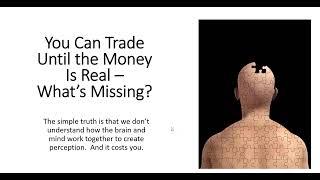
The broadcast is now starting. All attendees are in listen only mode. Welcome everyone. My name is Randy Howell and I am delighted that you are at this webinar from Trader State of Mind today. First things of order though is let's make sure you can hear me. If some kind people would please type in a why into the question box, I would greatly appreciate it and I would know. Yes, yes, yes, yes. I always like hearing that. I hate it when it just goes death on you. Okay, we got it. Hello from Dubai. Well, thank you. I get more and more people from Dubai. It's amazing. Okay, what I did, the only ground rules that I have is these presentations. You can write questions anytime you have them, even starting right now. The thing is, I'm not going to answer questions until after the presentation. Otherwise I just kind of like, I have a hard time keeping my mind straight. So as you come to a question, type it in and send it so that we have some, we have some stuff we can do when we get the end of the presentation. I want your questions. So hold on. Now what we're doing here is we're going. You know something? If you could only like de. Stress yourself. If you could only like stress proof yourself, imagine what that would be like in your trading. Just imagine. Okay? Now the question is, what do you mean by stress proofing? What is this going to be? Because ultimately what we're talking about here is that the people that most are most interested in me can trade until the money is real. What's missing? You know, we don't understand trust. We don't understand the way our brains put together. For instance, in stress. The definition of stress that I use is meeting the challenges of any event. That means if there is a challenging event in your near future, heading to it, or you're in the midst of it, there is going to be a stress response. Okay? The only thing that matters at that particular time is what are the beliefs that you hold about your ability to manage the stressor that's influencing.
The physiology. Now to put it this way, the physiology can either be distress or eustress. I want you to consider this a grand mal seizure. Nobody wants them, they're debilitating. They're just absolute person to person and absolute harm's way and everything. Now consider this. Consider an orgasm. Hmm? Now if you were to take a brain scan of both those two things, the grand mal seizure and the orgasm, do you know what you would find?
They look exactly alike. The difference between the two is the interpretation that the observer has about it. I Have never met a person that likes a good grand mal seizure. Okay. On the other hand, an orgasm, that's different. Do you see the difference in interpretation, the difference in belief? Well, what we want to do is only say, okay, I can trade into the money is real. But the problem is when it gets real, everything breaks up. What is missing here? Well, let's start with the motivation to the brain. Okay? Is that what is your brain's biggest deal? Its primary directive is survival in the moment. And what it's going to do is the moment that it sees that it's in the midst of an experience. Remember the brain scan. You're in the midst of it and all of a sudden though it says, oh my God, this is terrible, horrible thing. You have now just found out that the physiology of that stress goes to distress and all of a sudden you discover yourself with anxiety and you're in, you're in fight flight. However.
If you had understood it differently, if you'd seen it as, hey man, I'm, you know, I'm really enjoying this. I'm ready for this. I know how to cover my losses. I know how to do this stuff. All of a sudden you've ended, ended up in eustress, which means that stress seems positive to you. Like every great athletic team in the world gets cranked up before a game, what they're doing is they're using eustress to get that energy level to be able to play beyond their ordinary means. And yet when you start seeing it, oh, that's eustress. Yeah. What we want to be able to do is figure out how we can produce that eustress so that we then we realize the stress is going to be there. Now the question is what kind? It starts in that moment. And you know something, you get it, is that a lot of this is just simply the evolutionary psychology. Part of this is, is also the beliefs that you formed growing up in a family, in a culture, in a community with circumstances. So we've gotten there and say, wow, okay, it's doing in the moment. So this bias of survival in the moment is everything about forming us. And it just so happens that we are loaded with a bias to think negatively about the future. And so you can understand how in working with stress anxiety, that it's easy to get out of eustress and over there into distress. So what we want to do is go, well, what are we going to do with that? What are we going to do with this? And what I want to do.
Is talk about three different.
Concepts in the brain, first of all, at the very core of our brain is what's known as the reptilian brain. It would be called the brain stem. And it's running on automatic processes and stuff like that that you would never know. Like the way your heart keeps beating, the way you keep breathing, all that stuff is working on an anatomic level. And a lot of people might call that unconscious. I'm saying no, what happens is this is a part of the brain that carries on a lot of that stuff. The response from a reptile to a threat, perceived threat is one thing. They don't have much thinking going on. However, on the up, the next level is mammalian brain. That's the one that you and I share with other social mammalian animals. And what happens, it's also known as the emotional brain. And again, what I want you to hear is its bias is toward negative interpretation.
Okay, it's bias. And if you're going to de stress yourself, if you're going to stress proof yourself, you're going to have to take something that has been at least six and a half million years in the making and you're going to have to alter it so that just reacting with uncertainty, reacting with threat, does not produce the stress response. It's going to give you a eustress response. Now that last part that makes us so different, all that green area that we call the gray area called the human brain, the neocortex, we become so identified with this that we think, you know something. All we need is a good strategy. And you know, once we get a good strategy, we're going to be able to make money in this. That's, that seems like logical thinking. It's not. It is rationalizing. Because what happens at that moment, the thinking brain thinks, it doesn't include the mammalian brain. That's a big deal. Because the mammalian brain is. If you looked at, if you looked at emotion as the locomotive, a huge locomotive, then thinking brain thought would be the caboose. It's along for the ride. It makes up stories, it's where the people go and make up stories about the train. However, the engineer, the driver of that train are your beliefs. And in trading, they're your beliefs about your ability to manage uncertainty. This is all housed in different places in the brain. And ultimately, until that neocortex, that new brain and the old brain of the mammalian brain, the emotional brain, come together and start working together, it's going to be difficult, if not impossible, to stress proof your brain. So the point is we are not Separate from that brain, we have to learn how to work with it. And out of that, what you discover is this. This is more operationally what it would look like.
Here you have the geeky, thinking brain driving the mind like a car, you know, and it's, everything's fine, everything's dandy, and he's totally ignoring this character in the backseat. That backseat is your mammalian brain. It's your caveman brain. And it is so focused on survival in the moment. This rational brain can see probability. But what happens is if you don't know that caveman's there, if you don't recognize, I need a strategy of working with that rather than just trying to stuff it in the back seat and tell it to shut up. How do I calm it down so that when I am facing uncertainty, when I'm facing a challenging situation that I do not have the control over, I only have the control over my performance? You're recognizing that when this caveman guy gets threatened or sees great opportunity, the thinking brain is blown out of the water. So this is the partnership that is simply going to have to be forged. Because ultimately is this.
Unlike your thinking brain, that sees risk and reward? Okay, when you're thinking, that's what you're talking about. There's this ratio of risk and reward, this and that, the other. Like, I'm risking this much capital to make this much money, blah, blah, blah, blah, blah. That's not the way the caveman brain sees it at all. Not at all. And, you know, here you are, you have a caveman looking into the eyes of a modern human. And the deal is that your caveman brain is built to react to threat or opportunity. Think about was common for big animals like saber toothed tigers and big bears to attack and devour human beings. So the thing is, man, you had to be wary, you had to be careful, and that was a threat. Life could be very threatening, and you had to learn to deal with it. So it's wired. It's worried for automatic responses that are outside of thinking. When an event like that happens, at the same time, that human represents something completely different. It actually comes to the moment where it can see risk and reward. What we want to do is say, how do we learn to calm our caveman nature down so that we can get to that thinking brain that that allows you to trade from patience, from being okay with itself, come win or lose, and to stay disciplined when that loss to the caveman brain, if left alone, is seeing it as a threat to life. But this is the Way we have to get it. Because understand that caveman does not think the way we think. It can't. It has no idea what money is. Absolutely no thing in money.
It sees threat. And again, that's the difference between.
Risk and reward. Okay, because that's an intellectual concept. And the difference between that and the caveman seeing something very different. It doesn't see risk and reward. What it sees is, am I going to be devoured? Is this a threat to my biological existence? And if you're sitting there and have problems with entry and you're one of those people who get there and all of a sudden, as long as nothing's there, maybe it's okay. But when you start seeing that set up form and it starts getting stronger and stronger, more and more closer and closer to where you're going to be having to enter. Suddenly what happens? You start looking for more, guess what, more experience, more confirmation. And all of a sudden the trade gets around you. That's the safety tiger chasing you. But you're running at the same time. If you face it, you have to get angry. You have impulsively had to fight to the death. That would be, guess what? That would be revenge trading. So you're looking at it going, whoa. The losses are not cerebral to the emotional brain. They are life threatening. So what I want you to do is I want you to get this.
And start noticing that maybe you have been absolutely ignoring the way the body, the brain actually reacts to challenging moments. And by not knowing how to do that, not having skills to be able to do that, you're not stress proofing for sure. What you're, you're basically making sure that you end up in repetitive pattern. So what I want to do, I want to take you through a trip. I actually want to talk to you about what happens when your survival brain senses threat. First of all, at the very top, in the center, you see sensory input. You start having information coming from your senses about stuff going on there. You're looking at the chart, you're seeing what it's doing, all that stuff, and it's going to the thalamus. This is where the, there's a gut level analysis going on. And here a decision is made. And in this decision, if you were to view the thalamus as this intersection, busy intersection, with a traffic cop moving, letting traffic go this way and that way and stuff like that. But when an emergency truck comes, say a fire engine, what happens is the cop stops traffic in all directions and lets the emergency through.
That's called the Traffic cop. And ultimately when that happens, when there is a perceived threat, the thalamus looks at that, shuts off thinking, and you wonder, I was doing fine, then I just got overwhelmed. That's what happened. And suddenly what happens is that you are then a decision point has been made and suddenly that signal is directed to the amygdala and that's.
12 nanoseconds. That's called a load road. It's very direct. However, if it's not a threat, what happens is that information takes twice as long to get to the thinking brain, the neocortex, where all the reason and logic are and you can really go through it and you can do all your thinking stuff that you were able to do with paper trading. And ultimately what happens is that though.
If that information gets to the amygdala first and it's twice as fast, suddenly it is immediately firing an emotion response pattern that's on automatic and fires immediately. And in 3 nanoseconds, that chemistry is in the bloodstream, altering the way you perceive reality. You're in reactive survival mode. But if you were able to stress proof yourself, what you would have, you would be able to calm that down, that caveman down, and you would be able to have it go to the neocortex where you would be able to make a logical, rational decision and you end up with the probability mind. The deal is this, if you keep waiting to find a strategy that's going to take out this emotional learning you need to do, you're going to be thinking a long time and it's going to take cost a lot of money to you, or you leave a lot of money on the table. It's really up to you. But the thing is you go, well.
The deal is really this, that.
When the brain invents a short term solution to deal with that threat, what it does is it wires it in or actually locks it in. So that becomes an automatic reactive pattern. So the next time that generalized stress shows up, the brain automatically fires it, wires it right in. And then this is what you experience. It is after the patterns there, after the emotional patterns there. This is the emotional hijacking, either fear or aggression. You know, it's like a lot of people, you know, sit there and get bored and I hate that. And when I get bored, I start feeling queasy because other thoughts coming up. And what happens? I just think, once again, I need to be in a trade. If I'm going to be trading, I have to be trading, right? And you find something not even Your trading plan, before you know it, you're out to lunch and you just, you have no idea why. This is what happened, friends. This is exactly what happened. So.
The question really is, how do you free yourself from this evolutionary dead end? Because think about it.
Traders get into this evolutionary, evolutionary dead end a lot when you understand that 98% of traders lose. And out of that there comes a drain on capital, a drain on social support, all that stuff. And all of a sudden you find yourself a dead trade.
So you can either go that route or you can say, how do I free myself from this?
What is it going to take to stress proof myself so that I, so that I'm no longer being triggered to revenge, trade, get into trades, or just getting over trading like, like revving up for opportunity? What is it, what is it going to actually take? Well.
Let'S really start at a particular place because ultimately I really call it, its response ability is you can't help what God handed you through history that you fell into, got wired into you before you could even think. However, what you can do is understand this is the way it happens. A critical event happens, an activating event, and there is an immediate appraisal, okay? And that's by the thalamus. And that is what has to change. We have to change the way that traffic cop makes decisions on a rapid, primitive, survival instinct level. Because out of that appraisal comes the emotion, good or bad. And out of that emotion comes behavior, the actions that you take. But what I want you to notice is it's the interpretation in the thalamus about whether or not this is an emergency, whether or not you can handle it. And when you're looking at your trading account, when you're looking at the P and L statement, what you're looking at is a truth meter that is telling you what the real emotions, what the real beliefs you have about your ability to manage uncertainty are on display right there. And most people will find that they really need to really check into their beliefs and to be able to start changing them, which is not as easy as just clicking your heels and saying a few affirmations and visualizing success. It's a lot different than that. You have to convince your caveman brain, the emotional brain, that it's time to change and give it reason to change. This is your responsibility. It's not going to happen. And I promise you, it's wired by evolution very differently than it's going to help you. So out of this.
There is no such thing as freedom from emotion. A Lot of people say, just leave your emotions at the door. Just try to do that. Just try to do that. However, what is possible is freedom of emotion. You are always going to be running into challenging moments, not just in trading, there are a dime a dozen in trading, but in your life. And the question really becomes, what if you could train yourself, your brain to respond by triggering and bringing forth different emotional programs than the ones that were there historically. This is when your brain and your emotional brain really begin to say, we can build a new partnership and it can be something that absolutely revolutionizes the way that we trade. Why is this? So the piece that you need to get is that all thinking is emotional state dependent. You know, you're looking at this right here as you see this heart representational of the emotional brain. And you see that pinkish looking thing that is representational of the thinking brain. And what you're seeing is you see the plug between them and what you're recognizing is that.
You actually have the ability of training yourself to pull forward discipline, courage, self soothing and impartiality into the mind that engages that uncertainty. If you train yourself, okay, so you actually use emotion to create the brain that engages uncertainty. This, friends, is where the fun begins. It's like it is what has to happen. And maybe your strategy does need to be looked at. But the truth is, unless you can get this moment right here and learn how to manipulate and retrain the brain and the emotional brain so that you get the right set of emotional cocktails together, the kind of brain that you want engaging that uncertainty. Because ultimately the only emotional states that you really need engaging uncertainty is the discipline of a ruler, the impartiality of a sage, and the patience of being calm. So you're going, those are the three emotional programs that are necessary, or at least that's the outcome. And the question is, how do you start, how do you start.
Getting this all together and saying, you know something, I can manage this. The good news is that in the field that I live in, in the world that I live in, emotions are not feelings, they're not psychological, they are biological action potentials whose job is to coordinate activity between the environment that would be the markets and the organism that would be the trader. And because they are biological action potentials, they also will have a biological signature that ramps up an emotion and moves it out. And the very first place is this emotional regulation. The way I teach it starts with understanding the way you breathe is part of an emotion.
Tomorrow I would love for you to take a look at the way you breathe while trading, most of you will find out that you start breathing very high in the chest or you will start noticing that you're holding your breath, what you're doing. When you breathe that way, you are halting air to the brain and you are taking the emotion and you are revving it up and favoring fight, flight. Okay, if you think about anger, you think about fear, you're oh yeah. And so by going to diaphragmatic breathing, training yourself, not just in the yoga studio, but actually training yourself, which is the first, the first step that I take in my trainings is you train yourself to diaphragmatically breathe in the midst of uncertainty and the stress of uncertainty and produce what is known as a relaxation response where you, you just.
You just take the rheostat of the emotion and just really calm it down so that it never reaches the threshold where it takes over mind. That's the first huge step in learning how to stress proof yourself. This is called emotional regulation. And what happens is that it will have, because it is biological, it will have a particular biological signature that includes diaphragmatic breathing and, and also the tension in your muscles. Those are both representation of what is known as emotional motivation. So what you've done there is when calming the muscles down, when you feel tense muscles, when you're stressed, what you're feeling is the muscles preparing the big muscles preparing you for fight or for fleeing.
What you also recognizing is that the tense muscles and the holding of the breath stops oxygen from the brain so that your, your logical brain cannot operate. So this is not something that's a nice idea. It's something that you have to do. If you're going to master the mind that trades, you're going to have to learn to regulate the emotions and the meaning of those emotions as they arise. And to kind of point this out, I want you to take a look at this diagram.
First thing is I want you to go back to a moment when you really truly got really just either got angry, you got frightened, you got really stressed out and you're just sitting there and you're just feeling it more and more and more and more and feeling it more. Take a snapshot of that. What I want you to notice is the tension in your body just in a little bit of revving up I did for you. And just then look at the breath. What do you notice about it now? Here's what I want you to do while you're still holding that thought of that, of that really bad situation.
I want you to pull air in to your nostrils, down your throat, into your belly, not into the top of the lungs, into the belly. Then let that expand to chest, hold for a moment and then release slowly. You can still be thinking about the bad event, but what I want you to do is pull air into belly, expand to chest, hold, release slowly pull air into belly, band to chest, hold, release slowly. Still holding the stressful event. Pull air into belly, expand to chest, hold, release slowly. And as you release, slowly let the tension in your body drain, drain, drain like honey slowly flowing out of a jar until you're loose and limp, loose and limp like a baby. Now, what I want you to notice is what happens between getting stressed up and letting history take its thing and just finding out the way that you reactively do to it a negative memory. Then what I want you to notice is you can hold the memory up, the bad memory. You're doing diaphragmatic breathing and then what you're doing is you're doing tension reduction. And what I want you to notice is what happens. You have interrupted the emotion. You've made it impossible for the negative emotion to take over mine. And what you're doing is you're breathing in such a way that produces calm and patience so that you have more control over what's happening. I want you to notice what happened in that little bit experience. This is why it's vital to first learn how to regulate the emotion by your breath and by tension reduction after that. That's not going to solve the problem. You still have to get to the beliefs that underlie the stress. But this is how you interrupt a stress response and calm it down. This is the exact thing that I used when I was a therapist to train people to ward off panic attacks. Instead of going to the hospital thinking they were having a heart attack, they would do diaphragmatic breathing, they would release tension, and they might have to do that for 20 minutes, but it's a lot better than going to the emergency room thinking you're having a heart attack. So this is the very basic skill that you're going to have to learn. And I would like for you to start tomorrow. I would like for you to be able to start doing the diaphragmatic breathing, then detention reduction and do it as you trade. Don't do it just in the yoga studio where everything's peaceful and stuff like that. No, I wanted out. I want you to be able to do this under combat conditions. And what you will do is it will give you the chance to be able to redirect.
The information that is going to the amygdala and keep it from. From going there and get it to go to your new brain that can do some thinking. So.
The deal, though, is that emotional regulation, relaxation response is not going to solve the problem. It'll slow it down. It'll allow you enough of a mind to realize that I can get my mind cranking, but what do I do there?
How do I begin to really, how do I get it? So the emotional regulation will stop you from getting just swept away, but at the same time, you still need another tool that allows you to open the door of the mind, to look in and start making sense about all that's happening, all the forces running amok in your brain under pressure. You got it? So that's what we want to do. And how do we do that? We start awakening the observer. And for those of you very classy people that have been following me a long time, you'll probably recognize that's me. Okay? That's actually a photograph of me. Now, what we want to do is we want to awaken the observer. And the key in doing this is that this is where all those subconscious beliefs are hanging out. And you need to make them, and they're called at that moment, implicit beliefs. They're limbic beliefs. And they're not in working awareness. What you're doing, you're saying, okay, I need to produce an ability to be able to look in and see those implicit beliefs and make them explicit. You actually want to see the beliefs that are driving the health of your trading account. Okay, now.
So you know that we need to produce an observer. What does that look like? Well.
In this particular graphic, what I want you to look at in mindfulness, what you're doing is you're stepping out of your thoughts, you're stepping out of your beliefs, and you're beginning to recognize that you are separate from your thoughts. That's not you thinking, okay? Those are actually emotional programs that have been wired in, won the match, the competition, and they're the ones firing when you're facing, like, critical moments. What I want you to see is the guy on the left is totally caught up in the thoughts, and he doesn't know that he's separate from them. As you practice and become more competent at observation, observer mode, what you're doing is you might have the same thoughts, but you realize that you and your thoughts aren't the same. And you begin to go, wow, look at those thoughts. And they were just absolutely running the show. So the deal is that the observing self is essential to step out and recognize.
The observer that I am has fused to those thoughts, those beliefs to the point where I believe that they are me. And this is one of the biggest things is how do you step back out of self leaning beliefs? Well, observation is the very first step. You step back and go, oh my God. This is what, this is limbic learning. I learned this. This is not necessarily all the potential that lives within me. But as long as that observer is fused to this tiny little tunnel it sees only these self loaths under pressure.
It must be changed. And again, this is part of your responsibility is that it's not going to change by itself. This is a very successful pattern. That's why it's there, that's why it's so dug in. And it's just not going to change because you do a few affirmations, a few visualizations and you could do some. No, that's not the way it works, friends. You got to have more powerful tools than that. And then ultimately you're using that observer and by the way, for these, those you. That's my son in the, in the photograph. And again, that's me whispering into his ear, thank you, Photoshop. Now the key is, as you develop the ability to observe and quit fusing to thought, you open the door of the mind and you look in. Have you noticed there's a constant barrage going on inside the mind? You know, even if you're observing it, you're watching the thoughts flow by, but you're not identifying with them. And what you're really looking for is that voice.
That criticizes that judges, that tries to seduce you into jumping into bad deals. That one, okay, what you're doing is you're recognizing. Oh, in mindfulness I'm beginning to recognize that really the mind, if you perceive the brain as a community of rival emotional programs that have duked it out to control the construction of the self, by the way, that is David Eagleman's translation of what a brain is. Somehow in the miracle of mind emerging out of that brain.
That space that we call mind, becomes the governing committee where different emotional programs have been given voice in your mind. And they're still highly competitive. They're both destructive parts, they're constructive parts. And if you haven't developed the mindfulness skills, it's hard to tell the difference. Here you are locating. The very first thing is you want to locate the thoughts. And in particular what you're going to be looking for is what I call the inner critic. And here, this is kind of like, this is me too, by the way.
I've never shared so many photographs for myself. The key is what you're looking at is a mind that full of different aspects of being. And what you're doing is when you have self doubt, when you are of different minds about something, when you have the urgency, get in, get in, get in, get in. You are seeing this thing happen and you're realizing, oh, I'm not in control of the voices within the mind that control peak performance. That's right. So now we're going, mmm, okay. It's not just talking in your head and you need to know because it's dangerous to leave this unattended. And if you are a trader still trying to find consistent profitability, you have experienced this phenomenon all too often and it's really time for you to acknowledge it. And the very first thing that you're looking for is you're looking for the inner critic.
In this particular graphic, it's the one that's judging. You're not going to make it. How dumb could you have possibly been to think that you're going to be as successful in trade? That's the inner critic, the big guy, the little guy there, that's called the adapted voice. In Jungian archetypal work, it's called the orphan. And you're seeing those shrugged shoulders and you're seeing the hopelessness, the powerlessness. That's exactly what the inner critic is out to do. Do all human beings, for better or for worse, have a very destructive element to themselves. It's been described various ways through time. I call it the inner critic. In the Star wars movie, it was the dark side of the Force. And you notice that there's another side of the Force. And what you have to do is come to the moment of choosing which side you're going to feed. And here what you're doing is, this is actually a really great cartoon. Even when you're trying to draw the inner critic, it's going to say something like, you drew me all wrong. So now we've introduced two powerful players on the stage of the self, on the governing committee of the mind. And the question is, understand this. Anytime you hesitate, anytime you seek revenge, anytime you start really self guessing yourself, all that, that's the inner critic there, attacking, whispering, yelling, screaming, your orphan's ear, okay? That produces the confusion, the self doubt, all that stuff that has you hung in a particular place. And the key is this. It will not change until you go about doing the heavily emotional lifting of rebuilding the foundations of the mind that you bring into a moment. It can be done, but you have to do it. And when you do it, what you discover is this. Is there always going to be voices running in around your head. There's always going to be all sorts of different chatter going in all sorts of different directions. But the thing is, as you calm your mind, as you're able to get that, you begin to realize I am not those voices. That does not define who I am. But this is the kind of. And by the way, that's me again. I got very popular, didn't I? So you're looking. And by the way, the actual photograph, the back photograph, I shot in Australia. Okay, so the key is we're sitting here and we're realizing that that monkey mind was what the Easterners call that is always present. It depends on whether or not you understand what it's doing, what its job is, what it's trying to do to you, and what you have to do to be able to separate, step back out of that. Okay, this is a really big deal because ultimately you can get away with this stuff in regular life. But in trading, the time compression is so great, the tendency toward distress is so hard because cause and effect just almost happened like that, particularly in day trading. So the deal is, how do you go about.
Solving problems that you've been ignoring or don't even know that you have from. First you stop saying, is the strategy stupid? There are a number of strategies that if your mind's right, will produce profitability. In trading. The problem is everybody wants to look at the strategy rather than at themselves and realize that I have got a brain that simply was not built for the rigors of trading. It was built for short term survival. It was built to control outcome, it was built to, to win. It was built to be right and not wrong. And you land in an endeavor trading that you do not have control over the outcome, you do not have control, you can't make things happen. And you have to become a really good loser and come to the moment where, yeah, it's just a loss, it's not a big deal. I don't hate losing anymore. A loss is just part of the feel that takes. You have to tease apart a lot of that stuff to be able to do that. And you need the tools to be able to do it.
And ultimately it really comes down to this, is that you must adjust your responsibility to grow, is that you realize that the mind, the brain that produced the mind that I brought to trading. It's just not up to the task that I'm going to have to rebuild that if I want to be a consistently profitable trader and quit talking the talk and actually start walking the walk. The deal is you are going to have to change the way the brain responds to uncertainty. The way that the brain that you brought simply was built for another time, another place. And you're asking it to do something that unless you got won the genetics lottery, it can't do. Hence all the burnout in trading. Now.
The truth is the world out there doesn't change. What changes as you start realizing that I can build new beliefs, a new way of seeing things is that through new beliefs I see a very different world. Okay, you don't have to win. You know, my view is this is that winning only means you landed on the right side of probability ready. To you, it doesn't mean anything about your meaning, your mattering, your worth, your adequacy. And losing only means landing on the wrong side of probability relative to you. Again, what happens is you learn to separate performance.
From your being. That's really important. So we've gotten there.
And then what happens is that how do you grow this? The movie Lord of the Rings was one of the most powerful archetypal movies that it has ever been. Others that are really great are Star Wars. The movie Gladiator was one of the most powerful archetypal movies ever. And if you were to watch Star Trek the Next Generation, you would also see where the writers really built their characters around archetypes. Archetypes are emotional programs that were developed over eons of time that allow different talents within a group to come together. To be able to increase the odds of survival. You needed the discipline of a leader. You needed the courage of a warrior. You needed the self calming to calm down orphans fear. You needed the wisdom.
The good counsel. You also needed the compassion. You also needed not just that, but you needed to be able to see beyond, beyond the sage. You needed to be able to see magician. You needed to be able to see. How do I transform the world that I'm in? How do I change the way I think? Well, we do it by developing the archetypes. And it just so happens that I have, I've developed ways of actually going in and pulling forward the emotional programs.
And learning how to say, yeah, I can pull up memory, I can get access to these particular emotional programs and build a mind. And then what I do is I also teach you how to be able to use symbolic Representation to be able to say, you know, it's like Frodo here and here is that, you know, he's the warrior that he is. He has to fight himself. Most of these other guys are fighting foes outside of himself. Frodo is fighting the wars inside himself. And you see, these are, wow. These are different representations of the archetypes. And the truth is these are all built into your human nature. And by working it, you can learn how to pull those forward to be your responses to uncertainty rather than the ones you fell into the programming of. This is powerful. So the deal, what I encourage you is this, is that I encourage you to wake up and to accept the challenge of building the probability mind. Okay. By the way, this is a very famous sculpture that I love and I've seen it several times and it's in a different location now, but this is just, you can see the awakening beginning to wake up to the potential power living within man. And the key is that you can stay with tunnel vision for as long as you want. The trading gods do not care. The difference is, are you listening and saying, okay, this isn't working. And I know that I'm listening to Randy and I'm going, you know something? This makes sense. This is emotional intelligence. This isn't mythology. This is actually using the way the brain produces and works with emotion and cognition and learning how to pull it together to build a much more effective mind. This is what this is. The then you realize is that trading actually becomes a journey, a path into personal growth, self mastery and developing your potential.
Who would have thought that people wanting to earn money were actually getting into something that was going to force them to their very core and to rebuild themselves in order to be accomplished. That that's why people that have to have a tremendous love of trading and passion for trading, that they're willing to do anything. Those are the people that ultimately find the resources and say, I'm going to evolve myself so that I can build this mind. And if you come to that and say, you know something.
I'd like to become that change. Well, if that is there. First of all, if you, if this is the first time you've seen me and stuff like that, go to YouTube, I've got well over 200 videos there that go the deeper. Go to my website, Trader State of Mind and start reading the articles, watching the videos, really exploring the free stuff. We have free book and also getting at and reading my book and start really beginning to see the way this theory and how this process put together and if you come to the moment after you kick enough tires and get a lot of the free stuff and look in, you say, you know something? I'm gonna go for this first. The first, the group course. It's God, we have lots and lots of people go to the group course. It includes five group meetings with me. The webinars are recorded. It has to be because we're all over the world in different time zones. And what we do is we go over this exact process that I've described here. We teach you this process over a period of 10 weeks. It's an intense course and when you show up, you better have already started to work or you'll be left behind. I really.
I'm not here to hold your hands, I'm here to open your eyes. So that is a very powerful thing. You get unlimited access 24 7. And guess what? The next course starts in January. And my promise to you is now would be a good time to start working. But people.
Join this thing two and three months in advance and they make sure they have the emotional regulation pieces down so that when they get there, they don't have to start their learning then. But they've got a two or three month head start. We have lots of people to do that. And if you do it early, what happens is I'm going to give you a free gift. And it's an emotional regulation workshop that I did with professional traders and have it recorded. I'm going to give it to you. Not because I want you to get my course, I want you to be prepared when you show up. Okay. And I want to, I want to encourage you to be prepared. The other end, other thing that once you go beyond kicking tires, is our individual course. It's highly comprehensive and it's very personal. You know, it gets at all the meat of what's actually holding you back. And it comes with 10 sessions with me. And it's really a multimedia graduate level course is what it really is. But the main thing is it really gets in and just takes it so much deeper. Okay. Than you can imagine. And a lot of people just simply say, randy, I want to do the individual course because I want to work with you. And that's how it works. So friends, this is what I have seen over the last 17 years of what it takes to stress proof your trading. You build a mind that no longer experiences distress, but eustress. That's what you do. If you want to learn how to do that, really think about this, come to the website, really explore it and take the next step. Meanwhile, if there are any questions, I would be very, very happy to talk with you and to answer them. Okay.
Type them in, please type them in. And I'll take a few of these things.
Okay. This is from Anise. I am very consistent and profitable for several months until I trade big size and lose it all. I find it very difficult to overcome this challenge. What's the fix? Well, okay, the fix is changing things. First of all, there's two thing that's going on here. First of all, what you're doing is you're producing profitability for a period of couple months. And what happens is you get euphoric and out of that you become. You become overconfident and you start really blowing things. And what I'm hearing you do is something that.
You'Re profitable and you say, okay, now I'm going to size up. And what happens is you immediately jump from wherever you are to big size and you lose it. Well, that's exactly what happens when you overwhelm the system.
The deal is the way I teach sizing up is that you first find profitable and then you incrementally start increasing the size. And what that is, initially, it freaks out, but I'll call the orphan. And over a period of two or three weeks, it calms down. But what you have to do is you have to meet.
The criteria that when you were profitable, you have to meet that criteria again before you size up again. Usually that takes a couple months. And I have, I've taken a person from one or two contracts to five or 10 contracts over a period of a year. And at first he said, randy, this is way too slow. Until he figured out that slow is fast.
He allowed. Basically what we were doing is we were allowing his central nervous system to acclimate to the new pressure before that bullheaded cognitive brain of yours thinks that I've got it, I'm going to do it. What happens is that we're taking the emotional brain along that is very resistant to the added risk because it sees it as added threat and it's building the trust. And right now your emotional brain doesn't trust your thinking brain because you keep doing really rookie mistakes. So the thing is, is that it's the. It's the jumping too big. Do it incrementally and learn how to take that and learn how to get the trust back from what I call the orphan so that it will allow you to actually move to another size. Good question, though. Really, I really appreciate that. Okay, are there Any other questions? I don't see any right now. Hello, from France. I'm reading. I'm reading your book. It's really great. Well, thank you. Thank you very much. Okay, well, this is good. I. I'm good with this. So. Hello. You see anything?
Okay.
I'm. Can you have the link sitting?
Okay, we can do that. We can do that. We've got that. Meanwhile, I wish you great trading. I great you. I wish you happy trails. And the deal is, it's just something to think about is this. Tomorrow, either with your phone or a mirror or some video camera.
Catch yourself trading, watch yourself trading. And what you'll discover is this.
Is that you will see this stuff happening. You will actually see the triggering of an emotion in your eyes. You'll see the tension, you'll see the breathing, and you'll see the collapse of the observer and being washed away. What I ask you to do is say, what if there was something else there that we could do differently? Okay. That's the point. And I have people several times a week who write me and say, randy, I have. I have become a consistently profitable trader from watching all the content you have on YouTube. I want to thank you very much. And personally, I go. I have no idea how they've done that, but I constantly get this kind of feedback. So the key is, take this seriously. Take a look at it. Okay? And meanwhile, if you're so mind, to actually evolve the mind. I will see you in January. Take care, my friends. Trade well. Be well. Good night.









