The Blind Spot in Your Trading Mind that Robs Your Potential 1
Randy Howell (Traders State of Mind) explains how a trader's emotional brain — especially the amygdala and limbic system — creates a blind spot that sabotages probability-based trading. He describes how emotions (arousal → feeling → motivation), limbic beliefs and temperament drive most trading decisions below conscious awareness, and outlines a staged training (emotion regulation → mindfulness → internal dialogue work → peak-performance reorganization) to develop a probability-based trading mind.
Chapters
Welcome everyone. My name is Randy Howell with Traders State of Mind. And before we get started, let's just make sure that people can hear me. Okay? If some, some kind people would just type in a Y for yes, that allows me to see that. Yep, we're, we're good to go. And yes, everybody can hear me and everything's good.
So have we got that? Yes. Hey, good day. Thank you, thank you, thank you. Okay, tell me something. Who in here has had the experience of sitting there going, you know, I've got my act together, I know how I've got my trading plan, I know I've planned my trade. And then you get into it and something happens and before you know it you've done stuff that you said, I swear I wouldn't do. And then when you look at it afterwards, you go, why didn't I see that? Why didn't I see that? And all of a sudden you realize that there is a blind spot sitting right in your perceptual field that's there again and again and again and again. And what it's doing, as long as you can't see that blind spot, as long as you can't master that blind spot, it's going to rob you of potential. So let's take a look and go, you know, what is it going to take? What's going on with this blind spot and what am I going to do to be able to figure it out? First of all, let's start with what actually comprises successful trading. You're going to know about two of them. Everybody spends money on that trading system. Boy, I'll tell you, got those fancy today. I've been all day, I've been working with traders and I'm looking at their, you know, their offices. They've got those big, huge screens. They've got all this really cool stuff. Man, I want to taste them. It looks impressive. They have beautiful trading systems. They really do. And they also, most of them are well trained. They're working for, they're working with trader trainers that teach a methodology that gives them an edge. It allows them to really control risk, keeping those, those losses small and letting winners run. They do that and they're really focused in on that and go, you know, if I can only do this, then I'm going to win. But what they don't notice is that third leg sitting on the right hand, bottom side of the screen. They don't look at their trading psychology. They don't think that's a part of the problem. And at the same time you go, well, is it, Do I need trading psychology? If I have a really good system and if I have really good methodology, what do I need it? And the way we're going to look at this thing is, honestly, at first, most traders just simply don't suspect that their emotions or their psychological nature are part of the problem. And they just look all sorts of different places. New stuff, man, new indicators, new teachers knew this, new that. And what happens is finally they start wheedling down.
And they keep themselves blind to the way emotion and thinking are connected. That's what's happening. And it's really, really wow. So it gets there. And at first, particularly if you're learning to trade, you're working under good teacher, you've paid a lot of money, you've done all this stuff and you think, man, I've got the right teacher, I've got the right stuff, man, I'll tell you something, I'm going to be there. And you're paper trading, of course you are. You're learning how to use a methodology, you're learning how to use a platform, and of course you're going to be paper trading so that you're not. While you're all thumbs learning that you put it together. And then, and then all that time there's been a reset button. But the very moment that you move from paper trading where things aren't real, there's a reset button to the moment where the money's real. Your logical mind just seems to evaporate and emotional storms just erupt out of nowhere and you never see them coming. You'd think, what's going on? Why can't I see these coming? And why can't I adapt and change the way I trade to be able to compensate for them? Well, this is a good questions, friend. And we're saying the truth is, is there going to be a lot of blood in this game? The one thing I've learned is that there is no trader willing to learn until they've really felt the blunt force of pushing against the wall of trading, getting bloodied, either like hemorrhaging or bleeding from a tiny thousand cuts. What happens? They finally have to come to a moment of where they say, you know, help, help. And the question really is, is when do you realize that your approach is simply not working? When do you realize that you begin to say, you know something.
I get it. I see a lot of traders come in and they just, they're just full of themselves. They think that they're going to come in, they think they're going to make a million dollars and do all this stuff and what happens is they get, they like the movie about Sinclair is that there's going to be blood. And all of a sudden you realize is that there's going to be a large number of people looking to get rich quick in this game and they're going to get, they're going to get knocked out. And then what you get is you get the people who say, you know something, I'm working on this but I really need help. And where we get to when we get down to that emotional stuff and that psychology stuff, what we're really looking at is the emotional brain. As a matter of fact, this little section called the amygdala, which by the way in Latin means almond shaped. And that's exactly what happened. The amygdala is almond shaped. All of a sudden you start realizing the amygdala, amygdala and the hypothalamus a little bit about that later, okay, Is sitting down there and it's the one triggering both blind spots. And it's also triggering your reaction to threat or to opportunity. It's not your logical mind that's doing that. It's your primitive emotional brain. And my friends, the one thing that you don't want is have that operating because it's going to be blind to the probability based kind of thinking required for trading. As a matter of fact, what you discover very quickly.
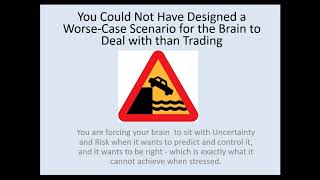
Once you accept that there's something, there's something amiss here, there's something not right about the brain that I brought to trading or me. But the truth is you could not have designed a worst case scenario to take the brain that you have been dealt from evolution.
Natural selection, adaptation that is really focused on short term survival. You could not have taken and designed a worst case scenario than the trade. Because all of a sudden you're putting that brain that has been designed for short term survival, you're asking it to be able to do long term probability. That's not what it's designed for. And guess what, it's going to flip out. That's exactly what it's going to do. It's not your fault. But that's not really the issue. This is the way your emotional brain is built. It's the way it's going to deal with uncertainty. When your emotional brain encounters uncertainty, the first thing that happens is it experiences vulnerability.
When it experiences that vulnerability.
To risk. Because all of a sudden you have vulnerability, I could lose something. Suddenly what happens is it's Triggered and all of a sudden it's, it's, it's wired for fear and is either going to avoid or attack the source of that fear, the source of that threat. That is exactly what's happening in your trading. Whether or not you can't pull the trigger or whether or not you're revenge trading, you're firing the fight flight response. You're experiencing either aggression.
Or the avoidance of fear. The deal is this. It's not your fault, but it is your responsibility, friends, is that this is the brain that you brought. And it's not going to change just because you say a few affirmations, just because you say some really cool, you know, some really cool platitudes about what the brain does and stuff like that on pressure. No, it's, it requires a reorientation of the way the emotional brain engages uncertainty. That's the hardest thing because let's take a look at this, what I want to show you. If you take a look at this iceberg, ultimately what we're calling the conscious mind here is your thinking brain or your neocortex. That's all that thinking, that's all that calculating, that's all that logic, that reason and stuff like that that you want to help make decisions, decisions. Then you look at this subconscious mind, the part that's beneath the surface. That's not Freudian, friends. That's the emotional brain. Your emotional brain does not speak a language of talking in your head. What it's done, it's adapted you emotionally to changes in the environment that fire automatically.
Without thinking. Thinking shows up much later and it's interested in short term survival. It wants to control outcome. But when it covers that, oh my God, I'm not doing that, I'm in trouble, it's going to fire the fight flight response. That's what you're getting and that's what's happening with your trader psychology.
And it is an integral part of learning to trade. There's a lot of people that have really great systems. There's a lot of people that have really good.
Methodology, plans, rules that give them an edge. But the problem is they don't have the mind developed to execute the plan. And ultimately what they do is they mess up. And this is what we're looking at is 95% of the decisions you're making while trading are happening on what could be called a subconscious or below the threshold of consciousness. It's happening in the emotional brain where it doesn't think, it reacts. This is the problem and what we have to do what you have to do is you have to learn to say, well, what do I need to know? Well, the very first thing that you really do need to get is what is an emotion? Okay, I have a couple definitions and the one that I currently like the best is that an emotion. I want you to listen to this. Listen to it deeply. If you got a pencil or a pen, write this down. It's a biological action potential that coordinates action between the environment. That would be the, that would be the trading, okay, and the organism, that would be you.
That's what it's doing. It is literally biology doing this. It takes over mind. And so anytime that there is a change in status in the environment, automatically an emotion fires and it's going to contaminate or exemplify the thinking that's based on that emotion. And usually fear or aggression. And if you look at it an emotion, you will have done this. If you understand this, you begin to understand a lot of my work. The first element of that emotion is arousal. That's the body cranking up, getting ready for action. You notice it by holding your breath, you notice it by tense muscles. You notice it by racing heart. Okay? That's not biological phenomenon going on by itself. That's the emotion getting ready to kick ass. That's what it is, friends. And once it reaches a particular threshold, suddenly there is a switch thrown and it is no longer arousing, it's no longer growing. It becomes a feeling. And a feeling is not touchy feely, friends. It's. It is the subjective experience of the emotional chemistry in your body. And this is the moment that thinking is compromised. Suddenly cortisol anxiety is pulsing through your bloodstream, through your brain and your thinking becomes anxious or you have a revenge motive. Oh my God, you know, there's something, they've taken that from me. I'm going to get them back. I'm angry, I'm aggressive. And suddenly you see testosterone and dopamine in there. All sudden you're fueling a raging bull. Then the motivation, the motivation of an emotion is what is the emotion telling you to do? And it's real simple. Avoid fear based stuff, attack anger based stuff, or approach. And friends, that's what we're looking for. We're looking for you to be able to develop the brain and the mind that approaches.
Okay, from concern, the market, that's the ticket. The meaning. These are the beliefs that you don't even know you hold about your ability to manage uncertainty. And this is, it's a big deal, is that you don't even know you have them. These are actually the limbic system, your emotional brain. Actually, through experience, builds beliefs, bills, what we would call limbic learning wires it in and it shows up to you as an implicit unconscious belief that operates outside of consciousness. That's what you're triggering all the time when you say what just happened? What just happened? That's your blind spot. And the fifth part of it is temperament. That's genetics. That's when some people are just more anxious, some people are more risk tolerant, all that stuff. But that's what you're dealing with, friends. You're not dealing with emotions. Like, oh yeah, there's an emotion there and I can just calmly turn it on and off or I can just stuff it, I can pretend I don't have them. The only time you don't have emotions is when you're dead. And what we're doing is we're saying these are the components that you can use to actually learn to master emotions. Meanwhile.
Once you've all seen this about what's happening in the emotional brain, you have this uncertainty and risk that you, the traitor, discover. And guess what? Unless trained instinctual emotions, fear and anger are going to show up and they're going to operate the brain that engages, engages that uncertainty, that risk and that stress. And suddenly you have fight, flight. That's what you got, friends. That's what you inherited from a long time ago in a place far, far away. And if you want to be in denial, you can be like the figure on the right hand side, modern man. And you're looking at the more primitive stages of our development from evolution. And it's saying, stop following me. Well, the truth is, is that it's not going to stop following you. You are biology, you are emotion. And it's wired into you in the same way the very first hominoid that got out of the tree. You carry that emotional architecture in you as a modern human being. And there is no Descartes that was right, I think, therefore I am. You are never devoid of emotion. In fact, thinking is always emotionally dependent. There's always the emotional ground and that's that coordination of all that action with the environment that's happening on a subconscious level. Okay, there's a good book, Blink Gadwell. I encourage you to read it. It gives you an idea of how this works. So we've got this.
We'Ve got this and we're saying.
Anatomically, what does it actually look like? I'm going to show you what the blind Spot and how your reactivity actually occurs. What you're going to look at on the bottom left hand side of this graph, you're going to see external input. That's all that sensoriality, mendalities, that's what you're seeing, that's what you're healing, that's what you're kinetically feeling. That's all your senses that are feeding into a certain bias. It goes to this thing called a sensory thalamus that really acts kind of like an air controller. It's deciding which way the jets are going to go, whether or not they land, whether you're sending them to another place. And it also acts like a traffic cop. So information comes in and if that traffic cop says, you know something, this is way too, this is way too dangerous. This guy is about to enter a trade and you know something he could lose. Well, what happens if the urgency is there? The, the thalamus is going to send that signal down the low road, the circuitry of the low road that takes it right, right to the, the amygdala into fight flight rather than to send it to the high road, slower road into your neocortex where all that wonderful thinking analysis can occur. That's what's happening, friend. There's a traffic cop in there that is based on limbic learning and experience that's deciding what's going to happen before it ever gets to your thinking mind. This, friends, is the problem you have to solve. This, friends, is the blind spot. And so we get this thing and go, well, what? Well, Randy, I don't know, this sounds real theoretical.
How does it apply to me in trading? Oh my goodness gracious. Have you ever had, do you have entry problems pulling the trigger? What that is, is that there your, your limbic brain sitting there and it's saying that you're about to risk capital. But if you are stopped from actually entering the trade from its perspective, that short term survival, boom. And so you know, it wins and it gets a shot of dopamine and you have, you have this thing where you can't, you freeze on the trigger. Have you done impulsive triggering? Oh my God. I have to get it before it gets away or. Oh my God, man. I mean, I'm going to get this thing, I'm going to get this, I'm going to prove myself. Yeah, impulsive trading, that is the switch. This act now, don't think about it, act now. The trade goes against you and you just lose your stuff. You just start, wow, wow, wow, wow. You start Throwing good money after bad. You do all that stuff. That's the traffic cop, that's the, that's the sensory thalamus. That's this emotional brain blinding you at the very moment that you need to be thinking clearly. Revenge trading. Oh my God, I've lost. I've got to make up for these prior losses. I, I'm going to get that money back. Suddenly, aggression shows up and it overwhelms the thinking and all of a sudden you're in a fight. Do you think the trading CODs care? Okay, the blind spot. Boom. There you are again, getting out early. Oh my God. You know, I could lose what I've gained here. I need to get it right now. Yeah, scarcity, thinking, it's sitting there, friends. This is what it looks like in trading. That's all this emotional brain stuff acting underneath the awareness of the thinking brain. This is traitor psychology.
Refusing to take a loss until it just blows up in your face. A lot of people say, you know something, if I'd only taken that loss back then it wouldn't be as bad. But it went from a hundred dollars to a thousand dollars. Yeah, same thing, man. It's that traffic cop. And then winning and losing, you know, often, you know, we want to win, we want to make things happen. Nothing could be worse than you trying to make things happen. As if you could make the markets do something. And losing. I don't want to lose, man. I'm doing anything, you know it's gonna turn around. You don't know. And the truth is really good traders are very good losers. What they do is they realize that once they get into a trade, once they make a decision, they don't know if that setup is. It may be valid, but you know, the pattern may not be really be repeating. And there's just a probability that pattern is going to happen. If it doesn't happen, man, they need to get out of dodge. Keep the loss short. So we begin to see this thing. Yeah, it applies directly to you, it applies deeply to you. And here's the deal.
Once you realize that all thinking is emotional state dependent, you begin to recognize the need to understand emotion in a trading mind. Okay, if you cannot deal with emotions, you're never going to master the trading mind. And ultimately your job as a trader is to forge a new relationship between the thinking brain, which you need desperately in trading with the emotional brain that you have to have because it's controlling the kind of thinking you're doing. Mastering yourself is true power, friends. So we begin to see what we need. And yet at the same time, we wear this flesh and it really gets in the way. It really gets in the way. And all of a sudden, here's the deal that you need to get. As much as we want to believe that we're rational beings that deal with emotions, the truth is, is we are emotional beings.
First. And we make up reasons, reason to go wherever our emotions tell us to go. And often those emotions are lying to us. And what does that really look like? Well, I'll tell you, it's really interesting is that the beliefs that your limbic system builds, and those are the ones about engaging uncertainty. And they're all about your capacity to be able to deal with uncertainty. Creates the inner map that you project onto the markets. And then out of that you get all this sensorial information and you're looking at the external world, you're looking at the markets, but you're looking at them through your beliefs.
The Olympic beliefs, the ones that you didn't have a dang thing to do with in creating. And those, the ones that you brought to trading, you're seeing in the trading account whether or not they're effective extracting capital from the markets. Because the belief really is an assumption that the brain has given the force of truth. And it causes you to see what you see. You believe and then you see. You do not see and then believe. This is the power, friends. Your beliefs about your ability to manage uncertainty create the help of your trading account for good or for better. But this is where we're at. And what we would really want to do is one last thing about the brain. And this is the one that is really tough. At the very core of this. Our brain has been designed over millions of years to believe that it can control outcome. And in many ways it had to. You know, a lot of times we, our ancestors praised very perilous stuff and they had to believe, come hell or high water, that they could prevail and create outcome. What you discover in trading is that control over outcome is an illusion. And what we have to do is we have to do something very different. If we can't control outcome, why trade? Well, there's something better, friends.
But it doesn't having to do, it doesn't have to do with controlling outcome. It has to do with rebuilding your fear based brain into a probability based mind. This is where it starts, Wren. And where it really begins is with your acceptance that what you're doing right now is not working based on your trading account, that you're wasting perfectly good money by throwing more and more cash at something that's not working. Understand the typical trader, the vast majority of traders burn through their capital in three or four years.
Okay? They believe so strongly in their platform and their methodology, their risk management, and they believe that their psychology is okay. It's good that they don't see what the trading account is telling you. If you're a normal human being, your psychology is not built for trading. You're gonna have to develop it. So we get this, we get this acceptance and all of a sudden the very first thing, the very first skill is to recognize, wow, this is what happens with an emotion. This chart has been around for over a hundred years. It's called the Yerkes chart. And what you're seeing is that you can. Where you see stress, think emotion, think fear, think anxiety, think aggression. And ultimately what you're doing as performance, as the intensity of performance grows up, the more, the more stress there. What you discover is that at first you get better, okay? Then you reach a peak performance area. But if you stay stressed, you end up in anxiety and everything collapses. This is the thing, you realize that, you know something? I need to start managing my emotions. They're biological and I need to learn how to work with them because they're determining, thinking. And the way we do that, the way. The first part I teach is through breathing and muscle tension and really becoming an observer of your heart rate. And you're noticing that most of you. And if you're trading tomorrow, really, it doesn't take. Take a mirror, put it up, watch your breathing. My promise to you is you're going to notice that you're holding your breath or what you're breathing is with the top, very top part of your lungs. And you're not pulling any air into the lower lobes, which means you're not getting any oxygen into the brain. And therefore you're not going to be able to think very good. And if you start diaphragmatically breathing, what you're going to do is you're going to start oxygenating the brain and you're going to give it and you're going to say, you don't have to go to fight flight. You can stay in the neocortex. The same thing with muscle tension. Start noticing how much tension you carry in your body, particularly under stress. That's emotional arousal, friend. That's just not muscles type. That's emotional arousal. Watch your heart rate or heart rate. Notice it bounces around. Part of my training is being able to manage the heart Rate to keep it within a particular range so that they, so that the performance mind can be at its, at its best. This is where, this is the very first skills that anybody that's going to be successful in trading needs to start. However, that's never enough. That's never enough. Regulating the emotion is not enough. What you have to do is you have to feel. You have to build a door that can look into the mind, okay? That's the key. And until you manage emotion, you're not going to get to the door of the mind when you do. And this, we teach this through mindfulness, awakening the observer or metacognition, depending on how you want to talk it over. On the left, what you're looking at is a typical human being that's identifying with their thoughts. You're saying, oh, I think I'm scared. I'm scared. I'm this, I'm this, I can't do this. I'm going to be able, boy, I'm going to make up for those losses. I'm going to get this money back. Well, I, I, I, I, I.
Over here, when you're in observer mode, what you're seeing is the person steps back out of thought and noticing, well, look at these, look at these neurological behaviors. These thoughts arising. They aren't me. I'm not identifying with them. And suddenly what you discover is that you and your thoughts are not the same. You and your beliefs are not the same. In fact, this thing you call you is just simply one potential organization of a self. And what you're discovering is that you need to reorganize the potential that you represent into a different functioning mind. Okay?
That's done through mindfulness or applied mindfulness. And when you take that mindfulness and move it to the next step, it gets even more interesting. All of a sudden you realize this is where people get spooked out, is that their mind is a pretty crowded place. It's a crowded neighborhood in there. And all of a sudden you realize that, you know, there's more than one voice, there's more than one element going on. And if you've ever had self doubt, you notice that you're in an argument. If you've ever tried to, if you've ever had an internal struggle, you realize there's several voices going on in the mind that are duking it out. Okay, and this is something. Oh, you think I'm crazy? Do you know what happens? This is the human mind. This is what the Eastern traditions call monkey mind. This is. And what you're seeing is a disorganized mind that you're taking to manage probability. Friends, that's just simply not the way it happens. But that's what you bring to trading. Yet.
When we look at it from a different perspective, here's what we discover is the mind. First of all, the brain would be a community of emotional programs that rival each other and they're trying to take control. When that brain produces mind, what you have, you have a community. What you have is a board of directors. You have a place where these emotional programs that are in competition with one another are given voice. And suddenly you go, wow. There's lots of different in neurobiology, they're called spheres of influence. And all of a sudden you realize that, wow, you know, in the board of directors there's parts of the mind that want to go one direction, parts of the mind that want to go the other. And the truth is, is can you wake up, observe before the ship goes down. So if you stay mindless, you continue trading from your self owning beliefs. And the question is, who controls the trading committee in your mind? This is the big deal. Most people don't. And what they do is they find out, they find themselves in this struggle right here. They start discovering there is an inner critic who judges, who criticizes or tempts you. And there is a more rational base part trying to get you to do other things. But most people discover that that rational base just goes away under stress and they experience a fear of like a, of a, of a, of a child, that, that kind of stuff. And all of a sudden you realize, wow, you know something? I have not been paying attention to my mind. I have not, I have not devoted energy to being able to develop my mind, the potential of my mind. And so I'm stuck with the mind that I brought to trading. And friends, that's not what you want.
That mind that you brought to trading, guess what? It's built for the certainty of short term survival. You know something? It has that lust. That's that guy on the left. I, I want, I want it, I want that really good. I want to get rich quick. I want to get rich quick. And the joke in trading is if you want to make a small fortune in trading, start with a big fortune. Because if you're trading from lust, if you're trading from overconfidence, that's exactly what's going to happen. Or what you do is you end up like this guy on the right where they're scared, they have dread, they don't know what's going to happen? They're consumed by worry. But you see that, that is a construction of the mind, okay? This is the fear based and aggression based mind of fight flight. This is what you brought. There's a lot right with it. It allowed you to survive. But managing probability.
It'S not going to work that way. So what happens, friends, if you want to be successful in this game, and success I define is consistent profitability. Not hitting home runs all the time, consistent profitability. You're going to have to develop a new mindset to get new results. Okay? You're going to have to teach the primitive emotional brain when it engages uncertainty not to have an immediate route, low road to fight flight. You're going to have to teach it to calm down and to re partner with the thinking brain. And you're going to have to think that teaching. You're going to have to teach the thinking brain to walk with the emotional brain as partner. Hard to do when you come from a rational, kind of a rationalistic tradition. And what you discover in skill four that we teach you, become a designer. And I use this, this, this comes from the movie Inside out by Disney Picture. And what you're looking at right here are five primitive emotions that are living within this little girl's mind. They're in competition without each other. Okay? And what you're seeing is depending on which ones, which ones are winning. It's what the little girl does that is what you came to trading with. But what we want to do, we want to move beyond that because we know that's not going to work for trading. What we want to do is develop a very different kind of mind. What we want to do is we want to find the courage of a warrior living within you. The courage of turning toward your fears, not away from them. Okay? We want to find the discipline of a ruler.
That'S being able to maintain order under pressure. And there's a famous painting of George Washington crossing the Delaware on Christmas morning. Attack the Haitians and Hessians. Excuse me, I got corrected. And what we're doing is you're beginning to realize you know something.
The men with him are scared out of the gourd. They're going through the Delaware River. It's chunks of ice. And if this doesn't work, the new country, the United States is dead. And what happens though is they believed in that ruler, they believed in the discipline of that ruler so much that they were able to maintain order under pressure, power. And this is something that's inherent to the human Condition. It's not something out there that you develop. No, this is inside you. Also inside you is the self compassion, the self soothing of a caregiver. That is probably the essential element of our being. If you want to change, is self compassion is the antidote to fear. And through self compassion you reorganize. That's how you get the limbic system to deconstruct a belief and to reorganize it into higher functioning beliefs. And when you get that self soothing, so fear is calmed down. What you discover is the ability to be able to think clearly. The impartiality of a sage. These are elements and I talk about from emotional programs and from the Jungian archetypal standpoint, I use both interchangeably. And this is the mind that you're building to engage uncertainty. This is the foundations of the probability mindset that I teach. Okay, this is not the mind you brought to trading that is built on fight flight. This is the mind needed for management of probability. And here you go. When this happens, what you discover is that these are the emotions, the ones we talked about. These are the emotions that give rise to the probability based mind. And what you discover is that you can maintain an emotional sobriety, emotional discipline. We actually call it impartial discipline. The impartiality of emotional discipline. Okay, that's what you're looking for in the mind with all the uncertainty flowing around it. It has a calm center. This is the mind you want to engage. Uncertainty. When that happens, a miracle happens is that suddenly you start focusing not on controlling outcome. Remember, that's what the brain is designed to do, to try to control outcome, to be right. Suddenly what happens is that you're focused on performance, which by the way, you can control. You can control the emotions that engage uncertainty. You can't control the outcome, but you can control the emotions that give rise to the mind that performs. Friends, this is the psychological edge that you're looking for, but you're not seeing because.
That blind spot is just absolutely taking you to lunch. So we've gotten that and all of a sudden we realize that you know something.
Ultimately then this is about me developing the mind that allows me to turn toward my fears and to master them from the inside out.
That demon, that, that, that dragon becomes your teacher and you know you have to master it. This is what the consistently profitable traders have learned to do. They have learned that this is really about a game of self mastery. It's not a game of winning and losing. Winning and losing really have very little to do with Trading performance. It has to do with the mind that performs. Okay? The moment that you deviate from your plan, you're no longer performing, you're gambling.
So if you think of all this stuff together, this, to me, this is a beautiful photograph that really depicts peak performance. You control the mind, you bring to the performance in the moment. Look at these guys. The captain's doing his job. He's maintaining discipline, maintaining the order. Tough situation going on. The courage has to be there because they're in. I want to tell you something, they're in rough water. They have to be courage. They have to turn toward their fear. They have to master that fear. They have to cool that fear down. And then they have to be able to think clearly as they engage this kind of water as they're sailing friends. This is the performance mind. This is the mind where they're not thinking about winning the contest. They are focused on performing in this moment.
That's trading. That's trading. If you were to say, what is this process, Randy? Well, let's take a look at it. Let's start with stage one. Way up there, center top. It starts with emotional regulation. Got to start there. The second is you develop the ability to be mindful, to step back out of thought and realize that you can become designer of it. Then you go to stage three, where you start realizing, I have an internal dialogue. It's historical and I need to start becoming aware of it so that I can disrupt it. Yeah, that's not being blinded by this internal dialogue, these limbic beliefs. This is disrupting them. Stage four, you start developing that peak performance elements itself. That's that ruler, that's that courage, that's that caregiver, that's that sage, that impartiality. You start realizing that these are elements of the self that are there and your job is to learn to summon them as you engage uncertainty. And that from stage that, Stage four, you begin to reorganize the trading mind, friend. That's the way it's done and it's the way we teach it. Okay? And my question is, how do you become the change? First of all, do you recognize that you're going to need to adapt to survive and become a successful trader? Do you get that? And my friends, if you don't know anything about me, start, just go to my website, get the free book, start reading all the free articles, start going to go to YouTube. There's 160 plus videos up there. Start really reviewing them. But if you've come to the moment where you studied Enough. And you've read my book and you go, you know something. I'm ready to say, you know something? I know I need to be able to develop the emotions and the mind that engage uncertainty. I'm tired of ignoring that and blowing up. I know that this is the piece that separates me from what I'm seeking. Well, we encourage you to. The group course, it's meeting pretty soon, begins next week. Okay. And if you sign up by the 11th, that's Saturday, we're gonna give you an emotional regulation workshop. Valued 199200 bucks for free. And you know, and to be honest with you, it's not so much an enticement for you to sign up, but I want you to sign up because you need the work. Because when you, when you get in this course, you realize this thing's, this is landing on the, on the surface and you're running right in the beginning.
It lasts for 10 weeks. We have five meetings. You go to a virtual classroom where you learn the fundamental skills you need to be able to regulate emotion, to become mindful and to be able to change the internal dialogue, the internal dynamics of the mind that engages uncertainty. Friends. Moving from survival based mind to probability based mind, powerful the other. For some people just simply say, you know something, this sounds great. Your individual course though, Randy, that comes with 10 sessions with you. Yes, and it comes, it's much more comprehensive, it's much more personal and it gets into the meat of what's holding you back. It really gets into the depth of that. And if you're interested.
Ask for a free consult. Contact us. Ask for a free consult. And really, let's take a look at this and let's see whether or not this work suits you and to see whether or not you really want to develop the psychology or whether or not you want the world to change for you. So friends, the key is this, is that a lot of the way trading is presented.
Is just absolutely unhealthy to the trader. To think that you're going to go in, learn a methodology, learn how to buy this, that and the other, get a few indicators, have this stuff, and then you're going to learn how to paper trade and then you're just going to somehow snap your fingers and click your heels and, and you're going to become a successful trader. That's a good way to become part of the carnage that trading basically is. Okay. However, if you recognize, if you come to the moment, you realize you know something, as much as I would like to push through this I'm having difficulty and I know that I need to really redesign how I engage uncertainty because I realize that's the key.
That'S the real treat because it's really about peak performance. And ultimately that's what I am, is a peak performance coach. I am interested in what stops you from performing at a peak level rather than trying to control outcome. That's the deal. And I really want to thank you.
And it's the. By the way, it's the same thing. If you take a look at sports, if you look at elite athletes, if you take a look at elite performers, they have coaches, they have people who are watching them, working with them. It's because at some moment it's not about winning, it's about performing. Okay, that's the deal. We can teach you how to develop that. Now, we have a few minutes here. And if you have questions, write them in. I'll be happy to answer a few of your questions and we'll, and, and of course if there's no questions, I'll assume that you got everything and you've got trader psychology down. But the thing is, is write down some really good questions about what, what's missing for you and your performances in trading. Okay. And in the, in the, in the time that we have left, we'll look at them and I'll, and I'll shoot straight with you. How's that now? I don't see. Actually, actually Dolores is holding the hand up. So.
So the deal is this.
There's a question about. Tell us more about the group course. What I'll say about this is that its cost is $3,500. Group. Oh, group course. Oh, okay. The group course costs 11.95 or five payments of $239. It happens over a period of 10 weeks. We meet five times and you have a virtual classroom where all this stuff is. And you have, you have access to it 247 for long periods of time. The other thing, the other thing is that.
When you're in there, you literally learn the skills and it's powerful. Okay, I think that's it. What are your thoughts on subliminal suggestions and changing beliefs? I think they're very profitable for people build them. And I certainly have used them. I certainly have built them into my programs at different times. But the thing is, when you start believing that you're going to program the subconscious mind, I think you're going down a very gray area is ultimately this is all about the limbic system producing limbic learning and locking in that learning into a belief, you're not going to subliminate it.
Okay? You're not going to, you're not going to say, well, you know what I'm going to do? Repeat these affirmations 10 million times and I'm going to have these visualizations and I'm going to change. I'm a program, the subconscious mind. No, you're not.
Okay, is. It feels good. You might. With hypnosis, what you see is you're able to build a trance that is. That changes things for a while, but it starts degrading and the big programming underneath it comes back to the surface. You look at stuff like that, like with smoking cessation and weight loss and stuff like that, they're good for a while, and then this stuff comes back. It's not like it can't work. It's just that the thing is to imagine that it's going to somehow magically change the way the emotional brain builds learning and builds beliefs, locks them in. Mean they literally lock in synaptically. And the deal is that you have to learn how to unlock those synapses and rebuild them into higher functioning. That. That's a big deal. How does someone with irregular heart rhythms and afib do with heart regulation? I have that exact issue. Okay.
Well, how does someone with irregular heart rhythms and afib do with the heart regulation? Essential is that I have fibrillation, I have afib. Okay. And.
I've got a heart I wouldn't necessarily wish on anybody. But the thing is that I spend a good bit of time and I realize that it's essential for me to regulate myself to maintain a. Not to allow myself to move into, anywhere near fight flight. It's. It's a big deal. So that's, that's where it starts, is that you may never be able to get the irregular heartbeat down to the rhythm that your cardiologist wants. You may never be able to get rid of all the afibs. But what happens is that what you, what you do is you develop skills that allow you to mediate that and to work with it. And the thing is, particularly if you're trading and you know, when you're hitting that stress and stuff like that, man, oh man.
You better learn to regulate. You better learn how to build the mind that engages in certainty. Because, you know, ultimately the heart's just reflecting a lot of what the stress, what the body is experiencing, the brain's experiencing in stress. So good luck with that. And I, like I said, I know I have a pacemaker and so as you can imagine, I know I have experience afibs. Experience them now and it requires work. Okay, I don't see any other questions.
Here's one. I just want to stop adding to a losing position. How much time do you think would it take with your course? That's, that's a question that, to be honest with you, it's, I think it's a well intended question, but it's also a question that does not address the fundamental issues. I can't tell you that what happens is people when you say I just want to do this one little small thing and I want to stop adding to a losing position. You know what you're telling me you have a fear of losing. Okay. And out of that what's happened is you'll add to that position. So that in the hope, in the gambling hope that you will not do that. That's a limbic belief. That's the limbic learning. And that's learned not just from biology. With six and a half million years, that's learned in your family of origin and it becomes a deeply primitive held belief how to go about changing. That takes work. In my individual course, that's why my individual course is three to four months long because I want to be able to make sure that you have the respite skills to be able to do the deep kind of change. Because you know, like I said, I just, I just love it. I just want to stop adding into a losing position as if that's just something minor. Okay, it's major. You are literally looking at a limbic learning triggering when you, when that trade goes against you and it becomes a losing position. And what you're doing is you're having the fight flight response trigger. And I know people who can do that in two months. I know people who can't do that in six months. It really, to me it depends on how, how are you motivated to really change that. And when I read something like, hey, you know, I just have this little bit of problem, you know, and.
Good luck with that. But the thing is, is there's no real way of saying how long it's going to take. It has everything to do with you. I have people go through my course in two months and are superb traders at the end have people who finish my course and are not and I'm teaching at the same level. So it's, it's really a lot about the person.
How does your course help with binary options traders? I'll tell you this, my course is about working with the brain that engages uncertainty. Okay.
I know what the brain is going to do from an evolutionary standpoint when it engages uncertainty. It feels vulnerability from vulnerability. It's going to trigger to emotions and then it's heading toward fight flight. Whether or not it's binary or anything else, it really comes down to how your emotional brain has developed beliefs, assumptions, biases that engage uncertainty. What are they? Okay. Because ultimately, what you discover in trading is all about emotional discipline. Okay. Can you stick to your plan? Can you maintain order under pressure? That's the big deal. So how well does it work? You know, if you're, if you have my work, my course works really well in sports. My course works very well in business. My course works over a great deal of different domains, not just trading. People get into my work and realize, oh, this is a lot bigger than trading. Yeah, it's how you engage the randomness, the uncertainty of life. It's like the Romans said, the future favors the brave. Okay, can you engage it? Are you so scared of losing that you're moving away? So I wish you well with that. And friends, we're out of time and I have thoroughly enjoyed myself. I liked your questions, and if I can help you.
I would be thrilled. Okay. I really enjoy helping people redesign the mind that engages uncertainty. That's what it's all about. So take a look at my website, get my free book, and then start really saying, do I really want to become the change, or do I want to continue dealing with these blind spots? It's up to you. The trading gods don't care. And push as much as you want until you come to the moment where you realize, you know something, this isn't working. I need help. Or if you push through and become profitable, great. If not, you know, there are other. There are other pursuits that can be a lot more enlightening than just trading. Some people just are not built for trading. So I wish you well and I'll see you next time. And good luck with your trading. Good evening.









