The Fatal Flaw in Risk Management that Causes You to Crash Your Trading Mindset
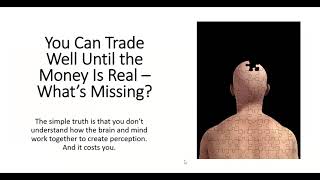
Randy Howell explains why traders crash under pressure: your brain's survival systems hijack rational thinking when fear hits. He traces the neuroscience from thalamus to amygdala, then teaches breathing and mindfulness techniques to stay in control when money is on the line.
Questions this video answers
August 31 (first meeting).
Join by August 24 to receive a free emotional-regulation workshop (otherwise the workshop is sold for $199).
A ten-week course that meets five times (materials/recordings accessible after sessions).
30 (typical enrollment 20–25; summer session had 12).
4:30 PM Eastern Time (sessions are recorded; recordings available the next morning).
Chapters
The broadcast is now starting. All attendees are in listen only mode.
Hello, everyone. First things first is let me know if you can hear me. Just type in a Y into the question box and we will know. And yes, thank you. Thank you. Thank you, William. Okay, what you need to know about my workshops is that I do a presentation and I hold questions to the end. But that doesn't mean that you can't write questions in as we go along. I know that if questions start coming in often there's a fatal flaw in the, in the presentation. It doesn't get finished. So anyway, what I ask of you is write your questions in as we come along and I will get them at the end. Okay, Fair enough. Okay, we're here and everybody's been trading and we're going, you know something? What, what is the problem with my risk management that Randy would say is there's a fatal flaw there. And in that, what we want to really do is say, you know something, when it really comes down to it, what there is, is there is a lot of people, what they can ultimately do is they can trade well into the money's real, their risk management system at that moment. It's just something where, okay, yes, I understand this. I have, I'm risking this capital with this much of a potential reward. I get it. And you know what happens? This is just the life and trading. And then.
The truth is very few people, including traders, understand actually how the brain works, what it's up about and about wanting to do and that simple truth. Not understanding the brain on stress, on when you really can lose, it costs you. And what we want to do is say what is the missing piece? You know, what's missing in the way that I'm doing my stuff and what can I do to fix that problem? Well, let's start there. Let's start right there. Is understand this is the major thing it actually has to do with the motivation of the brain, okay, for short term survival strategies. Now what you may say is, yeah, but I've got this neocortex, I've got this rational thing going. The key is this, is that your survival brain, the mammalian brain, the caveman brain, the limbic system, its prime directive is survival in the moment. Okay? That bias happens to predate the thinking brain for God knows I don't know how long. Generations upon generations upon multiple thousands of generations is you have a brain stem and you have an emotional brain. That's all about survival in the moment. And you have this recent arrival, the thinking brain, that kind of Hangs out there and it doesn't recognize that it's connected to the emotional brain and to survival instinct. Not knowing that costs us dearly. Costs us dearly. Because what I want to do, this is a very. This is an interesting way of understanding the brain, okay? And you have to go back through evolutionary development and you're looking at very bottom when you're talking about the reptilian brain, brain stem, that is a part of our brain, that is we share with reptiles, amphibians and stuff like that. It is an ancient brain. And it is all about making sure that.
Melabolic. Thank you. Melabolic metabolic reflexes are moving along and stuff like that. Then somehow what grew out of that reptilian brain is a mammalian brain. Suddenly we have a brain organized around emotions in the body, okay? Now, emotions are not what you think they are. They're not feelings, they're not psychological even. They're actually biological action potentials that coordinate activity between you and the environment, the markets. So anytime, anytime that there is a change in status in the market in your charts, there is automatically an emotional reaction, because that's exactly what that mammalian, that emotional brain is built to do. Now, I call it caveman brain because that's what our ancestors had then. Then out of that mammalian brain, that emotional brain grew. The human brain grew the neocortex, the thing that allows us to think. And often I call it the thinking brain. But what you're looking at is going, you know, when you're in the human brain thing and you're looking around and you've got your risk management stuff, and you've got your risk and reward and all that stuff, it's cerebral, it's thinking, and it's kind of like, okay, well, yeah, man, I can think through this thing. It's all rational, all that. The problem is that we are not rational creatures.
We are emotional creatures who rationalize. Big difference. That thinking brain of yours makes up alibis, makes up the story of what the emotional brain has already decided. And that thinking brain grew out of that emotional brain like it's a tumor. And ultimately lots of rich, rich, rich.
Data, communication data and lines are going from the emotional brain into the new. The new brain, the thinking brain. But it's almost like two 19th century telegraph lines are coming from the new brain back into the emotional brain. It's a mismatch. So you've got something that doesn't think and you're going, okay, well, I get it. It doesn't think. So what's going on here? The deal is, this is all outside of your awareness. Here you see this geek guy driving the brain, and he's got there and he thinks he's in control. He's got the whole thing. He's got all this technology. Look what he's done. He's flowed so far beyond animals and all that kind of stuff. He's human, and yet right behind him, it's the caveman brain, that mammalian brain, that emotional brain, the limbic system, and ultimately our ancestors, our ancient ancestors, stayed in what is known as rest, digest for most of the day, 90% of the time. Because if they weren't in, if they weren't actively, you know, hunting or actively trying to flee predators, they were chilled out. So it's not like it act it acted up. Today, it's been reversed. We stay on high alert 90% of the time and only stay and rest digest about 10% of the time. So you're driving along and you understand this thinking brain has only got too little communication going back into the old brain. And what happens is it doesn't even know the emotional brain is there. It can't figure out why it gets getting hijacked. The truth is, it sits there, and as soon as the emotional brain sees something that it perceives as dangerous, it triggers automatically hijacking that good thinking brain. And that, my friends, is exactly what's happening to you over and over again. The deal is this. Your caveman brain, this whole caveman thing is built to react to threat or opportunity in the near term future. Right now, okay, if you've ever had a trade go against you, and all of a sudden you start, that's exactly caveman brain. It's going, you know, it turned against me. And all of a sudden, it becomes something that is very, very dangerous. And what it does understand, it does not think. It coordinates action between the environment and the organism. When an emotion fires, it's in the bloodstream in 0.003 seconds. It takes about a quarter of a second for that information to get to the new brain to even think about. So the chemistry of the emotion in response to the change in status in the environment has already entered the bloodstream and is altering perception. So in here, what happens is you're really beginning to realize that that thinking brain doesn't have a whole bunch of strength. The emotional brain is creating patterns that automatically fire when things happen. And that's why, like, for instance, when that trade goes against you, you automatically want to defend yourself. You automatically want to not lose, because losing to the Caveman meant biological death. So, wow, now you're getting it. And here we go. And we like to think, oh, well, you know, here we are being very reasonable and stuff like that.
And we're thinking about risk and reward and all that kind of good stuff. You know, the thinking brain can think in probabilities, but the problem is the thinking brain is slave to the emotional brain. I know it doesn't appear that way. We rational creatures like to believe we're in control until we're not. In trading, we call that tilt. So we're sitting there and we're going, okay, well, what really happens? Your caveman brain receives in threat and opportunity, not risk and reward. I want you to hear that. I want you to hear that really well. Risk and reward. You could see that it's balancing that. And it's a very cerebral thing. Thing. But a threat.
No, it's in your face. Threat is like, oh, my God, this is a threat to my being in this cartoon. What you're looking at is that one. You know, sabertooth cat's there. One guy is staying to fight, the other is running fight flight. So the key is, understand this. To your emotional brain, there is no risk and reward. There is threat and opportunity. And if it's a threat, you become vulnerable. The brain gets confused, triggers into fight flight. What does that look like in trading? Let's say you went in there and that trade went against you right off the bat. And it just was hammering, getting close to that stop and bounce back off. And it really freaked you out. And it finally, finally, it got out of that rose a bit. A little bit. You got profitability, and you were so rattled that you took that. You took that little skinny profit and got out before it could be taken from you. And then on top of that, now you're scared. You're actually having anxiety, and now you're worried about getting in.
That's all response. That's all response to threat, perceived threat. And what happens is that your brain is already a negative assessment machine. So it's easy for it to think in the negativity part of it. And this is one of the reasons you have really serious problems. It is this kind of stuff, this instinctual survival traits that have. Were so useful for our caveman ancestors to survive, they turn against us in trading. Because in the everyday world, you know, being able to get and actually say, you know, something, I can. I am in control of this. I can handle this was really important. However, you take that same kind of brain you take, put it in the in the context of trading, it's in probabilities. Caveman doesn't know about probabilities. He knows about uncertainty being dangerous. Okay, so you're getting there. And then we say, well, tell me something, what does this look like, Randy? Okay, and this is really what I want you to look at is sensorial information coming in. That's what you're seeing, that's what you're touching, tasting and all that stuff. Okay. It's initially going to the thalamus. And the thalamus is going to appraise it really quickly that you gut level analysis. And then what happens is from there it's either going to send information to the neocortex to be able to think and logic and stuff like that. And what I want you to look at, that's taking 24 nanoseconds. That's what's known as the high road. But let's just say that information comes through the thalamus and there's a traffic cop there looking at this as an emergency situation, an emergency vehicle needs to come through. And what it's going to do is it's not going to, it's just going to block the avenue going to the thinking brain, it's just going to go straight to the amygdala.
That takes half the time to do that 12 nanoseconds. And so you have a gut level appraisal and all of a sudden it's in the amygdala and it's an instinctual response to threat at this particular time, our opportunity. Okay. And then all of a sudden reactive survival mind takes over. Happens all the time, all the time in trading. And then what you're noticing over here, if it happens to have gotten to the neocortex, what, what you have is you have a mind that can do risk and reward. You have a probability based mind. But what most of us do is that our brain is so engineered to avoid or not let loss happens. Okay. Because loss meant death. So you'll do anything, you'll fight to the bitter end. Yeah. That's called revenge trading. If it's an opportunity like, oh man, look at that big, huge. Look at that big, huge woolly mammoth over there. Boy. We kit that down and put it down. It feeds our village, our clan, for a. And so people get all cranked up on adrenaline and before you know it, they've jumped on that, on that woolly mammoth and people die. They may take it down, but they have to get themselves ready for that opportunity. They also have to get themselves ready to feel invincible. And so those, those are instinctual friends. And that's happening on a daily basis, on an hourly basis when you trade. And so the deal is this, once that brain invents a short term solution to deal with threat, it wires it in to become reactive pattern. Okay? It's just, it's in the brain, it's called myelinization. That's the, that's the wire, that's the insulation around a circuit so that it becomes really fast. And that's why it can happen in 12Ns. So you experience this as an emotional hijacking from either fear, oh my God, it's going to, it's going to take all my money, or aggression, you know, I'm going to get that money back. I'm going to show, I'm going to show the markets what, what's going to happen.
All this friends.
Is instinct. It's all pattern that the brain has created in response to uncertainty and the avoidance of uncertainty. And what happens is it shows up, it shows up in your trading. And the deal is this. If you keep, if you keep the brain set that came to you from natural selection through evolution, you're going to find yourself in an evolutionary dead end. There is no certainty trading. There is probability. And what happens is you'll take good. What really makes a really, one of the traits that really makes a good trader, a great trader, is their ability to lose. Where they realize that no longer matches up with what their edge is. And they're not going to go there. And they don't have any problem with it. It's just, you know, for them, they have trained themselves to see a loss that's only landing on the wrong side of probability. It's not a biological threat the way an untrained brain is going to do. And if it's a win, there's no reason to celebrate. It's only landing on the right side of probability relative to yourself. The real question.
Well, it starts out with understanding that trading is a nightmare for the emotional brain, okay? It perceives threat to existence and goes wonkers. And at the same time, it can't do that. It's going to have to be able to be retrained and into a very different way of doing it. The question is this, are you willing to retrain your brain? But here's the deal. The way this is going to happen is this. There's an event out there that happens that trade goes against you. That trade, the opportunity of a trade appears and then all of A sudden there is an appraisal done by that thalamus. Okay, now understand this is lightning speed. And then it turns into emotion. It could be aggression. Take advantage of this opportunity. Could be fear, oh my God, what if I lose? And then what I want you to notice in this diagram is it moves from emotion to action.
Notice that thinking is not necessary. Thinking may get involved in this, but it's usually an after event. And what happens is that thinking that does come out is incredibly skewed by the emotional brain. It's the appraisal, friends, that has to change. You have to be able to be able to regulate the emotion so that it doesn't trip. You just take you totally out. And then you have to be able to say, I'm going to have to find out a way of really re engineering the very basic components of my survival strategy as a human being so that we open the door so that it's no longer about the certainty of survival, the certainty of being right, but it is more about the probability. And you're going, okay, if I have an edge, I know that I'm going to extract more capital out of the markets than I give back. But I have to be able to take the losses not from caveman position, but from a logical, rational mind that is back in tune with risk management rather than threat opportunity type of perception. This is what has to happen. So.
What we do, what is impossible, is freedom from emotion. That's not going to happen. You just can't turn off the emotions. Well, you can kill yourself and that will stop the emotions from being. But understand you are an emotional being. You are the embodiment of emotion. So the deal is it behooves you to learn how to work with emotion. Because what you want is freedom of emotion. You want to be able to call forward the emotions that you need, the emotional cocktail. You need to produce a probability based mind in the face of uncertainty. That's not what evolution gave you, okay? But it is something that you can do. Remember that really when it comes down to it, you are not a rational creature. You're an emotional being who rationalizes. Okay, That's a big difference. You just simply.
You'Re going to rationalize whatever the emotional brain has said. So we're starting here and we're going, okay, what I get is that heart, emotions and brain is going to have to start working. And the main thing you have to get is that all thinking is emotional state dependent. You do not have thinking without emotion. Even what we call clear thinking is really.
An impartiality that is a very late stage emotion that's emerged really within humans recent past, now. So we get this and we go, okay, what you're saying, Randy, is I can use emotions to build a peak performance mind for engaging uncertainty. Yes. And the question is, how do you do it? How do you do it? How do you take all this stuff together and recognize that if you keep doing the same thing over and over again, you know, you have a pattern that fires and the brain's highly resistant to changing that pattern. And if you just try to force yourself on it, it just digs the grave deeper. So you're going, well, how do I deal with this? Well, friends, it starts with emotional regulation.
It starts with a form of emotional regulation that you're going to have to learn to be able to regulate the intensity of emotion from your breathing and from the amount of tension you have. We call this emotional regulation. For instance, tomorrow when you're trading, if you will notice how much tension is in your body, your neck, your body, your eyes, all that stuff. Now and then I want you to notice how you're breathing. If you're breathing diaphragmatically, you've probably got a lot of training. Diaphragmatically is pulling with your abdominal muscles with the diaphragm and pulling air to the lower lobes of your lung through. So lots of oxygen gets to the brain and it also calms emotions down. As a matter of fact, fear and anger cannot coexist with diaphragmatic breathing. And so what you're going to have to do is you're going to have to learn emotional regulation. Emotions are biological and they will have a particular signature that can be interrupted and can be. And can be, guess what? Change. So we're looking at that going, oh, this is the first step. Yeah. Remember, an emotion is biological, and breathing and muscle tension are part of the complex that makes up that emotion, the breathing. Literally, you're changing your breathing so that your brain's not getting oxygen. Breathing is shortened so that only your big muscles for fight flight is getting oxygen. And then muscle tension is revving up so that you can act, you can move, you can run, you can fight. And what we want to do is interrupt that. Because until you can interrupt that, you're never going to get the door of the mind. And so what I want you to do.
I teach you. The first part of my course is guess what? It's about breathing. What? Right now I want you to sit in your chair or in your bed or wherever you Are and I want you to observe the tension in the way you're breathing. I watch people breathe all the time. And what I've noticed is they do not breathe at all. That brings air to the top part of their lungs. It just sits there. It just sits there and barely moves as they breathe. Okay, what I want you to do is notice that. And what I want you to do.
Stand a little of erect so that your spine is kind of straight. And what I want you to do is to pull air from the outside into your nose, down your windpipe, down into your belly, let it expand to chest, hold for a moment and release.
And I'm going to shorten it up. I want you to pull air into belly using your abdominal muscles, Let it rise to chest, hold for a moment and let go. Pull air into belly and you can see those areas where you're using your belly muscles to pull out, drawing air down and then letting it rise to chest and releasing, pulling air into belly, expanded chest, hold, release slowly. Now what I want you to notice is the change in mood, change in emotional state that that little bit of breathing did. Like for instance, what I noticed in my own self is I'm talking more calmly.
Okay? I'm not talking with the acceleration that I was. That's what diaphragmatic bellows breathing can do. It can alter, it can produce the calmness, the patience that we often and getting excited and watching all those numbers and worrying and all that stuff takes it away from. But yet if we learn to volitionally breathe diaphragmatically as we trade, you will give yourself a big heads up. Okay, that's the set. And watch yourself tomorrow, really videotape yourself, Use your smartphone, use a mirror and see that. Now the deal is Herbert Benson during the 80s invented the relaxation response. And it worked so well that we thought that emotional regulation stuff was going to change the world. Well, it didn't. It didn't solve the problem. The key though is.
What emotional regulation does, is allows you to not be swept away by emotion. Because ultimately what you need to do is you need to arrive at the door of the mind. That's what emotional regulation can do. And this, understand this inside that door, looking into the mind, that's where your beliefs about your ability to manage uncertainty, that's where they take root, that's where they are. And the truth is there's a good chance you've been avoiding them, trying not to find them. And yet that's where we need to be able to go. Because until you change the beliefs about your ability to manage uncertainty. You're always going to default to the old instinctual stuff then.
And by the way, that's me. If you've never seen me, that's me. The key is this. You have to awaken the observer is there is a part of you that is witness to the going and coming of thought. And like, you begin to realize that, hey, you know something, this is really interesting is that my thoughts and I are not the same. They're different from one another. And in doing this and stepping back outside of thought, you begin to really look at it and go, wow. And what you're looking for, and particularly with observation, you are looking at.
When you're looking at your trading account, what you're really looking at are your beliefs in action. Your beliefs about the ability to manage uncertainty are being revealed in the health of your trading account. So if your trading account is not healthy like you would like it to be, your. You start saying, well, okay, I know that there are going to be beliefs there. Your sense of mattering is tied to performance, winning money. Your sense of worth is either tied to making money or not feeling worthy to make money. Your competency is tied to the making or losing of money, and even your lovableness. So now the thing is, is that what you're looking to do is how effective are those emotions about extracting capital out of the markets with your edge. Most people lose their edge, their method edge, because they can't manage the psychological edge. And what you're looking at is that the tool that we need is mindfulness. Because in mindfulness, what happens is in this illustration, what you're looking at on the left side, you know, there's all the shoulds, what ifs, all this stuff. And what happens is this is totally caught up in thoughts. You become a thinking. And you were so identified with thinking that you cannot separate yourself from that. In mindfulness, what you do is you pull back and are no longer identifying with your thoughts. You're going, oh, well, these are really interesting thoughts. Where do they come from? And we'll be talking about that just a little bit more on the right side. What you do is you realize the person's in observer mode. You know, the same kind of crazy stuff's going on inside the mind, but the observer is no longer identical. The person's no longer identifying, identifying with that as who they are. Now this is when you begin to take responsibility. You begin to say, this is the tool that I need. The way I respond to uncertainty, I can increase My ability, the way I respond, this becomes really powerful. But what are you going to do with that observer?
This is important, is that.
In modern neurobiology, the brain is really thought of as a community of rival emotional programs that are duking it out with one another for the control of the construction of the self. I want you to hear that what you're doing is that the brain is very competitive with itself. You know, if part of the brain's not being used, another part of the brain will take over that space and leave it with even less. So what you're doing is you're saying, you know something, I need to start learning how to observe this inner community. How do I go in and start using that observer of mine to start going, you know something?
If these thoughts aren't me, or as Pink Floyd said, there's someone in my head and it's not me, you start going, well, I've opened the door and I'm looking inside and I'm going, my God, there's a lot of thinking, there's a lot of thoughts. There's a lot of voices with different. With different motivations going on. It's the same brain that was a community of rifle emotional programs as mine. That brain has now been given voice to those emotional programs. And suddenly the brain becomes a governing committee of the mind. And what you discover is, is because your observer was not awake and you had not been really organizing yourself, there's a mutiny going on inside the brain, inside the mind, that you're going to have to learn how to do. The truth is, you can get away with not doing this in everyday life and just kind of kick the can down the road for as long as you can. But the thing is, in trading, it's kind of like instant karma, man. It's right back in your face.
And you discover is that if you're going to become successful in trading, not only you're going to have to get to know yourself really well.
You'Re going to have to master the mind you bring into the moment. This is the game that really trading is so.
But the thing is, is that conversation that you've kind of been sucked into.
It'S so pervasive that you don't even see it. It's just like this person sitting in all these mirrors is like, wow, where did this, all this stuff come from? Well, this is what's going on in the mind, and you didn't see it. You know, these emotional programs have taken over, and they just seem ubiquitous to you. They just seem like they're all really familiar, and they just. And what the brain does with familiarity, it takes it into the background so you can see it's there. So fundamentally, leaving the brain unattended and unexamined is really dangerous for the trading mind. Again, you can get away with it in a lot of fields in your regular life, but when you get into trading, just the compression of time is so great that it is really impossible to get there. Now, what do you think you're going to find when you open the door of that mind? Well, the first thing in my programs, particularly my. Our group course, is we want you to find the inner critic. The inner critic is that part that when you beat yourself up, I would say that you have fused to the inner critic. Okay, you are not the inner critic. But what happens is your brain's a negative assessment machine. And what you're going to see is you're going to see the judgment. You're going to see the. The. You know, it's just like critical nature. And you're going to get. All of a sudden, you get tempted. You know, you're going to. You're going to get tempted to jump into things and stuff like that. Impulse control. And what you're going to see is another part of the self called the adapted self. That's the one shrugging his shoulders. That is in response to the taunting of the inner critic. But that inner critic is going to be there. It's part of the. It's just that destructiveness that lives within all human beings. It's just simply part of our nature. And what you discover, it's stuck in there forever. And the deal is.
You know, it's actually the guy that. Stanley Milgram is the guy who actually figured this out. He was a social scientist from Harvard studying the Nuremberg trials after World War II. And he was amazed when he saw that Germans had been converted into Nazis, that industrialized genocide. And he was more amazed by. When these guys were asked, why did you do it? They just said, because I was told to. That was their answer. And Milgram just golly, that's crazy. So he set up a series of experiments. And the one that I like to use is one done where they recruited college kids to become guards in a prison system. And they. They recruited graduate students to become prisoners. The guards were told they were going to be using Pavlovakian conditioning and noxious stimuli to be able to train these prisoners to be compliant with requests. And they were going to use shocking to be able to do that. And they would increase the voltage until they complied. Then they told the guards, the prisoners, the graduate students, that they think they're shocking you, but they're not. You're going to pretend you're being shocked though, and you can see them. They think they have a one way mirror, but they don't. What happens is that when you see them up in the voltage, you're going to get more and more convulsed and maybe even die. So what happens? This was an experiment that was supposed to have gone on for 12 days over the Christmas holidays at a university. It was stopped in three days.
Because the college kids turned guards knowingly, willingly, voluntarily, volitionally applied. Two thirds of them applied lethal shocks, watched the graduate students, the prisoners, convulse and die, watched them being taken out on gurneys.
66%.
Okay. They switched regular college kids just trying to get some money over the Christmas holidays into a killing machine in three days. That's the destructive end, that's the inner critic. It's not going to go away. It's going to be there. You have to become vigilant to it and turn and actually learn to master it. So now we've gotten that game that's happening in there when you beat yourself up, when you fall into impulse trading, that's exactly what's happening. So every time that you hesitate, revenge, trade over trade, the inner critics there, whispering, whispering, and you're seeing, you're seeing two parts. You're seeing preach, preach, preach. And you're saying, oh, you idiot, you idiot going on. And the person's in the middle, the person right here has not produced the mindfulness to step back out of this and to recognize these parts of the self aren't him. But they're very competitive and they've had an easy way to go. But that's the adaptive voice. And the adaptive voice is adapting you to threats in the environment. Okay, so now we go. Boy, it's complicated in there, isn't it? Your job is to do this, is that, that monkey mind stuff, it's going to always be there. The deal is, is your job is to build a mind that masters that, whereas that's going on in the mind. But what happens is you come to the moment of where you're no longer being sucked in that conversation. So this is the human inner struggle that has not been mastered and you must master in order to become a consistently profitable trader. Okay, when you are beginning to listen to all those howling voices, the monkey mind, you get sucked into it. But like in here, and by the way, that's me too, is that you can actually come to the moment of where you're at peace with this. You no longer give them the power to judge or criticize you.
Or seduce you into really stupid behaviors. In your trading is this is simply what's going to happen. And the deal is this, is that the reason you can get away with it in regular life and can't get past it in trading life is that in trading, time is deeply compressed between cause and effect. You know, in regular life, it may be decades before you're forced to really look at your stuff. Like my dad, My dad smoked Camel unfiltered cigarettes for 52 years. People were telling him, you know, Howard, you really need to stop this. But he would look at it and say, I'm alive, I'm good, everything. Then one day, did some testing stuff like that. And he went back to the doctor and the doctor said, Mr. Howell, you need to get your affairs in order. My dad just really got all freaked out because, you know, suddenly the time compression happened. His denial had stopped it for a while, but the time compression finally happened. There it was. And you know, he didn't really have a lungs that could extract enough oxygen out of the air to sustain life. And it killed him because he refused to accept that he needed to master certain things. And my hope is that, I hope that you're more than that. But the key is in trading you have to take what is instinctual and you have to make it where it's no longer instinctual actions, it's response, ability. You have this responsibility, what you have to be able to grow a very different set of potentials within the mind to be able to deal with, with uncertainty. Uncertainty is going to be there. All these people that want these high success things, notice they don't make very much money. You know, you still have a ratio that's in the problem. So the thing is, what you discover is this as you begin to go, okay, I have to be able to respond to uncertainty not as a threat, but as a concern that my mind can be prepared for. Your caveman brain doesn't know about concern. He knows about threat and how to respond to threat. Fight, flight. So the key is how do we begin to train ourselves so that ultimately we can be in the mix of uncertainty. But what happens is the uncertainty does not trigger the survival instincts to do really uncalled for behavior while trading. And out of that, what we finally get. You discover.
The world out there doesn't change. But by changing the observer that you are in there you see a different world.
It's kind of like in quantum mechanics. In quantum mechanics there is a saying that we exist as potential. The observer of that potential is what brings forth the form.
Of that potential. And in trading what happens is you come with a brain and a mind that is incapable of the work of trading. It's a probability based thing where there are going to be lots and lots of losses. And what happens is your caveman brain doesn't like losses because it's a threat to biological existence. So the world out there is not what changed, it's the world inside you. Because you have different beliefs about your ability to manage uncertainty. You find discipline, you find courage, you find calming and you find critical thinking skills. That world in there can change friends. And you need that psychological edge to drive your method edge. That's when they start coming together. That's when psychology.
Platform and methodology come together.
And you make music and trading. And so what really comes down to there are in my work, I am interested in accessing the discipline of a warrior living within you as potential. Maybe it's not expressed very well in trading. I am looking for you to be able to find.
The. Wait, the discipline of a ruler. There's Eragon with his sword. I'm asking you to find the courage of a warrior. I mean these people are willing. They were putting their life at risk. You also need to find the tender loving care, the loving kindness, the self soothing of a caregiver. To be able to calm losses, to be able to build and let that orphan nature of yours know that it's okay, it's going to be loved, it belongs, it's okay. But learn from it. And like the ultimate was Frodo. I mean this guy had an enormous. He had all the power in the world in his hands and yet he couldn't do it alone. He needed Sam, his friend, to finally get that thing into the molten lava to destroy the evil. The key though is these are potentialities that live within you. And what we do in our course, what we do is we teach you through memory enrichment, where you go into memories, where you've seen these points of view, these archetypes expressed in action during a critical moment in your life. And what we do is we learn how to extract those and build that into a cocktail that builds a mind that can in fact engage uncertainty. Then we find symbols, archetypes to be able to represent those emotional programs so that you really truly are. You're learning the science, the cutting edge science. But what you're Also doing is you're using the symbolic representation to be able to pull up that kind of energy and learn, for that to be the mind you bring to uncertainty, not the one you came with, but you're rebuilding a mind.
For the rigors of trading, of the rigors of uncertainty, the rigors of probability that will scare your caveman brain to death. But it is something where that caveman part of yourself, the emotional brain, comes to trust you when you demonstrate that you can really handle this. And what I'm actually, my invitation to you is emergence. What I've talked about, I have been teaching for 25 years. I know it's something that people can emerge. People can say, you know, I used to. When I was in public mental health, it was very common for me to work with abused women and their children in getting them out of abusive situations. And interestingly, you know something? After you've been beat a number of times, you're scared. You know, you've become a victim. But at the same time, what I would see is I would see these women gain their strength, gain their courage to act, and they would.
Often for the sake of their children, not necessarily for their sake. But the thing is, these are potentialities that exist within you that you can learn to manifest. You can learn to summon and change the way you respond to the challenges of living. This is self mastery, friends. Who would have thought something like trading could be personal growth and leading into self mastery and developing the potential? And yet it is. Here we are. Now, my question is, you know, obviously I can talk till I'm blue in the face. And often what happens when people have deep set patterns? You can throw all sorts of facts at them, and their belief system simply repels them. If that's you, I understand. I'm okay. But if you're curious, let's start with if you don't know. If you. If you just come across me, you've seen a couple YouTube videos, you go, well, this guy's interesting. Boy, this is interesting. What I ask you to do is just simply go to my website and get my free ebook, okay? Just start there. But as interest is there, you know, you might want to start reading. You ought to read my book, Mindful Trading, because I lay out the way. The way you change, okay? But then what happens? You go up and you start maybe tinkering with different things, reading articles, watching more videos, doing all this stuff. And eventually it comes down to two things. The group course, which we have starting what we call our fall course, it starts August 31, for the first meeting. Yeah. And what happens is it is a ten week course meets five times. And what we do is instead of telling you about these things you need to do, we're actually teaching you how to do them. It's a really hands on. You're going in and you're actually learning how to produce this mind that engages uncertainty so differently than the way it is right now. And any rate.
And if you do it by August 24th, what I'm going to do is give you a free gift. It's actually a workshop that we did on emotional regulation. You can go right now to our website and pay $199 for it or you can get it free by joining early. Because if you come to this, if you come to this thing, believe me, I'm expecting you to have already spent two to three weeks working with emotional regulation. And we're going to blow past that. We're going to go to mindfulness.
Yeah. On August 31st, I'm expecting you to have been working with the emotional regulation materials and can duplicate that. We'll review it and we'll move it to mindfulness. And a lot of people end up at the last minute and go, wow, this is really overwhelming. The thing is, get in early. Okay. Check it out. The other is the individual stuff where some people just simply want to work with me. Okay. And that's the ignite individual course. It's highly comprehensive and it's very personal. Okay. And yeah, just go to the website, really explore. And what I want to do is I want to thank you for coming. This is a great opportunity. And if you have questions, let's find out if there are any questions already or if I've done such a great job that there just simply no questions. This would be the time to ask questions.
Not so far. Yeah, we'll just. I'll sit here and start closing down and if you have a question, I'll be happy to answer it. Okay. The major thing is this is tomorrow. I would really love for you to film yourself with your phone or if you have a video camera or at least, at least we're looking through a mirror and I want you to look at yourself and see what you're doing.
This is from Castan, I guess you mentioned about the breathing exercise. Pull air through nose into belly, let it rise and then to chest release.
When you release the air, do you.
Back the other way? Well, when you release the air, everything starts flooding out and there are. I look at it as I do remove almost all the air from my lower lobes and my top lobes. I do it on account of 4. 1, 2, 3, 4. Hold for a moment and then I pull the air back in with the diaphragmatic muscles. It's a great way of. Had a lot of people who've studied yoga and they say Randy, I already know this breathing but I said do you know it? Do you know it?
While trading? That's the only time it really counts. Okay, how many people are in the group? We cut it off at 30. It's typical. There are 20, 25 in them. This summer we had 12. Okay, that summer is a slow one but we don't want huge ones. We want it so that if you actually want to interact that I'm. We're there for interaction. So 30, 30 is the limit. Let's see here, when are the session days and times? The group course.
They'Re 4:30.
Eastern Time but.
They'Re also recorded. We have large numbers of people in Asia and we have large numbers to people in Australia that are not going to meet that. So what happens is that as you're going through this, the recordings made and you have access to the recording the next morning. So that's something that's just been part of the way that we work for about 15 years.
This is from George.
Have you known individuals that can make this transformation from failure to success in a really short time? Or is it something that always takes lot of time? Well George, what I'll say is this is that I.
If you are a really good ardent student, what I've noticed is to really make the. It really takes six months to a year to get it so that it's natural. I have had three or four or five clients over the years that have done my course, my individual course in two months. And I know one of them was immediately hired by a trading firm and allowed to run his own account and to use the proprietors money. Another one just simply went through the roof. I don't like instant success like that.
It breeds failure and it's something where I'm looking two months. What happens in our group course is that I'm ramming this thing pretty fast by you in two months. And what happens though is that you have access to the classrooms virtually forever. So you have the materials so that you can work with also at a later date you can also audit for free. Another one of the group courses I'm not looking for instance success. That's just not the way, you know when you look at a wiring diagram that's just wires but when it's an organic substrate, it just takes longer. Okay, here's William. If a person is a slow learner in other aspects of life, won't they also be slow in learning to be a successful trader? Could be.
The learning here is really about switching from a familiar way of interacting with uncertainty that you've inherited from.
Well, it's human years, 6.5 million years.
Some people learn at different paces and different things. It just so happens that this kind of work, I just simply. When I finally found this kind of work, man, I was on it and I was, I was really into the movement of it. So the thing is, is that.
It can take a long time. I know that I still practice the same exercises that I give you guys. Okay. I am a student of my own work. And for those of you who don't know, I come from a very chaotic family and that most. My parents were alcoholics, my mother was bipolar. It was really chaotic and it took me a long time to be able to work through that and to organize myself in the way that I am now. But it takes a while. This is from Amari. Hey Randy. I have purchased your book in audio format. Thank you so much. Providing this webinar. I finished and I'm already starting to journey my journal, my thoughts and look at my trades from third person. Yeah, that's exactly what we're looking for. We're looking for people to take the material and begin to say, you know something, this is something that's possible, but it's not for me. I don't want to try to offer this as a quick fix thing. It took you decades and decades and decades to get yourself into this place. And right now you start waking up and you're realizing that you're buying is against you from becoming a probability based thinker and you have to, you have to reverse engineer a lot of stuff and you have to really practice with the work to be able to get it to change in the direction that you need it to. So that's it. Well friends, I have enjoyed myself. Uh oh, a new one. Excuse me, I'll catch. This is Chastain Just bought the Intentional Mind for trading download earlier and going to listen to it after this. Thank you for your time. We'll be in touch. Looking to do the workshop as I am already profitable but want to get better and master it. Learned a lot from your free content already and your YouTube. Thank you. Thank you. Chastity. I'll tell you something. Most people, the thing is, is that if you're really looking at this, what you're. If you're already profitable, the key is you start looking at it and say what you should be aiming at is about a 50% win rate. And you would be also having a 2 to 1 ratio of your winners to losers. And I can tell you that's the ratio when I'm working with profitable traders. That's what we're shooting for.
Sometimes those numbers are not the ones they achieve. But the thing is, is that you need to have a ratio of winners to losers of at least 1.75 to 1. Okay.
We'Ll have access to this webinar recording. Yes, George, we will have that out tomorrow.
On the website homepage. Yes. And by the way, when you go to the website, we are having, we moved it, migrated it from one hosting company to the other and we're having some glitches. So my videos are not running on our website right now. But that's, that's something. That's a fix as soon as my developer guy gets back in town from the, from the holiday. So I want to thank you and get a hold of the recording tomorrow, but also videotape yourself tomorrow and start looking at just how much fear, how much tension there is. So I wish you well. I wish you incredibly well. Good luck. Take care. Bye. Bye.









