The Harder Your Try, the more Success Keeps Slip Sliding Away
Randy Howell explains why traders' survival instincts sabotage their strategies. When money triggers fight-or-flight responses, emotions override rules-based plans. He teaches emotional regulation through breathing, mindfulness, and memory reconsolidation to rewire how traders respond under pressure.
Chapters
Broadcast is now starting. All attendees are in listen only mode. Welcome everyone. My name is Randy Howell with Traders State of Mind and we are here to take a deeper look at something that just doesn't make sense.
And it's really about what does it really take to produce a mind that produces success in trading. If you're like regular people, you come to trading and the reason you've got to this place in your life is you try hard. And besides that, you, you don't give up, you don't ever do it. But before we go on, let's do something. Let's, let's, let's make sure that you can hear me. If some people would please type in a Y into the question box, I would greatly appreciate it. I just want to know that I'm not talking. Yep, okay. Thank you. Thank you, thank you. So the thing is we bring to, we bring to trading this thing that has produce success in our ordinary lives. We try hard, we stay focused, we don't give up, we push harder, we push harder and we just get focused on something and then we're not going to let it, we're not going to get it low until we win. And the truth is what you're going to see as you do that the more, the harder you try, the more success is going to keep slip sliding away from you. And we want to take a look at that and say, what's going on here? Okay, so let's start right here. First of all, trading looks simple in the advertisements. You know, the thing is, is it is talking about how much money you can make and all this kind of stuff and how, you know, you're just gonna, you ought to be doubting those guys who are sitting in front of big boats and big cars and stuff like that. But the thing is that they, they offer it. And the truth is you take a look at the numbers, you put it to the computer and you can say, you know something, man, you can make a lot of money. It would, it would give me the financial freedom and the personal freedom that I've always wanted. But the truth is, is that you see that chimpanzee, well, you know, at one time the guy sitting there in front of the computer and that chimpanzee had a common ancestor. And it just so happens we carry that brain with us called the mammalian brain. I call it the caveman brain and I call it the emotional brain. But the thing is we're bringing that to us and we're some there, we're back and we're Going, you know something, all through the last 6 to 8 million years, from that chimpanzee like character to the guy sitting at the computer, what we've done is we carry that midbrain, that emotional brain with us. And the truth is it does not work the same way that the thinking brain works. And so the problem though is your caveman brain has control of your trading when you're experiencing stress. Now how many of you have experienced stress in trading? All the time. So what you're doing is you're constantly triggering that emotional brain that was successful a long time ago in a place far, far away, in an environment that is completely different than the one that you and I are in at this very moment. Yet it doesn't know that. And it shows up and all of a sudden it can just blow out the thinking mind and where we wanted to go. How in the world does that work? Well, it starts with, it really starts with recognizing that everybody has a plan. Most of the people I work with, they're not that. They've been at this game for at least 2 years, 4 years, 10 years, and they have a plan. If they could only carry out that plan, if they could trade their plan and plan they trade, they would be minting money at the same time. It's kind of like Mike Tyson says, everybody has a plan until they get hit in the mouth. Now it's a little different in trading as you don't get hit in the mouth, but you boy, you can feel like you're being hit in the gut, you know you're getting hit in your pocketbook, you're hitting all that stuff and all of a sudden that stressor triggers, that challenging moment, triggers that you may lose, you may lose. And all of a sudden at that moment of stress, you're trading, plan absolutely disappears. It disappears and you do not have access to it. You don't have access to the rational mind that you need to run. What you have to do in trading, you have to be able to be disciplined, maintaining order under pressure. You have to be courageous enough to face the unknown, knowing that you could easily lose. You have to be self soothing rather than beating yourself up after a failure. And you have to be able to produce clarity of mind in order to do it. Yet at the same time, the moment you start thinking about making money.
You'Ve set yourself up for failure in trading. Ultimately what happens is a trader follows a plan and money shows up. He does not go in and make money. He's not going to make some money today. He's going to follow his plan today. The moment he moves out of plan.
He'S gambling. And I see a lot of that in trading. You go, well, what's the problem? Well, let's start at the beginning and say, you know something?
We misunderstand what's going on. We actually like to believe that we're rational creatures, okay? And the truth is.
That worldview dominates since Rene Descartes said, I think therefore I am, and brought in the rationalistic tradition and the age of reason. And it sounded good. It took us out of having to deal with emotions. We could find this state that felt like Spock, and we could stay outside of emotion. At least that was the belief. And then what happens is that.
The truth is we are a great ape. If you look in the mirror.
And you're looking at yourself in the mirror, you know, you look handsome, you go, you know something? I don't look like anything like an ape. Look at me. I'm groomed. I'm that. And the other. And the truth is, is that great apes also groom. They groom to help build attachment between members. And here, what we're actually doing is saying, you know something?
You are an emotional being, not a rational being. What you do is you. You rationalize. Your thinking brain rationalizes, make up stories that support whatever your caveman brain thought up. Now, the truth is, my guess is that you guys don't think very much about this. You know? No. If I could just stay in thinking and stop and push those emotions away. You can't do that. The only time you do not trigger two emotions is when you're dead. Anytime, and particularly in trading that there is a change in status in your chart as you're working a trade or even before, there is automatically an emotional program that fires and comes forward and takes over thinking to act and move you through to the next moment. Now.
The real problem, my friend, we can be apparently rational creatures until the brain actually engages uncertainty with risk. He could take a loss. And unfortunately for you, okay, your brain's built to control outcome. That's what caveman did. He had to control the environment. And by the way, that included the saber toothed tiger that took a long time to kill out. And remember, the Tiger was here 12,000 years ago. That's just about the time we started agriculture. Okay? So you're looking at it, and we want to be right. You don't want to be wrong. Because if you're wrong, you lose. And if you lose, I'm going to answer that in a minute. You also want to predict the outcome and never, never, never give up. And yet at the same time, you don't control outcome and trading. You don't have the capacity of doing that. And the truth is, is that you're actually looking at a phenomenon. The markets are going to do what they want to do. They're going to move this way and that way and the other. And the truth is you have no control over that. But what you do have control over is getting yourself into a mindset that can see what the market is giving away and you can take advantage of it. But the thing is, you're not going to force it to do anything. Yet at the same time, we're caught right here. We're trying to climb that mountain and never giving up and being strong and pushing forward at the same time. I'm asking you to be like the shadow in this thing. Step back.
And ask yourself, is this working? Is this working? And the answer is, no, it's not.
What works is very simple. You take a look at really successful traders and what they're doing is they're playing probability. And as long as they stay within their rules, probability is there. And over time, it will extract more capital out of the markets than it gives back. What happens is we. I wouldn't call it triggering to anger, but I would say, or wanting to lust. What happens is it triggers. And all of a sudden you see, you see, you see something you really can have. And all of a sudden the thinking brain's pushed aside and all of a sudden there you are, you're pushing forward and you're going to have aggression over trading. Are you going to have fear under trading, not being able to get in the trade, taking small, small losses, or even this, oh, no, you want small losses that you're sitting there and you go, you know something? The moment I get a little profitability, I need to take it off. But then, oh, my God, that trade goes against me. Fear and why? The truth is.
Fear of losing money is really, to the caveman brain, the emotional brain, the fear of giving up your life, of becoming somebody else's food that day. And so all of a sudden you're saying, it's not about the money. To the emotional brain, it's about your living. Very big difference. So now we're beginning to go, oh, my God, what's going on here?
The truth is.
The control of any of these factors being perfect, doing everything right to be, they're all illusions. Those illusions work pretty well, okay, in everyday life. I don't know about you but we didn't see those tariffs coming. And I want to tell you something, it has not been pretty out of nowhere. We thought we were in some kind of control and all of a sudden.
Monkey wrench got thrown in there. And suddenly again we discover that control is an illusion. It may be a really fantastic illusion, but it is deception. And in trading you're actually forced to have to acknowledge that in your regular life. Your ordinary day is you can keep putting off listening to the facts about your beliefs. You can deny them, you can just, you can make up the rationalization, you can ignore them, you can do all sorts of things, but eventually they catch up with you. And the best story I have ever heard about that is my own father. My father smoked Camel unfiltered cigarettes for 52 years. And every time somebody would look at me say, man, you know, you at least ought to go to filters. This is really proven that this is going to really hurt you. You'll get your insurance rates. They have insurance for non smokers and for smokers. And my dad would blow it away and he'd say, hey, I feel good, I feel great. He was denying.
He was compartmentalizing and pushing away the facts until one day he shows up at a doctor's office and the doctor says, Mr. Howell, you need to get your affairs in order. There is really nothing we can do. We can slow it down, we can give you oxygen, we can do everything. But the truth is, this is mine is you're a dead man walking. And suddenly he became religious about this whole thing. He just stopped smoking. He did all that. But the truth is damage was done. Damage was done. And I have no doubt that each and every one of you has tried the willpower stuff. Okay? I am sure that you've used positive thinking. I'm a successful trader. I'm a disciplined trader. I'm a disciplined trader. Everything's good. Everything's good. No, it's not. Willpower breaks down.
As you experience stress. It is going to suck the willpower and blow you away. And then of course, you have that control. You discover very simple, that emotional suppression. I know, I'll just push it down. I'll use visualization, I'll use the affirmations, I'll use nlp. I can't tell you how many NLP practitioners I've worked with over the years. And all of a sudden you realize, oh my God, none of this stuff works. This is what I thought would work. But the thing is, I need to look elsewhere. My brain's short term survival Orientation would simply compromise your need to take a long term perspective so that your edge can work. That's what it's going to do. And you're going to actually have to learn to be able to sit there and go, you know something, what I ultimately have to do is I'm going to have to teach.
My brain.
To enter an alien universe and adapt to it. Because this is what, this is what, this is what your brain, this is going out for lunch. Okay, we're going to a fast food joint, going to get some, we're going to get some, we're going to get some hamburger. Well, this is how hamburger used to get gotten. This is, this is what it was like. Even getting food as a hunter gatherer, particularly if you were the hunter, was dangerous, inherently dangerous. You weren't looking for little rodents, you weren't looking for little guys. You're looking for something that could feed a clam. And you were looking at hunters. And all of a sudden.
All those skill sets that you built and then you bring them to trading and they do not lead you to success in trading in the world of trading. They are two universes that are enormously alien to one another. And yet you're bringing a brain.
That seems rational on the surface until you put it under pressure and it looks like, yes, I can do this. All I have to do is follow my rules. And then you discover that, that your emotional brain is not having any of it. The moment that you hit the threshold of stress of where it's really challenging, where you really truly could use lose, or where you could really make some money here, and all of a sudden you discover the emotional brain just hijacks, pushes away the thinking brain, okay? And all you do is you start hearing information coming out of the thinking brain that supports whatever the emotion has already decided. Friends, that's the problem. There's no doubt that the family system you grew up in aided and abetted in the development of a lot of these old, old, old problems that were successful adaptations to a dangerous, dangerous world. And yet at the same time, now you get in trading and those same are actually dangerous. They are killing you. Your survival instincts are now killing you rather than helping you. So we're looking at what, what is going on here. So ultimately, here's what I'm saying.
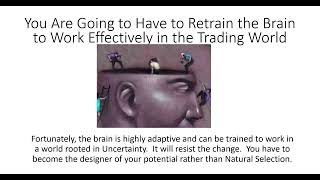
You're going to have to retrain your brain. It's the way it's been trained over the last millions of years is not going to be, is not going to be effective in trading. Not that it's bad it was built to adapt you for short term survival in another time and a place. So what you need is a different brain, a different way of engaging uncertainty. It's not death, it's not the fear of death that drives you, it's just the edge that drives you. And there's winners and losers. And your whole perception about winning and losing is going to have to change. Because the thing is there's going to be. To trading, you're talking about an edge that gives you, that allows you to extract more capital. Winning than you put back in losing at the same time. Both those are in a dynamic and you have to get, you have to get to the moment of where you're really a good loser. You keep those things small. You don't start gambling when the trade goes against you or when you see opportunity outside of your trading plan. At the same time, winning, you have to be very careful about it. One of the major problems I have with traders coming to see me is that they start winning and they start feeling good. I'm winning, I'm winning. Look at me, I'm winning. Look at, I knew I could do it. I knew I could do it. And then they blow the whole thing up. They sabotage themselves because the winning making you feel good.
It leads to endorphins coming in, dopamine triggering and all of a sudden making you feel real good and becoming very euphoric. And man, you feel good, you feel like you've got it. You can make everything happen and you're in control. You're large and in control. So here it is, you blow up. So all of a sudden, all these things that you so wanted, you discover that you're going to need to stay in the ordinary world if you want to stay as you currently are. If you're going to become successful in trading, you're going to have to rebuild.
The way the brain engages uncertainty. It can be done. Fortunately, your brain is enormously. It's called neuroplasticity. It is moldable. You can build a new brain, but you have to know how to do it. So out of this we go, oh, wow.
So what we're now talking about is saying we have always wanted to stay in the right side with the thinking brain because that's what you need to do. All this fabulous calculations and all that kind of stuff. But the problem is, is that you're going to be in partnership with your emotional brain whether or not you like it or not. They are not optional.
So the deal is, how are you going to use emotional Intelligence to start building a brain, excuse me.
Building a brain that can think clearly under emotionally challenging moments. Okay? And this is really where you begin to find out something.
Is your caveman brain doesn't know anything about money, Nothing. What he knows about is the threat to life or the threat or the opportunity of getting a big kill that feed the clan for a month. And ultimately you're taking that brain, that an emotional level acts like that. You bring it in without any working it and saying, you know something, I kind of need to change the motivations of this brain, of my emotional brain. And you bring that in and all of a sudden you just get portrayed. What we're looking to do is say that money to the caveman is a symbolic representation of your power to survive. You need that emotional brain retrained so that it gives the thinking brain the discipline, the impartiality, the self soothing, calming down and the courage to act in the presence of uncertainty. That's what's necessary, friends. Otherwise what you discover is a big truth. In neurobiology, all thinking is emotional state dependent on the left side of that graph. What you're looking at is a non stressed brain, okay? It's looking at stuff. This might be a paper trader. And what happens is that it's reviewing information and none of it says it's a threat because he knows he's on paper. No matter how much you try to make it believe that you're not. And trading in paper and trading live capital is very different game here. It's cool, it's calm, yet you put money in thing, you get real skin in the game. Suddenly what happens, it's alert. Because now to the caveman, it is danger of life. The amygdala goes eight, it starts heading toward the fight flight line and all of a sudden it. And on the way to hit aggression or fear, it also disables your thinking brain. Okay, if you've ever said, what on earth was I thinking? Well, this is exactly what happened right here. And it happens all the time. And you're going to have to learn how to control that, manage that, because otherwise if you don't, it will continue happening. Einstein was right. Doing the same thing over and over and over again, expecting a different result is the definition of insanity. So when you look around, there's a lot of insanity going around the trading world. If you grasp that 95% of traders lose money. Actually, it's probably more than that. I've worked with a broker who did a lot of that and had a lot of traders to look at. And what they found out is that their traders, only 4% of their traders, were actually consistently profitable. Okay? This is why, though, the brain gets disabled, and suddenly you're fueling your thinking brain, and it's enslaved to emotions that give rise to the fear of uncertainty or greed or lust. And all of a sudden, you're going, wow, man. You mean I have to learn to do this? Yeah, here's a good graphic that would explain it. Okay, if you're taking a look at this, here's your geeky thinking brain. Thinking. He's in control of the mind. He's driving. He's driving along. Everything is fine. You know, it's a clear. Clear. It's a clear thing. And in the back seat is this caveman brain just hanging around. It's just kind of doing the old rest, digest routine. It's like when there's nothing there to be stressed about. What happens is that emotional brain likes to chill out, calm down, and, you know, have a dinner, Just chill out by the pool or whatever. Okay? But let's just say he goes around a corner, he hits black ice. Suddenly, that thinking brain is needing to really think critically. But now it's an emergency situation. And guess what?
The emotional brain cuts off the thinking brain and nothing there. And then you have a Caveman driving a 21st century automobile on a black ice road. Now, does that sound like a good idea? No, but yet traders do it every day. They do not respect the power of the emotional brain. They do not learn the skill sets necessary to be able to keep calm enough so that fight flight is not triggered. Because once fight flight is triggered, all of a sudden, your heart rate booms. You know, you stop breathing, and those are parts of an emotion that are accelerating fight flight. And meanwhile, under those circumstances, the geeky thinking brain is just simply put out to pass through. And what you've got is you've got a car that you're trying to control, Basically with a great ape steering it, Rather than the human brain with the thinking brain that can actually manage that. We need to do something about that. Okay? So.
We can work with that brain through your biology. Okay? That's the first thing. But you have to really decide that, you know something. I'm willing to change. I'm willing to say, you know something, I get it. You know, Randy doesn't have to prove to me that what I'm doing is not working. I can look at my p statement right now and decide that, no, it's not working. What do I need to do. So ultimately I teach a five step process and this is something that I train particularly in my groups. And it's very good at what it's for. It will help you to produce the mind that can actually produce a thinking, powerful mind that can engage uncertainty. But first.
We need to take the pressure off the brain. Okay? The very first thing in emotional regulation, that's the first thing, is that breathing, the way you breathe and the way that you hold tension are actually part of an emotion. It's preparation to get the emotion cranked up. Like for instance, tomorrow when you get in front of your screens, I want you to notice how you're breathing. Particularly when a trade warms up or you're managing a trade, I want you to notice that you're probably not breathing. Most of the traders I first talked with are not breathing. They're holding their breath. That's ensuring no oxygen gets to the brain, no fuel gets to the brain and it's cut off. So guess what? The thinking brain's out of line. And then you're on emotion. If you change that breathing from shallow breathing or halted breathing to diaphragmatic breathing, it just so happens that the fear cannot take a hold and grow.
Diaphragmatic. Deep breathing is the antidote to the emotional arousal. And then what I want you to do is to notice how much tension is going in your shoulders, in your jaw, just all over the place. And then I want you to see how fixated you are. Most people will find themselves hunched over their screens looking at it tunnel, just tunnel vision. They're already hijacked and they're just sitting there. What I want you to recognize is because you didn't know to be able to manage that. You set yourself up, okay? Trading is just doing what it's doing. You're not preparing yourself to engage with the markets doing what they do. They go take care of them through your ignorance or your emotional ignorance, you're actually getting pounded, okay? In one way or the other. I work with a client who is an incredibly good trader. She.
Has an estate, she has a very large house, and she can buy a $20,000 purse if she wants to, all that stuff, and can easily make 10, 5, $10,000 a day. The problem is she goes through spells where she blows all that stuff up and suddenly it gets tight.
And this is what one of the things she's not doing. She starts winning. She doesn't realize she's triggering a intergenerational family conversation about money.
And it's taking over. And suddenly she Takes a loss and she has to get it back. And all of a sudden she's. She's screwing up a perfectly good trading mind. The first step is emotional regulation. The first step is to say, you know something? The way I breathe is going to determine whether or not I can get ahold of it and what I teach in my. In my group. Even before you get to the class, you're learning this breathing style of where you're pulling breath in through your nostrils, down into your abdominal area, then up into your chest, holding and then releasing. You're using your abdominal muscles, like on the left. You see at the bottom, you see those areas pointing out. You're pulling air down with your abdominal areas so that it goes to the lower lobes of your lung. You're getting a lot more oxygen into the lungs that's available to your brain to do the calculating that it's doing and to also hold the emotion from just going out, just amping up and taking over the mind. And then when you breathe out, what you discover is that the first thing is the abdominal section moves, and then the upper lobes of the lungs move. It's coming out, and you're putting all that and exhaling it into the world. And then you start pulling it again. It'd be like on account of four, okay, in and then out.
You will have to produce that as a standard way of breathing if you're going to produce emotional regulation. And then at the same time, you're also going to have to learn to release the tension in the body, because the tension you have in your body is emotional arousal. It's just not tense muscles. It's actually revving you up so that you hit fight, flight. That's the first stage. Is this going to solve the problem? No. But if you do not learn emotional regulation skills, you're going to get shot out of the water even before you begin.
I work with people that it's very common for them to have problems long before they get into their room and ready to trade. They pushed it away, they compartmentalized it. But there's dread, there's anxiety about what's going to happen, or there's lust about, I'm going to make some money. Yeah, yeah, yeah. Man, oh man. Who crazy. This is the very first thing. This is what you need to be doing. And I produce this personally as a practice where I interrupt myself many times a day to go back and start diaphragmatically breathing, because I know that's the way to stay calm, to have a mind that can Think clearly. That's the first thing you're going to need to do. And practice it tomorrow. Just take a look at it and notice the difference. So then the next thing that you're going to have to learn how to do is you're going to have to produce mindfulness. You're going to have to produce something that allows you to step back out of thought. And to begin something really important.
Those are not your thoughts. You do not have thoughts. You and your thoughts are different from one another. But the observer that you are is so fused, those thoughts that you identify them as you.
It gets you into a lot of trouble in your trading. It gets you into a lot of trouble. And look at that. What if, what if, what if, what if what? It's too much. I can't. I can't. I can't. Oh, my God. I'm, I, I, I, I'm, I'm a failure. I'm a failure. I can't do this. I can't provide for my family. You want to push those away, but at the same time they're there. And by pushing them away, you give them great strength. The next skill that I teach is I teach you how to set how to produce mindfulness. Where you step back out of thought and can observe them. And.
You know something? This bears repeating. I want you to hear this one more time. You and your thoughts are not the same. And particularly you and your beliefs are not the same.
You do not have thoughts, emotions and beliefs. They have you. They represent just one organization of a potential self. Based on your history and past adaptations. So what I want you to understand.
From a quantum perspective, they hold that there is no such thing as mass or energy. The universe, as we understand that reality as we understand it, exist as potential. The observer that you are organizes that potential into a self that can survive short term in the world. That locks in, and that becomes your identity. That's what you're frozen to. And in mindfulness, what you're doing is you're learning how to unfreeze yourself, step back out and realize, oh, my God. That's just one organization of a self. And I, for decades and decades, have been thinking, it's me. No.
That is just one organization of a self among many. And my promise to you is that in the human condition. You're going to find that there is both destructiveness and constructiveness happening simultaneously. You are the product of your brain organizing your potential for survival. It is not there to allow you to thrive. It is there to produce a perceptual map that allows you to negotiate the universe, the environment. And the thing is that.
You mistake this as you. What we want to do is we want to be able to say, my God. And a lot of people get really confused. They go, what do you mean? This isn't me. It isn't you. Okay? And again, in neurobiology, what they would say, you have never experienced reality. Instead, what you have experienced is all these neural feeds coming in from your eyes, from your touch, from your smell, from your taste, all that are coming in, being converted to electricity, being taken to the brain. And then the brain makes its best guess about what, what's out there. And understand this, your brain has never been out there. It's in a dark cranium and taking this feed and it's making its best guesses. In some areas, we have consensus reality, so we kind of see the same thing. But in trading, what happens that breaks down. You're seeing your individual organization of self and the beliefs that you have about your ability to manage uncertainty. And the deal is, until you can see them, make them aware of their presence.
You'Re enslaved to them. Your job is to wake up and to recognize, oh, this isn't necessarily working to my best interests. And what you discover is this. These beliefs that you have that you didn't even know that you fell into, okay, from history or from some experience. You didn't go about saying, I'm going to believe this, or if you did, like, I'm a disciplined trader. I'm a disciplined trader. No, your performances, your P and L statement will tell you what beliefs you're bringing to the game. The thing though, beliefs create the truth. The reality. It's not true, but it feels like true. The chemistry of true is. And suddenly you believe. I don't doubt it. This is my beliefs and this is what I'm going to do. Well, keep doing that. And most likely, if you bring regular beliefs from the ordinary world into trading, you're going to discover those beliefs are not effective for extracting more capital out of the markets than you give back. It's up to you. But the thing is, this is where it gets big, is you realize even your beliefs are. The ones are just simply assessments that have taken on the certainty of truth.
They're not true. They just have the certainty of truth to them. And you believe that they are you and that is what you are seeing through. If you change the beliefs, you see a different reality. I'll give you an example. I'm working with a guy several years ago and he's working with me because he's wanting to learn how to use his intuition better and trust his intuition. He trades with an eight figure account and he can kind of move things. Okay. And one day he and I are talking and, you know, he pulls up a chart and he says, randy, what do you think I see here? And I'm looking at him, Christopher, I have really no idea. You tell me. He says, I see blood. You see all this stuff around this area right here, that's a bunch of retail traders. And I know that they're scared money. And what I'm about to do is I'm going to go scare them, they're going to run.
And I'm going to suck the red blood right out of them.
And that's what he proceeded to do. He was a very different believer and observer of the markets than the retail traders were. Okay. This is how powerful the observer is in the creation of beliefs. And I want you to become better at it, or you need to become better at it. And this whole thing begins to allow you to imagine your mind as a governing committee. Okay. You know, in neurobiology it is said that the brain is a community of rival emotional programs that are constantly duking it out for the control of the construction of the self. You when.
That rival emotional programs are given rise and you have language centers, suddenly those emotional programs have thought and you are hearing the emotional programs that are in competition with one another in your brain as thoughts. And those thoughts represent special interest groups that want to control the real estate of the brain. So ultimately what you're wanting to do is to wake up and recognize your job. You're the chairman of the board. You're the one that needs to construct the governing committee that goes out and engages the uncertainty, the challenges of living. And you need to start weeding through.
All that chatter to find the ones that can build an effective team. The discipline, the courage, the self compassion and the impartiality, those are the emotional programs you want. A lot of this stuff is highly destructive that runs around in your brain and you're going to have to really come to grips with something. Thomas Jefferson said. He said.
The cost of freedom is eternal vigilance. Most of the traders I come to work with have not been vigilant about the mind they bring to the game. They're not developing it. If you take a look at some of the great athletes, what they do is they take great vigilance over what mind they're bringing into the game. And if you begin to think of yourself as a top line athlete and recognizing man. They're working with the mind. They're organizing the mind that's meeting the moment. They're just not playing the game. They're managing the mind that gives them enormous power. So that's what we were about. And ultimately you create an internal committee. And here, how many traders have I talked to like this? There's the trader staring at himself on the screen. And you can see that he's anxious. And at the same time you also see something that I call the inner critic, whispering things to him, you're not going to make it. Come on, take this trade. Come on, come on, come on. And you know you're a loser. You're never going to make it. Who told you you could trade? You know, take this, man, you can make a million dollars. Jump, bud, jump. All that. That's the internal, that's the unobserved internal committee. And you need to be able to open it up and say, those are not the guys that I want to be in charge of trading. I want to go in and actually recognize that I know I need to be able to say which emotional programs do I want taking charge of the action? What emotional programs do I need to produce a probability based mind that's intentional, that can handle the probability, which by the way, the brain you came can't. You're going to discover there are many voices in the head. If someone says, you will tell me I've got voices in my head. You think I'm crazy. No, I'm saying you're crazy if you don't acknowledge the competition going on inside your head for the incredibly expensive real estate of your brain. Okay? And you owe it if you're going to produce success in trading. You can't BS yourself anymore. You can't deny that this stuff's going on. You have to say, no, I need to master it. Trading literally becomes the most powerful course in self mastery you can imagine. Because the deal is time compression happens in trading and the impact between action and result is super fast. And you can't make up enough lies. You can't deny it, you can't repress it, you can't compartmentalize it because it's there in your face. You can do that. That's what my dad did with his smoking. He compartmentalized it. He pushed it away and pushed it away into a day when basically he was a walking dead. I don't wish that for you. Okay, the deal is, here we are, we've gotten that and we have this sentence for we have this historical internal dialogue, okay. And we want to say, which I get it, that there is an internal dialogue going on that keeps me stuck. It seems like there's an angel talking and there's a little devil talking. And what happens is that I can't, I don't, I don't, I can't discern them. I can't, I can't discern the good guys from the bad guys. But I clearly see with the results in my PI.
In my account that I see that in fact something's going on and I need to start discerning what in the world is going on underneath the hood of my mind. So.
This is how your brain initially learned how to deal with uncertainty. And what you're discovering is that primitive emotional brain that we share with our great ape ancestors is not good for the deal. What we're going to have to do is we're going to have to acknowledge uncertainty is there all the time. And as long as it's triggering uncertainty to stress and certainty to negative stress, distress, or moving into anxiety or fear or aggression.
You'Re gambling. So what we do is we realize that.
How do we build the mind? How do we build the mind? And the truth is the evolving trader has to dev into the beliefs that are driving his beliefs about money and power that are driving his trading. It's not unusual. I worked with one, this is a German family, a German who. And after World War II, part of his family lost vast real estate holdings in Poland. They were on the wrong side of the deal and out of that they lost everything. They went from super wealthy to, you know, looking for work. Another part of his family, during, after World War I when there was hyperinflation in Germany, the hyperinflation ate their, ate their wealth up and, and they decided that their family had a jinx, that we start making money and it'll be taking profits. That's a belief, a self limiting belief.
He had never known that. And all of a sudden he says, oh, that's a belief. It's not the truth. No. I have other people that. My favorite one is a guy who's been trading for 15 years comes to me and says, randy, I need help. I don't know what's going on, but what happens is I trade with this high six figure account and every time I go into seven figures, I lose back down into high six figures. That's been going on for 15 years. I don't understand what's the problem? Well, ultimately what happened is he Grew up in a family in Detroit. His father was a union mechanic at an automobile factory. And the union and the management were always in head and dead. And the union people just thought it was crazy. The guy could make millions of dollars being an executive with bonuses and stuff like that. And he was fierce about it. He was dogmatic about it. He would slam his fists on the table. Nobody's worth a million dollars there. His son is listening to all this. He grows up to be the traitor. And every time, as long as he's under a million dollars, he's fine. He goes over a million dollars and suddenly it's back down. That had been going on 15 years. My own case is that I grew up in a family that lost intergenerational wealth. The generation before me, and we were all trying to get the money back. Scarcity thinking. And I found that I was in several businesses where I was trying to get the money back that in our minds had been stolen from us. And I finally came to the moment of realizing that, you know, I'm locked into a perceptual map that is going to keep me small. And I finally was able to turn that so that I began to see. It's not that I was not in fact creating the value to produce.
Cash capital. I was looking for it elsewhere outside of myself and pulling it back. When I began to change and recognize that money for me was an exchange of values. Okay? That what I was offering was valuable and the way they paid for it was through capital. Suddenly my world changed. My ability to work. Fine. You need to find those emotional, those emotional blocks and they have to be brought down. And they're not necessarily easy, they're hard to see. And then real good news, you can intentionally awaken these emotions. Okay, you can actually say.
This is actually a statue in Maryland. Dolores.
Where is this? It was near D.C. and it's about a person emerging and this is really emerging to new beliefs, new ways of understanding it that you can build the potential of a ruler, the courage of a warrior, the self soothing of a caregiver, and the impartiality of the sage. They exist as potential. What we want to do is shift the observer that you are so that you can see that potential and start manifesting it. Not like new age mind ever manner stuff, but changing the observer that sees the reality you're in. And that's what we do, my friends. Ultimately what we want to do is I use a process called memory reconsolidation and memory enrichment. And what we do is we bring these Emotional programs to the front is, you know, ultimately I look for a challenging experience where you were really challenged and you didn't know if you were going to be able to do it. But what happens is that you were able to get through it. What happens is that your brain encodes experience into memory. You can pull that memory back up and you can start really remanufacturing it so that you have great access to the discipline of something that really happened, to the courage that really happened, to the calming down that really happened, to the impartiality that allowed you to think clearly under stress. You can learn that, you can enrich it, and you can pull those programs up that creates the mind. Remember, all thinking is emotional state dependent. And the deal is this.
With training, it is these programs that interact with uncertainty. If you take a look at the Lord of the Rings, this is the best archetypal emotional program movie I've ever seen. What have you got? You have a ruler there, Aragon. You have Frodo, who probably shows you the greatest courage you could possibly ever have. He has to fight within himself. You're looking at Ganondorf, who brings the wisdom to the game. You're looking at compassionate people who actually help people up. You're looking at warriors fighting. And what happens is that this is the mind that you can build. Okay? And the deal is.
Do you want to do it? Do you want to? Because ultimately, the biggest problem is patience.
And most people don't recognize patience is a form of action. And if you recognize that the market's going to do what they're going to do, it is you who has had the patience to be able to take what the market is giving you. If you're trying to do something, speed up the process when you're gonna. You're gonna miss what the markets are trying to give you. So the deal is, this is it. You know, the thing is that you develop the patience to be able to follow your plan and extract more capital out of the markets than you give back. And when that happens, what you're able to do is you're able to calm down that animal nature within yourself and to domesticate it to a large degree. But you have to work at it. You have to constantly be that empath that can calm that caveman, or in this case, Hulk down. Because that part of you is always there waiting to trigger. And you have to develop the skills of being able to deal with this is requirements for the trading mind. And out of that.
What you discover is that winning only really becomes landing on the right side of probability. It's nothing to get excited about. It's just landing on the wrong. And losing is only landing on the wrong side of probability. And what you're doing is you ask simple questions. You say, when you take a loss, you say, was this a method mistake?
Was this a psychological mistake? And let's just say, no, you followed your rules and that your psychology.
You managed the trade well. Then you go, well, then this is just simply a trade that landed.
Where it did because of probability. And the next and last question is this is, would you take the trade again? Was it a valid setup that you'd take again? Friends, that's victory. That's how you train yourself. That's victory. Matter of fact, a person here, David Dube, runs a trading room, and he has one of the best stories I've ever known about it. He is a very successful intuitive trader that also took his intuition and built it into a process so that people could follow him. And in his group, what happens is that they will take intuitive trades, but only the people that David knows can actually do this, can go with them. And they went into intuitive trade. And David got out early and didn't think anything of it. The next day they get together and all these guys are saying, oh, man, you should. How could you? Oh, man, you really missed the one of the month. Blah, blah, blah, blah. And David said, no, I didn't. I followed my rules. You know, I got in, it didn't meet the criteria, and I got out. What David is telling you is he's not going to gamble. It didn't meet his rules. The other people in that room that made all that money, they got lucky, they gambled, and they were right. David actually saw that. It's not meeting my criterion. I'm getting out. That's a victory, friends. That's a victory. So the deal is this.
This is a perfect example of what it's like. That trader, that surfer, does not control the surf. What he does, though, is he learns to master himself, to be able to engage that wave. If he does that, the likelihood is he's going to have one hell of a ride. But at the same time, you can never tell. You know, sometimes you get wiped out. But the deal is the mind stays there. What he can control is the mind he brings to that wave. That's exactly what we're looking to do here. Then. Last thing. Are you ready to learn these skills?
To be honest with you, most people that see me have been trading for four or five years, and they Come to the moment where they realize that what they've been trying isn't working and that they finally are going to submit to a teacher. But they have to go through that to understand there's something they can't see do by themselves. And I'm okay. You know, it's something where.
Traders are waking up and they recognize that through no fault of their own or anything like that, but they have taken their brain and they basket to perform in an alien world and they're going to have to teach it. And to do that, there's a couple ways of doing it. What I encourage is we have a group course coming up and it teaches these very skills. And we want you to get in early because we want you to have plenty of time to practice with the breathing skills before you show up for the course. Okay? So the course starts before the course and we're actually willing to give you a $200 gift to be able to get in early so that you can be practicing and prepared to have the best possible outcome with your, with you with this course. Okay. That is what I really, truly recommend. And it meets every two weeks for five, five times. And we meet as a group and basically I'm there during that group. I'm teaching the process. And you end up in a, in a.
In a, what do you call it, a classroom, a virtual classroom where you have access 24, 7 and you have access to it for the foreseeable future. Okay. It's a powerful, highly cost effective way of going about doing it. The other thing is that.
There'S individual work, that's when you're really darn serious and what you want to do is you want to work with the teacher. Okay. That, you know, understands the brain on uncertainty. And that's 10 sessions over three or four months. And it is engaging with me and it's a powerful course. But the truth is, is that depending on what you're looking for, that group course.
It'S the thing that teaches you the skills you need to see. Okay? It works. So I encourage you. And if it's the first time you've ever seen me go to my website and get my free workbook. Free book, okay? Then as you go knocking on tires, go to YouTube and just start really engaging all the videos I have there. Read the articles, okay. And then maybe check out the book and then start really looking. Because ultimately this is about changing the brain that you brought to trading. Nothing wrong with your, your trading brain, it's just that you're asking it to do something that is alien and you need to have you need to have the emotional intelligence to rebuild that mind for trading so I want to thank you for being here and I will take whatever questions you have in a little bit of time we have left and.
Are there any questions.
Will open eye meditation during a trading session be viable? I don't teach that what I teach is this is that I want your observer to be able to create a participant observer and you lock in and what happens is that observer is set you have called up the emotional programs to give rise to it and you're looking to produce a peak performance mind you're looking for a flow state where you're engaging on an automatic level I would much rather do that because if you're doing a meditation with your eyes open the chance of you getting back into the I used to do something similar to that with.
Heart rate and people got too calm.
To trade effectively they would miss things and that's.









