The Mental Block that Keeps You from Conquering Your Fear
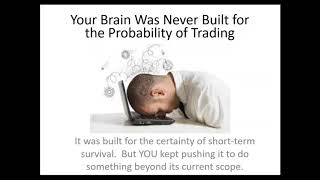
Randy Howell explains how your brain's survival instincts block probability-based thinking in trading. Fight-or-flight wiring makes you avoid losses instead of following the odds. Emotional intelligence and mindfulness can rewire this, turning knowledge into consistent performance.
Questions this video answers
He mentions dates: 'group course starts the 17th... The 21st' (speaker uncertainty noted).
A $150 rebate offered 'through Friday' for signups during the promotion window.
$249 a month (payment-plan pricing mentioned).
10 weeks total, meeting five times during that 10-week period.
An individual course option that includes 10 personal consults with Randy Howell.
Chapters
Welcome everyone. My name is Randy Howell with my trader state of mind. And I just thank you and I'm delighted that you're here. First things first, let's just make sure that I'm not talking to thin air. Okay. If you can hear me, just type yes, a few of you and we'll be good to go. Okay. Just let me know, do you want to make sure that we're there? And of course, ahaha. If you can't hear me, let me know that too. Okay? Okay. So yes, we're good. We're good to go. Okay. The other thing is I always hold questions toward the end. You can ask those questions and if they're of a technical nature, Dolores can answer them. But I want the question. It's just that it kind of. A lot of the questions are answered as I go along, so I tend to answer them as at the end. So good to go on that. And I have a question for you. Why is effective performance such a mystery for traders? You know, you're about to find out today, okay. And you're gonna find out what goes wrong and what you can do to write it. That's the big thing. And we're gonna be looking at there's a mental block. There is something that it's just like, it's like a wall that's there that stops us from seeing what we need to see. We're going to talk about that wall, we're going to talk about that block, and we're going to talk about what is going to be necessary to move from what you know is possible in trading to what you're doing in trading. And let me say this before I get started, there's going to be a very special offer at the end of this course under this program about the group course. Okay. We're going to be having a group course in September, just a little ways away. And so stay tuned. And if you're looking for an opportunity, this is it. And if you can't, if you can't hold on to the end, then I advise you the moment that you get the recording, we'll be sending a recording out to the people who came here tonight. You jump on it because it's something I think will pique your interest.
And it's very time sensitive. So it's kind of like you're gonna have to jump on it or it's gonna be lost. Okay, let's start with this.
Let's do this. You know something, you all know the draw dream that brought you to trading.
And what we're looking to do is to say this.
We know that it's about financial freedom. We know that it's about personal freedom, okay? And in theory, trading seems so doable. You look at it and go, you know something, I get the theory, I can handle this. I see what has to be done. I see that this is not like things aren't going to always go my way. But at the same time I can see that I'll have an edge and I can really execute that edge and the edge is going to come true. I'm going to see it grow and grow and grow. I can do that.
Then as you start trading and after you go through the learning curve of two to five years, you start going, you know, in practice things aren't going so well. You know, I wish I could say that I've taken that potentiality in trading and I've made it work for me and I've become really financially free and personal and personally free also. But at the same time we start noticing that trading is a lot different. And seen from a position of logic and knowledge, trading does seem a perfect opportunity. What do you do? You develop knowledge and you follow your rules. How hard could that be?
Well, the truth is it's really hard. Positive thinking, focus on success, winning attitude, you got that stuff, you got it going and you hit thinking. I'm going to add to the knowledge. I'm going to, surely I'm going to, surely I'm, surely I'm going to find success. And that anticipated success just doesn't come through. Again and again and again you begin to go. A lot of people after about five years are going, man, what's, what's going on here? This, this should be happening. The truth, my friends, is that you have no I idea what you're dealing with. You have no idea what you're asking your brain to do in trading. And because we can't see that, we don't know to change the way we approach. And suddenly that financial freedom seems to be like, just like at the beach, you know, it just kind of all those sandcastles just get taken away when the surf comes in. So what happens, what happens when it gets elusive like that? Well, of course, well, you know, you believe in yourself, you try harder, okay? But the harder you try, the more you keep repeating the same self limiting, stupid things again. It's like hitting an invisible wall. You know, you think everything that you've learned is you try harder, you're persistent, and yet no matter how hard you try, it almost seems like the harder you try, the more you trigger and the less you can follow your rules. And then you're going, well, why is this? I want you to read this. I want you to read in this graphic. The eyes are useless when the mind is blind. Ultimately, the very mind that you trade with is the problem. Okay? Your mind is blind to the ways of trading.
And the mind that you have, being a product of the brain, does not want to change. It's called self preservation. And the markets are unwilling to give you money. It's an impasse. Something has to give and it's usually your money. But what I want you to see here is that this is really about what, what observer, what mind are you bringing to the management of trading? Because your trading accounts can be telling you it's not working.
This is exactly where the vast number of traders get and stay stuck, okay? It happens routinely, every day. Traders keep trying to force their way on the market and the trading account keeps telling you that the markets don't care and that maybe what you're projecting onto the markets isn't the mind that you need to be able to trade. But the thing is that you don't want to change. Oh my God, you know, I have this stuff. I don't want to change. I want to make things happen. I want the secret knowledge.
That'Ll make things go away. I want the Holy Grail. And if it's psychology, then I need to be able to develop the right beliefs.
Got a whole list of beliefs that I'm going to affirm every day and I'm going to pretend I believe those. And the truth is, when you're actually in the midst of managing uncertainty, you discover those beliefs. Maybe you don't believe them so much. So here's the deal.
You've brought a brain to trading that wants to be right and in control. Because that's what you know, that's what your brain is designed to do. The problem.
Is that you're being control of outcome is not an option in trading, okay? The markets are too vast, they're too random. And the very foundation of your human nature of wanting to control outcome, wanting to control environment simply gets you, digs you deeper into the problem.
But you're sitting there committed to forcing your way anyway. You try harder and you're harder. The same success formula. And generally this is why most traders, they come in, they got some capital and they last between three and five years and they blow that capital out and they leave trading. That's the way it's been working Forever. And the real key is, is there's a new crop that starts the whole process again. Oh, this doesn't seem so bad. All I have to do is get it that. Oh, I'm not gonna, I'm gonna, I'm gonna have to work on probability. No. With no idea what it's actually like to train the mind for working in probabilities. Okay, that's not what it was trained, that's not what it developed to do. So we've got this dilemma going on here.
Your brain has you locked you into a way of understanding risk and uncertainty that will never work in trading. And again, don't believe me?
Ask your trading account. Look at your return on investment, look at your equity growth. Look, if you're losing or gaining money, that that trading account is going to tell you how effective your beliefs are that you're projecting onto the markets for extracting capital out of the markets. It's not going to be su. You're not going to be able to BS yourself. The thing is, is it's going to tell you if it's an effective belief system or not. The truth is, is most people aren't and it's reflected in their trading account help. So your brain is literally blinding you to what needs to be done. It's focused on self preservation and it is impossible for it to see probability. And this is the way it is, is your survival instincts are literally killing you when you take a look at this graphic. Listen to this. This is at the very core of survival neurobiology. Avoidance is the best short term strategy to escape conflict. Amen. And the best long term strategy to ensure suffering. Okay, that's where we're stuck, friends. So now you've got a mind, you've got a brain built for the short term survival. You've got an environment, you've got a situation that requires a mind built for long term benefit to be able to engage probability. This is a huge gap. This is the divide between traders who just have no clue of what they're about to get into and traders who make the grade and started recognizing they have to change the very foundation of the way they think to be able to become successful in trading. So ultimately we get it, okay? The brain was never built for the probability of trading. The markets have a lot more size than you have capital to prove the point. Okay? Just for and for all you alphas, for all you have to win, for making things happen, and all of you perfectionists who are doing everything not to lose, this is the undoing, okay? Is you have not only biological predisposition, but your psychology is developed to make things happen or not lose. And that very mind that you bring to the trading arena of probability sets you up for failure. So this is a. For some people, this is really tough, tough to hear. But what I want you to do is let's take a step back just a moment. We've talked about theory, we've talked about emotional intelligence here. We've talked about the neurobiology of the mind. But how do you experience this as a trader? It's really easy, okay? Have you ever experienced the fear of a potential loss? All the time. Have you ever had fear of pulling the trigger? The need to win and not lose? The fear of missing out on profits? If you take a look at those. And I want you to look at the avoidance of fear in here. And I want you to think about it from the emotional brain's perspective, right? Rather than your logical perspective to the emotional brain. If you can't pull that trigger, okay, that means you stay out of that trade and.
You live that day. You live another day, you live another moment. That's all the emotional brain's interested in. That's what fear is all about. When you start seeing revenge, trading anger, what do you think's happening? What happened is that you've taken a loss. It's not fair. You're going to get it back. You're going to punish the markets overconfidence. Okay, I can do this. Look at me. I've won several stuff. Look how much money I've won. I'm all really puffed up, man. I'll tell you. I've got it now. I've got it now. These are all short term survival strategies that served our caveman ancestors well. However, your brain was designed for survival in a caveman's environment. It is not designed for the environment of trading in probabilities.
Okay, that's the piece I want you to get. And you keep doing this over and over again ultimately, so I'm hoping you get this picture. It's really interesting because very few people just, they say, yeah, yeah, I hear you say it, but it doesn't reach the part that people need to hear.
So that you're willing to do it. And here's our buddy, Charlie Brown. Okay, how many times has he done this? I've been watching this for probably 40 years. Lucy always takes the football away from him. Okay, the deal's this. The survival instinct.
Is hardwired, is lightning, smoking fast and overpowers rational thinking in a Heartbeat. Rational thinking actually takes about a quarter to a half a second to happen. Once information comes into the system, into the brain, and a decision is made whether or not to route it the short path to fight flight, which is what's happening with almost everybody, or going, okay, I'm going to route it up to the rational brain. If it routes it up to the half brain, that takes a half a second to go to the amygdala. And to fight flight takes nanoseconds. And when you under stress, okay, what happens is the default programming triggers and you keep doing the same thing over and over again because it's short term survival, even though it's hurting you long term. So now we begin to see it. Okay, now that's the bad news, friends. But let's take a look at this thing.
What do you got to do to start changing the way you think, the way you perceive, and the beliefs about uncertainty and risk? How do you go about really doing that other than just having a bunch of glib affirmations that you put up and you repeat and you, you fall into the line that you're going to train your subconscious into believing these things. Unfortunately, you're not training the subconscious to be able to believe those things in the environment of risk and uncertainty. Okay? That's where we need those beliefs. So ultimately, what we're looking at, the biggest, hardest thing is for you to acknowledge that what you're doing is not working. And it's not going to work. Okay? That's the hardest part. Until you can come to that moment, instead of telling another convenient lie, another alibi that says, oh, it's just right around the corner, there's a new trick, there's a new teacher.
There'S a new room, there's a new whatever, okay, we're talking about, all of a sudden we realize, you know something. Ultimately.
I'm the problem. I'm the solution. My methodology works perfectly fine when there's not risk, when I'm not risking capital there. However, when I risk capital, all those instinctual stuff comes in and cracks in and suddenly I can't trade anymore. That's what we're talking about. Okay? So ultimately.
What we're about to do is everything that you see from here on out is taught in the group course that we're. That's coming up in September. Okay? This is the powerful stuff, because ultimately the group course is a process that step by step teaches you to empower the very brain mind that you brought to trading that certainty based into a probability and turn it into a probability based mind for effective trading. And those elements that we're going to be looking at are emotional intelligence. You really need to understand emotions. You have no clue what emotions really are, I promise you, or you would not be trying not to have them. You would see going, boy, I need to be, I need to learn how to use these things. The second thing is once you begin to grasp what emotions are and how they affect thinking, you say, you know something, I need to be able to regulate emotions so they don't overwhelm me. Just, you know, willy nilly. The third thing is we're going to be looking at the development of mindfulness. Being able to awaken an observer that can step back out a thought and recognize that you can actually design the mind that engages uncertainty rather than being stuck with the mind that you got and brought to the dance. Big deal. And in that, with that mindfulness, with that observer, you begin to look for the historical self limiting narrative that dwells within you. More about that later, it's very important. But more than that, as you begin to develop the empowered elements of your person, of your human being, you start discovering that in the same way that there's some, there's fear and there's criticism and judgment that live within you and your mind, there's also incredibly empowered elements that can be brought forward into working awareness that literally give you the edge, that give you the mind that works with probability. And the last thing is becoming intentional. You know, a really well trained trader, when they realize that they cannot get their mind and their act together to trade for whatever reason. It could be they had an argument with their spouse. It could be that they've just gotten, they've just taken a big win and they can't get their mind right again. What they do is they don't trade. They realize that no, I know how to produce this mine. I have a process for getting into trader state of mind. And when I'm not there in that mind, I'm not going to be so silly as to trade because then I would be gambling. Okay, this is what we're going to be looking at first thing, emotional intelligence. First of all, it's really, you know, you don't have emotions, okay? They have you, you don't have survival instincts. They have you. And the emotions overpower thinking very easily. Okay? The challenges is literally facing the uncertainty will always be there. And I want you to read this. And this is that, this is actually, this doctor, this scientist is actually talking about an emotion. Okay. As our feelings change.
This mixture of peptides travels. I want you to understand what she's doing here. She's saying that emotions actually are peptides. They're actually chemicals, they're actually, they're not feelings, they're not like touchy feely. They are literally chemistry. They're traveling throughout the body and the brain and they're literally changing the chemistry of every cell in your body, preparing you for fight flight, preparing you for concern, preparing you for being calm. The key is, is that what happens with most traders who have not developed their emotional intelligence, they don't know how to do this. They are just leaving themselves just to drift in the emotional currents of trading. You can't do that and make money. Emotions are not your enemy. Your job is to become smart in knowing how to use them to create the mind that trades. Okay? And I like to use. This is an image from Inside Out, a Pixar Disney film that I often refer people to so that they get a really good idea about what emotions are. And ultimately emotions are ancient. They are actually biological action potentials that coordinate action between the organism, that would be you, the trader, and the environment that's the market. And what they do is they take over mind, they create the mind. And if you see this movie, what you'll see is you'll see these five primary emotions right here. And they're not necessarily the ones that I use mostly and when I'm training, but this is the ones they use. These are the primary emotions. And ultimately what you're seeing is that.
They will actually form cooperations with each other. They'll be competitive with one another. And out of that mix of emotions, of all those peptides comes your thought. That's what you're trading with friends. Okay? You're not trading with your mind, you're trading with these chemistries. And you're going to have to learn how to work with them, really deal. Because what you have to get is that all thinking is emotional state dependent and that you are not a rational being.
What you are is a rationalizing being. Your left brain and all that wonderful logic and rationalization that you do simply creates alibis or explanations to support what the emotional brain has already decided. That's like when you decide not to get into the trade, you can't pull the trigger. There's good reasons for it. You get out of it, suddenly the emotion's gone, suddenly logic's back in the queue and you're going, why didn't I get in? Because you didn't know how to manage the emotion. You didn't see it coming, you got ambushed by it. Wouldn't it be sweet to be able to catch the emotion before it hatches and contaminates the mind? Wouldn't that be a great deal? Well, that's what we're going to learn how to do. The second thing is you're going to have to move from emotions as psychology to emotions that are biology, that produce a psychology. And the first way to start doing this is you start regulating the intensity of the emotion. It's biological. Ultimately, we teach a person how to start observing their body. The tension you hold in your body, the heartbeat that you feel, the way you breathe, are all components of the emotion. And what most people discover when they start observing their body, looking for emotions, they discover that the emotion has compromised them a long time before they ever thought. And they had no idea that they were so tense. They had no idea that their heart was pounding. They had no idea that they were holding their breath. They're just accelerating. They're putting gasoline on the emotional fire. And no wonder they can't produce a trading mind. It starts with emotional regulation, friends. That's where it starts. Without being able to manage the intensity the emotion through regulation, you never get to the mind. Mind is where all the really cool stuff is. But until you can, until you can regulate the emotion, which if you have ever pull, not pull the trigger, if you have ever had fear of missing out, if you've ever done revenge trading, you're not managing the emotion. And this is job one. This is what's taught in the course. Now, ultimately, what you discover.
Is that traders lose composure before they begin setting up a losing situation. They never see the emotion coming because you don't know what to look for. And by the time that you notice the emotion, you're already toast. This has to change. We teach you literally what to look for, and you begin to be a completely different kind of observer about emotion. You know, you can see it coming, you can prepare for it. It becomes powerful. That gives you the opportunity that you're really, really looking for.
The next thing that you learn is mindfulness. Literally, you're beginning to awaken the observer of the self. Have any of you ever been in a situation where you had only wished that you knew back then what you know now? And that you know that if you'd only known that, things would have turned out very differently? Of course you have. It happens every day. That's observing. But the problem is it's waking up way too late to make a difference. Imagine that if you were able to wake up and you were able to observe yourself, you're thinking your beliefs in real time.
Okay, you wouldn't be repeating the same old dumb things over and over and over again with this skill. And what you discover in what you really begin to discover is that a lot of people, this whole mindfulness stuff kind of trips people up. They think it's weird. It's not. It's everywhere. You know, it's from the Zen Buddhists. You can also see it in the Christian Bible when St. Paul is saying, you know something, I don't know what I do. I try to do what's right. But every time I try to do right, I do exactly what I said I wasn't going to do. I know there is a part of me, my truest self, that wants to do the right thing, but that I can't do. What you're seeing is he's producing an observer of his mind and he's seeing where he's tripping up. The same thing happens in mindfulness is particularly in, like with Zen, where you're stepping back and you become watcher of thought. It's powerful thing. And you begin to realize, oh my gosh.
I am not my thoughts. That's correct. You are not your beliefs. This is just simply one potential organization of a self that has occurred. And that observer of yours that's asleep has just fused to the thoughts, thinking, oh, those are me. And until you can step back out of that and notice that, oh, I'm having these thoughts, they aren't me. But boy, these are powerful thoughts. You're stuck in the old patterns. Powerful stuff, powerful stuff. And basically then you begin to recognize, as you begin to observe and start noticing all the conflicts going on inside the mind, that the brain is actually a rival emotional programs that had duked it out and have formed a self in the mind that you call you. But the truth is you're going to notice that all thoughts, you start noticing there's conflict, like who is the fir who has not been conflicted about a trading decision. There's all sorts of different viewpoints within the mind until you learn to isolate them and know which ones are the good guys and which are the bad guys. You're just kind of basically boxing with both hands tied behind your back. This is an education that has to happen. You know, ultimately.
This is the default programming, okay? You have to be able to see that it's not you, that it's really just simply one organization of a self. That's all it Is this is when people in this group course start going, aha, aha. I know I've. I've experienced this stuff. I've experienced these arguments and I've experienced this plethora of different viewpoints in my mind when I'm trying to make decisions.
Now let's take this thing that what, what. I'm going to bring my good friend Yoda in here for a cameo. And what I want you to recognize is this. Listen to what Yoda says is what is fear? The non acceptance of uncertainty. Okay.
What, what if you were able to step back and start noticing, how am I not accepting uncertainty? You'll see it again as results in your trading account, but you'll see it in the actions you take. Ultimately, what we discover very quickly is that we need to redesign the organization of the self that trades. Okay, ultimately you're gonna have to move from experiencing discomfort when exposed to uncertainty to being able to experience a sense of curiosity, a sense of concern, but not fear. The wiring in your system is the moment that your brain experiences uncertainty, experiences vulnerability and confusion. Out of that confusion, the direct course is to fight flight. The brain doesn't like to be in that confusion. Yet.
That'S where the traitor needs to become comfortable. And that vulnerability. Don't know if I'm right, don't know if I'm wrong.
Confusion. It looks like the probability is on my side, but the truth is I really don't know for sure.
And you begin to say, okay, I begin to understand. Fear is the non acceptance of uncertainty. Okay, this is where we want to go, friends.
Then what we do is we turn that mindfulness to tune into your historical narrative about risk, about money.
About winning. And all of a sudden you discover is that at the very core of these conversations, there will be a sense of inadequacy. There will be a sense of not mattering unless I win. There'll be a sense of unworthiness. Do I deserve to make easy money or do I deserve to make money? Don't I have to work hard and deserve my money and power? You know, the thing is, is we get into these things, particularly when you get into the trade, you're managing the train and that thing just bouncing all over the place. And you really, truly experience, oh my God, the powerlessness. You know, I really want to have power. I really want to make it do something. But the truth is, I can only watch. But imagine if you were watching from calm discernment rather than from fear. Wouldn't that be. Wouldn't that. Wouldn't that be exceptional. And inside you there is this argument. If you've ever had, if you've ever beaten yourself up, you know, if you've ever said, I'm going to prove it to you, I'm going to show you, I'm going to do that. You're hearing these internal narratives going on inside your mind that are being projected onto the markets and you're getting feedback again through your trading account, whether or not they're effective or not. And as long as you're in self doubt or overconfidence, my promise to you is that the mind's not prepared to trade well in probability. So this is the original adaptation. It's also the one that has to change. Ultimately, what we know is it's time to adapt. The wonderful thing about human beings versus other animals is that my dog, my dog is going to be a dog. He's going to dog around, he's going to chase the deer, he's going to chase the squirrels, he's going to chase the rabbits and he, he's just going to do that.
Getting outside of that space of possibility called dog is not possible for him. However, for us, we can actually adapt by design. We can actually see, you know something, this isn't working for us. I see the evidence in my trading account. I need to look down and find out what the belief system is, what the emotional reactions are, and begin to adapt them into another organization of the self that truly can handle the probability that I have to be able to do with trading. That's what we're looking for. And by the way, this stuff's not going to go away just because you wish. You're not going to learn knowledge. This has to be reprogrammed. And fortunately, we teach you how to do that. What we're looking for, we're looking for a mind that meets uncertainty.
And has curiosity, has concern, okay? Has discipline.
Has courage, can soothe itself and is impartial. That's the mind projected, as you might see in this image, is that this guy's in the midst of uncertainty, in the midst of confusion. But what he's done is he's not allowed the instinctual survival instincts to trigger and to take away mine. This is what we're looking to do because ultimately, again, remember the programming that you come stuck with when it experiences this level of uncertainty and the vulnerability associated and the confusion it's going to trigger. It's going to trigger to fight flight to the survival caveman stuff. What we want to do is retrain it for this okay, that's where we're going. We want that mind to be able to meet uncertainty and think about it. Think about surfing. It's a really great analogy, is that, you know, the human being is possessed to want to control outcome or possessed to control prediction, to control all that stuff. When you look at this guy going through this tunnel, do you think he controls the wave? No. That wave is gigantic. What that surfer is, is he master of himself? The wave is just being the wave.
He's not making it happen. What he's doing is he's controlling the mind that he brings into that moment of performance.
Is he going to wipe out? Is he going to go through that tunnel? We don't know. What we know though is that if his mind falters, he'll lose it. What we do though is that if he maintains mind, the chance of probability of really good ride is remarkably enhanced. And this is where the edge is in psychology is that you move away from the attempt to control outcome and move toward the ability to manage the mind that you bring into the moment of performance. Friends, that's what you can control. You can't control what's outside of the self, but you can control what's going on inside. This is where you really are controlling what you really can control. You're letting go of the illusion of control that all these sappy toys you've got give you. But ultimately it comes down to this is all probability, no matter how probable something looks. The same time when you, once you get into that trade, you don't know. And you have to become comfortable with that no matter what it does. You have to have the comfortable mind that can get out early and eliminate losses early and be able to say if it does, you go your way, I'm good, I can take it to target or beyond. So that's the mind we're looking for. And we're saying that it can be built. We're saying that instead of the instinctual stuff, we're saying that this is when it's built from discipline, courage, self soothing impartiality. This is the way you engage uncertainty. You're not making fear go away or anxiety, but what you're doing is you're downgrading it to a level of concern where you're focused, you're ready, you're there, you're zoned in, and you're in emotional control because you have freedom of emotions and you've produced the emotions that produce the mind that manages the moment of performance. Friends, this can be taught instead of you sitting there suffering every day going, when is this going to make sense to me? It can be taught friends.
So we get it is the trading mind is rooted in discipline, courage, self soothing impartiality as it engages uncertainty. How do we teach that? I can tell you. This is what we use, a process where we go into memory. We actually find a memory of a time when these things really were present. And we teach you how to reorganize that memory.
So that you have access to the emotional programs.
Once you do that, we teach you to realize, okay, when understand it's those combination of emotions that is giving rise to the mind that you're bringing to trading. Then we teach you how to use symbolic representation to be able to find a symbol that can help activate that emotional state. Again, this is part of the proprietary information that we teach in this course. But ultimately what you do is you recognize that the survival instinct is rooted in fear and aggression when exposed to the threat of uncertainty. And you realize that you're going to have to be able to manage mind and heart, okay? And it's like Lao Tse said, mastering yourself is true power. And the truth is in trading you're really going to have to, okay.
So this new month, new mind just doesn't happen. You know, it's not something where a lot of people will listen to my lectures and my webinars and they're looking for that tip. They're looking for that specialized knowledge that if they know that knowledge, then everything they've got, the psychology know, you have to be able to retrain neuro circuits.
It's not just some rush of an idea that changes everything. That's Hollywood. No, what happens is once you have that aha moment, you still have to retrain the brain to produce the mind that can manage uncertainty. So there you go friends.
The group course teaches you how to develop this step by step. And my question is, what's your trading account telling you? Is it saying, well, you know something, you could stand to get your psychology in order to be able to handle the method you have. Because the truth is, despite what you would like to think, the trading account's been stuck for a long time. Are you blown through accounts? Ultimately when you see that you're going, I need to be able to redevelop the mind, let me find a teacher. So ultimately.
My question to you is this, is that.
How much has it cost you to not develop your emotions in mind for trading? Okay? I know people who will say 10,000, 50,000, 500,000, 5 million I've heard that. But what I would also say is that's just losses. What I'm also asking you to look at is saying, what does it cost you in lost revenue? How many times have you just. Simply because you couldn't manage the emotion, you got out early and took a skinny profit. So you were you as marginal and you be. And you see that you've been leaving a lot of money on the table. You get it and you go, wow.
Man. I'll tell you something. This mind stuff is really important, and it is. So my question is this. How do you develop the mind for training? Wishful thinking. I know people who do that. Dogged pursuit. I know people who do that. Or investing in self development, which is best. I can tell you the learning curve with finding a teacher who could show you how to develop this stuff is a lot more sane. Okay? And what I want to do is I want to make a special offer to people who sit here and go, you know something? I get it. It's time for me to do something about my mind. I'm ready to go. I want something to go. What I want to do is give you a special offer. It's short term. It's very time limited. Our group course starts the 17th. Is that right? The 21st. However, today and tomorrow, if you sign up for this course, we will give you $150 rebate. Oh, through Friday. I'm sorry, Through Friday. This is Wednesday. Okay. Through Friday. So you've got three days. We will give you $150 rebate. You'll get that rebate on the. And this is all done on the payment plan because it's 249amonth. And you get that rebate on your last payment. So it's actually a rebound bait. It's not a discount. And PayPal, we can't do it on PayPal. Okay, now what I'm asking is, is it time for you to do something about the mind that you're bringing to trading? If it is, this is the very first time we've ever offered anything like this, but we thought we would try it. And if this is a time where you're looking for a deal and you have to have a deal, this is it. Friends. Okay. First time we've ever done it. And this thing teaches you step by step, over a period of 10 weeks, meeting five times during that 10 weeks, how to go through this process and develop the mind for probability. Okay. And to go to the schedule and get more information, you'll see that in the blue, right above the table Rock Mountain, right in the midst of it, you'll find more information about it. Look it up. And also, by the way, we also have an individual course that is far more comprehensive and personal, but that's not what we're talking about tonight. But if you're interested in the individual course, what that basically means is that it comes with 10 consults personally with me. And if you're interested and you're going, I don't know, what should I do about any of these? Get a free consult with it, Go to the website, hit contact us, and Dolores will schedule time for you and I to talk. Okay. But the clock is definitely ticking. Okay. On the. On the. On the rebate, I encourage you to take advantage of it. If you've come to recognize that there is something missing in your trading and you're tired of BSing yourself and you realize that it's actually time to take responsibility for the mind that you bring to trading. So I want to thank you guys. This has been really fun for me, and I have time for questions. If you have questions, please type them in. Okay. And we'll wait here for a few minutes and you'll get to hear me talk for a few minutes while we see if anybody has anything to say or ask. But what I. Ultimately, what I encourage is this, is that trading is really about platform methodology and psychology. What most traders do is they truly don't understand how important the psychology is. Okay. And because of that, they just absolutely blow themselves out. Okay. And. Okay, we're asking. So that. Can you put that in chat? Okay, we're trying to. Okay, we're dropping back. Okay. So. And I think right now that's the only question I see. The deal that I'm asking of you is to recognize you may not like psychology as something that.
Has to be done.
In trading, but the truth is, is once you have knowledge of trading, it's about psychology. It's about performance. It's kind of like if you go to the golf tour and go to the PGA and what you realize is all the guys there can drive a ball like crazy, they can putt, but ultimately, there's only about 10 really winning players.
Yeah, we just sent it. We. It's in the chat box. Box now. So you can take that thing down and lots easier. Thank you for that question. That was actually a very good question. And what you'll notice in the golf, though, is that there are going to be just a few players who are the money players. And ultimately you will Discover that they have developed that. Okay. Is this neural. No. Goodness gracious. Yeah. Let me. I'm sorry, is this neuro linguistic programming? No, neural linguistic programming breaks down under pressure. It's really good for sales and marketing type things. But this is actually coming out of emotional intelligence. My work began with working with violent prisoners and at risk youth. I ran groups with anger management and emotional control. That's where it started a long time ago. This has more to do with learning how emotions actually operate, learning how beliefs actually operate. And neuro linguistic programming is pretty old and I am out of. I'm a therapist by training and we never used NLP when working with populations. And that should tell you something. Okay.
And so no, this is anything but neuro linguistic programming. Do I use an anchor technique? Yeah, but they borrowed that from emotional intelligence anyway. Okay. But no, this is not neural linguistic programming. Far from it.
Anyway. I don't see any other questions.
I have thoroughly enjoyed myself and.
Yeah. And we will be sending you a link to the recording tomorrow morning. Okay. It'll go to the. It will be put on our website and it'll be the second, I think the second one down. Get it and take a look at it, really study it. Because this is, this is really powerful stuff and this is really more about biology generating cognition that it's the emotional intelligence work that, that I'm known for. Okay.
Thank you Bridge. Both. Okay. Randy, you mentioned at the beginning of the presentation that the mind will conduct short term avoidance at the detriment of long term. That's correct. Success. What would be the right synergist approach to bride Both would. First of all, it's really the what, what you're doing is you are managing the intensity. You are managing the intensity of the triggering of the emotion from the survival instincts. It's not that you don't want fear, you just don't want fear defined as biological threat. You don't want anxiety as catastrophic expectations of the future. What you want is that energy, emotional energy to show up as concern where you're focused, you're prepared, you're ready, but you're totally together in mind. That's what you're doing. And it's kind of like in trading it's the short term that is dangerous. It takes over. But if you manage it, you allow it to the party. And it's what I actually call. I actually call this short term survival instincts. Orphan. Orphan is your amygdala as a anatomical place and it's literally something where you realize that it's going to be your partner, whether or not you like it or not. You can't not have emotions. But what happens is that the amygdala can begin to trust higher brain function, or what I would call sage and ruler, discipline and impartiality. And in that trust, what happens is that the emotional state of, from what we call caregiving or self soothing calms the fear of the amygdala of the system down so that it becomes a participant in the movement. You want the, you want the alert of fear, you want the alert of concern, but you want to have it calm down so that you're acting from long term best interests in trading rather than short term best interest which will get you out of trades. This have you revenge trading, it'll have you doing lots of things. But that's where the thing is, is that the limbic system, the emotional brain, that short term focus.
Has enormous amounts of communication wiring going into the neocortex, the neocortex, all that rational thinking of yours has like two telegraph wires going back into the limbic system of the emotional brain. Ultimately what you're having to do is you're having to calm, calm, calm those impulses to move to fight flight down. And it can be done. It's not easy, I'll be the first one to admit it. But when you marry those, what you get is, you get the alert, you get the I need to be alert here that you want from fight flight. Okay, survival instincts. But what you do is you, you, you wire it so that it goes to the new brain where the logical thinking happens rather than the low path that goes to fight flight. That's really the, that's where the marriage happens. It actually happens at the hippocampus. So that may be a more of a technical answer than you want, but that's it. Well, friends, I thoroughly enjoyed myself and I encourage you to take advantage of this offer, take advantage of advantage of this moment to take your trading to another level and recognize. You know something.
I have totally neglected developing the mind that I bring to trading. I thought I could just, just come with any old mind and I could use all my knowledge. Nope. You have to be able to manage the emotions to produce the mind that trades. And that is the. Until you get that you're gonna have. You may have tremendous knowledge of trading.
And you may be a marginally profitable trader, but you're not going to make it to the level that you want to be. So anyway, regardless.
May, may the trading gods bless you. And the truth is my hope My wish for you is that you find success, particularly personally as a human being. And if I can help you, I would love to have that opportunity. So take care and God bless.









