The Missing Link Mastering the Emotional Storms that Wreck Your Profits
Randy Howell explains why traders sabotage profitable strategies: evolutionary fear and survival instincts override rational thinking. He shows how emotional regulation and mindfulness can rewire your brain to trade on probability instead of panic.
Chapters
Welcome, everyone. My name is Randy Howell and I welcome you. Glad to see all of you here in this July. And here we are in July. And the first thing I want to do is want to make sure that everybody can hear me. If someone would just type in a yes in the box there to let me know that, yes, we are in the. In the spheres and we can be heard. Okay? Yes, thank you. Thank you very much. Okay. You know, what I want to do today is I want you as a trader to start going, you know something, I see that this is possible, but the thing is, is what. What happens with these emotional storms, these things that just hijacked me out of nowhere and suddenly I'm not doing what I know I'm supposed to be doing. Fact, I'm probably doing just about the exact opposite to what I know I should be doing. What's going on here? Okay, and how do we change? That's what we want to explore.
And it starts. It starts right there. It seems so simple. If you got into trading through social media and you start seeing those big, gigantic numbers people are claiming and stuff like that, you know, it's really hard for the greed and the lust not to kick in and go, I can do this. I can. I could just take a thousand dollars and I can move it up into millions. And you do all that stuff, and it seems so simple. And you're seeing these photographs of people behind boats and huge cars and all that fancy stuff. You think, I can do that? You know, a caveman could do this. I'm a smart person. So, hey, man, this ought to be good. And so you're sitting there and you go, wow, okay, I'm buying into this. I don't want to work for the man anymore. I want to have financial freedom. I want to have personal freedom. Freedom. And, boy, this is the ticket, okay? And you ignore all that stuff, that there's a 95 to 98% failure rate in trading and that, oh, I don't know, 90% of those traders are gone in three years because they depleted their capital somehow. You don't listen to that. And what happens, though, you go from that euphoria, man, oh, man, I'm ready for this. I'm going to learn this stuff. I'm going to learn all this stuff. I'm going to have the knowledge, and. And with that, knowledge is power. And I'm going to. I'm going to be a consistently profitable trader and have my dreams. Then you step into the minefield of trading, and it's different than what you imagined.
It's not nearly so easy to make decisions under pressure than what you thought. And you know something that, pushing that will to win, that, you know, I'm going to make things happen, I'm going to make everything perfect. So I, so I'm not, I'm not going to lose. It blows up in your face. And you discover is literally the skills that used to work for you somehow are no longer working for you. And you've got a problem and every time you try to fix it, you just dig a little deeper. That's the one we're talking about. It's kind of like right here. And you'll discover a lot of people talk about me and the voices in the head. You'll learn a little more about basically what these voices are and what the internal commentary, internal dialogue is. But right now it starts with, hmm, in fact, you know, you just keep making the same mistakes over and over again and you don't understand why. And so really the key, though, is you know better, you know what should be done, but you can't do that. And what you are looking at, my friends, is something that if you're going to become a professional trader, you're going to have to solve. Not only solve, you're going to have to master something that you probably don't even consider.
That you're missing anything, but you are. Fundamentally.
Most people are trying to solve a problem that they do not understand.
And they're trying to solve a problem in a way that doesn't match up with what the real problem is. And here.
What you're looking at in this graphic is basically that hominoid right over there on the left, that human being sitting in front of his computer. Very little difference in terms of genetics separates them. Understand, for us as human beings and bonobos, the cousins of the chimpanzees, there is 0.2 difference in our genetic makeup. We're carrying all that from six and a half million years ago all the way back to when life really starts showing up in animal form over 600 million years ago, we are still tuned. We've got primal, instinctive, defensive mechanisms that are built to keep us alive in the short term. And ultimately, what you're doing, the way you're treating this, we generally are throwing gasoline onto a smeltering problem and it blows up. And you don't, you don't understand why. The basic thing, you don't understand the nature of the problem.
But when you start seeing.
The repeating patterns, okay, that's when you know the Primitive brain is involved because that primitive pattern is something that the limbic system built so that when it engaged, when it engaged uncertainty, it was automatic. And the way it's happened and what happens is you're trying to push that limbic learning away and just outthink it. And what you do is you keep sabotaging yourself. So what you're truly looking at is you're looking at emotionally directed neural circuits that are firing in response to limbic learning. And that limbic learning is all about.
Survival in the moment, controlling outcome, being right and for God's sake, not wrong, okay? And all of a sudden you get into trading and you realize, oh my God, I can't control that. Yeah. And when you, when you, when you send that emotional brain out of control, it starts making the same stupid mistakes over and over and over again.
And a big deal is to recognize that limbic learning is not logical. Friends, you'll find out later is that logic is an illusion itself. The thing is, limbic learning is emotional. And for me, understand, for me, when you're talking emotion, it's not psychological, it's not a feeling. You know, from my standpoint, an emotion is a biological action potential that coordinates activity, action between you, the trader and the environment. That would be the markets. When there are changes in the market, there are automatically emotional responses in response to those changes. They are going to be pre programmed. They're not going to be in your awareness, they're going to be operating below your awareness in the emotional brain. Brain, okay, Taking a loss, understand? Taking a loss to your caveman brain literally is being consumed, okay, by another animal. You take a loss, you're dead, you're somebody's meal. And this is what you're looking at this guy encountering a bear. And all of a sudden all that stuff's there. Thinking is the caboose, okay? Emotion is the locomotive. That's the big deal that everybody really needs to get. Because actually what you discover is this emotion controls thinking. Now in neurobiology what we would say is that all thinking is emotional state dependent. And what you're doing when you're saying, okay, I've got my plan and I'm going to trade my plan, and then you get into the situation where you start chasing losers or, or you get, you get sucked into over trading and stuff like that, what you're really actually looking at is thinking. But the problem is another emotion other than the one that you need to be there is giving rise to that thinking. You know, you might have the fear of Loss there, anxiety or fear, clear and present danger. And it's altering the kind of thinking and it does not want to lose. And you end up chasing losers. Oh, it's going to turn. It's going to turn. It's going to turn. No, that's your primitive emotional brain forcing solutions and it just knocks out the thinking brain. And as you, as you do that, what you discover is that, yeah, thinking just is way overrated. You cannot think your way out of this problem. You're going to have to teach yourself a new emotional response to uncertainty. And my promise to you, based on evolution, it will be unnatural and that you will have to maintain it. Okay? Because it's not what your body and brain were designed to do the first time by natural selection, but you have the ability of changing that. So we've gotten this far and then go, hmm. Until you do that, you're going to be imprisoned, friend, by the emotional patterns that have been established by your emotional brain to uncertainty. And I'll give you a hint. When the brain engages uncertainty, the emotion that's associated with that uncertainty is fear. And out of fear can come aggression. So there's your over trading, revenge trading and your fear of like taking losses, your fear, your fear of entry, all that stuff. But the thing is, is that thing is sitting there and that's why you're not addressing this part of it. This is what has to be done. More willpower is not going to change the deal. It only when you keep trying to use willpower against it under stress, the more ingrained pattern just simply fires heavier and heavier. So the mechanics of this adaptation existed long before thinking arrived as a possibility. You know, basically your thinking brain grew as a tumor out of the emotional brain. And consequently there's lots of communication wires going into the thinking brain from the emotional brain. But there's kind of like two 19th century telegraph lines going from the thinking brain back into the emotional brain to get out of those life patterns, out of those patterns responses to uncertainty, you're going to have to learn to change that. And understand when your brain engages uncertainty, it fills vulnerability. Out of that vulnerability comes confusion. Out of that confusion comes the knee jerk reaction called fight flight. Okay? It doesn't matter what kind of plan you have at that particular time, you're never going to be executing that knowledge because you can't manage the emotions that give rise to the thinking and action that you're trying to do. That's where we're going, friends.
Now.
Here'S one of the biggest things you really really need to learn is that you're not a rational being, okay?
You're actually.
An emotional being. And that emotional being will rationalize.
The chance of reason showing up in the midst of conflict, in the midst of uncertainty, is pretty rare. You have to have a really well trained brain. And the thing is, it's what everybody is driven into trading by, is, oh, I can make a lot of money, okay? And probably. And that certainly sells a lot of beginners into this stuff. And it's something where certainly I have. I've profited from this myself. But the key, though, is to really recognize, oh, my God, I'm not a rational being. I've been pretending I am. And the truth is, Rene Descartes was wrong. Spinella was right. Rene Descartes said, I think, therefore I am. And Spinella, in the 16th century, had basically already figured out that we were emotional beings. And here we want to be able to say, you know something, I need to be able to manage the flesh, okay, in order for me to get a grip on the mind that trades. Because my lust for money, my desire to make money is in fact, going to be in a roadblock in the way to produce success in trading.
So.
Have you ever.
Have you ever thought what's really wrong? The truth is, you bring a brain to trading that is just simply not up to the task. Understand what your brain evolved to do. It evolved to control environment and what we would say is control outcome today. It evolved to be able to not lose again. Not losing was deadly, okay? It was consumption, and winning meant that you prevailed, lived another day, okay? That was a big deal. Those were very powerful, powerful motivations. And it was a really great illusion for our caveman ancestors to believe, even though probably 95% of them died. What you're looking at is they had to believe they were in control. They had to do that. And it shows up. It shows up from way back then to right now in the trading mind that you bring to trading. And the key is, is it was very successful back then.
Okay, not so now. Let's take a look at what the emotional brain actually looks at when it looks at uncertainty. Yep, here it is. And you're looking at it, and you see uncertainty, the potential of loss and potential of loss. To the caveman brain, you have means that you're dead. And in this particular case, you can understand why this man really feels threatened. He's got a really big cat in front of him that actually used to hunt us down. So you've got your brain on this.
Hooked on this, winning and not losing as survival strategies. And you take it to trading where guess what in trading is you're going to lose a lot. Really good traders.
Are really good traders, large in part because they've learned how to lose. They've learned how to lose well. They've learned how to make sure that loss does not get magnified by them triggering to wanting to beat the saber tooth tiger. So we've gotten that, we're saying, okay, this is what the problem is now. Not only that, look at this way, let's talk about, let's talk about that alpha, the one that says, oh, I want to win, I'm going to go out, I'll make things happen. Yeah, I don't mind taking risks. Well, this is what capturing food was like 30, 40,000 years ago. You're looking at a woolly mammoth, a huge mastaton, and you're looking at a group of people. These are little spears they have, okay, and they're, they're actually going in to attack that guy. Now how many of them do you think dies in doing that? A lot. To take down an animal like that, you have to be pretty sophisticated paramilitary organization with spears. And you also have to have a high tolerance to risk. Some of you are going to die. But the truth is, is that when you kill that animal, you feed your village, your tribe for a long time and you build a lot of prestige and you also, you also get access to the babes. You know, that was part of the deal. That's why you would risk so much. But you had to be really high on testosterone to be able to take on a moment like this. I'm not willing to take on a moment like that. And yet our ancestors had to. And this, my friends, what I want you to do is this is what you're bringing. This is your desire to make money, win and not lose. Shrinking, you know, you're shrinking your capital. But to him dying, this is the power the emotional brain has over your trading. And the key is this is what has to change. It's not your fault. There's nothing wrong with you, okay?
What's there is a brain that was adapted for one thing. Being asked to do something completely opposite, that's its worst nightmare. That's what we've got here. You're going to have to produce a really unnatural mind. And the question is what you really need? The glib answer is what you need is a probability based mind rather than a survival base mind in order to be able to deal with the uncertainty that's what you need. That's what really great traders have. They don't have a survival baseline. They have a mind that thinks in probability. They know they're going to be using a lot, losing a lot. And what they're going to be doing is they're going to be keeping their losses really small. That's what their job is. And then when they get lucky, okay, they're going to maximize the profit they can get out of that. And the real question is, how do you do it? Okay, now we're going to go from what I've tried to do here, folks, is I'm trying to define the problem you have in trading in a way that actually.
Makes it possible for you to be able to redevelop the mind, the brain, for managing uncertainty in a very different way than the way you came to the game. Okay? But understanding the problem is the first step on the journey. Without that, you're stuck. So the first stop, where is it? It's with emotional regulation.
You'Re going to have to manage.
First the triggering of an emotion and its growth before it pushes out into action. Remember, biological action potential. Its job is to see something in the environment, say threatening and trigger immediately and have an action that it's already producing evasive or aggression, okay? And if you don't do it, if you try to overpower it, that little, that little half a pound in your brain is going to become an 800 pound gorilla. Okay? So what we want to do is how do you learn how to regulate, how do you regulate an emotion? Well, the good news is, this is the good news is that emotions are biological, okay? And because they're biological, they're going to have a biological signature.
And one of those signatures is breathing and one of those signatures is muscle tension. If you notice, if you, if you're trading tomorrow, watch yourself. Get yourself a mirror. Better than that, get a video feed where you can literally watch yourself. And watch yourself as you go into really where you commit capital to risk. You know when you have that moment of where you're going, okay, okay, yeah, it's confirmed. I've got all the confirmation I need. And what now? I need to place my order now. Okay, there. Or you're in the trade and it's bouncing around, bouncing around, bouncing around. All of a sudden what you notice is, boy, you're not breathing at all. Your muscles are tense all over the body, particularly your jaw, particularly your neck, or you might be.
That is emotional arousal. And it's triggering and it's revving up the emotion, getting it ready for action. What you want is to be as calm and cool while you're hunting as this leopard is right now. He's hunting, he's waiting for the forest to give an opportunity to him. You want that. You want to translate it into a calm state of mind so that you can actually begin to approach the mind. My promise to you is this. It's emotional regulation is not going to change the game because ultimately we have to get it to beliefs that are driving your performances. Not the ones you say you believe, but the ones that revealed in your trading account. If you cannot emotionally regulate yourself, you're never going to get to the door of the mine. Okay, it's really that simple. But once you get things regulated, obviously our courses are really built on the first stage. So it's to begin to teach you how to breathe with awareness. In particular critical moments, teach you so that you stay relaxed, understanding that that's not necessarily going to change performance, that we see it all the time. But the thing is, is that if you have a runaway emotion, you're never going to get to the door of the mind anyway. You get to the door of the mind. This is what you realize is this when you start developing observation or, or mindfulness, you discover that you and your thoughts are not the same. There's a lot of thoughts running around in your head that are trash, though, and they need to be dumped out, they need to be challenged. And you need to realize, huh, huh. What you are is simply one organization of your potential. And you're beginning to see this stuff is that in quantum mechanics, there is a axiom that basically concludes that there is no such thing as mass or energy. That's illusion. As Einstein told us, however, the world reality exists as potential, and it's the observer of that potential that gives shape. And what we desperately need to do in trading if you're going to become a consistently profitable trader, is we have to change the observer. You are of uncertainty. Okay? We have to shift the caveman brain into an intentional mind that is comfortable with uncertainty. And the first thing up is you have to develop this and go, well, okay, well, I've gotten that. I'm noticing that my thoughts and I are not the same. But also you and your beliefs are not the same. And the truth is this.
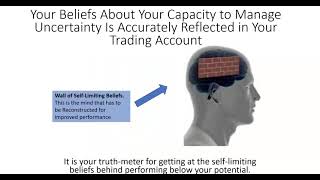
Your beliefs are killing you, killing your trading account. You're literally your trading account is demonstrating to you the beliefs that you're projecting onto the screen of the markets. And you're finding out whether or not those beliefs that are driving performance.
Are in fact effective in extracting more capital out of the markets than you give back. What you say you believe is basically bs. You need to see it demonstrated in your trading account. And fundamentally, the tool of mindfulness or observation is the transformational key that allows you to separate your identity, who you think you are, from your beliefs that you hold about yourself. Or actually, you don't have police friends, they're having you. You've kind of fell into them in your family of origin or through evolutionary psychology, you fell into them. You would never know that these beliefs are just simply ways of seeing the world. They're not true, okay? They're just beliefs that feel true, feel certain. And in trading, you get the opportunity to change them so that they're effective managing uncertainty, not your survival. So we want to get you so that you're no longer drifting an uncertainty. And this is really about your beliefs, about your capacity to manage uncertainty. That's the one being, that's the ones that you are producing the results in your trading, okay? And there is, I promise you, there is a wall in your brain and it's often called the wall of self limiting beliefs that have you really stuck. But the.
The trading account actually is the only friend that you're ever going to have in trading because it's the truth meter. When you start BSing yourself, it's going to be one that absolutely says, look at this, look at this, look at this. And ultimately what you're doing is getting at those beliefs. That's what's important.
So those beliefs, my friends, are also pretty. It's not rocket science, okay? But they're revealed in your trading performances and your bottom line. The first one is that you don't matter unless you make money. Okay, if I make a bunch of money, I'll be a big dude. The other one is a lot of people don't believe they deserve making easy money. They want to make it hard. Yeah. The next one is not good enough. Inadequacy. I'm not really good enough. You know, I'm never going to make this.
The fourth one is scarcity. You believe that what you make will be taken from you, so you stay small. And the fifth one is powerlessness, that you're just, you're just thrown into a hurricane of forces beyond your control.
Those are the five beliefs that drive your performances, friend. They're not true, but what happens is the observer has never really.
Examined them and started asking about what I could do to change those beliefs. And those beliefs come out of your Evolutionary psychology. And they come out of your family of origins and on the circumstances of things that have happened to you. And then the really big thing happens is that.
In my line of work, I call the brain a community of rival programs, or the hood, okay? And those programs are duking it out to be able to basically form the self and take it out into the future. And if you want to see this in action, what it really looks like, watch the movie Inside Out. It's a kids movie built by Disney Pixar, and it brilliantly shows how emotions become the cognitive currents in your head. Okay? Now what you're doing though is when that, when that biology of the brain somehow morphs and becomes this miracle called mind, we move from a community of rival emotional programs to, to a committee, a ruling committee of the self. Okay? This is when you start hearing the inner community going on and what you realize is, oh my gosh, these, this, this community of rival programs now has a voice and they're running in my head. And the mind is where these programs literally duke it out for control. And if you've ever, ever been in self doubt, you know exactly what this scene is like right here you have different parts of the cell, we're going off into different directions. And when that's happening, you're not going to have a cogent mind that's focused on trading. So you're seeing this mind as a committee of the self and you're going, okay, what will. Okay, how does that help, Randy? It helps a lot because what you're going to do is you're going to start noticing that it's not one just big glob of goo in there. There's a lot of factions. Whether or not you call them aspects of the self, subpersonalities, voices, our brain areas. The key is, is that there's a lot of conflict going on about control. Who's going to control the organization of the mind that trades? And this is where you start going, well, have you ever experienced self doubt, anger or overconfidence? Well, if you have, you have experienced the untamed internal struggle going on inside your mind between what I call the inner critic and your orphan nature, or what we would call the adapted voice. That inner critic is that part of you that judges, criticizes or tempts you. If you've ever had self condemnation, self doubt, you hear the inner critic saying, you're not going to make it. That was the stupidest thing in the world. You're just a loser. That's the inner critic. That's not you, that's just some, not some benevolent voice in your head. No, that's the inner critic. And the inner critic wants to destroy you.
Stanley Milchamp did a bunch of experience in the 60s and 70s of where what he did is he put, he would recruit people to become guards and then recruit people to become.
Prisoners. And they were told that they're going to use classical conditioning to be able to condition the prisoners to be compliant with orders. And that's what the guards were going to do. And then the, the prisoners, graduate students, which is simply told be defiant. They think they're going to be shocking you, but they're not going to really be shocking you. You're just going to pretend though, you're going to act like you're being shocked. So they got this together and what they discovered very quickly is that people.
Now these are college students, okay, that were doing this as the, as the guards ultimately came to the moment of where they knew that they were giving lethal electrical shocks to the prisoners, the graduate students and they would watch them convulse and die. They converted kids in college to cold blooded killers in three days. Yeah, powerful, isn't it? This is the kind of stuff there is this part called the inner critic. It will judge you, it will tempt you. Get in that trade, you can make that money back. Go, go. Yeah, that and on the other side is your orphan nature which is your response to threat. You know when you see that in, when you see that trading account go down, what you're experiencing is fear of life. You feel as though you're being killed. That's what the caveman brain in you perceives. And what happens is out of that it triggers to either aggression or to avoidance. And obviously over trading, revenge, trading are elements of the aggression and not trading, not getting into thing. Fear of missing out. Is that part of that avoidance? And that is what's going on inside the mind. The, the uncontrolled, untamed internal dialogue. Everybody starts here, friends. It's just kind of the way it is now pictorially you might see something like this. On one side there's these little whispers, you hear this stuff and if you ever had the inner commentary, you know, it's got an opinion about a lot of things. And what, what most traders say is, yeah, it's pretty much telling me that I'm never going to make it. And it's telling me that I need to make up for all these losses and that I, I, there's all things I have to do in order to Prove myself. Okay? It judges, it criticizes, it blames, and it controls and it tempts. There's also this orphan nature, the adapted voice. And that's just simply the brain organizing your potential into a creature, a self that can survive in the world in which it's born on a survival basis, okay? It adapts to survive from fear. That's what it does. And if you've ever lost control and just went crazy, you know what it's like. If you've ever sat there and your finger frozen trying to enter a trade, but you couldn't do it, you have felt your orphan nature. Until that orphan feels as though he's got new mentors that can help him through this. The inner critic's gonna win your trading battle. And so it's really depends. So what's happening is, what we're saying is that it's this unobserved internal dialogue, the struggle that shows up in your trading sessions all the time. Particularly in the heat of the moment when threat, when stress is there, of course you're gonna trigger to more primitive emotional positions. The deal is, is you have to be able to emotionally regulate that. You have to observe it that you're not that. And you have to start using that observer to start reconstructing the mind that changes. Understand, your brain originally adapted you from the totality of a potential that you could be. And it organized and just cut that out where 95% got cut out and only a little bit of your potential got organized into the self that trades. So what we have to do, we have to take that and kind of reverse engineer it. What we have to do is we have to say, okay, what we're now going to do is that within the probability, the potential of that you are not only is there an inner critic who wants to destroy you and an orphan nature that simply is trying to survive this moment and acts from fear or aggression. What also lives within you is the discipline of a ruler, okay? The ability to maintain order under pressure. You also have.
The courage of a warrior that's literally being able to turn toward your fears to master them, that lives within you. Also. It probably hasn't been well developed, depending on what kind of family you grew up in. You also have one of the most underdeveloped parts that the traitor really needs. It's the self nurture the self, soothing the self compassion of a caregiver. This is when, when you have taken a hit, when you've end these things, that orphan nature of yours desperately needs to be calmed down. It doesn't need to be berated, it doesn't need to be beat up. It needs to calm down. Okay? And calming that down, what you do is you release the mind to be for other elements of the self to come board part aspects of your being that are not codified into pattern, but they're there. And then the sage part of you, that impartial thinking, that clear thinking can actually show up because it's not being contaminated by fear to be able to do the job of making decisions about probability. These are all, these are all emotional programs existing in your DNA. Now these are called, they're also called archetypes, symbolic representations of those of those emotional programs. They're all there. The difference is that you have to learn to be able to focus on them, be able to pull them up, rather than the easy accessible adaptive patterns that you learned before you knew what you were doing. When that really happens.
Something really crazy happens as you start discovering that it's very different. I'm going to use here a scene from Lord of the Rings. It's what you discover one of the best archetypal movies ever presented. What you discover is all these warriors are there to protect the boundary of the kingdom. There is a ruler there claiming his throne. There is an innocent there to actually deal with the evil that exists in that area. What you also find is you find nurture, you find that being able to calm down before the fights with the orcs, you find all that. And you also find, like in Gandorf, you find the sage, the wisdom that leads you through this. These are all elements of the mind, of the brain.
And you can learn to access them. That's the whole point. This is the mind. This is the mind, the discipline of a ruler, the courage of a warrior, the self soothing, probably the most difficult one at all to really implement of a caregiver and the impartial thinking of a sage. This is the mind that needs to be summoned up. Remember, it's not natural, it's potential, but it was potential that got cut out of the original self that I organized by these emotional programs. And it can become accessible. Now I use a process called memory enrichment that allows me to use memory to get at these programs and pull them forward from experience.
I don't use affirmations and I don't use visualizations because under pressure those start failing. Okay? And what we want to do is give you the best shot at survival that we can. And out of that, out of that training, what you discover is you start building a process. You start building A way of getting to that mind, which I call the intentional mind. I also call it the traitor state of mind. And if you take a look at a batter like this right here, he's preparing to face the 100 mile an hour fastball. And what he's doing, it started the ritual, the preparation started before he got to the on deck circle. But on the on deck circle he's zoned in, man. He has skills that he's developed since childhood about watching that pitch, zoning in on that and producing the person who can hit that 100 mile an hour fastball. Then when he gets in actually into the batter's box, what you'll notice is each pitch he will take a foot out. He really established that he will re establish that mine, not the one that has fear of facing that fastball. They re establish the one that believes that it can hit that fastball, goes back in and the game goes on. These are the rituals that have to be developed as a trader to be able to develop that mind and maintain that mind as you trade. Or you can stay in the same mind and you can see, keep hoping that new knowledge, new this, new that is going to change the deal.
But the truth is, after you learn method, after you gain the knowledge of trading, trading literally, according to most folks who really trade well, trading is about 80% psychological. But everybody gets stuck on the acquisition of knowledge as if that's going to solve the problem. Friends, wrong problem.
The problem is organizing the mind, Developing the mind to handle uncertainty and probability. That's the big deal. And what would it look like?
Think about riding a wave like this. Do you think that surfer is in control of that massive gigantic wave? No. Do you think he is in control of his performance? Yes. He knows he cannot control the outcome. So what he's learned to do is build a mind that he brings into the moment of performance.
Okay, so he and that wave are dancing together. He's not trying to control it, but what he's doing is he's maintaining the mind that he brings to perform in something so powerful that is beyond any reasoning to him. That's what can be taught, that's what can be learned. And it's really up to you. And the real key is you have to be willing to face your dragons instead of lying about him pretending I'm not there. Talking positive talk, talking prosperity, blah blah, blah, blah, blah. No, what you're doing is you have to find the courage living within you, the discipline living within you, the compassion living within you and the thinking living within you to face that dragon, not kill it, but master it, okay? There will always be uncertainty, friends. There will always be internal struggle. The difference is the empowered mind that you bring to the struggle. That's the difference maker. And until you really begin to do it, you're stuck as an amateur, okay? Because it's just like if you've ever gotten to a poker game with a professional poker player, you realize he's not gambling. And most likely because you're playing him, you are. It's the same thing in trading is really good. Traders are not gambling. They're managing probability really well and they're managing themselves so they can manage probability. That's the deal, friends. That's the deal.
And when it comes down to it, it's kind of like back to what this guy Victor said and he's just let you know, this is one of the most famous, wealthiest traders in the bin. And what he's saying is truly basically the key to trading success is emotional discipline, friends.
If it was something else, if knowledge, there'd be a lot more people making money. And yet there you go, it's emotional discipline. You truly have to become the designer of the mind that engages uncertainty rather than its adaptation. You make this leap and that's why few make it, actually make it. So you have to make a transition from the survival brain that you bring to the game to the probability mindset that you have to have. And out of this.
Our courses, both our group course and our personal course is really about self mastery. We're not going to help you develop trading knowledge. We're going to teach you the tools for producing self knowledge. We're going to teach you how to change and master the self that trades. So what most people find is these skills generalized to other areas. Okay. And most people get into this work and realize, oh my God, Randy, this is changing my life in a lot of different areas. Yes, it is. Yes it is. That's the power of it. And you know, it's kind of like who would have thought that trading would become an avenue of self development? Well, it is. And within that, what I hope you've learned is what it takes, what it's going to take, and that you really have to become the pay the change that you're looking for in your trading. How do you do that? You know, ultimately, gosh, you know, get a hold of all our free, free stuff. Many people, long before they meet and talk with me in person, have done Randy Howell weekends, that means watched all my YouTube stuff and then they, they will Do a lot of the free reading. Then they buy the book and they get it and go, okay. They're getting more familiar with these concepts as aliens they may seem. But ultimately it comes down to it is there's two avenues of actually learning the skill sets. One is through a group course, and we have one starting in September now. Yeah, it'd be our last one for the year. Okay. And it comes with five sessions. And fundamentally it's.
Five sessions of about an hour apiece.
Group sessions. Group sessions. My partner here is making sure that people understand their group sessions. These not individual sessions. And ultimately it's handled in a classroom and it teaches the core skills that you're going to need to be able to build a mind that trades. Okay. And it's pretty inexpensive. And if you sign up early and what most people actually have come to do is they get in early because they want to have plenty of time.
To get the skills mastered. Because when you get in this course, you discover that I will have expected you to have already done the emotional regulation components, and I will have expected you to have been doing them for at least two weeks to a month. And then we start mindfulness. This, this thing starts fast and furious. And what most people have done is they've decided to do it at their own pace so that they start early and are very well prepared when they get to the course.
We have a number of people already signed up for the September course, for instance. So you look at that. And if you sign up early, what we're doing is we're encouraging that because we want you to be prepared. Okay. And we offer an emotional regulation workshop free. You can go to our website and pay $199 for it, or you can get it free. The other is the individual course. And it's the, it's the course that people want to take with me. They say, no, Randy, I actually want to work directly with you. And it's highly comprehensive, it's highly personal. You. You learn a lot about yourself. Okay. And we go through a. Basically it's, it's pretty much going through like a multi, multi faceted graduate level course, multimedia graduate level course, where we have curriculum and we move through it. And at the end, you, you have your, you, you equip very differently than you were before. The main thing is it comes with 10 personal sessions with me on Skype or I guess, soon as we move to Zoom on Zoom. But those, those are things until you get there and you want to kick on more stores. There's lots of on more tires. There's lots of stuff on the website. Read about them. Okay. And if you're critically interested in that individual course and you've really thought through it and say, yeah, I want to find out if Randy I. Are matchups. If we're. We can work together. And if I. If I'm talking to him personally, whether or not I can believe him, ask for a free consult. But we just don't like giving away free consult to anybody because I. I just simply don't have that time to be able to devote to talk to everybody just to talk about their trading. Okay. But we're looking for serious people for that, so I want to thank you for being here. And if you have questions, I have enough time to take a few. Would be happy to answer any. And here's. Here's a few. Well, here's a few questions I actually got before here. Okay.
Please explain what an emotional hijacking is. That's a good question. An emotional hijacking is when you encounter you, this organization of self that you encounter. And your primitive brain, your emotional brain does not think you're capable of managing it. What it will do is it will seize control from the thinking brain so that it immediately moves into fight flight. And out of that, you. You're hijacked. Your thinking's offline, and you're acting from emotional impulse. That's what that is. And here's another one.
If I know I am supposed to plan my trade and trade my plan, why can't I do it when the money counts? Go back to. That's the emotional hijacking. The thing is, when the money counts, what you're looking at is a challenge. You're meeting a challenge to living. And your caveman brain is looking at that as like, I am risking my life. Okay. Caveman doesn't know anything about Bitcoin. It doesn't know anything about contract size. It doesn't know anything about losing $200. What it knows is life and death. And you're getting there, and you're trying to trade your plan. Something happens, and all of a sudden, you're no longer. You're trying to use logic and reason when they don't exist. And so you're not using discipline, impartiality, and you're not soothing, and you're not finding the courage. And what happens is it just gets blown out of the water. That's what happens when you. When you. When you say, I'm going to follow my plan. Yeah. And then stress happens.
Next question. What is the difference between what you teach and things like nlp, Positive thinking, subconscious training. Yeah, that's really an interesting question. The major difference.
Is that there is a belief that you can control things outside of the self. And what I'm saying is that you have an enormous opportunity to turn toward the darkness living within you, toward your demons, toward your dragons. And it is those that have to be mastered, you know, internally. Okay. And.
That is the main thing, is that you have to internally master this. Okay, here's a, here's a question. When I take a loss.
When I take a loss. When, when I. What happened?
Hold on, hold on a second. When I take a loss, when I need. When I take a loss, when I need a trader's morale boost. I will review your DSM yeah. Videos and even other trading related videos and publications. Is. Is it proper? Is this a proper route to take? Oh yeah, man. Everybody does that take on or using to hide from the cold cruel world trade. No, you're doing exactly what you should be doing, is that a lot of people, a lot of people have the group course and the individual course come to these workshop, these webinars just to kind of like stay in the loop and keep this mind thinking in this line. And you know, our, the group course, you know, you're allowed access to the group course forever. You go in and you, you keep practicing. You need to keep practicing, particularly when you fall down and you start. He's going, well, I need to look at what the belief that's driving my orphan nature at that moment and heal it. Okay, what is the cost of the individual course? Right at $4,000. A few bucks less than that. And it's for people who are dead serious about it and realize that, that they floss a lot more than that by not by not learning the skills there. Okay. And now what we also do though is we can break that payment into three payments over a period of basically two months. I used to think it was three months, but my accountant wife was able to explain to me that actually it's 60 days. You make a payment, a month later you make a payment, a month later you make a payment payment. But it spreads the, it spreads the cost out and a lot of people end up doing that because it's, it just helps your cash flow a lot. It keeps ahead of the game and I'm happy to do it. I don't really care which way or the other.
Oh, the cost of the group course is a chat a tad below 1200 and it also can be it can also be broken down into five payments. So it makes it very affordable. And they're paid over a period of.
10 weeks. So again, what we're doing is we're doing everything we can.
To cost ourselves reasonably and so that we make it affordable. And what we discover is we really don't want people looking for discounts. They have not. They're still looking for the Holy Grail. And they need to learn that the holy Grail just simply doesn't exist. It exists as potential living within you. And I figure if you're asking for discounts, you're just still looking and not getting what the problem is. It's not more knowledge. I'm teaching you something very different than knowledge. I'm teaching you self mastery. That's the big difference. Okay.
One last question. This was actually an interesting one. What happens to me when I put winning days together and then give it all back and more? Boy, how many times have I heard that officially I call this sabotage. And ultimately it takes two forms.
And remember, this is going to tie back into belief. One form, the person doesn't really believe they deserve to make easy money like this. So they start having the good days, good weeks, good months. And there's something inside them saying, you know, this is going to good, something's got to fall. Something, something's going to happen. So you can already see they're creating the possibility of them blowing up. That's one avenue. The other avenue is you start, and this is very common with, with my, my individual clients, is that initially they do not believe that anything could be beyond fear. You know, if I could just master this fear I'm having, Randy, boy, I would, man, I'd be on easy street. And they learn how to master their fear and they're no longer trading from fear. And then they find the next big dragon. And that next big dragon is overconfidence, what I would call euphoria. They start feeling good. Oh man, look at me, I'm doing, I'm doing it. And the truth is, no, you're not doing it. You have learned a skill set that allow you to take a mind built for one thing and be able to convert it to doing something else. And the truth is, is that you're doing it well. But it's not you. You have learned a system that's allowing you to do that. And what the overconfident trader is doing is, hey, hey, man, this is great. It's just going to go on like this forever. I'm in charge. No, you're not. And that's what happens with sabotage. So that would be an answer to that. Okay, I have time for one more question or we can cut out a couple minutes early. We don't have any others. So I want to thank each and every one of you. Okay. And tomorrow when you go back and look at the and start trading, I want you to look at the emotions on your face and I want to ask you, you know, get that mirror, look at them. And I want you to ask the question, what would it. What would be different if I were managing the emotions that I'm trading with rather than them popping up and managing me? That's the big deal. Until that time, again, it's my favorite childhood. What? Oh, the recording will be on my website and on YouTube tomorrow. You'll probably get a warning of that before, but it generally takes me to in the early afternoon to get it up and I'll have it up then. But when I was growing up, my hero was the cowboy singer Roy Rogers and they signed their TV show off like this. Happy trails to you until we meet again. And my friends, happy trails to you until we meet again. My hope is you have a great life. My hope is that you get this mind in order to so that it can trade effectively. Okay. And I just appreciate having the opportunity to speak with you and if I can help you, let me know. Thank you.









