The Roadmap to Trading as a Business
Rob Booker argues that traders fail because they lack business skills, not technical ones. Start by making $1 a week for four weeks, then scale. Build systems like a franchise: documented processes, training manuals, and a formal approval process for trading systems to stop emotional switching.
Chapters
Hey, everybody, welcome. Sorry for the delay in getting started. We're four minutes late. We were changing the batteries out in the microphone and now Melvin is gently placed atop the microphone situation.
All right, I got some good stuff for everyone today. We're going to look at the charts in a little bit. I think there's some reasonably interesting things going on, maybe not terribly interesting, but I wanted to talk about the roadmap to creating and trading as a business. And this may end up being. This may end up as one of the first lessons that we ask new, brand new lifetime members to watch, because I think there's an important lesson here. There are three primary lessons that come from the book E Myth Revisited. If you've ever read it, these lessons will be familiar to you. If you've never read it before, I'm going to summarize some of the important parts and maybe you could choose to read it on your own later. Number one, I'm going to draw.
A little picture of a brain.
So it does not equal money. It's not exactly how the author describes this, but here's the formula that doesn't exist that most people think does exist. Most people think that good technical skills in an arena, any kind of endeavor or good brain power or a lot of knowledge about something should equal profitability for a trader. This means that there are a lot of people that know a lot of stuff about fundamentals, economics, interest rate announcements, central bank governor names, but they're not very good traders. There's nothing wrong with that, and I've certainly fallen into that category for months at a time myself. It's nothing to be embarrassed about, and I'm not trying to criticize any kind of other educators or anybody, but I know a lot of people who know a lot about the markets but that don't make money. That's lesson number one is just simply having technical skills isn't enough to make a profit. In fact, I don't know how to say this kindly and I don't know how to say this politically correctly. So I don't care, Nate. I'm not going to try. Some of the most successful traders I ever met were dumb.
Nate's cheering it was good news for me, too. And what I mean by that is didn't used correct grammar, didn't spell correctly typed emails in all capital letters because they couldn't figure out that that was a social faux pas and a variety of other kinds of things. Didn't know the names of the central banks, constantly quoted currency pairs and other financial instruments. Incorrectly, I mean, all kinds of different things. And they were still great traders. So instead of having great technical skills, what I want to ask you to consider at least is having good.
Business skills.
Instead. Now, what does it mean to have good business skills instead? So most people are learning how to trade, which I have said I don't think is a very good idea. I think it's a giant waste of your time. I think that learning how to trade is. It can be interpreted in a lot of different ways. So maybe this is just semantics. So please be patient with me as I describe this. Most people are learning to trade, and what that means is most people are pursuing perfection in technical or fundamental analysis, and they're trying to build a perfect formula, a perfect robot, a perfect formula. And they're trying to learn to trade like someone else. So that's not running a business. That's not it. We assume that in order to have a business, you need to be able to do a modicum, minor amount of technical analysis or fundamental analysis at a minimum. In order to open up a pie shop and sell pies, you need to know how to get a pie out of the oven that is similar to what a pie would taste like. If you look at some of the most successful restaurants in the world. Nate, can you name one?
The French Laundry. Okay, so that's the most famous restaurant in the world. It's not franchised. It's only one place. He did what he did best, and he didn't worry about maximizing revenue. He just worked on his craft. It's a great example. That's not one of the most successful restaurants in the world. That's one of the most famous. What's one of the most successful restaurants in the world? Oh, McDonald's. McDonald's. Right. McDonald's doesn't make the best food. It built the best process. It makes the most money. Applebee's doesn't make a lot of great food, but Applebee's has a lot of locations. Olive Garden. I know I'm offending some of you. Doesn't make the best Italian food in the world, but it's more successful than a mom and pop, one location Italian food restaurant. Why is that? It's because technical skills, being.
Thomas whatever his name is at the French Laundry doesn't turn you into the richest restaurant entrepreneur in the world. You're a craftsperson. That's great. That's fine. But that's learning how to be perfect at roasting beef cheeks. That doesn't make him the largest restaurant chain in the world. What makes you successful as a trader is learning how to.
And this is it.
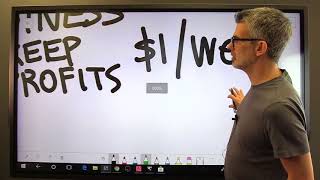
Learning how to keep profits. Just like any successful business in the world.
Tesla eventually fell because Tesla doesn't make money. They can make. They don't even right now make high quality cars. I love Tesla. I love Elon Musk. I'm just being real here for a moment. Any company that's flying high in the stock market is going to be making money, producing profits and has an expectation of success in the future. Any trader that's long term successful isn't necessarily the smartest trader or the best technical analyst or anything else they've learned how to hold onto and keep profits. It's why I say when you first join, or even before you join, your goal should be.
To make a dollar a week for four weeks. No more, no less, a dollar a week for four weeks. Don't worry about making more than that. And why is that? Because the lesson is make money and keep it. The lesson isn't be the best at technical analysis. The lesson isn't Nate, show off to your friends that you caught a big move. That kind of stuff is stupid. Bragging to your friends that you know how to draw lines on your charts better than anyone else doesn't make you a trader. It doesn't make you a trader for a living. It just makes you a person who academically knows a lot about a particular subject. I don't care about that and I never have. It's why many of the subjects in the world of trading don't interest me. It's because I'm not here to trade. We're not addicted to trading as a family of traders. That's not our priority. Our priority isn't to trade a lot. That's stupid. That's the dumbest thing I've ever heard in my life. The goal is to make money and hang on to it. So if near the beginning of your trading career or if you're starting over because it hasn't been going well, if your goal is to make a dollar a week, all the pressure's off. You know that your goal is to find one maybe quality trade, take it, and then you're out of it pretty quickly. You might just open up your trading platform and say, looks like the pound dollar falling.
I'm going to go ahead and sell maybe, maybe one mini lot.
One standard lot's not going to do it. I'll just take a bunch of trades here until I get up to one mini lot. So I might wait until those trades get up to a dollar in profit and then I'll close them and I'm done. And why would I do that? Once again, because the goal of trading isn't to take a lot of trades or be active in the market every day. Think about that for a second. Chick Fil A, a famous fast food restaurant in the United States, ultra successful, super profitable, doesn't open on Sundays for religious reasons. They're still ultra profitable. They're focused on making money. And once they are making money, they don't have to serve chicken sandwiches on Sunday. The goal isn't to be making chicken sandwiches. The goal of Chick Fil A is to make money. In N Out Burger, the most.
Cultish hamburger chain in the United States, only has hamburgers, fries and shakes and soft drinks on the menu. Their goal isn't to have lots of food items or be serving lots of food items or be open 24 hours a day. The goal of In N Out Burger is to make money. Why do they keep making money? So that they can make their customers happy by giving them delicious hamburgers. But the goal is first they got to make money. If they're not making money first, then they can't serve hamburgers to anyone. There are a lot of people that say, well, our first goal isn't to make money, it's to X, Y and Z. Well, that's the stupidest thing I've ever heard. Because if you're not striving to make and keep your profits as a trader, then you're just a hobbyist. You're just the equivalent of someone building train toy train sets in your basement. It's not going to last. So that's why at the beginning it's a dollar a week for four weeks. Then after the first four weeks, go up to $2 a week for the next four weeks. Then you will have eight weeks of profitable trading under your belt. During that eight weeks, 90% of all traders, more than 90% of all traders anywhere, trading any financial instrument during that same eight week period of time will have lost most of their trading capital. Most people who trade from home take about eight to nine, 10 weeks to lose about half of their trading capital or more than that. And during that time, you've made money. So you're not comparing yourself to other people. You're just learning to hold on to your profits. Now after that, we could scale that number up. Look at that. I moved. Wow, wow, wow. $2 a week come down. It's on sale now. I don't know what's going on There. I've never seen that. Have you ever seen that happen? Nate? That is bizarro.
Okay. Your first goal as a trading business is to keep your profits. You start small, you build from there. Sam Walton built the world's biggest company in terms of revenue. Makes more revenue, top line revenue, than any other organization in the world, unless that's changed recently by doing one thing. He started one store and he did that, right? So he started small. Sam Walton didn't go the first year he was in business. Why don't I have, what, 1,000 stores and $500 billion in revenue? Colonel Sanders didn't make money until he was like 60 years old or whatever, making Kentucky Fried Chicken. He had a small business that was making money. That's why it got picked up and expanded. Show me a business. Except for show me a business that had any sustainable success that wasn't making money long term. None. Zero. That's why Tesla better hurry up and start making money or they're in big trouble. Okay, number two.
I want you to think about your trading business.
Now. You may live in Spain. You may live in the United States, you may live in Canada. You may live in Australia. National.
National chain.
Think of your trading business as a national chain. Think of your trading business as the nations in Spain, England, Australia, New Zealand, wherever, Krypton, wherever you are located, as a national business. The premier national business. So think of yourself as a big business.
With only one outlet right now.
Here's what I mean by that. You want to run your trading business as if you were.
A sophisticated business with processes in place. But even though you're only right now one location, you can't expand one location of a business unless its books are in order, unless its marketing is in order, unless its sales process is in order. Last year, when I almost sold my company to Market Traders Institute, I asked for millions of dollars to buy this business that we're sitting inside of right now. And they agreed that they would pay that amount of money. And then they went through the process of due diligence in my business, and they said, wow, you're just basically running a mom and pop shop. You're not really. You're not even really running a business. And I initially took offense at that. And then I decided to be a reasonable individual and consider how I've been running my business. And I have been running my business because I love you. And I haven't really had any processes in place in the back end. So I do training and I do videos and I have a website, but I don't really do anything else that's sophisticated or process driven. And I decided that that would be the moment to change it. And that deal eventually fell through for a variety of reasons. No hard feelings, but I just wanted to. I don't know, it's a long story, but I basically just wanted to keep my independence and my freedom. Although I would be willing to sell my business at some time in the future, it just wasn't the right time. And I realized I wasn't really running my business as a business. I was running my business as a hobby. Well, that's how most people run their trading business. Think about the things that a national chain would have.
They would have books.
And they would close the books at the end of the month and those books would show if they had turned a profit or had a loss and they would know why that was. They would have a sales.
Process.
Or one set process for making sales. And you would, as a trader, have one set process for making money. They would have training programs for new hires. Do you have a program written out where you could train someone to trade the way that you do? Could you hand that over to somebody else with a guide? Do you have instruction manuals for the way that you approach your trading business? It could be philosophical, it could be whatever. But if it's basically nothing more than just what's in your head, you don't really have a trading business. And if you don't really have a trading business, you're never really going to do it for a living. We talk more about this and expand this later, but have some books. Know how much money you're making, know what your profit and loss is on a regular basis and track it on a daily basis using what of those little indicators in the bottom of your screen or MyFXbook or whatever else you want. Have a set process for making sales. You might have two sales channels or distribution channels. You might have discretionary trading at the end of the month with me and also a robot that you like to run on a regular basis. And then you might have some training manuals or processes for if someone wanted to learn what you would do, you would have a process for teaching them step by step. Okay, that makes sense. All those things make sense. And any national chain is going to have that. So they can expand from one outlet to 100. Well, you would have those things. So you can expand from a dollar a week to $2 a week, to $10 a week to $100 a week to $500 a week and so forth. Every successful trader who traded for a living that I ever met had some sort of process that they had. Now what that does is when you have that, it makes it harder to change what you're doing on the fly. You can't suddenly start making cheeseburgers when right now what you make is yarn. That wouldn't make any sense. Let's get on to the next one.
The next thing that you're going to have, the next quality of three that you're going to have. I'm just going to mark this out. Systems of systems.
Here's what I mean by that.
Most traders say or think that the goal is to get a trading system, a set of rules that you follow to execute a trade. What you really need, and here's the key that we don't talk about, what you really need is a.
Process.
For.
Approving.
I'm going to just take the time to write this out. I usually try to write too fast and then I end up moving the whiteboard around.
What you really need is a process for approving a system. You don't just need a system off the shelf, you need a process as a business for approving a system so you don't just switch between systems all the time and constantly. You need a process for testing, building, making, developing, doing a trading system. You need systems inside of systems. You need a system for. What do you do on a daily basis? What's your checklist and what's your routine? I wake up in the morning, I check my 30 days of Finch honeymoon account. I close everything if I'm overall in profit for the day or the week, or even the month in some cases. And then at the end of the week on Thursdays, I trade in the morning for a couple of hours and I have a process and a checklist for what I look for for that. And then at the end of the month, from the 25th until the 3rd of the 4th of the, I have a system in a process for doing end of month trades. And it's written out, it's trainable, I'm training you on that system and that's it. And in order to change what I do, I would need a process for approving something different. So my process, for example, would include.
It has to produce a system in order to be approved. Whether I make it or someone else makes it has to produce less drawdown or same drawdown with more profit.
Either one of those two things is fine.
So that's the key.
And the pace of change is glacial. As our friend and fellow member Scott Haywood would say he changes things at a glacial pace. Why? Because it doesn't benefit any of us to switch from making.
Widgets into crafting cheeseburgers or whatever. It doesn't do any of us any good to keep switching. It doesn't make any sense. So we accept the weaknesses and the failures of the systems that we're using and we attempt to reduce drawdown over time and. Or have the same drawdown and make more money. That's the key. And then the goal isn't. Think of the process that most people have for approving a trading system.
Just think of answer. How do most people approve a trading system?
It excites them, so they approve it. It's new, so they approve it. It's exciting or new and they approve it. There it is. That's what people do. And they just switch to a new trading system or some other emotional reason for changing what they do as a trader. So we don't. That's not. We don't care about that. I don't care if it's new or different or whatever. A lot of people will also change their trading system when they hit a difficulty. They'll just drop out of it. Like a person that just moves from one relationship to another, like, because they just can't have a commitment. So that's what. But if you're running a national business, you can't just keep switching what you make as your core business. You can't keep doing that. That's not going to work. You can't keep releasing new products to take people's attention off of the fact that you're not making any money. You have to make money and you have to have a process for approving what you do differently or what you change. That's all I have to say about running your trading as a business. I don't want to mix this up with any other stuff at all. So we'll conclude now. Hit me up in the chat room and let me know what you think about the training we just did and say, hello, I'm glad to be here with you. Love you all very much, and we'll see you next week or tomorrow or whenever we do this one next. Bye for now.









