The Silent Partner in Your Mind that Creates Trading Havoc
Randy Howell explains how your emotional brain hijacks trading decisions, causing revenge trading and blown accounts. Willpower can't override survival instincts, but you can train yourself with mindfulness and physiological regulation to activate courage, discipline, and impartiality instead.
Questions this video answers
June 7, 2018
$1,195 (or five payments of $239, every two weeks over 10 weeks).
Five group meetings.
Starts in seven days (from the webinar date).
Ten sessions with Randy (individual mentorship).
Chapters
Welcome everyone. My name is Randy Howell with my traders state of mind. And you know, I just love to see people going, you know something, what is, you know what, how do I develop myself? How do I develop my mind for trading? How do I go about developing the potential that I am as a human being into a higher level? And, and here we are to look at this stuff and I have a question for you. Oh yeah, I should do this.
If you can hear me, please just simply type in a Y. And my joke is always that if you can't hear me, type in a note. But so far I've never had anybody to do that. Thank you. I got it. Okay, we're live and people can hear us. Good. My question is this what actually stops you from achieving the kind of success that you know is possible in trading? You know, let's take a look. And better than that though, let's find out what you can actually do about it. But I want you to see that gap between what you see as possible and your current performance was that it's that gap that we're looking at really where.
We have to look at some brain science and we also have to look at some psychology about how do you produce the mind.
That narrows that gap so that what you see is potential in your trading becomes reality. So let's, let's talk about this. Okay. And here it is. Your silent partner is like a sleeping bear. When it's asleep, all is cool and calm. You'd never even know he was there. But when he wakes up, there's trouble.
And that's when you discover that not only is he your silent partner, but also he's your majority partner. And all of us have this and you just don't see it. We have this part and you might have noticed it. And let me give an example just in case you think that, well, this doesn't apply to me because it most likely does. Have you ever been in a setup where you're looking at the setup, it's forming, you start getting the, you start getting the information going, yeah, this is a warm setup. It's, it's, it's clicking, it's clicking and there comes an entry moment, but then you keep seeking more information, more, more and more, more confirmation your silent partner shown up. Have you ever been in a trade and it starts going against you and you just absolutely lose your stuff? And either you jump out of the trade before it really gets started or you start throwing good money after bad.
What caused that? This is the bear, the silent partner that suddenly woke up. And suddenly the thinking brain that was sitting there going, hey, this is pretty good man. Hey, every, that beast seems so calm and tame, it's not even there. I can just logically do this. And suddenly out of nowhere, as if by no warning at all.
Rational thought is thrown out the window and you're an emotional just basket case blowing things up or just simply freezing. Okay?
So the truth is that the thinking mind actually serves emotion. And no matter how many times it is that you look at other programs and stuff like that.
The truth is, is we want to believe in the supremacy of logic and thinking. We minimize emotion, yet at the same time we notice that when we minimize it, it's not like it goes away. And particularly the survival emotions that in and around fear and aggression, it's like you don't see them, they're just, they're like I said, they're just like a sleeping baby. But when they wake up, they become the 800 pound gorilla, the committee of your trading mind. You're going, wow, so what is, what's going on here?
And you know, and if.
If there were really no.
If there was no emotions, you wouldn't have to be thinking about it. But why can't you see something that is so powerful that it can compromise thinking? If it were nothing?
So ultimately your silent partner is looking through the eyes of emotion rather than thinking.
And here you are probably having consumed lots and lots of knowledge about trading. You're being told, you know, glibly, like with platitudes to, yeah, control your emotions, don't let emotions get in the way and stuff like that. And my, my thing is this is that how are you going to do that?
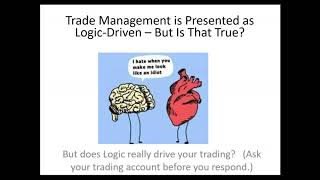
You know Spock, the famous guy who's supposed to have no anything other than logic and no emotion in him? What you discover is that he does have emotion in there and it constantly compromises his logic. He pretends to be rational, but underneath it, what you see, a boiling pool of emotion. And what we have is, we have, we want to believe the thinking brain, mind is like supreme. But the emotional brain, your silent partner is there watching, just waiting. Okay? And here's the tragic flaw, friends, right here. How many times who can identify with this? You know, here we have, on the left side we have the thinking brain and on the right side we have the emotional brain. And here's the thinking brain saying, I hate it when you make me look like an idiot, okay? And my question to you is this.
How many times have you experienced this? How many times has your Thinking been compromised, and you've ended up doing things that you wish you hadn't done once the heat of the moment was over. Okay, here is the fatal flaw to logic. Okay? We want to believe that trade management is going to be logic driven, but what you discover is it's not. The truth is that thinking serves emotion. And no matter how many times, okay, you think otherwise and you want to believe otherwise. And we want to believe in the supremacy of logic and thinking when we get into the heat. I don't mean when things are. When your two traders are sitting there jaw talking and telling fish stories. No, I'm talking about when you have capital at risk.
Say 1% of your trading account, 2% of your trading account, and you put it at risk and, and you could lose. And you have between a 40 and usually between a 40 and 60% chance of losing. And all of a sudden you start saying, where's that logic? Where's that logic? Well, that logic, that thinking brain did not.
Also say, you know something? Where is the emotional brain? You know, I need to partner with it. I don't need to try to push it away. I need to partner with it. And yet what happens is, you know, you take a look at this image, how many times we keep looking at the money and how many of you say, you know something, I have a target that I need to reach. I have to make this much money. I'm down 2, 3, $400. I have to make that money up. And the lure of money, what it does is it starts having you look for trades.
From a mind that's now tainted with emotions about, oh my God, I have to, I have to do this, I have to do this. There's a, there's like, oh my God, an urgency to do that. And what you do is. You see this woodcut? This is from the 19th century. This is not an old. This is not a new phenomenon. It's sitting here waiting for us. Okay? So worst, we don't see the flaw in our trading logic, and we keep doing the same things over and over again. This is the proof that you're looking for when you keep doing the same stupid things over again. Just like when the brain was saying, I hate to be made look like an idiot, you see that happening. And ultimately what you're looking at.
What you're looking at is not greed or fear. What you're really looking at is the emotional learning, the emotional meaning about you engaging with uncertainty. And it, the measurement, at least through your trading account, is do you believe that you can manage the uncertainty that you're. You're engaging, or do you believe that you can't?
Okay, the performance beliefs, not the one you talk about, not the one that you say, you know, I'm really scared and I'm just going to work harder. But I'm talking about the fear itself. It shows up. The thing is, there is no force of will in trading.
What you're doing is you're saying, I'm testing my beliefs about my ability to manage uncertainty, and I'm using the trading account as my barometer. Whoa, you're no longer talking about how you feel. Okay, that confident feeling, I can do all this. But you're saying no, you're actually giving the judgment, the assessing of the mind that you bring to trading, to judge it. You're using the trading account, takes it. It creates a completely different thing. Okay, so we get this, that we fall for this. And yet.
Whenever you suspect there is something amiss between your idea of logic and emotion, your brain's need to control, I want you to hear that it's got a powerful need to control.
Control outcome. No less will lie to you. Because ultimately, what you discover, your thinking brain, your left brain, what it's really doing.
It'S not the horse that pulls the cart, it's the cart. And what you discover is that it's going to create stories, it's going to create explanations, it's going to create alibis for whatever your silent partner, your emotional brain, has already decided so it will lie to you. And as long as you believe it, and long as you start, as long as you actually go, well, I feel confident. I feel that as long as you're using feeling states to judge if you're doing okay or not, you're gonna be, you're gonna have a long, you're gonna have a tough life in trading. What I'm saying is use your trading account. It could care less about how the way you feel.
What it's showing you is real.
Performance data. That is not a lie. It's not an explanation to please you. That supports some sense of the organization itself. No. And then you find out that victory by force is not going to work. Victory by will is not going to work. Victory by hard work is not going to work or doggedly pursuing success. And that's where a lot of alpha type of folks get in trouble in trading. They come to trading from businesses and from corporate where they have fought. You know, they said, I'm going to win. I'm going to show you. I'm going to show you I can do something. And out of that sheer will, they project against the world and they, they conquer that world, okay? And golly, it feels good, it feels empowering. Yet you take that same mind, that same mindset of success and you bring it to trading and it means nothing. As a matter of fact, the problem I have with alpha type traders, you know, the ones who want to win, the ones who I'm used to winning, I can make things happen, is that they blow up accounts. They so get so easily get sucked into the urgency to act.
That they lose all reason and they don't realize that the game changer in trading is you wait to see what the markets are telling you to do. You don't make the markets do anything. That's a real fatal flaw and it goes against the Alpha's mindset. So you're looking at this, you want to be right, you want to be in control, you want to win.
And you don't want to lose, but you do anyway. It goes against your self construct, man. And all of a sudden you're going, well what is this? Ultimately, winning and losing.
To our ancestors meant life. We had to win for short term survival.
Then we met trading two or 300,000 years later, okay, with the brain still way back there trying to survive in the short term by winning and not losing. And suddenly what happens is that in trading, not only are you going to become a loser, remember you're gonna be losing between 40 and 60% of your trades. You darn well become, you better become a master loser, okay? That's a crucial part of success in trading.
And that's the problem. You go, wow, you know, I don't want to lose, I don't want to lose. Well man, if you don't, if you take a look at a trader, a successful traders monthly, basically performances, what you'll see is you'll see a number of small losses. And then what you'll see on the positive side, you'll see a number of fairly small gains. He's doing okay. And then you'll see there are some days, four or five days, six days during the course of a month where he had exceptionally good days. And that's the thing that really breaks it. But what you really discover, he's become a very good loser in that when his hypothesis does not work, he firmly recognizes that moment. If he continues, he's gambling.
He'S no longer following his plan, he no longer is in the edge. He's now gambling and hoping. Okay, so win, loss, uncertainty, okay, this is where. This is where it all begins. You desire to win by controlling outcome and making things happen. That actually creates the conditions for losing in trading. And it upsets your silent partner, your emotional brain, because suddenly, if it starts seeing that it cannot trust our brain function. That's all that logic. That's all that discipline that you're supposed to be using. If it can't trust it, it becomes even more reactive. It becomes not a silent partner, but a very verbose partner and the one with the biggest share. So then you go, wow. And, friends, you carry this caveman in the back of your brain.
That saying, you know, it's so simple, even a caveman can do it. No, it's not. Ultimately, what I'm calling caveman brain here is your survival instincts of the emotional brain. It wants survival in the short term.
It sees a victory if it stops you from getting into a trade that you could lose. It sees, okay, I've stopped him from getting the late and the possibility of a loss. Whereas that. Meanwhile, that thinking brain guy that thinks he's driving.
Actually is going, you know something? What I really want to do is I want the probability of winning. I've got probability on my side, and what happens is, I can manage that risk so that if I'm wrong in my. And my hypothesis, I can get out with a small loss and I can trade another day. Well, what happens is. Do you think the caveman is just gonna say, well, okay, whatever you think, thinking man, no, it doesn't work that way. If you were to look at the. If you were taking a look at the human brain, okay, what you would discover is the limbic system. The emotional brain, caveman brain, has extensive communication networks, neurotransmitters going into the neocortex at that thinking stuff. But yet the thinking part of the brain has two primitive telegraph lines going back into the limbic system, into the emotional brain. That's the communication. Got massive communication going from the emotional brain to the thinking brain, but minimal communication going from the thinking brain back into the caveman brain. So what are you gonna do? Okay, so what we want to do is we want to say, you know something? He's got millions of years of survival programming that can snap into place and just hijack logical thinking. And all of a sudden, wow. The survival instincts start governing. And again, if you've ever experienced freezing of getting into trade, jumping into trades, losing, just losing control while you're in a trade, revenge trading, or getting out early and leaving a bunch of money on the on the table. Or when you win, you get all excited and you jump back into trades and do stupid things and get into trades you'd never have. This is it. This is it. This is you not recognizing your silent partner and he's sitting there in the back of your head, but you have done everything you can not to see. And friends, it may have worked in your life prior to trading, okay? A lot of people, it's worked very well. If you're going to continue trading and become a successful, consistently profitable trader, you're going to have to get to know your caveman. Not only that, you're going to have to integrate him into the way you actually engage uncertainty.
Okay? Because ultimately this is really oblivious to the world beyond logic. You don't see the torbito. You think you're in control while your silent partner is reading the emotional torpedoes under stress. And what I want you to understand is this stress business. You know, if you're not in stress, if you're doing simulation work, you know, the loss doesn't really count. It's a paper loss. So the stress isn't there, the challenge isn't there, the risk isn't there. But the moment that you move into true challenge of where you're risking capital, your emotional brain goes on alert. It's waiting.
Damn. The torpedoes would be what one of the parts would say. The other would say, oh my God, let's stop there. You know, we could get ourselves hurt. But this is where it is. By dismissing the power of emotion, overthinking and staying ignorant of emotions power, you're setting yourself up for emotional hijackings. Friends, this is, to be honest with you, the trading gods don't care. The markets don't care. In matter of fact, really good traders want you to never get control of your mind. Because once you achieve this and learn how to observe this.
It'S like taking money from people who don't know how to control their emotions. Okay, but what's actually happening, what I want to show you in this graph on the left side here, what you're seeing is something really important you're seeing.
Where you see reptilian brain, the this is brainstem stuff. That's data sensorial information coming in. It goes into the limbic system.
And there is something called the sensory thalamus area that makes a quick decision based on history about whether the incoming data is threatening or something appealing. And again, I want you to look at this in terms of impulse appealing or in terms of fear, like freezing. And it makes a decision about going, okay, well I see danger. So I'm going to send the signal directly to the amygdala and I'm going to trigger the fight flight response and we're going to really get moving.
That's what happens when hijacking occurs. What happens when you think rationally through it? The information gets to the sensory thalamus, it says, oh, this is no big deal, what happens, it's not life threatening, we're going to send it through the thinking circuits and it goes into your neocortex and that's where all that logic and that's where your trading mind's at. But the deal is, is that if you do not learn how to manage that sensory thalamus area, you stay victim to the survival instincts about what your primitive brain, your caveman, is seeing out of those eyes of yours. He's seeing the same things you see, but he sees them very differently. He sees them from a short term survival standpoint, whereas your thinking brain will see them from a potentiality standpoint and long term probability. So it worked for survival. It's in place and you're not going to stop it just simply because a little willpower. Friends, your willpower is just up against an 800 pound gorilla. It's just a wimp of willpower. So.
You'Re stuck in this control of outcome stuff being right, not losing and winning and you got to have logic. But this is the obstacle. You have learned to control outcome, you've learned how to do this and, and you're wired to hate uncertainty. The brain is just absolutely does not like ambiguity. What it wants is, it will take a reassuring lie and believe that because it feels good rather than to take the truth of, oh, I just screwed up, I really need to get out of this thing in a heartbeat until you retrain it. Okay? So unless you go in and start retraining.
One, the emotional brain, two, the thinking brain, and learn how to integrate them and re partner that emotional brain and thinking brain, you're not going to make it in trading. And I realize, oh well, I've read this and I've read that about these particular people and everybody can do it. No, they can't. What you do is you find some people that have won the genetics lottery for appetite for risk. And those guys can risk capital and they have a high tolerance to the risk and they can do it, but they, they are outliers, they're not typical to what is normal for human beings. And there are other peoples that have high functioning autism that their emotional Architecture is so different than the typical architecture that they do not, they're not wired to perceive the threat. It's all just curious information to them. Neither of those, if you're in this program, if you're watching this, neither of those.
Are your situation. You weren't born with this appetite or tolerance of risk. You have normal levels of risk tolerance and stuff like that. And you're going to have to learn to work with fear and aggression and to be able to calm them down and to be able to produce a disciplined, patient mind rather than the reactive mind that you came stock with from cavemen. That's the main thing. So what you discover very quickly is this, is that your survival instincts are killing you. And what's worse, you don't even see it.
Few survive in the trading, in the trading world because they refuse to change the mind trades. It's not platitudes that you declare that's going to change things. It's not reading and saying, well, I understand that no one trait is important and that what happens, it's a whole group of trades that really becomes important. You can say that till the cows come in. You tell that to your silent partner, the emotional brain. And your survival instincts, they see as a threat to life right then in that moment. And suddenly your great intellectualization is just thrown out the window and you're into the midst of an emotional hijacking. Okay, so, so what can you really, how do you, how do you go about really learning how to perceive and work with uncertainty? Okay.
This whole idea of winning has to change because you have no control over whether or not you win or lose. This is something that's going to have to change.
And for most traders, this is the sticking place. You know, it is wired into them to want to win. When I was in high school, I played for a very big high school in football and they were really champions and all that kind of good stuff. And on our locker room was a sign. And it said, winners never lose and losers never win. And that's something that was just built into us from the seventh grade on. And yet what happens if you take that kind of thinking and put it into trading? What you realize is it's dangerous. Okay, what we're looking to do, we're looking to.
Move from the way the brain and you think about winning and losing so that you stop bleeding or start blowing it up. What we want to do is we want to say, well, how do you go about, how do you go about changing if you really wanted to? I mean, it's just really hard work. And so we get it. How do you go about changing the mind? Until you can regulate the intensity of your emotional reactions to uncertainty, you're never going to get to the mind where your beliefs are. So it's just not something where you can go in and trade. You know, in this particular illustration, what you're looking at is they're just trading brains. You know, it's like a body part that you can just intermittently change. Now you have to, you have to able to calm down the emotions that drive the survival instincts. That's the first order of business, friends. Only then can you get to where the action's at. And that's where, that's where your brain's at. So what do we do? And from here on out, what happens is that you're going to be seeing the process that we're going to be teaching in our group course that starts later this month. Okay, this is the exact stuff, except instead of slides that show you basically infomercial type stuff, you're going to be learning how to do what we're showing you here how to do it. Not like platitudes, know how. And the first things is emotions are biological. They are not psychological, okay? They take over. Psychology.
Knowledge means nothing if you can't use that knowledge. And what you discover, there are plenty of really smart people that trade unsuccessfully. The real key is for guys to be able to develop a system that does have an edge. The key is develop the emotional intelligence to know what makes you tick and to be able to get in and find the demons in you and to master them. You learn to master the fears. You don't conquer the fears by brute force. No, you master the fear and you learn that I can dissociate fear from uncertainty. Evolution has wired them together. You as a designer of your own biology and psychology can learn to separate fear.
From uncertainty and the inevitable vulnerability that comes out of triggering to uncertainty. And the wiring that is hardwired from the sense of vulnerability into fight flight. To do that, the very first thing you do is you have to really, truly understand emotions differently. And this is where emotions originated. You know, bad movie, I admit, but really good graphic. Okay, what you're looking at here is the emotional brain is all about survival in the moment. When you take a look at this, you have an activating event. You have this big monster of a tiger with, you know, they're actually only had 6 inch incisor teeth. That guy looks like he has about 9 or 12 inches. But what happens is you're up face to face. Of course, this guy is true. Triggering to fear. And in that triggering of fear, it really depends on what circuitry has been created. Does it go to fight or does it go to flight?
Okay, it can be trained one way or the other. Suddenly, it triggers and.
The emotion starts arousing.
And it builds, it builds, it builds. Let's say it's cortisol. Let's say it's fear, okay? It builds and builds and builds, and the cortisol levels get so high that it starts not just revving up, arousing, but it starts spilling over into your body, into your brain, and suddenly it has a feeling component. When you feel the emotion, you're actually feeling the chemistry of the emotion in your body and your brain. Then emotional motivation takes over, and it's compelling you, and I mean compelling you to attack, avoid, or approach. Okay? That's the deal. That's also that emotional motivation is what you have to untether and reorganize so that you get emotions triggering, but they go to approach rather than attack or avoid. And then the powerful part of the emotional belief about your capacity to manage the challenges awakens in nanoseconds, in the blink of an eye. And by the way, none of the sense of information has gotten to the thinking brain yet. None of it. This is happening in the blink of an eye, and you make decisions based on reactive emotions or trained emotions. Friends, this is happening to you every day in your trading. And it really depends on whether or not if you're successful, you'll be able to manage it if you stall or if you're bleeding or blowing up. What you're demonstrating is that you are not successfully managing the emotion and learning how to transform that emotional energy into a productive emotion that can help you guide your training performance. Okay, so let's say you get to this and you. You get your emotional regulation down. You got your breathing.
Down in such a way and the tension in such a way in your body that you're able to regulate the intensity of emotion that it no longer just absolutely takes you out. Okay? The next skill that we teach is mindfulness. And this is one way of describing mindfulness is noticing what you notice. You know, not just, you know, most people so get so fused with their thought life that they think they're thinking and them are one and the same. In mindfulness, you learn to step back out of that thinking and recognize, oh, my God, my thoughts and I are not the same. My beliefs and I are not the Same. In fact, this thing that I call I is just simply one potential organization of a self. Okay? And that. The truth is that I got born into circumstances. I adapted to those circumstances. And that adaptation, my emotions, learned how to fire to kind of keep a dance going on with the environment. And what you're doing is you're going, I'm stepping back. I'm managing these emotions now. And what I'm seeing is. I'm seeing. I'm seeing thought forms inside my mind that I need to start really looking at and going, where are these. Where are these things coming from?
Because what you've been doing, you have been projecting what we call implicit beliefs, unconscious beliefs onto the markets. And you've been getting feedback through your trading account. All right? Okay. But the emotional brain doesn't want you. It has no reason for you to see anything else but what you're seeing. It's organized you as a virtual representation to see according certain beliefs and friends. You do not see and then believe. That's not the way it works. You actually believe, and then you see. That's why you can have two different traders looking at the same darn information, and they see a completely different picture. And how does this work? Well, it's really cool. And this work, what you do is you begin to see the relationship between brain and mind differently. And you begin to see the brain as a committee of rival emotional programs that have duked it out and have created itself. That basically becomes the identity you are. If you want to see a really good example of this, the Pixar Disney movie Inside out is a beautiful.
Idea of how these emotional programs form mind. It's this reorganization that we want to take a look at. And what you discover in mindfulness, in particular, what you discover is that in mindfulness, what you discover is that the emotional programs in the brain that have duked it out and won, okay, they are given voice in your mind as thoughts. Your mind becomes a committee. And what you're discovering is that as you wake up, the observer living within you, what you discover is that committee is just absolutely a mutiny and it needs to be reorganized. And you're. You're coming there to be able to do it. But you have to understand what's going on inside the mind. And even when you get your reactive emotional biology under control, you have to get to the door of the mind. And this is where you start finding the real challenges where body and mind are connected, beliefs and actions become one. And suddenly you start listening to this historical internal dialogue. And a lot of people say, well, Randy, I don't want to think that I have a bunch of thoughts running around in my head and voices running in my head and argument's going, I must be crazy. What I'll tell you is this. Whether or not you call them voices in your head, whether or not you call them, in neurobiology, we're called them reference points. Different parts of the brain show up at the trading committee and they have different agendas. And if you have not had an argument with yourself, then you're blind as a bat. Because think about the last time. If you have problems getting into trades, think about the argument, yes, no, yes, no, of getting in, getting out of a trade. Golly, I mean, I'm in this trade. I should really need to let it stay longer. You know something, this thing's got a lot of energy and you know, God, want. And there's another, get out, get out, get out while you have the money. You hear the internal dialogue, okay? And it's indispensable for you to get to the point of where you're going, oh, I get it, I get it. I have an inner critic. I have something going on in here. And what we say is in our work. What you learn is that resident in that committee of the mind is an inner critic. You will know that inner critic as the one who judges you, as the one who criticizes you, that you never measure up. You're, damn, there's something wrong with you, you're stupid, blah, blah, blah. Or the one that keeps egging you on. Get it, get it, get in, get in, get in, get in. And then when you get in and act and it was a bad thing to get into, you hear that hollow laughter. That's the inner critic friend, that's not you. That is an element within the committee of the mind that you need to learn to manage. Then there's an adapted voice, usually based on fear, that is basically trying its best to adapt a self that can manage the circumstances of life. Sometimes it's controlling, sometimes it's fear based, sometimes it's perfectionism. Sometimes, you know, it's the alpha and all that. You start going, I have to win, I have to win, I have to win. Oh gosh, I don't want to lose, I don't want to lose. I don't want to lose. Oh my God, I don't want to lose. You hear those running in the mind and you try to ignore them. No, friends, you don't ignore them. What you do is you transform them. You learn how to work with them. Okay? As a human.
You just want to avoid the discomfort of this internal struggle. And it is a struggle, friends. But it has to be mastered to produce the success in trading. That friends is why so few traders become winning traders. They not willing to master the internal struggle going on within them.
And the truth is you inherited this thing, it's not you. You inherited these self looming beliefs from your history. They were downloaded into you from your culture, from your family, from circumstances, all that stuff. And yet they're not you. They're only default programming that whispers or shouts into your ear. And what happens is that's where most people are stuck. And they, you know, the thing is only if and that you hear these people. If only if, only if. No, the truth is there is this internal dialogue going on within you. And the truth is it's only one organization of a potential self, what also exists in you. Step four, that we teach.
Among all those emotional programs in the brain and all these voices within the mind, what you discover is that there is an incredible empowered self within you. In the same way that there is fear and judgment living within the mind.
So is their discipline, so is their courage to face your fears. So is their self compassion, so soothing that can calm your fears down. And so is clear thinking, okay? Impartiality. Those are emotional programs that you have not learned how to bring forward into working awareness under pressure. And these, this course teaches you how to do that. So you have to redesign the mind that engages uncertainty, friends. That's the bottom line. The raw talents there. It's there, friends, and each and every one of you, it has been minimized though and has been misdirected, particularly under pressure. That's the big deal. The challenges, the challenges of life, the challenges of putting a risking capital with an uncertain result, okay, but these are the emotional programs and they're there, okay? So what we're looking to do is something different. We're looking to activate these things. And this is so cool because this is between the brain and the mind. For me, I say that the mind emerges from the brain, okay? Suddenly in the brain you have courage as an emotional program. But in the mind it takes the shape of an internal warrior where you find the courage to face your fears. And that courage is not the absence of fear, friends. It's the ability. The warrior is able to act in the face of fear, but then you also find discipline. And I define discipline as being able to keep your act together under pressure. That discipline is that of a ruler. Remember, the emotional program Is discipline. The ruler is the symbol, the part that lives as a voice in your mind that I call archetypes, okay? These are internal strengths that are built into your DNA. You also have the self compassion, the self soothing of a caregiver. You can calm your fears down using compassion. You know, I used to ask how many in here have found that beating the self up has been an effective way to make you a better trader and calm you down? Nobody said, of course it's a terrible way, but we keep doing it. And yet compassion, self soothing is a much better way. With those three programs, with those three archetypes, what you do is you start taking control of the management of the mind. And what emerges is the impartiality of a sage. The impartiality is what we call in the thinking mind the logic and reason that you want to be acting from, okay? But impartiality is easily contaminated by fear or aggression, by uncertainty. And these other three elements of yourself have to be developed to be able to produce the circumstance of a well grounded, disciplined, patient mind for impartiality to show up. This and what I want you to understand, friends, this is living within you. And we teach you how to access these emotional programs and to bring them into working awareness to build new mind that engages uncertainty. That's the power. Step five may seem weird to you. Intention. Ultimately a lot of people think, oh yeah, I got it, I can get all these things and I'm going to be fine. No.
You have to live with intention. You have to decide, I'm going to create this mind. And what I'm going to do is I'm going to start building a plan, a psychological plan that allows me to intentionally invoke this mind into awareness to use.
You. Come to a moment of where if I can't invoke that mind, if I can't bring that empowered mind into place, that which I call the trader state of mind, I simply don't trade today because I know that I haven't got my act together. I have internal conflicts that I need to resolve before I get my brain and mind engaged in the work of uncertainty. But it's the intention, okay? And I might also say, say the vigilance where you really have to make sure that, that you're really maintaining yourself. Talking a game may make you feel good and look good to your friends, but your trading account doesn't care. But that is before you engage uncertainty.
It is what mind is trained to show up, to engage the uncertainty that matters, okay? That's the Deal. And you have the ability to manage it. Okay. Or you have the ability.
To do nothing and to let the emotional programs that run the brain right now continue. They won't change until they see a reason for short term survival. Friends, that means into your trading account drains.
So this is really about the historical mind versus the trained mind at the level of survival. It's not about the fluff of looking good. And what you're doing is you're actually looking at what change we're looking to produce in our clients. We're looking at an event activating uncertainty. That's trading. Okay, so uncertainty pops up. It's unavoidable.
The primitive default programming is to produce vulnerability that in the brain. And the vulnerability, the brain doesn't like that and it wants to go down the left side. There a threat to survival. And you're in the fight to flight activation. What we're teaching to do is that vulnerability. What you're doing is you are using emotional intelligence to say, okay.
I have a choice of using the default programming or I can train myself to fall into a disciplined curiosity when I engage uncertainty. And suddenly what you discover, that's the approach motivation that's been activated. And that's, that's the brain you want, that's the mind you want. And it can be learned. Isn't that the coolest thing in the world?
So what we're looking.
Is you do not conquer by force the dragons of fear, sabotage and impulse. You master them. You master the emotional programming that lies behind your performances again, not the ones you're talking about. And you see mistakes not as signposts that you're an idiot or that you're not worth and all this. No, what you do is you see, oh, having my self limiting belief being exposed here for me to work on completely different way of approaching how to talk the mind. So if you can experience fear.
You are to turn toward the fear and master it rather than conquer it. That's the big deal.
And you know something? You're gonna have a committee of the mind regardless. And it's going to engage uncertainty. The only question is which one's gonna show up? Do you want the old default programming that you see what's doing and you know you're missing the silent partner erupting and taking over everything. Or do you want a mind that you have designed to engage uncertainty with a calm, disciplined, patient mind? Okay, it's really up to you because ultimately you're writing your own story. You're developing your own mind. Okay? When you were a child, it was downloaded into you. But somewhere around the age of 25, your brain matured and it became capable of writing its own story.
Here we are giving you the tools that you need to be able to write a different story about the way your mind engages uncertainty and risk. Not the old story you see in your trading account history, that story. If you're satisfied with that, you certainly don't need this course. You certainly don't need to be listening to me. But if you're not satisfied with your performances in your trading account that show up in your trading account, then you start going, oh, this is a story that has been embedded into my brain and it's acting out like a self fulfilling prophecy. And it will continue doing that until I learn how to alter it. You've got it. So the real question here, friends, how do you become the change? How do you say, here I am? And you know something, What I'm discovering is that I've learned a lot about knowledge. And what I discover is a lot of trainer trainers give lip service to trader psychology. And they say, yeah, it's important, yada, yada, yada. And they go back to it and what happens? It's all, it's all over and over again and they keep ignoring.
This big, big, huge elephant in the living room. The need for working with emotions. We have a group course coming up and it includes five group meetings with me. Okay, group. And it's a webinar floor mat, except it's kind of like this, except you can talk with me. And you have a virtual classroom. And you go to the virtual classroom and the materials, there's the reading, the videos and the guided meditations are there that we use. Okay? And the deal is, it starts in seven days, friends. If you're ready to really begin to take control of your destiny, sign up now. If you do now, you do it real soon. By Sunday, we're going to give you a free emotional regulation workshop. Normally we sold one today for $199. 200. And we want to give it to you free. And we're not giving it to you as enticement. We want to give it to you because look, this course doesn't play around. When you show up, it's assuming you've been working with materials for a week or two. If you show up the last couple days, what happens is you go, whoa, I'm already way behind. Yes, you are. We want you in there, we want you practicing. Because a lot of this is practice, a lot of this is Literally rote training. You can do it. Okay. It just has to be done. And Doris, could you actually put the link there so that they can go to the group course information? It's a big thing. So I would never do it myself. But Dolores is an accountant and she has capacity. Maybe not she not able to.
Any rate, the explanation is being made. The other thing is using the individual course. It is highly comprehensive and very personal.
You can actually see.
Yeah. For more you can just hit that group course thing right there. You're going to have to copy it and paste it. Okay. The deal is this, is there's that in the individual course. The individual course is for people who just really say, you know, I want, I want the mentorship that 10 sessions with Randy can get. Okay. And if you're sitting there floating around wondering about it, I encourage you, if you don't know very much about me, is first of all, get my free ebook. Okay. Go to our website. There are close to 200 videos that you have that can access to on my YouTube channel. There are gobs of articles there. There's lots and lots of stuff. It's a very content rich place where a lot of people, that's what they do. That's their whole thing. They go. And they also say, oh, he's got some. He's got some individual stuff that you can put up pretty cheaply. I've got a book, my mindful trading book. I've got a workbook. I have a series of guided meditations there. There's lots of stuff for. Depending on where you are in the journey into developing yourself, the people who are looking at the group course and the individual course recognize they have a problem and they realize that bringing a pop gun to the war is not going to make a heck of a lot of difference. They actually need to be instructed about how to go about creating the mind. But if you're not there yet, there's other areas. But the key is it really comes down to it. You can either continue doing what you're doing now and hope for a different outcome. Okay. Or you can decide to become the change. My hope is you decide to become the change and look at the group course. Now, do you have any questions? We have about five minutes and I'll be happy to answer any questions that you might have. You have to type them in and we'll answer them as they come in or not. Okay.
Okay. What Delores has said is that you're going to be getting a link to this webinar right here. Okay. It's an email that you can then access and in that you will also get a link to it. Okay. And right now I'm not seeing any questions at all.
Which is fairly unusual, but.
It happens. So what happens if I don't see any other questions?
Oh, question. How much does the group course cost? It's $1,195 or five payments of $239 every two weeks for the duration of the course over 10 weeks. And what I encourage, if you do nothing other, get the first one. Get it. And start practicing the emotional regulation piece immediately. Okay, it works. It's the emotional regulation is that if you cannot regulate the emotion, you'll never be able to do the awakening, the observer, the mindfulness pieces of where you begin to look into the mind and find the self limiting beliefs that are holding you back and finding the empowered aspects of your being, of your humanness that you really need. So friends, I want to thank you for coming. I absolutely wish you well.
My hope is that when you really come to this.
Okay.
Previous slide. That's an MC Escher, by the way. Just to let you know, he's the one that does. Okay, I have a question. Okay. How many voices do you.
You know something, that is a. What I do is I work with a series of archetypes. And the ones that I am interested in is I am looking for the discipline of the warrior. I'm looking for the courage of the warrior. I'm looking for the self soothing of the caregiver. And I'm looking for the impartiality of the sage. I already know the fear, the orphan is there. I know that the destructiveness of the inner critic is already there. What I have discovered over the years that I've been doing this is that a successful trading mind can be built from those four big archetypes, four big emotional programs. Are there others? Yes, they are. But the ones we're interested in and believe me, to be able to get to those four emotional programs and to pull them up and start acting from them is an achievement. And people can easily produce the consistency and trading that they have not had when they, when they start using those archetypes. Okay, that's a good question. That's an excellent question. One more. How do I get over my exuberance? I'll answer this way. First of all, your exuberance is what I call euphoria. And euphoria is an emotional state that says the good times are going to roll on forever. Just jump in. Everything's Going to be fine. And what you discover is that blows up accounts, as I'm sure you, if you're exuberance, I'm sure you have done that. The very first thing is I actually am working with a guy who has this issue right now. And ultimately you have to be able to go in and you actually have to be able to map the emotion. And you have to, you have to start seeing that there are signposts of the emotion long before you jump into the trade. Okay? And you, you were literally learning also from the way I interpret is that you were trying to prove the self. You're saying, oh God, look at me, look at me, look at me, look at me, look at me. I'm good, I'm good, I'm great, I'm great. I'm showing how good I am. And what happens is that the only mindset that's allowed while you trade is disciplined impartiality. Okay? The moment you start feeling good is dangerous when you win.
A professional trader does not feel good, or if he's feeling good, he gets up, leaves his. He leaves his trading station, goes out, whoops it up. Then when he gets himself back, he gets his mind back for trading and goes back in. But he does not allow himself to feel good because the exuberance also is overconfidence. And it has a lot of that stuff to it. And it's to the trader who's gotten beyond fear.
The overconfidence, the euphoria is incredibly dangerous. But anyway, that would be the way to do it. And, and friends, it's 5:30. I want to thank you very much.
Yeah, I still feel so good. I had the best day of my whole life as a trader in Brazil. And now tomorrow can be a dangerous one for me. Well, what happens is that until you get your act together, until you get your mind together, then what happens is you don't trade. I have a client right now who basically he's been working with me for a while. He's always had the problem. He's been an alpha, jumping into trades and being in control. And he wrote me earlier this week and says, Randy, I earned 2% on my trading account today. And what I'm doing for the first time in my life, I'm not trading Wednesday, Thursday or Friday before I meet you, he said, that's the first time that I've ever been able to do that. What he's doing is he's taking that exhilaration, you know, a 2% gain in your trading account in one day. Is a pretty.
I think anybody would appreciate that but what you're seeing is that his discipline has shown up to be able to manage the exuberance of what I would call his orphan self to say, look at me, look at me, I'm winning. I'm an alpha man. Look at me. He's finally got it that no, the truth is if I trade again beyond the 2%, I know that right now I'm not capable of managing the euphoria and the overconfidence so what I'm doing is I'm sticking to my trading plan at another time when I have. When I have developed my humble confidence to a higher degree, I may look at that 2% rule again but right now I know that it triggers me to euphoria that has been the death of my trading for four years and he's learned how to get it back anyway, that's what we teach. And friends, I hope you're good.
I hope the best for you and we're finished and I hope to hear from you. Take care.









