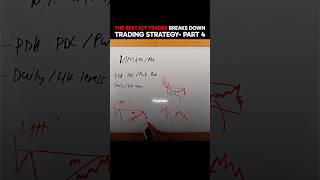
A London-open trader (speaker) compares two approaches: trading to the key level versus trading away from it, preferring to trade away as a swing trader. The speaker describes using 1-hour/15-minute structure, targeting fair value gaps, and relying on smart-money-concepts (SMT/divergence, breaker block, displacement) as cues to enter on the distribution side (right-hand side) of the curve.
Chapters
If you're a London open trader, there's two schools of thought. Neither is wrong, right? You trade to the key level or you trade away from the key level. In my opinion. I like to trade away from the key level personally. I'm a swing trader. So if I see this full hour, right and I can get like a 2 to 1, I can just hit the next open for my stop, loss a little under there and take profit in that fair value gap. But the only thing I don't like is we don't get to that fair value gap. As you're getting close to it, it could just run short of it. Like you might get an SMT in the market for example. Like let's say this is the. The euro Euroman will get there pound got there. Euro has weakness. So you're going to get divergence and you're trying to long and boom, you're just on your ass. But you see the best day that this is offered. Yeah. Consider this chart a retracement into a key level four hour. It should look like this on the 15 minute and you're trading that. And the cue to know that it's happened is you get this smart money reversal. You get the breaker block with displacement, it's closing nicely under it. That's the framework manipulation breaker block. The right hand side of the curve is what you're looking to trade, mainly the distribution side of the curve.