Using Mindfulness to Develop an Edge in Your Trading Psychology
Randy Howell (My Trader’s State of Mind) explains how mindfulness and emotional intelligence provide a psychological edge in trading. He frames poor live performance as a mismatch between the trader’s default observer (survival/emotional programming) and the observer required for probability-based markets, argues that emotions are biological action-potentials that precede thought, and outlines an applied training process (emotional regulation, noticing emotions/thoughts, accessing constructive emotional programs via memory/symbolic representation, and intentional trading). He also promotes group and individual courses and a free ebook for further training.
Chapters
These are in listen only mode.
Welcome everyone. My name is Randy Howell with my Traders State of mind and I am delighted to see you here. And the first thing let's do, let's find out if you and I are talking to one another. If you would simply type in a yes or a Y if you can hear me, I would really greatly appreciate that. That would, that would eliminate me talking for a while and people beginning to say, Randy there, I don't understand anything you're saying. Thank you, thank you. We've got plenty of yeses. Okay. What we're here to do, interestingly, a month or so ago on my YouTube channel, someone wrote and says, randy, why don't you talk about mindfulness? After all, it's the name of your book, Mindful Trading. And I thought, you know, for the last several years I have been approaching trading mine from an emotional intelligence perspective completely. And what I haven't done is I haven't been looking, I haven't been teaching it, showing it, revealing it from a mindfulness perspective. So today we're going to look at it from a mindfulness perspective. And I would like to thank the guy who actually said that because it was just like one of those things. Wow, I wish. Yeah, I'm glad I saw that. So one, one bit of housekeeping is that I hold my questions toward the end and what I want to do is I want to be able to lay out basically the route of my presentation. And after that I'll take any questions you want. You can write them in as we go. Dolores is here and she's the one actually at the control. She's actually producing it. So the questions will be there and just have them as they come ask. It's just that I'm going to be addressing them afterwards. Okay. That's the big thing. So let's look at mindfulness and trading. What I want you to do first is to notice the gap between your potential as a trader and your results. For those of you who can trade in simulation and just basically mint money, then it goes live and everything goes just absolutely bonkers. For other people who go up and down, they have really good days, they put stuff together and they blow stuff up and then they come back and they move. What I want you to notice is the gap. Okay. And as you're looking at that gap, what I want you to notice is that there is a certain observer observing that gap. And most likely there's a big question mark there about why is it, why is it that I can do simulation? I can do this in theory, but in practice, it falls apart. This becomes a much more powerful question. Begin to go, okay, there's a gap in performance here. And what I want you to do is become mindful. I want you to become observer of that performance issue, okay? Because ultimately it's not the hard work, it's not the persistence, it's not the winning attitude. Those are almost all there. Everybody believes. And they also believe that it's going to be different from them. They hear all the stuff about how few make it and how much are watched out, but somehow it's going to be different for you. Something different. And yet you get in here and you see the potential so close, and yet it's. It just seems to vanish like a mirage as you approach it. So ultimately, here's what we need to do. And I love this. We're using a fictitious character to quote from. Okay? What we need to do is we need to learn to see the problem behind the problem. You're looking at it and go, you know, I can make a bunch of surface solutions about how I do this, but ultimately the problem is not the problem. The problem is your attitude about the problem. Do you understand?
In this particular case, Mr. Jack Sparrow here is asking us to change the observer.
That you are that approaches the problem.
The observer that's been built around hard work, winning ways and persistence and making things happen and not being a loser, that is proven not to work. Okay? So what we want to do is we're going to say, wow, actually the lack of performance is only really a symptom of the problem. We need to train the eyes, we need to train the observer to be able to look for the real problem, okay? And a lot of people really don't want to see the real problem. They would much rather have fluff problems than that they pretend to have rather than the bigger one. So what we want to do ultimately is we want to see your trading.
From a completely different perspective. We already know that the current, the way that you observe trading has you stuck, okay? Or you wouldn't be here. And there is a limit to the observer that you are. That's not revealing the potentiality that trading can be for you. And we're saying, okay, this is really about my mindset. Yes, it's not all mindset. You really do have to have an effective methodology. You really do. You have to be able to demonstrate that that methodology can in fact extract capital out of the markets. But what we're looking for is to develop the trading psychology, the mindset that works with that methodology to be able to give your psychology an edge. And what we know that's missing, and somehow we can't see the problem yet. We want to learn how to put on a different frame of reference to be able to see it. So what we do here, let's see if we can change this slide. Okay? Thank you. So ultimately, we want to become a different observer, because ultimately what you're doing right now is that most traders walk into a minefield. They don't know where the mines are. They don't know why they keep running into things. They have a way and it should work. But this thing is somehow they're blind. They don't have a map. They don't have an understanding.
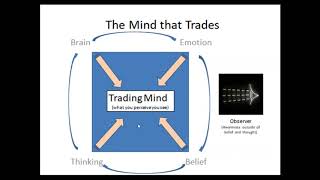
And they've been told a lot of things. But when they get out there and actually start practicing it, they discover there's a massive difference than have knowledge of trading and to be able to perform trading. This is what we're saying. We're saying, okay, what I understand is I don't understand how the brain, emotion, and mind work together. That's the first thing that I ask you to look at and say, you know something? The way I understand, the way I observe, the way the brain, emotion, and mind interact, I don't see why I'm not winning. Well, the truth is, most likely, if you don't understand the way the brain, emotion, and mind interact together, it's impossible that you would win consistently in trading. Why is that? Why is that? Well, let's start with this. Let's look at the mind that trades, okay? The mind that trades starts with emotion and brain. The brain. You know something? First of all, I ask you to understand the brain very differently. You know, at worst, it starts out as an adaptive organ. Okay? That brain is composed of a community of rival emotional programs. Rival. I want you to hear that they're competitive with one another, and they're both. And they're also cooperative with one another. And these particular emotional programs duke it out, compete with one another to produce the mind that you see through your eyes. There is no you in there. There is an organization that the emotional brain has put together that perceives reality from a particular perspective. It's only one potentiality of an observer, though. The next thing that happens is emotion, brain and emotion can't be separated as mind can't be. Ultimately, what you discover is emotions are not what you think they are at all. When you begin to observe them and say, well, you know, I think emotions, you know, they're psychological things. You Feel them. Oh, that is blind as a bat. Emotions, friends, are biological action potentials that coordinate action between you, the organism, and the environment, the markets. That's what they are. They are not psychological, but they do take over psychology. And then we start seeing this other thing, belief. All of a sudden we realize, oh, my God. Wait, wait, wait, wait, wait. What are you talking about? My beliefs? I believe I'm a winner. The truth is, that's an assumption you're holding. But the beliefs we're looking for are the beliefs that are revealed by the health of your trading account.
Literally what you're doing, this thing that you call brain and mind to me, from a neural, biological perspective, the brain is simply organizing a virtual representation of reality out there from sensorial data coming into it. And then you project that virtual representation that is rooted in your beliefs, the markets.
And your trading account is measuring the effectiveness of that virtual representation. Okay? It's not measuring the truth. It's measuring the effectiveness of your virtual representation to extract capital from the markets. And if it's. If that virtual representation is effective, then your trading account is growing. If it's ineffective, it's stagnant or declining, and you're going, oh, well, then what happens is the beliefs that I say that I have are not really the beliefs that I'm performing from. No, we need to learn how to observe that. That's an observer that's on the right side of that screen. You're beginning to say I need to become a different observer, a different watcher, to be able to see the beliefs that are actually driving my performances rather than the lies that I'm telling myself.
Finally, thinking occurs. Do you see how far away thinking is from the action? You have the brain that organizes and has emotions. You have emotions that generate beliefs. You have beliefs that generate thinking. And ultimately, what you discover is, oh, my God, my thinking is so far away from the action that no wonder that I'm getting blindsided all the time. So what we want to do is that observer needs to change. We need to become a very different observer of the trading mind. If you don't, you're basically condemning yourself to purgatory. And that's just. It's not. You know, the markets don't care if you win or lose. They don't care what kind of fine mind you have. They don't care about what kind of pedigree you have. They don't care about your winning attitude.
What matters only is, do you have an organization of the mind that can extract capital out of the Markets as measured by your trading account, not by all your bs, not by all your talking about winning ways and stuff like that. But can you see the growth in your trading account or not? That tells you the effective performance, mind or not? So now that we've gotten that, are you observing your mind differently so far?
Are you beginning to see the interconnection between the brain, emotion and mind? Now, let's take it to a different level. In mindfulness, what you're basically doing is you're producing awareness, but a new kind of awareness. You're just not drifting in whatever you got born into, whatever kind of beliefs that you heard from somebody else and you're saying, oh, oh, yeah, that sounds good. I think I'm going to believe that. No, what happens is what we want to do is out of awareness, we want to take the next step to new knowledge. A new knowledge like what we're talking about right now, about how emotions are very different than what you think they are. And the truth is you don't have a choice about emotions. They're there anyway. And if you try to push them away and ignore them, they're going to bite you, which you probably know a lot about. The deal with awareness and then new knowledge that comes out about that, about your trading mind is then you have to develop the mind. You have to start saying, oh my God, I'm beginning to recognize that the mind that I brought to trading was never going to produce success in trading. It is built for different purposes and I'm going to have to develop a very different mind. The truth is, the brain that you brought to trading was built to manage certainty, to stay alive in the moment one more time. And it's driven by survival instincts that are really short term oriented. That's a great mind for caveman. It's maybe a great mind for what you're doing, what you were doing before you got to trading. But in trading, in trading.
There is no control over outcome. None. And as long as you're trying to control outcome, trying to make things happen, trying to predict, you know, and I'm going to be a winner, I'm going to prevail, I'm not going to lose. Then you're going to lose. Because ultimately the mind for trading is about probability. It has to accept probability.
No known outcome. It's a big deal, it's a big shift. And out of that, as you achieve that new way of interacting with the environment as probability.
Rather than as certainty, you develop mastery. Okay, this, friends, is what mindfulness can bring to Your trading, it helps you master emotions.
Yourself.
But then let's start here. What is mindfulness?
I like to keep it very simple so that we don't get into some big huge debate about what mindfulness is. At its core.
Mindfulness is the capacity to truly notice what you notice. To be able to have a curious attitude, non judgmental attitude about watching what you do. In mindfulness. You, if you were mindless would be beating yourself up. Mindlessness would be self sabotage. Mindlessness would be basically self limiting. Self talk where you know, you go, you just, you know, you say, I'm not going to be able to do it, it's not going to happen. What happens is if you're mindful, what you're doing is you're saying, I notice that I have these conversations inside my, between my ears and as I look at them they're very judgmental and yet I'm here and I'm looking at them non judgmentally and I'm going, wow, this is really interesting. How did I get organized this way? So then what we do is you start going, hmm, I need to become observer not just of noticing things, but I began to start having to observe the judgments that are running through my mind and the assumptions held as truth like winners always win, losers never win. That kind of stuff. You're beginning to, what you want to do is you want to start noticing the unexamined patterns and perceptions you have that you bring to, to the trading journey because it's going to be different and ultimately what you discover in particular. And this is kind of a really silly cartoon, but if you take a look at it, we take things so obvious and we want to think, oh yeah, this is so true, this is it. And yet at the same time, when you start practicing it, it doesn't work. Who in here has not used positive thinking as a way of mind control going into trading? And has it worked? No, it doesn't. It doesn't. The markets don't care if you're thinking positive, what happens. This is a random possibility and you're working with probabilities, you're not working with positiveness. And you start saying, well, I'm a winning, the winning attitude, I'm going to win, I'm going to keep that positive winning thing. I know lots of people come in with winning attitudes, they take it for granted. And what they discover is the winning attitude puts him in a situation of overconfidence and suddenly they're over trading and blowing up counts. Okay, short term it may work, but long term, over the long haul, it doesn't produce consistent profitability. That's what we want to look at. So it's the stuff that's so familiar that we want to start taking look at and going, you know something, I should have been looking at this because just because it's familiar, it's become ubiquitous. I don't see it operating. And is it really being successful? Is it producing the ability to extract capital out of the market? And for my trading account to grow, that's the only barometer that we have. And what I can tell you is that the winning mindset, you're going to have to change how you understand winning. You're going to have to become a different observer of winning. In fact, you're going to have to become a completely different observer of losing. Because ultimately you'll find really good traders are just absolutely black belt losers. They know how to lose in such a way that minimizes loss and allows them to trade for another day. And they know how to do that. And they don't take it personally that, well, I just took a loss. And what they do is they say it's not about the outcome, it's about the performance. That's the powerful distinction in observation and mindfulness that has to be made. And the first thing that we have to do is we have to get past the assumptions that we had. Like for instance, do you remember when the world was considered to be flat? It was not too many centuries ago. The Catholic church fought tooth and nailed about not wanting to accept that there was a globe here. And so what you're saying is that if you have a mindset rooted in an old paradigm, okay, and you bring it to the paradigm called trading, what do you think is going to happen? You're going to find out whether or not that paradigm is functional or not. The truth is, is nobody fell off the end of the earth. They ended up finding out that it was round you could sell around the world. Magellan did that, okay? The Chinese did that many years before Magellan. But the point is, is what we're seeing is a virtual representation. We're seeing through the beliefs that we basically downloaded from history, okay? And then we're projecting those beliefs onto the markets and we're seeing if they're effective or not. Not true. We're not talking about truth here. We're talking about are those beliefs effective in managing uncertainty? Because ultimately what you're doing is you don't see the markets, okay? You've never seen the markets. You see a virtual representation that your brain has organized and projected upon the phenomenon of the markets. As long as you think you're seeing the markets you think you can predict, you can't predict. You create hypotheses that may or may not happen. And if the hypothesis is wrong, you take your loss and get out. If it's right, you run that baby. Okay? There's lots of different ways of handling that, but the key is this. I want you to understand in this mindfulness, you do not see the markets. There is no market out there. That's the truth. There is an observer that you are that's interpreting the markets from their beliefs, and you're seeing the effectiveness of that observation, of that interpretation in your trading account. That's what you have to work with, friends. Okay? Not what you want to believe, but what the trading account is telling you and revealing to you about your beliefs and performance. So.
Ultimately, what we're now doing is saying, oh, now we need to take this observing self.
And that's really what I call this mindfulness phenomenon. And there is a observing self living within all of us. And what you'll notice is that you are not your thoughts, you are not your beliefs. You'll notice that there is an awareness outside of thought and belief. And what you're doing as you develop this observing self is you're turning that. You're turning that microscope, you're turning that enlarging glass onto yourself. You want to see what's behind your performances that's causing you to behave persistently the way you do. It's nothing personal. This is where people get so staked to an identity going, I'm a. This is the way. I'm a man. This is the way. I'm a winner. I'm going to hold on to this. I don't care what happens. Well, you know, the markets don't care either, and they're much more gigantic than you. And it's going to cost you money to hold on to beliefs like that. What I'm asking you to do is to see your blindness, to start saying you know something. As I observe, I'm holding onto this idea about winning. I'm holding on to this idea about losing. And what happens when I see my trading account. I recognize there's something really wrong with the beliefs that I'm projecting. This is observation. This is what you're learning how to do. Okay? So we're asking here is accept the trading account. It's the only truth meter that you got. It's the only friend you have and certainly don't Trust your own mind, okay? You want to observe that mind. You don't want to believe it. So from there, what I want you to see here, this is a really important slide, and I want you to grasp it that this is what's happening in your brain. And understand this. Your mind, by some miracle that we don't really understand, emerges from your brain. Okay? So basically, your mind is an extension of your brain. So ultimately, take a look at this. At one moment, you see a stimulus, a trigger, something activating event happening in the environment, in the markets. It automatically triggers an emotion. That emotion may not be defined yet. It may be just startle or surprise, but it's heading. It could be heading to fight flight, it could be heading to discipline. It could be that emotion could be heading someplace. What alters the course of that emotion is this filter called your thalamus. It's a part of your limbic system, and all this neural information is coming into the thalamus and it's making a decision. Is this something by history that I've seen is dangerous? And if it's really dangerous, I'm going to send it to the low road, I'm going to send it over the amygdala, or this isn't so good. This might be interesting. I'm going to send it to the thinking brain.
Out of that, that switch, the high road or the low road, comes interpretation, thinking. Okay? I want you to see how far away thinking is from the original stimulus and the emotion that emerged. And out of that thinking comes behavior. And that's when you say, if you've ever had this thing where you go, you know something? I don't know what in the heck happened to me? I'm doing a review and I literally said, what was I thinking? You were thinking from the emotion that emerged from the triggering of your encounter with uncertainty. That's what you were doing. And you triggered to fight flight rather than to disciplined impartiality or a patient mind. And then the thinking got skewed based on that fight flight mind, and you started doing really dumb, stupid things that you looked at and go, what in the world was I thinking? That's a hijacking. What we're looking to do is to say, I understand that I need to start managing the emotional nature, because ultimately I can develop an awareness about emotions that allows me to use emotions effectively to create mine. Or I can continue in the same old ways in my mindlessness and I can get sabotaged by my emotions continually. It's your choice again. The markets don't care. So we've come into this thing and what I want you to also understand is that there is no freedom from emotion. They are part of who you are. They happen before thinking. In fact, all thinking is emotional state dependent. And here what you're doing is you're seeing this graphic of, you know, basically the viper you're looking at is programmed by our brain over millions of years to activate the amygdala immediately. Remember it hit the thalamus and the thalamus was the to send it to the amygdala, which is the fear monger in your brain and the one that heads to the fight flight thing, or to send it into all that blue area, actually the gray area of your brain so that you can think about things. That's default programming. And until you can solve that problem, the default programming understand this. Every time that you encounter uncertainty, your emotional brain, what's happening with this girl right here, triggers to confusion and then vulnerability. And vulnerability is hardwired to fight flight. Until you master that, until you change the direction of that survival instinct, you're going to be a really bad trader. Simply because you know what happens is you're constantly dealing with uncertainty, you're constantly dealing with risk. And the emotional brain is going to see uncertainty and risk as threat. Same way it sees that viper unless you learn how to cool it down. Okay, so ultimately what we have here, the way most traders come into trading.
Is they basically get in a fight with their emotional brain that they can't win. Okay? Is understand this what you call rational thought, many other people would call rationalization. Your left brain creates a story or an alibi that supports whatever your emotional brain decides.
Rene Descartes was wrong. I think therefore I am ultimately. And as long as you're in conflict here, you've got a problem. What we're looking to do is to integrate emotion and reason into a performance mind. This friendship is the difference maker. Okay? And what I want you to notice is this is all about observation. Step back and start observing. How many times have you gotten this conflict right here where your thinking brain and your emotional brain got into conflict? And who won?
The emotional brain does, okay? You have to learn to manage it. And I'm going to go so far as this is exactly, this is the exact circuit right here you're looking at that causes all the problems. Okay? What you're seeing is over on the left bottom side, you are seeing sensorial modalities, information coming into the thalamus. That's that bottom left hand character and that thalamus, based on history, based on basically what it's adapted to in the past, is going to decide whether or not this is a threatening stimuli or whether or not it's going to be an interesting stimuli and. And can re. And can have thinking if it's threatening. And this is done on a very primitive basis in nanoseconds. Nanoseconds.003 seconds, it will decide to go the low road and it will send that information over the amygdala. Okay? So you have activity in the amygdala. You have chemistry in the brain in.003 seconds. That is literally the blink of an eye. And the chemistry is already there. And you're in fight flight. Whether or not you're trying to pull the trigger, whether or not you're just going powerless getting into the trade and it's going all over the place and it's going sideways, or whether or not you finally hit the black and you have this enormous urge to take your profit now before it's taken away from you. Okay. There's the other path, though. The other path will go. I'm going to send that to the thinking brain. Well, friends, that takes microseconds. That takes a half a second.
You have already. It's already blown out the emotions already there. It's already there. It's flooded and already hijacked the mind. This is what you have to solve, friends. And it just so happens I can teach you how to do that. Okay? So this is. This is the thing that you're going to have to solve right there. Okay. If you're going to become a consistently profitable trader. Okay. Otherwise, you're gambling. So.
Now let's talk about more than just mindfulness. Let's talk about applied mindfulness. Let's talk about how you can use mindfulness to actually change the brain, change the mind that trades. Okay. This is really about developing the awareness to observe both the body.
As an emotion and your thoughts as extension of your real performance beliefs. So, you ready? I am. This is when it gets really interesting to me. You know, we've looked at kind of what the problem is. Now we want to look at the solution. Right in the middle is emotional intelligence. Okay. And ultimately right on that left upper second, the very first thing is you have to start perceiving emotions. Most people do not perceive emotions until they've been hijacked totally by them. Okay. And ultimately what you would be doing is that tomorrow, if you want to actually want to see this, I'll talk. I'm going to talk a little more extensively about this in a minute, but just hold on a second. The first thing is you actually have to perceive the emotion. Okay? And let's say this now, I've already said it once, but here's I'm going to go this one more time is what is an emotion? It's not a feeling. Friends, I want to go back to the definition I gave you the first time. An emotion is a biological action potential.
That organizes activity between the organism, the trader, and the environment, the markets. Okay, I know that sounds weird. That's what an emotion is. To a neuroscientist. The next thing in that emotional intelligence loop is understanding emotions. That's what we're talking about here. That's that circuitry I was showing you, looking, and I'm hoping you're getting. Is that the way you've been trying, you've been trying to overpower emotions or deny emotions and they just blow you off, they blow you out of the saddle? You have to understand the way they work, be able to use them. The next thing is using the emotion and managing the emotion so that, okay, I can use this emotion to create the mind that I'm going to bring in to engage the uncertainty and risk of trading. No longer am I just going to let the old programming show up and trigger. This is when you start becoming a manager of emotions. You recognize there's no freedom from emotions, but you recognize you have freedom of emotions, that you have an enormous say. So if you really work to be able to say what emotions show up in a moment to manage uncertainty, it doesn't have to be the default programming. Fight, flight. It can be the trained response like I teach in my courses of disciplined impartiality with a patient mind. That is what can engage and that is the edge from a psychological standpoint. Now the key is, are you going to use your emotional nature or are you going to get used by it? Okay. Because ultimately the deal is this, is that you have to recognize that the rational brain is simply making up alibis for what the limbic system, what the emotional brain has already decided. And that your survival brain, what a lot of people would call caveman brain, is very focused on these survival instincts and rightfully so. You know, there were some bad dudes looking for us when we were just 10, 20,000 years ago, and ultimately they had to act fast before thinking for life's sake. You know, today you may feel psychological discomfort in the vulnerability of uncertainty, but there's no saber toothed tiger there to Gobble you up. The limbic system can never know that. The rational mind can. But you have to learn how to cool the limbic system down. This is where we're going, friends. This is where it gets really interesting. Because the first job of mindfulness after understanding emotions is noticing emotions. You know, in here, you know, you have this big bear, and the guy's going, thank you for contacting the fight or flight response. All of our advisors are busy at the moment.
It's moved into freeze. The thing is, what's happening here is what we're saying is that when the observer is observing uncertainty.
If you lead it to mindlessness, what happens? That observer is your caveman brain. And it's going to react fight, flight. However, if you have a trained observer of discipline, impartiality, you're not pretending fear is not there, but you're, you're. And you're acknowledging the potentiality of that fear. But what you're also doing is recognizing that if I manage the emotion that create mind that I engage uncertainty with, I can manage the uncertainty much more calmly, much more patiently, much more disciplinedly Than if I just simply get run over by the emotion. And if you notice this, what happens is all emotions have a biological signature. That allows you to spot the emotion before it has a head steam. This is big news, friends. This is something I teach in the course and you start this is actually known as emotional arousal. And what you'll notice in this particular guy on the left, he's beginning to feel the tenseness in his neck, the tenseness in his shoulders. He's feeling emotional arousal. The emotions already triggered, okay, now it's building up. And at some moment, he's going to either have to interrupt that emotional arousal or that emotional arousal. Arousal is going to hit a point where a lever is turned and it's no longer arousing. But the chemistry of the emotion is flooding in the brain and the mind, altering thought.
And ultimately, emotions have both a breathing and a muscle tension signature. By using breathing and muscle relaxation, you can control the intensity of the emotion so that it does not hijack rational thought. You can do that? I teach that. And it's the first thing that I teach. It's literally the first step in the process that I teach. Does it change everything? No. But what happens? Unless you can manage the intensity of the emotion so it doesn't hijack, then you're never going to get to the mind anyway. Once you do that, once you get past that, then the second job is to begin to observe thoughts okay. And what you discover very clearly is that you and your thoughts are different. You're not having thoughts, they're having you. And you begin to go, oh my goodness gracious. And what you discover is the brain is a community of rival programs, emotional programs that it organizes cell and the mind is where those programs are given voice as your thoughts.
And also I use a lot of mindfulness. And here's the joke, you know, Buddha's asked, what have you gained from meditation? He said, nothing really. You know, it didn't do very much for me. But what I lost is anger, anxiety, depression, insecurity, fear of old age and death. Wouldn't that be a really great thing to lose? If you're a trader engaging all the time with uncertainty, yeah, what a great deal. And what you begin to realize that as I train the observer of who I am that I bring to trading, I change the kinds of thoughts that are occurring in mine. Suddenly there is no longer self doubt there, but what you see is there is the openness to possibility, not winning. I'm going to win, I'm going to win. No, you can't win. You know, this is not about winning an outcome. This is about winning the mind that you bring to the performance. And ultimately you want a mind that basically says, oh yeah, okay, I landed on the right side of probability, that's called winning. Ah, I landed on the wrong side of probability, that's losing, I performed well. That's the new standard, that's the new paradigm of winning that has to be developed through mindfulness. So my question is, do you keep a thought log and do you start noticing the different emotions that thoughts come from and do you notice the numerous voices in the mind? And my promise is you got lots of voices. You have a neighborhood in there. And if you don't think, you don't think about the last time you had self doubt. Think about the last time you had an argument with yourself about what you wanted to do. Think about the last time that you were in a trade and you hit the black and you wanted to get out and you also wanted to hit the target.
That's the voices in the mind. And what happens is you're only listening to the historical dialogue. You're not listening to the dialogue that you have created in the mind by managing the different emotions that give rise to thought. This is where you start realizing is, wow, I'm really just only one potential organization of a self. This thing that I'm calling I and that I can go in with mindfulness and I can alter how my potential is organized into a self that trades friends. At that point, you're right, you're cooking. Because ultimately, if you take a look at this, if you see this as the committee of the mind and literally and all these different players and forces, they all have different agendas. They one each wants to take the mind in a different way. Some are destructive, some are constructive. Well, this is what people mostly find when they wake up the observer of the self and they look inside the mind. They realize, oh my God, this is in disarray. I need to go in, I need to reorganize the way this mind functions. It's just absolutely against itself and it's creating horrible results. Your job as observer is to be going, okay, I can observe the different voices in the mind. Okay, and how do you do that? Well, I'm going to help you here. I'm going to, I'm going to tell you what we've got here. You have an inner critic in your mind that criticizes you, tempts you, judges you. And if you don't think, just think about the last time. Says, when was the last time you had an argument with yourself? How's the last time said you were a dummy. You couldn't ever do this or do this. Do it. When? When? Get in there. That's the inner critic. That's not you.
That is the inner critic as part of the committee of the mind. It's not going to go away. It's like a backseat driver. It's not going to go away. It's going to be there. But most of us give it enormous power by trying to ignore it and push it away. Or we get positive thinking mantras rather than confronting the inner critic within the self from power. So, okay, we know there's an inner critic in there. Okay. And instead of ignoring tomorrow, what I want you to do is to observe him. The next thing is this, is that the inner critic starts invoking fear or the need to prove itself to your orphan nature. Your orphan nature is your fear, your need to prove the self. And suddenly there's this self pity. Oh my God, look, I've just wasted a hundred thousand dollars. What am I doing? Fear. Oh my God, I'm going to die. How am I going to tell my wife? Oh my God, Resentment. I resent the markets for taking the money. I am going to, I'm going to get angry. I'm going to take it back. Dread. Oh my God, I hate to even open the office door. I just know I cringe anger I'm going to get you back. I'm going to get you back. I'm going to show you worry. Oh my God. What's going to happen in the future if I get into this trade? What's going to happen? Is it going to lose all those things? At the very core of that is the inner critic. And it's been running absolutely with blotch free, with no, with no confrontation examination by you at all.
Okay, this has to stop. You have to become a powerful observer of the mind that you bring to trading. You can't let this historical self be the one doing your trading under stress. And that's what people do, and that's why people lose. It's this very undisciplined mind that you have to master to engage uncertainty. But let me tell you this, this is what's interesting. And this is where the observer, this mindfulness becomes really important. In the very same way that you have fear and self judgment living within you, easy to access. You also have discipline, you have courage, you have self soothing and you have impartiality. These are emotional programs that are committee members in the mind. The difference though is you don't know how to access them under stress. The key is, how do you do that? Okay, now this is when mindfulness really gets important. And what you do is you build the committee of the mind. The coursework that I do, ultimately we teach you how to first pull up the emotional program itself. Discipline, courage, self soothing, impartiality. And to build a mind that comes out of those emotional programs. Remember, all thinking is emotional state dependent. And suddenly you're beginning to say I have ability to go into real memory and find times when I have experienced these emotions and I have been able to work into challenge and land well. Okay? So ultimately the big thing here that I want you to understand, probably the biggest one, is calming the fear down. Something we call self soothing. But ultimately self soothing is really self compassion. It is compassion, self compassion that takes the old neural patterns of identity.
And can tease them apart so they can be reorganized into higher functioning. And ultimately what we're doing is we start recognizing, okay, first we can get at the emotional programs and we can learn to call them up during moments of stress, during trading, rather than the old programs. But better than that, friends, your brain also produces something called symbolic representation. And what that is is it starts attaching, it objectifies the emotions, okay? And what that means is suddenly discipline, the ability to maintain pressure, maintain order under pressure, becomes ruler, like in George Washington. Here, you know, the Thing is, these men believed in him.
And it just so happens he was able to maintain order under pressure on this, on a crossing the river in ice and attacking the Hessian soldiers. And without this, we would have a hard time being an independent America. But also the thing is what you discover is there's courage, which by the way is not the absence of fear, it's actually being able to act in the presence of fear. And that courage becomes warrior. You will have a warrior nature that by symbolic value you can pull up. You will also have this self soothing or self compassion in you that usually has to be developed because it's just gone AWOL and it's missing. You pull it up and what you do is you start soothing the fear down. That fear is known to the orphan. But what you're doing in soothing the fear down, you allow the rational mind to be present. When that's done, you have the impartiality, the clear thinking, the sage. These are parts of your brain and parts of your mind that you can learn to activate and bring into working awareness. We teach it, okay? It's very teachable. That's the whole point. You don't, you don't have to be stuck with the mind you brought and wish for magic to make things different. You can actually go in and reorganize the mind to be effective in engaging uncertainty. Okay? That's the deal. Like this surfer, what you have, what you recognize, he's not in control of outcome, he's in control of the mind. He is in the moment of that performance. The future hasn't come. The past is gone. There is now. And if you notice the really top end sports players, particularly if you take a look at the lpga, well that too, the pga, what you'll see is that every trader can hit, he can just knock the. Huh. This is golfer.
The golfer. They can all drive, they can all putt, but there's only 10 big money players. What you'll see is that they carry sports psychologists with them because they know that they cannot control the outcome. They can't control whether or not they win or lose. They can't control the weather, they can't control whether or not another guy's having a great day. What they can control, particularly with the help of a mentor, is the mind they bring into that moment. Here in surfing, it's all about managing the mind in that moment. That wave is gigantic. Yet at the same time, if that surfer maintains mine, the chances are the probabilities are he's going to get a rush out of this. It's in. Fantastic. So this is what you can do with your trading mind. Okay. And there's a process to it. Okay. We teach this process both in our group course and our individual course. It starts with emotional regulation.
Nothing starts until you can regulate the intensity of the emotion. The next piece of that process is mindfulness. You become observer their body so you can get at the emotion. You become observer of thought, and you start examining thought. You start naming.
The thought forms and you start realizing there's an internal dialogue. There is a perceptual map going on inside your brain. And you find the inner critic, you find the orphan, and you start. You stop giving the inner critic so much power. The only power it has is the power you give it. Then you learn how to access the heroic emotional programs as a function of memory. And that's what's so important about my work. It literally comes out of memory work where you pull up when these things have actually happened. You're not depending on affirmations and visualizations of what you wish would happen. This stuff really happened. You pull up the ability of discipline as ruler, of courage as warrior, as self, soothing as caregiver, and impartiality as sage. And then you do the internal struggle. You engage in certainty. Not from the old mind that has a direct route to fight flight from this new mind you've created that works from impartiality and discipline and patience. And then the final straw is you become intentional. You would never think of trading unless you could produce the intentional trader state of mind. If you can't do that, you don't trade. And that's great trading. You realize I'm not capable of doing this right now. I need to back off. So this is the process. We teach it in our group course and our individual stuff. So this is retraining. And the truth is, is that you have to decide. This is all personal development. Remember, the. The mind that you brought to trading is not going to be the mind that's going to be successful. It's going to require development. It was designed for something completely different for survival in the short term versus thriving in the long term. So it's going to have to be developed. You're going to have to develop that mind. Otherwise you're fooling yourself. Okay? And a lot of people in trading fool themselves. I'm okay if people insist on it, but you don't have to, friends. You can commit to development. And if you do, how do you become that change? Well, guess what? We have a way. How Would you guess that the first thing is a group course one starting in January. It's got five meetings with me. We meet as a group. You study from a virtual classroom. And what happens is you learn the process as you go through. And basically what happens is you have a lot of. You have unlimited access 24,7 to the classroom. And it's very, very powerful. Okay. And the other thing is that if you want to learn more about this, go to the website. Gosh, it is content rich. It's got all that. It's down at the bottom. It's the my trader state of mind. That's the group course. Other people opt for the individual course because it's highly comprehensive and very personal. And it's basically 10 Skype sessions with me over a period of three or four months where it gets really deep into the trading mind. Okay. And it's for people who are really serious and say, you know something. I realized that having a mentor with me really helps me and works within that. Okay. And again, on the website you will find big long descriptions of this where you really get the whole idea about what's there. And also when you're there, there is a free ebook. And what I want you to do is get it. But we'll also discover is there's tons of videos there and there are tons of, tons of articles there. There is lots of stuff where you can get to know my work. You can really explore whether or not you're ready to actually take the dip and say, you know something, it's time I got serious about developing the mind that trades no matter what you do, I hope the best for you. Okay? And I want to thank you, but get the free ebook. It's, you know, it's, it's a good start. It really shows you a lot of. If you're really interested, go on and get my book. Mindful training. Now, if there are any questions, I would be happy to get to them. As many as we have for a few. And here we have two. What about positive expectations?
Expectancy expectations.
You can have all the positive expectations that you want, but that doesn't control outcome. Basically it would be the difference between saying I have the positive expectation that I'm going to win. That's a setup for failure right there. A positive expectation redefined as through observer. Would I have the expectation to perform well? Okay. Is you're totally locked into performance rather than outcome. You can use the expectation. You know, I, you know, I teach how to build a mind that is all about performing because we Know that if you perform well, probability is on your side. Not. But probability is on your side, but not outcome. Okay, that's the big deal. I want you to hear that. I've just finished your book.
I just lost that one.
Okay, I've just finished your book and now realize that as a trader, my job is to find probability and want to enjoy risk management with my back. Tested methodology. My mind is now aware of my thoughts, conversations and body language when emotions kick in. That's a good start, man. That's exactly what you're looking at. Again, what you're looking at is you're talking about a transition from a mind that wants to win.
But the problem is that you want to win about something that you have no control over to a mind that wants to perform well. And if you perform well, probability is on your side. And that is the new winning. Okay, I've been trading for more than a year. Forex. Oh, I've been trading forex for more than a year now. I've had great success in demo trading, but almost none in live investing. I found the stress and pressure of day trading overwhelming. Now I have switched to swing trading stocks.
ETFs, hoping for less stress and more control over my emotions. Do you think this is a reasonable change or am I just fooling myself? Nothing will change. You know, I, I work with fund managers, I work with portfolio managers, I work with traders, I work with active investors. And ultimately the time frames are different, but the, the challenges of uncertainty remain the same. I can understand where swing trading would be easier. I've worked with a number of swing traders and the deal is you still have to pull the trigger. You still have to be able to engage the uncertainty of the probability of winning or losing. And you have to see how that impacts self identity. Okay, is, you know, if it works, then, hey, then, you know, I'm all for it. I'm a very pragmatic guy. But what I would encourage you to do is look at this and after you've done some time, simply say, okay, tell me something. Was I avoiding having to deal with my fears? Ultimately, this is really all about recognizing that your fears are your teachers. And ultimately what you're going to discover is that there is no rocket science here, friends. Your fears will be based on a sense of inadequacy, a sense of not mattering, a sense of unworthiness and a sense of powerlessness. Okay? Those are the real ones. Okay? And ultimately those are the ones that are going to have to be solved. And you do that with the internal work that I do. Okay, so if you find out that if it works, great. If it doesn't work, what I ask you to do is explore more and recognize that within you there is a heroic organization itself that can be developed, that can master your fears, master your emotions. And you can day trade or swing trade or have different positions open for different times. Recording link. Yeah, you'll be getting a recording link tomorrow. Okay, that's Doris saying that. And it will, it will be posted and it will be on my YouTube channel. Okay. I think most people who start trading have the most important mind frame. They don't know what to expect, which is perfect. The problems start with expectation. After people have traded for a period of time, if you remove expectations, you remove 90% of the problems. Well, good luck with that. Human beings have been having expectations for as long as there's been thinking. And you know, my dog with only a rudimentary neocortex has expectations about dinner. He starts about 6 o'. Clock. He starts coming up to us looking very pitiful. And what he's doing is he's, he's building probability that he's going to get fed. And at 6:30 real soon from now, that dog will be fed. The dog has expectations. It's wired into our biology. However, as you develop observation, you begin to start going, okay, I need to cool my expectations. The deal is the expectations needs to be rethought. If you're having expectations of making money, of winning trades and controlling outcome, those are the kinds of expectations that flow out of the typical winning attitude. What I'm asking is that in the new winning mindset, your expectations are about performance. I will have the expectation that I can manage the mind that I bring into the moment of trading. If I do that, that gives me the edge in probability that my methodology gives me. Okay. And I wouldn't necessarily say that.
Traders get into trading with high expectations. They are crazy to believe that they're going to make a hell of a lot of money. They have a $500 account and somehow think they're going to work that thing up to a million dollar account and they're going to be in crazy financial condition and they're going to have personal freedom. And that usually for people who survive the cut is most people require minimally three years to get profitable. Most people require about five years to get profitable and to begin to build up the account so that it's throwing off enough capital to start sustaining a life. Unless you happen, you know, unless you have a quarter of a million dollars that you start with and can use regular stuff. But the thing is is I think the expectations already there. What I would like to see in early traders is for them not to be fed such BS about what's possible and quickly and what they really need to be doing to build a probability based mine. If they started doing that, there'd be a lot less traders but they would be traders much more prepared for the rigors and the challenges that managing uncertainty really have. And believe me, trading is a. Until you make that shift in paradigm in the mindset, trading is difficult, man. Okay. Well friends, we've hit the hour mark. I want to thank you for coming. I thoroughly enjoyed myself and I love the questions. Thank you. If you're interested, contact us. And by the way, just to let you know, is that when you get interested and you really want to see if this thing's working for you, ask for a free consult. Dolores would be happy to organize a time that we can meet. But when you do that, I really want you to check out, check my website out, check the whole thing out. Make sure that you understand that. Okay? I'm motivated to be able to develop the mind for trading. That's when I'm interested in talking to you. If you're just kicking tires, not really, I want you to kick more tires. Learn that you need to develop the mind. Okay. Because I like serious students and I like people who are ready to learn. So I thank you guys very much. I have had a great time. Have a great day trading tomorrow and observe your body for emotions tomorrow morning when you start trading. Okay? Take care. God bless you.









