What Does it Take to Turn Trading Into the Freedom You Seek
Randy Howell explains why traders fail: their emotional brain hijacks decisions under pressure. He teaches emotional regulation through breathing and stress awareness, then reorganizing subprograms like ruler, warrior, and sage into a disciplined trading mind. He contrasts ambush versus chase trading styles and answers questions about his courses and methods.
Questions this video answers
Five group meetings over a period of 10 weeks.
Three to four months, comprising 10 Skype sessions.
About five to ten minutes (practical baseline), and then use the breathing during live uncertainty.
He states roughly 95% of people lose money; consistently profitable traders who earn a living drop to about 2.5%.
A free book titled Mindful Trading and a YouTube channel with ~300 videos.
Chapters
The broadcast is now starting. All attendees are in listen only mode.
Hello, my name is Randy Howell, and I am delighted to see you here today. And what we're doing is we're taking a look at this thing. Oh, before we get any further, please, some kind people into the question box, type of. Why? In order to let me know that, yes, you can hear me. I'd hate to be talking I don't know how long and find out that nobody's hearing. Yep. Okay, I'm hearable. Okay. So if you're having a problem hearing me, it's on your end. It's not on my end. Good. Okay. What we're going to do is, you know, all. Every trader, when they really started looking at it, they see the promise of trading, and it's. It's gigantic. It's personal freedom, it's financial freedom. And you're going, you know something, wow, that's what I'm going to be working for. But the thing is, is that how do you actually turn trading into the freedom that you're seeking? The promise is that. Is that freedom. But what we want to do is say, you know, a lot of people come into trading with those potential promises there, but very, very few ever actually realize them, so that the trading actually becomes a vehicle to produce the kind of freedom that you're looking for. So we want to take a look at that because, you know, some of it is just.
We don't necessarily like to acknowledge.
That we're actually great apes. You know, if you. If you look into the mirror, what you'll look at is a face, and it's got some hair on it, maybe a beard, maybe not, you know, maybe color in the eyes and all that stuff. And you look at it and go, that's a human being. I am nothing like an animal at all. And on the surface, you are so right. You know, I'm looking at a photograph of my granddaughter right now, and she's just the cutest little thing that you can ever possibly imagine. And I just. My brain just absolutely does not want to see her as a primate, as. As a great ape. And that is just growing up like a human being. Okay. Yet it is that very situation that we do not acknowledge this aspect of our being that just absolutely cripples us in the pursuit of profitable trading. And so what we want to do.
Is start there because, you know, ultimately, it just seems doable. You look at it and, you know, you're programmed from your caveman days to win against all odds, because that's basically what our odds were of surviving. And we had to believe that, that we could win against all odds. And it's, you know, if you work really hard, you follow rules, success is going to happen. And you have to be really persistent. You just can't give up. And that has worked so well. And a lot of people, I am known, you know, a lot of people have always claimed me as a workaholic. And it's one of those things where if I keep working, keep working, keep working, you know, I produce, it's going to happen one way or the other. And I learned from my mistakes. So it's. Even the mistakes just become part of a work. And yet at the same time, you take that same mind to trading and you know, you know in your thinking brain that it's just a game of numbers. And yet those deeply held survival emotions keep ambushing you at your very best, best laid plans, and you find yourself doing the same stupid thing over and over and over again. But you know better, but it keeps happening. So we want to take a look at that and go, how could that happen? The truth is, is that trumbling, troubling, trading presents a stumbling block to success that people just keep missing by refusing to look at their emotional nature. That, that ape that lives within us, that's the emotional brain, that's the, that's that limbic system, that's that mammalian brain. That's what it is. We don't necessarily see it, we keep overlooking it. And therefore we forfeit the knowledge needed to make trading to the, to the next level. And we're doing it to ourselves. It's not like, it's not like the, the markets are out to get you. They don't have to. If we insist on staying in a particular comfort zone, a pattern that says, this is the way I'm going to produce success. And you cannot hear that. Trading is giving you feedback that what you're doing is not working as long as you stay stuck there. And I find it takes somewhere between two and five years for a person to realize that, you know.
They know how to trade. They just can't trade when they want to trade. And effectively. So we're looking at that. We're going, okay, Randy, I'm listening to you. And there is this stumbling thing, but what's it connected to? I don't understand it. Well, this right here is exactly what.
Oh, let's see.
At first you look in all the wrong places for answers. You, you know, I, I have never stuck my head into a mortar, but I Guarantee you there's nothing in there that I want to find. Okay, you, you do this, you find, oh, what are. The teacher. What does the teacher, you know is, I did that in there. He does this, he does all of this doing these things, and, oh, this thing, this, this way, that way. And all of a sudden you, your, your trading room is full.
Of all the debris from yesterday's plan. And so we keep looking in all the wrong places simply because that's what we know. We don't know to look at ourselves. And it's in doing this that things begin to make sense. You know, fundamentally, we started out with kind of like a spinal cord. We call it the reptilian brain. And it is really a primitive brain, okay? And over time, over time, over time, evolution produced different kinds of variations. And suddenly what happens is mammals emerged out of just reptiles and whatever dinosaurs were, okay? And then they became very different and they. This emotional brain, also called the limbic system. You know, you can start feeling emotions here.
And all of a sudden, emotions, if you feel them, that means the chemistry of that emotion is already in your bloodstream, altering the way you perceive.
So the deal is, is developing the emotional brain that engages uncertainty is the challenge. Because what we're wanting to do is we're wanting to fundamentally, what we want to do as a thinking brain, the one that knows the rules, knows how to trade, but can't trade under pressure. What we really want to do is we want to domesticate that limbic system, that mammalian brain, so that we're no longer acting that way. We're no longer acting instinctively in the face of uncertainty. That's the deal. Because the, the. The reptilian brain, that's all it's doing. The mammalian brain, that emotional brain is. It's so hard for the. In for the thinking brain to even see it, perceive it, until it gets slapped across the face and knocked across the room. That's when we call that tilt, actually, I call it emotional hijacking. So you're looking at it and saying, we see this evolution from a brain stem to a reptilian brain to a mammalian brain, it keeps growing. And now we're something different. We have this thinking brain that often is disconnected to the root, that it grows from the limbic system. And what we need to do in order to be able to domesticate that limbic system, we are going to have to learn.
How to work with it, how to calm it down, how to take it in our own directions. Because ultimately, my friends, there is no such thing as Freedom from emotion. All these people say, oh, you just leave your emotions out the door, blah, blah, blah, blah. Well, the only time you can do that is when you're dead. An emotion is a biological action potential.
Now think about that. It's a biological action potential. It's going to get the body moving in directions. And it's a potential that all it needs is triggers and cues in the environment and it automatically happens. And so the thing is, the emotion does not go through thinking. Thinking supports the emotion. So if you're not accepting the lack of control over outcome.
And realizing that, it's your undoing. But the thing is, you ask the question why? The truth is, is our, our forefathers, our ancestors, deep ancestors, had to believe in a particular lie, that they could survive against all odds.
Everybody has that. America was settled by people like that. And a lot of them died, a lot of them perished. But the thing is, they kept believing, kept believing with deep faith. And suddenly what happens is America's become something that we would never have recognized 200 years ago. Okay, so we've gotten that. And at the same time, your brain did not evolve to think. Your brain evolved to avoid uncertainty. Because that uncertainty or the biological threat to it, you know, understand nine foot bears were common in Europe and in North America, all over the place, 20,000 years ago. Now you have to go to Alaska to find these big huge giants. But they were everywhere. And what happens is they liked us. They slept in the same caves. They thought we were easy pickings and we should be having a fear of them. You know, when we see something like that, we should have this recoil of fear. Okay? But the thing is, is that that bear, except in Yellowstone, doesn't exist anymore, not at least for most of us. And yet we still enter trading as if a bear or saber toothed tiger is after us. Okay? It's only money. And money has been confused by your caveman brain with the power to survive. So we're looking at this and going, you know, we've got a fix here.
Your brain also evolved to protect the status quo. It's kind of like the same thing is that a company has to build a bureaucracy in order to run the company. Then the bureaucracy starts, basically, it starts looking at its own self preservation. It becomes a comfort zone. That's what happened to Sears, that's what happened to Kmart. That's what happened to all that. They calcified. But the thing is, is that you have to calm your brain down to be able to get where the magic happens. Where there's flux because ultimately your brain only learns from mistakes. Yet we don't want to take a mistake, we don't want to take a loss, a mistake. We want to win, win, win. Yet at the same time, the brain does not learn from winning. That locks in a particular way of being in the world. And, and if you have a, if you get locked into a way of seeing success as driving hard, being very persistent, and never giving up, you're going to get your, you're going to get your, you're going to get your plow cleaned in trading. So we have to get to where the magic is, where it's uncomfortable already. In order for us to be able to start evolving the human being that we are, to be able to handle the uncertainty of the markets. That's what we've got. We've got to actually get out of our comfort zone. Because when you're in your comfort zone, you're making the same idiot mistakes that you, you always do, persistently doing so.
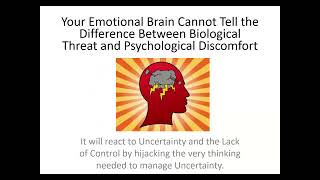
And here's the, here's the real deep problem of having an emotional brain that the thinking brain has no idea about is that your emotional brain cannot tell the difference between biological threat, that big bear, and psychological discomfort. Oh, my God. It's, it's going against me. It's going against me. Am I, am I, am. What's going to happen here? That, that right there is that. You know, ultimately, when we were evolving, a little tumor started growing out of our emotional brain, out of the limbic system. And it grew and it grew and it grew. And as it grew, the limbic system laid down really complicated communication networks of nerves going into that. So there's a lot of communication from the emotional system into the thinking system. However.
The thinking brain did not lay tracks back into the emotional side of our brain. And you know, ultimately, it's like what it laid down was two 19th century telegraph lines. So you're not really getting strong communication back to the emotional brain. But the emotional brain has enormous communication into the thinking brain. This is why the thinking brain doesn't. It just disconnects, it forgets about that. It's an emotional creature that thinks it's rational. So here we are, we're beginning to get this and ultimately think about this in freezing and avoiding behavior, you know, trying to get into trades or, you know, freezing and going, oh my God, it's profitable. I better take it really quick before it's, it's taken from me. You know, ultimately, the emotional brain is anticipating threat, okay, and stopping you to ensure Survival in the short term at the expense of the long term. How many times have you got finally into profit? And then you're so overwhelmed by having gone through all that flux and all that stuff that you take that skinny profit, book it, and you go, whew. And then you see that thing hit target or go beyond. Okay, it's doing exactly what your plans figured it was going to do. And this is. Understand this is not. This is. You know, we learn a lot of our anxieties, our angers and stuff like that in the families we grew up in and the communities and the culture that we are and embedded in all sorts of crazy things that happen. But this is also coming back from our ancestral mind. It's coming back from even before cavemen understand. We came off the African savannah and we were wandering. We came up to where basically the Middle east is. Some of those guys took a left, went up to Europe. Some of those take a right going down into the southern part of Asia, others going upwards into what we would call the Russian in Eastern Europe and stuff like that. All that stuff. That's all a migration of taking that brain that was adapted for the African savannas, where there was danger everywhere, into worlds that we had to adapt to. So we can see that that brain is highly adaptable. The deal though, how do we deal with the uncertainty monster? That's the deal. And so now, you know, it's kind of like this. Have you ever done this? You know, which is worse, man? Okay, I've got a. You know, I'm on this. I'm on this road and what happens is I'm dealing with these demons I've got. And, you know, if I took this fork, you know, something could other happen and, you know, some other bad dudes might be down there. You know, I just may take the demon that I know instead of the demon that's going to appear on it. You're already thinking in a defeated way. The thing is in looking at that, you begin to say, oh, if I'm thinking this way, what are the beliefs, what. What's going on here that I need to work with instead of trying to push it away and pretend it's not. There you go. Wow. This is the way that my brain organized the potential that I am into a being that is in movement with the environment. This is a much better way of doing it because ultimately you're going to be having. You are going to be having challenges for the rest of your life. It is going to be struggle. The deal, though is you're built for that struggle of survival. And you're the one, you're the animal that has evolved that can in fact.
Voluntarily change the way they engage with the environment. Okay?
So when you fear pulling the trigger, you are trying to control outcome by avoiding the risk of losing greater capital. Okay? And then you stay skinny though, and you don't learn from it. You don't learn how to evolve the brain into a probability baseline. This is where the problem is. And then like in revenge trading or over trading, what happens here, you're trying to control outcome and win to get that rush by attacking the threat of your short for your short term survival. And what happens is that, you know, you, you get in there and what happens is the trading gods just don't really care.
And you can get angry, but what good does the anger do? If you had regulated that anger back to where it was frustration or annoyance, you could start going, you know something, I need to look in and say, you know something, I am triggering to attack motivation.
So ultimately I also feel threat. This guy right here has just taken some losses. He's revenge traded and he's angry. He's going to beat up the person. He's blaming the gods of trading who, who has taken his money from him. How useful is that? It's not. It may have worked in American football, but it's not going to work in trading. Then you take a look at this. Is that the default way a trader's brain reacts to uncertainty in the short term has to be overcome? Okay, Is that, understand this is when you are first born. You and I are very different than other social mammalians. Other social mammalians already have instinctual drives in place. Like a giraffe can get up and run in three hours. A chimpanzee can start getting around, motoring around and starts looking for food. Food. You know, our babies, our human babies were born premature. And they had to, because what happened is women and humans started walking erect, okay? Because it really was a lot of stuff going on up here where we were all working on two feet. But the problem is it revolved organizing the girdle, the pelvic girdle differently and the birth canal smaller. Nature's, nature's way of dealing with this was to say, okay, the way we're going to get that baby down that very small hole is very simple. We are going to have a premature brain. So you were born, compared to other social mammalians, nine months premature. Matter of fact, in neurobiology, they call the next nine months after birth external gestation but during that time of when the, when that baby is just understand, it is remarkably incomplete compared to other social mammalians. It is live wiring itself as it goes. And all the stuff going on in the family, going on in the culture, the mood from national news, all that stuff is sitting there and that is what is organizing you into the human being that you eventually take to trading. Okay? And what we want to do is, we want to do, we. We want to make changes because the truth is we cannot control outcome, but we can control the mind that we bring to the game of trading. Okay? Top athletes don't think about winning and losing. They think about performing. Matter of fact, there was a. Several years ago, there was an Olympic athlete. He was a hurt, he was a hurdler, and he was, he's an American, was highly favored. And all the journalists were talking how he was going to do this and that and the other and blah, blah, blah, blah. Just getting, you know, just building up the case, really, just getting him. You know, you can understand why you don't want your athletes to see the press clippings because a lot of coaches look at letting athletes see press clipping is kind of like eating rat poison. You know, it's just not good for the athlete. So anyway, this athlete gets down and he actually is. Does his hurdle stuff and he does win, okay? And afterwards, you know, he's sitting there huffing, huffing and getting his breath back. And all these journalists get on him and they think, what's it like? What's it like? What's it like to win the goal? What's, what's it like to set the new world record? What's it like? What's it feel like? And he looks, and he looks up at these people and he says, you want to know what I'm thinking and feeling right now? What I was doing during, while I was racing? You want to know that? Yes, yes, the world wants to know. He says, well, I'll tell you. 1, 2, 3, 4. 1, 2, 3, four. 1, 2, 3, Four. 1, 2, 3,4. There was none of this glorious winning euphoria. What he was doing. 1, 2, 3, 4. 1, 2, 3,4. Was a mnemonic that his coaches had been working with him for 12 years. Each number symbolized where that body needed to be at a particular moment in time. And he had learned it through sheer repetition about how to do that. His mind was focused on performance.
He was not thinking about winning the goal. He was thinking about performance.
The same to you. What we want to do is to move Away from gambling, thinking that you control outcome, to where what we're doing is, we're saying, okay, the difference between probability management and gambling is that you have an edge in probability and you have the mind that can actually execute that edge that friends. It's the difference between gambling and probability management. So now.
Traders are not taught this kind of knowledge, you know, to be particularly accessible in the moment. And a lot of my work involves actually getting into minute moments within a trade. I'm talking about a quarter of a second, okay, Expanding it and viewing that in an expanded way and starting actually getting at, you know, what is happening emotionally at, at these really little intervals. Because understand an emotion can trigger in nanoseconds, okay? And it's, it. It surges the chemistry of that emotion through the body rapidly. So you're having to think going, you know, and thought is running through your head at 225 miles an hour. So the deal is, is that we need to learn to slow things down so that we're not consumed in the heat of the moment. So that is when the trader starts learning how to apply knowledge in the environment where it has to be used. He's not learning it by paper trading over here where there's really no risk, no what happens, he's got at least small risk that he's engaging with continually so that he gets used to learning in the environment of that stress. That is how you start domesticating your caveman brain.
Now what I want you to do is look at this. Here you see a progression of humanoids from a common ancestor that we had with chimpanzees to a modern man that has been so far divorced from the big primates that he would not even know that he is one. Here though, what happens is this. If the same brain, the same emotional brain, the limbic system that that chimp like character down there is the same brain that is in your brain, okay? It's not built to look at a computer which with probabilities it's built living in an environment and making sure that it knows how to survive and look for danger and look for opportunity and seize the moment and work. That's what it's is there for. So the point is this. The successful trading mind is not natural to the evolution of the brain, but it can be built and it can be taught. I see that, I see that happening every day. But you have to actually acknowledge that.
Old caveman brain, that emotional brain, mammalian brain, is there and it's making 95% of the decisions and then deals this is that man has inherited this need to control outcome as a survival trait. It had to be in control, even if it had to lie to itself. Okay, it's kind of like I often use a graphic where there are two movies playing. One is a.
Comfortable lie, and there's tons of people lined up around that theater. And then An Inconvenient Truth is playing at the next one, and only one person's there. That's the deal. The surviving traitor, after all this is over with is the one that went to the Inconvenient Truth and learned what he needed to learn instead of falling into a continual deception about who he can be. This is what it takes and what I want to show you.
I am a very big fan of the movie Inside out by Disney Pixar. It's pretty old now, and I'm talking about the very first one, not the one when the girl became a teenager who. But what they're showing you right here is emotional programs. Over on the right is Joy. Doesn't look too joy at that time beside her. The green one is called in, is basically disgust. The red one is anger. The blue one is sadness. The one in the behind is anxiety. Now, there are more emotional programs, but the point is, is what they're showing you that in neurobiology terms now, even making a cartoon, they've actually shown you that they're not. They're looking at subpersonalities. They're looking at different emotional programs that have different kinds of specialty skills and things like that they bring to the game. And they have to be trained. The point is this.
The brain is a community of rival emotional programs that have organized you into a survival self. You don't have thoughts, you don't have emotions. They are creating you. Okay, I know that's kind of steps back, but until you see that you have just fallen into this current and has just been taken away and these are not original thoughts, you're actually going to have to learn to say, oh, my God, I begin to recognize these emotional programs. They're not me, but I need to learn how to lead them. I need to learn how to organize them and into higher functioning. That, my friends, is where our courses look at. Because when it really comes down to it, your brain, you. We love to believe that we're rational creatures that sometimes get emotional. But the truth is, is we are rationalizing creatures. We are emotional creatures that rationalize. And here, you know, you have this thing going, very well said, laid out, very rational points. But I still hold my emotional opinion based on no facts or evidence. That's exactly what you're seeing in our politics today. Okay? It's not new, it's been, it's been a long time. But the thing is, is can we use that thinking brain to bridge the gap between our emotional nature and our upper rational nature? This you're thinking, the thinking simply is producing an alibi.
For what the emotional brain has already decided. And you see this all the time in trading, okay, is that when you start producing excuses and things like that, you're not helping yourself. You may be easing short term pain, but you're not learning how to play this game. So ultimately what's happening here.
What is revealed behaviorally in trading, are the most primitive beliefs about managing uncertainty. And where you find this is in your trading account, the health of your trading account. And it's really, it has a lot to do with this half full, half empty, overflowing, whatever. Because ultimately at the bottom of this thing, what you're going to discover is in this I am stuff. You, you am beliefs. There is not any final you. There are these beliefs that organize you into an observer that basically recreates your reality. And what happens is desires, drives, beliefs, all that stuff are there. And until you become aware of them, you're basically just.
What can I say? You're just drifting along and you're wishing for things to change when in fact you don't know. That is why what you see out there emotionally react to is a reflection of the beliefs that you're projecting onto the markets.
There's a fellow that I worked with, he's incredibly brilliant trader and he trades with a high eight figure account and he can actually move markets a little and stuff like that. And one day he and I are talking on Zoom and he, and he pulls up a chart and he says, randy, what do you think I see here? And I'm looking at Christopher, I have really no idea. Why don't you tell me? He says, I see scared money. And what I'm going to do is I'm going to shake them just a little bit, I'm going to scare them. And what happens is when they get scared and bail, I'm going to suck the blood right out of them. And that's exactly what he did. That's a very different observer. Okay, the same chart.
But do different observers see a completely different world?
Okay, that's the deal. That's what I want you to look at. You need to get at the beliefs that are driving your emotional reactions to challenging moments and then evolve Them domesticate that.
That old caveman guy till he becomes something very different.
The truth is this is. Do you fear the unknown? You're facing it all the time in trading. You don't know anything all the time. Or do you embrace the unknown? If you embrace that unknown, what you're saying is you realize that the markets are going to do what the market's going to do. Your job is to look at the markets as they go through things and see what it is willing to give you at this point, particular moment in time. You're not going to insert your will on the market. So this is the deal going, okay, I can embrace the uncertainty and build a mind for that. That, friends, is when it starts getting really interesting. Now.
Your brain and your body evolved to fear the unknown and for good reason. Okay? We would not be here if the brain had not evolved that way and it hadn't been a successful solution. And of course your psychology followed. Your psychology just produced all the alibis and reasons and things like that. And we got complexes going, we got disorders going and all that kind of good stuff. But the truth is, is that that brain and body evolved to fear the unknown. Okay? Trading requires that you develop skills to embrace the uncertainty of the unknown. Okay? There. Even when you think you know what's going on, all you have is hypothesis that could be so wrong. And if you are right, you didn't make it that way. It just so happens that probability fell on that. You did not do it. You hopefully didn't get in its way, but what you did is you allowed it to come to you. That's what we're looking for. Okay, so now we, now we saying, okay, we're gonna have to develop skills that allow us to, to embrace the uncertainty that we've all been avoiding. Okay, so how do you do that? How do you build a mind for the management of uncertainty? Well, this way, right here, the default programming, I promise you, is not going to work. You know, ultimately the numbers that game out over trading is that 95% of people lose money. Well, if you take a look and ask the question, well, who is consistently profitable in earning a living? It drops to about two and a half percent. So you start realizing is that a lot of people come to this game, a lot of smart IQ people come into this game, but very few develop the emotional intelligence to be able to react, remanage how our emotions produce the mind that engages. This is what we're going to have to do. And no, you don't have to do it, okay? But you got to recognize that the default programming of the brain and mind will resist change because the inherent fear of the unknown in all its forms, okay, that's just the human condition, friends. Whether or not we like it or not, we are in fact an animal. And we don't like not being in control. We don't like when chaos comes and knocks on the door and says, hello, hello, hello. But.
To do that, we're going to have to regulate emotions.
Before they compromise your trading mind. Like, for instance, you know this. In this particular case, we're showing. We're showing something that symbolically is going to alert everybody. I personally have been bitten by a copperhead a couple of years ago. And I want to tell you right now that.
That boy was that painful. So, man, I know copperhead, okay? But here, here's this brain, two orbs sitting right there. There's eyes. And what happens is it sees. It sees this thing called copperhead, in this case, some sort of viper. And you know immediately what it does is it's danger, danger, danger. Now, I might add that I have saved many rattlesnakes, copperheads. I will. I'm the guy in our neighborhood who will come around, and if you have a snake that you really are scared of, I will go catch that snake and I will release it on my property and just hope that it doesn't get in the way of other. Other human beings. I don't have. I have decoded that the symbol snake of danger. And what I'm saying to you is this, is that we're. We are just taking a loss is a symbol that the. That the viper just got you. So what we need to do is we need to regulate the emotions. And they are biological. They take over the mind. And you discover this all thinking is emotional state dependent. No exceptions. You might think you're rational, but that's rationalizing. So now we're going, whoa, how do you go about doing this? Actually, the truth is, is that I also teach in some of my advanced pieces where a person's wearing a heart rate, they're using an app that categorizes their heart rate in certain bands. Because what you discover is that.
As the heart rate accelerates, you get closer to fight flight. And it's really helpful to have it as a band saying, this is the zone I can work in. But what you're doing is that you don't have to do these that sophisticated. If you're looking at yourself, if you have a camera feed on you, even a mirror, you're Going to see the tenseness in your body, you're going to see that you're just practically trying to go right through the screen of your, your computer just buggy eyed. You're fixated that you're already contaminated, man. The emotion's already there. What you're looking to do is you're looking to find an emotional sweet spot so that the autonomic nervous system is not activated. Okay? And there's a spot between fight, flight and rest, digest. That's when you're too calm that the trader has to learn to maintain for an effective trading mind. And I have found that you can do that and you can get it for, to maintain itself for an hour to an hour and a half before it just kind of like sucks all the gas out of the system and you need to start over. So the deal is it starts with emotional regulation trends. That's breathing, that's a diaphragmatic. Breathing is moving air into the belly, expanding to chest, holding, releasing, slowly. Do that couple more times. Air into belly, expand to chest, hold, release, release the tension in your body, let it drain, drain, drain. One more time, pull air into belly, expand to chest, hold, release slowly release the tension in your body, let it drain, drain, drain. Like honey flowing out of a jar. What I want you to notice in this small little exercise that we've done, your heart rate would have dropped, the emotional intensity would have dropped. Now imagine if you began to really practice emotional regulation and you learned how to stop it from just overwhelming you getting intense than hitting a switch where the, the emotional chemistry floods into your body.
That, that has to be learned. I mean this is, I actually consider this kind of remedial. But the thing is, I discovered that this is not taught. So in order to be able to really develop the mind, you're going to have to learn how to regulate emotion. That's the very first thing that I do in our courses. Okay, so this is the, the deal with emotional intelligence. You understand the nature of emotion and that leads to its management. The next thing that is going to have to happen is you're going to have to develop an observer. A lot of people go, what are you talking about? That's weird. The truth is, is your thoughts are not your thoughts. You and your thoughts are not the same. You and your beliefs are not the same. You and your emotions are not same. As a matter of fact, you don't have emotions, you don't have beliefs, you don't have thoughts. They're having you, okay? And until you grasp that and Realize that you have just been. You have just been like.
Dust in the wind. And what we're saying is, as you develop the ability to observe, step out, step out of identifying with thought. You begin to realize there's an enormous amount of space there for growth. And also you start noticing that the brain has bad guys living in it and good guys living in it. And you need to get wise and figure out which ones are which. And organize your mind, the ruling committee of the mind, around the good guys.
So.
Ultimately, you come to see you as only one potential organization of a self. In quantum mechanics, I really like the way they put it so simple is that.
Everything exists as potential. And for them there's no form, there's no atoms, there's no. It's just potential. The observer of that potential is what creates the form. Form that potential takes. If you get that and all of a sudden you're like, oh, these are physicists talking about. And by the way, emotional. The, the neurobiology guys have their basic. Same thing is you've never experienced reality. What you've really done is you've experienced the biases and the assumptions and beliefs that the brain has as observer of stuff out there. And they don't even observe stuff out there. They're getting feeds coming in through your nerves and. And they try to make sense out of it. And you create this really weird world, okay? And very few end up being able to create a world that is consistently profitable. This is the challenge is you have a lot of potential sitting around there for different directions. And you're going to have to learn to reorganize it into higher functioning. And what you also discover that historical self.
Generally, it's only the adaptation to the world you were born into. Okay? It's not you, but it locks in so well that you would never know because that infant that you were is live wiring just. By the time it's five, most of the major part of your personality is wired in. So all of a sudden you can see is that you need to be really careful about what's going on in your head. You can't let just random thoughts start running around your head unchallenged. And all of a sudden you also recognize that your brain is a negative assessment chain. And it's going to make negative assessments about a whole bunch of stuff. And you're going to have to change that. Only you can do that. Then in the way we teach this stuff.
We start teaching people how to develop the empowered self. You've gotten some bad stuff going on you have an inner critic that is a blamer, is an accuser, criticizes you and gets you sucked into stupid stuff all the time. And what happens is that you have a part of yourself that's fearful or aggressive in order to be able to prove themselves. What we're looking to do is to say no. Beyond all that, there are programs living in you as part of your human endowment that are incredibly powerful. And it's really about who are you going to feed, how are you going to develop these parts of the self that allow you, okay, that allow you to operate on a completely different level than you are right now. So we're not interested in fear or overconfidence, creating the mind that trades. You can though, I mean, you can boast about yourself or you can say, oh my God, what's going to happen next, blah, blah, blah. But what we want to do is we want the emotional programs of the discipline of a ruler, the ability to maintain order, that is primary. You have to have that one archetype, that one emotional program, or nothing else matters. You have to have the courage of a warrior. You have to look at the fear right in the eye and not blink. You also have to have compassion. You have to have self soothing because that is the actual emotion that actually takes a hardwired.
Emotional pattern and gets it to change into higher functioning. That's the only one that'll do. And so if you do all that, what happens is you get the impartiality of a sage. And it's that sage that you want. Making decisions, these are the kinds of decisions we need to make. These are our parameters. This is where the edge is. These are emotional programs, friend. And the deal is who's got the megaphone in your head? Okay? And what are you going to do about it if the wrong guys have it? Like for instance, I want you to take a look at this.
These guys are in serious water. And what happens is that the ruler, the captain, he has to maintain discipline of that boat or they're in trouble. Then you notice different skill sets. There are people doing one thing and the other. Some people are, they're having to experience the courage to be able to act during these. They're having to calm themselves, they're having to calm their fears and they're having to think clearly all the same time under stress. Okay? This is an effective team. They put themselves in this position, so they have to train for this. You're putting yourself in a position of probability and risk, so you have to train to produce that Mind on a continual basis. On a continual basis. So the real question I'm asking you is this is what mind shows up when you engage the uncertainty of the unknown. Do you have a mind like on the left where, you know, it's calm, it's together, it's not in control of outcome, but it's in control of the mind.
That engages the uncertainty? Or do you live in question? This, friends, is what you can control. This is what you can control. And what I want to do is kind of give you a model is. I often use the. The image, the way that a North American cougar hunts compared to an African lion. Both are apex predators, okay, they're, they're serious big cats. But the lion stalks, chases, and has to have a big pack because they're constantly getting hurt, they're getting killed, they're all that kind of stuff because the way they attack.
Well, there's a lot of challenging there. At the same time, on the other side is a North American cougar. You see him, he's up a tree, and what he's doing is he's hunting.
Now, he's probably 15, 20ft up, and he's looking for the deer, and he's looking for what the forest will give him. He's over one of the transportation corridors, running through a forest, and he's waiting for the deer to walk underneath him. He's also high enough that the deer can't crane his neck and see him. So he's sitting there. Watchful wakefulness.
Patience. Patiently waiting for the markets to give him something. The deer walks under. He drops silently. The deer never knew anything. Its neck is snapped, it drops to the ground, is dead.
Okay.
That'S how he hunts. Now, let's just say if he misses him and the deer gets up and runs.
The cat doesn't follow. He recognizes the loss. A small one goes back up the tree, sets up again to see what the forest is going to give him again. That's the cougar. And what happens is it's a perfect view of what the mind of a trader needs to be is they realize that, oh, he's not sitting in the tree being lazy. No, he's actually probably hungry. And he's just sitting there very patiently. Watchful wakefulness. Waiting for whatever the forest will give him that day. Okay, he's not out stalking. He's out not taking big losses. His losses are small and occasionally gets a big kill that feeds him for a couple weeks. So now you're looking at two different ways. And what I'm. What I'm encouraging you to do is say I need to transition. You are a hunter in trading. The difference is, are you an ambush predator like the cougar? Are you a stalking, chasing predator like the. The African lion? The one that wins in the markets is the cougar, okay? So I want you to think about that. And what I want to do is. Yeah, you know, the truth is, a lot of people who come and they. They've just. They've heard about me, they've seen some of my videos and they're curious and they come and what I'm saying is get to know me. I. I encourage you to get my free book, okay? It's. It's free and it'll start giving you a lot of information about it. Go to my. Go to my YouTube website. I've got 300 videos up there that people. People do weekends over and stuff like that. And what they do is they. They're again, they're exploring because they're going, you know, this Randy Howell guy, he's thinking about this very differently than anything I've heard. And the truth is, is it works. And then you go, well, maybe, you know, get my book, Mindful Trading, read more, deeper, and then start saying, well, you know, I really. Am I really committed to change and can I come to trust this guy? Well, what I would recommend, seriously, is our group course. It's five group meetings with me, okay, In a webinar format. And it teaches these very skills that we have shown you here. That's what it does over a period of 10 weeks. And.
We get great reports about it. Actually, there's a guy in this group now that is in the group, and.
He just came because he's. Again, a lot of people like to listen to what I'm saying because they hear it. Other people say, you know something, I get it. I want to work individually. And what happens is we have an individual course that is highly comprehensive and very personal, I might add, that exists over three to four months. We have 10 sessions that are on Skype, okay? So you actually will have a lot more contact with me and work with them. And we work the same program, but at a deeper level, because I teach a process. I teach a process that allows you to evolve your brain, okay? Again, we're moving. We want to domesticate that ape, okay? And so it can become more human. And we need to work it. We need to work it. So these are the things that we're looking at. And also that group, we have one starting in January. And it is not too early to get in. So if you have questions, we can start right now. Yeah, type in questions.
What was the first one that came in?
Oh, yeah.
Oh, he's not on. Okay, well, let's see. Either works. Okay, the deal is this, is that if. Well, you know, if we don't have any questions, then I get to leave earlier.
So the bottom line is this. I want you to start, like, looking around and start really thinking and decide whether or not you want to invest in the development of the mind that you bring to this game. Everybody invests heavily in all the. All the trappings, the methodologies, the trading systems and the teachers, the gurus and the whole point. You hear the fisherman stories when, when people. When people start talking about trading. I'm asking for something different. I'm asking for you to control the mind that you bring into the management of uncertainty. That's the critical factor that has to be mastered. So I don't see anything. Oh, here we go. How long should you do the breathing work before a trading session? It really depends depending on where you are in it. Most people find they really need to breathe for about, I don't know, five, 10 minutes. It's not something you have to go on for, on and on. What you're looking for is you're demonstrating that you've got your system. Cool. What's more important, Brad, than practicing the breathing is then to start using that breathing in the presence of the uncertainty of a trading situation.
You know, basically what happens. I get a lot of people who have been very well trained in yoga and I would do this breathing stuff. And they say, randy, I already do that. As a matter of fact, I have a lot more sophisticated breathing system than you. And I said, well, tell me something. Are you profitable? And they say, of course, no. And I said, then you don't know how to breathe in the environment that you need to be breathing and calming yourself down in. That's what you need to trade for. So here, what I'm asking of you is to actually look at it and say, it's not so much how much do I need to breathe in order to get myself ready to trade. It's. Once you've gotten there, can you maintain the calmness that you've established? As setups start appearing, they start warming up, they start having all sorts of information, and then the trade goes against you and all that. Can you maintain breath? There. That's when it really counts. Now, this is from Michael. You made the following statement. A person is not Their thoughts or beliefs. How would you respond to this question? Who is the person? Who is a person.
If you take away their ownership or responsibility for their thoughts and beliefs? First of all, I'm not taking it away. I'm asking you to own it. Meaning if you dissociate a person's ownership of their brain where thoughts and beliefs exist.
That'S not quite accurate. But we're not. Wouldn't we humans just be a collection of unconscious body parts? No, we're not built that way, Michael. The thing is, is that.
We exist as potential. We exist that what has happened is that in an unawareness, we are shaped by the environment. We have an adaptive brain. That's what it does. It adapts us to be able to engage the world and survive it. It's adapting us from very primitive assumptions and biases and beliefs. What we're doing is realizing that those biases, you can see them every day in your trading account. What we're saying is those are not the ones that are working. What you're going to have to do is you're going to have to recognize that the observer and the observed have distance between them and that at some moment there is a place. There's. Stephen Wolinsky would say there's a trance of. No trance. And you're coming to a moment of where you're stepping back and you're recognizing the way that history organized you is simply not working well for trading. And you're saying I need to reorganize that. I need to reorganize the source of thoughts. I need to reorganize the beliefs that cause me to see the world that I see.
You will always have beliefs. You will always have all that. But the thing is, is that. Do you own them? Most of the people that I know that I work with in this game don't own their beliefs.
Who wants to own I'm a failure? Who wants to own that I only matter if I make a bunch of money? Now, the deal is, is that what I'm asking you to do is to take that ability to. Of discerning and finding a much deeper sense of your identity. I'm asking you to begin to observe what I call inherent worth. Where suddenly your performances has nothing to do with your value as a human being. It's that through observation, you're finding this part of your element called inherent worth that is somehow a child of creation, child of this universe, and somehow it's conscious. You are conscious creation. And you're saying this is a great gift how do I go about organizing it to be even to bring more light into this world, to be able to walk and to be able to create and become captain of own destiny. When you get to that moment, you've reached self mastery instead of just hanging on to identities that no longer matter. I hope that was good enough answer. That's the one that came forward. Okay.
Yes, it is recorded and it will be available sometime tomorrow. Is that sometimes we get, get busy and we don't get to it to the afternoon. But that's, that's the plan that will be here. It will be on our website. Yeah, yeah.
Why do I watch a book read that? Why do I watch a trade go against me and not close it out? Well, there's a lot of reasons I can't get in your mind and read your mind, but there's lots of reason in that what happens is that you don't want to take a loss because what happens is losing means, oh, you're a loser. I grew up in a crazy high school football town where on our, on our dressing room when we were going in it, there is a sign that said.
Winners never lose, Losers never fail. Never win, never win. The thing is, what we're doing here.
Hold on, let me just make sure I got. Oh yeah, yeah, yeah. The thing is, is because you don't want to take the loss because whatever taking a loss means, that's the very thing that you need to be able to learn how to change. That's actually the piece where you have to separate the loss.
From your being. The loss is about competencies are probabilities. Your being is a question beyond trading. Okay, I'll give you an example. A friend of ours is an enormously successful trader. He's made well over $200 billion million dollars in the last several years and all that kind of stuff. And I asked him, I said, tell me something, how did you do this? And he says, Randy, I can, I can point to the exact minute. And he said, a number of years ago I was trading and I was a successful trader, but I made a blunder and I lost three quarters of a million dollars in a course of five minutes. And he said, randy, that was when three quarters of a million dollars was really a lot of money to me. And then I said, oh my God, I have to tell my wife. And I fretted about it. I thought about not telling her and stuff like that. And I thought about how she was going to leave me, she was going to do all this kind of stuff.
But he sat his wife down, told her what had happened. The wife looked at him, stood up, came over, held him, and they cried for about 15 minutes together. He says, randy, after that, I knew, come win or lose, I was loved. I was lovable, and I was loved. That is what made all the difference in the world. And that is one of the fundamental pieces. What are we trying to prove?
What he was trying to do is he was trying to prove that he was lovable by making a bunch of money. That was the way his brain had organized it. What he discovered is that his wife loving him had nothing to do with his success or failure as a trader. It had to do with something much deeper. That's what I mean. Okay.
Okay. Yes. I practice breathing while I'm trading. Good. But as I get closer to the moment, I lose awareness and my body starts get to getting stiff. I only gain awareness afterwards. How to practice awareness, meditating the scenarios over and over again. I actually use a similar thing like that. I use stress inoculation modules of where we're going into those moments. And I'm teaching you as you. As you come into moments like that, you train specifically to see a flashing light, thought stopping, and then pulling up an empowered mind to move into that, rather than the dissociation that you just experienced. Okay. It's training.
Raven.
If we sign up for the winter class, is there any course material prior to the first class, or do we get in in January? Oh, boy. No. What happens is that, first of all, you get by signing up early, you get a $200 gift. And it is. It's an emotional regulation seminar that I did a couple years ago. It's a recorded. Yeah, but the thing is, it's teaching you emotional regulation, which is deeply important. And then what I'm asking you to do is before January, whatever it is that it opens 15th, is that you practice with that first class until you can do the breathing and the relaxation and the stress inoculations in your sleep. If you do that, you will be well prepared for the course. And we actually. I didn't do that for a long time. And then I had this Romanian guy said, but I don't want to wait three or four months. I want to get started with it and all. And he explained to me, he says, you know something? If I start right now, I'll be really ready, and I can. I can accelerate in the class. And I thought, well, my God, that's pretty smart. I wish I had thought of that.
Yeah. What Dolores is saying is you can pay the entire Amount up front, and you get access to all the modules, and you can go at it as you. You know, you go as you go, but at the same time, you're not going to ask me questions about modules beyond where we are in the group course. Okay. Yeah, we proceed through it because everything I teach is a process. We add one skill, then another than another, then another than another, and that's how people. That's how people really, it. It takes. It takes a couple months to actually retrain.
Yeah. And we have 10 people registered already, you know, and it's quite October, so it's a pretty popular course for that. And at the wintertime, you know this. They're popular. Okay.
Bertrand.
How do you break the sacrifice pattern? The one where you believe that if you wait long enough and suffer enough that things will eventually turn in your favor? Oh, my God. How do you break it?
Well, I would say find a good therapist, but no, seriously, to your question is that what you're looking at is kind of a martyr, and that is really more of an organization of your potential that I have no doubt would have been. Would have been occurred while you were growing up developmentally. Okay. The deal is, is what you do is you recognize. And I'm going to tell you some things here that you probably don't know about. But what happened is that that one that waits, waits, waits, waits till the ship comes in and the ship never comes in. That's what I call orphan.
Waiting and waiting and waiting. And probably there's a reason you learn to wait. Okay? But what happens is that that voice, that orphan voice, is also connected to this inner critic that just keeps you locked into the same pattern. What you need to learn is how to awaken that warrior, awaken that caregiver, awaken that ruler, awaken that sage, so that a different adult are helping that part of you, that basically developmental lag part of yourself, to open up, to begin to trust, and to begin to. To be mentored very differently. And this occurs in the group course, but that kind of stuff is very common in the individual course. Like I said, we take a much deeper approach, but I. And we take a deeper look at family systems and how you became. Basically, I look at families as people makers. And what we're looking for, you know, you have. You have your. All the stuff that came from history, and you also have that. That live wiring that you do when you're born into the world that organizes you. And I can tell you this, is that the most important part of this is, is to develop Deep compassion for yourself. Because it is the compassion that is the engine of survival. It is the compassion that allows that basically contracted part of the self to become open to life again, to something new and better. And you've got it is through self love. And it's something you have to develop. Okay. The ship's never going to come in if you don't go steer it. Okay. I want to thank you folks. I've. I've really enjoyed myself and I'm just all excited. I don't know what I'm going to do now. But anyway, if you have interest in this work, really take a good look at it. Okay. Just go to traderstateofmind.com and start really exploring it and start really beginning to go, oh my God. I'm beginning to see how my brain became organized the way it had. And I can begin to see how these brain spheres came into to have different like personalities and stuff like that. And they're all highly competitive. And you are a human being and you have been given a gift of becoming captain of your own destiny. That is a requirement in trading. And the truth is I believe that we all as human beings are on that journey into, into life. And it's really all about what world are we ready to create? Okay, I choose. I choose the world that I'm in. I choose light. To any rate, I want to thank you. Give it some thought and happy trails to you until we meet again. And keep shining on to that moment. Take care.










