What Holds Your Trading Back?
Randy Kardec argues traders fail because of psychology, not skill. Your caveman brain hijacks rational thinking under uncertainty. He teaches regulating emotion through breath, building observer awareness to separate yourself from limiting beliefs, and developing courage, discipline, and self-compassion to trade intentionally.
Chapters
The broadcast is now starting. All attendees are in listen only mode. Welcome, everyone. First thing, let's make sure that you can hear me is if you will just simply type in a Y into the question box. Is that the right one? And let me know. Yes, good. Okay, we're done. Just a couple quick things. First is for those of you who haven't been to one of my presentations, I hold questions toward the end, but when you come to a moment of where you have a question, type it into the question box. And that'll be able to get us started without waiting and having a lag time. So I encourage the questions, but I will, I will hold them to the end because often the questions are really answered in the course of the presentation. Okay, so without further ado, let's really start looking at this.
And I ask you an earnest question, folks, is what's actually holding your trading back? You know, the thing is, is that.
We want to believe that we know what to do, we know how to trade. We've invested a lot of energy, a lot of money, most likely with different teachers, different systems, different that and that the other. And we may be doing this for years as we're trying to learn how to create that edge.
And you believe in your heart of hearts that if you work hard, you stay rational, push those emotions out of the way, that you're going to be able to land in success. And there's a good chance a lot of you have already found success.
In a different domain. And you're going to say, I'm just going to pull those over and use the same formula for success that I've used in the past of my life. And then you bring over to trading and you discover something. It's a completely different world. Different rules appear to success in trading than success in the broader range of life. Completely different. What in the world is going on here? What is going on? Let's start here.
As we have been taught since the Descartes, in times that mind, body and emotion are separate from one another, is that there's logic over here, there's emotion over there, and they're completely different. The deal is, if you hold this belief, then you are already compromised. Because the truth is, is that the rational, logical mind is blown out of the water by the emotional brain under times of stress. Now, that emotional brain has some other names that I use. It's known as the mammalian brain. It's known, I call it the caveman brain. It's also perfectly called the limbic system. The key though, in trading what you're going to discover is that you never have freedom of emotion, no matter how hard you try, no matter how you just put up that stiff upper lip. Ultimately, what you discover as the emotional brain.
Is always with you. There are always emotions. So the thing is, is that you don't have freedom of emotion. What you have, what you have is freedom of emotion. And that's just what I teach.
So the deal is.
What most people really want to believe is this, is that the rational mind is going to solve all the problem. As long as you can keep those pesky motions out of the way, it's never going to help you to trade effectively. What you need is something that takes that thinking brain and the emotional brain and finds a space in between. Now here it's called wise man. I've now wise mind.
The key here is what you're looking to do is to produce a particular intentional mind. Because basically.
The mind that you bring to trading is built for a very different world. And if you apply to apply it to trading, where you do not have control.
Okay, where winning and losing are not under your control, you discover that the mind you brought, it's not there. And you have to build an intentional mind so that when you engage uncertainty.
A very different mind pops up to meet that uncertainty than the one that evolution and most likely that you fell into when you were growing up. So that's really the deal. And out of that.
Our whole notions of hard work, being rational and all that kind of stuff and really being able to problem solve are just simply assumptions that you brought to trading. But you hold them as if they were the truth.
And if you do, if you're not the master of your emotions in terms of recognizing you can't live without emotions, but you can, you can train yourself to. When you engage risk and uncertainty, you summon up a very different mindset based on emotional nature and you discover, guess what, it can work. The thing is, is that what I'm asking of you is I want you to test it out. I want you to make sure that you have come to the conclusion that rational mind alone is not going to work. That your emotional brain, there is something that really stops you coal in using that emotional brain. And the truth is you don't know how to work with the emotional brain. And if you're going to be successful in trading, you're going to have to.
Now, particularly if you hold on to whatever you feel is truly the success formula, and particularly.
Particularly that first roadblock is that you can believe that you can turn Your feelings on and off. You can be tough, you can hold, you can just keep the emotions out of it. How many times have you heard that? The truth is it's the only time that you're not having emotions is actually when you're dead. An emotion in many ways has to be really re understood in the context of what really happens because you ultimately find out that an emotion is not psychological at all. An emotion really is a biological action potential that is built to fire with an automatic solution. Anytime that you encounter uncertainty, anytime you encounter something new out of the ordinary. Now you're programmed for fight flight under those particular situations. If you do that, you're going to end up having problems with entry, you're going to be having problems with life over trading, you're going to be having problems with bench trading, you're going to be problem with scarcity thinking, all that stuff happens. The key though is how do you actually, how do you actually go to the place where you say, you know something, What I really need to understand maybe is a little bit more about my beliefs so that I can actually understand things. But first what I want to do.
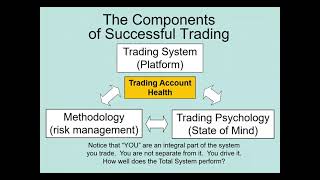
Is talk about what really comprises successful trading. Everybody knows that you need a really good trading system. You got that platform, okay? And a lot of people go through and they search for years and years and years and they finally find a system that really doesn't crash on them and really helps them and stuff like that. And they get that. And guess what? They're still not doing the kind of trading, they're still held back in trading success. The other thing is everybody knows that you're supposed to have a methodology that allows you to risk. You, you have trading rules that allow you to minimize risk and maximize profit. And yet at the same time, what you discover is you know that you've trained that. And it's really interesting in my interest in my work with traders. Often the trader, as he starts developing a better psychology, he discovers that his methodology, his rules don't really have an edge. So what you're getting at is, okay, I've got the trading system, I have methodology, and I give lip service to trading psychology, the state of mind I'm in when I'm trading. But the truth is what I'm discovering, even though I know how to trade, when the money's not real and my rules will actually really work, they have an edge in them somehow when the money's real and that's real money on the line, something happens and I can't trade well. I keep making the same stupid mistakes over and over again. That, my friends, is trading psychology. That ultimately is about the mind, the emotions that you bring to the moment of uncertainty that give rise to the mind that engages the uncertainty. That's what we're looking at there. This friends, when they're put together as a triangle, produces a healthy trading account. However, if you leave, it's any one of these. Because people try to ignore trading psychology because they don't want to think, oh, my God, something's wrong with me. I can't acknowledge something's wrong with me. There's a lot right with you. But you're asking the brain to do something that is just absolutely alien to it. And you're asking it to basically engage the worst nightmare of its life. And then you wonder why you keep having tilts, why you keep becoming decompensated and falling apart and blowing up accounts and losing chunks of stuff or just bleeding or you're too scared to get in. Well, this is where it's at. There has to be a place that this, you.
You really need to take a look at and say, is this working? And what I'm looking for in my work with traders, I'm looking for the problem that keeps happening over and over and over again. Because what I know is right there is where the problem's at. You will start finding implicit beliefs. Limbic learnings that just simply take over, are reactive when you engage that situation, and out of that, you get in trouble, the next thing, the second roadblock to your success is actually believing that hard work will produce success in trading. Okay, the truth is, is that. Have you ever noticed that hard work produces an urgency to act and you end up doing things. Hard work burns into the trader's mind, is incapable thinking like a trader. Hard work, it holds you, it tells you that you have to be doing something to be trading. When in fact, you discover that one of the most powerful skills that traders develop over the years is patience. Actually, not doing something is actually doing something. But we are the type of people who feel we have to be doing something. We don't want to be bored. Oh, God. Boy. It means we're not doing anything. And because of that, we think the hard work, the pushing, pushing, pushing will actually produce success. It produces horrible situations. So we're getting there and going, well, what's going on here? Well, right here, this is a North American cougar. And do you know what this cougar is doing right at the moment?
Looks like he's just hanging out, chilling out, having a really good time, actually. The cougars, hunting cougars are ambush predators. They will sit up 15, 20ft off the ground. They will wait very patiently for the deer to show up in the setup. They know that, they know the habits of the deer and they're sitting there. It's just all they have to do is wait. And they don't have any urgency about it. As you look at this cat right here, there's no urgency going on. And yet he's an apex predator.
Okay? He's the apex predator in North America. And he sits and waits. And when a deer sets into that trap, sets up into that setup, he simply drops 15, 20ft, hopefully breaks the neck of the deer. So it just drops right there or suffocates it very quickly. If that deer were to get up and get away, the cougar will not chase.
It will take that small loss.
We'll get back up the tree and we'll wait for the next ambush. That's the trading mine. That's a particular trading mind. It's highly effective for ambush predators. You, my friends, as a trader are an ambushed.
Predator. You are not. You're not a stalking predator. You're not making things happen. You're not going after the markets. You're sitting there patiently waiting. And if you get bored when you're trading, you need to look at the boredom and start saying, oh, this is revealing. This is revealing something about me that is holding me back from being a successful trader. If you have not come to the ability of being in the present moment like a cougar, you're not going to trade. Well, it's just that kind of way. So what happens is effective action.
Is not what you think it is. Effective action for this cougar in trading is about is built upon the premise of patience, not urgency, not making money.
It's built on the principle of following a plan, a performance mind. So there we are, we're going. Okay, well, I not doing very much of this. You might have remembered this. The thing is that third problem is that believing that you are actually a rational being and the markets are rational, you can follow all those squigglies and things like that. And what you discover is that they're not rational. Markets are not rational. When you are looking.
At your methodology and you're looking at your screens and you're looking, they're being populated and you're seeing all those different things indicating all sorts of different strengths and stuff like that. What you're really looking at is the trading psychology that's in the game at that moment, right here, there was a period of time that got into a lot of trouble where this was called irrational exuberance. And out of that, people went wild, people went crazy, they lost reason. The reason was never there. Okay? That's the whole point. It's really a myth. And your job is to really become an understanding and go, well, you know what, actually, what is a trading mind then? What are emotions? What is this thinking? What is all this technology I have and why doesn't it work? Well, we look into this and this is really important. If you guys are really wanting to understand at the very core, foundational level, what's holding you back is.
In neurobiology we say that you have never experienced reality. What you have experienced instead is the brain taking on a bunch of data feeds into the darkness of your skull. And based on its beliefs, it creates a truth that's out there. The truth, friends, is inside your head and also depending on your beliefs. And this is literally when you are looking at your account, the health of your account, what you're really looking at are the beliefs that you're projecting onto the markets that you assume are true.
And you're seeing how effective they are for managing uncertainty.
There's a, there's a story. At one time I had two guys that sat side by side, traded. One became a stellar, you know, was the best guy in around, and the other was Mar, was profitable but marginal. They had the same equipment to trade, the same mythology. They said the whole thing. The difference was in the beliefs that they brought. And projected on the screen of the mind, they saw two completely different truths. One saw that somebody's out to get me. The other saw opportunities here at risk. So you can begin to see the problem. And I generally don't quote too many, too many therapists, but this one, I am Karen Horney, really nailed it. Rationalization may be defined as self deception, okay, by reasoning.
That's where we're at. So we're beginning to recognize, okay, if I'm trading and I talk a good game, you know, I can talk all the talk, talk the talk, okay? What you're doing is you're producing rationalization and what you're doing is you're deceiving yourself. The key is, is that when you take a look at your, when you really take a look at the health of your trading account, it's busting up the self deception that we all do. Then we all would like to believe that we're all star men and women and all that kind of good stuff. But the truth is the, the markets tell us something different. Trading sells us something different. And it really shows us where we self deceive and out of this.
As long as you look outside of the self, success is going to elude you. In trading they know. What traders know is that really it comes down to it, success is in their head and they take that seriously. And they, what they do is they spend a lot of time working on their head just like other really star performers. I mean when you take a look at some of these great athletes, like a Kobe Bryant, you take a look at a Michael Jordan, you take a look at say golly, any really great football player, any, any player. What you do is you see them there, yeah, they got skill sets, but they're working with their mind a lot. Michael Jordan embarrassed people with his work ethic. You know, here he is at that time in his generation, the best basketball player anybody had ever seen. But, but he was also the hardest worker. He was always working on his edge. And in a case like this, you're looking at everything in that. Think how hard that is for that guy to maintain emotional sobriety with all that noise, with all that flak just going all over the place. That is the performance mind. That is what you have to develop and you have to take it seriously. Now.
What happens if you don't? Let's talk about the fifth roadblock to success. Avoiding fear and anxiety because you view them as detriments rather than as paths to self mastery. As long as you fear fear, what's going to happen is the trading gods are going to be their worst nightmare you've ever had. When you're looking, when you experience, when you experience like fear of entry, what you're saying is what is going on here? What's going on here? That that fear is stopping me in my tracks. Here's the key really, when it comes down to it, there are really only four self limiting beliefs in trading that really drill down. The first one is mattering and you equate money with mattering. If I make a lot of money, then I'll matter. People respect me and all that stuff. The other is whether or not you deserve easy money. Am I deserving of this money without hard work or I'm not deserving of victory, of having a great life. A big one is adequacy. I don't feel that I'm really adequate. Even though I boast and stuff like that down at the bottom, I just don't really feel adequate. And one that may seem weird in Trading is lovable. Am I really lovable? If I make a bunch of money, people will love me, they will like me, you know, And Elton John found out that just the worst thing in the world is to have a lot of money. It attracts a lot of leeches. So you're looking at this thing and you're going, the truth is, by turning toward, by turning toward your fear and anxiety, you have just turned on the path of self mastery.
So here you have decided that, okay, I know that if I fear fear that I've already lost. You know, I have traders who literally walking down the hall to going to their, to their office where all the computers are, they already have dread. They're going, oh my God, what's going to happen? They're already fearing the uncertainty or they're already fearing the fear. And it's the same way when entry's there. Do you, do you want more? Do you want more confirmation? Do you want more confirmation? That's the fear. Fearing fear is, you know what you've got? You've got conditions for a valid setup. Is that a valid setup? So you're looking at this and all of a sudden you can't separate biological fear from psychological discomfort. It just so happens in trading you're going to have a lot of psychological discomfort. It's going to go against you a lot. What you've done is you've gotten a certain level of potential where you realize that, okay, I've got an edge here, and if I execute well, the probability is really on my side. But even if it doesn't turn out that way, I'm not going to succumb to fear because I'm going to take the small loss and I'm going to learn to trade another day. And what you discover very quickly is this. It's rational thinking. It's just simply hijacked in the heat of the moment. You have to trade. You have to retrain your brain, your mind for the environment that trading presents. It's a different environment than wherever you came from. Okay, so how do we do that? First.
Let'S actually get real.
And define what an emotion really is.
Is it psychological? No, it takes over psychology. Is it a feeling? A feeling is a component of an emotion. It's actually the chemistry of the emotion in your bloodstream. But the very first thing is that what is an emotion? Well, it is now defined in neuroscience is something pretty different. It's really a biological action potential that triggers any time that there is a disruption to familiar pattern. So what happens is like when you're trading and the trade doesn't go the way you think you want it to go, that's a disruption. Automatically what's going to happen is an emotion is going to emerge and the ones that we have to really look for in trading are fear, anger, lust and greed. Now once that emotion has triggered, what happens now? Well the first thing that an emotion has to do with it has to.
It has to get the body ready for fight, flight. It arouses, it gets cranked up, it's getting ready to fee or to flee or to fight. That's the arousal. You would know it by speeding up heart rate, you would notice by tense muscles. You would know it by holding your breath. Okay, that's just not holding your breath. The emotion is triggered. The freight train's out of the yard, it's gaining ahead of steam. The next thing that happens is at some moment the emotion quits accelerating as arousal. It's a trip switch. And all of a sudden, all of a sudden chemistry flows out into the blood, into the brain and you have a feeling. That's the subjective experience of the emotion. This is where thinking is compromised because understand it's that all thinking is emotional state dependent. Now what happens next? All of a sudden you got the, it's got it, you got, it's not arousing, it's got the chemistry in there. And then the next thing is an emotion is going to tell you what to do. That's emotional motivation. It's going to tell you to avoid something, stay out, attack something over trade or to approach. If you have it under control then.
What'S beneath all that is the belief, the meaning, the assumption that has become wired into your brain is unexamined truth.
Most of us, most of us, it goes down to that we don't necessarily feel worthy by ourselves. We try to make ourselves worthy by what we do. We do not experience our own self worth. We want to build it by performance. We don't necessarily think that we believe that we're inadequate but we want to hide and pretend that we are. And we don't believe we're, we're lovable just the way we are. One of the best traders I know and his friend of mine has the. It's just crazy how much money he's made. It's in the last couple years he's 200 million. I think he's over, over a while he's made about 300. So it's big time. He actually came to the moment and said how do you do this and he said, you know something there it took me about three quarters of a million dollars. But I finally came to understand that whether or not I won or lost, that I was okay, I was good, and that my wife is not going to leave me. After that I no longer cared about whether or not I won or lost. It was all about how well am I performing. So you begin to see that you're going okay, I can begin to see what the belief in this case Mitch's thing is. I'm good, I'm good just the way I am. That performance does not define who I am. It just shows my competence at a particular moment in time. And the last thing about emotion is your temperament. That's the genetics. Some people are just a little more anxious, other people more risk tolerant, that kind of thing. And that's way past my pay grade. So what we have here is that. Oh, that's what an emotion is. Well, duh, yeah. And once you begin to understand it, it really helps you understand how to start working with it. So here's the things you really need to understand. Okay. Understand it is into self preservation. That's the big thing.
It would much rather it will take, it will take not getting into a trade in order to avoid the risk of losing. Okay. That's why you have so much time entering. It will not want to take a loss because losing to the brain means death. It means consumption. Your energy is going to go transferred to somebody else and so you're going to fight like everything against it. So you're looking at there and what you discover is your brain is a negative assessment machine. It just assumes harmful intent. You're also big news friends. Your brain does not distinguish uncertainty all about trading and fear doesn't do it. It also organizes you to avoid uncertainty. That's so. Oh man, you know something? I've just got this thing, I've got this great system and they're going to teach me how to win all the time, blah, blah, blah, blah. Also the brain forms self fulfilling prophecies, patterns, life patterns based on avoidance and also aggression. And that you see that all the time. That's the ones that keep happening over and over again. And those are the ones that have to be interrupted. And those beliefs that were core of it had to be changed. And then guess what? The patterns go on automatic and they fire as emotions without your even knowing that. And so other the thing is what you discover is that you're not trading from the kind of mind that is going to give you the edge. The psychological Edge that drives your method. You're trading based on fear or anger or greed or lust. That's what we've gotten. Now, what does this look like?
The vast majority of traders lose a lot of money. And what I want to show you, you start over there on the left and let's say the emotional state, okay? That emotional state has everything to do with your thinking because all thinking is emotional state dependent. Now just imagine if you already have a thing inside your head that says, I'm not good enough. I just, I don't know what it is. I just, I never, I never measure up a big deal in trading, okay? And all of a sudden you have a state of mind, thinking that. And a perceptual map pops up and says, oh, well, I, okay, I'm just, I'm just going to enter this trade. Then the actions you take, you know, then you start avoiding, you start doing this. And you know, you move, you, you stay out of trade. You should have got in. Then you get anxious because, oh my God, I've lost all these trades, now I need to get in to prove myself. Then you produce these realities, profits and losses. And all of a sudden it goes back to the anticipatory emotional state you had when you entered trading. Anyway, this is what's happening all the time, okay? It's not like it's going to go away. It is there. What you can do, you can't stop emotions from triggering. But what you can do, you can interrupt the pattern. But more important than that, you can start building a process that allows you to manage the emotional state that is summoned up when you engage uncertainty. And that's what my work is all about. Now, the very first thing that you're going to have to do, if you're going to get to the mind and start changing it.
You'Re going to have to learn how to regulate the biology of an emotion. By denying the emotion. It's just going to kill you. But the thing is this, is that what you're really looking to do is once you realize, oh, Randy, I understand now the meaning of emotion. And it's biological. If it's biological, then it's going to have components that are biological. Breath, heart rate, tension, and your muscles. Yeah, you're going to have to disrupt that so that you're not following all the instinctual stuff that this modern human is basically buying into. Understand evolution is going to push those genetics that were successful through survival into you. The problem is that's where it starts. Because.
Those are things you inherited. They're not good for the world that you're trying to adapt to. You need to readapt. And that's where we start looking at this going, okay, and then we have to. Then the big one is having to be right or not being wrong. And we call that confirmation bias. But we only. You know something, I know I'm right. I just can't make it happen. Well, what I want to ask you is that there is no such thing as truth. What There is an assumption that you have come to buy into and it suddenly becomes the truth. You're certain of it. The thing is, the certainty is simply chemistry, friends. Most of this mood and all this alteration and stuff like that, that's all chemistry. When you look at an antidepressant, what do you think they're doing? That drug is actually managing the chemistry of the feeling component of emotion. The problem with that is it's not managing the belief.
Okay, that generated the feeling in the first place. So the first thing is that of course caveman wants to be right, otherwise he's dead. So what happens is you have to get past that and you have to recognize that in trading in particular, just by definition, you're going to be wrong a lot. I mean, a lot. And you need to start really getting used to that.
Then.
You'Re going to have to start really saying, you know something? What I think I'm really hearing is that I have been pretty mindless, I haven't been observant and I do not see the self limiting beliefs that are in operation. I don't even know they're there and yet they're whacking me on the side of the head. And this is why being able to produce an observer to actually so that you're no longer identifying with belief that it can help you so much. Because understand.
You come from your evolutionary psychology with a powerlessness. If you're exposed to threat and you're either going to attack the threat or you're going to try to avoid the threat. And neither work in trading with capital at risk. So we're going to have to get drilled down. And this is probably one of the bigger pieces in my stuff is I am looking for foundational beliefs. I'm not talking about the little pithy ones that you talk about. Talking about the ones where you keep seeing over and over again, you're making the same mistake.
All over again, no matter how hard you try. Well, what we were looking at is an implicit belief, Olympic belief at that moment. And what you want to do is you want to root that and you want to find it, because that's the one that has to change on a foundational level. Okay, that's the, that's the big deal. Then.
You know, fundamentally your brain is going to create a map. It's called a perceptual map, and it is built upon your beliefs. So what happens is that you're going to be having the external world and you're going to, you've got your five senses and it's integrating that sensory information. It's going to the brain. And basically that all that sensory stuff and all that brain has done is produce short term success, survival, success, success. And then you're discovering, oh my God, the beliefs that I have used for survival, short term survival, success, aren't working here. The inner map that's being produced from the beliefs are blowing me up. So what we have to do is this is all boiling down to what are the beliefs about your ability to manage uncertainty? What are those beliefs? And are you actually looking at them? Because they're the ones that you keep messing up on. They're the ones that have to be changed.
Now, seventh roadblock is that believing that you are your beliefs, you become prisoner to beliefs. But the truth is, is that beliefs are not certain. Beliefs are assumptions about the world that most likely you were fed long before you could think for yourself. And they were so familiar, they were so over. You didn't even see that they were beliefs. You just thought that was the way they were. Because I can't tell you how many traders will tell me. I just don't. I'm just not good enough. I'll never make it. The truth is, is that the trick in trading is that you have to be able to redesign the mind that engages uncertainty. Though very few people find that narrow path, it's always there. But most of us stay locked up by our beliefs that limit who we can be. Because ultimately, when you finally get into mindfulness, you realize that you and your beliefs are not the same. You discover that you're not having beliefs, beliefs are having you, and they're being exposed in your trading account. So ultimately, what we're looking at now is a path to self mastery.
Where you start, you actually have to develop an emotional regulation and a mindfulness practice. You have to develop an observer, because the observer that you are is generating the world you see out there. The world that's out there.
Believe me, that's not the case. It's when you have three traders, and I use an example of a friend of mine, who trades with a rather large of account, and he can actually move markets. And one day he and I are looking at something, and he pulls up a chart and he says, randy, what do you think I see here? And I said, well, Christopher, I really don't know what you see. You tell me. And he said, I see blood. I said, what? He said, yeah, there's so many of these retail traders sitting right here that I can just shake them up a little bit. And they're going to get scared because.
They just don't have the right beliefs, and they're going to start getting out of the trade, and I'm going to suck their money up. I'm going to suck the blood out of them. He has a very different set of beliefs. He is not prisoner to his beliefs. He has actually been. He's been freed of that, developed others that allowed him to use other people's beliefs against them. So you begin to see, wow, in emotional regulation, you slow the system down, it's not going to solve the problem. What it does, though, is it gets you to the door of the mind. And mindfulness actually recognizing you and your thoughts, you and your beliefs are not the same. That's actually opening the door of the mind. So you can look in and begin to start really beginning to understand what's going on inside your head. And out of that, fun starts happening.
Because when you start really developing a mindful practice and you start quit identifying with your thoughts and your beliefs, you begin to say, well, oh, look at this. You know something? I can actually begin to reconstruct the performance mind. I can actually use different beliefs that I start habituating. And what you discover particularly is the brain.
Is actually a neighborhood of rival gangs competing for supremacy. Okay, that's what it is. And it's kind of like one of the theories now of why we dream Is because the visual cortex doesn't have much to do when we sleep. And if it didn't do anything, rival areas of the brain would invade that area of the brain and take over. So nature's answer to that is for us to dream. But here what we're saying is, okay, so you're saying the brain is really a rivalry of competitors struggling for dominance. Yeah. You can take a look at who's in control of your mind by what you're trading and how you're doing. But when we go from brain to mind, something extraordinary happens. Suddenly what you discover, the mind is where these emotional programs have been given voice.
And the mind is a space that I actually call the Governing committee of the self. And what you discover is that there is an enormous amount of competition between parts of that committee of the mind that want one thing and that other one other. And there's also part of the self that just simply wants your destruction. I call that the inner critic. It criticizes you, it judges you, it tempts you, it tries to seduce you into dumb, stupid things. And most traders just fall right down, right down into. Into it. But this is the trading committee, okay? And as long as you remain mindless that this is happening is that you do have, and you might say, randy, are you saying I'm crazy if I have all these voices? No, I'm saying you're crazy if you don't recognize the different competing spheres of interest in the mind, the different resources within you that have very different agendas. If you've ever had.
A self doubt about what should I do, or if you've ever gotten to an argument with yourself, you're experiencing this very thing. So what we want to do is we want to disrupt that. And what we also really want to do, we want to start controlling.
Who is on that committee. But first, when people first wake up in observation and they start recognizing their mind is really best understood as a committee, what they discover, there's a mutiny going on. The, the ruler, the CEO, the chairman of the board is being overran by just scallywags. And your job is to reorganize it for higher functioning. That's what we want to do. How do we go about reorganizing it? Well, it just so happens that once I teach you how to.
Produce emotional regulation, produce mindfulness, and start really noticing that there's some really dangerous areas of your mind that can take over and do a lot of damage. I call that the inner critic. You also discover that you have inner resources that can build a mind built for the management of uncertainty. And it starts here. With the courage of a warrior. You have to be willing to turn toward your fears with courage in an attempt to master them, because your fears become your teacher. Instead of avoiding your fears, you turn toward them. But this time you'll have a completely different way, different set of skills to engage those fears. The second thing that you're going to have to have is discipline of ruler.
And discipline as a ruler. What I really mean by that is the ability to maintain order under pressure. Most traders I know are really good on paper, but when their money's real discipline breaks down, they start trading from fear rather than from discipline. What you have to learn is a way of pulling that discipline up and summoning it. And by the way.
Not by visualizations and affirmations, but by actually going in. I call it memory enrichment, where we actually go into memories and find these strengths where you demonstrated them, and we're building it from there. And what you have is you have something that actually is not something you're wishing for, but it's something that you've actually done before. It's in you. The next thing is you're going to have to have the self compassion, the self soothing of a caregiver. You're going to be taking losses for the rest of your life in this game. You're also going to have to be able to calm the self. You're going to have to let them know, no matter what, whether or not you win or lose. As my friend said, Mitch said, I'm good. I'm okay. You're going to have to come to that. That where you discover that there is an inherent worth to you, that it's beyond your performances. And that's what I also teach, that accessing that and recognizing that you are not defined by your performances, your being is a totally different matter.
Now, when you have these three different elements, these are both emotional programs and simultaneously archetypes of the Jungian type. When you have the warrior, the ruler and the caregiver together working, what you're able to do is you're able to reduce the fear so that you can bring the impartiality of a sage forward. The rational thinking that you're looking for rather than the rationalization of your emotions triggering. This is a big deal, friends. This is actually the pathway that I use to teach how to get out beyond that. So what do we look at here? Well.
In the process that I teach and understand it is a process. There is not magic. The very first stage is emotional regulation. You have to be able to regulate the intensity of the emotion or you'll be swept away a long time before you ever get to the mind. This is what happens most of the time. Now, the second stage is development of mindfulness, of where you no longer are identifying with thoughts and beliefs as who you are and you start finding a great freedom. Is that in mindfulness you can start defining the players on the stage of the self. And the first thing you do in mindfulness is you realize that you're going to have to disrupt the historical internal dialogue that's the one going on between this inner critic that I've talked about, the one that wants destructiveness, and the Adapted self, the one that simply is following fight flight. But as you do that and you're disrupting it, what you still have to do is you still have to develop.
This empowered part of the mind. Find the inner resources to build the intentional mind that you're going to bring into trading, okay? And once you, once you find it, you have to get them working together so that you actually are imagining that you're actually imagining that your mind is a committee and that they all are in communication with one another. And they are. Okay, it's electrical communication, but it's communication. And suddenly what happens is that you reorganize the trading mind to the intentional mind rather than historical internal dialogue, friends. That's where things get great. That becomes the peak performance.
Okay? And what happens is that when you organize that, it becomes natural for you to emotionally regulate. It becomes. Becomes natural for you to be mindful to make sure the team's together. It becomes natural for you to develop.
The ability of being vigilant so that the internal, the old internal dialogue doesn't show up and bust you. You keep developing those parts, the empowered parts, and you keep having that team of reorganized parts of the self working together to engage uncertainty. You habituate it as your response to uncertainty. And really, when it comes down to it, is that who's in charge of the organization you're trading? Mine.
If you're happy with it for sure, stay with it. The problem though, is that my promise to you is the mind that you brought to trading is not going to be the mind that produces success in trading. And you know, I could be wrong. There are a few of you who will make it. The thing is that when you finally come to the.
Belief and understanding that, oh my God, he is right, the mind that I brought is flawed for trading. I'm not saying it's flawed in every domain of your life, but I am saying trading is a different animal, friends. And if you have not organized it for trading, you, you're missing. You, you're slamming right into all the evolution that's built your mind to be. Wanting to control outcome, wanting to be right, not wanting to lose because that meant death and wanted to be able to predict outcome. Yeah, all that. None of that works in trading. You're not control of winning and losing. You're in control of the mind you bring to the performance. And that's what you're going to have to have. And my question is, who's going to populate your trading mind now? Why is this important, friends? Well, it really comes down to that eighth roadblock, you're going to be stuck in self preservation, short term self preservation and justification. That's just the way it is. Is that here you're looking at, there's a saying is you, you can't lead a horse to water. You can lead a horse to water, but you can't make him drink. And a mule, you can't even lead to the water. And the markets don't care. And the question is, do you want to build a mind that can achieve the dreams you have? Because ultimately.
If you leave the brain to its own thing, it's going to be short term self preservation. That means you're going to continually keep get hijacked. You're going to fall into the same traps. That caveman brain needs some help from you. Okay? Now.
So you. What you really might say is this. It's really all about updating your ancestral mind. That ancestral mind. Here is the caveman dude in the backseat. Unfortunately, the geeky little driver doesn't even know the caveman's there.
Caveman pretty quiet until there's danger. And all of a sudden, the caveman brain fires through these instinctual automatic patterns that just take out your thinking brain. Now, I've showed you a way that you can go about start really compensating for that and building a new mind. Okay? And it's work. What I teach is process. I do not teach some magic bullet. It takes a while to get this stuff in and to be able to turn the ship around into a different direction. But the truth is, is that new brain driving the car and the old brain in the back seat, they have to become partners. And you have to take that caveman brain very seriously or it's going to continue doing what it's doing to you right now. So, friends, that's what we're up to. Depending on who you are and how much you know about me. You know, if you're just looking at this going, boy, this guy is talking from a place I've never heard, check some more stuff out. Go to the website, start looking at the videos there. I mean, on YouTube, I've got well over 200. Start reading the articles, start reading around and start going, let me learn more about this. Get the free book, all that stuff. Do all the stuff of kicking the tires so that you start saying, who is this guy about? What's he all about?
Then when it really comes down to it.
If people really want to move, they might buy the book, they might buy some guided meditations. It might do Some stuff just check me out, checking out. But finally it comes down to two courses that we offer. The group course teaches the basic skills, what I just outlined. It teaches the emotional regulation, what an emotion is emotional regulation, mindfulness, the historical internal dialogue, the empowered mind and engaging the struggle. It teaches all that. It has five group meetings over a period of 10 weeks and everything's recorded because we work all over the world and you know, you know, 4:30 here could be 4:30 in the morning in Australia and all that kind of good stuff. And the key is, is that when you're in this group course, it's a virtual classroom that you're working with that you have access 247 to. And you really. It's pretty darn. It's the tools you need. It's the tools you need to be able to produce the mine that you're looking for. And we have a, we have a class starting pretty soon a little later this month and it's going to be on 3:30. Now what I can tell you is this if you're. That's the first meeting. Oh, that's the first meeting, yeah. It'll go on for five sessions. But the thing is, is that it.
We, it's already half full and we want people in early because people don't recognize the magnitude of what they're about to get into. This is not a course you take lightly. It's a course. When.
You come to the first meeting, I'm assuming that you have been working with the materials for two to four weeks. And what we want to do is to get you to do that, to start early, to be able to maximize what you're going to get out of this course. If you sign up two weeks before or more like now, you going to get an emotional regulation workshop that we sell for $200 on our website. We're going to give it to you free. So I want you to really consider it. If you're looking at this thing and saying, you know something, I get it, is that I realize that I really haven't looked at this from a neurobiological emotional intelligence standard stance. And I need to. The other thing for people who are really, really serious about this stuff is our individual course. It is highly comprehensive and very personal and it gets to the meat of what's holding you back. It's a multimedia thing. And the main thing more than anything is you get direct mentorship by me. I mean I am there for all five sessions and things like that. But fundamentally it is, it's 10 sessions with me as we go through this process. And I like to do it over three or four months simply because it takes that long to start producing change. So this is a shooting match. And what I'm asking of you is recognize caveman brain is going to be there until you learn how to work with it. I teach you how to work with that part of your brain and to start making communication from the thinking brain and the emotional brain possible. I want to thank you for being here and I'll take some questions and I think we already have one or two. Okay. This is from Sunny. Do you think that watching a documentary about the North American cougar and its stated mine will help me with trading? It'd be a good start. The thing is, is that what you're looking to do? You have to. You have to see that cougar as a symbolic representation of the kind of mindset required. Required for trading. But just watching a documentary, what happens is you really in some ways have to become that cougar. Okay. You have to start saying, how do I develop the patience? How do I develop that stuff? Watching it can inspire you. But. But to actually change neural circuitry is a lot harder than that now.
So.
Well, Simon, I just see you signed up for the group course. Good. The thing is, is that. Oh, oh, that's. I've answered that. This is from. Look at this. We have a guy from our group course asking me a question even before the. Before the group course starts. That's pretty clever, Simon. You're the first person that's ever done that. I actually thought there was something wrong with me and felt I was a loser and useless, which was getting down real bad. You have described everything I'm going through. I can't wait for the group sessions to start. You are what I have been searching for. God answered my prayers. Well, thank you, Simon. I really appreciate that. And what I will say is this, is that I believe that when the student is ready, the teacher will appear. I do. And what I'll tell you is get that. Get the emotional regulation down. It's very common. Is that. Understand soon you will be challenging that that statement you made. I thought I was a loser. What happens is the self you're currently constructed as fell into the beliefs that you were a loser. In my guess, you were taught that that's what your role was in a family. And what you do is you recognize. Oh my God. If I step back out of that, I realize that's just one organization of a self that could be. And what you're doing is you're on the path to really differentiate that. Good for you. This is from Alan.
When you have an attachment to a pattern like buying the bottom or top for an extended period of time, that has been successful a few times, but that does not have consistency in the long term. How. How could one detach from this pattern? Obviously, the times one was successful in making such patterns did provide a feeling of success in getting it right, and thus the attachments to the pattern. Attachment issue seems to be a common factor in many areas of my life, of course. Any suggestions? Well, first of all, what you've basically done in finding that initial success, what you did is that is what is known as the dopamine reward system. You got it, you got a flush, you got. Basically you got a snort of cocaine. And what happens is it's very quick to habit formation.
What I can tell you the thing is, there is no magic here. What there is is that in the course that we're describing is the first thing you, oh, this is an emotion. It has been. It's Olympic learning. That's exactly what limited learning is. It produces a reward thing. It fires in wires the pattern. And what you have to do is eventually you're going to have to expose yourself to the urgency for you to follow that and you're going to have to be breathing to be able to control it. Okay. And then from there, you're going to step back out of it. But what you're going to have to do is you're going to have to replace it with a higher. A higher way of working with it. So I know that that's not really answering your question, but I would say take the group course and it would be a lot more clear.
If I slaughtered your name. I apologize. Good morning, Randy. I am Kayira Moses from Uganda. Well, welcome. I have read and watched most of your YouTube videos. It's wonderful, mostly when you highlight about the brain thinking and emotions and sabotaging beliefs. I have tried to work around my sabotaging beliefs. Can mantra and hypnosis reprogram my subconscious if it contains those archetypes? I am not a friend of.
Pure hypnosis.
There's a lot of hypnosis in my work, the guided meditations that I use. The problem with hypnosis is that it reduces a trance that initially is very powerful and it dominates the other trances that drive your perception. Over time, though, that hypnotic trance wears out and the old patterns show back up. Ultimately, this is all about getting back to the incredible belief that holds you back. And again, it's not like hocus pocus with hypnosis. It goes away. In my guided meditations, what you're doing is you're using the emotion of compassion. Compassion for your struggle, compassion for your suffering. And you're approaching the pattern.
And basically honoring that struggle because at one time it was an effective pattern or it wouldn't have become cemented. And what you're doing is you're approaching it with compassion. It is the compassion that does the work of change. It needs leadership. But without compassion, change is not possible. Compassion is simply the engine of survival on a long term basis. So the key is that you're looking to be able to. There's nothing wrong with hypnosis. There's nothing wrong with that if you understand its limitations. And ultimately what you're getting at is that a very core fundamental belief in my work, what I'm doing is I'm teaching you to find inherent worth. Either from that of you being a social mammalian, where everybody in a clan had value to the survival of the group and zeroing in on that and realizing that since there have been mammals that has been the way, social mammals, that has been the way it is. I also teach it from a spiritual standpoint. And so one is humanistic, one is spiritual. But the thing is, what you're getting at is the foundational belief about your value as a human being. That is why as long as you're chasing money to prove that, you're going to fall in the ditch. But the key though is what I'm asking of you is not to strong arm of belief. You're approaching it from compassion because it would not be there if it had not been successful at one time. Okay, the last question, my friends. This is from Bill. Hi, Randy. You often comment on people who have been highly successful in business and other competitive fields. I do. Yet they don't do well when they attempt to trade.
The markets. That's true. Do you deal with people who have not had success in other endeavors in life and also don't do well when they attempt to trade? Yeah, all the time. While these two different types of people should be still be working to improve their trading mind, are there some actions that the less successful people should be specifically doing to change? Yeah. Bill, you've taken the group course before and what you do is you go in, you find child in the desert, you keep working child in the desert till you become to believe that you are inherently worthwhile. When you see people who are saying, I just not good Enough, I'm not good enough. I never make it. You know, I'm, you know, I'm like the guy a little earlier today says I'm a loser. That's a learned, that's a learned belief. It's not truth. And what you're doing is you're looking for. When you see the self limiting belief is you're looking for again, it. Initially you have to be able to get at the inherent worth. You have to come to the moment of where you recognize that as a social mammalian, that it's there whether or not you like it or not, and you start putting your attention on it. Or if you're coming more from a spiritual standpoint, is that the work that I do, it has you meeting an inner master in between thoughts and you begin to ask, am I worthy? Do I, I matter? And you're getting it from that level. And it doesn't really matter to me which way you do it. But the thing is you have to start at the base. And then what happens is that once you realize that you matter, you start realizing that you're worth fighting for. And you start developing those archetypes, warrior discipline, calming. To be able to honor the struggle and recognize, oh, you're built for this struggle. Every human being has to go through this struggle. It's just the way it is. So, Bill, good luck. But start there. You have access, you have access to these materials. Take advantage of it. I want to thank you. We went a little over tonight and well, this afternoon, I want to thank you for being here. And friends, no matter what, I really wish you the best.
Nobody has any. Very few people have any clue of an idea of what they're getting into when they get into trading. They really believe that what's wrong with other people? You just plan your trade and trade your plan. That's all you do. And then they walk in and have money and they have no idea what they're triggering. They have no idea that they're actually triggering the survival instincts of your caveman brain. And it's it, it and all, it's just bewildering. I understand that. At the same time, if you have, if you have come to a moment where you've said that it's going to take what it takes, that's what it takes. And you recognize that no matter how great your trading plan is, no matter great your platform is, if you don't have the psychology that drives that stuff, you've got a gaping hole.
And trading is one of those powerful forms of self mastery. I've ever known is that it's hard to BS the trading gods.
It's hard to just BS yourself. That trading account is telling you how effective the beliefs you bring into trading about your ability to manage uncertainty. That's what it's telling you. And what you're looking at is long held beliefs that you have to change. And I've given you the process about the way you go and change them. If I can help you friends, I'd love to. But if not, my heart goes out to you. I wish you well. And tomorrow morning go knock them out. But knock them out with performance.
Not about winning and losing. Fair enough, thank you and have a great evening. Goodbye.









