What s it Going to Take to Get to the Next Level in Your Trading
Randy Howell explains how emotional hijacking sabotages traders and what it takes to move past it. He focuses on probability-based thinking as the core shift that separates struggling traders from successful ones.
Chapters
Welcome everyone. My name is Randy Howell with my traders State of mind and we are here to look at trader psychology about how trader psychology can be applied to your work, to your methodology, to your system and make a better performing machine. Let's say that a trading machine. Before we get started I want to thank Tom Thomas Barman Thomas and I go way back and he is one of my favorite people. Never lost trading. He has phenomenally, he has just the top dog system for traders and for investors in the world. And it's something where I don't know how lucky you are to have this kind of system. It's a pleasure that. But let's. There comes a time in traders journey where they realize that something essential is missing and their performance is in trading and that whatever that is that's missing is holding them back. You know how to trade, you do simulation and you just make paper money like crazy. But somehow when the risk is real and the money's live, something goes wrong. You know, they see that you see the potential and you can taste it. But something's missing. And we're gonna be exploring what that something is today. But first I have a question for you.
What would it mean for you if you were trading at your potential? And I really mean that. You know I'm, I know that there's people have lollipops floating around in their head and stuff like that but I really ask you earnestly what would it mean if you were trading at your potential today? What would it look like? What would your trades look like? What were your entries look like? What would your stops look like? What would your exits look like?
What would things happen when you were things going against you or for you, what would they look like? That's what we're going to be exploring today. So we're going to get started.
Oh, there is one last thing my faithful assistant Dolores has said. Randy, you forgot to tell them to hold the question. Well, I'm going to hold questions till the end. You can ask the questions anytime, just type them in at the same time. What happens is I find a lot of questions are answered during the lecture and so I hold the questions toward the end. Got it. So let's take a look at this thing. You know, on the surface trading looks pretty darn doable.
You know that it's about the numbers, okay. And that you can't get messed up on one trade and that you just put up the numbers and you follow your rules. It's that simple. Just follow your rules. But then something else takes over and crashes the party. Survival, emotions trigger and you fall apart all at the wrong times. It's been happening since day one. I see it every day. Yet you have that sense of going, you know something, I know what success is. I know I felt it before I can achieve it. But whatever it is, something is just happening to my, my success on the way and I need to solve that problem.
So ultimately dealing with your emotional nature is the biggest challenge in trading. Once you know how to trade, okay, ultimately yes, everybody stumbles here.
But the key is.
Do you understand? Do you learn from the stumble? Okay. And ultimately though, when they start on this they don't want to deal with emotions. And ultimately what traders do is everything to try not to work with their emotions. They try some crazy stuff like I'm going to deny them. I'm going to use hypnotism, I'm going to use ETFs, I'm going to use all that tapping stuff and neuro linguistic programming. All these techniques that allow you to push emotion aside. But there again it still happens. And you'll notice they spend money on more know how more things to make trading easier and more predictable. In fact they get so bogged down with all the stuff that it really hurts their trading.
And still the emotions are there, still the emotions are there. And the key is you go well why is this? Because the thinking brain, my friends, is the last one to know about anything. I want you to take a look at this graph. There's information coming in the spinal cord. That's what a lot of people call the reptilian mind. Tiblian brain. It enters there if you notice that information is immediately accessible by the limbic system or what we call the emotional brain. This is where you feel. And if that feeling state is such that it's such an immense emergency, it will act before thinking. It will act before things are sent to the rational mind. For you to do your rational best in your trading, the very last place that the information gets to okay is to the thinking centers of the brain. Because ultimately it's too late for survival at that particular moment in time. You have to be able to trigger and onitse the limbic system triggers to feeling states in nanoseconds. That's like.005 seconds. The thinking brain starts thinking anywhere between a quarter of a second and a half a second later. Do you see the problem is like that's where the hijackings occur. So now we're going on this. Okay, now we got it. Okay, we got this information Coming in to the brain stem, it's being immediately sent to the limbic system. Limbic system is deciding to take the low road, which is like emotional hijacking or the high road, sending information to the neocortex so that you can think. Friends, this is where if you could calm that limbic system down and have the information go to the thinking brain, you'd be a whiz bang traitor. Unfortunately, we don't know. Well, I can teach you. We don't know yet how you go about calming the emotional brain down and giving it something else to chew on other than survival. So ultimately what you discover is emotions, particularly the ones that are real critical in trading. Fear, anger, overconfidence, are directly linked to the emotional brain. It acts before thinking. If you go back to that slide before you get it, is that the limbic system it generates literally action. You're doing something you're, you're holding, you're not able to get in the trade. You're frozen on that mouse before you can think. And thinking, all it's going to do is produce an alibi. Now that supports whatever the emotional brain is thought. So. So when you get hijacked, this is exactly what's happening. And until you learn to deal with it differently, it's going to continue to happen. How many in here have been trading for more than two, three, four years? I bet a lot of you. If you're in Thomas's group, you've been around the block, okay? You're not, you're not a newbie. And tell me something, are you still doing the same stupid things over and over again? You get better at it, they get more subtle, but they're still there. They still hijack you.
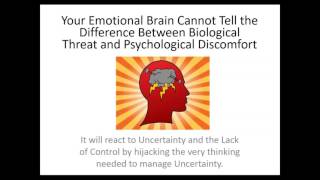
The time. It's just wrong. It just shouldn't be hijacking you then. But it is, okay? And here's the kicker. Your emotional brain can't tell the difference between a biological threat and psychological discomfort. And remember, that's the bad boy that's making the decision to act first or send information to the, to the new brain. If it can't tell the difference between biological threat, say a tiger eating you up, and psychological discomfort. Oh my gosh, I'm in uncertainty. I have capital at risk. What do you think's going to happen? It's going to trigger to survival without learning how to defuse this glitch.
It's really impossible to stop the emotional hijacking when you're risking capital where there is uncertainty. Because what you're doing is just like with this in this graphic right here, you have a man sitting in front of a grizzly bear. And what happened is to the emotional brain, all threat. That means all uncertainty is going to be triggered to be that grizzly bear, and it's going to go on high operation. This is where you literally have to learn to manage the mind that you bring into the moment to engage uncertainty. That's the trick, friends. That is the trick. So let's take some examples. Okay.
Whoops. I think you went past one, Doris.
No. Well, okay, okay. So what happens is let's move on.
So ultimately.
We're having a breakdown ourselves here. Here we go.
Bottom line is your brain evolve to protect the status quo, okay? And that's your comfort zone. That's how you feel good, that you feel calm, everything's okay. And ultimately what happens is that when this happens, you're in a situation where you get to the comfort zone. You keep pushing it, but this isn't the way we've always done it. Where I'd much rather become. I'd much rather have the suffering that I've had, that I'm comfortable with than, oh, God, what if I get into trade? Maybe I'll even lose more. This is the way it works. And freezing is that. You know, the thing is, there's your limbic system, your emotional brain. There's your rational mind. They're partners, they're watching it screen. And suddenly what happens is the rational mind looks and says, ah, here's an opportunity. This is a good risk to reward situation. It has a high probability. You know, like with Thomas's system, 65% probability, man. All you have to do is risk the capital. And then at this other time, the emotional brains go, well, what if I lose? You know, if I hijack you right now and we don't do anything, I. I've conserved your life. That's the way it thinks. So there you go, we're sitting there and we're going, hmm. However, you can stay in that comfort zone, but it keeps you small. What you're looking for is, how do I get to where the magic happens?
This is where you have to learn how to regulate the emotions and understand the way the mind works.
So we get it, is that the emotional brain cannot tell the difference between biological threat and psychological discomfort. That's something that you're going to really, really need to get and understand. Because until you understand it, it's going to continue and do something about it. It's going to react to uncertainty in the same way that it is to that bear. So we know that we can have emotional storms and ignore them. Ignoring them is not a way to find success in trading. So what does it look like in this particular case? We just gave you the example. You know, the thing is, you're sitting there and you know, the thing is, we call it the uncertainty monster. What if I lose? What if I lose? Well, the truth is, is you know what you're doing is that you already, you're already seeing that your emotional brain is taking over and it's going to stop you from even getting in the trade. The truth is you can lose. That's why you have stops. That's why you have the ability of going, you know something, What I need to do is I know that there are going to be losses and my job is to minimize the loss. That sounds logical. However, logic is not what makes the decision. Until you get the uncertainty monster under management, what happens? You're stopped from making logical decisions. This is what we want. This is what we want to teach you how to do. Also, the thing is, is that you're sitting there and you're going, oh my God. This is particularly when, when you, have you ever had fomo? When you have that situation of where you finally fought through the trade. You've, you know, it's got to the point where it's gotten into the black and all of a sudden you find, you know something, I have a fear of losing what I've got. I better get out of it right now. And what you realize is that you, you know, it's better, you know something, if I just take the money now, it can't be taken away from me. Okay? And you go, yeah, maybe it could reach the target, but you know, right now I really want it. We call that scarcity thinking. And you see that sabers toothed tiger sitting out there, you see that viper sitting out there. But also what you also don't see is it hitting its target and actually working with probability. This is your survival mind, okay? And this is what you got to work with and go, you know something, this thing's triggered. It can't tell the difference between discomfort and biological threat. So anytime that I get the money and I just have a little bit, I've got enough to pay my broker, but I don't have enough to pay me. But I take it anyway because I'm scared that I could lose it. You know that your survival brain has trumped your thinking brain or who of you have done revenge trading or over trading? Yeah.
Something'S been taken from you, okay? And you're going to get it back. It's not fair. You're going to show them and you get angry and you're going to fight them and you're going to take it back. And in that anger what happens that attack motivation, you start making really stupid decisions. And the same thing with over trading, you start having I get it back, I can get it back, I could get it back. Do you see that the thinking mind is already compromised and it's making an alibi for what the emotional brain wants to do here. This is typical, this is what happens to every trader and they go keep going through this particular pathway or the other two until they learn to be able to calm that emotional brain down and bring the thinking brain back online and understand it's not an easy job. The emotional brain has enormous connectivity and communication to the thinking brain.
But the thinking brain has like two primitive telegraph lines coming back into the emotional brain. You really have to max out what you can do from the thinking brain to manage the discomfort from triggering to biological threat in the emotional brain. And this is where it goes. So now you've seen it. So ultimately if you really want to become a successful trader, this is what must get done. It's this right here, it's this default that happens in a trader's brain reacting to uncertainty. It has to be taken off of short term. That's what happens is that it has to move from a short term survival instinct to a probability management of long term benefit. This is not taught to traders when they come into trading. They're not taught how, well, you know something.
Yeah, I'm risking capital, but how do I deal with that risk? It's not taught. Everybody dances around this issue. And by the way, and I'll say this about Thomas, Thomas Metney actually sought me out when I was at a New York presentation because he realized how important this aspect was to proper trade management. So you've actually got a guy that you're following that is, he's on the note that these two pieces, the methodology and the technology.
Have to be woven into the fabric of your performance mind. But this is the deal, this is what's missing is this not taught. They may talk about it and say yeah, manage those emotions too but, but they don't really teach you. And they may give you platitudes, yeah, you breathe, you do this. But they don't actually fundamentally teach you how you go about creating the mind for trading. That has to happen because ultimately instead they're taught in a Classroom, okay? And what happens out of that classroom? They learn knowledge and then they're taught, then they're told to go out and apply that knowledge or they follow somebody else's lead but find themselves not following the lead because they're only taking some of the trades that the master traders taking. Ultimately.
You have to be able to access your trading knowledge under the pressure of the moment. You don't know how to use that knowledge until you can do that. You know, it's just like American soldiers are taught in near, narrow, near combat situations about how to act and keep calm and cool under combat situations. Under chaotic situations, they think calmly. Then in the same way you have to train your mind too.
And you don't have a rich daddy who's going to pay for everything. You're going to have to learn on your own. Okay? So here you go.
This is the, this what I'm talking about. It's not for the get rich crowd. It takes work to change the basic programming that you brought to trading. And understand this is not bad programming. Understand this programming allowed our species to become a dominant species on the planet and to transcend a lot of barriers. At the same time. We still carry the emotional brain from our prehistoric ancestors. We have to learn how to do it and it's going to show up whether or not you like it or not. Let me give you an example. Instead of giving you just theory, let me give you an example of how this works. This is a client I'm currently working with, okay? And Mike is a very good student. He.
In his work. We finally come down to a moment of where literally where he enters a trade when there is order fill, okay? At that particular moment in his Methodology he has five 3 minute chart bars that are going to tell him whether or not he should stay in that trade or get out of that trade with a small loss. And it's something that his trade teacher has been talking to him, has it down and what happens is Mike and he's cpa. He, he's real rule bound. You would think that he's disciplined, okay? And he is until he gets to this moment. And what happens in that third bar where the magic happens, he will see. And this is something that happened quite recently to him. He says, Randy, I saw it and it did not meet criteria to staying in the trade. It was close though. And I said, you know what? I'm going to give it room, I'm going to give it room. I just don't want to lose this one. I don't want to lose, I'm going to give it room. Then he gave it room, and then it started falling really against him. And then he added more money, thinking that I can save this trade. I can save this trade. And when the dust settled, you know, he, he had a loss. He had a good sized loss on his hands. Ultimately, what you're looking at is a very rational human being. At the same time, what happens is he's acting really rationally because he does not understand the mind that moves into that moment. Ultimately. Let me explain what happened to him. And this is what you're going to have to learn with yourself. This is not about wishful thinking. Ultimately, what happened with Mike. Mike. Mike confessed. He said, you know, Randy, what's revealed here is that I've always felt as though that I'm not really smart like other people, but I've always worked hard. And I said, you know something, I'm going to outwork people and be successful. And he found a profession where hard work, really staying at it did in fact pay off for accounting when he got into trading. And he's in this situation, what's triggering, and there's a little side bit here. When he was in high school, his best friend was a valedictorian at school.
And that valedictorian didn't even have to work for the grades. Meanwhile, Mike had to work like crazy because he didn't want to look like he was stupid. That's a big deal right there. Okay. Ultimately, he's equated winning with working hard. And if I win, I'm not stupid. I want you to hear that in this trade, what we finally found was this. Is that the moment that that bar said that he should be out and take the small loss, he didn't want to take the loss because instinctively, at a primal level, he thought he was going to be shown to be stupid. And he felt shame.
And he didn't want to feel that shame. So what he did is he gave it more room and then he threw money on it and ultimately took a loss at it. What was not regulated was the belief system that he brought into the management of uncertainty. The belief was about, literally, I'm going to be found out, be stupid if I lose. I don't want to lose. I want to win. I'm going to work hard for it. He did work hard for it, but the trading gods don't care.
They don't care. Ultimately, he created his own destiny. He was not able to perform.
In the moment the way he needed to, to be able to Give his methodology the edge that it could give him. That's what I want you to see. Ultimately, the successful trading mind is not natural to the evolution of the brain, but it can be taught. And Mike is a good example. He's learned this lesson, okay?
And ultimately.
This trait of needing to control, needing to control outcome.
Allowed us to prosper as a species. Now it has to be modified to create the probability mind. You have a survival based mind and it is rooted in self preservation, it is rooted in power and it is rooted in being able to have status. Advertisers take advantage of this all the time, particularly self preservation and power in trading. And you have a lot of idiots who, you'll hear them in trading rooms where they talk about, look at me, look at me, I've done that. And they develop followings, they develop status, yet they're not effective traders. They're faking it. The key is though, you see this and you want to control outcome. That's the mind that you bring to trading. It was a great survival trait. It is absolutely disaster.
When it comes to managing trades though, because ultimately the one key you have to get is that you do not control outcome in trading. No matter how hard you work, no matter how powerful you are, no matter how much you can influence people, ultimately this is not controllable. You are you at a place where you don't. You have an illusion of control and it feels good, but you do not have that control in trading. But you do have the ability of managing the mind that you bring to trading now. So ultimately, what we really want to be able to do, we want to be able to harness the emotional programs in the brain that give rise to mind. This is the first step when you start saying, how do I go about changing this? How do I do this? Ultimately, the first big thing is whatever you think the brain is, we work from a different perspective here. We view the brain as a community of rival emotional programs that have organized you into a historical or survival self. This movie Inside out is a great movie if you want to see the neural biology of the way emotional programs get together, become competitive and cooperative to create the mind. This is a great movie to watch. You know, it depicts it. It is deeply, deeply neuroscience based on you begin to see, wow, okay, in this picture you are seeing the emotional programs creating a mind and one that really went off and did some crazy stuff in this little girl's life. But ultimately you begin to say, okay, I need to have a different understanding of emotion, brain and the mind. And I'm going to have to really recognize that it's a pretty sophisticated place in there. My being stupid, my being ignorant of the way the mind brain works is not serving my trading. And you really have to decide which is more important. Do you want to build an effective trading mind or do you want to be right? If you want to be right, don't trade. It's not going to work for you. If you want to build an effective trading mind, carry on. Let's look more. Ultimately, once these emotional programs have given rise to thinking and you literally are hearing these things in your mind, when you hear thoughts, when there's thinking going on in your mind, that's not you. That's these programs taking electrical bioelectrical energy getting into the space called mind and that energy being generated into thoughts in your mind. And here's the deal. Read this thing. You know, you try to be rational, but ultimately what happens, what the brain will do, it will hold on to an emotional opinion based on no facts or evidence, okay? Thinking that rational thing of yours is simply producing an alibi for what the emotional brain has already decided. That's all that stuff when you're all that gibberish going on in your head when you're in the midst of a hijacking, if there's thought going on and it makes sense at the time, but actually the logic centers have been hijacked by fear or by anger or by overconfidence. And you're just producing an alibi. You're producing an explanation that supports those emotional programs. That has to stop if you're going to become a really good trader.
So what happens is ultimately.
What I have found is the worst thing you can do is to listen to yourself. The best thing you can do is listen to your trading account. What your trading account is doing.
It is showing how effective the beliefs are that you see your life through. You see uncertainty through how effective they are about extracting capital out of the markets.
If they're not very effective, you're going to see it negatively in your trading account. If they're effective, you're going to see that also. Because ultimately what you're going to discover here is that, well, I tell you what, you know, it's kind of like it's not seeing is believing, it's actually believing is seeing. I know people. Have you ever been people who are negative? They always think about how bad things are going to happen. And then when something bad happens, they say, see, see, I told you. And they don't see all the good things that happened around them, but they focus on the bad. Have you seen people who say have bad things happen to them and they only focus on the good? And they say, life is good. What happens is half empty, half full. Ultimately, what we're looking for is a mind that can extract capital out of the markets. It's neither positive nor negative. It's a mind that can stay calm and disciplined and follow a plan consistently. It's neither right nor wrong. It follows a plan and it's not being triggered to survival motivations. So.
Ultimately.
Ultimately, what you see out there is just a reflection of your beliefs. This is the way it's described in neurobiology. In neurobiology, we would say that you know something, you have never experienced reality as a trader, we would say you have never experienced the markets. Instead, what you've experienced is your brain taking sensorial information from your senses, organizing it into a virtual representation that you are projecting upon the markets to make sense out of them. The markets can't be made sense out, but you're taking a virtual representation that makes you appear to make sense out of it, you're acting from it, and then you're getting feedback in your trading account about whether or not it's an effective virtual representation. Okay, So I want you to see this observer. Beliefs, emotions, perception, ultimately that observer Plato once said, you know, the truth is in the eye of the beholder. And.
In quantum mechanics we would say that.
Reality exists as potential. The observer of the potential brings forth the form we observe through emotions. And that alters our perception. So what I want you to see is how important it is to be able to start reworking the mind for probability thinking rather than certainty thinking. And this is something that you're not taught. And ultimately here what we now are seeing is what you see is generated by beliefs. And here's the kicker. I want you to hear this. Your beliefs about your capacity to manage the uncertainty of the unknown. I want to repeat that because it's really important.
Literally what you see, your performances are generated by your beliefs about your capacity to manage the uncertainty of the unknown. In the case when I was talking about Mike, and he's had this thing at a point where he's messing up in trade management of whether or not he should be in or out of a trade. Ultimately, what you're seeing is his belief about being stupid, about being not good enough, is there? And what he's trying to do is he's trying to cover it up. It's the COVID up that generates the emotional reactivity that basically costing money that day. And ultimately if you fear the unknown, it's gonna bite you as a trader. You're going to have to learn to embrace the unknown. That's the big deal. Okay, this is the essential question. So ultimately we have a dilemma here guys.
Your brain body evolved to fear the unknown. And your psychology followed this dictate. And there you are sitting on the ledge of where you are and there you're looking over there. Back to that first question I asked you. What would it be like, you know, if, if you were really achieving your potential where you want to be. And then between you is the gulf of uncertainty. Ultimately there you are, is.
It'S unknown. If you want to get there, if you want to get past that gap, it's going to require that you develop skills that embrace uncertainty of the unknown. Even with Thomas's systems, his systems will get you at 65% predictability. Well, at the same time there is still that gap. There is still the fear of the unknown failure. And the key is he's giving you everything that a system can possibly give you. What is being asked of you is to develop the mind that can use that high probability system to your advantage rather than falter. The moment that 65% doesn't pay the bills, that's what you want. You're looking at it, you're going, okay, I've got now, now what I'm hearing is my brain and my body and my psychology against me developing a probability based mind. Yeah, you're going. Your survival instincts have been wired in hundreds of thousands of repetitions over millennia. And here we are in just probably this generation. You decide to undertake learning how to manage uncertainty. Okay, you're just the tip of an iceberg, going to take some work. So the question is, how do you go about building this mine? Change is not going to be easy. Fundamentally, what you're going to have to recognize is that the default program that you came with is going to resist change. And it's okay, you can do it, you know, as long as you have money, you can resist change. When you finally get out of money, some change has to occur. Either you have to come to the moment where you realize I have to change or I'm going to continue losing capital or I've lost so much capital I need to get out of trading. And what we all know in trading, that's about a three year cycle. It's so common, it's a three year cycle, they burn out their capital in three years and they finally go, oh my God, I wish I'd really paid attention to my emotional makeup and stuff like that. I was putting all my marbles on knowledge and rational. And the truth is they don't work. That's the first thing that you have some work to do with your default programming. Don't want to hear it, but you better. Then.
You remember. Do you remember the graphic of the brain where the brain stem was getting the information, the limbic system and then finally, much later, the thinking brain? Well, we come to this too. That's why it's so important to be able to regulate the emotion in this particular graphic. What you're seeing is you're seeing the organism, the human looking at what has now become associated with the threat. A triangle head. It's either a pit viper or a viper. And you know that information is coming down right through the sensorial modalities of the eye. It's going back, it's taking a shortcut. It's not going just directly to the visual cortex. It's going to the hippocampus into the limbic system. And it's going, oh my God, emergency, emergency. And it's short circuiting and jumping on the amygdala. And all of a sudden you have reactive and feelings and you've acted without thinking yet. That's emotions. Emotions are always going to coordinate the action between the organism, the trader and the environment, the markets. That's what it's going to do if it sees threat. This is your programming. They're biological, they take over the mind and all thinking is emotional state dependent. So.
Emotions are not optional, friends. We're going to have to learn how to deal with them ultimately. It's not like you don't want, it's not like you want emotions to go away. You want emotions there. As a matter of fact, you want what's known as the autonomic nervous system. You want it at a particular arousal level so that you're alert, you're focused, you're ready, you're in prime condition. What you don't want is you don't want it to trigger to fear or anger or overconfidence. You want to stay in a particular area. And I actually teach that.
In my more sophisticated, in my accelerated learning classes. We actually use a heart rate monitor that's strapped to the chest where we're actually measuring heart rate. And as you trade and we can actually see the heart rate as you trigger, where we have an optimum level. And we know that we need to stay in that for optimal thinking. Because if it rises. What we know is the autonomic nervous system is going to start triggering to fight flight. And that's where the bad stuff happens. So ultimately, it's being able to manage this sweet spot. And how do you do that? Well, emotional regulation. You start realizing that.
Emotions are in fact, biological. They have a breathing and a muscle tension component that you can directly access and change. And by changing and working with them, you can control the intensity of the emotion. They don't have to. They do not have to grab you and take you and blow you away. What you can do is, yeah, you can feel the grip of that fear. But you can also say, I know this is fear. I know that it will alter my thinking. I'm going to breathe diaphragmatically now. Instead of this short panning stuff. I'm going to relax the tension in my body. And what you'll see is, you'll see that. You'll see that emotional needle start coming back down to where it's calming down.
That doesn't solve the entire problem. What that does is it actually comes to the moment. It prevents the emotional hijacking. It gives you precious time to start working with the mind. And that's where the really cool stuff happens.
I work in a process where I. Part of it is I am helping you to develop mindfulness where you start noticing things instead of thinking, oh, well, you know something? These are my thoughts. You begin to recognize. No, thoughts are rising in my mind. They're having a life and then they're leaving it. Sometimes. Sometimes the thoughts rise in the mind and. And I get sucked into them and I get. Man, I get trashed along the way in there. What you start noticing is that there is an awareness outside of thought and beliefs in this graphic. It's a really cool graphic. You have this eye, this observer, observing the mind, and all of a sudden you can say, I can hear myself read this sentence in my mind. Try it and start noticing, oh, this just isn't a thought arising in my mind. I start noticing that there is something observing my reading of the sentence in your mind. That faculty is severely underdeveloped, and we have to develop it as a trader because it's the trick. It's the big thing about changing the mind, reorganizing the mind. But ultimately you learn that you are not your thoughts or beliefs. In fact, your thoughts represent only one possibility of a way. The self has been organized by those emotional programs into a self. And what we know is that's not going to be effective for trading that's the survival model and that we're going to have to change it. But by becoming mindful, developing this, awakening, this observer, we can begin to really begin to access and change things. Ultimately, you truly come to see you is only one possible organization itself. And a lot of my traders end up talking about. They quit talking about, I had this thought, I had this, I'm doing this. They talk in terms of the mind as a we. In the same way, when you go back to that graphic of the inside out where the emotional programs, there are very distinct emotional programs coming together to form a particular thinking entity that's a we. And all of a sudden you start realizing, whoa, all thoughts are coming out of these emotional programs. And I can have the ability of managing which emotions show up.
To create a mind that engages uncertainty. I can't stop emotions from showing up. I don't have freedom from emotions, but I do have freedom of emotions. I can be the observer that dictates what emotions show up to manage that uncertainty. It's still challenging, it's still uncertainty. But you can bring a disciplined, patient mind to engage the uncertainty rather than a frightened have to win mind completely different.
Ultimately, what you discover is all of us have a historical self. And that's. You hear it a lot. Is that like this photograph of this guy? You hear this critical voice inside your head. How many times have you heard that critical voice? You're not good enough to do this. What in the world thought. Why did you think you could trade? You're such an idiot like Mike, okay. And all of a sudden you feel this fear. You've had this tinge of fear or maybe even a sense of rebel showing back up. And ultimately that converts that old historical conversation. And remember, this is only one potential organization of a mind that's possible. It's just that this is the one that you got while you weren't looking as a kid. And ultimately you discover is the mind gets dominated by these emotional programs, particularly the negative ones, because the brain tends to be a negative assessment machine. It was built that way by evolution.
Ultimately, what we realize, this is the mind that you bring to trading. No wonder you're having problems. You and everybody else that starts this journey, they have problems. The real key is, are you going to learn to take that committee of the mind and learn to rework it. That's what's going to be required from your instinctual self to. To a probability self. That's the big deal. Ultimately, once you recognize that mindset way you can regulate the emotion and you begin to observe the mind, observe the body. What you ultimately also come to is you begin to develop an empowered self for managing the uncertainty of trading. This is where it gets interesting. Ultimately what you're doing is you're realizing, okay, there are these emotional programs that are just genetically wired into my brain. Yes. And what you can do is you. In the same way that there's criticism, in the same way that there's fear, the same way that there's anger as emotional programs in the brain, so are there discipline, courage, self compassion, and clear thinking. These are all emotional programs. And what happens is that you can in fact train yourself to access those programs to generate a mindset to perform rather than the ones that you came stock with. Okay.
You'Re not stuck with the one you came with. That's the real good news. And it's going to be necessary if you want to become a successful trader to reorganize that mind for probability thinking. So we've got all these emotional programs. We see that you can really do that. And ultimately what you're getting to is that, okay, I can actually develop a practice that allows more of my heroic emotional programs to be the ones shouting out the commands in my mind that come out of my mouth. Yes. In the same way, when you take a look at a really good baseball hitter, what you will do is you will see him on the on deck circle and you will see him going through a process, a ritual that he has gone through since Little League. That is to get the mind in the right place to get out of the fear. That's to get him into the place where he's disciplined, he's patient, he's ready, and he's raring to go. Then when he gets into the batter's box, you'll see that he has an abbreviated version of that in between pitches to keep him in that state of mind, in that peak performance mind. Ultimately, this is where you learn and I teach it in a very special way. I teach you to not use visualizations like pretend this is what I want it to look like, or affirmations. This is what, this is who I want to be. What I do is I get you to access memories where you find these programs, and mostly you find these programs where the mind has literally reconstructed the memory in a way that you don't have access to them. And I'm teaching you how to gain access to them. When you have access to them. You build that mind, you practice the uncertainty. Powerful stuff. And this is how you learn to act from the Discipline as a ruler, the courage as a warrior, the self soothing as a caregiver, and the impartiality of the sage. This is when you begin to take charge of the mind that's engaging the uncertainty. You're no longer worried about outcome. Oh my God, am I going to win? Oh God, what are people going to think if I lose? I could lose my house, I could lose. No, what you're doing, you're saying, you know what I really control here? I don't control outcome. I control the mind that I bring into the moment of performance that my friends, you can control.
And doing that.
That is the psychological edge that you need for the method and platform edge that Saitamas can give you. And all of a sudden what you have is you have the system working, you have trader psychology, you have methodology and you have platform working as a unit.
Okay? And that mind is the driver of that process and it's fine tuned now. So the point is this.
The challenges of managing uncertainty and probability are going to never change. If you trade, there's always uncertainty. You know, if you trade, you know you can do everything right and still be wrong. You, you can do everything wrong and still be right. But what you grasp is this is by taking a standard practice and applying it consistently over time, you know, that system, if you keep your head straight, it's going to extract capital. And ultimately, and just like in this competitive sailing, you see these different parts of the mind working together.
They're in the middle of performance, everybody is dancing that performance. You don't see anybody in there going, oh my God, oh my God, we're going to tip, we're going to tip, we're going to tip. No, everybody is doing their job. Everybody is following the lead of the ruler, the captain on that ship. And they're managing the turn, they're managing the waves, they're managing the wind, their focus. They're in peak performance. Mind. That's the difference maker friends. You can do that, you can do that. So ultimately what I want to do is, let's go back to that question I asked you at the beginning. What would it mean to you if you were trading at your potential? Okay, what I hope you've seen in this presentation is that I doubt seriously you're trading up to the potential that's possible for you and you begin to see, my gosh, you know something, I could either keep kidding myself or I can say, you know something, I see that in order to become the kind of trader that I know that I can be, they're going to have to. I'm going to have to reorder some mental stuff. I'm going to have to change the way I perform. Okay, this is what you can control. This is also the way you begin to say, oh, this is the way you reach potential. Any of the great athletes, the golfers, what you discover is they realize on any given day, somebody could be having a great day and the rainstorms come and all that stuff. However, what they can do is they can control their performance. They can stay in the mind that gives them peak performance. This is what you're being offered here. So the question mark in that mind is what do you want to do? What do you want to do? You know, ultimately.
I use the image of an American, a North American cougar, as just a perfect example of what a trader needs to look like. You know, the cougar is a alpha male. I mean, an alpha apex predator. Excuse me. It's top of the food chain. And you know, the thing is, is that what you discover very quickly, it does not stalk. It does not go around growling rah rah rah and scaring things. What it does, it learns the habits of the white tailed deer. It learns where they are, it learns to set up. It sets up on a tree, it goes to a rock outcropping and very patiently waits for the deer to show up in the setup. Then it acts okay. If you were to look at it, you might think, well, it's just lazy, half asleep. No, it's not. It's practicing patience, waiting for its meal to show up. In trading, it's the same thing is that there is no need to chase trades. You wait for the trade. This is the kind of hunting we're doing. We're not a stalking hunter, we're an ambush hunter. And you're waiting patiently for it to show up. Yeah, you may miss it. He misses them occasionally, but that's just a missed one and he misses a meal. He loses capital in his world. At the same time, he knows more deer are coming and he sets up again. Patience and discipline, my friend. Patience and discipline. So what I want to do is this. How do you become this change? There's a couple things. For those of you who are just getting to know me and my work and are just a little shy, I invite you to get the free book. Go to my website, get the free book, read it. It's a collection of articles that I've done over the years. I do several of them over time and then go deeper because There are numbers of free articles that can be read. There's free videos, free pass webinars. There's lots of stuff. People will spend hours and hours getting to know my work. And what they do is they want to know for sure, is this. Is this the highest probability decision I can make? But when you come to that, and that's with all the books and all that kind of stuff. But when you go, okay, I'm past that, Randy, how do I engage you? How do I start working with you? Well, there's two primary ways. One is the individual course. And the individual course is highly comprehensive. It is highly personalized. It is very similar in scope to the way Thomas works. Is that what happens is he works one on one with you? So do I. You're not in a room with a bunch of other people. You have a highly sophisticated system that's highly, highly comprehensive. And he personalizes it for you in the same way. In the individual course that we offer, you get a multimedia learning system that you download and that you use, and you work one on one with me for a period of three to four months. That's the big deal.
People who look at it and go, well, golly, I'd much rather work with this guy than just take a course where he's talking, but I never have access to him. That is for those people that realize that having a mentor is an incredibly effective way to produce fast change. The second one is through the group course, and we're having one come up in June. It would be a powerful thing. It's a lot cheaper. It's for people who are going, you know, I can't. You know, I'm not ready for that. And it's a system of where you learn the basic programs required to be able to manage the mine, to create the mine for probability management. And it meets over a course of 10 weeks, five times. And you go to a virtual classroom that has all gobs and gobs of videos, MP3s, lectures, and you get to learning of that very powerful stuff. When you meet, we talk about each of the lessons. Both the individual and the group course are driven by curriculum. It starts with emotional intelligence, where you start learning about emotions in mind. Then it goes to emotional regulation. Then it goes to observation. Then it goes to find out what's been blowing you up, what I call the historical dialogue. Then it goes to the next stage of generating the heroic mind. Then it goes to the internal struggle. And you learn finally to produce an intentional mind. And you end up with a trading plan that you create powerful stuff. Both of them, they're both good. And if you're interested, go to the website.
Down there at the bottom and hit free consult and go to the website, hit contact us and Dolores will arrange time that matches up my availability and your availability. And we'll talk very seriously about your trading and about what you need in your trading and whether or not I can help you in that trading. If it's something where about performance mine, I can. The deal is, is what I want you to do is to feel comfortable about working with me and also I want to feel comfortable working with you. So there you go. If you have questions, type them in. And we have a few minutes and I'll answer, I'll answer a few and we will go from there. And I again, what I want to do is. We're waiting here is. I want to thank Thomas Barman never lost trading. I cannot, I cannot speak more highly of his organization and what he does and the way he teaches and his system. Okay. And the real key is that when you come to this moment, you really need to ask the question, do I really want to learn to be a trader? I've actually had people get into these courses and realize that they didn't really want to be a trader. They didn't really want to take this kind of responsibility and build this kind of mind. I've also had people, when they come into this going, my God, I finally see what I was missing. I see what I was missing and now I move on. That's the deal. Well, I am not looking at any questions. So what I would like to do is, Thomas, thank you very much for having me. And there will be a. There will be. You will have access to this recording. It will be sent to you probably tomorrow morning after we render it and get it ready and the link to it and it'll be on our front page tomorrow morning. And it'll have. It'll be these, probably the second video there, you punch in. And then when you watch that, if you really want to watch everything else I've done, YouTube, there are literally more than a hundred videos where I'm either talking individually with you or we're in a webinar setting like this. So lots of stuff to look at and think about and to dig into and to realize that, yes, you do have the power to create the mind that becomes successful in trading. And with that, I thank you. I thank you all and I wish, I wish the best for each of you. Good evening.









